くらべてわかる日本語表現文型辞典
Usage 1
Meaning
A is somehow the case, though the reason is unknown; A is the case, though it is unclear.
How to use it
なんかA
なんか [Verb]
なんか [い-adjective—plain form]
なんか [な-adjective—だ / である / だった / ではない]
In context 4 examples
最近、なんか疲れるんだ。
I’ve been feeling kind of tired lately.
あの映画は評判はいいが、私にはなんか物足りなかった。
That movie has a good reputation, but somehow it left me feeling unsatisfied.
「新しい仕事、どう?」「いろいろあって、なんか大変なんだ。」
“How’s the new job?” “A lot’s going on, and it’s kind of hard.”
彼女が入社してから、職場がなんか明るくなった。
Since she joined the company, the workplace has somehow become brighter.
Read the original source text
Meaning
なんとなく、理由はわからないがA。はっきりしないがAだ。
How to use it
なんかA
なんか[動詞]
なんか[イ形-普]
なんか[ナ形-だ/である/だった/ではない]
Usage 2
Meaning
Meaning 1: A gives an example of what one wants to express with B. For example, A.
Meaning 2: An ambiguous expression of “A is B.” Also, by presenting and emphasizing A, the speaker expresses their values in B.
Meaning 3: In the form “AかなんかB”: something like A; an abbreviation for A or something else.
How to use it
AなんかB (AかなんかB)
Connection 1:
[Noun—∅] なんか
Connection 2:
[い-adjective—く] なんか
[な-adjective—で] なんか
[Noun—∅ / particle] なんか
[Sentence] なんか
Connection 3:
[Noun—∅] かなんか
Explanation
【Contrasts 1 and 2】
“Aなど” (Meanings 1 and 2, p. 200)
“AなんてB” (Meaning 3, p. 209)
Interchangeable. The expressions become more colloquial in this order: “Aなど,” “Aなんか,” “Aなんて.”
Notes
【Note 2】
・It can be attached after something one wants to emphasize.
○おまえ(なんか)に私(なんか)の気持ち(なんか)わかるものか。 — You (なんか) could never understand how I (なんか) feel (なんか).
○日曜日(なんか)に会社へ(なんか)行きたく(なんか)ないよ。 — I don’t want to go to work (なんか) on Sunday (なんか).
・In the form “Aなんかない,” い-adjectives, な-adjectives, and nouns can be used for A.
【Note 3】
・In “AかなんかB,” “なん” is the question word “何.” Depending on the thing, the forms “AかどこかB” and “AかだれかB” are also used.
○「めがねはどこかな。」「さっき、机の上かどこかで見たよ。」 — “Where are my glasses?” “I saw them a little while ago, somewhere on the desk.”
In context 12 examples
「今晩、何食べる?」「焼肉なんか、どう?」
“What shall we eat tonight?” “How about something like yakiniku?”
これがギリシャ建築です。この柱なんかにその特徴がよく出ています。
This is Greek architecture. Its features are clearly shown in details such as these columns.
マークシートは鉛筆で書くんだ。万年筆やボールペンなんかはだめだ。
You fill in a multiple-choice answer sheet with a pencil. Things like fountain pens and ballpoint pens are no good.
夏休みに旅行するなら、ハワイかグアムなんかどう?
If you’re traveling during summer vacation, how about Hawaii or Guam?
「連休にヨーロッパへ行ってきたんだ。」
「へえ~、いいなあ。俺なんか淡路島だよ。」
「かわいそう。私なんかタヒチよ。」“I went to Europe over the long weekend.” “Wow, nice. I went to Awaji Island.” “Poor you. I went to Tahiti.”
「仕事をやめるよ。」「やめるなんか言うなよ。」
“I’m quitting my job.” “Don’t say things like quitting.”
テレビなんか見ないで、早く寝なさい。
Don’t watch TV or anything; go to bed early.
「一人暮らしは寂しいでしょ。」「寂しくなんかないよ。」
“Living alone is lonely, isn’t it?” “I’m not lonely at all.”
ちょっと、水かなんか飲ませていただけませんか。喉が乾いて…。
Could you let me have something to drink, water or something? My throat is dry…
ねじ回しかなんか、先の尖ったものを持ってきて。
Bring me a screwdriver or something, something with a pointed tip.
昼は軽くうどんかなんか食べたいな。
I feel like having something light for lunch, udon or something.
初めての給料で両親に時計かなんか買おうと思っているんだ。
I’m thinking of buying my parents a watch or something with my first paycheck.
Read the original source text
Meaning
意味1:Bで表したいことの一例をAで示す。たとえばA。
意味2:「AはB」のあいまいな表現。また、Aを提示し強調することによって、Bで話し手の価値観を表す。
意味3:「AかなんかB」の形で。Aのようなもの。Aか何かほかのものの略。
How to use it
AなんかB(AかなんかB)
接続1:
[名詞-∅]なんか
接続2:
[イ形-く]なんか
[ナ形-で]なんか
[名詞-∅/助詞]なんか
[文]なんか
接続3:
[名詞-∅]かなんか
Explanation
【対比1,2】
「Aなど」(意味1,2 P.200)
「AなんてB」(意味3 P.209)
置き換え可能。「Aなど」「Aなんか」「Aなんて」の順に口語的。
Notes
【注意2】
・強調したいものの後につけることができる。
○おまえ(なんか)に私(なんか)の気持ち(なんか)わかるものか。
○日曜日(なんか)に会社へ(なんか)行きたく(なんか)ないよ。
・「Aなんかない」の形の時はAにイ形・ナ形・名詞が使える。
【注意3】
・「AかなんかB」の「なん」は疑問詞の「何」である。対象によって、「AかどこかB」「AかだれかB」の形もある。
○「めがねはどこかな。」「さっき、机の上かどこかで見たよ。」
絵でわかる日本語
Usage 1
Read this source entry ↗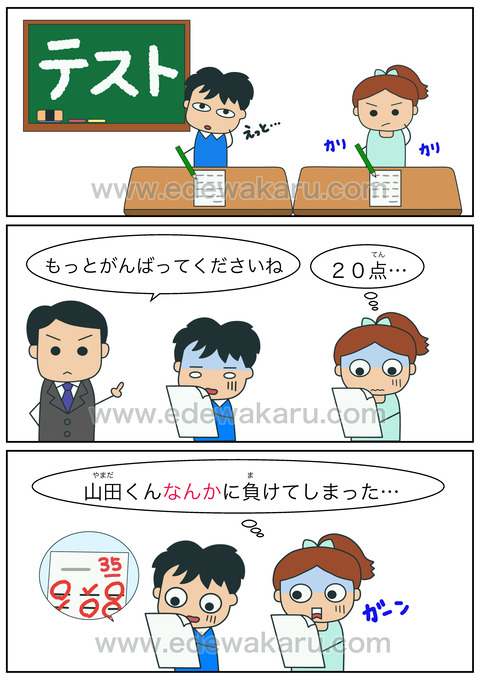
Meaning
Expresses disregard or contempt.
How to use it
Noun [dictionary form] + など・なんか・なんて
Explanation
Using 「〜など・〜なんか・〜なんて」 about another person or a target (thing, matter, or animal) expresses disregard or contempt.
[Comparison]
・I lost to Yamada-kun
なんか
→Expresses the feeling “I lost to the stupid Yamada-kun, who’s beneath me” or “I lost to Yamada-kun, whom I hate.” The speaker has no positive feelings toward Yamada-kun.
・I lost to Yamada-kun.
→Simply states, “I lost to Yamada-kun.”
Using 「〜など・〜なんか・〜なんて」 to express disregard or contempt toward another person or target is very rude, so you have to be careful how you use it 😣 「〜など・〜なんか・〜なんて」 can also give examples or express humility, so review those uses as well.
[Related patterns]
In context 6 examples
山田くんなんかに負けてしまった…[軽視する相手]山田くん
I ended up losing to Yamada-kun, of all people… [person being disparaged] Yamada-kun
A:日本語は難しいな…B:日本語なんて簡単だよ〜[軽視する対象]日本語
A: Japanese is hard… B: Japanese is easy, of all things~ [target being disparaged] Japanese
あなたなどに私の気持ちはわからないわ![軽視する相手]あなた
Someone like you could never understand how I feel! [person being disparaged] you
A:山田くんはオバケと話したことがあるそうよ!B:そんなバカな話なんか信じたらだめだよ〜[軽視する対象](オバケと話したという)バカな話
A: I heard Yamada-kun has talked to a ghost! B: Don’t believe such a stupid story~ [target being disparaged] the stupid story (that he talked to a ghost)
母:明日テストがあるんでしょ?遊んでいる時間なんてないはずよ!娘:は〜い[軽視する対象]遊んでいる時間
Mother: You have a test tomorrow, right? You shouldn’t have time to play! Daughter: Okaaay. [target being disparaged] time spent playing
こんなケガなんて全然痛くないよ[軽視する対象]少しのケガ
A little injury like this doesn’t hurt at all. [target being disparaged] a minor injury
Read the original source text
Meaning
軽視・軽蔑を表す
How to use it
名詞[辞書形]+など・なんか・なんて
Explanation
「〜など・〜なんか・〜なんて」を相手(人)や対象(もの・こと・動物)に使うと【軽視・軽蔑】の気持ちを表します。
[比較]
・山田くん
なんか
に負けた
→「自分よりバカな山田くんに負けた」「嫌いな山田くんに負けた」という気持ちを表す。相手の「山田くん」にはいい感情はない
・山田くんに負けた
→ただ「山田くんに負けた」と言っているだけ
軽視・軽蔑を表す「〜など・〜なんか・〜なんて」は相手・対象に使うと、とても失礼になりますので使い方に気をつけなければいけません😣 また「〜など・〜なんか・〜なんて」には【例をあげる】【謙遜】を表す用法もありますので復習しておきましょう。
【関連文型】
Usage 2
Read this source entry ↗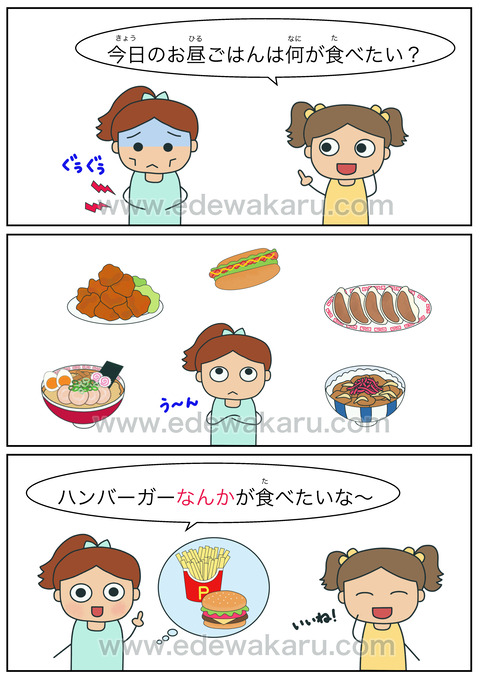
Meaning
Give an example.
How to use it
Noun [dictionary form] + など・なんか・なんて
Explanation
「〜など・〜なんか・〜なんて」 is a sentence pattern used to give an example from among various possibilities. 「〜なんか・〜なんて」 are colloquial forms of 「〜など」.
「〜など・〜なんか・〜なんて」 can also express disregard or contempt and humility, so learn those uses as well. Also distinguish 「〜なんて」 used to express emotion, which is a different sentence pattern.
[Related patterns]
In context 5 examples
A:今日のお昼ごはんは何が食べたい?B:う〜ん…ハンバーガーなんかが食べたいな〜
→(いろいろ食べたいものがあるが)例えばハンバーガーが食べたいA: What would you like for lunch today? B: Hmm… I feel like having something like a hamburger. →(There are various things I’d like to eat, but) for example, I’d like a hamburger.
小さい頃は、ピアノや水泳などを習っていました
→(いろいろ習っていたが)例をあげるとピアノや水泳を習っていたWhen I was little, I took lessons in things like piano and swimming. →(I took various lessons, and) for example, I took piano and swimming.
A:彼女の誕生日プレゼントは何をあげようかな…B:きれいな花なんかがいいと思うよ
→例えば花がいいと思うよA: What should I get my girlfriend for her birthday… B: I think something like pretty flowers would be nice. →For example, I think flowers would be nice.
彼女はケーキやクッキーなどのスイーツが大好きだ
→ケーキやクッキーのようなスイーツが大好きだShe loves sweets such as cake and cookies. →She loves sweets like cake and cookies.
店員:いらっしゃいませ。何かお探しですか?客:彼女のプレゼントを…店員:こちらのネックレスなどいかがですか?
→例えば、こちらのネックレスはいかがですか?Clerk: Welcome. Are you looking for anything? Customer: A present for my girlfriend… Clerk: How about a necklace like this one? →For example, how about this necklace?
Read the original source text
Meaning
例をあげる
How to use it
名詞[辞書形]+など・なんか・なんて
Explanation
「〜など・〜なんか・〜なんて」は、いろいろある中から【例をあげて言う】場合に使われる文型です。「〜なんか・〜なんて」は「〜など」の口語形です。
「〜など・〜なんか・〜なんて」には【軽視・軽蔑】【謙遜】を表す用法もありますので、一緒に覚えておきましょう。また【感情を表す】「〜なんて」は別の文型ですので区別をしておきましょう。
【関連文型】
Usage 3
Read this source entry ↗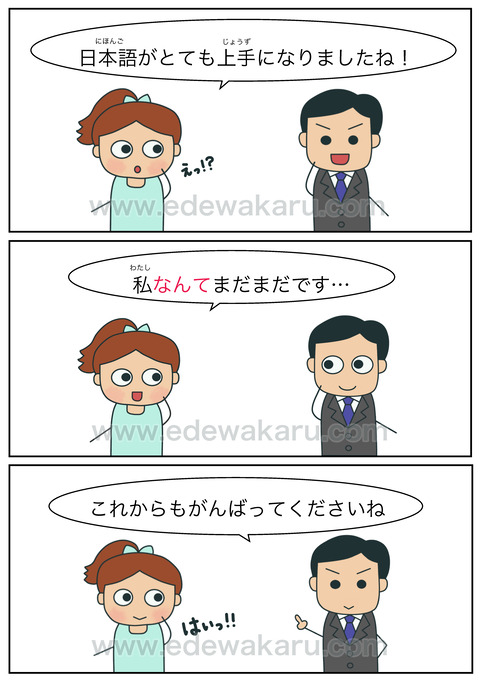
Meaning
Expresses a feeling of humility.
How to use it
Noun [dictionary form] + など・なんか・なんて
Explanation
Using 「〜など・〜なんか・〜なんて」 about yourself or someone close to you expresses humility 😊 「〜なんか・〜なんて」 are colloquial forms of 「〜など」 😀
[Examples]
① A: Your Japanese has gotten really good.
B: I still have a long way to go.
→The speaker humbly says, “I’m still not very good.”
② Boyfriend: You’re really beautiful.
Girlfriend: Me
なんて
… I think Tanaka-san is prettier.
→She humbly says, “I’m not beautiful.”
③ A: You’re really good at cooking!
B: I’m
なんか
not good at all.
→The speaker humbly says, “I’m not good at it.”
④ Boss: Starting this month, do your best as the team leader.
Subordinate: I don’t know if someone like me
など
can do it properly, but I’ll do my best.
→The speaker expresses humility, saying, “I don’t know if I can do it.”
⑤ My son
なんて
isn’t handsome at all~
→The speaker humbly says, “My son isn’t handsome.”
「〜など・〜なんか・〜なんて」 also have uses for giving examples and expressing disregard or contempt, so learn those as well. Also distinguish 「〜なんて」 used to express emotion, which is a completely different sentence pattern 😀
[Related patterns]
In context 5 examples
A:日本語がとても上手になりましたねB:私なんてまだまだです
A: Your Japanese has gotten really good. B: I still have a long way to go.
彼氏:君は本当に美人だね彼女:私なんて…田中さんの方が美人だと思うわ
Boyfriend: You’re really beautiful. Girlfriend: Me… I think Tanaka-san is prettier.
A:おいしい〜!料理がうまいね!B:私なんか全然上手じゃないよ
A: Delicious! You’re good at cooking! B: I’m not good at all.
上司:今月からリーダーとしてがんばってくれ部下:私などにきちんとできるかわかりませんが、がんばります
Boss: Starting this month, do your best as the team leader. Subordinate: I don’t know if someone like me can do it properly, but I’ll do my best.
うちの息子なんて、全然イケメンじゃないわよ〜
My son isn’t handsome at all~
Read the original source text
Meaning
謙遜の気持ちを表す
How to use it
名詞[辞書形]+など・なんか・なんて
Explanation
「〜など・〜なんか・〜なんて」を自分や自分に近い人に使うと謙遜していることを表します😊「〜なんか・〜なんて」は「〜など」の口語形です😀
[例]
①A:日本語がとても上手になりましたね
B:私なんてまだまだです
→「私はまだまだ上手ではない」と謙遜している
②彼氏:君は本当に美人だね
彼女:私
なんて
…田中さんの方が美人だと思うわ
→「私は美人ではない」と謙遜している
③A:料理が本当にうまいね!
B:私
なんか
全然上手じゃないよ
→「私は上手ではない」と謙遜している
④上司:今月からリーダーとしてがんばってくれ
部下:私
など
にきちんとできるかわかりませんが、がんばります
→「私にできるかわからない」と謙遜の気持ちを表している
⑤うちの息子
なんて、全然イケメンじゃないわよ〜
→「うちの息子はイケメンじゃない」と、謙遜している
「〜など・〜なんか・〜なんて」には【例をあげる】【軽視・軽蔑を表す】用法もありますので、一緒に覚えておきましょう。また【感情を表す】「〜なんて」は全然違う文型ですので区別しておきましょう😀
【関連文型】
どんなときどう使う 日本語表現文型辞典
Meaning
something like, someone like
How to use it
N(+ particle)+ なんかS
Explanation
~のようなものは
1)「~なんか」の形で、「~」を嫌だと思う気持ち、「~」を軽視する気持ちを表す。「など」と同じ意味に使うが、くだけた会話で使う。
2)文末では否定的な言い方をする。
3) ❷ のように反語表現とともに使う場合もある。 ❸ のように自分のことに使うと謙遜の意味になる。 ❹ のように場合によっては感情的な言い方になる。
4)「なんて」も同じように使う。
1)Expressions of dislike or contempt precede なんか. Same meaning as など, but used in informal speech.
4)なんて is used same way.
2)Takes negative sentence ending.
3)Can be used in rhetorical questions, like in sentence ❷ . When used about speaker, shows humility, as in sentence ❸ . Can show passionate feeling, as in sentence ❹ .
In context 4 examples
変なにおいのする納豆なんか、だれが食べるものか。
Who would eat something like natto with a strange smell?
あんな人の言うことなんて信じるものか。いつもうそばかりついているんだから。
As if I’d believe what someone like that says! They’re always telling lies.
わたしなんか何もお手伝いできなくて。すみません。
Someone like me couldn’t help at all. I’m sorry.
学校へなんか行きたくない。
I don’t want to go to school or anywhere like that.
Read the original source text
Meaning
something like, someone like
How to use it
N(+助詞)+なんかS
Explanation
~のようなものは
1)「~なんか」の形で、「~」を嫌だと思う気持ち、「~」を軽視する気持ちを表す。「など」と同じ意味に使うが、くだけた会話で使う。
2)文末では否定的な言い方をする。
3) ❷ のように反語表現とともに使う場合もある。 ❸ のように自分のことに使うと謙遜の意味になる。 ❹ のように場合によっては感情的な言い方になる。
4)「なんて」も同じように使う。
1)Expressions of dislike or contempt precede なんか. Same meaning as など, but used in informal speech.
4)なんて is used same way.
2)Takes negative sentence ending.
3)Can be used in rhetorical questions, like in sentence ❷ . When used about speaker, shows humility, as in sentence ❸ . Can show passionate feeling, as in sentence ❹ .
日本語文型辞典 英語版
Usage 1
Meaning
→
【なにか】a. なんか
B:冷蔵庫見てみたら? なんか入っていると思うけど。
Why don’t you look inside the fridge? I think there should be something.
Expresses something or some state which one cannot clearly refer to.
b. なんか〈appearance〉
Expresses the meaning of “I don’t know why it’s so” or “for some reason.”
c. ...かなんか[N/A/V かなんか]
B:忘れものをしたかなんかで、取りに戻っています。
He went back because he forgot something, I guess.
Expresses something that one cannot refer to clearly but is similar to the thing mentioned.
d. Nやなんか
Used to express the thing mentioned, N, and some other similar things.
Exemplifies the main one(s) among various other items. Implies that there are other similar sorts of things. This expression is used in the form など in casual speech.
b. V-たりなんかして
Exemplifies main one(s) among various other actions. Implies that there are other similar sorts of actions. A colloquial equivalent of など that is used in casual speech.
c. なんか...ない
With a variety of elements such as a noun, a verb, or a noun + verb, this なんか is followed by some negative expression. Although なんか...ない expresses negation towards a thing/state/event mentioned in the sentence, it also implies at the same time the speaker’s derogatory, humble, or unexpected feeling toward the thing/state/event expressed in the phrase with なんか. なんか...ない is rephrased as など...ない in casual speech.
How to use it
1. なんか〈things〉A casual way of saying なにか. Used in spoken Japanese.
2. なんかa. Nなんか
In context 31 examples
A:なんかたべるものない?
Is there anything to eat?
誕生日にはなんか買ってやろうと思っています。
I’m thinking of buying something for his birthday.
今日手伝えなかったことは、きっと何かで償うよ。
I’ll surely make up for what I couldn’t do for you today.
何か変な音が聞こえませんでしたか。
Didn’t you just hear some strange noise?
この部屋、何か臭わない?
Don’t you think this room smells like something?
彼女と話していると、なんかほっとした気持ちになる。
When I talk to her, I just feel relieved for some reason.
あの人の言っていること、なんか変だと思いませんか。
Don’t you think what she is saying is somewhat strange?
今日は子供たちがなんか妙に静かですね。なにかいたずらをしているんじゃありませんか。
The children are unusually quiet today. I wonder if they are up to something naughty.
なんか不思議だなあ、この町は。前に来たことがあるような気がしてならない。
I don’t know why, but I feel strange about this town. I can’t help thinking that I’ve been here before.
今度の休みは映画かなんか行かない?
Shall we go to a movie or something on the next day off?
この傷は石かなんかがぶつかってできたものでしょう。
I guess that a stone or something hit it to create this scrape.
お見舞いには果物かなんかを持って行くことにしよう。
I’ll take fruit or something when I pay a visit at the hospital.
田中君は試験が近いかなんかでとても忙しそうです。
Tanaka-kun seems to be very busy because his exams are approaching or something.
A:田中君はどうしたの?
What happened to Tanaka-kun?
スポーツは好きですが、野球やなんかの球技はあまり得意ではないんですよ。
I like sports, but I’m not good at ball games like baseball.
出張やなんかで旅行をするときはいつもこの鞄を持っていきます。
I always bring this bag when I do things like make a business trip.
この話は友達やなんかには言わないで下さいね。
Please don’t tell this story to your friends or anybody else, OK?
山で遭難したときは、持っていたチョコレートやなんかを食べて救助を待ちました。
When I got lost in the mountains, while I was waiting to be saved I ate things like the chocolate that I had brought with me.
お酒はワインなんか好きで、よく飲んでいます。
As for alcohol, I like things like wine and drink it quite often.
食料品なんかは近くの店で買うことができます。
You can buy groceries and other things at the shop nearby.
山本さんや鈴木さんなんかはこの案に反対のようです。
People like Yamamoto-san and Suzuki-san seem to be against this idea.
部品やなんかは揃っているんですが、技術者がいないので直せないんです。
We have all the parts and things, but we can’t fix it because we don’t have a technician.
休みの日は本を読んだりなんかして過ごします。
I spend my days off doing things like reading books.
どうしたの? ひとりで笑ったりなんかして。
What’s the deal? How come you’re snickering by yourself and all?
お父さんたら急に怒り出したりなんかして。この頃少し疲れてるのかな。
What’s with Father that he does things like suddenly get angry? I wonder if he hasn’t been a little tired out these days.
お金がないから、旅行なんか滅多にできない。
I don’t have any money at all, so I can hardly do things like take a trip.
あんな男となんか口もききたくない。
I don’t even want to speak to such a guy.
そんなばかげたことなんか考えたこともありません。
I’ve never thought about such a stupid thing.
こんな汚い部屋になんか一日だって泊まりたくない。
I don’t want to stay in such a filthy room even for one night.
こんな天気の良い日に家の中で本を読んでなんかいないで、外を散歩しましょうよ。
Don’t do things like reading a book inside on such a nice day as this. Let’s take a walk outside.
あんな映画ちっともおもしろくなんかないよ。
That movie is not at all interesting.
Usage 2
Meaning
【なんか...ものか】[...なんかV-るものか]
B:おもしろくなんかあるものですか。すごくくだらない話でしたよ。
It wasn’t in the least bit interesting. It was a really worthless lecture.
With a variety of elements such as a noun, a verb, an adjective, or a noun + verb, なんか...ない negates the following statement. At the same time, it expresses the speaker’s derogatory feeling towards a thing/state/event mentioned in the phrase with なんか, and means “this is stupid, insignificant, outrageous.” なんか...ない is a casual way of saying など...ものか.
In context 6 examples
家になんか帰ってやるものか。
I never, ever go back home.
誰がそんな話なんか信じるものか。
Who the hell believes such a story?
あんな男となんか二度と口を利いてやるものか。
I won’t talk to such a guy ever again.
あんなひとに教えてなんかやるものか。
It’ll be a long time before I ever teach someone like that.
一人でも寂しくなんかあるものか。
I’m not in the least lonely.
A:講演会いかがでしたか。おもしろい話が聞けたでしょう。
How was the lecture? You must have heard an interesting talk.
Bunpro Grammar Reference
Meaning
Such as, Things like, Emphasis
How to use it
Verb + なんて
[い]Adjective + なんて
[な]Adjective + なんて
Noun + なんて(1)
(1) なんか
Nuance
A casual expression used for emphasis or pointing out similar things. Often used simply to fill in the silence in sentences.
Explanation
なんか is an expression in Japanese that is frequently associated with the adverbial particle など. They are thought to have overlapping meanings in many circumstances, and なんか itself may be considered an adverbial particle. なんて is an extension of this, and may be considered an abbreviation of などという 'to say something like'.
Both なんか and なんて are used in the same way as など, having translations like 'such as', and 'things like' in English. The primary difference between なんか and なんて is that なんて is far more common after 用言 (conjugatable words). This includes verbs, い-Adjectives, and な-Adjectives. On the other hand, なんか is almost exclusively used after 体言 (unconjugatable words). In other words, nouns.
こんな嵐の中走るなんて、頭おかしいんじゃない。
You are going to do something like run in the storm? You must be crazy.
北海道がこんなに寒いなんておもわなかった。
I didn't think Hokkaido would be this cold or anything.
心配なんてしている場合じゃない。
This is no time for things such as worrying.
テレビなんか叩けばだいたい直るだろ。
Things like TV's will be fixed most of the time if you hit them, right?
Despite the 体言 and 用言 tendency, most native speakers will not consider it incorrect to use either なんか or なんて with any type of word.
Fun FactBoth なんか and なんて are often used to show a low evaluation of the word that they follow. This can come across as humility when used in relation to oneself, or as an insult when used in relation to others.
私なんか5年間スペイン語の勉強をしているのにまだ全然会話ができないです。
I have studied Spanish for 5 years, but I can't speak it at all yet. (Humility)
お前なんてどうせ、家でゴロゴロしているだけだろ。
Someone like you probably just loafs around the house, don't you? (Insult)
Don't let this point stop you from using なんか or なんて though, as many native speakers use it simply to fill the silence in modern Japanese.
酷いことを言ったのは分かるんだけど、なんか、感情的になって言っちゃった。
I am aware that I said something mean, but, you know, I said it because I got emotional.
In context 19 examples
- 人生なんてそんなもんさ。
Such is life.
- こんな嵐の中走るなんて、頭おかしいんじゃない。
You are going to do something like run in the storm? You must be crazy.
- 心配なんてしている場合じゃない。
This is no time for things such as worrying.
- テレビなんか叩けばだいたい直るだろ。
Things like TV's will be fixed most of the time if you hit them, right?
- 北海道がこんなに寒いなんておもわなかった。
I didn't think Hokkaido would be this cold or anything.
- お世辞なんて大嫌いだ!
I hate things like flattery!
- 嘘なんかつかないよ。信じてよ。
I would never do something like lie to you. Trust me.
- 私が太っているなんて言わないで。
Don't say things like I am fat.
- 僕には道案内なんてできませんよ。
I am unable to do things like give directions.
- 雨なんかに負けている場合じゃないですよ。
Now is not the time to give in to something like rain.
- あんな高い絵を買うなんてどうかしている。
That person is crazy to buy an expensive picture such as that.
- あの強いチームに勝つなんて思わなかった。
Things like winning against that good team didn't even cross my mind.
- 紹介なんていりません。自分で恋人を見つけます。
I don't need things like referrals. I can find my own lover.
- 「夢なんか捨てちまえ」って言われたけど、僕は諦めたくないんだ。
I was told 'things like dreams should be tossed aside', but I won't give up (on mine).
- 人の話なんか全然聞いていないんだから、困ったもんだ。
Since that person doesn't listen to things like what other people are saying, I'm in a bind.
- 泣き寝入りなんてしたくない。最後まで戦う!
I refuse to do something like giving up in frustration! I will fight to the end!
- 私なんか5年間スペイン語の勉強をしているのにまだ全然会話ができないです。
I have studied Spanish for 5 years, but I can't speak it at all yet. (Humility)
- お前なんてどうせ、家でゴロゴロしているだけだろ。
Someone like you probably just loafs around the house, don't you? (Insult)
- 酷いことを言ったのは分かるんだけど、なんか、感情的になって言っちゃった。
I am aware that I said something mean, but, you know, I said it because I got emotional.
IMABI
The Particle など・なんか
Read this IMABI lesson ↗Explanation
The Particle など・なんか
In this lesson, we will learn about the adverbial particles など and なんか.
The Adverbial Particle など1
The adverbial particle など is used to give related examples, appearing after nouns as well as verbal predicates, translating into English as “etc.,” which also indicates how など itself does not necessarily create the list but concludes a list. When the need arises the glue that forms the list is handled by the particle や.
1. 私は休日は雑誌ざっしを読むなどして過すごしました。
I spent the holidays doing stuff like reading magazines.
2. 東京やニューヨーク市などの大都市には大勢たいせいの人が住んでいます。
A lot of people live in metropolises such as Tokyo and New York City.
3. 音楽やビデオゲームなどが若者に愛用されている。
Things such as music and video game are cherished by young people.
4. お茶・砂糖さとう・塩など
Tea, sugar, salt and so on
5. レモンやミカンやタンジェリンなどの果物くだものを買い集めた。
I bought up fruits such as lemons, mandarin oranges, and tangerines.
6. 彼など適任者てきにんしゃだね。
Someone like him is suitable, right?
7. このパソコンなどお買かい得どくです。
Something like this personal computer is a bargain.
8. ヨーロッパの信用しんよう不安で海外経済が減速げんそくしていることなどが影響えいきょうしている。
Events such as overseas economies decelerating due to uneasiness of confidence in Europe are taking an effect.
9. 私はテレビでアニメなどは見ません。
I don’t watch things like anime on TV.
10. 休暇中に洗濯や掃除などしなくてもいい。
It’s alright to not do laundry, cleaning, and such during vacation.
11. 泣いてなどいられない。
I can’t just be crying or the like.
12. 今さら行くなどと2言ってももう遅おそいよ。
Even if you say you’re going to go now, you’re already late.
13. 甲冑かっちゅうなども精巧せいこうに出来できている。
Things like the armor are also exquisitely made.
The Adverbial particle なんか
A colloquial variant of など, the adverbial particle なんか mostly appears after individual complements of a sentence.
As far as coexistence with other particles is concerned, when など・なんか appear after subjects and direct objects, the case particles が・を that would respectively be present do not appear in the surface structure of the sentence. For other case particles, however, do coexist and appear before など・なんか, as the emphatic role these adverbial particles play encompasses the phrase + the information encoded by those case particles.
14. こりゃなんかええじゃん? (Casual)
Isn’t something like this OK?
15. 彼女になんか会わなければよかった。
If I had somehow not met her, it would have been good.
16. 表彰ひょうしょうなんか受けたくもねーし。
I don’t want any public acknowledgement.
17. 「ああ、佐伯あさっちゃんのところに行ったの。あんなヤツの言うことなんか、嘘っぱちだよ」
“Ahh, Sahaku went to Satchan’s place? What that guy says is a downright lie.
From 『冷たい誘惑』 by 乃南アサ.
Dialectical Variants: なんど・なぞ・なんぞ
Other variants of the particle など include なんぞ3, なぞ4, due to how voiced consonants were once always accompanied with pre-nasalization. This also explains the presence of the dialectal variant なんど5.
18. ガキ同士のなつき合いなぞ、退屈ではないか。
Two brats gettin’ all affectionate with each other would be uninteresting, no?
19. 病気なぞしてたまるか。
There is absolutely no way I’m going to get ill!
20. それを釣瓶なんどに植えて。
Plant it in a well bucket or the like.
From 『魔法修行者』by 露伴.
The particle など may seldom be seen spelled in kanji as 等, and even more rarely as 抔. ↩︎
Interestingly enough, because the quotative particle と is actually built into the particle など, などと is technically grammatical redundant. However, because native speakers no longer perceive it as its etymological breakdown, the quotative particle と does not get ellipsed when a citation verb immediately follows など. ↩︎
The combination of the interrogative pronoun なに and the adverbial particle ぞ, when utilized in Standard Modern Japanese discourse, it tends to sound more masculine and colloquial despite its longstanding history in the language. However, examples of it from the early 1900s shows that its colloquial tone is a relatively new feel of the variant as it fades out of use. ↩︎
なぞ is the direct descendent of なんぞ, losing the nasalization provided by ん. ↩︎
なんど is the combination of the interrogative pronoun なに and the quotative particle と, and its direct descendent is など, losing the nasalization provided by ん. ↩︎
In context 20 examples
私は休日は雑誌ざっしを読むなどして過すごしました。
I spent the holidays doing stuff like reading magazines.
東京やニューヨーク市などの大都市には大勢たいせいの人が住んでいます。
A lot of people live in metropolises such as Tokyo and New York City.
音楽やビデオゲームなどが若者に愛用されている。
Things such as music and video game are cherished by young people.
お茶・砂糖さとう・塩など
Tea, sugar, salt and so on
レモンやミカンやタンジェリンなどの果物くだものを買い集めた。
I bought up fruits such as lemons, mandarin oranges, and tangerines.
彼など適任者てきにんしゃだね。
Someone like him is suitable, right?
このパソコンなどお買かい得どくです。
Something like this personal computer is a bargain.
ヨーロッパの信用しんよう不安で海外経済が減速げんそくしていることなどが影響えいきょうしている。
Events such as overseas economies decelerating due to uneasiness of confidence in Europe are taking an effect.
私はテレビでアニメなどは見ません。
I don’t watch things like anime on TV.
休暇中に洗濯や掃除などしなくてもいい。
It’s alright to not do laundry, cleaning, and such during vacation.
泣いてなどいられない。
I can’t just be crying or the like.
今さら行くなどと2言ってももう遅おそいよ。
Even if you say you’re going to go now, you’re already late.
甲冑かっちゅうなども精巧せいこうに出来できている。
Things like the armor are also exquisitely made.
こりゃなんかええじゃん? (Casual)
Isn’t something like this OK?
彼女になんか会わなければよかった。
If I had somehow not met her, it would have been good.
表彰ひょうしょうなんか受けたくもねーし。
I don’t want any public acknowledgement.
「ああ、佐伯あさっちゃんのところに行ったの。あんなヤツの言うことなんか、嘘っぱちだよ」
“Ahh, Sahaku went to Satchan’s place? What that guy says is a downright lie.
ガキ同士のなつき合いなぞ、退屈ではないか。
Two brats gettin’ all affectionate with each other would be uninteresting, no?
病気なぞしてたまるか。
There is absolutely no way I’m going to get ill!
それを釣瓶なんどに植えて。
Plant it in a well bucket or the like.
日本語文型辞典
Usage 1
Meaning
A casual way of saying 「なにか」, used in spoken language.
⇾なにか
a. なんか
Used to refer to something that cannot be clearly identified.
b. なんか【様子】
Means “for some reason I don’t know” or “somehow.”
c. …かなんか
Used when referring to something that cannot be clearly identified but is similar to it.
d. Nやなんか
Used to refer to that thing or something similar to it.
a. Nなんか
Picks out a main item from among various things as an example. It implies there are similar things as well. A casual, spoken-language way of saying 「など」.
b. V-たりなんかして
Picks out a main action from among various things as an example. It implies that similar things are done as well. A casual, spoken-language way of saying 「など」.
c. なんか…ない
Attaches to various elements such as nouns, verbs, or a noun plus particle, and is followed by an expression of negation. It negates the matter indicated there, while 「なんか」 also conveys a feeling of contempt or humility toward what it singles out, or a feeling of surprise. A casual, spoken-language way of saying 「など…ない」.
How to use it
なんか【物事】
N/A/V かなんか
なんか
In context 31 examples
A:なんかたべるものない?
B:冷蔵庫見てみたら?なんか入っていると思うけど。A: Is there anything to eat? B: Why don’t you look in the fridge? I think there’s something in there.
誕生日にはなんか買ってやろうと思っています。
I’m thinking of buying you something for your birthday.
今日手伝えなかったことは、きっと何かで償うよ。
I’ll make it up to you somehow for not being able to help today.
何か変な音が聞こえませんでしたか。
Didn’t you hear some strange sound?
この部屋、何か臭わない?
Doesn’t this room smell kind of strange?
彼女と話しているとなんかほっとした気持ちになる。
When I talk with her, I somehow feel relieved.
あの人の言っていること、なんか変だと思いませんか。
Don’t you think what that person is saying is kind of strange?
今日は子供たちがなんか妙に静かですね。なにかいたずらをしているんじゃありませんか。
The children are strangely quiet today. Could they be up to some mischief?
なんか不思議だなあ、この町は。前に来たことがあるような気がしてならない。
This town is somehow so strange. I can’t help feeling as if I’ve been here before.
今度の休みは映画かなんか行かない?
Want to go see a movie or something on our next day off?
この傷は石かなんかがぶつかってできたものでしょう。
This scratch was probably caused by a stone or something hitting it.
お見舞いには果物かなんかを持って行くことにしよう。
Let’s take some fruit or something when we visit.
田中君は試験が近いかなんかでとても忙しそうです。
Tanaka seems very busy, maybe because exams are coming up or something.
A:田中君はどうしたの?
B:忘れものをしたかなんかで、取りに戻っています。A: What happened to Tanaka? B: He forgot something or the like, so he’s gone back to get it.
スポーツは好きですが、野球やなんかの球技はあまり得意ではないんですよ。
I like sports, but I’m not very good at ball games like baseball.
出張やなんかで旅行をするときはいつもこの鞄を持っていきます。
Whenever I travel for a business trip or something, I always take this bag.
この話は友達やなんかには言わないで下さいね。
Please don’t tell friends or anyone else about this.
山で遭難したときは、持っていたチョコレートやなんかを食べて救助を待ちました。
When I got lost in the mountains, I ate the chocolate and things I had with me and waited to be rescued.
お酒はワインなんか好きで、よく飲んでいます。
I like wine and things like that, and drink it often.
食料品なんかは近くの店で買うことができます。
You can buy groceries and things at a nearby shop.
山本さんや鈴木さんなんかはこの案に反対のようです。
People like Yamamoto and Suzuki seem to oppose this proposal.
部品やなんかは揃っているんですが、技術者がいないので直せないんです。
We have the parts and everything, but we can’t fix it because we don’t have a technician.
休みの日は本を読んだりなんかして過ごします。
On my days off, I spend my time reading books and things like that.
どうしたの?ひとりで笑ったりなんかして。
What’s the matter? You’re laughing to yourself and everything.
お父さんたら急に怒り出したりなんかして。この頃少し疲れてるのかな。
Dad suddenly went and got angry. I wonder if he’s been a little tired lately.
お金がないから、旅行なんか滅多にできない。
I can rarely afford to travel or anything like that because I don’t have money.
あんな男となんか口もききたくない。
I don’t even want to talk to a man like that.
そんなばかげたことなんか考えたこともありません。
I’ve never even thought of anything so ridiculous.
こんな汚い部屋になんか一日だって泊まりたくない。
I wouldn’t want to stay even one day in a filthy room like this.
こんな天気の良い日は、家の中で本を読んでなんかいないで、外を散歩しましょうよ。
On a beautiful day like this, let’s go for a walk outside instead of sitting indoors reading a book.
あんな映画ちっともおもしろくなんかないよ。
That movie isn’t interesting at all.
Read the original source text
Meaning
「なにか」のくだけた言い方で、話しことばに用いる。
⇾なにか
a. なんか
それとはっきり指し示すことのできないものごとを表すのに用いられる。
b. なんか【様子】
「なぜかわからないが」「なんとなく」といった意を表す。
c. …かなんか
それとはっきり指し示すことはできないがそれに類したものを表す場合に用いる。
d. Nやなんか
そのものやそれに類したものを表すのに用いられる。
a. Nなんか
いろいろあるなかから主なものを取り上げて例として示す。ほかにも似たものがあるという含みがある。「など」のくだけた言い方で話しことばに用いる。
b. V-たりなんかして
いろいろあることのなかから主なものを取り上げて例として示す。ほかにも似たことをすると言う含みがある。「など」のくだけた言い方で話しことばに用いる。
c. なんか…ない
名詞や動詞、名詞+助詞などのさまざまな成分に付き、その後に否定を表す表現を従える。そこで示されたことがらに対する否定を表すが、それと同時に「なんか」によってとりたてたものごとに対する軽蔑の気持ちや謙遜の気持ち、あるいは意外な気持ちなどの意が込められる。「など…ない」のくだけた言い方で話しことばに用いる。
How to use it
なんか【物事】
N/A/V かなんか
なんか
Usage 2
Meaning
Basic information: …なんかV-るものか. Attaches to various elements such as nouns, verbs, adjectives, or a noun plus particle, and strongly denies what follows while also expressing contempt for the thing singled out by 「なんか」 as “ridiculous, insignificant, or preposterous.” A casual way of saying 「など…ものか」. Example sentences: ① As if I’d go home! ② Who would believe a story like that? ③ As if I’d ever speak to a man like that again! ④ As if I’d teach someone like that! ⑤ As if I could ever feel lonely, even by myself! ⑥ A: How was the lecture? You heard an interesting talk, didn’t you?
B: Interesting? It was an incredibly stupid talk.
Read the original source text
Meaning
基本情報…なんかV-るものか説明名詞・動詞・形容詞や名詞+助詞などのさまざまな成分に付き、次に述べることを強く否定すると同時に「なんか」によって取り立てたものごとを「馬鹿げたもの、取るに足りないもの、とんでもないこと」と軽視する気持ちを表す。「など…ものか」のくだけた言い方。例文① 家になんか帰ってやるものか。② 誰がそんな話なんか信じるものか。③ あんな男となんか二度と口を利いてやるものか。④ あんなひとに教えてなんかやるものか。⑤ 一人でも寂しくなんかあるものか。⑥ A:講演会いかがでしたか。おもしろい話が聞けたでしょう。
B:おもしろくなんかあるものですか。すごくくだらない話でしたよ。