日本語文型辞典
Meaning
Used to negate “XはYだ.”
By repeating the other person’s words, it expresses criticism. It is a spoken expression used only with someone of lower status or someone quite close. It often takes the form “じゃない,” as in ②–④.
⇾ではなくて
How to use it
...ではない
N/Na ではない
...ではない
...ではなくて
In context 8 examples
これは、新しい考えではない。
This is not a new idea.
わたしの生まれた所は、札幌だが、育ったのは、札幌ではない。
The place where I was born is Sapporo, but I did not grow up in Sapporo.
この表現はけっして失礼ではない。
This expression is not at all rude.
昨日行ったレストランはあまりきれいではなかった。
The restaurant I went to yesterday was not very clean.
A:すみません、日程の変更をご連終するのを忘れていました。
B:忘れていましたではないよ。おかげで、予定が一日狂ってしまったんですよ。A: I forgot to let you know about the schedule change. B: “I forgot” is no excuse. Because of that, the schedule got thrown off by a whole day.
A:あ。そのこと、言い忘れてた。:言い忘れてたじゃないわ。おかげで大変な目にあったのよ。
A: Oh, I forgot to tell you about that. B: “I forgot to tell you” is no excuse! Because of that, I got into a lot of trouble.
A:ごめん、現像失敗しちゃった。
B:失敗しちゃったじゃないよ。どうしてくれるんだ。A: Sorry, I messed up the developing. B: “I messed up” is no excuse! What are you going to do about it?
A:あの、お借りしたビデオカメラ、こわれちゃったんです。
B:こわれちゃった、じゃないよ。大事なもの、君だからか貸したのに。A: Um, the video camera I borrowed from you broke. B: “It broke” is no excuse! I lent you something important because I trusted you.
Read the original source text
Meaning
「XはYだ」を否定するのに用いる。
相手の言葉を繰り返すことにより、非難を表す。目下の相手やかなり親しい相手にしか用いられない話しことばの表現。②~④のように「じゃない」になることが多い。
⇾ではなくて
How to use it
…ではない
N/Na ではない
…ではない
…ではなくて
絵でわかる日本語
Usage 1
Read this source entry ↗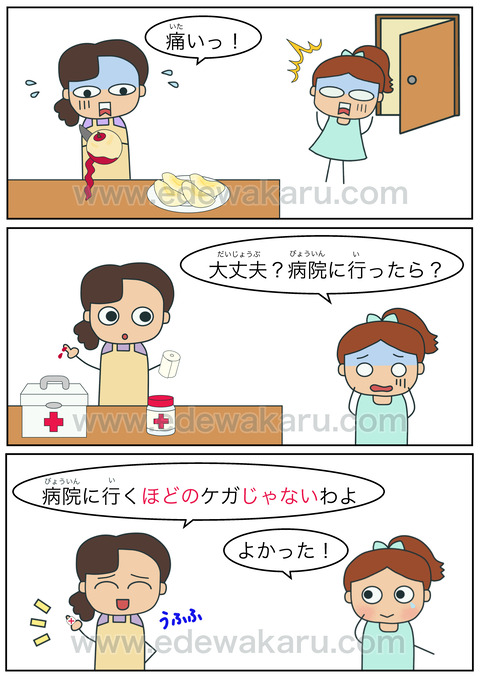
Meaning
Less of 〜
Not as much as 〜
Not good enough to be able to 〜
How to use it
Verb [dictionary form / ない-form] + ほどの + noun [dictionary form] + ではない
Explanation
“〜ほどの〜ではない” is a sentence pattern meaning “less severe than 〜” or “not good enough to be able to 〜.” It is used to express the feeling that something is “not a big problem” or “not a big deal.” The forms “〜ほどのことではない” and “〜ほどのものではない” are often used.
There are several sentence patterns that use “ほど,” so be sure to review them 😊
In context 6 examples
娘:大丈夫?病院に行ったら?母:病院に行くほどのケガじゃないわよ
→病院に行くほど、大きなケガじゃないわよDaughter: Are you okay? Why don’t you go to the hospital? Mother: It’s not an injury serious enough to go to the hospital. → It’s not such a serious injury that I need to go to the hospital.
妹:お兄ちゃん、なんで私のプリン食べたの?許せない!兄:そんなに怒るほどのことじゃないだろ?
→怒るほど、大きな問題じゃないだろ?Younger sister: Big brother, why did you eat my pudding? I can’t forgive you! Older brother: It’s not such a big deal that you need to get that angry, is it? → It’s not such a big problem that you need to get angry, is it?
A:ケーキかドーナツ、どっちがいいか決められないよ…B:…悩むほどのことではないんじゃない?
→悩むくらい大きな問題じゃないんじゃない?A: I can’t decide whether to have cake or a doughnut… B: …Isn’t it too small a problem to agonize over? → Isn’t it too small a problem to agonize over?
お土産といえるほどのものではありませんが、よかったらどうぞ
→お土産といえるほどすばらしいものではありませんが、よかったらどうぞIt isn’t anything wonderful enough to call a souvenir, but please take it if you’d like. → It isn’t anything wonderful enough to call a souvenir, but please take it if you’d like.
A:テスト何点だった?B:…人に言えるほどの点数ではないよ
→人に言えるほど、すばらしい点数ではないよA: What score did you get on the test? B: …It’s not a score good enough to tell people about. → It’s not a wonderful enough score to tell people about.
A:助けてくれてありがとうございます。せめてお名前だけでも教えてくださいB:名前を名乗るほどの者ではありません
→私は名前を教えるほどすばらしい者ではありません*アニメやマンガでよく使われています😄A: Thank you for helping me. At least please tell me your name. B: I’m not someone important enough to give you my name. → I’m not someone wonderful enough to tell you my name. *This is often used in anime and manga 😄
Read the original source text
Meaning
〜より程度が軽い
〜くらい、程度はすごくない
〜できるほどすばらしくない
How to use it
動詞[辞書形・ない形]+ほどの+名詞[辞書形]+ではない
Explanation
「〜ほどの〜ではない」は「〜より程度が軽い」「〜できるほどすばらしくない」という意味の文型です。これは「大きな問題ではない」「たいしたことではない」という気持ちを表す場合に使われます。「〜ほどのことではない」「〜ほどのものではない」という形がよく使われます。
「ほど」がつく文型はいくつかありますので、復習しておきましょう😊
Usage 2
Read this source entry ↗Meaning
Less of 〜
Not as much as 〜
Not good enough to be able to 〜
How to use it
Verb [dictionary form / ない-form] + ほどの + noun [dictionary form] + ではない
Explanation
“〜ほどの〜ではない” is a sentence pattern meaning “less severe than 〜” or “not good enough to be able to 〜.” It is used to express the feeling that something is “not a big problem” or “not a big deal.” The forms “〜ほどのことではない” and “〜ほどのものではない” are often used.
There are several sentence patterns that use “ほど,” so be sure to review them 😊
Read the original source text
Meaning
〜より程度が軽い
〜くらい、程度はすごくない
〜できるほどすばらしくない
How to use it
動詞[辞書形・ない形]+ほどの+名詞[辞書形]+ではない
Explanation
「〜ほどの〜ではない」は「〜より程度が軽い」「〜できるほどすばらしくない」という意味の文型です。これは「大きな問題ではない」「たいしたことではない」という気持ちを表す場合に使われます。「〜ほどのことではない」「〜ほどのものではない」という形がよく使われます。
「ほど」がつく文型はいくつかありますので、復習しておきましょう😊
日本語文型辞典 英語版
Meaning
Used to negate expressions of the form XはYだ.
B:忘れていましたではないよ。おかげで、予定が一日狂ってしまったんだよ。
What do you mean, you forgot? Thanks to you, my entire schedule is a whole day off.
B:言い忘れてたじゃないわ。おかげで大変な目にあったのよ。
It’s not enough to say that you just forgot! Do you know all the trouble you put me to?
B:失敗しちゃったじゃないよ。どうしてくれるんだ。
Didn’t turn out? Now what are you going to do?
B:こわれちゃった、じゃないよ。大事なもの、君だから貸したのに。
What do you mean, it got broken? Listen, I trusted you with something valuable.
Expresses criticism or blame by repeating the other party’s words. Used in spoken language, but only when the speaker is addressing someone with lower status or someone with whom s/he has a close relationship. As in
(2)
-
(4)
, it often takes the form じゃない.
How to use it
1. ...ではない[N/Na ではない]
2. ...ではない
3. ...ではなくて→
In context 8 examples
これは、新しい考えではない。
This is not a new idea.
わたしの生まれた所は、札幌だが、育ったのは、札幌ではない。
I was born in Sapporo, but I wasn’t raised in Sapporo.
この表現はけっして失礼ではない。
This expression is definitely not impolite.
昨日行ったレストランはあまりきれいではなかった。
The restaurant we went to yesterday was not very clean.
A:すみません、日程の変更をご連絡するのを忘れていました。
I’m sorry, but I forgot to inform you about the change in schedule.
A:あ。そのこと、言い忘れてた。
Oh, that. I forgot to tell you about it.
A:ごめん、現像失敗しちゃった。
Sorry, your photos didn’t turn out.
A:あの、お借りしたビデオカメラ、こわれちゃったんです。
Um, you know that camcorder I borrowed from you? Well, it got broken.
Read the original source text
Meaning
Used to negate expressions of the form XはYだ.
B:忘れていましたではないよ。おかげで、予定が一日狂ってしまったんだよ。
What do you mean, you forgot? Thanks to you, my entire schedule is a whole day off.
B:言い忘れてたじゃないわ。おかげで大変な目にあったのよ。
It’s not enough to say that you just forgot! Do you know all the trouble you put me to?
B:失敗しちゃったじゃないよ。どうしてくれるんだ。
Didn’t turn out? Now what are you going to do?
B:こわれちゃった、じゃないよ。大事なもの、君だから貸したのに。
What do you mean, it got broken? Listen, I trusted you with something valuable.
Expresses criticism or blame by repeating the other party’s words. Used in spoken language, but only when the speaker is addressing someone with lower status or someone with whom s/he has a close relationship. As in
(2)
-
(4)
, it often takes the form じゃない.
How to use it
1. ...ではない[N/Na ではない]
2. ...ではない
3. ...ではなくて→
AIUEO JLPT Grammar
Meaning
This sentence pattern is a casual negative expression used to state that noun 1 is not noun 2. It is mainly used in conversations with close friends or family and in casual settings. It is also used in written language, such as in reports or papers, when stating negative facts. However, it is not suitable for situations requiring politeness. In formal situations or when addressing superiors, it is appropriate to use 「〜ないです」 or 「〜ありません」. In spoken language, 「〜では」 is often replaced with 「〜じゃ」. Similar to "… is not ...” in English.
How to use it
Noun 1 は + Noun 2 では + ない
In context 5 examples
私は学生ではない。
I am not a student.
彼女は医者ではない。
She is not a doctor.
彼らは学生じゃないです。
They are not students.
私たちは友達じゃない。
We are not friends.
彼の趣味は音楽ではない。
His hobby is not music.
Read the original source text
Meaning
This sentence pattern is a casual negative expression used to state that noun 1 is not noun 2. It is mainly used in conversations with close friends or family and in casual settings. It is also used in written language, such as in reports or papers, when stating negative facts. However, it is not suitable for situations requiring politeness. In formal situations or when addressing superiors, it is appropriate to use 「〜ないです」 or 「〜ありません」. In spoken language, 「〜では」 is often replaced with 「〜じゃ」. Similar to "… is not ...” in English.
How to use it
名詞1は+名詞2では+ない
Explanation · 日本語
この文型は、名詞1が名詞2でないことを表すカジュアルな否定表現です。主に親しい友人や家族との会話、カジュアルな場面で使用されます。書き言葉では、論文や報告書などで事実を否定的に述べるときにも使われますが、丁寧さが求められる場合には適していません。礼儀が求められる場面や目上の人に対しては「〜ないです」や「〜ありません」などの丁寧な形を使うのが適切です。口語では「〜では」を「〜じゃ」に置き換えることが多いです。