文法
Meaning
An expression used to advise someone to do (or not do) something.
Used to give advice or a warning that something bad will happen if they do not do so.
How to use it
V (た-form) + ほうがいい
V (ナイ-form) + ほうがいい
In context 15 examples
疲れているとき、早く寝たほうがいいよ。
When you're tired, you should go to bed early.
大切な試験の日は早く家を出たほうがいい。
You should leave home early on the day of an important exam.
健康のために、できるだけ運動したほうがいい。
For your health, you should exercise as much as possible.
肉だけじゃなく、野菜も食べたほうがいいですよ。
You should eat vegetables as well as meat.
毎日、少しずつ単語を覚えたほうがいいよ。
You should memorize a few words each day.
君はもっと勉強したほうがいいよ。
You should study more.
熱があるから、今日はゆっくり休んだほうがいいよ。
You have a fever, so you should take it easy and rest today.
習ったことは、その日のうちに復習したほうがいいよ。
You should review what you learned that same day.
悪いことをしたら、素直に謝ったほうがいいよ。
If you do something wrong, you should apologize sincerely.
ここらへんは滑りやすいから、気をつけたほうがいいよ。
It's slippery around here, so you should be careful.
いくら考えてもわからないなら、先生に相談したほうがいいよ。
If you can't figure it out no matter how much you think about it, you should ask the teacher for advice.
これはちょっとグロテスクな映画なので、苦手なら見ないほうがいいよ
This is a somewhat grotesque movie, so if that's not your thing, you shouldn't watch it.
今日は雨が降るらしいから、傘を持っていったほうがいいよ。
It looks like it's going to rain today, so you should take an umbrella.
そっちは危ないから行かないほうがいいよ。
It's dangerous over there, so you shouldn't go.
そのプリン、たぶん賞味期限が切れてるから食べないほうがいいよ。
That pudding has probably passed its expiration date, so you shouldn't eat it.
Read the original source text
Meaning
〜すること(しないこと)を、相手に助言する表現。
そうしなかったら悪いことが起こると助言や忠告をするときに使う。
How to use it
V(た形) + ほうがいい
V(ナイ形) + ほうがいい
DoJG 日本語文法辞典(全集)
Meaning
Had better do something
How to use it
Vinformal past | ほうがいい | |
| 話したほうがいい | Had better talk |
| 食べたほうがいい | Had better eat |
Explanation
It is strongly suggested that someone do something.
In context 4 examples
日本語の本を読んだほうがいい・いいです。
You'd better read Japanese books.
野菜も食べたほうがいいよ。
You'd better eat vegetables, too.
もう帰ったほうがいいですか。
Had I better go home now?
和子はもっと英語を勉強したほうがいいね。
Kazuko had better study English harder.
絵でわかる日本語
Meaning
You should〜
How to use it
Verb [dictionary form] + ほうがいい
Verb [た-form] + ほうがいい
Verb [ない-form] + ほうがいい
Explanation
“〜ほうがいい” is a sentence pattern used to give advice or counsel, as in telling someone they “should〜.” When the [dictionary form] is used and when the [た-form] is used, the meanings are almost the same, but I think the form “〜たほうがいい” is used more often 😊 Be careful: it is not used with the [なかった-form] 😮
[Examples]
⭕️You should go.
⭕️You should go.
⭕️You shouldn’t go.
❌You shouldn’t have gone.
“〜ほうがいい” is a sentence pattern studied at the beginner level, but it is very often used in everyday conversation. Be sure to review it 😉
In context 4 examples
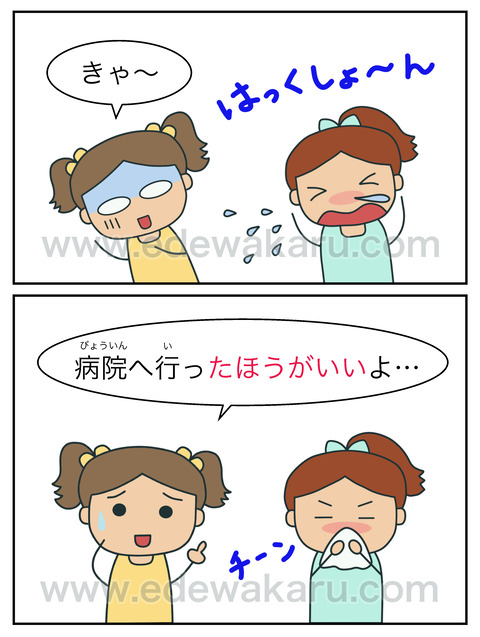
病院へ行ったほうがいいよ
→病院へ行くべきだよ(復習:〜べきだ)You should go to the hospital. →You ought to go to the hospital (Review: 〜べきだ).
お肉だけじゃなくて、野菜も食べたほうがいいよ
→お肉だけじゃなくて、野菜も食べるべきだよ(復習:〜ちゃ・〜じゃ)You should eat vegetables, not just meat. →You ought to eat vegetables, not just meat (Review: 〜ちゃ・〜じゃ).
今日は傘を持ってったほうがいいかな…
→今日は傘を持っていくべきかな…(復習:〜てく)(復習:〜かな・〜かしら(口語形))(復習:〜かな・〜かしら(文法))Maybe I should take an umbrella today… →Maybe I should take an umbrella with me today… (Review: 〜てく) (Review: 〜かな・〜かしら (colloquial form)) (Review: 〜かな・〜かしら (grammar)).
彼は口が軽いから教えないほうがいいよ
→彼は口が軽いから教えるべきではないよ(復習:口が軽い)He’s loose-lipped, so you’d better not tell him. →He’s loose-lipped, so you shouldn’t tell him (Review: 口が軽い).
Read the original source text
Meaning
〜するべきだ
How to use it
動詞[辞書形]+ほうがいい
動詞[た形]+ほうがいい
動詞[ない形]+ほうがいい
Explanation
「〜ほうがいい」は相手に「〜するべきだ」というように、忠告やアドバイスをする時に使う文型です。【辞書形】を使う場合と【た形】を使う場合はほとんど同じ意味ですが、「〜たほうがいい」の形の方がよく使われると思います😊また
【なかった形】には使いませんので気をつけましょう
😮
[例]
⭕️行く
ほうがいい
よ
⭕️行った
ほうがいい
よ
⭕️行かないほうがいいよ
❌行かなかったほうがいいよ
「〜ほうがいい」は初級で勉強する文型ですが、日常会話(にちじょうかいわ)でとてもよく使います。しっかりと復習しておきましょう😉
毎日のんびり日本語教師
How to use it
Verb た-form+ほうがいい
Verb ない-form+ほうがいい
Noun+の+ほうがいい
い-adjective dictionary form+ほうがいい
な-adjective+な+ほうがいい
(Verb dictionary form+ほうがいい)
Explanation
This grammar expresses advice or a suggestion based on the speaker's subjective judgment. Therefore, it cannot be used with a superior.
It rarely also attaches to the dictionary form of a verb (7), but in the case of verbs it basically attaches to the past form or negative form.
The comparative expression 「~より」 often appears before it.
Notes
Similar grammar: 「~ほうがよかった」
Similar grammar: 「~ほうがましだ」
In context 10 examples
体調が悪いなら休んだ方がいい。
If you're not feeling well, you should rest.
危ないから下手に触らないほうがいい。(很危险所以不要随意触摸比较好。)
It's dangerous, so you shouldn't touch it carelessly. (It's dangerous, so you'd better not touch it casually.)
健康のためにタバコは止めたほうが良い。
You should quit smoking for your health.
澄ましているよりも笑顔のほうがいいよ。
A smile is better than keeping a straight face.
健全な育成のために、親は子供を束縛せず自由にさせたほうがいい。
For healthy development, parents should let their children have freedom instead of restricting them.
将来の選択肢は多い方がいい。
It's better to have more options for the future.
明日は忙しいので、今日行くほうがいいです。
I'm busy tomorrow, so it's better to go today.
恋人にするなら年下よりも年上のほうがいい。
If you're choosing a romantic partner, older is better than younger.
国家間で争うよりも当然平和なほうがいい。
Of course, peace is better than conflict between nations.
神様なんていないほうがいい。
It would be better if there were no such thing as God.
Read the original source text
How to use it
動た形+ほうがいい
動ない形+ほうがいい
名詞+の+ほうがいい
い形容詞原形+ほうがいい
な形容詞+な+ほうがいい
(動辞形+ほうがいい)
Explanation
話者の主観的な判断によるアドバイスや提案を表す文法です。したがって目上の人に使うことはできません。
稀に動辞形にも接続することもありますが(7)、動詞の場合は基本的に動た形あるいは動ない形に接続されます。
前にはよく比較の「~より」が呼応します。
Notes
似ている文法「~ほうがよかった」
似ている文法「~ほうがましだ」
NINJAL 日本語文型データベース
Meaning
Used when recommending or advising the listener to do ~. It is often said to mean that if they do not do ~, something bad may happen.
How to use it
Vたほうがいい/Vないほうがいい
Notes
A sentence-final assertion has a strong advisory tone, so it may sound rude when used with someone in a higher position. It can also be used with someone in a higher position if phrased indirectly using expressions such as 「〜と思います・〜かもしれません・〜そうですよ」.
In context 8 examples
山登りをする前に、ちゃんとルートを確認しておいたほうがいいですよ。
Before going mountain climbing, you should check the route properly.
若いときは、いろいろなことにチャレンジしたほうがいいと思う。
I think it’s better to try various things while you’re young.
「夕方から降るって。傘を持っていったほうがよさそうだよ」
“They say it’ll rain from this evening. It looks like you’d better take an umbrella.”
「まだコスト面の問題が十分解決されていませんよね。新商品の発売はしばらく見合わせたほうがいいんじゃないでしょうか」
“The cost issues still haven’t been resolved sufficiently, have they? Wouldn’t it be better to hold off on launching the new product for a while?”
疲れているときはあまり無理をしないほうがいい。
When you’re tired, it’s better not to push yourself too hard.
「体に悪いから、あまりお酒を飲みすぎないほうがいいよ」
“It’s bad for your health, so you’d better not drink too much.”
光の刺激で眠れなくなるので、寝る前はパソコンやスマートフォンの画面をあまり見ないほうがいいそうです。
I hear that it’s better not to look at computer or smartphone screens much before bed, because the light stimulation can keep you from sleeping.
「このヨーグルト、賞味期限が1週間前なんだけど、食べても大丈夫かな」「悪くなっているかもしれないから食べない方がいいんじゃない?」
“This yogurt expired a week ago. Is it okay to eat?” “It might have gone bad, so wouldn’t it be better not to eat it?”
Read the original source text
Meaning
聞き手に〜するように勧めたり、忠告したりするときに使います。〜しなければ悪い結果になるかもしれないという意味で言うことが多いです。
How to use it
Vたほうがいい/Vないほうがいい
Notes
文末を言い切る形は忠告の意味合いが強くなるので、立場が上の人に使うと失礼に感じられます。「〜と思います・〜かもしれません・〜そうですよ」などの表現を使って、間接的な表現にすれば、立場が上の人にも使えます。
IMABI
Best That
Read this IMABI lesson ↗Explanation
Best That: ~方 Patterns & ~に越したことはない
For some reason, students are compelled to use the word 方 excessively.
Best/Better That
方がいい means “best to…” and with verbs, you should use the past tense, and with adjectives or the negative, you should use the non-past tense. However, this can still be used with the non-past of verbs, and いい can be replaced with phrases like 賢明だ (wise).
~方がいい is used in the written and spoken language. It is often used in daily conversation, but it is often used by Japanese learners when giving suggestions/advice, which may lead some Japanese to smirk.
Non-past +方がいい is primarily used with one’s in-group as it is used a lot in situations where you are giving direct advice on what is best to do. Past+方がいい is felt to be more euphemistic and is often used towards one’s out-group. However, some people have personal preferences for one or the other.
1. 今すぐ行った方がいいです。
It’d be best to go right now.
2. 寝た方がいい。
It’s best to sleep.
3. よく考えた方がいい。
You’d better think that over.
4. 泳ぐ前に、日焼ひやけ止どめを塗ぬった方がいいよ。
It’s best to put on sunblock before swimming.
5. 卵たまごは食べない方がいい。 (Contrasting and or highlighting)
It’s best to not eat eggs.
6. {ほとんどの}わずかな店みせしか開いていないから、今食品を買った方がいい。
Since there are only but a few stores that are open, it’s best to buy food now.
7. 彼はそこへ行った方がよい。
It is best for him to go there.
8. 毎日運動した方がいい。
It’s best to exercise every day.
Nuance Note: Even when there is not a second reference mentioned, this pattern implies a comparison between things. It may sound pushy depending on the context as it can be used to impose your will/thought. When you want to make a simple suggestion, you can use ~たらいい.
Again, other things than just いい may also appear in this fashion.
9. 当人に会って直接に話し合った方が効果こうかはあると思います。
I think that it is effective to meet with the said person and directly talk together (about it).
Non-Past + 方がいい
It is also worth noting that when you use the pattern “Non-past+方がいい”, there could be several things that are good to do in the said situation, but you pick one as an example of being good.
10. 折りにふれて想起そうきするほうがいい。
Occasionally, it is good to call it to mind.
~がよい
~がよい can create a suggestion bordering on a command, and it uses older grammar by just directly following verbs without the need of a nominalizer like の.
11. そうするがよい。
You had better do it.
~方: How to…
Following the stem of a verb, ~方かた means “how to…”. Sometimes this may not show up in translation. For instance, 読み方 may very well be able to be translated as “how to read,” but it can also be sufficiently translated as “reading” depending on context.
12. 弟の笑い方が気に食わねー。(Slang)
I can’t stand the way my little brother smiles.
13. 日本語の書き方をよく知っていますか。
Do you know how to write Japanese well?14. 行き方が全く分からない。
I don’t know the way to go at all.
15. どの読み方を使うべきかは分かりません。
I don’t know which reading I’m supposed to use.
16. 本当に酷ひどい言い方だよ。
That’s a hideous way to talk.
17. しかたがありません。(Set Phrase)
It can’t be helped.
18. 簡単な覚え方を教えてくださいませんか。
Could you teach me an easy way to remember?
~に越したことはないが
~に越こしたことはない(が) means “can never…too much” and is used in giving common sense advice. The verb 越す has meanings all related to the idea of “surpassing”. This phrase is used to show that nothing beats doing X. So, when young people use it in certain situations, it can make them sound arrogant.
If turned into ~に越したことはなかった, you end up showing regret. This is because you recognize what was the best thing to do, but you didn’t do it. This directly follows verbs and adjectives, but for adjectival nouns, the copula is either as である or not there at all (which is most common).
19. 傘かさを持つに越したことはない。
It’s always best to have an umbrella.
20. 貯金をするに越したことはなかったが、ちょっと生活を楽しむことができた。
Nothing would have beat saving, but I got to enjoy life a little.
21. 用心ようじんに越したことはないが、そんな服装を着るなんて派手はですぎるじゃない?
You can never be too careful, but isn’t wearing an outfit like that too showy?
In context 20 examples
今すぐ行った方がいいです。
It’d be best to go right now.
寝た方がいい。
It’s best to sleep.
よく考えた方がいい。
You’d better think that over.
泳ぐ前に、日焼ひやけ止どめを塗ぬった方がいいよ。
It’s best to put on sunblock before swimming.
卵たまごは食べない方がいい。 (Contrasting and or highlighting)
It’s best to not eat eggs.
{ほとんどの}わずかな店みせしか開いていないから、今食品を買った方がいい。
Since there are only but a few stores that are open, it’s best to buy food now.
彼はそこへ行った方がよい。
It is best for him to go there.
毎日運動した方がいい。
It’s best to exercise every day.
当人に会って直接に話し合った方が効果こうかはあると思います。
I think that it is effective to meet with the said person and directly talk together (about it).
折りにふれて想起そうきするほうがいい。
Occasionally, it is good to call it to mind.
そうするがよい。
You had better do it.
弟の笑い方が気に食わねー。(Slang)
I can’t stand the way my little brother smiles.
日本語の書き方をよく知っていますか。
Do you know how to write Japanese well?
どの読み方を使うべきかは分かりません。
I don’t know which reading I’m supposed to use.
本当に酷ひどい言い方だよ。
That’s a hideous way to talk.
しかたがありません。(Set Phrase)
It can’t be helped.
簡単な覚え方を教えてくださいませんか。
Could you teach me an easy way to remember?
傘かさを持つに越したことはない。
It’s always best to have an umbrella.
貯金をするに越したことはなかったが、ちょっと生活を楽しむことができた。
Nothing would have beat saving, but I got to enjoy life a little.
用心ようじんに越したことはないが、そんな服装を着るなんて派手はですぎるじゃない?
You can never be too careful, but isn’t wearing an outfit like that too showy?
Read the original source text
Explanation
Best That: ~方 Patterns & ~に越したことはない
For some reason, students are compelled to use the word 方 excessively.
Best/Better That
方がいい means “best to…” and with verbs, you should use the past tense, and with adjectives or the negative, you should use the non-past tense. However, this can still be used with the non-past of verbs, and いい can be replaced with phrases like 賢明だ (wise).
~方がいい is used in the written and spoken language. It is often used in daily conversation, but it is often used by Japanese learners when giving suggestions/advice, which may lead some Japanese to smirk.
Non-past +方がいい is primarily used with one’s in-group as it is used a lot in situations where you are giving direct advice on what is best to do. Past+方がいい is felt to be more euphemistic and is often used towards one’s out-group. However, some people have personal preferences for one or the other.
1. 今すぐ行った方がいいです。
It’d be best to go right now.
2. 寝た方がいい。
It’s best to sleep.
3. よく考えた方がいい。
You’d better think that over.
4. 泳ぐ前に、日焼ひやけ止どめを塗ぬった方がいいよ。
It’s best to put on sunblock before swimming.
5. 卵たまごは食べない方がいい。 (Contrasting and or highlighting)
It’s best to not eat eggs.
6. {ほとんどの}わずかな店みせしか開いていないから、今食品を買った方がいい。
Since there are only but a few stores that are open, it’s best to buy food now.
7. 彼はそこへ行った方がよい。
It is best for him to go there.
8. 毎日運動した方がいい。
It’s best to exercise every day.
Nuance Note: Even when there is not a second reference mentioned, this pattern implies a comparison between things. It may sound pushy depending on the context as it can be used to impose your will/thought. When you want to make a simple suggestion, you can use ~たらいい.
Again, other things than just いい may also appear in this fashion.
9. 当人に会って直接に話し合った方が効果こうかはあると思います。
I think that it is effective to meet with the said person and directly talk together (about it).
Non-Past + 方がいい
It is also worth noting that when you use the pattern “Non-past+方がいい”, there could be several things that are good to do in the said situation, but you pick one as an example of being good.
10. 折りにふれて想起そうきするほうがいい。
Occasionally, it is good to call it to mind.
~がよい
~がよい can create a suggestion bordering on a command, and it uses older grammar by just directly following verbs without the need of a nominalizer like の.
11. そうするがよい。
You had better do it.
~方: How to…
Following the stem of a verb, ~方かた means “how to…”. Sometimes this may not show up in translation. For instance, 読み方 may very well be able to be translated as “how to read,” but it can also be sufficiently translated as “reading” depending on context.
12. 弟の笑い方が気に食わねー。(Slang)
I can’t stand the way my little brother smiles.
13. 日本語の書き方をよく知っていますか。
Do you know how to write Japanese well?14. 行き方が全く分からない。
I don’t know the way to go at all.
15. どの読み方を使うべきかは分かりません。
I don’t know which reading I’m supposed to use.
16. 本当に酷ひどい言い方だよ。
That’s a hideous way to talk.
17. しかたがありません。(Set Phrase)
It can’t be helped.
18. 簡単な覚え方を教えてくださいませんか。
Could you teach me an easy way to remember?
~に越したことはないが
~に越こしたことはない(が) means “can never…too much” and is used in giving common sense advice. The verb 越す has meanings all related to the idea of “surpassing”. This phrase is used to show that nothing beats doing X. So, when young people use it in certain situations, it can make them sound arrogant.
If turned into ~に越したことはなかった, you end up showing regret. This is because you recognize what was the best thing to do, but you didn’t do it. This directly follows verbs and adjectives, but for adjectival nouns, the copula is either as である or not there at all (which is most common).
19. 傘かさを持つに越したことはない。
It’s always best to have an umbrella.
20. 貯金をするに越したことはなかったが、ちょっと生活を楽しむことができた。
Nothing would have beat saving, but I got to enjoy life a little.
21. 用心ようじんに越したことはないが、そんな服装を着るなんて派手はですぎるじゃない?
You can never be too careful, but isn’t wearing an outfit like that too showy?
日本語NET JLPT文法解説まとめ
Meaning
An expression used to advise someone to do (or not do) something.
Used to give advice or a warning that something bad will happen if they do not do so.
How to use it
V (た-form) + ほうがいい
V (ナイ-form) + ほうがいい
Explanation
"had better"
Express an advice or recommendation.
Used to advise or giving warning that something bad will happen if you don't.
In context 22 examples
疲れているとき、早く寝たほうがいいよ。
When you're tired, you should go to bed early.
大切な試験の日は早く家を出たほうがいい。
You should leave home early on the day of an important exam.
健康のために、できるだけ運動したほうがいい。
For your health, you should exercise as much as possible.
肉だけじゃなく、野菜も食べたほうがいいですよ。
You should eat vegetables as well as meat.
毎日、少しずつ単語を覚えたほうがいいよ。
You should memorize a few words each day.
君はもっと勉強したほうがいいよ。
You should study more.
熱があるから、今日はゆっくり休んだほうがいいよ。
You have a fever, so you should take it easy and rest today.
習ったことは、その日のうちに復習したほうがいいよ。
You should review what you learned that same day.
悪いことをしたら、素直に謝ったほうがいいよ。
If you do something wrong, you should apologize sincerely.
ここらへんは滑りやすいから、気をつけたほうがいいよ。
It's slippery around here, so you should be careful.
いくら考えてもわからないなら、先生に相談したほうがいいよ。
If you can't figure it out no matter how much you think about it, you should ask the teacher for advice.
これはちょっとグロテスクな映画なので、苦手なら見ないほうがいいよ。
This is a somewhat grotesque movie, so if that's not your thing, you shouldn't watch it.
今日は雨が降るらしいから、傘を持っていったほうがいいよ。
It looks like it's going to rain today, so you should take an umbrella.
そっちは危ないから行かないほうがいいよ。
It's dangerous over there, so you shouldn't go.
そのプリン、たぶん賞味期限が切れてるから食べないほうがいいよ。
That pudding has probably passed its expiration date, so you shouldn't eat it.
タバコは吸いすぎないほうがいいよ。
You shouldn't smoke too much.
無理をしないほうがいいですよ。
You shouldn't push yourself.
あまり冷たいものは飲まないほうがいいですよ。
You shouldn't drink too many cold things.
水で冷やしたほうがいいですよ。
You should cool it with water.
ここで、その話はしないほうがいいよ。
You shouldn't talk about that here.
その椅子は汚れているから、座らないほうがいいよ。
That chair is dirty, so you shouldn't sit on it.
部屋を掃除したほうがいいですよ。
You should clean the room.
Read the original source text
Meaning
〜すること(しないこと)を、相手に助言する表現。
そうしなかったら悪いことが起こると助言や忠告をするときに使う。
How to use it
V(た形) + ほうがいい
V(ナイ形) + ほうがいい
Explanation
"had better"
Express an advice or recommendation.
Used to advise or giving warning that something bad will happen if you don't.