日本語文型辞典
Meaning
Basic information: A stiff, written-style expression.
Means “not only … but also.” Used after first mentioning something of a lesser degree, when saying that the matter extends beyond that to something of an even greater degree. For example, ① means, “She can read not only modern language, but also the more difficult classics.” ② means, “Not only my coworkers, but even my family (who should have been the people who trusted me most) look down on me.” When used in the form “V-nai bakarika,” it tends to refer to something unfavorable.
The usage is the same as in 1. An expression that first mentions something of a lesser degree and then says that it extends to something of an even greater degree.
How to use it
…bakarika …mo/…made
N bakarika …mo/…made
Na na bakarika …mo/…made
A/V bakarika …mo/…made
sore bakarika
In context 9 examples
彼女は、現代語ばかりか古典も読める。
She can read not only modern language but also classical literature.
会社の同僚ばかりか家族までが私を馬鹿にしている。
Not only my coworkers but even my family look down on me.
そのニュースが放送されると、日本国内ばかりか遠く海外からも激励の手紙がよせられた。
When that news was broadcast, letters of encouragement came not only from within Japan but also from far overseas.
手術をしても歩けるようにはならないかもしれないと言われていたが、手術後の回復はめざましく、歩けるようになったばかりか軽い運動もこなせるようになった。
They had said that surgery might not enable him to walk, but his recovery after the operation was remarkable: not only did he become able to walk, he also became able to manage light exercise.
最近では、東京や大阪のような大都市ばかりか、中小都市でも道路の渋滞がひどくなってきているらしい。
Recently, it seems that traffic congestion has become severe not only in major cities like Tokyo and Osaka but also in medium-sized and small cities.
(例) 彼は自分の失敗を認めないばかりか、相手が悪いなどと言い出す始末だ。
親切に忠告してやったのに、彼は、まじめに聞かないばかりかしまいには怒りだした。
薬を飲んだが、全然きかないばかりか、かえって気分が悪くなってきた。(Example) Not only does he refuse to admit his own mistake, but he even goes so far as to say that the other person is at fault. Even though I gave him some friendly advice, he not only failed to listen seriously, but eventually got angry. I took the medicine, but it not only had no effect at all; on the contrary, I started to feel worse.
上田さんは英語が話せる。そればかりか韓国語もインドネシア語も話せる。
Mr. Ueda can speak English. Not only that, he can also speak Korean and Indonesian.
彼はその男に着る物を与えた。そればかりか、いくらかの金まで持たせてやった。
He gave the man some clothes. Not only that, he even gave him some money to take along.
日本の私立高校には、たいてい制服がある。そればかりか靴やカバンまで決まっているという学校が多い。
Most private high schools in Japan have uniforms. Not only that, many schools even specify students' shoes and bags.
Read the original source text
Meaning
基本情報説明書きことば的なかたい表現。
「…だけでなく、その上に」という意味。まず、程度の軽いものについて述べて、それだけでなくて、さらにそれよりも程度の高いことにも及んでいるという場合に使う。例えば①は、「彼女は、現代語が読めるだけではなくて、それよりももっと難しい古典も読める」という意味になる。②は、「会社の同僚だけではなくて、(一番信頼してくれるはずの)家族まで私を馬鹿にしている」という意味。「V-ないばかりか」の形で使われる時には良くないことについて使われる傾向がある。
用法は1と同じ。はじめの文で程度の軽いことについて述べて、次にさらにそれよりもっと程度の高いことにも及んでいることを述べる表現。
How to use it
…ばかりか …も/…まで
Nばかりか…も/…まで
Naなばかりか …も/…まで
A/V ばかりか…も/…まで
それだかりか
AIUEO JLPT Grammar
Meaning
This sentence pattern indicates that in addition to a certain matter, something else follows. The latter part is often a stronger or more emphasized idea than the former. It has a similar meaning to「〜だけでなく」.
How to use it
Verb + ばかりか; adjective + ばかりか; na-adjective + な + ばかりか; noun + ばかりか
In context 5 examples
このプロジェクトは時間がかかるばかりか、費用も多くかかる。
This project not only takes time but also costs a lot of money.
このレストランは料理が美味しいばかりか、サービスも素晴らしい。
Not only is the food at this restaurant delicious, but the service is also excellent.
彼女は遅刻したばかりか、宿題も忘れてしまった。
Not only was she late, but she also forgot her homework.
彼は風邪を引いたばかりか、入院にまでなってしまった。
Not only did he catch a cold, but he ended up in hospital.
この薬は効果がないばかりか、副作用も強い。
This medicine is not only ineffective but also has strong side effects.
Read the original source text
Meaning
This sentence pattern indicates that in addition to a certain matter, something else follows. The latter part is often a stronger or more emphasized idea than the former. It has a similar meaning to「〜だけでなく」.
How to use it
動詞+ばかりか形容詞+ばかりか形容動詞な+ばかりか名詞+ばかりか
Explanation · 日本語
この文型は、ある事柄に加えて、さらに別の事柄が続くことを表す表現です。後件が前件よりもさらに強調された内容であることが多いです。「〜だけでなく」の意味を持ちます。
文法
Meaning
Not only ~
How to use it
V (plain form) + ばかりか
いA (plain form) + ばかりか
なAな/である + ばかりか
Nである + ばかりか
Notes
① The following clause often uses expressions such as 「〜も」, 「〜さえ」, and 「〜まで」.
② Expressions of intention, commands, invitations, and the like rarely occur in the following clause.
In context 8 examples
トムさんは10年も日本に住んでいるのに、漢字ばかりかひらがなさえ書けない。
Even though Tom has lived in Japan for ten years, he can't write not only kanji but even hiragana.
ジェームスさんは日本語ばかりか、英語もペラペラだ。
James is fluent not only in Japanese but also in English.
薬を飲んでいるのに、咳が止まらないばかりか、ひどくなる一方だ。
Even though I'm taking medicine, not only is my cough not stopping, it's only getting worse.
彼は無断欠席が多いばかりか、出勤しても真面目に働かずスマホばかり触っている。
Not only is he often absent without permission, but even when he comes to work, he doesn't work seriously and just plays with his smartphone.
キムさんはスポーツが上手なばかりか、成績も優秀である。
Kim is not only good at sports, but also has excellent grades.
嘘ばかりついていると、信頼を失うばかりか、友達をなくすことになるよ。
If you keep lying, you'll not only lose people's trust but also lose your friends.
初めて料理してみたが、見た目ばかりか、味も最悪だ。
I tried cooking for the first time, but not only does it look terrible, it tastes awful too.
鬼滅の刃という漫画は国内ばかりか、世界中でとても人気がある。
The manga called Demon Slayer is very popular not only domestically but all over the world.
Read the original source text
Meaning
〜だけでなく
How to use it
V(普通形)+ ばかりか
イA(普通形)+ ばかりか
ナAな/である + ばかりか
Nである + ばかりか
Notes
①後件には「〜も」、「〜さえ」、「〜まで」などがよく使われる。
②後件に意志や命令、勧誘などの表現はほとんど来ない。
DoJG 日本語文法辞典(全集)
Meaning
Not only ~ but also
How to use it
(i) {V/ Adjective い} informal | ばかりか | |
| {話す/話した} ばかりか | Not only does/did someone speak |
| {高い/高かった} ばかりか | Not only is/was something high |
(ii) Adjective な stem | {な/だった} ばかりか | |
| {静かな/静かだった} ばかりか | Not only is/was something/someone quiet |
(iii) {Noun /Nounだった} | ばかりか | |
| {先生/先生だった} ばかりか | Not only is/was someone a teacher |
Explanation
~ばかりか~(さえ)A compound particle/conjunction which is used to connect two nouns or two sentences, the first of which is something normally expected and the second of which is something normally unexpected.
In context 6 examples
日本では子供ばかりか大人さえ漫画を読んでいる。
In Japan not only children but even adults are reading comic books.
あの人は絵を見て楽しむばかりか、自分でも絵を描く。
He not only enjoys looking at pictures; he also draws them.
アメリカでは大学生ばかりか、中学生、高校生さえ日本語を勉強している。
In America not only college students but even junior and senior high school students are studying Japanese.
僕の寮の部屋は狭いばかりか、窓さえないんです。
My room in the dorm is not just small; it doesn't even have a window.
トムは漢字が読めないばかりか、平仮名さえ読めない。
It's not just kanji that Tom cannot read; he cannot read even hiragana.
父は食べるのが大好きなばかりか、料理をするのも大好きです。
My father not only loves to eat, he also loves to cook.
どんなときどう使う 日本語表現文型辞典
Meaning
not just
How to use it
N / 〔Plain form〕(Na-adjective な / Na-adjective である / Noun である) + ばかりか
Explanation
~だけでなく
1)「~だけでなく、その上にもっと程度の重い事柄も加わる」という意味。
2)後の文には「も・まで・さえ」などがよく使われる。
3)「ばかりか」では、「ばかりでなく」と違い、後に意志や希望、また命令や誘いなど働きかけの文が来ることはほとんどない。
◆ × 有名な観光地ばかりか、静かないなかの生活も見たい。→○有名な観光地ばかりでなく、静かないなかの生活も見たい。/ × 自分のことばかりか、他人のことも考えなさい。→○自分のことばかりでなく、他人のことも考えなさい。
2)Clause following often takes も (also), まで (until), or さえ (even).
3)Unlike ばかりでなく, clauses that make appeals, such as volition, hope, commands, or solicitations, rarely follow.
1)Not just does one thing happen, but something even more drastic does as well.
In context 4 examples
いくら薬を飲んでも、風邪が治らないばかりか、もっと悪くなってきました。
No matter how much medicine I took, not only did my cold fail to get better, it got worse.
このごろ彼は遅刻が多いばかりか、授業中にいねむりすることさえあります。
Lately, he is often late, and he even sometimes dozes off during class.
彼は仕事や財産ばかりか、家族まで捨てて家を出てしまった。
He abandoned not only his job and possessions but even his family, and left home.
あの人は仕事に熱心であるばかりか、地域活動も積極的にしている。
Not only is that person devoted to their work, but they also take an active part in community activities.
Read the original source text
Meaning
not just
How to use it
N/〔普通形〕(ナAな・ナAである/Nである)+ばかりか
Explanation
~だけでなく
1)「~だけでなく、その上にもっと程度の重い事柄も加わる」という意味。
2)後の文には「も・まで・さえ」などがよく使われる。
3)「ばかりか」では、「ばかりでなく」と違い、後に意志や希望、また命令や誘いなど働きかけの文が来ることはほとんどない。
◆ × 有名な観光地ばかりか、静かないなかの生活も見たい。→○有名な観光地ばかりでなく、静かないなかの生活も見たい。/ × 自分のことばかりか、他人のことも考えなさい。→○自分のことばかりでなく、他人のことも考えなさい。
2)Clause following often takes も (also), まで (until), or さえ (even).
3)Unlike ばかりでなく, clauses that make appeals, such as volition, hope, commands, or solicitations, rarely follow.
1)Not just does one thing happen, but something even more drastic does as well.
絵でわかる日本語
Meaning
Not only..., but also...
How to use it
Verb, adjective, or noun [plain form] + ばかりか
Explanation
“AばかりかB” is a sentence pattern meaning “not only A, but B as well.” It means “not only A, but what’s more, even B, to an extreme degree” or “not only A, but even B, which is worse,” and can be used for both good and bad things. It is more formal than “〜ばかりでなく” and expresses the speaker’s surprise or feeling that something is unexpected. Remember the patterns often used with it.
[Patterns often used together]
・〜ばかりか+
〜も
・〜ばかりか+
〜まで
・〜ばかりか+
〜さえ
・〜ばかりか+
〜すら
There are many sentence patterns that include “ばかり,” so let’s review them 😊
In context 7 examples
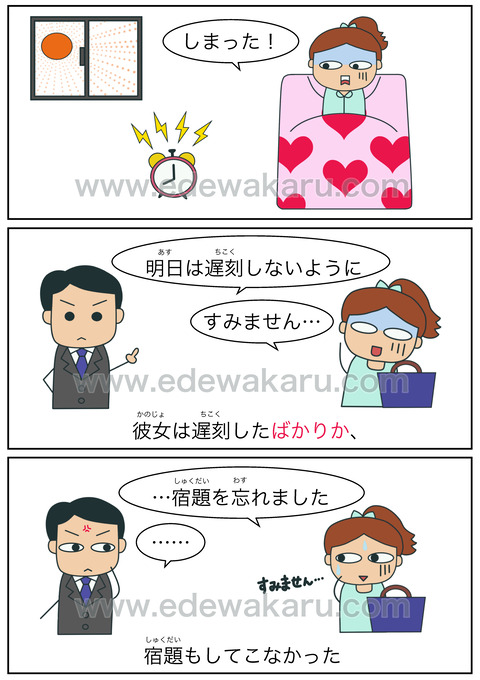
彼女は遅刻したばかりか、宿題もしてこなかった
→遅刻しただけでなく、さらに宿題もしてこなかったNot only was she late, she hadn’t even done her homework. →Not only was she late, she hadn’t even done her homework.
彼は頭がいいばかりか、スポーツもできる
→頭がいいだけでなく、さらにスポーツもできるNot only is he smart, he can play sports too. →He’s not only smart, he can also play sports.
私のお兄ちゃんは、英語ばかりか中国語も話せる
→英語だけでなく、さらに中国語も話せるMy older brother can speak not only English but Chinese too. →He can speak not only English, but Chinese as well.
田中さんは美人なばかりか、性格までいい
→美人なだけでなく、さらに性格もいいTanaka-san is not only beautiful, but even her personality is great. →Not only is she beautiful, her personality is great too.
日本のアニメは国内ばかりか、海外でさえ人気がある
→国内だけでなく、さらに海外でさえ人気があるJapanese anime is popular not only in Japan, but even overseas. →It’s popular not only in Japan, but even overseas.
お酒を飲みすぎて、頭が痛いばかりか吐き気もする…
→頭が痛いだけでなく、さらに吐き気もするI drank too much, so I have a headache and feel nauseous… →I not only have a headache, I feel nauseous too.
マイクは5年も日本に住んでいるのに、漢字ばかりかひらがなすら書けない
→漢字だけでなく、ひらがなすら書けないMike has lived in Japan for five years, but he can’t write not only kanji, but even hiragana. →He can’t write not only kanji, but even hiragana.
Read the original source text
Meaning
〜だけでなく、さらに〜も
How to use it
動詞・形容詞・名詞[普通形]+ばかりか
Explanation
「AばかりかB」は「Aだけでなく、さらにBも」という意味の文型です。「Aだけでなく、さらに程度はすごくてBも」「Aだけでなく、さらにひどくてBも」という意味で、いいことにも悪いことにも使えます。「〜ばかりでなく」よりもかたい言い方で、話者の驚きや意外だという気持ちを表します。よく一緒に使われる文型を覚えておきましょう。
[よく一緒に使われる文型]
・〜ばかりか+
〜も
・〜ばかりか+
〜まで
・〜ばかりか+
〜さえ
・〜ばかりか+
〜すら
「ばかり」がつく文型はたくさんありますので、復習をしておきましょう😊
日本語文型辞典 英語版
Meaning
【ばかりか】A formal expression with the tone of written language.
Means “not only...but also....” Used to make a statement about something of a lesser degree and then indicate that this also extends to something else at a higher degree.
For example,
(1)
means “she can read not only modern works but also the classics, which are much more difficult.”
(2)
means “not only my colleagues, but even my family (who should have the most faith in me) are treating me like a fool.”
When this expression is used in the form V-ないばかりか, it tends to be used to refer to something unfavorable.
(例)彼は自分の失敗を認めないばかりか、相手が悪いなどと言い出す始末だ。
He not only ignores his own mistakes, he tops things off by saying that the other party is to blame.
(例)親切に忠告してやったのに、彼は、まじめに聞かないばかりかしまいには怒りだした。
Even though I gave him a piece of advice out of kindness, he not only refused to listen seriously, he also ended up getting angry.
(例)薬を飲んだが、全然きかないばかりか、かえって気分が悪くなってきた。
Although I took some medicine, it didn’t work for me at all; instead, it made me feel sick.
Used the same way as Usage 1 (above). The first sentence describes something of a relatively lower degree, and the second one indicates that this extends to another thing at a higher degree.
How to use it
1. ...ばかりか ...も/...まで[Nばかりか ...も/...まで][Na なばかりか ...も/...まで][A/V ばかりか ...も/...まで]
2. そればかりか
In context 8 examples
彼女は、現代語ばかりか古典も読める。
She can read not only modern works but also the classics.
会社の同僚ばかりか家族までが私を馬鹿にしている。
Not only my colleagues at work but also my family treat me like a fool.
そのニュースが放送されると、日本国内ばかりか遠く海外からも激励の手紙がよせられた。
When the news was broadcast, letters of encouragement were sent to them not only from within Japan but also from abroad.
手術をしても歩けるようにはならないかもしれないと言われていたが、手術後の回復はめざましく、歩けるようになったばかりか軽い運動もこなせるようになった。
Although he was told that he might not be able to walk even after surgery, his recovery has been remarkable; not only has he started to be able to walk, he can even do some light exercise.
最近では、東京や大阪のような大都市ばかりか、中小都市でも道路の渋滞がひどくなってきているらしい。
Recently, traffic congestion seems to be getting much worse, not only in big cities such as Tokyo and Osaka, but even in small and medium-sized cities.
上田さんは英語が話せる。そればかりか韓国語もインドネシア語も話せる。
Ueda-san can speak English. In addition, he can also speak Korean and Indonesian.
彼はその男に着る物を与えた。そればかりか、いくらかの金まで持たせてやった。
He gave some clothes to the man. What is more, he also let him have some money.
日本の私立高校には、たいてい制服がある。そればかりか靴やカバンまで決まっているという学校が多い。
Students at private high schools in Japan usually wear a school uniform. Moreover, many schools even have designated shoes and school bags.
Read the original source text
Meaning
【ばかりか】A formal expression with the tone of written language.
Means “not only...but also....” Used to make a statement about something of a lesser degree and then indicate that this also extends to something else at a higher degree.
For example,
(1)
means “she can read not only modern works but also the classics, which are much more difficult.”
(2)
means “not only my colleagues, but even my family (who should have the most faith in me) are treating me like a fool.”
When this expression is used in the form V-ないばかりか, it tends to be used to refer to something unfavorable.
(例)彼は自分の失敗を認めないばかりか、相手が悪いなどと言い出す始末だ。
He not only ignores his own mistakes, he tops things off by saying that the other party is to blame.
(例)親切に忠告してやったのに、彼は、まじめに聞かないばかりかしまいには怒りだした。
Even though I gave him a piece of advice out of kindness, he not only refused to listen seriously, he also ended up getting angry.
(例)薬を飲んだが、全然きかないばかりか、かえって気分が悪くなってきた。
Although I took some medicine, it didn’t work for me at all; instead, it made me feel sick.
Used the same way as Usage 1 (above). The first sentence describes something of a relatively lower degree, and the second one indicates that this extends to another thing at a higher degree.
How to use it
1. ...ばかりか ...も/...まで[Nばかりか ...も/...まで][Na なばかりか ...も/...まで][A/V ばかりか ...も/...まで]
2. そればかりか
くらべてわかる日本語表現文型辞典
Meaning
A alone would be enough, and on top of that, there is B too.
How to use it
A ばかりか B も (A ばかりか B まで)
[Verb] ばかりか
[i-adjective—plain form] ばかりか
[na-adjective—な/である/だった/ではない] ばかりか
[Noun—∅/である/ではない/だった] ばかりか
Explanation
【Contrast 1】
「AばかりでなくB」 (Meaning 1, p. 279)
「AばかりかBも」 has an emphatic meaning of “on top of that,” but 「AばかりでなくB」 does not carry that strong meaning; it simply states that, with regard to the topic, there is not only A but also B.
○梅田へは、地下鉄ばかりでなく、バスでも行ける。 — You can get to Umeda by bus as well as by subway.
×梅田へは、地下鉄ばかりか、バスでも行ける。 — You can get to Umeda by bus as well as by subway.
「AばかりかB」 is not followed by an imperative in the following clause.
○日本語ばかりでなく、英語も勉強しなさいよ。 — Study English as well as Japanese.
×日本語ばかりか、英語も勉強しなさいよ。 — Study English as well as Japanese.
「AにとどまらずB」 (Meaning 1, p. 251)
「AはおろかB」 (Meaning 1, p. 273)
「AどころかBも」 (Meaning 1, p. 168)
Notes
【Note 1】
・It can also be used in the form 「Sentence. そればかりかB」.
○彼はこの競技を始めて1年ほどでオリンピックに出場した。そればかりか、メダルまで取ってしまった。 — He made it to the Olympics about a year after taking up this sport. On top of that, he even won a medal.
In context 4 examples
あの店の料理は安いばかりか味もいいので、人気がある。
The food at that restaurant is popular because it’s not only cheap but tasty too.
彼は英語ばかりか中国語も話せるらしい。
Apparently, he can speak Chinese as well as English.
急発進、急ブレーキは危険なばかりか、燃費も悪くなる。
Rapid acceleration and sudden braking are dangerous, and they also worsen fuel economy.
朝ご飯ばかりか昼ご飯までご馳走になって、申し訳ございません。
I’m sorry to have imposed on you for lunch as well as breakfast.
Read the original source text
Meaning
Aだけでも十分なのに、そのうえBもある。
How to use it
AばかりかBも(AばかりかBまで)
[動詞]ばかりか
[イ形-普]ばかりか
[ナ形-な/である/だった/ではない]ばかりか
[名詞-∅/である/ではない/だった]ばかりか
Explanation
【対比1】
「AばかりでなくB」(意味1 P.279)
「AばかりかBも」には、「そのうえ」という強調的な意味があるが、「AばかりでなくB」には、そのような強い意味はなく、単に主題についてAだけではないBもあるということを述べる文である。
○梅田へは、地下鉄ばかりでなく、バスでも行ける。
×梅田へは、地下鉄ばかりか、バスでも行ける。
「AばかりかB」は、後文に命令形はつかない。
○日本語ばかりでなく、英語も勉強しなさいよ。
×日本語ばかりか、英語も勉強しなさいよ。
「AにとどまらずB」(意味1 P.251)
「AはおろかB」(意味1 P.273)
「AどころかBも」(意味1 P.168)
Notes
【注意1】
・「文。そればかりかB」の形で使うこともある。
○彼はこの競技を始めて1年ほどでオリンピックに出場した。そればかりか、メダルまで取ってしまった。
日本語NET JLPT文法解説まとめ
Meaning
Not only ~, but also ...
How to use it
V (plain form) + ばかりか
いA (plain form) + ばかりか
なAな/である + ばかりか
Nである + ばかりか
Explanation
not only 〜 but also・・・"
① The following clause often uses 「〜も」, 「〜さえ」, or 「〜まで」.
② Expressions of intention, commands, invitations, and the like rarely occur in the following clause.
In context 8 examples
トムさんは10年も日本に住んでいるのに、漢字ばかりかひらがなさえ書けない。
Even though Tom has lived in Japan for ten years, he can't write not only kanji but even hiragana.
ジェームスさんは日本語ばかりか、中国語もペラペラだ。
James is fluent not only in Japanese but also in Chinese.
薬を飲んでいるのに、咳が止まらないばかりか、ひどくなる一方だ。
Even though I'm taking medicine, not only is my cough not stopping, it's only getting worse.
彼は無断欠席が多いばかりか、出勤しても真面目に働かずスマホばかり触っている。
Not only is he often absent without permission, but even when he comes to work, he doesn't work seriously and just plays with his smartphone.
キムさんはスポーツが上手なばかりか、成績も優秀である。
Kim is not only good at sports, but also has excellent grades.
嘘ばかりついていると、信頼を失うばかりか、友達をなくすことになるよ。
If you keep lying, you'll not only lose people's trust but also lose your friends.
初めて料理してみたが、見た目ばかりか、味も最悪だ。
I tried cooking for the first time, but not only does it look terrible, it tastes awful too.
鬼滅の刃という漫画は国内ばかりか、世界中でとても人気がある。
The manga called Demon Slayer is very popular not only domestically but all over the world.
Read the original source text
Meaning
〜だけでなく・・・
How to use it
V(普通形)+ ばかりか
イA(普通形)+ ばかりか
ナAな/である + ばかりか
Nである + ばかりか
Explanation
not only 〜 but also・・・"
①後件には「〜も」、「〜さえ」、「〜まで」などがよく使われる。
②後件に意志や命令、勧誘などの表現はほとんど来ない。
毎日のんびり日本語教師
How to use it
Verb plain form + ばかりか
な-adjective stem + な/である + ばかりか
い-adjective plain form + ばかりか
Noun + ばかりか
Explanation
This is an additive grammar pattern that adds to what was stated in the first clause and states something more in the latter clause.
The latter clause often pairs with 「も」 and similar expressions.
It has the same meaning as 「【N3 Grammar】~ばかりでなく~も/~ばかりでなくて~も」, but 「~ばかりか」 is the more formal expression.
Notes
The 「ばかり」 series
In context 8 examples
助けてと言っても助けてくれないばかりか、笑ってこっちを見る始末だ。
Not only did they refuse to help when I asked, they even ended up laughing and looking at me.
これ以上効率を追い求めるのは従業員の命を危険にさらすばかりか、信用をも失いかねない。
Pursuing even greater efficiency could not only put employees’ lives in danger, but could also cost us our credibility.
栄養のバランスに注意しなければ肉体ばかりか精神にまでも支障をきたしかねない。
If we don’t pay attention to nutritional balance, it could harm not only the body but even the mind.
命令を質問の形に変えると、 気持ちよく受け入れられるばかりか、 相手に創造性を発揮させることもある。
Turning a command into a question can make it not only more readily accepted, but can also bring out the other person’s creativity.
状況は変わってないばかりか、もっと酷くなっている。
The situation hasn’t changed; if anything, it has gotten worse.
世界情勢は1か月後ばかりか、明日のこともどうなってるかは誰にも分からない。
No one knows what the global situation will be like not only a month from now but even tomorrow.
彼は文句言うばかりか、人にも文句を言わせようとしてくる。
Not only does he complain, he also tries to get other people to complain.
神なんて人間に何の影響も与えない祈っても無駄な存在だ。そればかりかそもそも存在すらしない。
God is a being who has no effect on humans and is useless to pray to. Besides, God doesn’t even exist in the first place.
Read the original source text
How to use it
動詞普通形+ばかりか
な形容詞語幹+な/である+ばかりか
い形容詞普通形+ばかりか
名詞+ばかりか
Explanation
前項で述べたものに加え、更にそれ以上のことを後項で述べる累加・添加の文法です。
後項ではよく「も」などが呼応します。
意味は「【N3文法】~ばかりでなく~も/~ばかりでなくて~も」と同じですが、「~ばかりか」のほうが硬い表現です。
Notes
「ばかり」シリーズ
NINJAL 日本語文型データベース
Meaning
Used when you want to say that there is something more than “~,” even though “~” alone would be enough. It expresses the speaker’s feelings about the additional matter, such as surprise, admiration, dissatisfaction, or a negative attitude.
How to use it
V plain form+ばかりか
i-A plain form+ばかりか
na-A plain form+ばかりか (however, “na-Aだ” becomes “na-Aな+ばかりか・na-Aである+ばかりか”)
N ばかりか・N plain form+ばかりか (however, “Nだ” becomes “Nであるばかりか”)
Other
Notes
“~” is a matter mentioned in the context or one that is easy to anticipate in that situation. After “~ばかりか” comes a sentence expressing another matter that is harder to anticipate than “~.” A sentence that makes a request or otherwise acts upon the listener does not follow.
The particle “も” is often attached to the word expressing the other matter.
In context 25 examples
スミスさんは日本語が流暢に話せるばかりか、日本の古典文学も読んで理解できるらしい。
Apparently, not only can Mr. Smith speak Japanese fluently, he can also read and understand classical Japanese literature.
この新しい図書館には本を読んだり勉強したりする場所があるばかりか、コーヒーを飲んだり話したりできるカフェもある。
This new library has places to read and study, and it also has a café where you can drink coffee and talk.
この子は3歳で漢字の読み書きができるばかりか、この辞書の内容を暗記して言うことができる。
At three years old, this child can not only read and write kanji, but can also recite the contents of this dictionary from memory.
田中さんは面白いアイディアを考えるばかりか、それをすぐに実行する。
Mr. Tanaka not only comes up with interesting ideas, but also puts them into practice right away.
妻は体調がよくないのに、病院に行こうとしないばかりか、仕事も休まない。
Although my wife isn’t feeling well, she not only refuses to go to the hospital, but also doesn’t take time off work.
古い蔵から見つかった200年前のこの絵は、どこも傷んでいないばかりか色あせもなく、昨日描いたみたいにきれいだ。
This 200-year-old painting found in an old storehouse is not only undamaged anywhere, but has not faded at all; it is as beautiful as if it had been painted yesterday.
あの大臣は失言したばかりか、それを謝らずに他の人のせいにしたことで信用を失ってしまった。
That minister lost the public’s trust not only by making a gaffe, but also by blaming someone else instead of apologizing for it.
私は今学期、出席が足りなかったばかりか試験の点数も悪かったので、進級できなかった。
I couldn’t advance to the next year because not only did I have too many absences this semester, but I also got poor exam scores.
あの先生の説明は、誰にでもわかりやすいばかりか内容的にも非常に高度だ。
That teacher’s explanations are not only easy for anyone to understand, but also very advanced in content.
古い油は、おいしくないばかりか体にもよくないから、使わないほうがいい。
Old oil is not only bad-tasting but also bad for your health, so it’s better not to use it.
前の仕事の方が給料が高かったばかりか休みも多かった。しかし、今の仕事の方が断然楽しい。
My previous job not only paid more, but also gave me more time off. However, my current job is far more enjoyable.
昨日見た芝居は内容が面白くなかったばかりか、役者も力量不足だった。
The play I saw yesterday not only had an uninteresting plot, but the actors also lacked skill.
この山は景色が単調なばかりか危険な場所もあり,初心者には勧められない。
The scenery on this mountain is monotonous, and there are dangerous areas as well, so it cannot be recommended to beginners.
豆腐は栄養が豊富であるばかりか値段も安いので、ありがたい食品だ。
Tofu is a welcome food because it is not only rich in nutrients but also inexpensive.
暴飲暴食は健康的でないばかりかお金の無駄遣いである。
Overeating and drinking too much is not only unhealthy but also a waste of money.
昨日の会議は雰囲気が険悪だったばかりか、長時間に及んだ。
Yesterday’s meeting was not only tense in atmosphere, but also went on for a long time.
掃除が好きじゃなかったばかりか片付けも苦手だった私だが、一人暮らしを始めてからすっかりきれい好きになった。
I not only disliked cleaning but was also bad at tidying up, but after I started living alone, I became thoroughly house-proud.
年金生活者ばかりか若者も生活苦を嘆いている。
Not only pensioners but also young people lament the hardships of making a living.
今回の台風では川が増水した。そればかりか地盤もゆるんでしまった。
The river rose during this typhoon. On top of that, the ground became unstable.
この作品は歴史小説として傑作であるばかりか、史実の記録としても非常に貴重だ。
This work is not only a masterpiece as a historical novel, but also extremely valuable as a record of historical facts.
彼女はだまされて、財産ばかりか友人までも失ってしまった。
She was deceived and lost not only her fortune but even her friends.
この物件は希望の間取りでないばかりか、価格的にも予算オーバーだ。
This property not only lacks the layout I wanted, but is also over my budget.
あの人は昔、有名な女優だったばかりか、会社も経営していたそうだ。
Apparently, that person was not only a famous actress in the past, but also ran a company.
会議の議事録は正確なデータではなかったばかりか、議論されていない内容が書かれていた。再度確認する必要がある。
The meeting minutes were not only inaccurate, but also included content that had not been discussed. They need to be checked again.
佐藤さんはプロゲーマーとして有名で、国内からばかりか海外のファンからも、たくさんの応援メッセージを受け取っている。
Mr. Sato is famous as a professional gamer and receives many messages of support not only from fans in Japan but also from overseas.
Read the original source text
Meaning
~だけでも十分なのに、~以上のことがあると言いたいときに使います。~以上のことに対する話し手の驚き・感心・不満・否定的な感情などの気持ちを表します。
How to use it
V普通形+ばかりか
i-A普通形+ばかりか
na-A普通形+ばかりか(ただし、「na-Aだ」→「na-Aな+ばかりか・na-Aである+ばかりか」)
Nばかりか・N普通形+ばかりか(ただし、「Nだ」→「Nであるばかりか」)
その他
Notes
「~」には、文脈にある事柄や、その場面で予想しやすい事柄がきます。「~ばかりか」の後には、「〜」よりも予想しにくい別の事柄を表す文がきます。相手への働きかけの文はきません。
別の事柄を表す言葉に「も」をつけることが多いです。