絵でわかる日本語
Meaning
(Cause / reason) Because 〜 / since 〜
How to use it
Verb / adjective / noun [plain form] + もので / ものだから
* The present affirmative form of nouns and な-adjectives is “ーなもので” or “ーなものだから”
(Examples: 学生なもので・きれいなものだから)
Explanation
“〜もので” and “〜ものだから” are expressions of cause and reason. These patterns are often used when you want to say that something happened “because there was an unforeseen circumstance or an unwilling reason, even though I actually didn’t want to do 〜.” In spoken language, “〜もんで” and “〜もんだから” are used. “〜ものですから” is also used as a polite form 😊
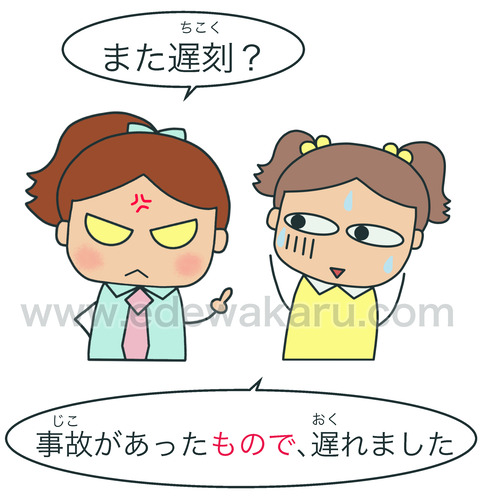
Examples: I was late because there was an accident.
I don’t remember well because it was a long time ago.
I bought a lot because it was cheap.
[Additional note]
As you learned at the beginner level, “〜から” emphasizes cause and reason more than “〜ので,” so you should avoid using it when apologizing. “〜もので・〜ものだから” is close in meaning to “〜ので,” so it is often used when apologizing 😉
[The “もの” series]
〜たいものだ・〜てほしいものだ
〜たものだ
〜たものではない
〜というもの (Nというもの)
〜ないものだろうか
〜ないものは〜ない
〜もの・〜んだもの
〜ものか
〜ものがある
〜ものだ (feeling/emotion)
〜ものだ (inherent property / general way of thinking)
〜ものだ・〜ものではない
〜もので・〜ものだから
〜ものと思っていた
〜ものなら
〜ものの
〜ものを
〜ようものなら
In context 3 examples
事故があったもので、遅れました
→事故があったので、遅れましたI was late because there was an accident. →I was late because there was an accident.
昔のことなもので、よく覚えていません
→昔のことなので、よく覚えていませんIt was a long time ago, so I don’t remember well. →It was a long time ago, so I don’t remember well.
安かったものだから、たくさん買ってしまった
→安かったので、たくさん買ってしまったIt was cheap, so I ended up buying a lot. →It was cheap, so I ended up buying a lot.
Read the original source text
Meaning
(原因・理由)〜ので / 〜から
How to use it
動詞・形容詞・名詞[普通形]+もので / ものだから
*名詞・な形容詞の現在肯定形は「ーなもので」「ーなものだから」
(例:学生なもので・きれいなものだから)
Explanation
「〜もので」「〜ものだから」は
原因・理由
を表す表現です。この文型は「
本当は〜したくなかったが、〜ので」というように、「予定外のことや不本意な理由があったので〜だ」と言いたい時によく使用されます。話し言葉では「
〜もんで」「
〜もんだから」が使われます。丁寧形として「
〜ものですから」という言い方もあります😊
例:事故があったもんで、遅れちゃったんだ
昔のことなもんだから、よく覚えていないの
安かったものですから、たくさん買ってしまいました
【補足】
初級で勉強したように「〜から」は「〜ので」より、原因・理由を強調してしまいますから、謝る時には使用しないようにしましょう。「〜もので・〜ものだから」は「〜ので」に近い文型ですから、謝る時によく使われます😉
【「もの」シリーズ】
〜たいものだ・〜てほしいものだ
〜たものだ
〜たものではない
〜というもの(Nというもの)
〜ないものだろうか
〜ないものは〜ない
〜もの・〜んだもの
〜ものか
〜ものがある
〜ものだ(感慨)
〜ものだ(本来の性質・一般的な考え方)
〜ものだ・〜ものではない
〜もので・〜ものだから
〜ものと思っていた
〜ものなら
〜ものの
〜ものを
〜ようものなら
NINJAL 日本語文型データベース
Meaning
This is used to give the cause or reason for something from a personal point of view. It is also often used when apologizing, and often to assert that something is justified because one cannot change the situation and there is nothing to be done about it, or to seek empathy about the circumstances.
It can also be used in the form 「〜もので。」 without a following sentence.
How to use it
Ⅴ普通形+もので
i-A普通形+もので
na-A普通形(ただし、「na-Aだ」→「na-Aな+もので」)
N普通形+もので(ただし、「Nだ」→「Nな+もので」)
Notes
「〜」 is filled by a cause or reason. After 「~もので」 comes a sentence expressing a situation that results from that cause or reason.
In context 20 examples
「帰りませんか」「あ、今日はまだ仕事が残っているもので、すぐには退社できないんです」
“Are you heading home?” “Oh, I still have work left to do today, so I can't leave right away.”
「今日は、おじいさんは?」「祖父はひどい風邪をひいたもので、ここ1週間寝込んでいるんです」
“How is your grandfather today?” “He caught a really bad cold, so he's been bedridden for the past week.”
「お待たせしてすみません。連絡したかったんですが、スマホを忘れたもので」
“Sorry to keep you waiting. I wanted to contact you, but I forgot my smartphone.”
「すみません。子どもが風邪をひいて保育園に預けられないもので、今日は欠勤させていただきます」
“I'm sorry. My child has a cold and can't be left at daycare, so I'll have to be absent from work today.”
友達に教えてもらったテスト範囲が間違っていたもので、昨日の英語のテストは半分も書けませんでした。
The test material a friend told me about was wrong, so I couldn't even write half of yesterday's English test.
時間がなかったもので、まだレポートは完成していないんです。
I didn't have time, so I haven't finished my report yet.
駅前のマンションがいいんですが、あまりにも家賃が高いもので、まだ迷っています。
I'd like an apartment near the station, but the rent is so high that I'm still undecided.
「大学生活はどう?」「やっと慣れてきたんですけど、何しろ家から遠いもので、通学が大変なんです」
“How's university life?” “I've finally gotten used to it, but it's so far from home that the commute is difficult.”
「ご無沙汰ばかりしていてすみません。ここのところ忙しかったもので」
“I'm sorry I've been out of touch so often. I've been busy lately.”
客「マスター、昨日の午後、臨時休業だったね。どうかしたの?」店主「昨日はちょっと体調がよくなかったもので午後早めに店じまいしまして……」
Customer: “Master, you were unexpectedly closed yesterday afternoon. Did something happen?” Owner: “I wasn't feeling very well yesterday, so I closed up early in the afternoon...”
その病院は対応がよくなかったもので、すぐに転院しました。
That hospital's service was poor, so I transferred to another one right away.
「お宅のお庭は、いつもお花の手入れが行き届いていますね」「暇なもので、他にやることがないんですよ」
“You always take such good care of the flowers in your garden.” “I have a lot of free time, so there's nothing else to do.”
反抗期だからしかたないかもしれませんが、息子が素直じゃないもので、手を焼いています。
It may be unavoidable because he's going through puberty, but my son isn't very obedient, so I'm having a hard time with him.
先を急いでいたんですが、あまりにも夕焼けがきれいだったもので、思わず見入ってしまいました。
I was in a hurry to get somewhere, but the sunset was so beautiful that I couldn't help stopping to gaze at it.
僕は料理が得意じゃなかったもので、子どもたちによく文句を言われていました。
I wasn't good at cooking, so my children often complained to me.
「すみません。わさびを抜いてもらえますか。苦手なもので」
“Excuse me. Could you leave out the wasabi? I can't handle it.”
「ごめんなさい。せっかく誘ってもらったけれど、母が入院中なもので、なかなか出かけられないんです」
“I'm sorry. I really appreciate the invitation, but my mother is in the hospital, so I can't get out much.”
「すみません。父は留守で、私は本人じゃないもので、その件についてはわからないんです。また後でお電話いただけますか」
“I'm sorry. My father is out, and I'm not the person you're asking about, so I don't know about that matter. Could you call again later?”
「悪いことをしたら叱らないといけないとは思っていましたけど、5歳頃まで病弱な子だったもので、ついつい甘やかしちゃって……」
“I thought you had to scold a child for doing something wrong, but he was a sickly child until around the age of five, so I ended up spoiling him...”
お恥ずかしい話ですが、去年までは社会人じゃなかったもので、親からお年玉をもらってました。
This is embarrassing to admit, but until last year I wasn't working yet, so I used to receive New Year's money from my parents.
Read the original source text
Meaning
個人的な観点で物事の原因・理由を言うときに使います。おわびの場面でもよく使い、自分では状況を変えられず、しかたがないという意味で正当性を主張するときや、その事情について共感を求めるときに使うことが多いです。
後の文のない「〜もので。」の形で使うこともあります。
How to use it
Ⅴ普通形+もので
i-A普通形+もので
na-A普通形(ただし、「na-Aだ」→「na-Aな+もので」)
N普通形+もので(ただし、「Nだ」→「Nな+もので」)
Notes
「〜」には、原因・理由がきます。「~もので」の後には、その原因・理由から生じる事態を表す文がきます。
Bunpro Grammar Reference
Meaning
Because, My excuse is, My explanation is
How to use it
Verb + ものですから(1) + Phrase
[い]Adjective + ものですから(1) + Phrase
[な]Adjective + な + ものですから(1) + Phrase
Noun + な + ものですから(1) + Phrase
(1) もので、もんで、もんですから
Nuance
A strong phrase that indicates the thing which can be determined as (A) as being an excuse or reason for something.
Explanation
ものですから is a strong, slightly emphasized version of ものだから, a phrase that is used when explaining something or giving an excuse for one's reasoning. This grammar structure can simply be thought of as an extension of から 'because', with the noun もの 'thing' having its usual role of emphasizing what is said before it. Common translations include 'because (A)', and 'the reason is (A)'.
ものですから may appear directly after verbs and い-Adjectives, or な-Adjectives and nouns that are followed with な.
昔大工として働いていたものですから、リフォームなら私に任せてください!
Because I used to work as a carpenter, if you are renovating, leave it to me!
この道路は狭いものですから、スピードを落として運転をしてください。
Because this road is narrow, please drive slowly.
苦いものが苦手なものですから、コーヒーやお茶は飲めません。
Because I don't like bitter things, I can't drink things such as coffee and tea.
この車は中古なものですから、不具合だらけです。
Because this car is second hand, it is full of defects.
Occasionally, ものですから will be abbreviated to もので, or もんで, without any change in the overall meaning. The change of だ to its conjunctive form で indicates that there is something coming after, despite the fact that what comes after may sometimes be omitted if it is obvious.
彼は日本に住んでいたもので、日本語はまあまあ話せます。
Because he lived in Japan, he speaks Japanese fairly well.
私は運転をするのが嫌いなもんで、出かけるときにはいつもタクシーと電車を使っている。
Because I don't like driving, I always use taxis and trains when I go out.
いや、危なかったもんで...
Well, because it was dangerous…
Despite the slight difference in emphasis, ものだから and ものですから can be thought of as a single interchangable grammar structure in most situations.
Fun-fact
Although it is not a rule, ものですから will primarily be used when explaining one's actions, as a way of emphasizing that the situation of (A) specifically led to the speaker doing (B).
In context 19 examples
- 売上が良かったものですから、発注しすぎてしまいました。
Because sales were good, I accidentally over-ordered.
- この車は中古なものですから、不具合だらけです。
Because this car is second hand, it is full of defects.
- 私は運転をするのが嫌いなもんで、出かけるときにはいつもタクシーと電車を使っている。
Because I don't like driving, I always use taxis and trains when I go out.
- 苦いものが苦手なものですから、コーヒーやお茶は飲めません。
Because I don't like bitter things, I can't drink things such as coffee and tea.
- 昔大工として働いていたものですから、リフォームなら私に任せてください!
Because I used to work as a carpenter, if you are renovating, leave it to me!
- 彼は日本に住んでいたもので、日本語はまあまあ話せます。
Because he lived in Japan, he speaks Japanese fairly well.
- いや、危なかったもんで...
Well, because it was dangerous…
- この道路は狭いものですから、スピードを落として運転をしてください。
Because this road is narrow, please drive slowly.
- 育児は初めてなものですから、いろいろと教えてください。
Because it is my first time raising a child, please teach me various things.
- 熊の足跡があったものですから、山に入るのはやめました。
Because there were bear tracks, I gave up on going into the mountains.
- アクセントが違ったものですから、地元の方ではないのかと思いました。
Because his accent was different, I thought, he isn't from my hometown.
- 明け方まで仕事をしていたものですから、もう眠いです。
Because I was doing work until dawn, I am already sleepy.
- 脂ものが苦手なものですから、あの店のラーメンは食べられません。
Because I dislike fatty things, I cannot eat that shop's ramen.
- 怪しい格好をしていたものですから、疑ってしまってごめんなさい。
I am sorry that I doubted you because you were being suspicious.
- 薄暗かったものですから、家を探すのに時間がかかってしまいました。
Because it was dim/gloomy, looking for the house unfortunately took a lot of time.
- 銀行の窓口がとても混んでいたものですから、遅くなってしまいました。
Because the ticket window at the bank was crowded, I was (unfortunately) late.
- 彼女に憧れていたものですから、お会い出来るなんて光栄です。
Because I have admired her, it is such an honor to be able to meet her.
- 天体観測が趣味なものですから、新しい望遠鏡が欲しいのです。
Because my hobby is astronomical observation, I want a new telescope.
- この広場では花火が禁止なものですから、他の場所を探さなければなりません。
Because fireworks are prohibited in this plaza, we have to find another place (to set them off).