文法
Meaning
The utmost ~; expresses that a degree is extremely high and has reached the highest state.
How to use it
N + の至り
Notes
A quite formal expression, used in formal situations.
In context 4 examples
このようなトラブルが起こったのは、全て私の不徳の至りです。申し訳ございませんでした。
It is entirely due to my own shortcomings that this kind of trouble occurred. I sincerely apologize.
トムさんは学生の頃、若気の至りでよく喧嘩をしたり、悪いことをして両親を困らせていた。
When Tom was a student, he often got into fights and caused trouble for his parents by doing bad things in a fit of youthful folly.
憧れのアーティストからサインをもらえるなんで、感激の至りだ。
To be able to get an autograph from the artist I admire—it's the height of excitement.
私のようなものが、このような賞をいただけるなんて、光栄の至りでございます。
For someone like me to receive such an award is the greatest honor.
Read the original source text
Meaning
最高に〜だ。程度が極めて高く、最高の状態に達していることを表す。
How to use it
Nの + 至り
Notes
かなり硬い表現。改まった場面で使われる。
Bunpro Grammar Reference
Meaning
Utmost, Height of, Extreme, Heartiest, Such a, Very, really, Completely, Deeply
How to use it
Noun + の + 至り + だ
Noun + の + 至り + です
Nuance
A formal grammar point, used to express the utmost height of (A). The climax of (A).
Explanation
の至り is a set, formal expression used to highlight that (A) is the highest level of something, and will often be used positively, although not exclusively. It is a combination of the case-marking particle の, and the noun 至り 'pinnacle', or 'climax'.
Common translations include 'the utmost (A)', or 'the extreme of (A). To use this structure, attach it to the end of a noun, where that noun is the 'limit' for whatever is being expressed.
ここ4年間色々と教えていただき、恐縮の至りです。
I am extremely grateful for the many things you have taught me over the last four years.
このような大切な式に、こんな私を招待してくださったことは光栄の至りです。
I am extremely honored that you invited me to such an important ceremony.
色々とアドバイスをしていただいて、感謝の至りです。
I am extremely grateful for all the advice you have given me.
(A) is usually some emotion that can be experienced to a high degree when confronted with certain situations such as 光栄 'honor', 赤面 'embarrassment', 感謝 'gratefulness', 恐縮 'obligation', etc.
Fun Fact
若気の至り is a set expression that is used to indicate some blunder made on account of being young and not thinking things through thoroughly. 若気 is a noun that roughly translates as 'youthful impetuousness'.
大学生の頃は若気の至りでたくさん悪いことをしてしまった。
I did a lot of bad things when I was in college, due to an extreme moment of youthful indiscretion.
In context 18 examples
- 演説:「特別賞を受賞することになり、光栄の至りです。」
Speech: 'Receiving the special reward is an extreme honor.'
- 色々とアドバイスをしていただいて、感謝の至りです。
I am extremely grateful for all the advice you have given me.
- ここ4年間色々と教えていただき、恐縮の至りです。
I am extremely grateful for the many things you have taught me over the last four years.
- このような大切な式に、こんな私を招待してくださったことは光栄の至りです。
I am extremely honored that you invited me to such an important ceremony.
- 「このような小さな誤りに気づくのに数日もかかるとは、赤面の至りです。」
'I am extremely ashamed that it took a few days to notice such a simple mistake.'
- 演説:「たいそうな品をいただき、恐縮の至りです。」
Speech: 'We are extremely grateful for your generous gift.'
- インタビュー:「ファンや映画評論家の皆さまから肯定的なレビューをいただき、感激の至りです」
Interview: 'We are extremely moved by the positive reviews we have received from fans and film critics.'
- 伝記:「若気の至りで、給料の良い仕事を辞めて独立開業した。」
Biography: 'Due to an extreme moment of youthful indiscretion, I had quit a well-paid job and started an independent business.'
- 演説:「講演者として本会議に招待してくださったことは、光栄の至りでございます。」
Speech: 'As a speaker, being invited to this conference is an extreme honor.'
- 演説、他の企業の代表者:「この機会に、御社の新支社が設けられたことは、ご同慶の至りに存じます。」
Speech, the representative of another company: 'On this occasion, I would like to offer my heartiest congratulations on establishing your company's new branch.'
- こんな賞を私がいただけるなんて、光栄の至りでございます。
That I would receive a prize such as this is the utmost of honors.
- まさかこんな初歩的なミスを犯してしまうとは…恐縮の至りです。
To think that I would make such a rudimentary mistake. You have my utmost apologies.
- ファン:「あなたのファンになって10年目です。お会い出来るなんて感激の至りです。」
Fan: ‘This is my 10th year of being your fan. I am deeply grateful for being able to meet.’
- 歌手:「君みたいな素敵な人に応援して頂けて、こちらこそ感謝の至りだよ。これからもよろしくね。」
Singer: ‘Having a person as wonderful as you cheering me on, I should be the one to say that I am deeply grateful. Please continue to cheer for me!’
- 若気の至りで自分の心と体を大切に出来なかった日もあるが、別に後悔はしていない。
In the height of my youth there were days that I didn’t take care of my mind or my body, but I don’t really regret it.
- 部下が上司に:「こんな私みたいな人の事を褒めて頂き、恐縮の至りです。これからも精進して参ります。」
Subordinate to their boss: ‘You have my utmost gratefulness for praising a person such as me. I will continue to give it my all from now on.’
- 上司が部下に:「昨日は合コンでお会いしてしまうとは赤面の至りだよ。どうかこの事は二人だけの秘密に…。」
Boss to their subordinate: ‘It was the height of embarrassment seeing you yesterday at the mixer. If you could somehow keep this between just you and I…’
- 大学生の頃は若気の至りでたくさん悪いことをしてしまった。
I did a lot of bad things when I was in college, due to an extreme moment of youthful indiscretion.
Read the original source text
Meaning
Utmost, Height of, Extreme, Heartiest, Such a, Very, really, Completely, Deeply
How to use it
Noun + の + 至り + だ
Noun + の + 至り + です
Nuance
A formal grammar point, used to express the utmost height of (A). The climax of (A).
Explanation
の至り is a set, formal expression used to highlight that (A) is the highest level of something, and will often be used positively, although not exclusively. It is a combination of the case-marking particle の, and the noun 至り 'pinnacle', or 'climax'.
Common translations include 'the utmost (A)', or 'the extreme of (A). To use this structure, attach it to the end of a noun, where that noun is the 'limit' for whatever is being expressed.
ここ4年間色々と教えていただき、恐縮の至りです。
I am extremely grateful for the many things you have taught me over the last four years.
このような大切な式に、こんな私を招待してくださったことは光栄の至りです。
I am extremely honored that you invited me to such an important ceremony.
色々とアドバイスをしていただいて、感謝の至りです。
I am extremely grateful for all the advice you have given me.
(A) is usually some emotion that can be experienced to a high degree when confronted with certain situations such as 光栄 'honor', 赤面 'embarrassment', 感謝 'gratefulness', 恐縮 'obligation', etc.
Fun Fact
若気の至り is a set expression that is used to indicate some blunder made on account of being young and not thinking things through thoroughly. 若気 is a noun that roughly translates as 'youthful impetuousness'.
大学生の頃は若気の至りでたくさん悪いことをしてしまった。
I did a lot of bad things when I was in college, due to an extreme moment of youthful indiscretion.
Nuance · 日本語
(A)の最大限を表す丁寧な表現。(A)の頂点。
Explanation · 日本語
「の至り」は、(A) が最も高い水準に達していることを強調する、硬い表現です。肯定的な文脈で使われることが多いですが、必ずしもそうとは限りません。これは、格助詞「の」と名詞「至り」(意味:頂点・極み)の組み合わせでできています。
この表現は「最上級に (A)」や「極めて (A)」といった意味で使われます。(A) には名詞が入ります。
ここ4年間色々と教えていただき、恐縮の至りです。
I am extremely grateful for the many things you have taught me over the last four years.
このような大切な式に、こんな私を招待してくださったことは光栄の至りです。
I am extremely honored that you invited me to such an important ceremony.
色々とアドバイスをしていただいて、感謝の至りです。
I am extremely grateful for all the advice you have given me.
通常、(A) には「光栄」「赤面」「感謝」「恐縮」など、特定の状況で強く感じる気持ちが入ります。
豆知識
「若気の至り」は、「若かったために軽はずみな行動をしてしまったこと」を表す定型句です。「若気」は、「物事を深く考えず、勢いだけで行動してしまう若者の気持ち」を意味する名詞です。
大学生の頃は若気の至りでたくさん悪いことをしてしまった。
I did a lot of bad things when I was in college, due to an extreme moment of youthful indiscretion.
絵でわかる日本語
Meaning
Extremely 〜
How to use it
Noun [dictionary form] + の至り
Explanation
“Aの至り” means “extremely A” and is a pattern that emphasizes that something is in the highest degree. “A” is used with a set group of nouns. It is a very formal expression and is often used in formal situations.
[For those with time to spare]
“若気の至り(わかげのいたり)” is an idiomatic expression used to say, “Because I was young, I could not tell right from wrong,” or “I did something bad because of my youth.”
[Examples]
When I was a student, I was always getting into fights—it was the folly of youth.
Though it was the folly of youth, I am very sorry that I said something so rude back then.
Let’s review the grammar patterns that use “至る” 😊
[Grammar patterns with “至る”]
In context 5 examples
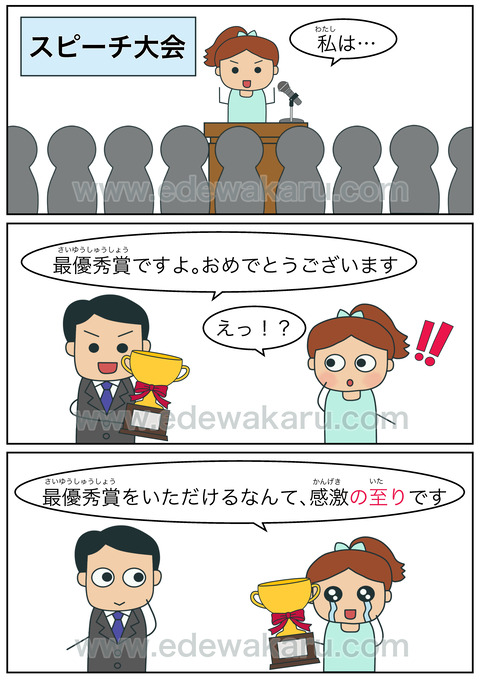
最優秀賞(さいゆうしゅうしょう)をいただけるなんて、感激の至りです
→最優秀賞をいただけて、とても感激していますTo think I would receive the grand prize—it is the greatest honor! →I’m so moved to have received the grand prize.
チームのリーダーにならせていただき、光栄の至りです
→リーダーにならせていただき、とても光栄ですI am deeply honored to have been made team leader. →I am very honored to have been made leader.
部下:昨日は飲みすぎてしまい赤面の至りです…上司:まあ、たまにはいいんじゃないか?
→昨日は飲みすぎてしまい、とても恥ずかしく思っています…Subordinate: I drank too much yesterday; I’m mortified… Boss: Well, I suppose it’s okay once in a while. →I drank too much yesterday, and I feel terribly embarrassed…
何から何までお世話になり、恐縮の至りです
→何から何までお世話になり、本当にありがとうございましたI am deeply humbled by all the help you have given me. →Thank you very much for all the help you have given me.
このようなミスをしてしまい、汗顔の至りです
→このようなミスをしてしまい、とても恥ずかしいですI am deeply ashamed to have made such a mistake. →I’m very embarrassed to have made such a mistake.
Read the original source text
Meaning
非常に〜だ
How to use it
名詞[辞書形]+の至り
Explanation
「Aの至り」は「非常にAだ」という意味で、「最高の状態だ」ということを強調する文型です。「A」には決まった名詞に使われます。とてもかたい言い方で、多くの場合は改まった場面で使用されます。
【余裕のある人へ】
「若気の至り(わかげのいたり)」は「若かったので、いいことと悪いことの判断ができなかった」「若さのせいで悪いことをしてしまった」と言いたい時に使われる慣用表現(かんようひょうげん)です。
[例]
学生の頃は
若気の至り
で、ケンカばかりしていた
若気の至り
とはいえ、あの時は大変失礼なことを言ってしまい申し訳ありませんでした
「至る」がつく文型の復習をしておきましょう😊
【「至る」がつく文型】
くらべてわかる日本語表現文型辞典
Meaning
Meaning 1: An emphatic expression of a feeling that A could not be greater.
Meaning 2: A is the cause of something leading to a particular event.
How to use it
A no itari
[Noun - ∅] no itari
Notes
【Note 1】
・This is an idiomatic expression.
【Note 2】
・It is used only as a set phrase, so the examples of usage are limited.
In context 8 examples
日本代表に選ばれたことは、光栄の至りです。
Being chosen to represent Japan is the greatest honor.
社長に直々にお会いできて、感激の至りです。
I am profoundly moved to have the opportunity to meet the president in person.
社内での横領事件が発覚し、まさに汗顔の至りです。
The embezzlement case within the company came to light; I am truly mortified.
私のような者にお褒めのことばをいただき、恐縮の至りでございます。
I am deeply humbled to receive words of praise from someone like me.
あの頃は若気の至りで、お恥ずかしいことも多々ありました。
Back then I was young and foolish, and there were many things I am embarrassed about.
部員が大量にやめたのは、指導者である私の不徳の至りです。
The fact that so many club members quit is entirely due to my shortcomings as their leader.
管理する立場にいながら、その規則を誤解していたことは誠に不明の至りでございます。
It was truly foolish of me to misunderstand that rule despite being in a position of responsibility.
解雇を上司のせいにするのは短慮の至りだ。
Blaming my superior for my dismissal is the height of rashness.
Read the original source text
Meaning
意味1:これ以上ないくらいAであるという感情の強調表現。
意味2:Aを原因として、ある出来事にまで結びつく。
How to use it
Aの至り
[名詞-∅]の至り
Notes
【注意1】
・慣用的表現である。
【注意2】
・決まり文句としてしか使われないので、用例は限られる。
日本語NET JLPT文法解説まとめ
Meaning
“The ultimate ~.”
Expresses that something is of an extremely high degree and has reached the highest state.
How to use it
N + の至り
Explanation
“Extremely”
Indicates a very high degree, leaving nothing more to be desired.
This is a quite formal expression, used on formal occasions.
In context 4 examples
このようなトラブルが起こったのは、全て私の不徳の至りです。申し訳ございませんでした。
It is entirely due to my own shortcomings that this kind of trouble occurred. I sincerely apologize.
トムさんは学生の頃、若気の至りでよく喧嘩をしたり、悪いことをして両親を困らせていた。
When Tom was a student, he often got into fights and caused trouble for his parents by doing bad things in a fit of youthful folly.
憧れのアーティストからサインをもらえるなんで、感激の至りだ。
To be able to get an autograph from the artist I admire—it's the height of excitement.
私のようなものが、このような賞をいただけるなんて、光栄の至りでございます。
For someone like me to receive such an award is the greatest honor.
Read the original source text
Meaning
最高に〜だ。
程度が極めて高く、最高の状態に達していることを表す。
How to use it
Nの + 至り
Explanation
“extremely”
Indicates a very high degree, leaving nothing more to be desired.
かなり硬い表現。改まった場面で使われる。
毎日のんびり日本語教師
Meaning
Supreme
Unparalleled
Extremely
How to use it
Noun + の至りだ
Explanation
This pattern intensifies emotions with certain words such as 光栄の至り (the greatest honor), 感激の至り (deeply moved), and 幸甚 (most grateful).
「若気の至り」 is a set expression describing immature actions or mistakes made by a passionate, high-spirited young person.
Notes
Related grammar: 「【N1 Grammar】~の極み(きわみ)」
The 「至る」 series
In context 7 examples
このような式典に参加でき、光栄の至りです。
It is the greatest honor to be able to attend a ceremony like this.
皆様のご声援に感激の至りでございます。
I am deeply moved by all your support.
少しでもお役に立てば幸甚の至りです。(能够稍微有点帮助真是荣幸之至。)
It would be the greatest pleasure if I could be of even a little help. (It would be an honor to be of even a little help.)
限られた時間でしたが大変貴重なお話しを伺え、その場にいられましたことが光栄の至りでした。
Although our time was limited, I was able to hear a very valuable talk, and it was the greatest honor to be there.
多くの方に応援して頂いて感謝の至りです。
I am immensely grateful to have received support from so many people.
褒めていただき恐縮の至りです。
I am deeply humbled that you praised me.
学生時代はよく若気の至りで悪いことばかりした。
When I was a student, I often did bad things in the heat of youthful exuberance.
Read the original source text
Meaning
无上
无比
非常
How to use it
名詞+の至りだ
Explanation
光栄の至り、感激の至り、幸甚など、一部の語について感情を強調する文型です。
「若気の至り」は血気盛んな若者がする稚拙な行為、失敗を表す慣用表現です。
Notes
関連文法「【N1文法】~の極み(きわみ)」
「至る」シリーズ