日本語文型辞典
Meaning
Means “there is no need to do so” or “it is not worth doing so.” It is also said as 「…にはあたらない」.
Used to decline an offer from someone by saying “you needn’t go to that much trouble.” It acknowledges the other person’s thoughtfulness and is more polite than 「その必要はありません」.
How to use it
…にはおよばない
Nにはおよばない
V-るにはおよばない
それにはおよばない
In context 5 examples
検査では何も異常は見つかりませんでした。すっかり元気になりましたから、ご心配には及びません。
The examination found nothing abnormal. I’ve fully recovered, so there’s no need to worry.
分かりきったことだから、わざわざ説明するには及ばない。
It’s obvious, so there’s no need to go out of your way to explain it.
こんな遠くまで、はるばるお越しいただくには及びません。
You needn’t come all this way from so far away.
A:車で家までお送りしましょう。
B:いいえ、それには及びません。歩いても5分ほどの所ですから、どうぞご心配なく。A: Shall I drive you home? B: No, there’s no need for that. It’s only about a five-minute walk, so please don’t worry.
A:空港までお迎えにあがりますよ。
B:大丈夫です。よく知っている所ですから、それには及びませんよ。A: I’ll come meet you at the airport. B: It’s all right. I know the place well, so there’s no need for that.
Read the original source text
Meaning
「そうするほどのことはない」「その必要はない」という意味を表す。「…にはあたらない」とも言う。
相手の申し出に対して「そこまでしてくれなくても大丈夫」と断わる場合に用いる。相手の気配りを認める含みがあり、「その必要はありません」よりも丁寧な言い方。
How to use it
…にはおよばない
Nにはおよばない
V-るにはおよばない
それにはおよばない
日本語文型辞典 英語版
Meaning
Expresses the meaning of “it is not necessary to do something” or “there is no need to do something.” Can be rephrased as ...にはあたらない.
B:いいえ、それには及びません。歩いても5分ほどの所ですから、どうぞご心配なく。
No, please don’t bother. It takes me only five minutes or so on foot, so don’t worry.
B:大丈夫です。よく知っている所ですから、それには及びませんよ。
I’ll be fine. I know the place well, so please don’t bother.
Used to decline an offer made by the listener and means “you don’t need to go to such an extent.” Implies the speaker’s acknowledgement of the listener’s consideration, and sounds more formal than その必要はありません.
How to use it
1. ...にはおよばない[Nにはおよばない][V-るにはおよばない]
2. それにはおよばない
In context 5 examples
検査では何も異常は見つかりませんでした。すっかり元気になりましたから、ご心配には及びません。
Nothing abnormal was found in the examination. I’m completely recovered, so you don’t need to worry.
分かりきったことだから、わざわざ説明するには及ばない。
This is an obvious matter, so you don’t need to explain.
こんな遠くまで、はるばるお越しいただくには及びません。
Please do not bother to come all the way to such a distant place.
A:車で家までお送りしましょう。
Let me drive you home.
A:空港までお迎えにあがりますよ。
I’ll pick you up at the airport.
Read the original source text
Meaning
Expresses the meaning of “it is not necessary to do something” or “there is no need to do something.” Can be rephrased as ...にはあたらない.
B:いいえ、それには及びません。歩いても5分ほどの所ですから、どうぞご心配なく。
No, please don’t bother. It takes me only five minutes or so on foot, so don’t worry.
B:大丈夫です。よく知っている所ですから、それには及びませんよ。
I’ll be fine. I know the place well, so please don’t bother.
Used to decline an offer made by the listener and means “you don’t need to go to such an extent.” Implies the speaker’s acknowledgement of the listener’s consideration, and sounds more formal than その必要はありません.
How to use it
1. ...にはおよばない[Nにはおよばない][V-るにはおよばない]
2. それにはおよばない
くらべてわかる日本語表現文型辞典
Meaning
Meaning 1: There is no need to go so far as A.
Meaning 2: It is below the level of A. It does not reach A.
Meaning 3: In the form “Aもおよばない.” One cannot do A at all to that extent.
How to use it
Aにはおよばない (Aにもおよばない / Aもおよばない)
Connection 1, 2:
[Verb – dictionary form] にはおよばない
[Noun – ∅] にはおよばない
Connection 3:
[Noun – ∅] もおよばない
Explanation
【Contrast 1】
“Aにあたらない” (Meaning 1, p. 211)
“Aにあたらない” means there is no need to do A because it has little value, whereas “Aにはおよばない” means there is no need to go so far as A.
○この作品は評価するにあたらないひどい出来だ。 — This work is so poorly made that it is not worth evaluating.
×この作品は評価するにはおよばないひどい出来だ。 — This work is so poorly made that it does not warrant evaluation.
○大丈夫です。ご心配にはおよびません。 — It’s all right. There is no need to worry.
×大丈夫です。ご心配にはあたりません。 — It’s all right. There is no cause for concern.
“AはもちろんBもC” (Meaning 1, p. 285)
【Contrast 2】
“Aほどでもない”
Substitution is possible if A is something with a range, but not when A is a fixed level or numerical value.
○今年も1位にはおよばなかった。 — We didn’t reach first place this year either.
×今年も1位ほどでもなかった。 — We weren’t even at the level of first place this year either.
【Contrast 3】
“Aもつかない”
The meaning is the same, but it appears in many idiomatic expressions, such as “cannot imagine/think/come up with A.”
Notes
【Note 1】
・“Aは言うにおよばずB” is an idiomatic expression meaning that A goes without saying, but B as well.
【Note 2】
・Emphatic words such as 遠く or 到底 may be included, as in “Aには遠くおよばない” or “Aには到底およばない.”
・“Aの足元にもおよばない” means being at a level far below A.
○私など、あなたの足元にもおよびません。 — Someone like me is nowhere near your level.
In context 12 examples
面接では丁寧な言葉であれば、無理に敬語を使うにはおよばない。
As long as you use polite language in an interview, there is no need to force yourself to use honorific language.
この症状は単なる風邪です。ご心配にはおよびませんよ。
These symptoms are just a common cold. There’s no need to worry.
電話で返事をください。わざわざ来るにはおよびません。
Please reply by phone. There’s no need to go out of your way to come here.
こちらこそお世話になっているんです。礼にはおよびません。
We are the ones who have been indebted to you. There’s no need to thank us.
インドカレーが辛いといっても、タイ料理にはおよびませんよ。
Indian curry may be spicy, but it’s nothing compared with Thai food.
工場の機械を昼夜フル回転で生産したが、予定量にはおよばなかった。
We ran the factory machines at full capacity day and night to produce goods, but we still fell short of the planned quantity.
今年の新車モデルは若者を満足させるにはおよばないものが多い。
Many of this year’s new car models fall short of satisfying young people.
我がチームは優勝するにはおよばなかったが、全力は尽くした。
Our team fell short of winning the championship, but we gave it our all.
宇宙空間はわれわれの想像もおよばない世界だろう。
Outer space is probably a world beyond our imagination.
犯人は普通の人なら考えもおよばない方法で、金塊を盗み出した。
The criminal stole the gold bars using a method that an ordinary person could never imagine.
ネット上には親たちの理解もおよばないひどいサイトがあり、それを子どもたちは利用しているのだ。
There are terrible websites online that parents cannot even begin to understand, and children are using them.
息子が芸能人になるなんて、思いもおよばなかったよ。
I never imagined that my son would become an entertainer.
Read the original source text
Meaning
意味1:Aまでする必要はない。
意味2:Aより下の程度だ。Aには達しない。
意味3:「Aもおよばない」の形で。そこまではまったくAできない。
How to use it
Aにはおよばない(Aにもおよばない/Aもおよばない)
接続1,2:
[動詞-る形]にはおよばない
[名詞-∅]にはおよばない
接続3:
[名詞-∅]もおよばない
Explanation
【対比1】
「Aにあたらない」(意味1 P.211)
「Aにあたらない」は大した価値がないからAする必要はないという意味で、「Aにはおよばない」はAまでする必要はないという意味である。
○この作品は評価するにあたらないひどい出来だ。
×この作品は評価するにはおよばないひどい出来だ。
○大丈夫です。ご心配にはおよびません。
×大丈夫です。ご心配にはあたりません。
「AはもちろんBもC」(意味1 P.285)
【対比2】
「Aほどでもない」
Aが幅のあるものなら置き換え可能だが、決まったレベルや数値の時は置き換えできない。
○今年も1位にはおよばなかった。
×今年も1位ほどでもなかった。
【対比3】
「Aもつかない」
意味は同じだが、想像/考え/思いもつかないなど、慣用表現が多い。
Notes
【注意1】
・「Aは言うにおよばずB」というのは、Aは当然で言わなくてもわかるだろうがBも、という意味の慣用的な表現。
【注意2】
・「Aには遠くおよばない」「Aには到底およばない」のように遠く・到底などの強調の言葉が入る場合もある。
・「Aの足元にもおよばない」は、Aよりずっと下の程度だという意味。
○私など、あなたの足元にもおよびません。
絵でわかる日本語
Usage 1
Read this source entry ↗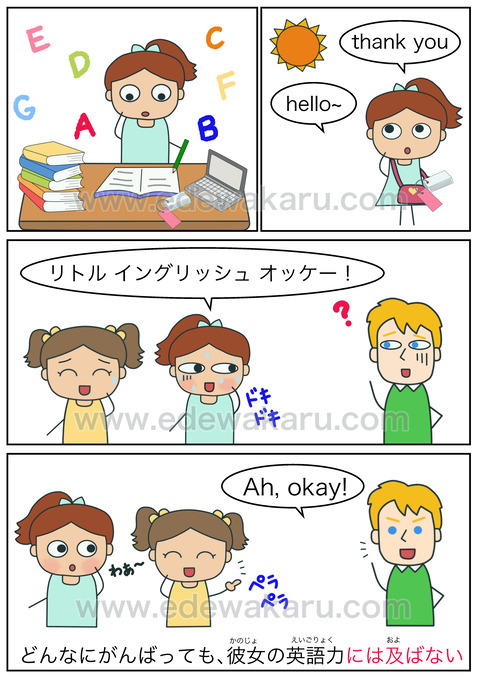
Meaning
Cannot match 〜
How to use it
Noun [dictionary form] + には及ばない
Explanation
“Aには及ばない” means “cannot match A.” In the form “BはAには及ばない,” it is used to say that “A is so impressive that B is not at a level where it can beat A.” The “は” in “〜には及ばない” can be omitted.
[Examples]
① No matter how hard I try, I can’t match her English ability.
[A] Her English ability
[B] My English ability
→No matter how hard I try, I can’t match her English ability.
② Her cooking is very delicious, though it doesn’t match the taste of an upscale restaurant.
[A] An upscale restaurant
[B] Her cooking
→Although her cooking isn’t at the level of an upscale restaurant, it’s very delicious.
③ A: He’s really good at tennis, isn’t he!
B: Yeah. No matter how much I practice, I can’t match him…
[A] Him
[B] Me
→No matter how much I practice, I can’t beat him.
④ When it comes to saving money, no one can match Yamada.
[A] Yamada
[B] Everyone, or anyone other than Yamada
→No one can beat Yamada.
⑤ As for computer knowledge, I can’t compare with him at all.
[A] Him
[B] Me
→He knows a lot about computers, and I can’t match him at all.
“〜には及ばない” also has a use meaning “there is no need to 〜,” so let’s learn that as well 😉
In context 5 examples
どんなにがんばっても、彼女の英語力には及ばない
No matter how hard I try, I can’t match her English ability.
高級レストランの味には及ばないが、彼女の料理はすごくおいしい
Her cooking is very delicious, though it doesn’t match the taste of an upscale restaurant.
A:彼は、すごくテニスが上手いよね!B:うん。どんなに練習しても彼には及ばないんだ…
A: He’s really good at tennis, isn’t he! B: Yeah. No matter how much I practice, I can’t match him…
お金を貯めることに関して言えば、誰も山田くんには及ばない
When it comes to saving money, no one can match Yamada.
パソコンの知識については、まったく彼には及ばない
As for computer knowledge, I can’t compare with him at all.
Read the original source text
Meaning
〜には勝てない
How to use it
名詞[辞書形]+には及ばない
Explanation
「Aには及ばない」は「Aには勝てない」という意味の文型です。「BはAには及ばない」の形で「Aはとてもすごくて、BはAに勝てるレベルではない」と言いたい時に使われます。「〜には及ばない」の「は」は省略することができます。
[例]
①どんなにがんばっても、彼女の英語力
には及ばない
【A】彼女の英語力
【B】私の英語力
→どんなにがんばっても、彼女の英語力には勝てない
②高級レストランの味
には及ばない
が、彼女の料理はすごくおいしい
【A】高級レストラン
【B】彼女の料理
→高級レストランの味に勝てるレベルではないが、彼女の料理はすごくおいしい
③A:彼は、すごくテニスが上手いよね!
B:うん。どんなに練習しても彼
には及ばない
んだ…
【A】彼
【B】私
→どんなにれんしゅうしても彼には勝てない
④お金を貯めることに関して言えば、誰も山田くん
には及ばない
【A】山田くん
【B】みんな・山田くん以外の人たち
→誰も山田くんには勝てない
⑤パソコンの知識については、まったく彼には及ばない
【A】彼
【B】私
→彼はパソコンのことをすごくよく知っていて、まったく勝てない
「〜には及ばない」には「〜する必要がない」という意味の用法もありますので、一緒に覚えておきましょう😉
Usage 2
Read this source entry ↗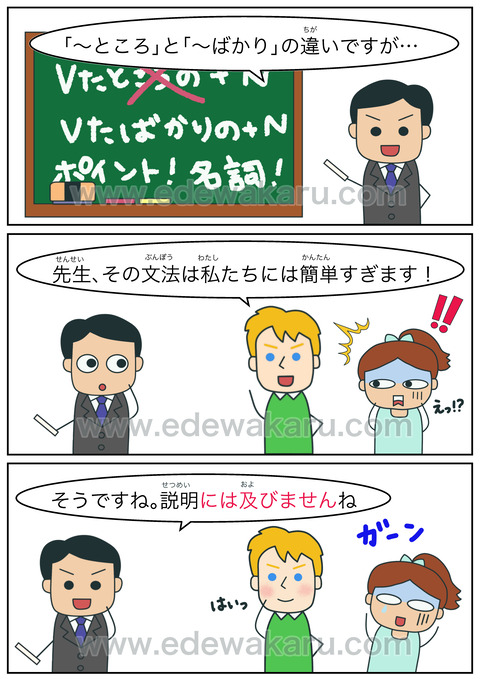
Meaning
There is no need to 〜
There is no need for 〜
How to use it
Verb [dictionary form] + には及ばない
Noun [dictionary form] + には及ばない
Explanation
“〜には及ばない” is a pattern meaning “there is no need to 〜” or “there is no need for 〜.” It is used to tell someone, in response to their concern or offer, “There’s no need to do that” or “It’s not that serious.” “それには及ばない” is used to politely decline by saying, “You don’t need to go that far.”
[Example]
A: I’ll walk you to the station.
B: No, it’s only about a five-minute walk, so there’s no need.
“〜には及ばない” also means “cannot match 〜.” There is also a similar pattern, “〜にはあたらない,” so let’s review them 😊
In context 5 examples
この文法は簡単ですので、説明には及びませんね
→説明する必要はありませんねThis grammar is easy, so there’s no need to explain it. →There’s no need to explain it.
A:昨日会社を休んだそうですね。大丈夫ですか?B:ちょっとかぜをひいただけですので、心配には及びません
→かぜをひいただけですので、心配する必要はありませんよA: I heard you took the day off work yesterday. Are you okay? B: I just caught a little cold, so there’s no need to worry. →I just caught a cold, so there’s no need to worry.
A:駅までお送りしますよB:いいえ、歩いて行けますので、ご心配には及びません
→歩いていけますので、心配いりませんよA: I’ll walk you to the station. B: No, I can walk there, so there’s no need to worry. →I can walk there, so there’s no need to worry.
結果はお電話でお知らせしますので、来ていただくには及びません
→来ていただく必要はありませんWe’ll let you know the result by phone, so there’s no need for you to come. →There’s no need for you to come.
A:今日はありがとうございました。お礼に何かごちそうさせてくださいB:お礼には及びません。当然のことをしたまでですので…
→お礼の必要はありませんA: Thank you for today. Please let me treat you to something as a thank-you. B: There’s no need to thank me. I only did what anyone would do… →There’s no need to thank me.
Read the original source text
Meaning
〜する必要はない
〜の必要はない
How to use it
動詞[辞書形]+には及ばない
名詞[辞書形]+には及ばない
Explanation
「〜には及ばない」は「〜する必要はない」「〜の必要はない」という意味の文型です。相手の気持ちに対して「〜する必要はありませんよ」「〜するほどのことではありませんよ」と言いたい時に使われます。「それには及ばない」は、「そこまでしなくても大丈夫ですよ」と丁寧に断る場合に使われます。
[例]
A:駅までお送りしますよ
B:いいえ、歩いて5分くらいですので、
それには及びません
「〜には及ばない」には「〜には勝てない」という意味もあります。また、類似文型(るいじぶんけい)に「〜にはあたらない」がありますので、復習しておきましょう😊
毎日のんびり日本語教師
How to use it
Verb dictionary form + に(は)及ばない
Noun + に(は)及ばない
Explanation
① In the pattern 「AはBに(は)及ばない」, this expresses that B is superior to A.
In this usage, it means the same as 「~には敵わない(かなわない)」.
② In response to another person's feelings or suggestion, this expresses a tactful refusal meaning “there's no need to go out of your way to ~.”
Notes
Similar grammar: 「~には当たらない(あたらない)」
Similar grammar: 「~までもない/までもなく」
In context 7 examples
数学で言えば、私は彼に及ばない。
When it comes to mathematics, I don't measure up to him.
彼の洞察力には到底及ばない。(根本无法达到他的洞察力。)
I cannot compare with his powers of insight. (I simply cannot match his insight.)
コンピューターの知識では、彼に全く及ばない。
When it comes to computer knowledge, I don't come close to him at all.
何年練習しても、彼の才能には及ばないだろう。
No matter how many years I practice, I probably won't match his talent.
私は当然のことをしただけなので、お礼には及びません。
I only did what anyone would do, so there's no need to thank me.
帰り道は分かっていますので、心配には及びません。
I know the way home, so there's no need to worry.
わざわざお迎えに来ていただかなくても結構です。それには及びません。
You don't need to go out of your way to come pick me up. There's no need for that.
Read the original source text
How to use it
動辞形+に(は)及ばない
名詞+に(は)及ばない
Explanation
①「AはBに(は)及ばない」の文型で、AよりもBのほうが優れていることを表します。
このとき「~には敵わない(かなわない)」と同じ意味になります。
②相手の気持ちや提案などに対して、「わざわざ~する必要ない」という婉曲的な拒否を表します。
Notes
似ている文法「~には当たらない(あたらない)」
似ている文法「~までもない/までもなく」
NINJAL 日本語文型データベース
Meaning
It expresses the meaning that there is no need to do something.
それには及ばない is an idiomatic expression.
How to use it
Vるには及ばない
Nには及ばない
In context 6 examples
お互い知っている間柄なので、わざわざ挨拶するには及ばない。
Since we know each other well, there’s no need to go out of our way to exchange greetings.
明日こちらからうかがうので、お越しいただくには及びません。
I’ll come by tomorrow, so there’s no need for you to come here.
本プロジェクトの目的はこれまでも何度も共有してきて、分かり切ったことなので、説明するにはおよびません。
We have shared the purpose of this project many times before, and it is already clear, so there’s no need to explain it.
すっかり元気になりましたので、ご心配には及びません。
I’ve completely recovered, so there’s no need to worry.
「親切にしていただきありがとうございます」「いえいえ、礼には及びません」
“Thank you for your kindness.” “Oh, there’s no need to thank me.”
「車で空港までお送りしますよ」「いえいえ、予約したタクシーが来るので、それにはおよびません」
“I’ll drive you to the airport.” “No, no, there’s no need; the taxi I booked is coming.”
Read the original source text
Meaning
~する必要がないという意味を表します。
それには及ばないは慣用的な言い方です。
How to use it
Vるには及ばない
Nには及ばない