日本語文型辞典
Meaning
Basic information: Nをかぎりに. Attached to time expressions such as 今日 or 今回, it means “with that time as the last.” The time expression often includes the moment of speaking. ④ is an idiomatic expression meaning “as loudly as possible.” Examples: ① Let’s completely forget everything up to now, starting today. ② This store will close permanently after tomorrow, New Year’s Eve. ③ This association will be dissolved after this occasion. ④ Everyone shouted at the top of their voices, but no reply came.
Read the original source text
Meaning
基本情報Nをかぎりに説明「今日」「今回」など時を表す語に付いて、「その時を最後にして」という意味を表す。発講時を含む時を表す語が使われることが多い。④は慣用的な言い方で「できるだけ大きな声を出して」の意味。例文① 今日をかぎりに今までのことはきれいさっぱり忘れよう。② 明日の大晦日をかぎりにこの店は閉店する。③ この会は今回をかぎりに解散することとなりました。④ みんなは声を限りに叫んだが、何の返事も返ってこなかった。
日本語文型辞典 英語版
Meaning
【をかぎりに】[Nをかぎりに]
Attaches to words demonstrating time, such as “today” and “this time,” and means “with that time as the last.” Often used with words which include the time of the utterance. Example
(4)
is an idiomatic expression meaning “at the top of one’s voice.”
In context 4 examples
今日をかぎりに今までのことはきれいさっぱり忘れよう。
As of today, let’s forget everything that has happened until now.
明日の大晦日をかぎりにこの店は閉店する。
As of tomorrow on New Year’s Eve, this store will close.
この会は今回をかぎりに解散することとなりました。
It is decided that this meeting is dissolved as of now.
みんなは声を限りに叫んだが、何の返事も返ってこなかった。
Everyone shouted at the top of their voices but they got no reply.
IMABI
Limit
Read this IMABI lesson ↗Explanation
Limit: ~限り, ~を限りに, ~限りでは, ~に限って, ~に限らない, & ~とは限らない
限り is a rather complicated noun. Although it means “limit” and understanding it is no problem for most students, similar looking structures with it cause problems.
限り
~かぎり shows up in a lot of expressions, but what comes before it must be taken into account. Although particles may be a pain to get used to, you should still love them.
1. ~かぎり: This shows a parameter of a certain condition. Before ~かぎり, you may see nouns, adjectives, and verbs.
1. 保証ほしょうの限りではない。
It is not in the warranty.
2. 目の届とどく限り、晴れ渡わたっている。
The sky is clear as far as the eye can see.
3. 可能な限り、薬を飲まないようにしています。
I’m trying as best I can to not take the medicine.
4. できる限りのことをするのも無理なのだ。
Doing as much as possible is also no good.
5. 法律ほうりつの及およぶ限り厳密げんみつに処しょすべきだ。
It should be strictly dealt with to the full extent of the law.
6. 今年も能力の限り、お役に立てるよう働くことを誓ちかいます。
I vow to work to be of benefit [to X] to the best of my ability this year as well.
7. 外は豪雪ごうせつでも、部屋のなかにいるかぎりは真夏日まなつびのようだ。
Even if there is heavy snowfall outside, for as long as you’re inside the room, it’s like a hot summer day.
読み物: A Passage from 心 by 夏目漱石
8. 次の日私は先生の後あとにつづいて海へ飛び込こんだ。そうして先生といっしょの方角ほうがくに泳いで行った。二丁ちょうほど沖おきへ出ると、先生は後ろを振ふり返って私に話し掛かけた。広い蒼あおい海の表面に浮ういているものは、その近所に私ら二人より外ほかになかった。そうして強い太陽の光が、眼めの届く限り水と山とを照らしていた。私は自由と歓喜かんきに充みちた筋肉を動かして海の中で躍おどり狂くるった。先生はまたぱたりと手足の運動を已やめて仰向あおむけになったまま浪なみの上に寝た。私もその真似まねをした。青空の色がぎらぎらと眼を射いるように痛烈つうれつな色を私の顔に投なげ付つけた。「愉快ゆかいですね」と私は大きな声を出した。
漢字 Notes:
1. 蒼い is a very literary spelling for blue. And, you may also encounter 碧い in similar contexts. 蒼い is a rather dull “blue”, and it is often used in contexts where one “is blue in the face”. 碧い is used when “blue” may have anywhere from a light to dark green hue to it.
2. ~掛ける is usually spelled as ~かける in everyday writing.
3. Rather than using 満ちる, 充ちる has the added nuance of inundation. 満ちる is over all the most important spelling due to the fact that 充 does not have the reading み(ちる) listed in the 常用漢字表.
4. 躍る differs from 踊る in the sense that the latter is “dance” in a rhythmic sense whereas the former is just jumping up and down.
5. 已む specifically describes a phenomenon, action, or condition that has continued for some time stopping completely. It is generally replaced with 止む except in literal situations like this when the writer wishes to make this nuance clear.
6. 浪 specifically refers to ripples in water or water rising up.
The next day, I followed Sensei into the ocean. I then swam in the same direction as him. After going over a hundred meters offshore, Sensei turned around to talk to me. It was only us floating atop the surface of the wide, blue sea. The strong sunlight made the water and mountains glow for as far as one could see. I madly danced around in the waves with my muscles full of joy and freedom. Sensei, again, suddenly froze his arms and legs and lay flat on his back asleep on the waves, and so I mimicked him. The blue sky cast a scathing light into my eyes as if to pierce them out. “How pleasant!”, I yelled out.
Questions:
1. Find an example where a Japanese item is naturalized for the English translation.
2. Why might liberties in translation be needed with this passage?
~ない限り, which is an application of above, can be translated as “until” in contexts like below.
9. 君が考えを改あらためないかぎり、うまくいかない。
Until you rethink yourself, things won’t go well.
10. あいつは、あまりにも疲れていないかぎり、夜遅くまでIMABIを編集へんしゅうするそうだ。
That guy seems to edit IMABI up into the night unless he’s too tired.
11. 汚水おすいを飲まないかぎり大丈夫ですよ。
So long as you don’t drink filthy water, you should be fine.
After adjectives at the end of a sentence, ~かぎりだ shows the speaker’s emotions with what is being said not being simply about the nature of things, but the matter at hand doesn’t extend beyond a certain limit.
12. 誰からも連絡がなく、寂さびしいかぎりだ。
It’s just very lonely that I don’t get contact from anyone.
Another thing that this form can do that the two below cannot is be followed with a volitional expression.
13. 生きている限り歌おう。
I’ll sing until I die.
As a suffix after temporal phrases in the form of ~かぎりで, it express deadline.
14. 来月末限りで辞任するつもりだ。
I plan to resign at the end of next month.
2. ~を限りに, when used with time phrases, explicitly states when will be the last time that one does something. With non-temporal phrases, it shows some sort of physical limitation.
15. 彼は声の限りに叫さけんだ。
He screamed to the top of list lungs.
16. 今日を限りに酒は飲みません。
I will not drink alcohol from this day forward!
17. これを限りにお前とは縁えんを切る。
From here on I break my ties with you.
18. 今年の年末を限りに期限が切れる。
The term/period/deadline will expire at the end of this year.
3. ~限りでは: Verbs of cognition such as 知る, 見る, 聞く, 読む, etc. come before, and the following clause deals with a judgment. In totality, this construction means “as far as…”.
19. 知られる限りでは依然行方不明いぜんゆくえふめい。 (Headline)
[X] is/are still missing as far as is known.
20. 私の知っている限りでは、彼はそんなことをする人ではありません。
As far as I know, he is not the kind of person to do something like that.
4. ~に限って: This raises a time, person, or thing to mean “insofar/unless”. This is used a lot with とき.
21. あたしが出かけるときにかぎって、雨が降るのよ。(女性語)
It doesn’t rain unless I go out [somewhere].
22. 我わが社しゃの社員に限って、そのような不正はするはずがない。
Insofar as our company’s workers, we have no reason to do such illegality.
23. 読みたいときに限って、アクセスできない。
I can’t access it insofar as to when I want to read it.
As one would expect, this phrase has a negative form, ~に限らない. This means that something is not yet decided. Of course, in formal/written situations, you can see it as ~に限らず.
24. 怠なまけたがるのは、子供に限ったことじゃない。
Wanting to slack off is not limited to just kids.
25. 対象はアメリカ人に限りません。
Our target is not limited to Americans.
26. 韓国語を勉強している学生は、東アジア専攻に限りません。
Students who study Korean are not limited to East Asian majors.
5. ~とは限らない may resemble ~に限らない, and the best of students mix them up. However, because of the particle と, no part of speech limitations exists. ~とは限らない means “not necessarily”. This phrase is frequently used to speak against stereotypes.
27. 日本人がみんな勉強ばかりしているとは限らない。
It’s not necessarily the case that all Japanese people do nothing but study.
28. アメリカ人は、必ずしも日本人より背が高いとは限らない。
Americans are not necessarily taller than Japanese people.
29. テキサスの人がみんな必ずバーベキューばかり食べるとは限らない。
All Texans don’t necessarily eat just barbecue.
30. 念ねんを入れたからっていい仕上しあがりになるとは限らない。
Because we paid attention to detail, it’s (now) a good finish.
In context 41 examples
~かぎり: This shows a parameter of a certain condition. Before ~かぎり, you may see nouns, adjectives, and verbs.
It is not in the warranty.
保証ほしょうの限りではない。
It is not in the warranty.
目の届とどく限り、晴れ渡わたっている。
The sky is clear as far as the eye can see.
可能な限り、薬を飲まないようにしています。
I’m trying as best I can to not take the medicine.
できる限りのことをするのも無理なのだ。
Doing as much as possible is also no good.
法律ほうりつの及およぶ限り厳密げんみつに処しょすべきだ。
It should be strictly dealt with to the full extent of the law.
今年も能力の限り、お役に立てるよう働くことを誓ちかいます。
I vow to work to be of benefit [to X] to the best of my ability this year as well.
外は豪雪ごうせつでも、部屋のなかにいるかぎりは真夏日まなつびのようだ。
Even if there is heavy snowfall outside, for as long as you’re inside the room, it’s like a hot summer day.
次の日私は先生の後あとにつづいて海へ飛び込こんだ。そうして先生といっしょの方角ほうがくに泳いで行った。二丁ちょうほど沖おきへ出ると、先生は後ろを振ふり返って私に話し掛かけた。広い蒼あおい海の表面に浮ういているものは、その近所に私ら二人より外ほかになかった。そうして強い太陽の光が、眼めの届く限り水と山とを照らしていた。私は自由と歓喜かんきに充みちた筋肉を動かして海の中で躍おどり狂くるった。先生はまたぱたりと手足の運動を已やめて仰向あおむけになったまま浪なみの上に寝た。私もその真似まねをした。青空の色がぎらぎらと眼を射いるように痛烈つうれつな色を私の顔に投なげ付つけた。「愉快ゆかいですね」と私は大きな声を出した。
The next day, I followed behind the teacher and plunged into the sea. Then I swam in the same direction as he did. After we had gone about two chō offshore, the teacher looked back and spoke to me. On the broad, blue surface of the sea, there was no one nearby besides the two of us. The strong sunlight shone on the water and the mountains as far as the eye could see. I moved my muscles, filled with freedom and delight, and leaped about wildly in the sea. The teacher suddenly stopped moving his arms and legs again and lay on his back on the waves. I imitated him. The color of the blue sky was so dazzling and intense that it seemed to shoot painfully into my eyes and onto my face. “It’s delightful, isn’t it?” I called out loudly.
蒼い is a very literary spelling for blue. And, you may also encounter 碧い in similar contexts. 蒼い is a rather dull “blue”, and it is often used in contexts where one “is blue in the face”. 碧い is used when “blue” may have anywhere from a light to dark green hue to it.
The next day, I followed Sensei into the ocean. I then swam in the same direction as him. After going over a hundred meters offshore, Sensei turned around to talk to me. It was only us floating atop the surface of the wide, blue sea. The strong sunlight made the water and mountains glow for as far as one could see. I madly danced around in the waves with my muscles full of joy and freedom. Sensei, again, suddenly froze his arms and legs and lay flat on his back asleep on the waves, and so I mimicked him. The blue sky cast a scathing light into my eyes as if to pierce them out. “How pleasant!”, I yelled out.
~掛ける is usually spelled as ~かける in everyday writing.
The next day, I followed Sensei into the ocean. I then swam in the same direction as him. After going over a hundred meters offshore, Sensei turned around to talk to me. It was only us floating atop the surface of the wide, blue sea. The strong sunlight made the water and mountains glow for as far as one could see. I madly danced around in the waves with my muscles full of joy and freedom. Sensei, again, suddenly froze his arms and legs and lay flat on his back asleep on the waves, and so I mimicked him. The blue sky cast a scathing light into my eyes as if to pierce them out. “How pleasant!”, I yelled out.
Rather than using 満ちる, 充ちる has the added nuance of inundation. 満ちる is over all the most important spelling due to the fact that 充 does not have the reading み(ちる) listed in the 常用漢字表.
The next day, I followed Sensei into the ocean. I then swam in the same direction as him. After going over a hundred meters offshore, Sensei turned around to talk to me. It was only us floating atop the surface of the wide, blue sea. The strong sunlight made the water and mountains glow for as far as one could see. I madly danced around in the waves with my muscles full of joy and freedom. Sensei, again, suddenly froze his arms and legs and lay flat on his back asleep on the waves, and so I mimicked him. The blue sky cast a scathing light into my eyes as if to pierce them out. “How pleasant!”, I yelled out.
躍る differs from 踊る in the sense that the latter is “dance” in a rhythmic sense whereas the former is just jumping up and down.
The next day, I followed Sensei into the ocean. I then swam in the same direction as him. After going over a hundred meters offshore, Sensei turned around to talk to me. It was only us floating atop the surface of the wide, blue sea. The strong sunlight made the water and mountains glow for as far as one could see. I madly danced around in the waves with my muscles full of joy and freedom. Sensei, again, suddenly froze his arms and legs and lay flat on his back asleep on the waves, and so I mimicked him. The blue sky cast a scathing light into my eyes as if to pierce them out. “How pleasant!”, I yelled out.
已む specifically describes a phenomenon, action, or condition that has continued for some time stopping completely. It is generally replaced with 止む except in literal situations like this when the writer wishes to make this nuance clear.
The next day, I followed Sensei into the ocean. I then swam in the same direction as him. After going over a hundred meters offshore, Sensei turned around to talk to me. It was only us floating atop the surface of the wide, blue sea. The strong sunlight made the water and mountains glow for as far as one could see. I madly danced around in the waves with my muscles full of joy and freedom. Sensei, again, suddenly froze his arms and legs and lay flat on his back asleep on the waves, and so I mimicked him. The blue sky cast a scathing light into my eyes as if to pierce them out. “How pleasant!”, I yelled out.
浪 specifically refers to ripples in water or water rising up.
The next day, I followed Sensei into the ocean. I then swam in the same direction as him. After going over a hundred meters offshore, Sensei turned around to talk to me. It was only us floating atop the surface of the wide, blue sea. The strong sunlight made the water and mountains glow for as far as one could see. I madly danced around in the waves with my muscles full of joy and freedom. Sensei, again, suddenly froze his arms and legs and lay flat on his back asleep on the waves, and so I mimicked him. The blue sky cast a scathing light into my eyes as if to pierce them out. “How pleasant!”, I yelled out.
君が考えを改あらためないかぎり、うまくいかない。
Until you rethink yourself, things won’t go well.
あいつは、あまりにも疲れていないかぎり、夜遅くまでIMABIを編集へんしゅうするそうだ。
That guy seems to edit IMABI up into the night unless he’s too tired.
汚水おすいを飲まないかぎり大丈夫ですよ。
So long as you don’t drink filthy water, you should be fine.
誰からも連絡がなく、寂さびしいかぎりだ。
It’s just very lonely that I don’t get contact from anyone.
生きている限り歌おう。
I’ll sing until I die.
来月末限りで辞任するつもりだ。
I plan to resign at the end of next month.
~を限りに, when used with time phrases, explicitly states when will be the last time that one does something. With non-temporal phrases, it shows some sort of physical limitation.
He screamed to the top of list lungs.
彼は声の限りに叫さけんだ。
He screamed to the top of list lungs.
今日を限りに酒は飲みません。
I will not drink alcohol from this day forward!
これを限りにお前とは縁えんを切る。
From here on I break my ties with you.
今年の年末を限りに期限が切れる。
The term/period/deadline will expire at the end of this year.
~限りでは: Verbs of cognition such as 知る, 見る, 聞く, 読む, etc. come before, and the following clause deals with a judgment. In totality, this construction means “as far as…”.
[X] is/are still missing as far as is known.
知られる限りでは依然行方不明いぜんゆくえふめい。 (Headline)
[X] is/are still missing as far as is known.
私の知っている限りでは、彼はそんなことをする人ではありません。
As far as I know, he is not the kind of person to do something like that.
~に限って: This raises a time, person, or thing to mean “insofar/unless”. This is used a lot with とき.
It doesn’t rain unless I go out [somewhere].
あたしが出かけるときにかぎって、雨が降るのよ。(女性語)
It doesn’t rain unless I go out [somewhere].
我わが社しゃの社員に限って、そのような不正はするはずがない。
Insofar as our company’s workers, we have no reason to do such illegality.
読みたいときに限って、アクセスできない。
I can’t access it insofar as to when I want to read it.
怠なまけたがるのは、子供に限ったことじゃない。
Wanting to slack off is not limited to just kids.
対象はアメリカ人に限りません。
Our target is not limited to Americans.
韓国語を勉強している学生は、東アジア専攻に限りません。
Students who study Korean are not limited to East Asian majors.
~とは限らない may resemble ~に限らない, and the best of students mix them up. However, because of the particle と, no part of speech limitations exists. ~とは限らない means “not necessarily”. This phrase is frequently used to speak against stereotypes.
It’s not necessarily the case that all Japanese people do nothing but study.
日本人がみんな勉強ばかりしているとは限らない。
It’s not necessarily the case that all Japanese people do nothing but study.
アメリカ人は、必ずしも日本人より背が高いとは限らない。
Americans are not necessarily taller than Japanese people.
テキサスの人がみんな必ずバーベキューばかり食べるとは限らない。
All Texans don’t necessarily eat just barbecue.
念ねんを入れたからっていい仕上しあがりになるとは限らない。
Because we paid attention to detail, it’s (now) a good finish.
Read the original source text
Explanation
Limit: ~限り, ~を限りに, ~限りでは, ~に限って, ~に限らない, & ~とは限らない
限り is a rather complicated noun. Although it means “limit” and understanding it is no problem for most students, similar looking structures with it cause problems.
限り
~かぎり shows up in a lot of expressions, but what comes before it must be taken into account. Although particles may be a pain to get used to, you should still love them.
1. ~かぎり: This shows a parameter of a certain condition. Before ~かぎり, you may see nouns, adjectives, and verbs.
1. 保証ほしょうの限りではない。
It is not in the warranty.
2. 目の届とどく限り、晴れ渡わたっている。
The sky is clear as far as the eye can see.
3. 可能な限り、薬を飲まないようにしています。
I’m trying as best I can to not take the medicine.
4. できる限りのことをするのも無理なのだ。
Doing as much as possible is also no good.
5. 法律ほうりつの及およぶ限り厳密げんみつに処しょすべきだ。
It should be strictly dealt with to the full extent of the law.
6. 今年も能力の限り、お役に立てるよう働くことを誓ちかいます。
I vow to work to be of benefit [to X] to the best of my ability this year as well.
7. 外は豪雪ごうせつでも、部屋のなかにいるかぎりは真夏日まなつびのようだ。
Even if there is heavy snowfall outside, for as long as you’re inside the room, it’s like a hot summer day.
読み物: A Passage from 心 by 夏目漱石
8. 次の日私は先生の後あとにつづいて海へ飛び込こんだ。そうして先生といっしょの方角ほうがくに泳いで行った。二丁ちょうほど沖おきへ出ると、先生は後ろを振ふり返って私に話し掛かけた。広い蒼あおい海の表面に浮ういているものは、その近所に私ら二人より外ほかになかった。そうして強い太陽の光が、眼めの届く限り水と山とを照らしていた。私は自由と歓喜かんきに充みちた筋肉を動かして海の中で躍おどり狂くるった。先生はまたぱたりと手足の運動を已やめて仰向あおむけになったまま浪なみの上に寝た。私もその真似まねをした。青空の色がぎらぎらと眼を射いるように痛烈つうれつな色を私の顔に投なげ付つけた。「愉快ゆかいですね」と私は大きな声を出した。
漢字 Notes:
1. 蒼い is a very literary spelling for blue. And, you may also encounter 碧い in similar contexts. 蒼い is a rather dull “blue”, and it is often used in contexts where one “is blue in the face”. 碧い is used when “blue” may have anywhere from a light to dark green hue to it.
2. ~掛ける is usually spelled as ~かける in everyday writing.
3. Rather than using 満ちる, 充ちる has the added nuance of inundation. 満ちる is over all the most important spelling due to the fact that 充 does not have the reading み(ちる) listed in the 常用漢字表.
4. 躍る differs from 踊る in the sense that the latter is “dance” in a rhythmic sense whereas the former is just jumping up and down.
5. 已む specifically describes a phenomenon, action, or condition that has continued for some time stopping completely. It is generally replaced with 止む except in literal situations like this when the writer wishes to make this nuance clear.
6. 浪 specifically refers to ripples in water or water rising up.
The next day, I followed Sensei into the ocean. I then swam in the same direction as him. After going over a hundred meters offshore, Sensei turned around to talk to me. It was only us floating atop the surface of the wide, blue sea. The strong sunlight made the water and mountains glow for as far as one could see. I madly danced around in the waves with my muscles full of joy and freedom. Sensei, again, suddenly froze his arms and legs and lay flat on his back asleep on the waves, and so I mimicked him. The blue sky cast a scathing light into my eyes as if to pierce them out. “How pleasant!”, I yelled out.
Questions:
1. Find an example where a Japanese item is naturalized for the English translation.
2. Why might liberties in translation be needed with this passage?
~ない限り, which is an application of above, can be translated as “until” in contexts like below.
9. 君が考えを改あらためないかぎり、うまくいかない。
Until you rethink yourself, things won’t go well.
10. あいつは、あまりにも疲れていないかぎり、夜遅くまでIMABIを編集へんしゅうするそうだ。
That guy seems to edit IMABI up into the night unless he’s too tired.
11. 汚水おすいを飲まないかぎり大丈夫ですよ。
So long as you don’t drink filthy water, you should be fine.
After adjectives at the end of a sentence, ~かぎりだ shows the speaker’s emotions with what is being said not being simply about the nature of things, but the matter at hand doesn’t extend beyond a certain limit.
12. 誰からも連絡がなく、寂さびしいかぎりだ。
It’s just very lonely that I don’t get contact from anyone.
Another thing that this form can do that the two below cannot is be followed with a volitional expression.
13. 生きている限り歌おう。
I’ll sing until I die.
As a suffix after temporal phrases in the form of ~かぎりで, it express deadline.
14. 来月末限りで辞任するつもりだ。
I plan to resign at the end of next month.
2. ~を限りに, when used with time phrases, explicitly states when will be the last time that one does something. With non-temporal phrases, it shows some sort of physical limitation.
15. 彼は声の限りに叫さけんだ。
He screamed to the top of list lungs.
16. 今日を限りに酒は飲みません。
I will not drink alcohol from this day forward!
17. これを限りにお前とは縁えんを切る。
From here on I break my ties with you.
18. 今年の年末を限りに期限が切れる。
The term/period/deadline will expire at the end of this year.
3. ~限りでは: Verbs of cognition such as 知る, 見る, 聞く, 読む, etc. come before, and the following clause deals with a judgment. In totality, this construction means “as far as…”.
19. 知られる限りでは依然行方不明いぜんゆくえふめい。 (Headline)
[X] is/are still missing as far as is known.
20. 私の知っている限りでは、彼はそんなことをする人ではありません。
As far as I know, he is not the kind of person to do something like that.
4. ~に限って: This raises a time, person, or thing to mean “insofar/unless”. This is used a lot with とき.
21. あたしが出かけるときにかぎって、雨が降るのよ。(女性語)
It doesn’t rain unless I go out [somewhere].
22. 我わが社しゃの社員に限って、そのような不正はするはずがない。
Insofar as our company’s workers, we have no reason to do such illegality.
23. 読みたいときに限って、アクセスできない。
I can’t access it insofar as to when I want to read it.
As one would expect, this phrase has a negative form, ~に限らない. This means that something is not yet decided. Of course, in formal/written situations, you can see it as ~に限らず.
24. 怠なまけたがるのは、子供に限ったことじゃない。
Wanting to slack off is not limited to just kids.
25. 対象はアメリカ人に限りません。
Our target is not limited to Americans.
26. 韓国語を勉強している学生は、東アジア専攻に限りません。
Students who study Korean are not limited to East Asian majors.
5. ~とは限らない may resemble ~に限らない, and the best of students mix them up. However, because of the particle と, no part of speech limitations exists. ~とは限らない means “not necessarily”. This phrase is frequently used to speak against stereotypes.
27. 日本人がみんな勉強ばかりしているとは限らない。
It’s not necessarily the case that all Japanese people do nothing but study.
28. アメリカ人は、必ずしも日本人より背が高いとは限らない。
Americans are not necessarily taller than Japanese people.
29. テキサスの人がみんな必ずバーベキューばかり食べるとは限らない。
All Texans don’t necessarily eat just barbecue.
30. 念ねんを入れたからっていい仕上しあがりになるとは限らない。
Because we paid attention to detail, it’s (now) a good finish.
どんなときどう使う 日本語表現文型辞典
Meaning
the last time
How to use it
N + を限りに
Explanation
~を最後として
今まで続いていたことが今後はもう続かなくなるということを言うときに、その最後の期限を表す。
Final time period when something that has continued until now will no longer happen.
In context 3 examples
今日を限りに禁煙することにしました。
I’ve decided to quit smoking starting today.
今回の取引を限りに、今後A社とはいっさい取引しない。
With this transaction, we will cease all dealings with Company A from now on.
今年度を限りに土曜日の業務は行わないことになりました。
It has been decided that Saturday operations will end after this fiscal year.
Read the original source text
Meaning
the last time
How to use it
N+を限りに
Explanation
~を最後として
今まで続いていたことが今後はもう続かなくなるということを言うときに、その最後の期限を表す。
Final time period when something that has continued until now will no longer happen.
絵でわかる日本語
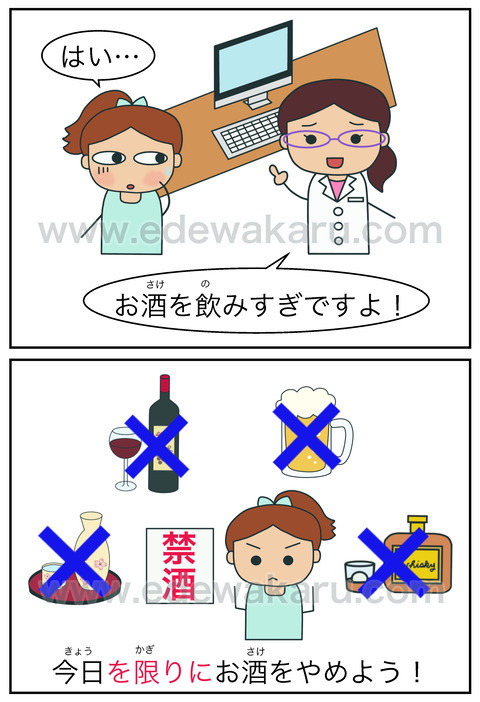
Meaning
with that time as the last occasion, ~
stop doing ~ after that
How to use it
Noun [dictionary form] +を限りに
Explanation
「〜を限りに」 is a sentence pattern meaning “with ~ as the last occasion” or “stop doing ~ after ~.” It is used with nouns indicating time, such as 「今日」「今回」「今月」, when you want to say “with that time as the last occasion” or “stop doing ~ after that” 😊
(Review: 〜など・〜なんか・〜なんて)
【For people taking N1】
「〜を限りに」 also means “to the limit of ~” 😮 「声を限りに〜」 comes from this pattern, but it is an idiomatic expression, so be sure to learn it separately 😉
「声を限りに(こえをかぎりに)」
[Meaning]
with the loudest voice one can produce / as loudly as possible
[Example]
I shouted at the top of my voice.
There are many patterns in the 「限る」 series too, so be sure to distinguish and learn them 😀
【The 「限る」 series】
〜限り(限界)
〜限り
〜限りだ
〜限りで・N限りのN(限定)
〜限りでは(範囲)
限りなく〜に近い
〜とは限らない
〜ない限り
〜に限ったことではない
〜に限らず(〜も)
〜に限る
〜を限りに
In context 4 examples
今日を限りにお酒はやめよう!
→今日を最後にお酒をやめよう!I’m going to quit drinking starting today! →I’m going to quit drinking, with today as the last day!
あのデパートは今回のセールを限りに閉店するんだって
→あのデパートは今回のセールを最後に閉店するんだって(復習:口語形「〜って(伝聞)」)I hear that department store is closing after this sale. →I hear that department store is closing after this sale (Review: colloquial 「〜って」 (hearsay))
健康のために、今日を限りにタバコは吸わないぞ
→健康のために、今日を最後にタバコを吸わないぞFor the sake of my health, I’m not smoking after today! →For the sake of my health, I’m not smoking after today!
今回を限りに二度と遅刻をしません
→今回を最後に、二度と遅刻をしませんI will never be late again after this time. →I will never be late again after this time.
Read the original source text
Meaning
その時を最後にして〜
〜を最後に〜をやめる
How to use it
名詞[辞書形]+を限りに
Explanation
「〜を限りに」は「〜を最後にして〜」「〜を最後に〜をやめる」という意味を表す文型です。この文型は
「今日」「今回」「今月」
など、時を表す名詞に使って、「その時を最後にして〜」「その時を最後にして〜をやめる」と言いたい時に使います😊
(復習:〜など・〜なんか・〜なんて)
【N1を受ける人へ】
「〜を限りに」には「〜の限度まで〜する」という意味もあります😮「声を限りに〜」はこの文型からつくられましたが、慣用表現ですので、特別に覚えておいてください😉
「声を限りに(こえをかぎりに)」
[意味]
出せる最大限の大声で・できるだけ大きな声で
[例文]
声を限りに
叫んだ
「限る」シリーズもたくさんありますので、区別をして覚えておいてくださいね😀
【「限る」シリーズ】
〜限り(限界)
〜限り
〜限りだ
〜限りで・N限りのN(限定)
〜限りでは(範囲)
限りなく〜に近い
〜とは限らない
〜ない限り
〜に限ったことではない
〜に限らず(〜も)
〜に限る
〜を限りに
くらべてわかる日本語表現文型辞典
Meaning
Meaning 1: Do B at time A; event A marks the end.
Meaning 2: Do B to the utmost limit of A.
How to use it
Aを限りにB (Aの限り(に・を)B/Aのを限りにB)
Connection 1:
[Verb—た form] + の + を限りに
[Noun—∅] を限りに
Connection 2:
[Noun—∅] を限りに
Explanation
[Contrast 1]
“Aを最後にB” (Meaning 1, p. 338)
“Aを限りにB” focuses on A as the final point in time.
“Aを最後にB” carries the nuance that something which should continue will no longer do so.
○彼とは梅田で別れたのを最後に、連絡が途絶えた。 — After parting with him in Umeda, we lost touch.
×彼とは梅田で別れたのを限りに、連絡が途絶えた。 — After parting with him in Umeda, we lost touch.
Notes
[Note 2]
・“Aを限りにB” is an idiomatic expression and is often used in the form “Aの限り(を)B.”
In context 8 examples
今日を限りに店をやめさせていただきます。
As of today, I will be closing the shop for the time being.
今回を限りに、当審議会は解散いたします。
With this session, our council is hereby dissolved.
ギャンブルはあの時を限りにやめたんだ。
I quit gambling after that time.
資金援助を断ったのを限りに、我々の交流事業は終わった。
Our exchange program ended when they refused financial assistance.
応援団は声を限りに叫び続けている。
The cheering squad continues to shout at the top of its lungs.
力の限り、戦ったのだから悔いはない。
I fought with all my strength, so I have no regrets.
我々は言葉の限りを尽くして、彼を説得した。
We used every word at our disposal to persuade him.
彼は我が子に愛情の限りを注いだ。
He gave his child all the love he could.
Read the original source text
Meaning
意味1:Aの時点でBをする。Aという出来事でおしまいになる。
意味2:Aの限度まで目一杯にB。
How to use it
Aを限りにB(Aの限り(に・を)B/Aのを限りにB)
接続1:
[動詞-た形]+の+を限りに
[名詞-∅]を限りに
接続2:
[名詞-∅]を限りに
Explanation
【対比1】
「Aを最後にB」(意味1 P.338)
「Aを限りにB」はAという終わりの時点に焦点を当てて述べている。
「Aを最後にB」は続くべきものが続かなくなるというニュアンス。
○彼とは梅田で別れたのを最後に、連絡が途絶えた。
×彼とは梅田で別れたのを限りに、連絡が途絶えた。
Notes
【注意2】
・「Aを限りにB」は慣用的表現であり、「Aの限り(を)B」の形でよく使われる。
毎日のんびり日本語教師
How to use it
Noun + を限りに
Noun + 限りで
Explanation
Attaches to nouns expressing time and indicates a deadline.
In particular, 「~を限りに」 attaches to time nouns such as 今回, 今日, 今月, 今年, and 本日.
It is used to express a resolve to stop doing something after that deadline, or regret when something comes to an end.
Notes
The 「限る」series
In context 16 examples
ダイエットのため、今日を限りに甘いものは食べません。
For my diet, I won’t eat sweets starting today.
この試合を限りに引退します。
I’m retiring after this match.
二人はその日を限りに、二度と会わなかった。
The two never saw each other again after that day.
着られなくなった服を今日を限りに捨てることにした。(决定把不能穿的衣服今天扔掉。)
I decided to throw away the clothes I can no longer wear, starting today. (I decided to throw out the clothes I can no longer wear today.)
太ってきたので今日を限りに暴飲暴食止めます。
I’ve been gaining weight, so starting today I’m stopping overeating and overdrinking.
今日を限りにお菓子を食べるの控えます。
Starting today, I’m going to cut back on eating snacks.
この要綱は、令和5年3月31日を限りにその効力を失う。
These guidelines shall cease to have effect after March 31, 2023.
利用者が減ったことで最後まで残った鉄道も今年9月30日を限りに運行を取り止めた。
Because the number of users had declined, even the last remaining railway stopped operating after September 30 of this year.
今の仕事は今月末限りで辞める予定だ。(现在的工作预计本月末之前辞职。)
I plan to quit my current job at the end of this month. (I plan to resign from my current job by the end of this month.)
当店は今月31日限りで閉店致します。
Our store will close on the 31st of this month.
仕事の人間関係でついに限界が来て、本日限りで退職をしました。
I finally reached my limit with the relationships at work, and resigned effective today.
4年に一度の1日限り、たった10秒の試合のために練習をしてきた選手たちに尊敬の念を覚えます。
I feel respect for the athletes who have trained for a once-every-four-years event that lasts just one day, for a match of only ten seconds.
2000年3月10日、東海道・山陽新幹線の食堂車がこの日限りで廃止された。
On March 10, 2000, the dining cars on the Tokaido and Sanyo Shinkansen were discontinued, with that day as their last.
もし「もうこの辺でいい」という気持ちが生まれたら、俺はその日限りでサッカーをやめる。
If I ever start feeling that “this is good enough,” I’ll quit soccer that very day.
せっかく出会えた人達のことを大切にしたい。その日限りで終わりにはしたくない。
I want to cherish the people I was lucky enough to meet. I don’t want things to end after just that one day.
から揚げ弁当が8日、9日限りで50円引きです。
Fried chicken lunch boxes are 50 yen off on the 8th and 9th only.
Read the original source text
How to use it
名詞+を限りに
名詞+限りで
Explanation
時間を表す名詞に接続して、期限を表します。
特に「~を限りに」は今回、今日、今月、今年、本日などの時間名詞につきます。
その期限を過ぎたら何かを止めるような決意を表したりや、何かが終わって残念がるような場合に使います。
Notes
「限る」シリーズ