日本語文型辞典
Meaning
Basic information: Nのさい(に); Vさい(に). It can often be rephrased as とき (“when”), but differs from とき in that (a) it is more formal, (b) it also carries the sense of an opportunity, chance, or trigger, and (c) it is less often attached to a negative form. Also, the expression このさい in ③ is a set phrase used when making a bold decision prompted by something, and cannot be rephrased as とき.
Examples:
① When getting off, please be careful not to leave anything behind.
② When I went to Kyoto the other day, I visited a classmate from elementary school.
③ Since this is the occasion, why don’t we take the plunge and move to Spain as a whole family?
④ When an international conference is held in our prefecture, as mayor I would like to ask that you please use our city’s facilities next time.
Read the original source text
Meaning
基本情報Nのさい(に)Vさい(に)説明「とき」と言いかえられることが多いが、「とき」とことなる点は、(a)「とき」よりかたい言い方である(b)機会・チャンス・きっかけなどの意味がくわわる(c)否定形に付くことがすくない、などである。また③の「このさい」という表現は、なにかをきっかけとしておもいきって決断するときに使う慣用表現で、「とき」と言いかえることができない。例文① お降りのさいは、お忘れ物のないよう、お気をつけください。② 先日京都へ行った際、小学校のときの同級生をたずねた。③ このさい、おもいきって家族みんなでスペインにひっこさない?④ 国際会議を本県で開催される際には、次回はぜひとも我が市の施設をお使いくださるよう、市長としてお願い申し上げます。
日本語文型辞典 英語版
Meaning
【さい】[Nのさい(に)][Vさい(に)]
Can often be paraphrased as とき. Differences between さい and とき include: (a) さい is more formal than とき, (b) さい has the additional meaning of opportunity, chance, or trigger, and (c) さい is less likely to be used with negative forms than とき. Also, it should be noted that このさい, as in
(3)
, is an idiomatic expression used when a decision is made by resolutely seizing an opportunity, and as such it cannot be paraphrased as とき.
In context 4 examples
お降りのさいは、お忘れ物のないよう、お気をつけください。
When getting off (the train), be sure not to leave anything behind.
先日京都へ行った際、小学校のときの同級生をたずねた。
When I went to Kyoto the other day, I visited a classmate of mine from elementary school.
このさい、おもいきって家族みんなでスペインにひっこさない?
This is an opportunity, so why don’t we take the plunge and move to Spain all together as a family?
国際会議を本県で開催される際には、次回はぜひとも我が市の施設をお使いくださるよう、市長としてお願い申し上げます。
When an international conference is held in this prefecture, I as mayor of this city beg that next time you use our city’s facilities.
どんなときどう使う 日本語表現文型辞典
Meaning
when; on the occasion of
How to use it
Vる・Vた/Noun の+際(に)F
Explanation
さい(に)
~ときに
1)ある特別の状況にあるときに、またはそうなったときにという意味。
2)「ときに」と同じ意味だが、改まった言い方だから日常的な普通のことにはあまり使わない。
2)Same meaning as ときに, but because it is a formal expression, is not usually used in everyday speech.
1)To be in a special condition or when something has become a certain state.
In context 5 examples
非常の際はエレベーターを使わずに、階段をご利用ください。
In an emergency, please use the stairs instead of the elevator.
これは昨年、ある大臣がアメリカを訪問した際に、現地の子どもたちから受け取ったメッセージである。
This is a message that a certain minister received from local children when he visited the United States last year.
申込用紙は3月1日までにお送りください。その際、返信用封筒を忘れずに同封してください。
Please send the application form by March 1. At that time, be sure to include a stamped return envelope.
昨年、わたしがボランティアセミナーを行った際の記録をお見せいたします。
I’ll show you the records from the volunteer seminar I held last year.
国を出る際に、友人、知人からたくさんのお金を借りたのです。
When I left the country, I borrowed a lot of money from friends and acquaintances.
Read the original source text
Meaning
when; on the occasion of
How to use it
Vる・Vた/Nの+際(に)F
Explanation
さい(に)
~ときに
1)ある特別の状況にあるときに、またはそうなったときにという意味。
2)「ときに」と同じ意味だが、改まった言い方だから日常的な普通のことにはあまり使わない。
2)Same meaning as ときに, but because it is a formal expression, is not usually used in everyday speech.
1)To be in a special condition or when something has become a certain state.
絵でわかる日本語
Meaning
When…
On the occasion of…
How to use it
Verb [dictionary form] + 際
Verb [た-form] + 際
Noun [dictionary form] + の際
Explanation
“〜際” is a sentence pattern meaning “when…” or “on the occasion of….” It is used when you want to use a more formal expression than “〜時,” or when you want to say “take the opportunity of… to do something” 😊 Remember that the form “〜際は〜ください” is often used.
[Examples]
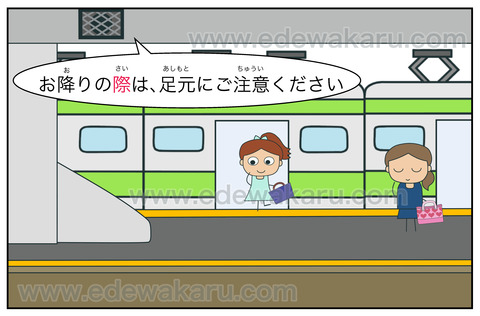
Please watch your step when getting off.
[More formal than “〜時”]
Please make sure not to leave anything behind when you go home.
[More formal than “〜時”]
Please contact us if any problem occurs.
[More formal than “〜時”]
When I go to Tokyo, I plan to take the opportunity to meet my university friends.
[Use meaning “take the opportunity of…”]
Please call me when you come to Osaka.
[More formal than “〜時”]
“〜際” is a formal expression, so it is not used very often in everyday conversation 😅 You may often hear it in train announcements, so it’s good to remember it 😉
(Review: 〜ことがある)
In context 5 examples
お降りの際は、足元にご注意ください
→(電車を)降りる時は、足元にご注意くださいPlease watch your step when getting off. →Please watch your step when getting off (the train).
お帰りの際は、お忘れ物のないようにしてください
→帰る時は、忘れ物がないようにしてください(復習:〜ようにしてください)Please make sure not to leave anything behind when you go home. →When you go home, please make sure you haven’t left anything behind. (Review: 〜ようにしてください)
何か問題が発生した際は、ご連絡ください
→何か問題が発生した時は、連絡してくださいPlease contact us if any problem occurs. →Please contact us when a problem occurs.
東京に行く際、大学の友達に会うつもりだ
→東京に行く機会を利用して、大学の友達に会うつもりだWhen I go to Tokyo, I plan to meet my university friends. →I plan to take the opportunity of going to Tokyo to meet my university friends.
大阪に来る際は、電話してくださいね
→大阪に来る時は、電話してくださいねPlease call me when you come to Osaka. →Please call me when you come to Osaka.
Read the original source text
Meaning
〜時
〜機会に
How to use it
動詞[辞書形]+際
動詞[た形]+際
名詞[辞書形]+の際
Explanation
「〜際」は「〜時」「〜機会に」という意味を表す文型です。この文型は
「〜時」よりかたい言い方を使いたい場合
や、
「〜の機会を利用して〜する」
と言いたい時などに使われます😊
「〜際は〜ください」
という形がよく使われると覚えておくといいと思います。
[例]
お降りの
際
は、足元にご注意ください
【「〜時」よりかたい言い方】
お帰りの
際
は、お忘れ物のないようにしてください
【「〜時」よりかたい言い方】
何か問題が発生した
際
は、ご連絡ください
【「〜時」よりかたい言い方】
東京に行く
際、大学の友達に会うつもりだ
【「〜の機会を利用して〜」の使い方】
大阪に来る
際
は、電話してくださいね
【「〜時」よりかたい言い方】
「〜際」はかたい言い方ですので、日常会話(にちじょうかいわ)で使うことはあまりありません😅電車のアナウンスなどでは聞くことがよくあると思いますので覚えておくといいと思います😉
(復習:〜ことがある)
NINJAL 日本語文型データベース
Meaning
Expresses when an action or state occurs.
It is also used in the form “~際のN.”
How to use it
Vる際・Vた際
Nの際
Other
Notes
“~” is usually preceded by a word describing an action or event, such as “決める,” “発生(する),” or “開会式.”
If “~” is a verb and occurs at the same time as, or before, the action or event described in the clause after “~際,” it takes the dictionary form. If the action or event in the “~” clause is completed before what is described in the clause after “~際” occurs, “~” takes the ta-form.
In context 14 examples
社長主催のパーティーに出席する際、先輩にマナーについていろいろ注意された。
When I attended a party hosted by the company president, a senior colleague gave me various pointers on etiquette.
こちらが大統領が来日した際、夕食会で出された料理です。
This is the dish that was served at the dinner party when the president visited Japan.
入社試験の面接会場に向かう際は、遅刻しないよう、時間に余裕をもって出かけることが大切だ。
When heading to the interview venue for a company entrance exam, it is important to leave with plenty of time so that you won’t be late.
新しく家を建てる際は、実際に住むときのことを考えて、動線に不便がないかどうかよく確認したほうがいい。
When building a new house, it is better to consider what it will be like to live there and carefully check whether the layout will make it inconvenient to get around.
災害が起きた際は、この避難図に書いてあるルートを通って避難してください。
If a disaster occurs, please evacuate via the route shown on this evacuation map.
これから面接試験を受けていただく際の注意点を述べます。
I will explain some points to keep in mind when you take the interview exam shortly.
アルバイト先のレストランでは、接客トラブルが発生した際のマニュアルが準備されている。
At the restaurant where I work part-time, there is a manual for when a customer service problem occurs.
大阪出張の際、駅に近いこのホテルをよく利用していた。
Whenever I was in Osaka on business, I often stayed at this hotel near the station.
「出産の際、ご主人は立ち会いを希望されますか」
“Would your husband like to be present for the birth?”
このサービスは18歳以上の方が登録可能です。お申し込みの際、年齢が確認できるものをお持ちください。
This service is available to people aged 18 and over. Please bring something that verifies your age when you apply.
本製品をご使用の際は、安全のため、以下の点にご注意ください。
When using this product, please observe the following points for your safety.
この時期は熱中症予防のため、外出の際は、帽子をかぶるようにしましょう。
During this time of year, to prevent heatstroke, be sure to wear a hat when going out.
定期購入の解約はウェブサイトから行えます。その際、登録番号とパスワードの入力が必要となります。
You can cancel your subscription through the website. When doing so, you will need to enter your registration number and password.
賃貸物件で給湯器などの設備が故障し、修理や交換が必要になることがある。その際の費用は一般的にはその物件の所有者が負担する。
In rental properties, equipment such as water heaters may break down and need to be repaired or replaced. In such cases, the cost is generally borne by the property owner.
Read the original source text
Meaning
ある動き・状態がいつ生じるのかを表します。
「〜際のN」の形でも使います。
How to use it
Vる際・Vた際
Nの際
その他
Notes
「〜」には、ふつう、動作や出来事を表す言葉(「決める・発生(する)・開会式」など)がきます。
「~」が動詞の場合、「~」が「〜際」の後の文が表す動作・出来事の時点と同じか、それより前に起こるなら、「~」は辞書形になります。「~」の完了後に、「〜際」の後の文のことが起こるなら「~」はタ形になります。