IMABI
Potential IV
Read this IMABI lesson ↗Explanation
Potential IV: ~かねる・かねない VS ~きれる・きれない VS ~える/うる・~えない
Now that you have learned more Japanese, it is now time to delve into differences with phrases related to “can” or “can’t” that are more advanced and somewhat difficult to get straight. Be careful with the role of ~ない in this lesson.
Certainly, when a student realizes that 理解しきれない, 理解しえない, and 理解しかねる are possible on top of 理解できない, to the student, it seems at first glance that they must be interchangeable because they all translate as “can’t understand”. However, as with any similar phrases in Japanese, there will always be differences. Let’s get started at figuring out what these differences are.
Although there are clear nuance differences and writing style differences between them, as the example with 理解する demonstrates, ~きれない, ~えない, and ~かねる have the basic meaning of “can’t”. It’s now time to look at them individually and then compare.
~かねる・かねない
The 一段 verb かねる means “to serve/combine two or more functions or roles simultaneously”. Other verbs that could be used instead for this include 組み合わせる and 兼ね備える.
1. 彼は教師と教育理事長を兼ねています。
He is both a teacher and the education chair.
2. 彼はその二つの部の部長を兼ねています。
He is in charge of the two departments.
3. 総理が外相を兼ねた。
The Prime Minister concurrently held the Foreign Minister position.
4. 朝ごはんと昼ごはんをかねて遅めに食べることが多い。
I eat breakfast with lunch late a lot.
5. 応接間と書斎しょさいを兼ねた部屋です。
This is a room that serves as a parlor and a library.
6. 趣味を兼ねた仕事
Job combined with hobbies
7. 観光と取材をかねて旅行していた。
We were traveling to both sight-see and cover an event.
Meaning Note: News’ crews go places all the time not to just cover the story, but also to enjoy the place they’re at.
~かねる shows that something is impossible. This is more so impossibility of doing something in a certain situation. Say you really hate someone, and you are asked if you’re going to agree with him, you might say “I can’t agree with such a person”. So, it expresses the inability, reluctance, or refusal to do something. It can be translated as “cannot” or “(am) not able.”
8. 彼は、「表明には承服しょうふくしかねる」と怒りの面持おももちで言ったそうだ。
I hear that he said that he could not consent with the assertion with an angry face.
9. そんな悪徳あくとく業者には賛成しかねる。
I cannot agree with such an unscrupulous businessman.
10. そんな方法には賛成しかねる。
I can’t approve of such methods.
11. 動機を図りかねる。
To not be able to fathom the motive.
12. この場では決めかねますので、また別途べっと会議を設けましょう。
Since it is impossible to decide at this place, let’s set up a separate meeting again.
13. 彼女は彼氏が来るのを待ちかねていた。
She couldn’t wait for her boyfriend to come.
14. 申しかねますが。
I hesitate to say but…
~かねない is the negative form of -かねる. Since -かねる shows the impossibility, -かねない shows that something very well “can” happen. This ending is especially used when the situation is bad. So, it means that there is a danger/possibility that the bad thing might occur.
15. 彼は嘘をつきかねない男だ。
He is a man capable of telling a lie.
16. 彼なら嘘をつきかねないと思う。
I wouldn’t put it past him to lie.
17. このまま進めば、人間の絶滅をも引き起こしかねない。
If it continues at this rate, it may lead to human extinction.
18. このままでは、個人情報が漏洩ろうえいしかねない。
At this rate, personal information might be leaked.
19. このレフェリーは規則にうるさいので試合を台無しにしかねない。
This referee is fussy about the rules, so he could ruin the match.
20. 彼はせっかくのチャンスを棒ぼうに振ってしまいかねない。
He might end up making a complete waste of an opportune moment.
~きれる・きれない
This is the potential form of ~切る. It is used to show that you can completely do something, of which a lot is to be done. So, it’s negative form, ~きれない shows that you can’t do this.
So, as for 理解しきれない, you can still understand somewhat, but you can’t understand entirely. It is often used with expressions that show quantity and degree. It is often written in 漢字 as ~切れない.
21. 学校でいくら注意しても子供を守りきれないんだよ。
No matter how much we warn them at school, we cannot completely protect the kids.
22. 彼の行為こういは言葉で褒ほめ切れないほど立派ですよ。
His actions are beyond praise.
23. 言い切れます。
I can completely say (that…).
24. 1日で食べきれないほどのバナナを買いました。
I bought more bananas than can be eaten all in a day.
25. 待ちきれなかった。
We couldn’t wait (completely).
~える・うる/~えない
Though this has already been taught in Potential II, remember that this pattern is old-fashioned and used in the written language. It doesn’t show that something is literally impossible, but that since the conditions don’t match up, the possibility is slim to none. With non-volitional verbs the interpretation changes slightly to more of “it shouldn’t/can’t be that…”.
26. 期待しえないことだ。
It’s something that you can’t anticipate.
27. 忘れ得ぬ日
A day I can never forget
28. 過酷事故かこくじこは原理上げんりじょう起こりえない。
Severe accidents in theory can’t occur.
Compare and Contrast
All of these endings show impossibility in the forms ~かねる, ~きれない, and ~えない, but let’s see how well they can be used in a situation of stating one’s actual abilities.
29.
A: 韓国に来てどのくらいですか。
B: 半年です。
A: 韓国語はどの程度話せますか。
B: まだ十分話{〇 せません・△ しきれません・X しえません・X しかねます}。
A: How long has it been since you came to Korea?
B: It’s been half a year.
A: How much Korean can you speak?
B: I still can’t speak well enough.
From this data we can see that these endings cannot simply be used to show capacity.
The situation is not saying that you can’t speak a certain quantity of something completely. The situation is asking for your competency of the language itself. So, ~きれない is not correct.
Now, consider the following.
30. 田中が犯人だと断定できましたか。
Could you conclude that Tanaka is the criminal?
31.
Response 1: いえ、彼が犯人だとは断定できません。
Response 2: いえ、彼が犯人だとは断定しきれません。
Response 3: いえ、彼が犯人だとは断定しえません。
Response 4: いえ、彼が犯人だとは断定しかねます。
Translation: No, I cannot conclude that he is the criminal.
In this case, all four responses are correct, but they are all slightly different. In the first response, you are objective stating that it is impossible to decide. In the second situation, you state that you can’t 100% call him the criminal because there is still some doubt. In the third response, you can’t say that he is the criminal given the surrounding circumstances. It is also very uncommon to use this in 話し言葉. The fourth response implies that you refrain from stating definitively that he is the criminal.
With the last comment, you can see how ~かねる can be used in polite contexts in denying/rejecting things.
32. いろいろ考慮しましたが、お引き受けしかねます。
I’ve thought hard on this, but I cannot undertake it.
So, even in situations where all are possible, there will be differences as defined thus far. They are all used in showing that one can’t decide one way or another, as demonstrated by the criminal example.
33. 生徒が本当に分かっているのかどうか判断し{きれない・えない・かねる}。
I can’t determine whether or not the students really understand.
They can also be used in situations where because of a certain reason or cause, you can’t do something or it is extremely difficult to do something. The fine details, of course, are predicated on the pattern you choose.
34. 大きすぎて、把握はあくし{きれない・えない ・かねる}問題だ。
It’s a problem too big that I cannot fully grasp.
Remember that ~かねる implies that the speaker has a feeling of reluctance, which is part of the reason why they “can’t”. Again, as for ~えない, a consensus of the various circumstances can’t be made. So, in this example that means that the speaker can’t grasp certain parts due to conflicting issues.
Words Used
It is now time to examine what kinds of words these items are frequently used with to even further distinguish them.
X~きれない: Used with verbs concerning with degree, quantity. It is also used with volitional verbs in regards to recognition and decision. Ex. 数える, 押さえる, 対処する, 理解する, 等.
35. 彼のアリバイ説明で納得しきれないところがあります。
There are parts I’m not completely convinced in his alibi’s explanation.
X~えない: Used with volitional verbs in concern with recognition, progress, and remarking. It is not used with simple action verbs like 見る, 食べる, 飲む, 等. Verbs it is used with include 予期する, 期待する, 達成する, 等. It can also be used with non-volitional verbs such as ある, 存在する, 起こる, 等.
36. そんなことはありえないでしょう。
Isn’t something like that impossible?
37. 理解し得ない感情
Feelings that one cannot understand
38. 金にならないものは評価され得ない。
Something that won’t make money is cannot be assessed.
39. 客観的中立メディアなど存在し得ない。
An objective, neutral media cannot exist.
X~かねる: It too is used with volitional verbs of decision but also agreement, and it is also used in a lot of other expressions given its sense of reluctance. Ex. 理解する、決める, 耐える, 等.
40. すぐには決めかねます。
I can’t decide immediately.
41. 激痛げきつうに耐たえかねて呻うめく。
To not be able to bear the great pain and moan.
42. 先週、夫の虐待ぎゃくたいに耐えかねて、花子は実家に帰った。
Last week, unable to stand her husband’s abuse, Hanako returned to her parent’s house.
In context 40 examples
彼は教師と教育理事長を兼ねています。
He is both a teacher and the education chair.
彼はその二つの部の部長を兼ねています。
He is in charge of the two departments.
総理が外相を兼ねた。
The Prime Minister concurrently held the Foreign Minister position.
朝ごはんと昼ごはんをかねて遅めに食べることが多い。
I eat breakfast with lunch late a lot.
応接間と書斎しょさいを兼ねた部屋です。
This is a room that serves as a parlor and a library.
趣味を兼ねた仕事
Job combined with hobbies
観光と取材をかねて旅行していた。
We were traveling to both sight-see and cover an event.
彼は、「表明には承服しょうふくしかねる」と怒りの面持おももちで言ったそうだ。
I hear that he said that he could not consent with the assertion with an angry face.
そんな悪徳あくとく業者には賛成しかねる。
I cannot agree with such an unscrupulous businessman.
そんな方法には賛成しかねる。
I can’t approve of such methods.
動機を図りかねる。
To not be able to fathom the motive.
この場では決めかねますので、また別途べっと会議を設けましょう。
Since it is impossible to decide at this place, let’s set up a separate meeting again.
彼女は彼氏が来るのを待ちかねていた。
She couldn’t wait for her boyfriend to come.
申しかねますが。
I hesitate to say but…
彼は嘘をつきかねない男だ。
He is a man capable of telling a lie.
彼なら嘘をつきかねないと思う。
I wouldn’t put it past him to lie.
このまま進めば、人間の絶滅をも引き起こしかねない。
If it continues at this rate, it may lead to human extinction.
このままでは、個人情報が漏洩ろうえいしかねない。
At this rate, personal information might be leaked.
このレフェリーは規則にうるさいので試合を台無しにしかねない。
This referee is fussy about the rules, so he could ruin the match.
彼はせっかくのチャンスを棒ぼうに振ってしまいかねない。
He might end up making a complete waste of an opportune moment.
学校でいくら注意しても子供を守りきれないんだよ。
No matter how much we warn them at school, we cannot completely protect the kids.
彼の行為こういは言葉で褒ほめ切れないほど立派ですよ。
His actions are beyond praise.
言い切れます。
I can completely say (that…).
1日で食べきれないほどのバナナを買いました。
I bought more bananas than can be eaten all in a day.
待ちきれなかった。
We couldn’t wait (completely).
期待しえないことだ。
It’s something that you can’t anticipate.
忘れ得ぬ日
A day I can never forget
過酷事故かこくじこは原理上げんりじょう起こりえない。
Severe accidents in theory can’t occur.
田中が犯人だと断定できましたか。
Could you conclude that Tanaka is the criminal?
いろいろ考慮しましたが、お引き受けしかねます。
I’ve thought hard on this, but I cannot undertake it.
生徒が本当に分かっているのかどうか判断し{きれない・えない・かねる}。
I can’t determine whether or not the students really understand.
大きすぎて、把握はあくし{きれない・えない ・かねる}問題だ。
It’s a problem too big that I cannot fully grasp.
彼のアリバイ説明で納得しきれないところがあります。
There are parts I’m not completely convinced in his alibi’s explanation.
そんなことはありえないでしょう。
Isn’t something like that impossible?
理解し得ない感情
Feelings that one cannot understand
金にならないものは評価され得ない。
Something that won’t make money is cannot be assessed.
客観的中立メディアなど存在し得ない。
An objective, neutral media cannot exist.
すぐには決めかねます。
I can’t decide immediately.
激痛げきつうに耐たえかねて呻うめく。
To not be able to bear the great pain and moan.
先週、夫の虐待ぎゃくたいに耐えかねて、花子は実家に帰った。
Last week, unable to stand her husband’s abuse, Hanako returned to her parent’s house.
絵でわかる日本語
Meaning
〜there is / is not a possibility of 〜
〜can / cannot 〜
How to use it
Verb [ます-form] + 得る
Verb [ます-form] + 得ない
Explanation
“〜得る・〜得ない” is used to mean “there is / is not a possibility of 〜” or “can / cannot 〜.” The first thing to watch out for is the reading 😮
There are two readings, “うる” and “える,” and you need to distinguish their usage 😨
“得る” → うる・える
“得ます” → えます
“得ない” → えない
“得ません” → えません
“得た” → えた
“得ました” → えました
In other words, only “得る” has two readings, “うる” and “える”; all the other forms must be read with “え” 😊 (Review: 〜ということだ)
Also, remember that this pattern cannot be used simply to express [ability] 😌
⭕️ She can speak Japanese.
❌ She can speak Japanese (using 話し得る).
When expressing [ability], use “〜ことができる” or the potential form.
“〜得る・〜得ない” is a written expression, but “あり得ない” meaning “there’s no way” is also very commonly used in conversation 😊 Try using it in everyday conversation 😉
In context 4 examples
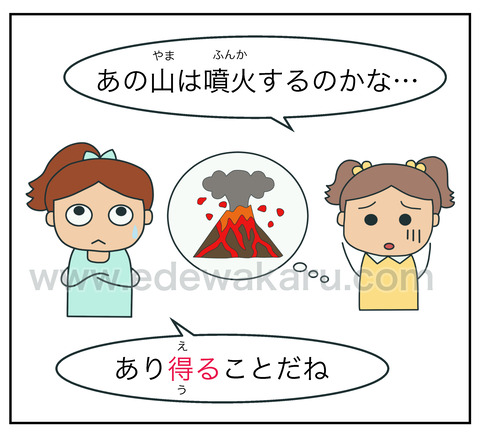
A:あの山は噴火するのかな…(復習:〜かな・〜かしら)B:あり得ることだね→噴火する可能性があるね
A: I wonder if that mountain will erupt… (Review: 〜かな・〜かしら) B: It’s possible. →There’s a possibility it will erupt.
彼が負けるなんてあり得ないよ!
→彼が負けるなんてあるはずがないよ!There’s no way he could lose! →There’s no way he could lose!
事故は誰にでも起こり得ることだ
→事故は誰にでも起こる可能性があることだAn accident is something that could happen to anyone. →An accident is something that could happen to anyone.
お酒やタバコは病気の原因になり得ます
→お酒やタバコは病気の原因になる可能性がありますAlcohol and tobacco can cause illness. →Alcohol and tobacco can possibly cause illness.
Read the original source text
Meaning
〜可能性がある / 〜可能性がない
〜できる / 〜できない
How to use it
動詞[ます形]+得る
動詞[ます形]+得ない
Explanation
「〜得る・〜得ない」は「〜可能性がある・〜可能性がない」または「〜できる・〜できない」という意味で使用される文型です。まず気をつけなければいけないのは読み方です😮
「うる」「える」
と2つ読み方がありますが、使い分けが必要です😨
「得る」→
う
る・
え
る
「得ます」→
え
ます
「得ない」→
え
ない
「得ません」→
え
ません
「得た」→
え
た
「得ました」→
え
ました
つまり、「得る」のみが「うる・える」と2つ読み方がありますが、その他は「え」と読まなければいけないということです😊(復習:〜ということだ)
また、この文型は
ただ「能力」を表す場合には使えないということを覚えておいてください
😌
⭕️彼女は日本語が
話せる
❌彼女は日本語が
話し得る
「能力」を表す場合には「〜ことができる」「可能形」を使うようにしてください。
「〜得る・〜得ない」は書き言葉的ですが、「あり得ない=あるはずがない」は会話でもとてもよく使われます😊みなさんも日常会話で使ってみてくださいね😉
毎日のんびり日本語教師
How to use it
Verbます-form + 得ない
Explanation
Expresses that something is impossible under the circumstances.
It cannot express inability.
When the potential form 「~れない/られない」 indicates that something is not possible, the two forms can be used interchangeably.
◯ I can’t speak Japanese.
✕ I cannot possibly speak Japanese. (with 「話し得ない」)
「~得ない」 is a relatively formal expression, but 「ありえない」 is also frequently used in conversation.
Notes
Related grammar: 「【N2文法】~得る」
In context 14 examples
あんなひどいことを言っておいて、今さら謝るなんてありえない。
After saying something so awful, there’s no way he can apologize now.
世の中には到底理解し得ない人間がいっぱいいる。(世界上有很多人无法理解。)
There are many people in the world whom I simply cannot understand. (There are many people in the world whom it is impossible to understand.)
私に想像し得ない世界が身近に広がっている。
A world I cannot imagine is unfolding close by.
彼の企みは到底実現し得ないだろう。(他的企图终究无法实现吧。)
His scheme will surely never come to fruition. (His scheme probably cannot be realized after all.)
人の気持ちは他人には理解し得ない。(别人的心情别人无法理解。)
Other people cannot understand someone else’s feelings.
現実的に達成し得ない目標を設定すべきではない。(不应该设定不现实达成的目标。)
You shouldn’t set goals that are realistically unattainable. (You shouldn’t set goals that cannot realistically be achieved.)
無償の愛なんて存在し得ない。(无偿的爱是不可能存在的。)
Unconditional love cannot possibly exist. (Unconditional love is impossible.)
おでんはおかずにはなり得ない。
Oden can never be a side dish.
同じ人間なんて存在しえない。
No two people can ever be exactly the same.
役に立たない人間なんていない。生きてる価値が無いなんて絶対にあり得ない。
There is no such thing as a person who is useless. It is absolutely impossible that someone has no value in life.
人間はこの世の真理には到達し得ない。
Humans can never reach the truth of this world.
恋は治療し得ない病である。
Love is an incurable disease.
僕の気持ちは、他人には到底理解し得ないものです。
My feelings are something other people simply cannot understand.
宇宙って私たちが想像しえない速度で膨張してるらしい。
Apparently, the universe is expanding at a speed we cannot imagine.
Read the original source text
How to use it
動ます形+得ない
Explanation
状況的に不可能であることを表します。
能力可能は表せません。
可能形「~れない/られない」が可能性がないことを表す場合、お互いに言い換えることができます。
◯日本語を話せない。
✕日本語を話し得ない。
「~得ない」は比較的硬い表現ですが、「ありえない」は口語としても頻繁に使われます。
Notes
関連文法「【N2文法】~得る」
NINJAL 日本語文型データベース
Meaning
It indicates that there is no possibility of “〜” happening.
It is a formal expression, but 「あり得ない」 is an idiomatic expression that is also used in casual conversation.
How to use it
Notes
This is the negative form of 「〜得る」, but it is read only as 「えない」.
In context 8 examples
命あるものは水と空気なしでは生存し得ない。
Living things cannot survive without water and air.
宇宙人がいる? あり得ないよ、そんなこと。
“Aliens exist? That’s impossible.”
彼はどうも優柔不断だ。いい指導者にはなり得ないだろう。
He seems to be indecisive. He probably cannot become a good leader.
アインシュタインの「相対性理論」は、発表当時は3人の科学者しか理解し得なかったというエピソードがある。
There is an anecdote that, when Einstein’s “Theory of Relativity” was published, only three scientists could understand it.
そんないい加減な説明ではとうてい誰も納得し得ないでしょう。
No one could possibly be convinced by such a careless explanation.
この道路建設計画の実現は、当面期待し得ないと私は考えております。
I believe we cannot expect this road construction plan to be realized for the time being.
今後、必要な電力が十分に供給し得なくなるということは考えられません。
It is inconceivable that, in the future, we will become unable to supply enough of the electricity we need.
1969年、アメリカのアポロ11号の着陸船イーグル号は、どこの国もなしえなかった月面着陸に成功した。
In 1969, the Apollo 11 lunar module Eagle succeeded in landing on the moon, something no country had ever accomplished.
Read the original source text
Meaning
〜の状況になる可能性がないことを表します。
硬い言い方ですが、「あり得ない」は慣用的な言い方として、くだけた会話でも使います。
How to use it
Notes
「〜得る」の否定形ですが、読み方は「えない」だけです。