絵でわかる日本語
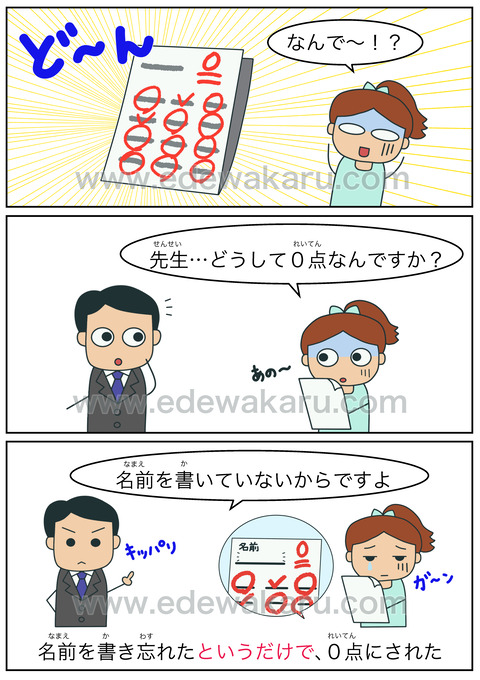
Meaning
~ for that one reason alone
How to use it
Verb, adjective, or noun [plain form] + というだけで
Explanation
“〜というだけで” is a sentence pattern meaning “for the reason that it is simply ~.” It emphasizes that [there is only one reason] and is used when you want to say that “a state came about for just one reason.”
It can also be changed to “〜というだけの理由で.”
[Example]
名前を書き忘れた
というだけで、0点にされてしまった
=名前を書き忘れた
というだけの理由で、0点にされてしまった
There are many sentence patterns containing “だけ,” so be sure to review them.
In context 6 examples
名前を書き忘れたというだけで、0点にされた[0点にされた理由]名前を書き忘れたから
I was given a score of zero just because I forgot to write my name. [Reason for receiving zero] Because I forgot to write my name.
A:あの歌手は歌があまり上手じゃないね…B:彼女はかわいいというだけで人気があるんだよ[人気がある理由]かわいいから
A: That singer isn’t very good at singing… B: She’s popular just because she’s cute. [Reason she is popular] Because she’s cute.
彼女は日本のアニメが好きというだけで日本語を始め、1年でN1に合格したそうだ[日本語を始めた理由]日本のアニメが好き
Apparently, she started learning Japanese just because she likes Japanese anime and passed N1 in one year. [Reason she started Japanese] She likes Japanese anime.
彼は1回遅刻をしたというだけで、会社を首になったそうだ[首になった理由]1回遅刻をした
Apparently, he was fired from his company just because he was late once. [Reason he was fired] He was late once.
10年前は、若いというだけでモテたものだ[モテた理由]若かったから
Ten years ago, people used to be popular just for being young. [Reason they were popular] Because they were young.
たまたま事件現場の近くにいたというだけで、警察に捕まってしまった…[警察に捕まった理由]事件現場の近くにいたから
I happened to be near the crime scene, and was arrested just for that… [Reason I was arrested] Because I was near the crime scene.
Read the original source text
Meaning
ただそれ1つの理由で〜
How to use it
動詞・形容詞・名詞[普通形]+というだけで
Explanation
「〜というだけで」は「ただ〜という理由で」という意味の文型です。これは[理由は1つしかない]ということを強調し、「ただ1つの理由で〜という状態になった」と言いたい時に使われます。
「〜というだけの理由で」
にチェンジすることもできます。
[例]
名前を書き忘れた
というだけで、0点にされてしまった
=名前を書き忘れた
というだけの理由で、0点にされてしまった
「だけ」がつく文型はたくさんありますので、復習をしておきましょう。