AIUEO JLPT Grammar
Meaning
This sentence pattern expresses admiration, surprise, or emphasis, showing strong emotions or the extent of an emotion towards something.
How to use it
Verb + ことか; adjective + ことか; adjective + な + ことか
In context 5 examples
彼がどれほど努力したことか。
How much effort he has put in!
あの時どれほど悲しかったことか。
How sad I was at that time!
そのニュースを聞いて、どんなに驚いたことか。
How surprising that news was!
あなたが来てくれて、なんと嬉しいことか。
How happy I am that you came!
このプロジェクトを完成するまでに、どれだけの努力が必要だったことか。
How much effort was needed to complete this project!
Read the original source text
Meaning
This sentence pattern expresses admiration, surprise, or emphasis, showing strong emotions or the extent of an emotion towards something.
How to use it
動詞+ことか形容詞+ことか形容詞な+ことか
Explanation · 日本語
この文型は、感嘆や驚き、強調を表す表現です。この表現は、何かに対する感情の強さや大きさを表現するときに使われます。
Bunpro Grammar Reference
Meaning
How…, What..., God knows...
How to use it
Verb + ことか
[い]Adjective + ことか
[な]Adjective + な + ことか
Noun + である + ことか
Nuance
A phrase that expresses (A) as being a particularly large amount that shocks even the speaker.
Explanation
ことか is a combination of こと 'thing', and the case marking particle か, used to present a question.
In sentences with ことか, words that highlight some particular number or extent are often used, before ことか comes at the end of the statement, expressing that 'extent' as being particularly unusual, or even unbelievable (thanks to the addition of か). This is often translated simply as 'how (A)', 'what (A)', or even 'god knows (A)'. Let's look at a few examples.
あの人のコンサートには何回いったことか。
God knows how many times I have gone to that person's concert.
うちの犬はどんなに可愛いことか。こんなに可愛いワンチャンは他にはいないはず。
How can I explain how cute my dog is? There is no other dog as cute as her.
なんて暇なことか。こんなに暇なのは久しぶりだ。
God knows how bored I am. It's been a long time since I've been this bored.
息子を一人で電車に乗せるのがどれだけ心配であることか。
God knows how worried I am to let my kid on the train by himself.
Literally, ことか can be translated as 'to what particular (A) is (B)!?', as the enquiry is often not directed at anyone specifically, but instead presents itself as a question simply to emphasize its magnitude.
Caution
In modern Japanese, this expression is used primarily in written language, and has a tendency to sound either poetic, or dramatic. Because of this, it may sound unnatural in daily speech, unless the speaker is purposely being dramatic.
どれだけお前の事を愛していたことか!それでも俺はお前に裏切られた!
God knows how much I loved you! Still, you betrayed me.
知らない人にありがとうと言われるのがどれだけ嬉しいことか。
God knows how nice it feels to have a stranger thank you.
In context 18 examples
- これをどれだけ待っていた事か。
God knows how long I have waited for this!
- 息子を一人で電車に乗せるのがどれだけ心配であることか。
God knows how worried I am to let my kid on the train by himself.
- あの人のコンサートには何回いったことか。
God knows how many times I have gone to that person's concert.
- なんて暇なことか。こんなに暇なのは久しぶりだ。
God knows how bored I am. It's been a long time since I've been this bored.
- うちの犬はどんなに可愛いことか。こんなに可愛いワンチャンは他にはいないはず。
How can I explain how cute my dog is? There is no other dog as cute as her.
- 文プロがあってどんなに便利な事か!
How convenient it is to have Bunpro!
- 君に会えてどんなに嬉しかった事か。
How happy I was after meeting you!
- 君に会える日を、どんなに夢見た事か。
How much I have dreamed of the day I could finally meet you!
- このプロテインのなんと美味しい事か!すごく飲みやすい。
How delicious this protein is! It goes down like nothing.
- 何たる事か、前回と同じ間違いをしてしまった。
What the...! I made the same mistake as last time.
- 子供のころ、この喫茶店に行ったことがある。あの時のドーナツは、何とうまかった事か。
When I was a child, there was a time we went to this coffee shop. God knows how delicious these donuts were!
- 彼に何回「気を付けて」と言った事か。今、同情する余地がない。
God knows how many times I told him 'be careful!'. Now I don't even feel sorry for him.
- 何たる事か!?これは私がずっと探していた石ではないか!
What the...!? Is this not the stone that I have been searching for!
- 文法を勉強するためのサイトを今まで何度、試した事か!
Until now, god knows how many sites I have tried learning grammar on!
- みんなに「頭がいい」と褒められるが、ここまで文法を理解するのにどんなに時間がかかった事か!
Everyone tells me how smart I am, but in order to understand grammar to this degree, how many hours it took!
- この男、こんな姿になるまでに、何回ジムに行った事か。
How much he must have gone to the gym to get a body like that!
- どれだけお前の事を愛していたことか!それでも俺はお前に裏切られた!
God knows how much I loved you! Still, you betrayed me.
- 知らない人にありがとうと言われるのがどれだけ嬉しいことか。
God knows how nice it feels to have a stranger thank you.
DoJG 日本語文法辞典(全集)
Meaning
How ~!; what a(n) ~!
How to use it
(i) Wh-word+particle~ | Adjectiveいinformalことか。 | |
| 何と{面白い/面白かった}ことか。 | How interesting it is/was! |
| どんなに{嬉しい/嬉しかった}ことか。 | How happy I am/was! |
(ii) 何{Counter/と}~ | Vinformalことか。 | |
| 何回{聞く/聞いた}ことか。 | How many times we {are listening/have listened} to it! |
| 何と美味しく{食べる/食べた}ことか。 | How we do/did enjoy eating! |
(iii) Wh-word~Adjectiveなstem | {な/である/だった/であった}ことか。 | |
| いかに困難{な/である/だった/であった}ことか。 | How difficult something is/was! |
(iv) Wh-word+Particle~Noun | {である/だった/であった}ことか。 | |
| {いかに/何と/何たる}天才{である/だった/であった}ことか。 | What a genius someone is/was! |
(v) どれ{ほど/だけ}~ | ことか。 | |
| どれほど望んだことか。 | How much someone has hoped for it! |
Explanation
A sentence final, exclamatory phrase used in written language.
In context 9 examples
カルフォルニアは何と太陽が明るいことか。
How bright the sun is in California!
私は今までに何度オーストラリアを訪ねたことか。
How many times have I visited Australia before now!
アメリカの大学に比べると日本の大学は何と貧弱に見えることか。
When compared with American universities, how unimpressive Japanese universities look!
ペダルを踏み替える時に膝がハンドルにぶつかる車がどんなに多いことか。
How many cars are there in which the driver's knee hits the steering wheel whenever he switches pedals!
日本語がよく読めるようになるためにどれぐらい勉強したことか。
How much I studied in order to read Japanese well!
新鮮な魚を探して何軒の魚屋を見て歩いたことか。
How many fish shops I have gone to in search of fresh fish!
この数学の問題を解くのに何時問使ったことか。
How many hours I have spent to solve this mathematical problem!
日本人はいかにしばしば内と外の行動を区別することか。
How often Japanese differentiate their behaviour in inside and outside spaces!
二人はどれだけ強く愛し合っていたことか。
How strongly the two loved each other!
絵でわかる日本語
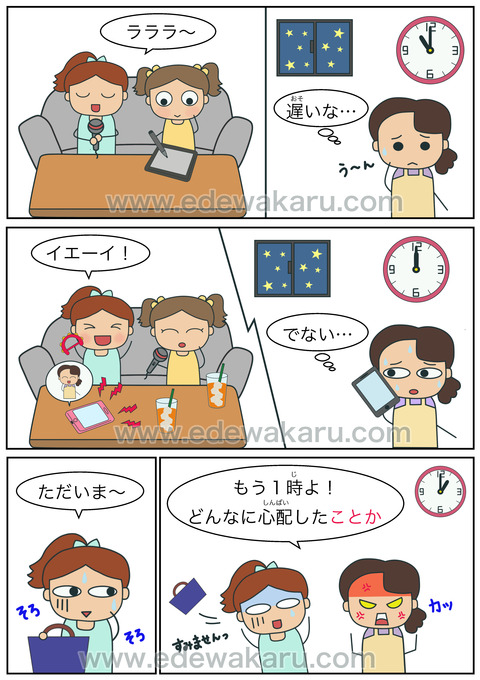
Meaning
Very ~
Extremely ~
How to use it
Verb [plain form]+ことか
Adjective [adjective]+ことか
Explanation
「〜ことか」 is a sentence pattern that expresses an extreme degree, and is used to mean “very ~” or “extremely ~.” It is used with the feeling that “it is so ~ that words cannot express just how much.” This pattern is used in the form 「question word+ことか」, but in most cases the forms 「どんなに〜ことか」 and 「どれほど〜ことか」 are used 😊
(Review: 〜を込めて・〜を込めた)
[Examples]
① How worried I was…
→ I was so worried!
(to the point that I can’t put it into words)
② How long I had been waiting for this day!
→ I had been waiting for this day so long!
③ How painful it must have been!
→ It must have been very painful.
④ How many times I warned him…
→ I warned him many times.
*This indicates that the number of times I warned him was high.
⑤ When my daughter’s marriage was decided, how happy I was!
→ I was so happy!
Remember that 「〜ことか」 is an emotionally charged way of saying that the degree is extreme 😀
[The 「こと」 series]
〜こと (command)
〜ことか
〜ことから
〜ことがある
〜ことができる (possibility)
〜ことができる (ability)
〜ことこの上ない
〜ことだ・〜ないことだ
〜ことだから
〜ことだし
〜ことで (Nのことで)
〜こととて
〜ことなしに
〜ことなく
〜ことに
〜ことにしている
〜ことにする
〜ことになっている
〜ことになる・〜こととなる
〜ことには
〜ことは〜が① (adjectives・nouns)
〜ことは〜が② (verbs)
〜ことはない
〜ことはならない
〜たことがある (experience)
〜だこと!
(〜は)〜てのこと
〜ても〜すぎることはない
〜ということだ
〜とのことだ
〜ないこともない
〜ないことには
〜なかったことがある
In context 5 examples
どんなに心配したことか…
How worried I was…
やっとN1に合格することができた!この日をどれほど待っていたことか(復習:)
I finally passed N1! How long I had been waiting for this day! (Review:)
彼女はずっと一人でがんばってきた。どんなに辛かったことか(復習:〜てくる(継続))
She has been working hard all by herself for so long. It must have been so painful for her. (Review: 〜てくる (continuation))
A:山田くん、遅刻のしすぎで首になったらしいよB:うん。私も何度注意をしたことか…(復習:〜すぎ(名詞化))(復習:「首にする」「首になる」)(復習:〜らしい(推量))
A: I heard Yamada got fired for being late so often. B: Yeah. How many times I warned him… (Review: 〜すぎ (nominalization)) (Review: 「首にする」「首になる」) (Review: 〜らしい (conjecture))
娘の結婚が決まって、どんなに嬉しかったことか
When my daughter’s marriage was decided, how happy I was!
Read the original source text
Meaning
とても〜
すごく〜
How to use it
動詞[普通形]+ことか
形容詞[形容詞]+ことか
Explanation
「〜ことか」は程度がすごいことを表す文型で、「とても〜」「すごく〜」という意味で使われます。
「それが、どれくらいの程度か言葉では言えないくらい、すごく〜だ」
という気持ちを込めて使用されます。この文型は「疑問詞+ことか」の形で使われますが、ほとんどの場合は
「どんなに〜ことか」「どれほど〜ことか」
の形が使われます😊
(復習:〜を込めて・〜を込めた)
[例]
①どんなに心配した
ことか
…
→(言葉で言えないくらい)
すごく
心配したのよ!
②この日をどれほど待っていた
ことか
→この日を
すごく
待っていた!
③どんなに辛かった
ことか
→
とても
辛かっただろう
④私も何度注意をした
ことか
…
→私も何度も注意した
*
注意した回数が多い
ことを表している
⑤娘の結婚が決まって、どんなに嬉しかった
ことか
→
とても
嬉しかった!
「〜ことか」は、
程度がすごい
ということを感情を込めていう言い方だと覚えておきましょう😀
【「こと」シリーズ】
〜こと(命令)
〜ことか
〜ことから
〜ことがある
〜ことができる(可能)
〜ことができる(能力)
〜ことこの上ない
〜ことだ・〜ないことだ
〜ことだから
〜ことだし
〜ことで(Nのことで)
〜こととて
〜ことなしに
〜ことなく
〜ことに
〜ことにしている
〜ことにする
〜ことになっている
〜ことになる・〜こととなる
〜ことには
〜ことは〜が①(形容詞・名詞)
〜ことは〜が②(動詞)
〜ことはない
〜ことはならない
〜たことがある(経験)
〜だこと!
(〜は)〜てのこと
〜ても〜すぎることはない
〜ということだ
〜とのことだ
〜ないこともない
〜ないことには
〜なかったことがある
日本語文型辞典
Meaning
Basic information: Interrogative+Naなことか; interrogative+A/V ことか. Expresses something as so intense that its degree or quantity cannot be specified, with a feeling of deep emotion.
Examples:
① Please put yourself in the position of someone who has to listen to three hours of a boring story. Just how tedious it is!
② To have two children die one after another. How painful it must be!
③ At last, I succeeded. How many years have I waited for this day!
④ Please tell the person directly. How happy they’ll be!
Read the original source text
Meaning
基本情報疑問詞+Naなことか疑問詞+ A/V ことか説明それがどの程度・どれほどの量であるかが特定できないぐらい、はなはだしいという意味を感慨の気持をこめて表す。例文① つまらない話を3時間も聞かされる身にもなってください。どれほど退屈なことか。② 続けて二人も子供に死なれるなんて。どんなにつらいことか。③ とうとう成功した。この日を何年待っていたことか。④ それを直提本人に伝えてやってください。どんなに喜ぶことか。
日本語文型辞典 英語版
Meaning
【ことか】[疑問詞+Na なことか][疑問詞+ A/V ことか]
Conveys a sense of deep emotion. Means the emotion is so intense that it is difficult to specify its degree or amount.
In context 4 examples
つまらない話を3時間も聞かされる身にもなってください。どれほど退屈なことか。
Put yourself in my place and imagine having to listen to that drivel for three hours. How boring it was!
続けて二人も子供に死なれるなんて。どんなにつらいことか。
To think that they’ve lost two children, one right after the other. I can't imagine how painful it must be!
とうとう成功した。この日を何年待っていたことか。
We finally succeeded. We've waited so many years for this day!
それを直接本人に伝えてやってください。どんなに喜ぶことか。
Please tell that directly to the person in question. She’ll be thrilled!
くらべてわかる日本語表現文型辞典
Meaning
Meaning 1: Used with an interrogative word as an emphatic expression meaning “very A.”
Meaning 2: Used with an interrogative word to express feelings of bewilderment or expectation about something unpredictable.
How to use it
Interrogative word + Aことか
Connection 1:
Interrogative word + [Verb] ことか
Interrogative word + [い-adjective—plain form] ことか
Interrogative word + [な-adjective—な / である / だった / ではない] ことか
Interrogative word + [Noun—である / ではない / だった] ことか
Connection 2:
Interrogative word + [Verb—dictionary form / ている / past form] ことか
Explanation
【Comparison 2】
“Interrogative word + Aやら” (Meaning 1, p. 74)
“Interrogative word + Aやら” is also used at the end of a sentence, and has the same meaning of expressing that one has no idea at all. “Aことか” expresses a feeling that something is unpredictable and cannot be used for something currently happening right before one’s eyes. Therefore, “Aことか” can be replaced with “Aやら,” but the reverse is not always possible.
○何を言うやら、この子は…。
×何を言うことか、この子は…。
“Interrogative word + Aやら” (Meaning 2, p. 74)
When A in “Interrogative word + Aやら” is a verb, the two can be substituted for each other.
Notes
【Note 1】
・The interrogative in A is one that expresses degree or frequency, such as “いかに,” “いくら,” “どれだけ,” “どれほど,” “なんと,” “なんて,” or “何(回/時間/人…).”
【Note 2】
・A is an interrogative such as “どれ,” “どこ,” “いつ,” “だれ,” “どんな,” or “なに.”
In context 8 examples
彼女の歌声はなんと美しいことか。
How beautiful her singing voice is!
毎年、悲惨な交通事故でどれだけの人が犠牲になることか。
How many people are victims of tragic traffic accidents every year!
一人で暮らすというのがどんなに厳しいことか君はわかっていない。
You don’t understand how difficult it is to live alone.
あの子はいくら言ってもきかないので、一日に何回注意することか。
No matter how many times I tell that child, they won’t listen, so I wonder how many times a day I have to warn them.
友達に金を貸したが、いつ返してくれることか。
I lent money to a friend, but who knows when they’ll pay me back.
うちの猫は今頃、どこで何をしていることか。
I wonder where our cat is and what it’s doing right now.
上司から話があると言われた。いったい何を言われることか。
My boss said he wanted to talk to me. I wonder what on earth he’ll say.
恋人を連れてくると娘は言ったが、どんな人を連れてくることか。
My daughter said she’d bring her boyfriend, but I wonder what kind of person she’ll bring.
Read the original source text
Meaning
意味1:疑問詞とともに用い、とてもAだと強調する表現。
意味2:疑問詞とともに用い、予想できず、困惑したり、期待したりする気持ちを表す。
How to use it
疑問詞+Aことか
接続1:
疑問詞+[動詞]ことか
疑問詞+[イ形-普]ことか
疑問詞+[ナ形-な/である/だった/ではない]ことか
疑問詞+[名詞-である/ではない/だった]ことか
接続2:
疑問詞+[動詞-る形/ている/た形]ことか
Explanation
【対比2】
「疑問詞+Aやら」(意味1 P.74)
「疑問詞+Aやら」も文末に使われ、まったく見当がつかないことを表すという意味では同じ。「Aことか」は予想できないという気持ちを表し、目の前で現在行われていることには使えないので、「Aことか」を「Aやら」に置き換えは可能だが、逆はできないこともある。
○何を言うやら、この子は…。
×何を言うことか、この子は…。
「疑問詞+Aやら」(意味2 P.74)
「疑問詞+Aやら」のAが動詞の場合は置き換え可能。
Notes
【注意1】
・Aの疑問詞は「いかに・いくら・どれだけ・どれほど・なんと・なんて・何(回/時間/人…)」など程度や頻度を表すもの。
【注意2】
・Aは「どれ・どこ・いつ・だれ・どんな・なに」などの疑問詞である。
毎日のんびり日本語教師
How to use it
Verb plain form + ことか
い-adjective plain form + ことか
な-adjective + である/な + ことか
Explanation
Emphasizes emotion.
The first clause is paired with question words such as 「どれだけ」, 「どれほど」, 「どんなに」, 「なんと」, and 「なんて」.
Notes
Related grammar: 「【N1 Grammar】なんという~/なんと~/なんて~」
In context 8 examples
私たちこうやって再会できたことが、どんなに嬉しいことか。
How happy it is that we were able to meet again like this.
両思いがどんなに幸せなことか。
How happy it is to have mutual feelings for each other.
苦しいとき、この曲にどれだけ救われてきたことだろう。
How much this song has saved me when times were hard.
このゲームの発売をどれだけ待ったことか。
How long I waited for this game to be released!
どれだけ子供達が辛い思いをしてることか。
How much pain the children are going through!
寂しい時、好きな人からの”好き”でどれだけ救われることか。
When I’m lonely, how much the words “I love you” from someone I love can save me.
先生のその一言で、私の心がどれほど軽くなったことか。
How much lighter my heart felt because of those words from my teacher.
年を取ると、生きることがどれほど難しいことだろうか分かってくる。
As you get older, you come to understand just how difficult it is to live.
Read the original source text
How to use it
動詞普通形+ことか
い形容詞普通形+ことか
な形容詞+である/な+ことか
Explanation
感情を強調します。
前件には「どれだけ」「どれほど」「どんなに」「なんと」「なんて」などの疑問詞が呼応します。
Notes
関連文法「【N1文法】なんという~/なんと~/なんて~」
IMABI
The Final Particle こと
Read this IMABI lesson ↗Explanation
The Final Particle こと
The nominalizer こと may appear at the end of declarative statements, and in doing so, it may emphasize the affirmative tone of the speaker. From this meaning, it has taken on final particle-like usages, and from there, very divergent applications have also come about which bear no resemblance grammatically to the notion of “nominalization.”
~ことだ
While not a final particle, ~ことだ follows predicates to provide a range of emotional reactions depending on tone and sincerity, all which stem from a literal role of emphasizing the speaker’s affirmation of the matter at hand.
For instance, Ex. 2 indicates shock and a strong visceral reaction, Ex. 4 highlights the speaker’s envy, while Ex. 5 is more than likely sarcastic. What is true for all these examples is that the speech register is plain speech across the board, which is what allows for such a wide array of emotions to be conveyed with it.
1. そうか、それはめでたいことだ。
Huh, well, that’s great news.
2. 大きくなりすぎたからとペットを簡単に捨てる人がいる。なんてひどいことだ。
There are people out there that can so easily get rid of their pets when they get too big. How deplorable.
3. 多数の死者が出たことは大変痛ましいことだ。
It’s so tragic that there were so many casualties.
4. 子供たちは夏休みで羨ましいこと(だ)。
I envy the kids for having their summer vacation.
5. まあ、それは大変なこと。
Well, that’s awful.
The predicates shown so far in these examples are all adjectival, and you may have noticed how the copula だ is not actually required, as its deletion in plain speech is commonplace, especially for female speakers. Yet, it is also this small detail that causes this grammar point to sound an awful lot like a final particle.
When following verbal predicates, the implication behind the speaker’s affirmation is often perceived as a “hint, hint” that the listener ought to follow suit. This is frequently used for creating warnings and giving advice, but it is noteworthy that such phrasing is never used toward superiors due to the direct nature of ~ことだ. In fact, it is fairly easy to make snippy remarks with this grammar point.
6. 壊れて困るのなら、わざわざ持ってこないことだな。
If it’s going to be such a problem if you break it, then don’t be going out of your way to bring it with you, y’know.
7. ちゃんと薬を飲んでゆっくり休むことだ。
It’s all about you actually taking your medicine and getting plenty of rest.
8. バレてまずいと思うなら、そもそも秘密など作らないことだ。
If you think it’ll be so bad if everyone finds out, then don’t be making secrets (for yourself) in the first place.
9. 悔しかったら、自分を磨くことだね。
If you’re vexed about it, then work on improving yourself.
10. なら、もっと強くなることだね。
Then become stronger, y’know.
~こと!: Commands
Stemming from its ability to give advance/warnings, as a full-fledged final particle, ~こと can actually create a command. These commands are firm and most notably gender-neutral, meaning that both men and women create commands this way.
Used notably by superiors to those of lower status, ~こと may mark a practical yet firm command. In this scenario, the speaker’s tone is resolute, but the command falls short of being as abrasive and direct as say other patterns like the imperative form (命令形) or even commands made via the te-form.
Something else that is noteworthy is that the final particle ~よ does NOT follow this application of ~こと, as this would actually disrupt the gender neutrality of the expression but also
11. とにかく謝ること!
At any rate, apologize!
12. 借りたお金を返すこと!
Pay back the money I lent you!
13. とにかく謝まること!
Anyhow, apologize!
~こと{だろう・でしょう}
Adding the suppositional auxiliary to the copula, sentences ending in ~こと{だろう・でしょう} express the speaker’s deep movement toward the situation at hand in a “oh how…!” sort of tone. This pattern is frequently paired with expressions like なんと・なんて at the start of the sentence.
14. まあ、IMABIを何年参考にしてきたことだろう!
Oh, how many years I’ve used IMABI as a reference!
15. なんということでしょう、こんなに大きなケーキ!
Oh my goodness, what a big cake!
16. どんなにうれしかったことだろう。
Oh how happy (he) must have been!
17. さぞかし無念だったことだろう。
It was certainly regretful.
18. 覚めれば、全てが変わっていることだろう。
Upon awakening, everything will have surely changed.
This grammar point is also related to ~ことと思う, which can be viewed as cutting out all the heightened emotion while still reflecting the speaker’s hope that the situation at hand is fine for the listener.
19. お気づきのことと思います。
I’m sure you have probably noticed this, but…
~ことか
Exclamatory in a way that is rarely heard in speech but very plausible in writing for its near-exaggerating tone, sentences ending in ~ことか are often paired with adverbial phrases such as どれだけ・どんなに “just how much.”
20. どれだけ雨が降ったことか。
Oh how it rained!
21. どんなに料理がおいしかったことか。
Oh how the dish was delicious!
22. どれだけ私が急いだことか。
Oh how I was in a rush!
23. どれだけ君がよく食べたことか。
Oh how you ate!
One application of ~ことか that is more likely in the spoken language is when it is followed by ~と思った, in which case the exclamation is captured in a thought bubble.
24. なんて不便なことかと思った。
I thought of how inconvenient that really was.
As far as part of speech is concerned, ~こと{だろう・でしょう・か} are still only final particle-like at best, with their exact emotional effects largely due to the additional morphology.
~こと in (Dated) Female Speech
The one adaptation of final ~こと that definitively enters the space of final particles is when it is used to show pure exclamation, much like the particle よ, which has traditionally been viewed as a hallmark of “female speech.”
25. なんと珍しい動物だこと!
My, what a rare animal!
26. まあ、きれいに咲いたこと!
My, they bloomed beautifully!
What makes this usage especially interesting from a grammar perspective is that ~こと can be seen following the 終止形. In fact, it is likely the case that the main reason for why this came about was so that female speakers would not have to end declarative sentences with ~だ or ~よ. Ending declarative sentences with ~だ would be far too direct and potentially masculine in tone, while ending declarative sentences with ~よ possess the added nuance of creating the assumption that the listener is hearing new information.
Back in Early Modern Japanese, the *female speech* final particle ~こと could be seen used in a wider variety of contexts than it does today, ranging from basic exclamation like above to even prompting agreement or oh-so indirectly asking a question (also for affirmation), applications which may still be heard in traditional service industries like ryokan and in film and literature in dated settings.
27. お変わりございませんこと?
I take it no changes with you?
28. そろそろいらっしゃいませんこと・・・
It’s getting right around that time for you to…
(って)ことよ
~ことよ may be used to create euphemized declarative statements, and it is the least dated of the female final particle こと’s usages. Admittedly, though, younger speakers tend to not use it, or not at least without the intervention of って to add an “I’m telling you…” tone.
Ultimately, this grammar point is a feminized version of ~ことだ from the start of this lesson, and as a result, it possesses a similar emotional flare, just what one might expect a housewife might say and why. Rather than being sarcastic or exhibiting some other elevated emotion, ~ことよ declaratives nudge the listener.
29. そんなに気を遣わなくてもいいことよ。
You don’t have to walk on eggshells like that, you know.
Now, in the case of ~ってことよ, which can be heard by younger speakers, the tone of ~って without ~ことよ can help clue us in to how different it is. While the add on of ~ことよ does soften the tone, the speaker is still very much shrugging off something, as is evident from Ex. 30.
30. いいってことよ。
Enough, it’s fine!
In context 30 examples
そうか、それはめでたいことだ。
Huh, well, that’s great news.
大きくなりすぎたからとペットを簡単に捨てる人がいる。なんてひどいことだ。
There are people out there that can so easily get rid of their pets when they get too big. How deplorable.
多数の死者が出たことは大変痛ましいことだ。
It’s so tragic that there were so many casualties.
子供たちは夏休みで羨ましいこと(だ)。
I envy the kids for having their summer vacation.
まあ、それは大変なこと。
Well, that’s awful.
壊れて困るのなら、わざわざ持ってこないことだな。
If it’s going to be such a problem if you break it, then don’t be going out of your way to bring it with you, y’know.
ちゃんと薬を飲んでゆっくり休むことだ。
It’s all about you actually taking your medicine and getting plenty of rest.
バレてまずいと思うなら、そもそも秘密など作らないことだ。
If you think it’ll be so bad if everyone finds out, then don’t be making secrets (for yourself) in the first place.
悔しかったら、自分を磨くことだね。
If you’re vexed about it, then work on improving yourself.
なら、もっと強くなることだね。
Then become stronger, y’know.
とにかく謝ること!
At any rate, apologize!
借りたお金を返すこと!
Pay back the money I lent you!
とにかく謝まること!
Anyhow, apologize!
まあ、IMABIを何年参考にしてきたことだろう!
Oh, how many years I’ve used IMABI as a reference!
なんということでしょう、こんなに大きなケーキ!
Oh my goodness, what a big cake!
どんなにうれしかったことだろう。
Oh how happy (he) must have been!
さぞかし無念だったことだろう。
It was certainly regretful.
覚めれば、全てが変わっていることだろう。
Upon awakening, everything will have surely changed.
お気づきのことと思います。
I’m sure you have probably noticed this, but…
どれだけ雨が降ったことか。
Oh how it rained!
どんなに料理がおいしかったことか。
Oh how the dish was delicious!
どれだけ私が急いだことか。
Oh how I was in a rush!
どれだけ君がよく食べたことか。
Oh how you ate!
なんて不便なことかと思った。
I thought of how inconvenient that really was.
なんと珍しい動物だこと!
My, what a rare animal!
まあ、きれいに咲いたこと!
My, they bloomed beautifully!
お変わりございませんこと?
I take it no changes with you?
そろそろいらっしゃいませんこと・・・
It’s getting right around that time for you to…
そんなに気を遣わなくてもいいことよ。
You don’t have to walk on eggshells like that, you know.
いいってことよ。
Enough, it’s fine!
どんなときどう使う 日本語表現文型辞典
Meaning
How…!
How to use it
〔Plain form〕(ナAな・ナAである/Nである)+ことか (how ...; what a ...)
Explanation
非常に~だ
1)「~ことか」の形で「『~』の程度の高さが普通ではない、どの程度かわからないほど強い」という意味を表す。
2)「なんと~ことか・どんなに~ことか・どれほど~ことか」のような形でよく使う。
1)Something before ことか is of such unusually high level, speaker cannot even imagine it.
2)Often used in patterns なんと~ことか, どんなに~ことか, どれほど~ことか.
In context 4 examples
初めての孫が生まれたとき、母がどんなに喜んだことか。
When my first grandchild was born, how happy my mother was!
明日、あの人がアメリカから帰ってくる。わたしはこの日をどれほど待っていたことか。
That person is coming back from America tomorrow. How long I have waited for this day!
10年ぶりに小学校の同窓会で昔のクラスメートに会った。なんと懐かしかったことか。
I met my old classmates at an elementary school reunion for the first time in ten years. How nostalgic it was!
1点差で優勝を逃したとは、なんと残念なことか。
How disappointing to have missed the championship by one point!
Read the original source text
Meaning
How…!
How to use it
〔普通形〕(ナAな・ナAである/Nである)+ことかW
Explanation
非常に~だ
1)「~ことか」の形で「『~』の程度の高さが普通ではない、どの程度かわからないほど強い」という意味を表す。
2)「なんと~ことか・どんなに~ことか・どれほど~ことか」のような形でよく使う。
1)Something before ことか is of such unusually high level, speaker cannot even imagine it.
2)Often used in patterns なんと~ことか, どんなに~ことか, どれほど~ことか.