AIUEO JLPT Grammar
Meaning
This sentence pattern expresses that something continues during a specific period or state. It emphasizes that something is limited or confined to a certain period or state.
How to use it
Verb + うちは; adjective dictionary form + うちは; adjectival noun + な + うちは; noun + の + うちは
In context 5 examples
若いうちはたくさん勉強した方がいい。
You should study a lot while you are young.
健康なうちは、何でもできる。
As long as you are healthy, you can do anything.
子供のうちは、遊びながら学ぶことが大切です。
While they are children, it is important to learn through play.
学生のうちは、やりたいことを何でもやってみましょう。
While you're a student, do whatever you want to do.
お金があるうちは、贅沢をしても良いと思います。
I think it's okay to indulge in luxury while you have money.
Read the original source text
Meaning
This sentence pattern expresses that something continues during a specific period or state. It emphasizes that something is limited or confined to a certain period or state.
How to use it
動詞+うちは形容詞辞書形+うちは形容動詞な+うちは名詞の+うちは
Explanation · 日本語
この文型は、ある状態や期間が続いている間という意味を表す表現です。この表現は、特定の状態や期間が続いている間に限定される状況を強調するときに使われます。
絵でわかる日本語
Meaning
Throughout the period that a certain state continues, …
How to use it
Verb [dictionary form] + うちは
Verb [ない-form] + うちは
Verb [ている-form] + うちは
Adjective [dictionary form] + うちは
Noun [dictionary form] + のうちは
Explanation
“〜うちは” is a sentence pattern meaning “throughout the period that a certain state continues, …”. It is used when you want to emphasize that “something continues throughout the time a state lasts, but the situation may change once that state ends.” 😮
[Examples]
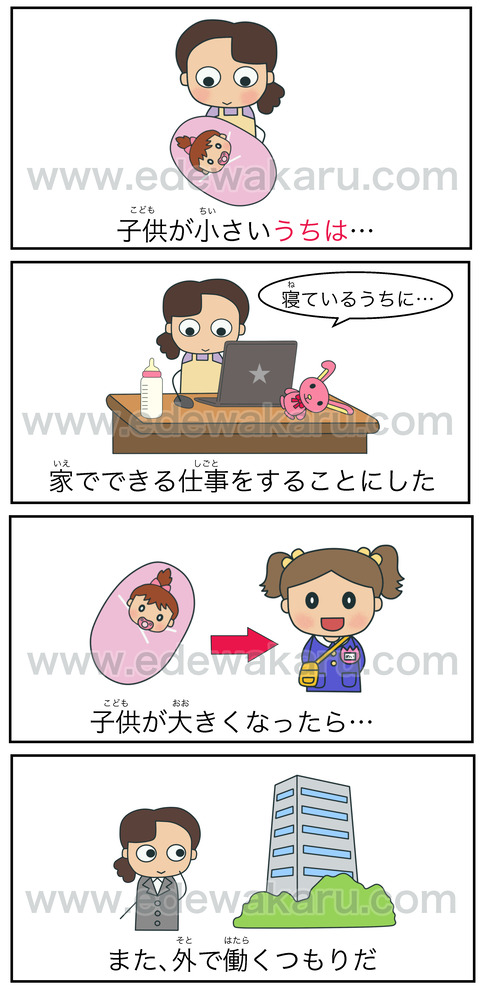
① While my child is young, I’ve decided to work from home.
→ I’ll work from home while my child is young, but I plan to work outside the home once they grow up.
② While I’m a student, I plan to keep working part-time.
→ I’ll keep working part-time while I’m a student, but I might quit after I graduate.
③ While studying abroad, you should study hard.
→ You have to study hard until your study abroad period ends.
④ As long as my mother doesn’t say “OK,” I probably won’t be able to study abroad.
→ While my mother doesn’t say “OK,” I can’t study abroad, but once she does, I’ll be able to.
⑤ While there are people who object, we can’t hold the event.
→ We can’t hold the event while there are people objecting, but we can once they are no longer there.
⑥ As long as you’re healthy, you don’t realize how precious good health is.
→ When you’re healthy, you don’t realize how precious good health is, but if you become ill, you’ll realize how precious it is.
“〜うちは” is a pattern that you have few opportunities to study. 😨 Also, there are many patterns containing “〜うち,” so I think it’s useful for people taking N3 or above to review them. 😉
(Review: 〜ておく)
Review: 〜か〜ないかのうちに
Review: 〜うち (Nのうち)
Review: 〜うちに (while a state continues)
Review: 〜うちに (change)
Review: 〜うちに入らない
In context 6 examples
子供が小さいうちは、家でできる仕事をすることにした
→子供が小さい時は、家でできる仕事をすることにした(復習:〜ことにする)While my child is young, I’ve decided to do work that I can do from home. → While my child is young, I’ve decided to do work that I can do from home. (Review: 〜ことにする)
学生のうちは、アルバイトを続けるつもりだ
→学生でいる時は、ずっとアルバイトを続けるつもりだWhile I’m a student, I plan to keep working part-time. → I plan to keep working part-time for as long as I’m a student.
留学しているうちは、しっかりと勉強するべきだ
→留学している時は、しっかりと勉強するべきだ(復習:〜べきだ)While I’m studying abroad, I should study hard. → I should study hard while I’m studying abroad. (Review: 〜べきだ)
お母さんが「OK」と言わないうちは、留学することはできないだろう
→お母さんが「OK」と言わない間は、留学することはできないだろうAs long as my mother doesn’t say “OK,” I probably won’t be able to study abroad. → While my mother doesn’t say “OK,” I probably won’t be able to study abroad.
反対する人がいるうちは、イベントを開催するわけにはいかない
→反対する人がいる期間は、イベントを開催するわけにはいかない(復習:〜わけにはいかない)While there are people who object, we can’t hold the event. → We can’t hold the event during the period when there are people objecting. (Review: 〜わけにはいかない)
体が健康なうちは、健康のありがたさには、なかなか気づかないものだ
→体が健康な状態の時は、ずっと健康のありがたさには気づかないものだ(復習:なかなか〜ない)(復習:〜ものだ(本来の性質・一般的考え方・変わらない事実))As long as you’re healthy, you don’t easily realize how precious good health is. → When your body is healthy, you never realize how precious good health is. (Review: なかなか〜ない) (Review: 〜ものだ (inherent nature/general way of thinking/unchanging fact))
Read the original source text
Meaning
〜の状態が続く期間は、ずっと〜する
How to use it
動詞[辞書形]+うちは
動詞[ない形]+うちは
動詞[ている形]+うちは
形容詞[辞書形]+うちは
名詞[辞書形]+のうちは
Explanation
「〜うちは」は
「〜の状態が続く期間は、ずっと〜」
という意味を表す文型です。この文型は、「〜の状態が続く期間はずっと〜するが、〜の状態が終わったら、状況が変わるかもしれない」ということを強調したい場合に使われます😮
[例]
①子供が小さい
うちは、家でできる仕事をすることにした
→子供が小さい時は家で仕事をするが、大きくなったら外で働くつもりだ
②学生の
うちは、アルバイトを続けるつもりだ
→学生の時はアルバイトを続けるが、
卒業したらやめるかもしれない
③留学している
うちは、しっかりと勉強するべきだ
→
留学が終わるまでは
しっかりと勉強しなければいけない
④お母さんが「OK」と言わない
うちは、留学することはできないだろう
→お母さんが「OK」と言わない間は、留学はできないが、
「OK」と言ったら留学できる
⑤反対する人がいる
うちは、イベントを開催するわけにはいかない
→反対する人がいる期間はイベントを開催できないが、
反対する人がいなくなったら開催できる
⑥体が健康な
うちは、健康のありがたさには気づかないものだ
→健康な時は健康のありがたさには気づかないが、病気になったら健康はありがたいと気づくだろう
「〜うちは」は勉強する機会が少ない文型です😨また「〜うち」とつく文型はたくさんありますので、N3以上を受ける人は復習をしておくといいと思います😉
(復習:〜ておく)
復習:〜か〜ないかのうちに
復習:〜うち(Nのうち)
復習:〜うちに(状態継続時)
復習:〜うちに(変化)
復習:〜うちに入らない
毎日のんびり日本語教師
How to use it
Noun + のうちは
な-adjective stem + なうちは
い-adjective plain form + うちは
Verb ている form + うちは
Verb negative form + ないうちは
Explanation
Expresses a period during which a certain state or situation continues.
The latter clause describes the nature or state of something under the circumstances in the preceding clause.
This pattern implies that when the situation in the preceding clause changes, the situation in the latter clause will also change.
Notes
The 「うち」series
In context 8 examples
今のうちはまだいいだろう。
For now, it'll probably be fine.
初めのうちはあまり無理しないようにしてください。
Try not to push yourself too hard at first.
子供のうちは学校での世界が全てになりがち。
When they're children, they tend to see the world at school as everything.
自分が正しいと思っているうちは他からの意見で成長することはない。
As long as you think you're right, you won't grow from other people's opinions.
太陽があるうちは暑いから出かけたくない。
I don't want to go out while the sun is up because it's hot.
自分で稼いだお金は、独り身のうちは自分のために使いたい。
While I'm single, I want to spend the money I earned myself on myself.
元気なうちは定年関係なしにしっかり働きたい。(我想在身体好的时候不考虑退休年龄好好工作。)
While I'm healthy, I want to keep working hard regardless of the retirement age. (While I'm healthy, I want to work hard regardless of the retirement age.)
若いうちはケガの治りも早い。(年轻的时候伤好的也很快。)
When you're young, injuries heal quickly. (Injuries heal quickly when you're young.)
Read the original source text
How to use it
名詞+のうちは
な形容詞語幹+なうちは
い形容詞普通形+うちは
動ている形+うちは
動ない形+ないうちは
Explanation
ある状態・状況が持続している期間を表します。
後件では前件の状況下における物事の性質や状態を述べます。
前件の状況が変化すると後件の状況も変化してしまうことを暗示する文型です。
Notes
「うち」シリーズ