絵でわかる日本語
Meaning
Leave something undone.
Leave something as it is without doing it.
How to use it
Verb [ない-form] + でおく
Verb [ない-form] + ずにおく
Explanation
「〜ないでおく・〜ずにおく」 is a sentence pattern meaning “leave something undone” or “leave it as it is without doing it.” It is used when there is some reason or purpose for not doing something and leaving things as they are. 「〜ないでおく」 and 「〜ずにおく」 can be used interchangeably.
When 「〜ずにおく」 is used with 「する」, it becomes 「〜せずにおく」 😊 Review 「〜ておく」.
[Example]
Let’s not eat breakfast.
=Let’s refrain from eating breakfast.
There are many patterns that include 「〜ないで・〜ずに」, so review them as well 😀
[Patterns that include 「〜ないで・〜ずに」]
In context 5 examples
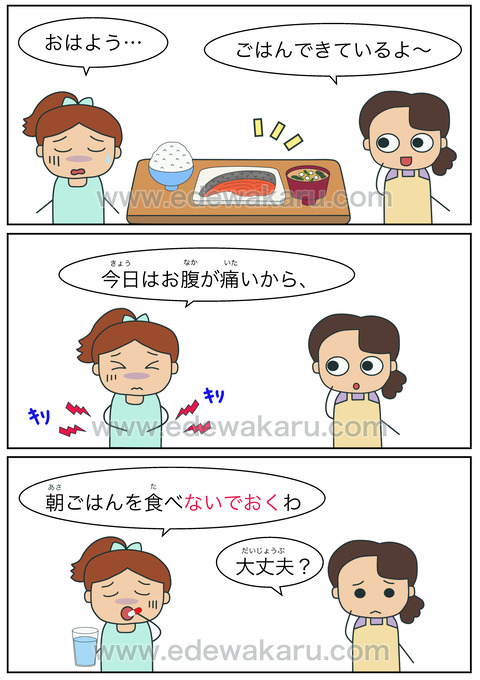
今日はお腹が痛いから、朝ごはんを食べないでおくわ
→朝ごはんを食べない状態にしておくわMy stomach hurts today, so I’ll leave breakfast uneaten. →I’ll leave myself in a state of not eating breakfast.
娘:なんで起こしてくれなかったの!?母:いつも起こしても起きないから、今日は起こさないでおいたのよ!
→今日は起こさないままにしておいたのよDaughter: Why didn’t you wake me up!? Mother: You never get up even when I wake you, so today I left you un-woken! →Today I left you as you were, without waking you.
貯金するために、お年玉は使わないでおいた
→お年玉は使わない状態にしておいたI left my New Year’s gift money unused so I could save it. →I left my New Year’s gift money in an unused state.
日本語を忘れないでおくために、毎日勉強するようにしています
→日本語を忘れない状態にしておくために、毎日勉強するようにしていますI try to study every day so that I don’t forget Japanese. →I try to study every day to keep myself from forgetting Japanese.
まだ宿題が終わっていないから、机の上は片付けないでおいてね
→机の上は片付けない状態のままにしておいてねI haven’t finished my homework yet, so leave the desk as it is, okay? →Leave the desk as it is without tidying it up, okay?
Read the original source text
Meaning
〜しないままでおく
〜しないで、そのままの状態にしておく
How to use it
動詞[ない形]+でおく
動詞[ない形]+ずにおく
Explanation
「〜ないでおく・〜ずにおく」は「〜しないままでおく」「〜しないで、そのままの状態にしておく」という意味の文型です。何か理由・目的があって、「〜しないで、そのままにしておく」「〜のために、そのままの状態にしておく」という意味で使われます。「〜ないでおく」と「〜ずにおく」はチェンジすることができます。
「〜ずにおく」を「する」に使う場合は「〜せずにおく」になります
😊「〜ておく」の復習をしておきましょう。
[例]
朝ごはんを食べないでおこう
=朝ごはんを食べずにおこう
「〜ないで・〜ずに」がつく文型はたくさんありますので、復習をしておきましょう😀
【「〜ないで・〜ずに」がつく文型】
日本語文型辞典
Meaning
Basic information: V-ずにおく. Expresses deliberately refraining from an action for some reason. Examples: ① My father got a phone call, but he seemed tired and was sleeping soundly, so I left him undisturbed. ② It would be a shame if she were shocked, so let’s not tell her about this for the time being. ③ I thought I might need it later, so I left the money I was given unspent. ④ If you’re having tests at the hospital tomorrow, wouldn’t it be better not to eat dinner?
Read the original source text
Meaning
基本情報V-ずにおく説明何かのために、ある行為をしないでおくことを表す。例文① 父に電話がかかってきたが、疲れてよく寝ているようだったので起こさずにおいた。② 彼女がショックを受けるとかわいそうだから、このことは当分言わずにおきましょう。③ あとでいるかもしれないと思って、もらったお金は使わずにおいた。④ あした病院で検査を受けるなら、夕飯は食べずにおいたほうがいいんじゃないですか。
日本語文型辞典 英語版
Meaning
【ずにおく】[V-ずにおく]
Expresses that, for some reason, a certain action is deliberately not taken.
In context 4 examples
父に電話がかかってきたが、疲れてよく寝ているようだったので起こさずにおいた。
There was a telephone call for my father, but since he was tired and sleeping soundly, I didn’t wake him up.
彼女がショックを受けるとかわいそうだから、このことは当分言わずにおきましょう。
It would be cruel to give her such a shock, so let’s not tell her about this for the time being.
あとでいるかもしれないと思って、もらったお金は使わずにおいた。
I thought I might need it later, so I didn’t use the money I had received.
あした病院で検査を受けるなら、夕飯は食べずにおいたほうがいいんじゃないですか。
If you’re going to have tests done at the hospital tomorrow, isn’t it better not to have any dinner?
NINJAL 日本語文型データベース
Meaning
Used when you want to say that, with some intention, you keep something in a state of not having done something.
How to use it
Notes
「〜」 takes a verb expressing a volitional action, such as 「食べる・言う・片付ける・消す」.
In context 5 examples
食後のデザートは後で食べようと思って食べずにおいた。それなのに、妹に食べられてしまった。
I thought I’d have dessert after the meal, so I left it uneaten. Even so, my younger sister ate it.
母は心配しすぎるから、私が転職したことは言わずにおくつもりだ。
My mother worries too much, so I intend not to tell her that I changed jobs.
肌荒れを早く治すには、あまり触らずにおいたほうがいいそうだ。
Apparently, it’s better to leave irritated skin alone if you want it to heal quickly.
食べ終わったら、食器はそのまま片付ずにおいてください。
When you’ve finished eating, please leave the dishes as they are without putting them away.
彼もよく考えて言ったことだろうから、今は否定せずにおいた。
He probably gave it a lot of thought before saying it, so I left it without rejecting it for the moment.
Read the original source text
Meaning
ある意図があって、~しないままの状態に保つと言いたいときに使います。
How to use it
Notes
「〜」には、「食べる・言う・片付ける・消す」など、意志的な動作を表す動詞がきます。