日本語文型辞典
Meaning
Basic information
Derived from the literary auxiliary “ず.” Expresses negation. Used only in written language and conventional expressions. In spoken language, “なくて” and “ないで” are used. It is formed by changing “ない” in “V-ない” to “ず.” “する” becomes “せず.”
Means “V-ないで” or “V-なくて.” ① simply links sentences and means “without giving up.” As in ③ and ④, it often expresses a reason when the causal relationship between the preceding and following sentences is clear. It is also used in spoken language, but is somewhat formal and characteristic of written language.
Means “neither X nor Y.” Sometimes words with similar meanings are listed, as in ①, ②, and ③; other times, contrasting words are listed, as in ④, ⑤, and ⑥. ③ means “all of them are equally wonderful” when comparing several things; ④ means “maintaining a suitable distance”; ⑤ means “neither hot nor cold.” These are idiomatic expressions. Others include “鳴かず飛ばず.”
How to use it
V-ず
…ず、…ず
A-からず、A-からず
V-ず、V-ず
In context 10 examples
途中であきらめず、最後までがんばってください。
Please keep going to the end without giving up halfway.
1時間待っても雨は止まず、ぬれて帰った。
Even after waiting an hour, the rain didn’t stop, so I went home wet.
出発前日まで予約が取れず、心配させられた。
I couldn’t get a reservation even by the day before departure, which made me worry.
だれにきいても住所がわからず、困った。
No matter whom I asked, I couldn’t find out the address, and I was at a loss.
飲まず食わずで三日間も山中を歩きつづけた。
I continued walking through the mountains for as long as three days without eating or drinking.
その時、彼はあわてず騒がず一言「失礼しました」と言って部屋を出ていった。
At that moment, he calmly said, “Excuse me,” and left the room.
展覧会に出品されている作品はいずれも負けず劣らずすばらしい。
All the works exhibited are equally wonderful, none better or worse than the others.
独立した子供達とは、つかず離れずのいい関係だ。
I have a good relationship with my grown-up children: close, but not too close.
日本の5月は暑からず、寒からずちょうどいい気候です。
May in Japan has just the right climate: neither too hot nor too cold.
客は多からず、少なからずほどほどだ。
There are a moderate number of customers—not too many and not too few.
Read the original source text
Meaning
基本情報説明文語の助動詞「ず」から。否定の意味を表す。書きことばや慣用的な表現でしか用いない。話しことばでは「なくて」「ないで」が使われる。「V-ない」の「ない」を「ず」に変えて作る。「する」は「せず」となる。
「V-ないで」「V‐なくて」という意味。①は単に文を並べて、「あきらめないで」という意味。③④のように、前の文と後ろの文の因果関係がはっきりしていて、理由を表す表現になることが多い。話しことばでも使うが、多少かたい、書きことば的表現。
「XでもないしYでもなくて」という意味を表す。①②③のように同じ様な意味の言葉を並べる場合と、④⑤⑥のように対照的な言葉を並べる場合とがある。③はいくつかを比べて「そのいずれもが同じようにすばらしい」、④は「ほどよい距離を保って」、⑤は「暑くなく、寒くなく」の意味。慣用句的な表現。他に「鳴かず飛ばず」など。
How to use it
V-ず
…ず、…ず
A-からず、A-からず
V-ず、V-ず
IMABI
The Auxiliary Verb ~ず I
Read this IMABI lesson ↗Explanation
The Auxiliary Verb ~ず I
~ず is the Classical Japanese negation auxiliary verb. Despite being an archaism, it is still used in a variety of situations, including several grammatical structures and set phrases.
The Auxiliary Verb ~ず
The function of ~ず is to show negation. This means that it is going to follow the 未然形 of verbs. However, because it is older, it follows the original 未然形. So, for verbs whose 未然形 may have changed over the centuries, it is still the original one that is used with ~ず.
Though extremely infrequent and almost entirely limited to set phrases, given that it has the potential to be attached to the 未然形 of adjectives, the following chart will show how to conjugate with it for both verbs and adjectives.
Class Example Verb 未然形 未然形+ず
一段 Verbs 見る 見– 見ず
五段 Verbs 学ぶ 学ば– 学ばず
サ変 Verb する せ– せず
カ変 Verb 来る 来(こ)- 来ず
形容詞 少ない 少なから– 少なからず
形容動詞 (Most Rare) 華麗だ 華麗なら– 華麗ならず
~ず also has three sets of bases, and as a consequence, a rather complicated history behind them. However, luckily for you, only the 連体形 ~ぬ and ~ざる and the 連用形・終止形-ず are ever used today.
The 連体形 ~ぬ is used quite a lot, although it is typically limited to set phrases or more literary settings. It can also be used as the 終止形. ~ん comes from this usage. However, ~ない is said to derive from ~なふ, which came into being in northern Japanese dialects during the classical period. The ざる-連体形 is even more limited, and it is typically only seen in set phrases. However, it does find itself in the phrase ~ざるを得ない.
~ずに is just like ~ないで. ~ず as the 連用形 can also function like ~なくて. However, the form ~ずに is going to always be equivalent to ~ないで.
Examples
1. 連絡が取れず、心配しました。(Somewhat formal)
Without having contact, I got worried.
Grammar Note: The above sentence uses ~ず in the 連用形.
2. 分からず屋 (Set Phrase)
An obstinate person.
3. 人知れず焦がれる。
To inwardly yearn for.
Word Note: 人知れず literally means “without it being known to people”.
4. 新都はいまだ成らず。(Classical)
The new capital is still not completed.
From the 方丈記.
5. 絶えざる不安 (Archaic/old-fashioned)
Anxiety that won’t cease
6. 見ざる聞かざる言わざる・見猿聞か猿言わ猿 (Set Phrase)
See no evil, hear no evil, speak no evil.
Phrase Note: This expression is usually turned into a pun about monkeys, especially the ones that enter 温泉 in Japan.
7a. やる瀬ぬ X
7b. やる瀬(が)ない 〇
Helpless
Grammar Note: やるせぬ comes from an over-generalization of ~ぬ.
8. 彼は知らずに側にいた。
He was by my side without knowing it.
9. 生き急がずに、ときには立ち止まってあたりを見回すのもいいよ。
It’s also good to just stop once and awhile and look around and not live one’s life so fast.
10. 何も書かん。 (Slang; dialectical)
I won’t write anything.
11. それは開いた口が塞がらぬことだ。 (ちょっと古風)
That’s a jaw-dropping situation.
12. 取りも直さずやりくりが大変になるということだ。(Set phrase)
Which is to say, managing will become challenging.
13. 怖いものもあらず。(Archaic)
To not even have things one is scared of.
14a. 好ましからざる状態 (古風な書き言葉)
14b. 好ましくない状態 (話し言葉)
An unfavorable situation
15. 瀧野は金彌の片足を拾い上げて、土踏まずを摑んだ。
Takino picked up one of Kanaya’s legs and gripped her foot’s arch.
From 『童謡』 by 川端康成.
16. 雪を積らせぬためであろう、湯槽ゆぶねから溢あふれる湯を俄にわかづくりの溝みぞで宿の壁沿いにめぐらせてあるが、玄関先では浅い泉水せんすいのように拡ひろがっていた。
It must be because they don’t allow snow to pile up, but the hot water flowing from the tubs was made to encircle the inn along the walls in a make-shift ditch, and it stretched like shallow spring water at the entrance.
From 『雪国』 by 川端康成.
Grammar Note: せぬ is not しない in this sentence. Rather, 積らせぬ is a negative form of the causative form of 積る.
17. それにしても、さっき、吉田と向き合った自分は、いかにも惨めに見えたことだろうと思うと、言いしれぬ侘しさが心を冷やしていく。
Even so, as I thought how wretched I, who had been face to face with Yoshida, a while ago, indescribable dreariness cooled my mind off..
From 『冷たい誘惑』by 乃南アサ.
18. このため石井委員長は、「内閣ないかくが取った措置そちは参議院予算委員会さんぎいんよさんいいんかいを愚弄ぐろうするものであると同時に、憲法けんぽうの精神 せいしんに反かえしており、断だんじて容認ようにんするわけにはいかず、予算委員長として政府に猛省もうせいを促うながす」と批判したうえで、委員会を休憩きゅうけいにしました。
As so, Chairman Ishi’i put the committee on recess upon criticizing that “the measures that the cabinet took mock the House of Chancellors Budget Committee and at the same time are against the spirit of the constitution, and being absolutely impossible to approve, as the budget chairman, I urge to the government to reconsider seriously”.
From NHK 区割わり法案 参院否決と見なす動議提出 2013年6月24日
Part of Speech Note: Set expressions like 土踏まず have gone from being verbal in nature to referring to the none that it represents this. This word means “arch of the foot”.
19. だが、さしのべられる手に応えた向こうみずがいた。
But, there was a foolhardy person that responded to the hand extended.
From 『野生の風』 by 村山由佳.
Word Note: In the sentence above, 向こう見ず is used as a noun, and in other contexts it can act as a 形容動詞.
20. だから心ならずも、最後の大事な仕事を片づけることができなかったのだ。
Against his heart’s intentions, however, he couldn’t finish the final, important job.
From 『海辺のカフカ』 by 村上春樹.
Phrase Note: ならずも is a combination なり, the Classical copula, + ず + も, which also follows ず in other set phrases such as 図らずも (unexpectedly).
21. 君はなんといってもただの未成熟な、寸足らずの幻想にすぎないわけだからね。
No matter what you may say, it’s because you’re no more than a lacking, immature illusion.
From 『海辺のカフカ』 by 村上春樹.
Phrase Note: 寸足らず is a set phrase that functions as a 形容動詞 or attribute that takes の. 寸 is a traditional unit of measurement equivalent to 3.03 cm. ~足らず is a suffix that means “just under”, and it gives a strong sense of lacking as the verb 足る in the negative suggests. In this sentence, 寸足らず stresses the inferiority of the addressee.
22. 村は鎮守ちんじゅの杉林すぎばやしの陰かげに半ば隠れているが、自動車で十分足らずの停車場の灯火とうかは、寒さのためぴいんぴいんと音を立てて毀こぼれそうに瞬まばたいていた。
The village was half hidden by its Shinto shrine grove, and the lamplight from the train station under ten minutes away by car flickered and made a great noise due to the cold like it was going to give way.
From 雪国 by 川端康成.
23. 細かい手の器用きようなさばきは耳に覚えていず、ただ音の感情が分かる程度の島村は、駒子こまこにはちょうどよい聞き手なのであろう。
Her fine, clever hand movements couldn’t be felt, but Shimura, who could only understand the emotion to the sound, was surely just the right listener to Komako.
From 雪国 by 川端康成.
Grammar Note: Typically, いる + ず is おらず, which utilizes the humble form to prevent the phrase from sounding odd, but the form いず still exists. This use is rather rare, so it is best for you to not use it. However, it does exist. So, don’t get confused when it does appear.
24. 宴会では半玉が太鼓を叩いて踊らねばならぬので、その五六人がこの家へ入らぬ日はなく、時折の滞在の間に、瀧野は彼女等の顔を見覚えてしまっていた。
Since young geisha’s have to beat taiko and dance at banquets, there wasn’t a day those five, six people didn’t come in this house, and while they stayed occasionally, and Takino ended up remembering their faces.
From 童謡 by 川端康成.
25. この家へ来なければお茶を引いていると芸者の言うのが、満更お世辞でないほど、町へ来るお客の大半はここ一軒に取られてしまうのだとすると、女中の言葉も全く信じられぬではなかった。
If you suppose that the majority of the guests that come to the town are taken in this one place to the point that what the geisha said about if she didn’t come to this house that she was on break is not completely flattering, one couldn’t completely disbelieve the maid’s words too.
From 童謡 by 川端康.
Grammar Note: Notice how the 連体形-ぬ is functioning as a nominal without the aid of の.
26. わが信ずる運命を手向たむけ、死によって互かたみの悲劇を理解しようがために、こりずまに剣を交わして戦ったのだ。
Offering the destiny I believed in, I incorrigibly fought and crossed swords in order to understand the mutual tragedy by death.
From 軽王子かるのみこと衣通姫そとおりひめ by 三島由紀夫.
Grammar Note: The ま in こりずま is a suffix used to show a certain condition.
27. 問とうは一いっ時ときの恥はじ問とわぬは末まつ代だいの恥はじ。(Proverb)
It is better to ask and be embarrassed than not ask and never know.
28. 小六が帰りがけに茶の間を覗いたら、御米は何にもしずに、長火鉢に倚り掛かっていた。
As Koroku was about to go home, he took a glance around the living room, and Oyome was leaning against an oblong brazier doing nothing.
From 門 by 夏目漱石.
Dialect Note: We can assume that しずに is an old, dialectical variant of せずに.
29. きつからず緩からずで休憩をするところを見つけられず、辿った道を振り返った。
Though (the journey was) neither harsh or smooth, having not been able to find a place to rest, I turned around to where I had come.
30. 天を恨みず人を尤めず
To not spite heaven and fault no one; to recover by reflecting on oneself
Conjugation Note: 恨む・怨む used to be a 上二段 verb. What this means is that the bases of conjugation alternated between i and u. So, the 未然形 would have been うらみ. Because it looked like a 五段 verb, it eventually became one. Thus, in Modern Japanese, 怨まず exists. However, set phrases cannot be changed.
Speech Modals with -ず
~ずにはいられない
~ずにはいられない means “can not help but…” Variants of ~ずにはいられない include ~ずにはすまない, ~ずにはおかない, and ~ずにはすまさない.
31. 勉強せずに、受験したから、落第しちゃった。
Because I took the exam without studying, I ended up failing it.
Grammar Note: You must use the 未然形-せ- of する.
32. 心配せずにはいられない。
I couldn’t help but worry.
33. 懲らしめてやらずにはおかない。
I couldn’t help but give him punishment.
34. 怒らせずにはすまないでしょう。
You probably can’t help but get angry, right?
35. 泣き出さずにはすまさない。
I can’t help but cry profusely.
~ずと
~ずと is a variant of ないでも and is often seen in the set phrase 言わずと知(し)れた. It is classical, so it would only be seen in such set phrases in the spoken language. Otherwise, it would be limited to writing styles and situations suitable for 古語的な書き言葉.
36. 言わずと知れたことだ。
It’s an obvious thing.
37. 文句を言わずと話を聞け。
Listen even if you don’t argue.
~に過ぎず
This is merely a form of ~に過ぎない, which is used to show that something doesn’t even pass a certain extent.
38. したがって、現代かなづかい論者の一人である吉川幸次郎博士が、日本語は発音をそのままに表記し得ることを大きな特徴とし、かつその表記法の歴史は、この特徴を生かしつつ発展して来たと述べていることを引用 し、発音をそのままに表記し得ることは、とりもなおさず表音式であり、表音文字=表音式であって、現代語に基づくことと表音式との差は五十歩百歩に過ぎず、現代かなづかいが、もともと表音的性格を有している仮名の線を、さらに徹底せしめたものであってみれば、現代かなづかいは表音式だと言い切ってさしつかえないと思うと述べている福田発言は、正しい判断と言ってよい。
Hence, Professor Kojiro Yoshikawa, one advocate of Modern Kana Orthography, cites that Japanese has had the great characteristic of being transcribed phonetically and the history of its orthography has developed this characteristic and capitalized on it, which is to say that being able to transcribe the language’s pronunciation phonetically is a phonetic system (phonetic characters = a phonetic system), and with there being a scant difference between basing it on the Modern Language and a phonetic system, Fukuda’s statement which states his belief that “if Modern Kana Orthography tries to be something that furthermore completes the line of Kana which originally possesses a phonetic nature, Modern Japanese Orthography without objection should be called a phonetic system” may very well be a correct judgment.
From 国語国字の根本問題 By 渡部晋太郎.
The main reason for choosing such a long sentence is that it shows how sentences in Japanese can get larger and larger the same way they can in English. Also, there are several uses of ~ず.
39. あやつは一介の庶民にすぎぬものだ。(ちょっと古風)
He is no more than a mere commoner.
~に忍びず
~に忍びず means “cannot stand to”. It is synonymous to ~に耐えられない. ~に忍びない is another more common form.
40. 見るに忍びぬ惨状さんじょうだった。
It was a sight too gruesome to stand seeing.
41. 物を捨てるのは忍びない。
I can’t stand throwing things away.
42. 捨てるには忍ばないと、彼はポケットに入いれた。
Not able to stand throwing it away, he put it in his pocket.
~ずじまい
This is a particularly odd expression. As you can imagine by looking at it, it is simply expressing a circumstance of ending up not doing something. This is actually occasionally used in the spoken language, and it is often treated as creative language. It is rather unique that voicing occurs with しまい.
43. 食べてしまおう、言えずじまい。
I’ll eat (them) all, not able to say a word.
From Chocolate Prayer by DIV
~ならいざ知らず
This pattern means that if X is the case, something might be so, but since the circumstances are completely different, so are the results. It often follows words of extremes like 神、大昔、赤ん坊、 ヒマラヤ、etc. What follows is something opposite of it, showing a sense of dissatisfaction or astonishment.
44. 安やすいホテルならいざしらず、一流いちりゅうホテルでこんなにサービスが悪わるいなんてとても信しんじられないよね。
I don’t know about cheap hotels, but I can’t even believe how awful this service is from a first-class hotel.
45. 3さん歳さいの子供こどもならいざいしらず、大人おとながこんなことを知しらないなんておかしい。
I don’t know about a three year old, but it’s strange that an adult doesn’t know something like this.
46. 新人しんじんならいざ知しらず、君きみがあんなことをするなんて。
I don’t know about newcomers, but you doing something like that…
47. 小ちいさい子供こどもならいざ知しらず、お年頃としごろの子供達こどもたちにはつまらないかもしれない。
I don’t know about small children, but (this) might be boring to older children.
48. プロ選手せんしゅならいざ知しらず、アマチュア選手せんしゅには無理むりでしょう。
I don’t know about pro-athletes, but it’s probably too much for an amateur athlete.
In context 50 examples
連絡が取れず、心配しました。(Somewhat formal)
Without having contact, I got worried.
分からず屋 (Set Phrase)
An obstinate person.
人知れず焦がれる。
To inwardly yearn for.
新都はいまだ成らず。(Classical)
The new capital is still not completed.
絶えざる不安 (Archaic/old-fashioned)
Anxiety that won’t cease
見ざる聞かざる言わざる・見猿聞か猿言わ猿 (Set Phrase)
See no evil, hear no evil, speak no evil.
やる瀬ぬ X
Helpless
やる瀬(が)ない 〇
Helpless
彼は知らずに側にいた。
He was by my side without knowing it.
生き急がずに、ときには立ち止まってあたりを見回すのもいいよ。
It’s also good to just stop once and awhile and look around and not live one’s life so fast.
何も書かん。 (Slang; dialectical)
I won’t write anything.
それは開いた口が塞がらぬことだ。 (ちょっと古風)
That’s a jaw-dropping situation.
取りも直さずやりくりが大変になるということだ。(Set phrase)
Which is to say, managing will become challenging.
怖いものもあらず。(Archaic)
To not even have things one is scared of.
好ましからざる状態 (古風な書き言葉)
An unfavorable situation
好ましくない状態 (話し言葉)
An unfavorable situation
瀧野は金彌の片足を拾い上げて、土踏まずを摑んだ。
Takino picked up one of Kanaya’s legs and gripped her foot’s arch.
雪を積らせぬためであろう、湯槽ゆぶねから溢あふれる湯を俄にわかづくりの溝みぞで宿の壁沿いにめぐらせてあるが、玄関先では浅い泉水せんすいのように拡ひろがっていた。
It must be because they don’t allow snow to pile up, but the hot water flowing from the tubs was made to encircle the inn along the walls in a make-shift ditch, and it stretched like shallow spring water at the entrance.
それにしても、さっき、吉田と向き合った自分は、いかにも惨めに見えたことだろうと思うと、言いしれぬ侘しさが心を冷やしていく。
Even so, as I thought how wretched I, who had been face to face with Yoshida, a while ago, indescribable dreariness cooled my mind off..
このため石井委員長は、「内閣ないかくが取った措置そちは参議院予算委員会さんぎいんよさんいいんかいを愚弄ぐろうするものであると同時に、憲法けんぽうの精神 せいしんに反かえしており、断だんじて容認ようにんするわけにはいかず、予算委員長として政府に猛省もうせいを促うながす」と批判したうえで、委員会を休憩きゅうけいにしました。
As so, Chairman Ishi’i put the committee on recess upon criticizing that “the measures that the cabinet took mock the House of Chancellors Budget Committee and at the same time are against the spirit of the constitution, and being absolutely impossible to approve, as the budget chairman, I urge to the government to reconsider seriously”.
だが、さしのべられる手に応えた向こうみずがいた。
But, there was a foolhardy person that responded to the hand extended.
だから心ならずも、最後の大事な仕事を片づけることができなかったのだ。
Against his heart’s intentions, however, he couldn’t finish the final, important job.
君はなんといってもただの未成熟な、寸足らずの幻想にすぎないわけだからね。
No matter what you may say, it’s because you’re no more than a lacking, immature illusion.
村は鎮守ちんじゅの杉林すぎばやしの陰かげに半ば隠れているが、自動車で十分足らずの停車場の灯火とうかは、寒さのためぴいんぴいんと音を立てて毀こぼれそうに瞬まばたいていた。
The village was half hidden by its Shinto shrine grove, and the lamplight from the train station under ten minutes away by car flickered and made a great noise due to the cold like it was going to give way.
細かい手の器用きようなさばきは耳に覚えていず、ただ音の感情が分かる程度の島村は、駒子こまこにはちょうどよい聞き手なのであろう。
Her fine, clever hand movements couldn’t be felt, but Shimura, who could only understand the emotion to the sound, was surely just the right listener to Komako.
宴会では半玉が太鼓を叩いて踊らねばならぬので、その五六人がこの家へ入らぬ日はなく、時折の滞在の間に、瀧野は彼女等の顔を見覚えてしまっていた。
Since young geisha’s have to beat taiko and dance at banquets, there wasn’t a day those five, six people didn’t come in this house, and while they stayed occasionally, and Takino ended up remembering their faces.
この家へ来なければお茶を引いていると芸者の言うのが、満更お世辞でないほど、町へ来るお客の大半はここ一軒に取られてしまうのだとすると、女中の言葉も全く信じられぬではなかった。
If you suppose that the majority of the guests that come to the town are taken in this one place to the point that what the geisha said about if she didn’t come to this house that she was on break is not completely flattering, one couldn’t completely disbelieve the maid’s words too.
わが信ずる運命を手向たむけ、死によって互かたみの悲劇を理解しようがために、こりずまに剣を交わして戦ったのだ。
Offering the destiny I believed in, I incorrigibly fought and crossed swords in order to understand the mutual tragedy by death.
問とうは一いっ時ときの恥はじ問とわぬは末まつ代だいの恥はじ。(Proverb)
It is better to ask and be embarrassed than not ask and never know.
小六が帰りがけに茶の間を覗いたら、御米は何にもしずに、長火鉢に倚り掛かっていた。
As Koroku was about to go home, he took a glance around the living room, and Oyome was leaning against an oblong brazier doing nothing.
きつからず緩からずで休憩をするところを見つけられず、辿った道を振り返った。
Though (the journey was) neither harsh or smooth, having not been able to find a place to rest, I turned around to where I had come.
天を恨みず人を尤めず
To not spite heaven and fault no one; to recover by reflecting on oneself
勉強せずに、受験したから、落第しちゃった。
Because I took the exam without studying, I ended up failing it.
心配せずにはいられない。
I couldn’t help but worry.
懲らしめてやらずにはおかない。
I couldn’t help but give him punishment.
怒らせずにはすまないでしょう。
You probably can’t help but get angry, right?
泣き出さずにはすまさない。
I can’t help but cry profusely.
言わずと知れたことだ。
It’s an obvious thing.
文句を言わずと話を聞け。
Listen even if you don’t argue.
したがって、現代かなづかい論者の一人である吉川幸次郎博士が、日本語は発音をそのままに表記し得ることを大きな特徴とし、かつその表記法の歴史は、この特徴を生かしつつ発展して来たと述べていることを引用 し、発音をそのままに表記し得ることは、とりもなおさず表音式であり、表音文字=表音式であって、現代語に基づくことと表音式との差は五十歩百歩に過ぎず、現代かなづかいが、もともと表音的性格を有している仮名の線を、さらに徹底せしめたものであってみれば、現代かなづかいは表音式だと言い切ってさしつかえないと思うと述べている福田発言は、正しい判断と言ってよい。
Hence, Professor Kojiro Yoshikawa, one advocate of Modern Kana Orthography, cites that Japanese has had the great characteristic of being transcribed phonetically and the history of its orthography has developed this characteristic and capitalized on it, which is to say that being able to transcribe the language’s pronunciation phonetically is a phonetic system (phonetic characters = a phonetic system), and with there being a scant difference between basing it on the Modern Language and a phonetic system, Fukuda’s statement which states his belief that “if Modern Kana Orthography tries to be something that furthermore completes the line of Kana which originally possesses a phonetic nature, Modern Japanese Orthography without objection should be called a phonetic system” may very well be a correct judgment.
あやつは一介の庶民にすぎぬものだ。(ちょっと古風)
He is no more than a mere commoner.
見るに忍びぬ惨状さんじょうだった。
It was a sight too gruesome to stand seeing.
物を捨てるのは忍びない。
I can’t stand throwing things away.
捨てるには忍ばないと、彼はポケットに入いれた。
Not able to stand throwing it away, he put it in his pocket.
食べてしまおう、言えずじまい。
I’ll eat (them) all, not able to say a word.
安やすいホテルならいざしらず、一流いちりゅうホテルでこんなにサービスが悪わるいなんてとても信しんじられないよね。
I don’t know about cheap hotels, but I can’t even believe how awful this service is from a first-class hotel.
3さん歳さいの子供こどもならいざいしらず、大人おとながこんなことを知しらないなんておかしい。
I don’t know about a three year old, but it’s strange that an adult doesn’t know something like this.
新人しんじんならいざ知しらず、君きみがあんなことをするなんて。
I don’t know about newcomers, but you doing something like that…
小ちいさい子供こどもならいざ知しらず、お年頃としごろの子供達こどもたちにはつまらないかもしれない。
I don’t know about small children, but (this) might be boring to older children.
プロ選手せんしゅならいざ知しらず、アマチュア選手せんしゅには無理むりでしょう。
I don’t know about pro-athletes, but it’s probably too much for an amateur athlete.
The Auxiliary Verb ~ず II
Read this IMABI lesson ↗Explanation
第012課: The Auxiliary Verb ~ず II
~ず is still used infrequently in Modern Japanese, howbeit typically in archaic expressions and set phrases. In this lesson, we will finally learn all about the auxiliary verb ~ず so that we can better understand Classical Japanese!
The Auxiliary Verb -ず
The auxiliary verb ~ず follows the 未然形 to show the negative. This is the easiest part about it. ~ず has three sets of bases. This is the hardest part about it. Throughout this lesson we’ll study ~ず by using the chart below. The base sets will be referred to by their respective 連用形.
未然形 な X ざら
連用形 に ず ざり
終止形 X ず X
連体形 ぬ X ざる
已然形 ね X ざれ
命令形 X X ざれ
The first base sequence of the negative auxiliary verb was な-, に-, X, ぬ-, ね-, and X. The な-未然形 and the に-連用形 faded away and the 連用形 was replaced with ~ず. This in turn became the 終止形. A third set of bases was created with the fusion of ~ず with あり. The base sets are interchangeable. For example, ~ぬ and ~ざる are both common.
Temporally speaking, although ず ultimately comes from にす, Old Japanese already had ず as the終止形. The third column most definitely appears later on in Middle Japanese.
The に- Bases
The な-未然形 was used in the speech modal ~なくに, which meant “because…isn’t”. It was also a 語尾 meaning “how…isn’t?”
1. み山には松まつの雪だに消きえなくに 都みやこは野辺のべの若菜摘わかなつみけり。
As even the snow on the pine trees hasn’t disappeared in the mountains, the (people in the) capital gathered young greens from the fields!
From the 古今和歌集.
Nuance Note: The prefix み- in this poem is used as a beautifier.
The に-連用形 was used in the Nara Period (奈良時代) in the same way as the modern ~なくて.
2. 去方乎不知 舎人者迷惑 行くへを知らに舎人とねりはまどふ
Not knowing the way to go, the low-ranking officials working for the nobility wander about.
From the 万葉集.
Culture Note: A とねり was a low-ranking official who worked for the nobility.
3. たづきを知らに
Not knowing the livelihood
The 連体形 and the 已然形 weren’t lost like the 未然形 and 連用形.
4. 人こそ知らね。
Though people don’t know.
Grammar Note: The particle こそ has the following verb be in the 已然形 in Classical Japanese.
5. 京みやこには見えぬ鳥なれば
Since it was a bird not seen in the capital
From the 伊勢物語.
Grammar Note: The 連体形 is used because the verb 見ゆ, the Classical form of 見える, is used as negative participle.
6. 八重葎茂やえむぐらしげれる宿やどの寂さびしきに人こそ見えね秋は来にけり
Although you could see no person in the loneliness of the lodge thickened with mixed weeds, autumn ended up coming.
From the 新日本古典文学大系.
Grammar Note: This sentence is in the 已然形 because of the particle こそ. Don’t mind other Classical grammar items.
7. いとやむごとなき際きはにはあらぬがすぐれて時めき給たまふありけり
The person didn’t have very high regards in status and found favor in particular.
From the 源氏物語.
Grammar Note: The 連体形 is used with conjunctive particles such as が.
8. 人の歌の返かえしとすべきをえ詠よみ得えぬほども心許こころもとなし
You should respond quickly to a person’s poem, and when you’re unable to write one, it (the situation) is precarious.
From the 枕草子.
Grammar Note: え…-ず is the negative potential. The 連体形, 読み得ぬ, modifies the noun ほど. The particle を in this sentence is interchangeable with the particle が.
9. 法師ほふしばかり羨うらやましからぬものはあらじ
Nothing/none is probably as unenviable as a priest.
From the 徒然草.
The ず- Bases
How did ~ず come from n-sounds? The incomplete first column of bases is the primary reason for the evolution that brought forth three sets of bases. To make a 終止形, the 連用形 combined with す, the Classical する, to create ~にす which became ~んす which became ~んず which became ~ず. ~ず’s 連用形 and 終止形 are still very important in Modern Japanese grammar.
10. 連絡が取れず、心配しました。
Without having contact, I got worried.
Grammar Note: The above sentence uses ~ず in the 連用形.
11. 分らず屋 (Set Phrase)
An obstinate person.
12. 君や来こし行きけむ思ほえず
Did you come? Did I even go? I can’t think naturally.
From the 伊勢物語.
13. 新都しんとはいまだ成ならず。
The new capital has still not materialized.
From the 方丈記.
14. 慈悲じひの心なからむは人倫じんりんに非あらず
If someone didn’t have a heart of compassion, he wouldn’t be human.
From the 徒然草.
Grammar Note: ~ず follows the verb あり (ある in Modern Japanese) normally.
15. 飽あかずして別わかるる袖そでの白玉しらたま
The white jewel of your sleeve which parted from you despite being unsatisfied.
From the 古今和歌集.
16. 悪所あくしよにおちて死しにたからず
I don’t want to die falling into a dangerous place.
From the 平家物語.
17. つゆまどろまれず
I couldn’t doze off even a little.
From the 更級日記.
18. 昔のごとくにもあらず
It’s not even like it was in the past.
From the 大和物語.
19. ゆく川の流れは絶たえずしてしかももとの水みづにあらず
The flowing of the passing water is endless at the same; moreover, it is not the original water.
From the 徒然草.
20. 住まずして誰たれかさとらむ
Without living there, who would understand (the pleasure)?
From the 大和物語.
21. 逢あはずして今宵明こよひあけなば春の日の長くや人をつらしと思はん
Without meeting, and then the evening ending up dawn, I will surely think of you as long as a spring day as being cruel.
From the 古今和歌集.
The ざり- Bases
The ざり- bases came from the fusion of ず- and the supplementary verb あり. The ざり- bases are interchangeable with the other sets but become prevalent in later Classical texts.
At the point of inception, the first and second base sets were essential one as “X, ず-, ず, ぬ, ね-, X”. Both 連用形 were acceptable with ざり- being preferred. The 連体形 were completely interchangeable. As for the 已然形, ね- was preferred when used with bound particles and ざれ- was preferred when used with an ending.
In the 室町時代 the ぬ-連体形 became an interchangeable variant of the 終止形. ~ぬ eventually replaced ~ず as the negative auxiliary verb and evolved into ~ん in the West and into ~ない in the East. When this happened, all of the bases were scrubbed for 形容詞 bases.
Examples
22. つひにゆく道とはかねて聞きしかど昨日今日きのふけふとは思はざりしを。
I had heard before of the path we will eventually go, but I didn’t think that it would be yesterday or today!
From the 古今和歌集.
23. 絶えざる不安
Anxiety that won’t cease
24. 何も書かん。
I won’t write anything.
25. 夢ゆめと知しりせば覚さめざらましを
If I had known that it was a dream, I would’ve never woken up.
From the 古今和歌集.
26. 山高きと知らず。
To not know the mountain is tall.
27. 怖いものもあらず。
To not even have things one is scared of.
28. 自らの信条を吐露せざれ。
Express one’s beliefs.
Speech Modals with ~ず
~ずに & ~ずにはいられない
~ずに and ~ずにはいられない mean “without” and “cannot help but…” respectively and are formed with the ず-連用形.
29. 勉強せずに、受験したから、落第してしまった。
Because I took the exam without studying, I ended up failing it.
Grammar Note: You must use the せ-未然形 of する for all Classical Japanese auxiliary verbs.
29. 心配せずにはいられない。
I couldn’t help but worry.
30. 懲こらしめてやらずにはおかない。
I couldn’t help but give him punishment.
31. 霞立 長春日乃 晩家流 和豆肝之良受
霞立 かすみたつ 長き春日はるひの 暮くれにける わづきも知らず
I also don’t know of the moon setting in the overshadowing long spring day.
From the 万葉集.
32. 怒おこらせずにはすまないでしょう。
You probably can’t help but get angry, right?
33. 泣き出さずにはすまさない。
I cannot help but cry profusely.
Variation Note: ~ずにはいられない variants include ~ずにはすまない, ~ずにはおかない, and ~ずにはすまさない.
~ずは・ずば・ずんば
The main usage of ~ずは is to show negative hypothesis and is equivalent to しないなら in Modern Japanese. So, ~ずは means “if…had not”. In the late 奈良時代 it was also used like ~ずに to mean “without…”. In the medieval era ~ずは was seen as ~ず(ん)ば.
34. 虎穴こけつに入いらずんば虎子こしを得えず。
Nothing ventured, nothing gained.
Literally: Without entering the tiger’s den, you won’t get the tiger’s cub.
35. 降伏こうふくせずば、命はない。
If you don’t surrender, you will not live.
36. 雉きじも鳴かずば撃うたれまい。
If the green pheasant doesn’t cry, let’s not shoot.
37. まろ格子上かうしげずば道なくてげにえ入いり來こざらまし
If I hadn’t raised the lattice, there would have been no path and it would have truly not have been able to come in.
From the 源氏物語.
38. 行かずばなるまい。
We have no choice but to go.
Grammar Note: ~ずばなるまい is the predecessor of ~なければならない.
39. 火に燒かむに燒けずはこそ真まことならめ
When we try to burn it by fire and it cannot burn, it’s definitely the real thing.
From the 竹取物語.
~ずて
The speech modal ~ずて means “not…” and is equivalent to ~ないで.
40. 麻都我延乃 都知尓都久麻掾 布流由伎乎 美受弖也伊毛我 許母里乎流良牟
松が枝の土に着くまで降る雪を見ずてや妹いもが隠こもり居をるらむ
How could you not see the snow that falls up to the earth of the pine tree branches and stay indoors dear?
From the 万葉集.
41. 比等未奈能 美良武麻都良能 多麻志末乎 美受弖夜和礼波 故飛都々遠良武
人皆の見らむ松浦の玉島を見ずてや我われは恋こひつつ居をらむ
Not looking at Matsu’ura no Tamashima that everyone is said to see, I was homesick.
From the 万葉集.
Exercises
1. Illustrate the bases of -ず.
2. What base does -ず follow?
3. Create a sentence using the first column of bases of -ず. Use the example sentences in this lesson to model your sentence.
4. How did -ず come about?
5. Create a sentence with -ず being in the 連用形 or 終止形.
6. Create a sentence with a speech modal utilizing -ず.
7. Create a sentence using the third column of bases of -ず.
8. Create a sentence using -ぬ, the evolved form of -ず.
9. Create a sentence with -ずんば.
In context 51 examples
み山には松まつの雪だに消きえなくに 都みやこは野辺のべの若菜摘わかなつみけり。
As even the snow on the pine trees hasn’t disappeared in the mountains, the (people in the) capital gathered young greens from the fields!
去方乎不知 舎人者迷惑 行くへを知らに舎人とねりはまどふ
Not knowing the way to go, the low-ranking officials working for the nobility wander about.
たづきを知らに
Not knowing the livelihood
人こそ知らね。
Though people don’t know.
京みやこには見えぬ鳥なれば
Since it was a bird not seen in the capital
八重葎茂やえむぐらしげれる宿やどの寂さびしきに人こそ見えね秋は来にけり
Although you could see no person in the loneliness of the lodge thickened with mixed weeds, autumn ended up coming.
いとやむごとなき際きはにはあらぬがすぐれて時めき給たまふありけり
The person didn’t have very high regards in status and found favor in particular.
人の歌の返かえしとすべきをえ詠よみ得えぬほども心許こころもとなし
You should respond quickly to a person’s poem, and when you’re unable to write one, it (the situation) is precarious.
法師ほふしばかり羨うらやましからぬものはあらじ
Nothing/none is probably as unenviable as a priest.
連絡が取れず、心配しました。
Without having contact, I got worried.
分らず屋 (Set Phrase)
An obstinate person.
君や来こし行きけむ思ほえず
Did you come? Did I even go? I can’t think naturally.
新都しんとはいまだ成ならず。
The new capital has still not materialized.
慈悲じひの心なからむは人倫じんりんに非あらず
If someone didn’t have a heart of compassion, he wouldn’t be human.
飽あかずして別わかるる袖そでの白玉しらたま
The white jewel of your sleeve which parted from you despite being unsatisfied.
悪所あくしよにおちて死しにたからず
I don’t want to die falling into a dangerous place.
つゆまどろまれず
I couldn’t doze off even a little.
昔のごとくにもあらず
It’s not even like it was in the past.
ゆく川の流れは絶たえずしてしかももとの水みづにあらず
The flowing of the passing water is endless at the same; moreover, it is not the original water.
住まずして誰たれかさとらむ
Without living there, who would understand (the pleasure)?
逢あはずして今宵明こよひあけなば春の日の長くや人をつらしと思はん
Without meeting, and then the evening ending up dawn, I will surely think of you as long as a spring day as being cruel.
つひにゆく道とはかねて聞きしかど昨日今日きのふけふとは思はざりしを。
I had heard before of the path we will eventually go, but I didn’t think that it would be yesterday or today!
絶えざる不安
Anxiety that won’t cease
何も書かん。
I won’t write anything.
夢ゆめと知しりせば覚さめざらましを
If I had known that it was a dream, I would’ve never woken up.
山高きと知らず。
To not know the mountain is tall.
怖いものもあらず。
To not even have things one is scared of.
自らの信条を吐露せざれ。
Express one’s beliefs.
勉強せずに、受験したから、落第してしまった。
Because I took the exam without studying, I ended up failing it.
心配せずにはいられない。
I couldn’t help but worry.
懲こらしめてやらずにはおかない。
I couldn’t help but give him punishment.
霞立 長春日乃 晩家流 和豆肝之良受
霞立 長春日乃 晩家流 和豆肝之良受
怒おこらせずにはすまないでしょう。
You probably can’t help but get angry, right?
泣き出さずにはすまさない。
I cannot help but cry profusely.
虎穴こけつに入いらずんば虎子こしを得えず。
Nothing ventured, nothing gained.
降伏こうふくせずば、命はない。
If you don’t surrender, you will not live.
雉きじも鳴かずば撃うたれまい。
If the green pheasant doesn’t cry, let’s not shoot.
まろ格子上かうしげずば道なくてげにえ入いり來こざらまし
If I hadn’t raised the lattice, there would have been no path and it would have truly not have been able to come in.
行かずばなるまい。
We have no choice but to go.
火に燒かむに燒けずはこそ真まことならめ
When we try to burn it by fire and it cannot burn, it’s definitely the real thing.
麻都我延乃 都知尓都久麻掾 布流由伎乎 美受弖也伊毛我 許母里乎流良牟
麻都我延乃 都知尓都久麻掾 布流由伎乎 美受弖也伊毛我 許母里乎流良牟
比等未奈能 美良武麻都良能 多麻志末乎 美受弖夜和礼波 故飛都々遠良武
比等未奈能 美良武麻都良能 多麻志末乎 美受弖夜和礼波 故飛都々遠良武
Illustrate the bases of -ず.
Illustrate the bases of -ず.
What base does -ず follow?
What base does -ず follow?
Create a sentence using the first column of bases of -ず. Use the example sentences in this lesson to model your sentence.
Create a sentence using the first column of bases of -ず. Use the example sentences in this lesson to model your sentence.
How did -ず come about?
How did -ず come about?
Create a sentence with -ず being in the 連用形 or 終止形.
Create a sentence with -ず being in the 連用形 or 終止形.
Create a sentence with a speech modal utilizing -ず.
Create a sentence with a speech modal utilizing -ず.
Create a sentence using the third column of bases of -ず.
Create a sentence using the third column of bases of -ず.
Create a sentence using -ぬ, the evolved form of -ず.
Create a sentence using -ぬ, the evolved form of -ず.
Create a sentence with -ずんば.
Create a sentence with -ずんば.
Read the original source text
Explanation
第012課: The Auxiliary Verb ~ず II
~ず is still used infrequently in Modern Japanese, howbeit typically in archaic expressions and set phrases. In this lesson, we will finally learn all about the auxiliary verb ~ず so that we can better understand Classical Japanese!
The Auxiliary Verb -ず
The auxiliary verb ~ず follows the 未然形 to show the negative. This is the easiest part about it. ~ず has three sets of bases. This is the hardest part about it. Throughout this lesson we’ll study ~ず by using the chart below. The base sets will be referred to by their respective 連用形.
未然形 な X ざら
連用形 に ず ざり
終止形 X ず X
連体形 ぬ X ざる
已然形 ね X ざれ
命令形 X X ざれ
The first base sequence of the negative auxiliary verb was な-, に-, X, ぬ-, ね-, and X. The な-未然形 and the に-連用形 faded away and the 連用形 was replaced with ~ず. This in turn became the 終止形. A third set of bases was created with the fusion of ~ず with あり. The base sets are interchangeable. For example, ~ぬ and ~ざる are both common.
Temporally speaking, although ず ultimately comes from にす, Old Japanese already had ず as the終止形. The third column most definitely appears later on in Middle Japanese.
The に- Bases
The な-未然形 was used in the speech modal ~なくに, which meant “because…isn’t”. It was also a 語尾 meaning “how…isn’t?”
1. み山には松まつの雪だに消きえなくに 都みやこは野辺のべの若菜摘わかなつみけり。
As even the snow on the pine trees hasn’t disappeared in the mountains, the (people in the) capital gathered young greens from the fields!
From the 古今和歌集.
Nuance Note: The prefix み- in this poem is used as a beautifier.
The に-連用形 was used in the Nara Period (奈良時代) in the same way as the modern ~なくて.
2. 去方乎不知 舎人者迷惑 行くへを知らに舎人とねりはまどふ
Not knowing the way to go, the low-ranking officials working for the nobility wander about.
From the 万葉集.
Culture Note: A とねり was a low-ranking official who worked for the nobility.
3. たづきを知らに
Not knowing the livelihood
The 連体形 and the 已然形 weren’t lost like the 未然形 and 連用形.
4. 人こそ知らね。
Though people don’t know.
Grammar Note: The particle こそ has the following verb be in the 已然形 in Classical Japanese.
5. 京みやこには見えぬ鳥なれば
Since it was a bird not seen in the capital
From the 伊勢物語.
Grammar Note: The 連体形 is used because the verb 見ゆ, the Classical form of 見える, is used as negative participle.
6. 八重葎茂やえむぐらしげれる宿やどの寂さびしきに人こそ見えね秋は来にけり
Although you could see no person in the loneliness of the lodge thickened with mixed weeds, autumn ended up coming.
From the 新日本古典文学大系.
Grammar Note: This sentence is in the 已然形 because of the particle こそ. Don’t mind other Classical grammar items.
7. いとやむごとなき際きはにはあらぬがすぐれて時めき給たまふありけり
The person didn’t have very high regards in status and found favor in particular.
From the 源氏物語.
Grammar Note: The 連体形 is used with conjunctive particles such as が.
8. 人の歌の返かえしとすべきをえ詠よみ得えぬほども心許こころもとなし
You should respond quickly to a person’s poem, and when you’re unable to write one, it (the situation) is precarious.
From the 枕草子.
Grammar Note: え…-ず is the negative potential. The 連体形, 読み得ぬ, modifies the noun ほど. The particle を in this sentence is interchangeable with the particle が.
9. 法師ほふしばかり羨うらやましからぬものはあらじ
Nothing/none is probably as unenviable as a priest.
From the 徒然草.
The ず- Bases
How did ~ず come from n-sounds? The incomplete first column of bases is the primary reason for the evolution that brought forth three sets of bases. To make a 終止形, the 連用形 combined with す, the Classical する, to create ~にす which became ~んす which became ~んず which became ~ず. ~ず’s 連用形 and 終止形 are still very important in Modern Japanese grammar.
10. 連絡が取れず、心配しました。
Without having contact, I got worried.
Grammar Note: The above sentence uses ~ず in the 連用形.
11. 分らず屋 (Set Phrase)
An obstinate person.
12. 君や来こし行きけむ思ほえず
Did you come? Did I even go? I can’t think naturally.
From the 伊勢物語.
13. 新都しんとはいまだ成ならず。
The new capital has still not materialized.
From the 方丈記.
14. 慈悲じひの心なからむは人倫じんりんに非あらず
If someone didn’t have a heart of compassion, he wouldn’t be human.
From the 徒然草.
Grammar Note: ~ず follows the verb あり (ある in Modern Japanese) normally.
15. 飽あかずして別わかるる袖そでの白玉しらたま
The white jewel of your sleeve which parted from you despite being unsatisfied.
From the 古今和歌集.
16. 悪所あくしよにおちて死しにたからず
I don’t want to die falling into a dangerous place.
From the 平家物語.
17. つゆまどろまれず
I couldn’t doze off even a little.
From the 更級日記.
18. 昔のごとくにもあらず
It’s not even like it was in the past.
From the 大和物語.
19. ゆく川の流れは絶たえずしてしかももとの水みづにあらず
The flowing of the passing water is endless at the same; moreover, it is not the original water.
From the 徒然草.
20. 住まずして誰たれかさとらむ
Without living there, who would understand (the pleasure)?
From the 大和物語.
21. 逢あはずして今宵明こよひあけなば春の日の長くや人をつらしと思はん
Without meeting, and then the evening ending up dawn, I will surely think of you as long as a spring day as being cruel.
From the 古今和歌集.
The ざり- Bases
The ざり- bases came from the fusion of ず- and the supplementary verb あり. The ざり- bases are interchangeable with the other sets but become prevalent in later Classical texts.
At the point of inception, the first and second base sets were essential one as “X, ず-, ず, ぬ, ね-, X”. Both 連用形 were acceptable with ざり- being preferred. The 連体形 were completely interchangeable. As for the 已然形, ね- was preferred when used with bound particles and ざれ- was preferred when used with an ending.
In the 室町時代 the ぬ-連体形 became an interchangeable variant of the 終止形. ~ぬ eventually replaced ~ず as the negative auxiliary verb and evolved into ~ん in the West and into ~ない in the East. When this happened, all of the bases were scrubbed for 形容詞 bases.
Examples
22. つひにゆく道とはかねて聞きしかど昨日今日きのふけふとは思はざりしを。
I had heard before of the path we will eventually go, but I didn’t think that it would be yesterday or today!
From the 古今和歌集.
23. 絶えざる不安
Anxiety that won’t cease
24. 何も書かん。
I won’t write anything.
25. 夢ゆめと知しりせば覚さめざらましを
If I had known that it was a dream, I would’ve never woken up.
From the 古今和歌集.
26. 山高きと知らず。
To not know the mountain is tall.
27. 怖いものもあらず。
To not even have things one is scared of.
28. 自らの信条を吐露せざれ。
Express one’s beliefs.
Speech Modals with ~ず
~ずに & ~ずにはいられない
~ずに and ~ずにはいられない mean “without” and “cannot help but…” respectively and are formed with the ず-連用形.
29. 勉強せずに、受験したから、落第してしまった。
Because I took the exam without studying, I ended up failing it.
Grammar Note: You must use the せ-未然形 of する for all Classical Japanese auxiliary verbs.
29. 心配せずにはいられない。
I couldn’t help but worry.
30. 懲こらしめてやらずにはおかない。
I couldn’t help but give him punishment.
31. 霞立 長春日乃 晩家流 和豆肝之良受
霞立 かすみたつ 長き春日はるひの 暮くれにける わづきも知らず
I also don’t know of the moon setting in the overshadowing long spring day.
From the 万葉集.
32. 怒おこらせずにはすまないでしょう。
You probably can’t help but get angry, right?
33. 泣き出さずにはすまさない。
I cannot help but cry profusely.
Variation Note: ~ずにはいられない variants include ~ずにはすまない, ~ずにはおかない, and ~ずにはすまさない.
~ずは・ずば・ずんば
The main usage of ~ずは is to show negative hypothesis and is equivalent to しないなら in Modern Japanese. So, ~ずは means “if…had not”. In the late 奈良時代 it was also used like ~ずに to mean “without…”. In the medieval era ~ずは was seen as ~ず(ん)ば.
34. 虎穴こけつに入いらずんば虎子こしを得えず。
Nothing ventured, nothing gained.
Literally: Without entering the tiger’s den, you won’t get the tiger’s cub.
35. 降伏こうふくせずば、命はない。
If you don’t surrender, you will not live.
36. 雉きじも鳴かずば撃うたれまい。
If the green pheasant doesn’t cry, let’s not shoot.
37. まろ格子上かうしげずば道なくてげにえ入いり來こざらまし
If I hadn’t raised the lattice, there would have been no path and it would have truly not have been able to come in.
From the 源氏物語.
38. 行かずばなるまい。
We have no choice but to go.
Grammar Note: ~ずばなるまい is the predecessor of ~なければならない.
39. 火に燒かむに燒けずはこそ真まことならめ
When we try to burn it by fire and it cannot burn, it’s definitely the real thing.
From the 竹取物語.
~ずて
The speech modal ~ずて means “not…” and is equivalent to ~ないで.
40. 麻都我延乃 都知尓都久麻掾 布流由伎乎 美受弖也伊毛我 許母里乎流良牟
松が枝の土に着くまで降る雪を見ずてや妹いもが隠こもり居をるらむ
How could you not see the snow that falls up to the earth of the pine tree branches and stay indoors dear?
From the 万葉集.
41. 比等未奈能 美良武麻都良能 多麻志末乎 美受弖夜和礼波 故飛都々遠良武
人皆の見らむ松浦の玉島を見ずてや我われは恋こひつつ居をらむ
Not looking at Matsu’ura no Tamashima that everyone is said to see, I was homesick.
From the 万葉集.
Exercises
1. Illustrate the bases of -ず.
2. What base does -ず follow?
3. Create a sentence using the first column of bases of -ず. Use the example sentences in this lesson to model your sentence.
4. How did -ず come about?
5. Create a sentence with -ず being in the 連用形 or 終止形.
6. Create a sentence with a speech modal utilizing -ず.
7. Create a sentence using the third column of bases of -ず.
8. Create a sentence using -ぬ, the evolved form of -ず.
9. Create a sentence with -ずんば.
AIUEO JLPT Grammar
Usage 1
Meaning
This sentence pattern conveys a balanced state by negating two extremes, indicating that something lies in the middle rather than being biased toward an extreme condition.
How to use it
Verb nai-form + ず + verb nai-form + ず; adjective い + からず + adjective い + からず; な-adjective + からず + な-adjective + からず
In context 5 examples
秋は暑からず寒からず、過ごしやすい季節だ。
Autumn is neither too hot nor too cold, making it a pleasant season.
ここから学校までは近からず遠からずの距離だ。
The school is not far from here.
その部屋は広からず狭からず、ちょうどいい大きさだった。
The room was neither too big nor too small, just the right size.
この服は派手からず地味からず、ちょうどいいデザインだ。
This outfit is neither flashy nor plain, just the right design.
講義の内容は深からず浅からずで、学生にはちょうど良かった。
The content of the lectures was neither deep nor shallow, just right for the students.
Read the original source text
Meaning
This sentence pattern conveys a balanced state by negating two extremes, indicating that something lies in the middle rather than being biased toward an extreme condition.
How to use it
動詞ない形+ず+動詞ない形+ず形容詞い+からず+形容詞い+からず形容動詞+からず+形容動詞+からず
Explanation · 日本語
この文型は、並列した二つの状態を否定しながら、何かが特定の極端な状態に偏らず、その中間の状態にあることを表します。
Usage 2
Meaning
The verb form 「ず」is a classical form of verb negation, equivalent to the modern 「ない」form. The meaning is the same as the modern form. Specifically, 「動詞ずに」has the same meaning as 「動詞ないで」, and 「せず」means 「しない」.
How to use it
Verb in ない-form + ず (+ に)
In context 5 examples
何も聞かずにテストを受けた。
He took the test without asking anything.
上司に相談せずに決定を下した。
He made a decision without consulting his boss.
朝ごはんを食べずに学校に行った。
I went to school without eating breakfast.
彼は準備運動をせず運動を始めた。
He started exercising without warming up.
資料を調べず論文を書いた。
He wrote the thesis without researching materials.
Read the original source text
Meaning
The verb form 「ず」is a classical form of verb negation, equivalent to the modern 「ない」form. The meaning is the same as the modern form. Specifically, 「動詞ずに」has the same meaning as 「動詞ないで」, and 「せず」means 「しない」.
How to use it
動詞ない形+ず (+に)
Explanation · 日本語
動詞ず形は、比較的古典的な動詞否定形式であり、動詞ない形の動詞活用部分と同じで、表現される意味も同じです。特に、「動詞ずに」の意味は「動詞ないで」と同じであり、「せず」は「しない」と同じ意味を持ちます。
絵でわかる日本語
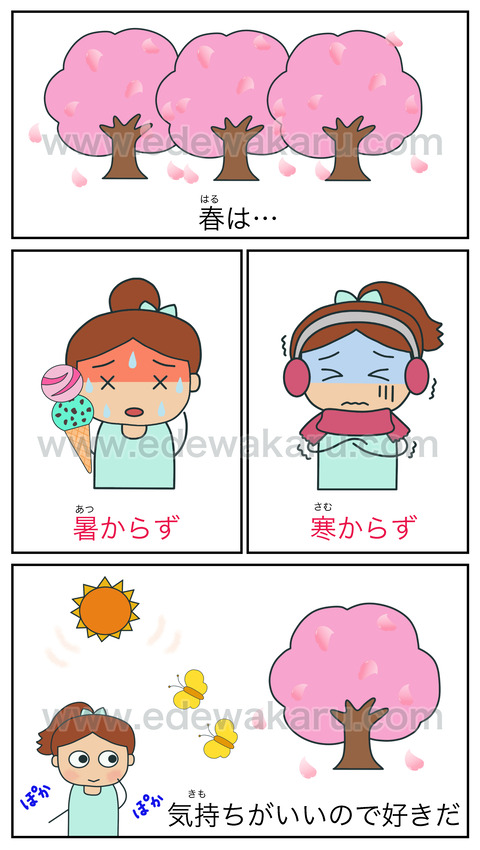
Meaning
neither 〜 nor 〜
How to use it
Verb [ない-form] + ず + verb [ない-form] + ず
い-adjective [remove ーい] + からず + [remove ーい] + からず
Explanation
「〜ず〜ず」 is a sentence pattern meaning “neither 〜 nor 〜.” It is used with a fairly limited set of expressions 😮 It would be good to memorize the idiomatic expressions that use 「〜ず〜ず」.
[Idiomatic expressions using 「〜ず〜ず」]
暑からず寒からず
→neither hot nor cold
飲まず食わず
→not drinking or eating anything at all
(Review: まったく〜ない)
負けず劣らず
→equal in merit; both are about equally 〜
つかず離れず
→neither too close nor too distant; a just-right relationship
These may sound formal, but idiomatic expressions are commonly used, so advanced learners should learn them 😉
In context 4 examples
春は暑からず寒からず、気持ちがいいので好きだ
→春は暑くもなく寒くもないので1番好きだI like spring because it’s neither too hot nor too cold, and it feels pleasant. →I like spring best because it’s neither hot nor cold.
2日間、飲まず食わずで小説を書き上げた
→2日間、何か飲んだり食べたりしないで小説を書き上げた(復習:〜上げる)I finished writing the novel over two days without eating or drinking. →I finished writing the novel over two days without drinking or eating anything. (Review: 〜上げる)
彼女は歌手に負けず劣らず歌が上手だ
→彼女は歌手と同じくらい歌が上手だShe sings as well as a professional singer. →She sings as well as a professional singer.
この学校の学費は高からず安からず、ちょうどいい値段だ
→この学校の学費は高くもなく安くもなく、ちょうどいい値段だThe tuition at this school is neither too high nor too low; it’s just right. →The tuition at this school is neither too high nor too low; it’s just the right price.
Read the original source text
Meaning
〜でもなく、〜でもなくて〜
How to use it
動詞[ない形]+ず+動詞[ない形]+ず
い形容詞[ーい]からず+[ーい]からず
Explanation
「〜ず〜ず」は「〜でもなく〜でもなくて〜」という意味を表す文型です。この文型は、ほとんど決まったものに使われます😮「〜ず〜ず」を使った慣用表現(かんようひょうげん)は暗記しておくといいと思います。
[「〜ず〜ず」を使った慣用表現]
暑からず寒からず
→暑くなく寒くなく
飲まず食わず
→全く飲んだり食べたりしないこと
(復習:まったく〜ない)
負けず劣らず
→優劣がつけられない・どちらも同じくらい〜だ
つかず離れず
→近すぎず、ちょうどいい関係
かたい言い方に聞こえますが、慣用表現はよく使われますので上級レベルの人は覚えておきましょう😉
日本語文型辞典 英語版
Meaning
【ず】Comes from the auxiliary verb ず, which is used in literary language. Expresses negation. Can be used only in written language and idiomatic expressions. In spoken language, なくて and ないで are used. Created by changing the ない in V-ない to ず. する becomes せず.
Means the same as V-ないで or V-なくて.
(1)
is an example of simply putting two clauses side by side to mean “don’t give up.” In many cases, as in
(3)
and
(4)
, the cause-and-effect relation between the first and second clauses is clear, and V-ず is used as an expression to indicate a reason. Although V-ず is used in spoken language, it is somewhat formal and has the tone of written language.
Means “neither X nor Y.” In some cases words with similar meaning are listed, as in
(1)
,
(2)
, and
(3)
, and in other cases words with contrasting meaning are listed, as in
(4)
,
(5)
, and
(6)
.
(3)
means that after comparing several items it is found that “all of them are equally wonderful.”
(4)
means “keeping a suitable distance,” and
(5)
means “neither hot nor cold.” Idiomatic expressions. Other examples include 鳴かず飛ばず (fall into obscurity), etc.
How to use it
1. V-ず
2. ...ず、...ず[A-からず、A-からず][V-ず、V-ず]
In context 10 examples
途中であきらめず、最後までがんばってください。
Don’t give up in the middle—please keep going until the end.
1時間待っても雨は止まず、ぬれて帰った。
The rain wouldn’t stop even after I waited for an hour, so I went home drenched.
出発前日まで予約が取れず、心配させられた。
I couldn’t get a reservation until the day before my departure, so I was really worried.
だれにきいても住所がわからず、困った。
No matter who I asked, no one knew the address, so I was in a real fix.
飲まず食わずで三日間も山中を歩きつづけた。
I continued to walk all over the mountains without eating or drinking for three whole days.
その時、彼はあわてず騒がず一言「失礼しました」と言って部屋を出ていった。
At the time, he didn’t get flustered or make a scene, he just left the room with a single remark: “Excuse me.”
展覧会に出品されている作品はいずれも負けず劣らずすばらしい。
All the works presented at the exhibition are equally wonderful.
独立した子供達とは、つかず離れずのいい関係だ。
I have a good relationship with my children, who are now on their own—not too close, but not too far.
日本の5月は暑からず、寒からずちょうどいい気候です。
The climate in Japan in May is just right—not too hot but not too cold.
客は多からず、少なからずほどほどだ。
The number of clients is just right—not too many and not too few.
Read the original source text
Meaning
【ず】Comes from the auxiliary verb ず, which is used in literary language. Expresses negation. Can be used only in written language and idiomatic expressions. In spoken language, なくて and ないで are used. Created by changing the ない in V-ない to ず. する becomes せず.
Means the same as V-ないで or V-なくて.
(1)
is an example of simply putting two clauses side by side to mean “don’t give up.” In many cases, as in
(3)
and
(4)
, the cause-and-effect relation between the first and second clauses is clear, and V-ず is used as an expression to indicate a reason. Although V-ず is used in spoken language, it is somewhat formal and has the tone of written language.
Means “neither X nor Y.” In some cases words with similar meaning are listed, as in
(1)
,
(2)
, and
(3)
, and in other cases words with contrasting meaning are listed, as in
(4)
,
(5)
, and
(6)
.
(3)
means that after comparing several items it is found that “all of them are equally wonderful.”
(4)
means “keeping a suitable distance,” and
(5)
means “neither hot nor cold.” Idiomatic expressions. Other examples include 鳴かず飛ばず (fall into obscurity), etc.
How to use it
1. V-ず
2. ...ず、...ず[A-からず、A-からず][V-ず、V-ず]
毎日のんびり日本語教師
Meaning
~without doing ~
How to use it
Verb ない-form + ず(に)
Explanation
「ず」 attaches to a verb's ない-form and expresses negation. It is a slightly more formal expression than 「ない」.
A verb expressing another action, etc., follows it, forming a sentence that means “do ~ without being in the state of doing ~” (an accompanying circumstance).
In spoken language, 「~ないで」 is used.
With 「する」, it becomes 「せず」, not 「しず」.
Notes
Nothing in particular.
In context 5 examples
挨拶もせずにごめんなさい!
I'm sorry I didn't even greet you!
いつでも笑顔を絶やさずに。
Always keep smiling.
ご無理なさらずに体調気をつけてください。
Please take care of your health and don't overexert yourself.
トイレ行って用足さずに帰ってくる。
I go to the bathroom, don't relieve myself, and come back.
大体何も苦労せずにクリアできるゲームとか面白くない。
Games you can basically clear without any struggle at all aren't fun.
Read the original source text
Meaning
~しないで~
How to use it
動詞ない形+ず(に)
Explanation
「ず」は動詞ない形に接続して、否定を表します。「ない」よりもやや硬い表現です。
後件には他の動作を表す動詞等が接続され、全体として「~しない状態で~する」という文を作ります。(付帯状況)
口語では「~ないで」が用いられます。
「する」の場合は「しず」ではなく、「せず」になります。
Notes
特になし
NINJAL 日本語文型データベース
Meaning
A way of expressing negation with 「〜ない」. It is used to express a negative cause or reason.
How to use it
Notes
The subjects of the clauses before and after 「〜ず」 may be the same or different.
When 「〜」 is in a verb clause and has the same subject as the clause after 「〜ず」, it takes a verb that does not express the speaker’s will (a verb that does not express a volitional action, such as 「治る・見つかる・間に合う」) or a potential verb (such as 「見える・わかる・できる」). If the subject of 「〜」 is different from that of the clause after 「〜ず」, any verb may be used.
After 「~ず」 come expressions of emotion, gratitude, apology, impossibility, physical condition, or an unintended outcome. Expressions that appeal to the other person or express the speaker’s will or hope do not follow.
In context 5 examples
お金が足りず、欲しいものが買えなかった。
I didn’t have enough money, so I couldn’t buy what I wanted.
友人の結婚式に招待されたが、都合がつかず出席できなかった。
I was invited to a friend’s wedding, but I couldn’t make it, so I wasn’t able to attend.
この店のケーキは甘すぎず、とても食べやすい。
The cake at this shop isn’t too sweet and is very easy to eat.
何をしても赤ちゃんが泣き止まず、困りました。
No matter what I did, the baby wouldn’t stop crying, and I was at a loss.
課長、昨日のA社との商談について、すぐに報告せず、申し訳ありませんでした。
Section chief, I’m sorry I didn’t report to you right away about yesterday’s business meeting with Company A.
Read the original source text
Meaning
「〜ない」という否定を表す言い方です。否定的な原因や理由を表すときに使います。
How to use it
Notes
「〜ず」の前後の文の主語は、同じでも同じでなくてもいいです。
「〜」が動詞の文で、その主語が「〜ず」の後の文と同じ場合、「〜」には話し手の意志を表さない動詞(意志的な行為を表さない動詞(「治る・見つかる・間に合う」など)・可能の動詞(「見える・わかる・できる」など)がきます。「〜」の主語が「〜ず」の後の文と同じではない場合は、どんな動詞の文でもいいです。
「~ず」の後には、感情・感謝・謝罪・不可能・体の状態・意図せず起こった結果などがきます。相手への働きかけ、話し手の意志や希望を表す表現はきません。
Yokubi — The Common Grammar Guide (https://yoku.bi)
Explanation
We briefly discussed the difference between なくて and ないで in [Lesson 11](../../Section1/Part1/Lesson11.md). Let's dig a bit deeper into it.
When we make a verb or い adjective into the なくて form, this behaves like a usual て conjunctive form ("do X, and…"). It is common in this usage to imply some cause \-\> effect sequence ("I didn't do X, and that is why Y happened") although not strictly required.
We can also make the negative with ないで instead, however in contrast with なくて, this usage often implies a manner or state in which the following action is being done. You can think of the statement before ないで to become an "adverb" to the statement after it.
There is another way we can use なくて and ないで, and that is using the verb forms 〜ず and 〜ずに. ず is an archaic conjugation of the negative auxiliary verb ぬ, but you don't really need to know this. Just remember that 〜ず is almost a 1:1 replacement to なくて (or in some cases なく), and 〜ずに is a replacement of ないで. In **some** cases, 〜ず alone (without に) can also be used as ないで (Yay, Japanese!).
ず and ずに are more formal and stiff-sounding than their なくて and ないで counterparts and are mostly used in literary stuff. However you will still hear plenty of ずに in spoken language too and they show up a lot in common phrases and expressions.
In context 2 examples
お役に立てず、申し訳ございません。
I am sorry I was not helpful
何も食べずに眠ってしまった。
He fell asleep without eating anything