文法
Meaning
Taking ~ as a good opportunity / using ~ as a turning point.
How to use it
N + を契機に
Notes
・Written expression
・The clause that follows is often a word or phrase with a positive meaning.
In context 4 examples
転職を契機に、次の会社では自分らしく働こうと決意した。
Taking my job change as an opportunity, I resolved to work as myself at my next company.
入院を契機に、今後はできるだけ毎日運動しようと思った。
Being hospitalized made me decide that from now on I would exercise every day as much as possible.
震災を契機に、改めて防災対策をしっかりしようと家族で話し合った。
In light of the earthquake disaster, our family discussed making our disaster preparedness measures solid once again.
スペイン人によるフィリピン支配は1521年マゼラン率いるスペイン艦隊がセブ島に到着したことを契機として行われた。
Spanish rule over the Philippines began with the arrival on Cebu Island in 1521 of a Spanish fleet led by Magellan.
Read the original source text
Meaning
〜をいい機会だと考えて / 〜をきっかけにして
How to use it
N + を契機に
Notes
・書き言葉
・文の後ろにはプラスの意味の言葉が来ることが多い。
Bunpro Grammar Reference
Meaning
Lead to, As a good opportunity to, As a result of, As a trigger
How to use it
Noun + を契機 + に(1)
Verb + の(2) + を契機 + に(1)
(1) にして、として
(2) こと
Nuance
A formal phrase, indicating the important opportunity of (A). (A) contains all of the base mechanisms required to trigger (B).
Explanation
を契機に is a grammar construction made up of を, the noun 契機 'chance' or 'trigger' and に. It is a formal pattern that is used to indicate some sort of trigger and may be translated '(A) led to (B)', 'as an opportunity to (A), (B)', or 'as a result of (A), (B)'. (A) may either be a positive or negative event, but will usually be something extremely big in terms of life, or current/historical events in the world.
を契機に will be seen after nouns, or verbs that have been nominalized with either の or こと.
子供が生まれたのを契機に、パチンコをやめることに決めた。
I decided to quit pachinko as a result of my child being born.
移動制限が緩和されたことを契機に、観光客の数が増えた。
The travel restriction being eased led to an increase of tourists.
彼女は出産を契機に、会社を辞めた。
She quit her job as a result of giving birth.
Alternatively, にして or として may replace に without any change in the overall meaning.
田中さんは入院を契機にして、タバコを止めました。
Tanaka-san being hospitalized led him to quit smoking.
大統領の暗殺を契機として、戦争が始まった。
The assassination of the president led to a war.
Caution
Unlike をきっかけに, を契機に will almost exclusively be used in relation to some turning point or critical juncture. Due to this, it can sound quite unnatural when used to express a trigger that would not be considered a big event.
先輩が楽しそうに料理をしている姿を見たのをきっかけに、私も料理を始めることにした。
Seeing my senpai enjoy cooking led me to start cooking too. (Natural Japanese)
先輩が楽しそうに料理をしている姿を見たのを契機に、私も料理を始めることにした。
Seeing my senpai enjoy cooking led me to start cooking too. (Unnatural Japanese)
In context 19 examples
- 子供の独立を契機に家を改造することにした。
As a result of my children becoming independent, I decided to remodel the house.
- 彼女は出産を契機に、会社を辞めた。
She quit her job as a result of giving birth.
- 田中さんは入院を契機にして、タバコを止めました。
Tanaka-san being hospitalized led him to quit smoking.
- 子供が生まれたのを契機に、パチンコをやめることに決めた。
I decided to quit pachinko as a result of my child being born.
- 移動制限が緩和されたことを契機に、観光客の数が増えた。
The travel restriction being eased led to an increase of tourists.
- 大統領の暗殺を契機として、戦争が始まった。
The assassination of the president led to a war.
- テレビ取材を契機に、(レストランの)人気が加速していった。
The television coverage triggered the acceleration of popularity (for the restaurant).
- 転職を契機に落ち着きを取り戻した。
As a result of my change in occupation, I was able to regain my composure.
- あんなに大人しかった彼が、引越しを契機によく話すようになった。
He, who was so quiet, has, as a result of moving, become quite talkative.
- 温泉を掘り当てたことを契機に大金持ちになりました。
Digging up the hot spring led to me becoming very rich.
- チームの優勝を契機に、練習施設を拡張した。
The team used their championship win as a good opportunity to expand their practice facility.
- 退職を契機に、一つの部屋を図書室として開放しました。
As a result of (her) retirement, a room was made available as a library room.
- あの法律の可決を契機に会社の売り上げが安定した。
The adoption of that law led to the company's steady sales.
- 初めてのトランジスタが考案されたのを契機に新しい技術革新が持ち上がった。
A new innovation in technology suddenly happened with the transistor being developed for the first time as a trigger.
- 学力の向上を契機に、入学を希望する学生の数は増えていきました。
As a result of the rising literary ability, the number of students looking to apply has been increasing.
- スプートニクは1957年に打ち上げられた。それを契機に宇宙開発の時代が始まった。
Sputnik was launched in 1957. As a result of the launch, the space race began.
- 鎖国とは、日本では海外との交流を遮断する政策であった。黒船の到着を契機に鎖国が終わった。
'Sakoku' was the Japanese policy of cutting off any cultural exchange with foreign countries. The arrival of the black ships led to the end of 'Sakoku'.
- 先輩が楽しそうに料理をしている姿を見たのをきっかけに、私も料理を始めることにした。
Seeing my senpai enjoy cooking led me to start cooking too. (Natural Japanese)
- 先輩が楽しそうに料理をしている姿を見たのを契機に、私も料理を始めることにした。
Seeing my senpai enjoy cooking led me to start cooking too. (Unnatural Japanese)
Read the original source text
Meaning
Lead to, As a good opportunity to, As a result of, As a trigger
How to use it
Noun + を契機 + に(1)
Verb + の(2) + を契機 + に(1)
(1) にして、として
(2) こと
Nuance
A formal phrase, indicating the important opportunity of (A). (A) contains all of the base mechanisms required to trigger (B).
Explanation
を契機に is a grammar construction made up of を, the noun 契機 'chance' or 'trigger' and に. It is a formal pattern that is used to indicate some sort of trigger and may be translated '(A) led to (B)', 'as an opportunity to (A), (B)', or 'as a result of (A), (B)'. (A) may either be a positive or negative event, but will usually be something extremely big in terms of life, or current/historical events in the world.
を契機に will be seen after nouns, or verbs that have been nominalized with either の or こと.
子供が生まれたのを契機に、パチンコをやめることに決めた。
I decided to quit pachinko as a result of my child being born.
移動制限が緩和されたことを契機に、観光客の数が増えた。
The travel restriction being eased led to an increase of tourists.
彼女は出産を契機に、会社を辞めた。
She quit her job as a result of giving birth.
Alternatively, にして or として may replace に without any change in the overall meaning.
田中さんは入院を契機にして、タバコを止めました。
Tanaka-san being hospitalized led him to quit smoking.
大統領の暗殺を契機として、戦争が始まった。
The assassination of the president led to a war.
Caution
Unlike をきっかけに, を契機に will almost exclusively be used in relation to some turning point or critical juncture. Due to this, it can sound quite unnatural when used to express a trigger that would not be considered a big event.
先輩が楽しそうに料理をしている姿を見たのをきっかけに、私も料理を始めることにした。
Seeing my senpai enjoy cooking led me to start cooking too. (Natural Japanese)
先輩が楽しそうに料理をしている姿を見たのを契機に、私も料理を始めることにした。
Seeing my senpai enjoy cooking led me to start cooking too. (Unnatural Japanese)
Nuance · 日本語
(A)が大切な機会だということを示す丁寧な表現。(A)は(B)を引き起こすためのものを全て持っている。
Explanation · 日本語
「を契機に」は「を」と名詞「契機」、そして「に」から成り立つ文型です。これは硬い文型で、「(A) が原因で (B)」や「(A) の機会に (B)」のような意味を表します。(A) には肯定的・否定的な出来事のどちらを入れても構いませんが、たいていは人生によって重要な出来事や、歴史的、社会的に大きな出来事が入ります。
「を契機に」は名詞の後や、「の」や「こと」で名詞化された動詞の後に使います。
子供が生まれたのを契機に、パチンコをやめることに決めた。
I decided to quit pachinko as a result of my child being born.
移動制限が緩和されたことを契機に、観光客の数が増えた。
The travel restriction being eased led to an increase of tourists.
彼女は出産を契機に、会社を辞めた。
She quit her job as a result of giving birth.
また、「に」は「にして」や「として」と置き換えられることもあります。この場合でも、全体の意味は変わりません。
田中さんは入院を契機にして、タバコを止めました。
Tanaka-san being hospitalized led him to quit smoking.
大統領の暗殺を契機として、戦争が始まった。
The assassination of the president led to a war.
注意点
「をきっかけに」とは異なり、「を契機に」はほぼ例外なく、物事や状況が大きく変わるような決定的な節目で使われます。そのため、それほど重要ではない出来事にこの文型を使うと不自然に聞こえることがあるので注意しましょう。
先輩が楽しそうに料理をしている姿を見たのをきっかけに、私も料理を始めることにした。
Seeing my senpai enjoy cooking led me to start cooking too. (Natural Japanese)
先輩が楽しそうに料理をしている姿を見たのを契機に、私も料理を始めることにした。
Seeing my senpai enjoy cooking led me to start cooking too. (Unnatural Japanese)
どんなときどう使う 日本語表現文型辞典
Meaning
use the opportunity of
How to use it
N + を契機に (して)
Explanation
をけいきに(して)
~をちょうどいい機会だと考えて
1)「それをいい機会だと考え、それを新たな行動の発端にして」と言いたいときに使う。後にはプラスの意味の文が来ることが多い。
2)意味、用法は「をきっかけに(して)」とほとんど同じだが、「をけいきにして」はできごとや行為を表す名詞につながることが特徴的である。
2)Nearly same meaning and usage as をきかっけに(して), but をけいきにして has characteristic of appending to nouns indicating events or actions.
1)Something is good opportunity with which to begin new action. Often clauses with positive meanings follow.
In context 3 examples
この災害を契機にして、わが家でも防災対策を強化することにした。
Taking this disaster as an opportunity, we decided to strengthen our disaster preparedness measures at home too.
転居を契機に、わたしも今までの仕事をやめて自分の店を持つ決心をした。
Moving prompted me to quit my previous job and decide to open my own shop.
今度の病気、入院を契機として、今後は定期検診をきちんと受けようと思った。
This recent illness and hospitalization made me decide to get regular checkups from now on.
Read the original source text
Meaning
use the opportunity of
How to use it
N+を契機に(して)W
Explanation
をけいきに(して)
~をちょうどいい機会だと考えて
1)「それをいい機会だと考え、それを新たな行動の発端にして」と言いたいときに使う。後にはプラスの意味の文が来ることが多い。
2)意味、用法は「をきっかけに(して)」とほとんど同じだが、「をけいきにして」はできごとや行為を表す名詞につながることが特徴的である。
2)Nearly same meaning and usage as をきかっけに(して), but をけいきにして has characteristic of appending to nouns indicating events or actions.
1)Something is good opportunity with which to begin new action. Often clauses with positive meanings follow.
絵でわかる日本語
Meaning
Do something taking ... as an opportunity
How to use it
Verb [dictionary form] + のを契機に
Verb [た-form] + のを契機として
Noun [dictionary form] + を契機にして
Explanation
“Aを契機にB” is a sentence pattern meaning “do B taking A as an opportunity.” It means “regard A as a good opportunity and do B.” In most cases, “B” is a sentence describing [starting something new] or [the beginning of a new change].
“〜を契機に” can be changed to “〜を契機として” or “〜を契機にして.”
[Example]
Taking a job as an opportunity, I started living on my own.
= Taking a job as an opportunity, I started living on my own.
= Taking a job as an opportunity, I started living on my own.
“〜を契機に” is a formal expression used in written language. Learn it together with “〜をきっかけに.” 😊
[Related grammar patterns]
In context 5 examples
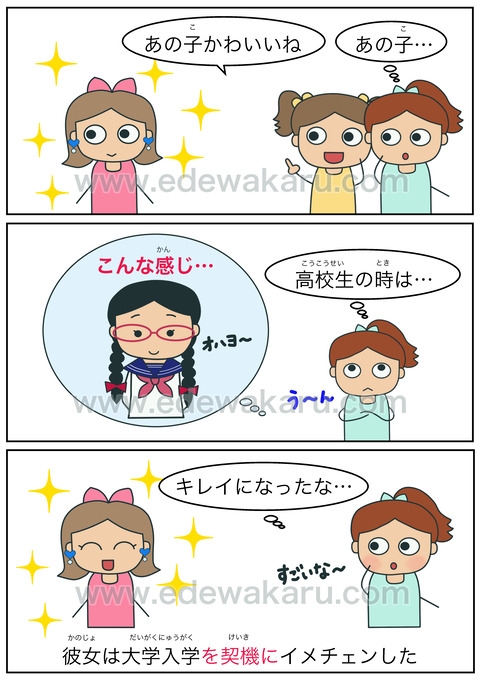
彼女は大学入学を契機に、イメチェンした
→大学入学をいい機会に、イメチェンしたShe changed her look when she entered university. → She took entering university as a good opportunity to change her look.
就職を契機に、一人暮らしを始めた
→就職を機会に、一人暮らしを始めたI started living on my own when I got a job. → I took getting a job as an opportunity to start living on my own.
お母さんの病気を契機に、看護師になろうと決めた
→お母さんの病気がきっかけとなって、看護師になろうと決めたHer mother’s illness prompted her to decide to become a nurse. → Her mother’s illness became the reason she decided to become a nurse.
田中さんは妊娠したのを契機に、お酒をやめたとのことだ
→妊娠をいい機会に、お酒をやめたとのことだI hear that Tanaka quit drinking when she became pregnant. → I hear that she took pregnancy as a good opportunity to quit drinking.
彼は病気になったのを契機に、健康に気をつけるようになった
→病気を機会に、健康に気をつけるようになったAfter he became ill, he started paying attention to his health. → He took his illness as an opportunity to start paying attention to his health.
Read the original source text
Meaning
〜を機会に〜する
How to use it
動詞[辞書形]+のを契機に
動詞[た形]+のを契機として
名詞[辞書形]+を契機にして
Explanation
「Aを契機にB」は「Aを機会にBする」という意味の文型です。「Aをいい機会だと思ってBする」という意味で、ほとんどの場合「B」には[新しいことを始めたこと]や[新しい変化が始まったこと]を表す文がきます。
「〜を契機に」は「〜を契機として」「〜を契機にして」
にチェンジすることができます。
[例]
就職
を契機に、一人暮らしを始めた
=就職
を契機として、一人暮らしを始めた
=就職
を契機にして、一人暮らしを始めた
「〜を契機に」はかたい言い方で、
書き言葉
として使われます。「〜をきっかけに」と一緒に覚えておきましょう😊
【関連文型】
くらべてわかる日本語表現文型辞典
Meaning
A is an event that marks a turning point in life or an era, and B is the change that follows.
How to use it
Aを契機にB (Aを契機としてB)
[Noun—∅] を契機に
Explanation
[Contrast 1]
“AをきっかけにB” (Meaning 1, p. 336)
“Aを契機にB” is a formal expression in which A indicates a major event that marks a turning point. In “AをきっかけにB,” A indicates a simple trigger or starting point for B, and is often used in conversation.
○ささいな食い違いをきっかけに、大喧嘩になった。 — A minor disagreement led to a huge argument.
×ささいな食い違いを契機に、大喧嘩になった。 — A minor disagreement led to a huge argument.
In context 4 examples
バブル崩壊を契機に、日本の経済は下降していった。
In the wake of the collapse of the bubble economy, Japan’s economy began to decline.
大震災を契機に、地震に対する関心が高まった。
The major earthquake served as a turning point that heightened interest in earthquakes.
彼女は結婚を契機に、会社をやめた。
She quit her job when she got married.
彼は引退を契機に、念願の牧場主になった。
After retiring, he finally became the owner of a ranch, as he had long dreamed.
Read the original source text
Meaning
Aは人生や時代において節目となるような出来事で、Bはその後の変化。
How to use it
Aを契機にB(Aを契機としてB)
[名詞-∅]を契機に
Explanation
【対比1】
「AをきっかけにB」(意味1 P.336)
「Aを契機にB」のAは、節目となるような大きな出来事を示すかたい表現。「AをきっかけにB」のAは、Bになった単なる発端、始まりを示し、会話などでよく使われる。
○ささいな食い違いをきっかけに、大喧嘩になった。
×ささいな食い違いを契機に、大喧嘩になった。
日本語NET JLPT文法解説まとめ
Meaning
Taking ~ as a good opportunity / using ~ as a turning point.
How to use it
N + を契機に
Explanation
・Written expression
・The clause that follows is often a word or phrase with a positive meaning.
In context 4 examples
転職を契機に、次の会社では自分らしく働こうと決意した。
Taking my job change as an opportunity, I resolved to work as myself at my next company.
入院を契機に、今後はできるだけ毎日運動しようと思った。
Being hospitalized made me decide that from now on I would exercise every day as much as possible.
震災を契機に、改めて防災対策をしっかりしようと家族で話し合った。
In light of the earthquake disaster, our family discussed making our disaster preparedness measures solid once again.
スペイン人によるフィリピン支配は1521年マゼラン率いるスペイン艦隊がセブ島に到着したことを契機として行われた。
Spanish rule over the Philippines began with the arrival on Cebu Island in 1521 of a Spanish fleet led by Magellan.
Read the original source text
Meaning
〜をいい機会だと考えて / 〜をきっかけにして
How to use it
N + を契機に
Explanation
・書き言葉
・文の後ろにはプラスの意味の言葉が来ることが多い。