どんなときどう使う 日本語表現文型辞典
Meaning
seems; looks like
How to use it
〔plain form〕+とみえて
Explanation
~らしく/~らしい
1)「~とみえて」の「~」で推量することを言い、後にその根拠を述べる言い方。
2) ❹ は、始めに根拠を言い、後にそこから推量したことを述べる形である。
1)Conjecture precedes とみえて; basis for statement follows.
2)In sentence ❹ , basis is stated first; surmise follows.
In context 4 examples
夜遅く雨が降ったとみえて、庭がぬれている。
It seems to have rained late last night; the garden is wet.
母はまだ病気からすっかり回復していないとみえて、何をしても疲れると言う。
It seems my mother has not yet fully recovered from her illness; she says that everything she does makes her tired.
この子は絵が好きだとみえて、暇さえあれば絵を描いている。
It seems this child likes drawing; whenever they have free time, they draw.
彼の話を聞いたところでは、彼はこの計画にそうとう自信を持っているとみえる。
From what I heard him say, he seems to have quite a lot of confidence in this plan.
Read the original source text
Meaning
seems; looks like
How to use it
〔普通形〕+とみえて
Explanation
~らしく/~らしい
1)「~とみえて」の「~」で推量することを言い、後にその根拠を述べる言い方。
2) ❹ は、始めに根拠を言い、後にそこから推量したことを述べる形である。
1)Conjecture precedes とみえて; basis for statement follows.
2)In sentence ❹ , basis is stated first; surmise follows.
絵でわかる日本語
Meaning
...; probably because ...
I think it’s ... because ...
How to use it
Verb, adjective, or noun [plain form] + とみえて
* With the affirmative present form of な-adjectives and nouns, 〜だとみえて is also acceptable.
([Example] 嫌いとみえて = 嫌いだとみえて; 休みとみえて = 休みだとみえて)
Explanation
“AとみえてB” is a pattern meaning “A must be the case, because B” or “I think A is the case because B.” “A” is what is being predicted or inferred, and “B” gives the reason or evidence. It is used to infer something after seeing a person or thing.
[Examples]
① Mom looks happy, so something good must have happened.
[A] Something good must have happened.
[B] Because she looks happy.
→Seeing that she looks happy, infer that something good must have happened.
② It must have rained while I was asleep, because the road is wet.
[A] It must have rained.
[B] Because the road is wet.
→Since the road is wet, infer that it must have rained.
③ He must not have passed N1, because he looks down.
[A] He must not have passed N1.
[B] Because he looks down.
→Since he looks down, infer that he must not have passed.
④ The shop must be closed today, because there’s no one inside.
[A] The shop must be closed.
[B] Because there’s no one inside.
→Since there’s no one inside, infer that the shop must be closed.
⑤ This cake must be spoiled, because it tastes strange…
[A] This cake must be spoiled.
[B] Because it tastes strange.
→Since it tastes strange, infer that it must be spoiled.
⑥ She must be in a bad mood, because she’s been angry all morning.
[A] She must be in a bad mood.
[B] Because she’s been angry all morning.
→Since she’s been angry all morning, infer that she must be in a bad mood.
There is also the form 〜とみえる, so let’s learn that along with this pattern 😊
In context 6 examples
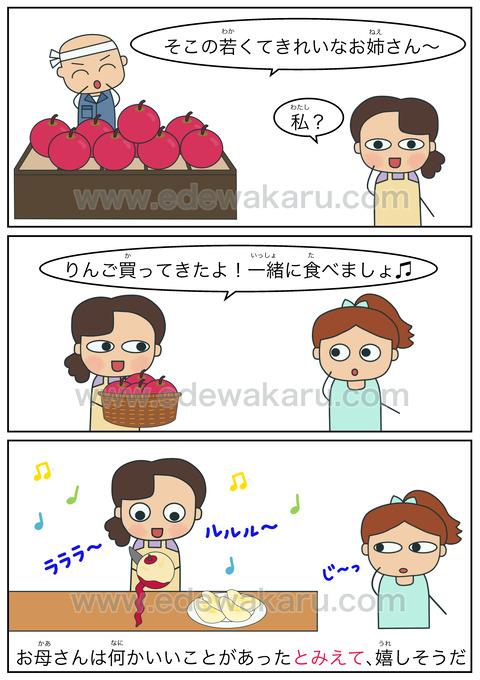
お母さんは、何かいいことがあったとみえて嬉しそうだ
Mom looks happy, so something good must have happened.
寝ている間に雨が降ったとみえて、道が濡れている
It must have rained while I was asleep, because the road is wet.
彼はN1に合格できなかったとみえて、元気がない
He must not have passed N1, because he looks down.
今日はお店が休みとみえて、店内には誰もいない
The shop must be closed today, because there’s no one inside.
このケーキは腐っているとみえて、変な味がする…
This cake must be spoiled, because it tastes strange…
彼女は虫の居所が悪いとみえて、朝から怒ってばかりいる
She must be in a bad mood, because she’s been angry all morning.
Read the original source text
Meaning
〜だから、〜なんだろう
〜が理由で、〜なんだと思う
How to use it
動詞・形容詞・名詞[普通形]+とみえて
*な形容詞・名詞の現在肯定形に使う場合は「〜だとみえて」でもOK
([例]嫌いとみえて=嫌いだとみえて 休みとみえて=休みだとみえて)
Explanation
「AとみえてB」は「BだからAなんだろう」「Bが理由でAなんだと思う」という意味の文型です。この文型は「A」には予想・推量したことが入り、「B」には理由や根拠が入ります。 ものや人を見たりして、何かを推量する場合に使われます。
[例]
①お母さんは、何かいいことがあった
とみえて
嬉しそうだ
【A】何かいいことがあったんだろう
【B】嬉しそうだから
→嬉しそうだから、何かいいことがあったんだろうと推量
②寝ている間に雨が降った
とみえて、道が濡れている
【A】雨が降ったんだろう
【B】道が濡れているから
→道が濡れているから、雨が降ったんだろうと推量
③彼はN1に合格できなかった
とみえて、元気がない
【A】N1に合格できなかったんだろう
【B】元気がないから
→元気がないから、合格できなかったんだろうと推量
④今日はお店が休み
とみえて、店内には誰もいない
【A】お店が休みだろう
【B】店内には誰もいないから
→店内には誰もいないから、お店が休みだろうと推量
⑤このケーキは腐っている
とみえて、変な味がする…
【A】このケーキは腐っているだろう
【B】変な味がするから
→変な味がするから、腐っているだろうと推量
⑥彼女は虫の居所が悪い
とみえて、朝から怒ってばかりいる
【A】虫の居所が悪いんだろう
【B】怒ってばかりいるから
→朝から怒ってばかりいるから、虫の居所が悪いんだろうと推量
「〜とみえて」には「〜とみえる」という形もありますので、一緒に覚えておきましょう😊
日本語文型辞典
Meaning
Basic information
N/Na(だ)とみえて; A/V とみえて
A way of stating something predicted from the current situation. The preceding clause contains the prediction, and the following clause gives its reason or basis. For example, in ②, the current situation in the latter clause, “puddles have formed,” is the basis for the prediction in the preceding clause, “it seems to have rained in the middle of the night.” The latter clause states a fact the speaker has actually observed.
A way of stating an inference drawn from something one has observed, used like talking to oneself. It is not often used by young people.
How to use it
…とみえて
…とみえる
In context 8 examples
最近忙しいとみえて、いつ電話しても留守だ。
He seems to be busy lately; whenever I call, he's out.
夜中に雨が降ったとみえて、水たまりができている。
It seems to have rained in the middle of the night, and puddles have formed.
何かいいことがあったとみえて、朝からずっとにこにこしている。
It seems something good happened; she has been smiling since morning.
隣の家は留守とみえて、ドアの前に数日分の新聞がたまっている。
The neighbors seem to be away; several days' worth of newspapers have piled up in front of their door.
今日の田中君はやけに気前がいい。何かいいことがあったとみえる。
Tanaka is unusually generous today. Something good must have happened.
合格発表を見に行った妹は、帰ってくるなり部屋に閉じ込もってしまった。どうも不合格だったとみえる。
My younger sister went to see the exam results, and as soon as she got home, she shut herself in her room. It seems she didn't pass.
学生にパソコンの使い方を説明したが、ほかの人に聞いているところを見ると、一度聞いただけではよくわからなかったとみえる。
I explained to the students how to use a computer, but seeing that they are asking someone else, it seems they didn't understand very well from hearing it just once.
花子は、先生にほめられた絵を会う人ごとに見せている。ほめられたことがよほどうれしかったとみえる。
Hanako shows the picture her teacher praised to everyone she meets. It seems she was very happy to have been praised.
Read the original source text
Meaning
基本情報N/Na(だ)とみえてA/V とみえて
現状を理由・根拠に予想されることを述べる言い方。前の節にその予想の部分が来て、後ろの節でその理由・根拠が表される。②を例にとって言えば、後ろの「水たまりができている」という現状を根拠に前の「夜中に雨が降ったようだ」という予想を述べる言い方である。後ろの節には、話し手が実際に観察した事実が述べられる。
自分の観察したことがらから推測したことを述べる言い方で、独り言のように用いる。若い人にはあまり使われない。
How to use it
…とみえて
…とみえる
日本語文型辞典 英語版
Meaning
【とみえて】[N/Na (だ)とみえて][A/V とみえて]
States a conjecture based on a current state of affairs. The first clause contains the speaker’s conjecture, and the second presents the reason or basis for this conjecture. For instance, in
(2)
above, the speaker states the conjecture 夜中に雨が降ったようだ (it looks like it rained during the night) in the first clause, and this conjecture is based on the state of affairs 水たまりができている (there are puddles) given in the second clause. The second clause describes a fact that the speaker has actually observed.
とみえる is used to state, as if the speaker were talking to him/herself, a conjecture based on what s/he has observed. Young Japanese speakers do not use this expression very often.
How to use it
1. ...とみえて
2. ...とみえる
In context 8 examples
最近忙しいとみえて、いつ電話しても留守だ。
He must be very busy recently, because he is not in whenever I call.
夜中に雨が降ったとみえて、水たまりができている。
It seems to have rained during the night, because there are puddles outside.
何かいいことがあったとみえて、朝からずっとにこにこしている。
Something nice must have happened to him, because he’s been grinning since morning.
隣の家は留守とみえて、ドアの前に数日分の新聞がたまっている。
It looks like our next-door neighbor is away, because there are newspapers from the past several days piled up in front of the door.
今日の田中君はやけに気前がいい。何かいいことがあったとみえる。
Today Tanaka-kun is being unusually generous with his money. Something good must have happened.
合格発表を見に行った妹は、帰ってくるなり部屋に閉じ込もってしまった。どうも不合格だったとみえる。
As soon as my sister, who went to find out her results for the entrance exam, got back, she locked herself in her room. It looks like she failed.
学生にパソコンの使い方を説明したが、ほかの人に聞いているところを見ると、一度聞いただけではよくわからなかったとみえる。
Although I explained to the student how to use a computer, it seems that hearing it just once was not enough for him to understand, because I saw him asking someone else.
花子は先生にほめられた絵を会う人ごとに見せている。ほめられたことがよほどうれしかったとみえる。
Hanako shows the drawing her teacher praised her for to everyone she sees. She must have been so happy that she was praised.
Read the original source text
Meaning
【とみえて】[N/Na (だ)とみえて][A/V とみえて]
States a conjecture based on a current state of affairs. The first clause contains the speaker’s conjecture, and the second presents the reason or basis for this conjecture. For instance, in
(2)
above, the speaker states the conjecture 夜中に雨が降ったようだ (it looks like it rained during the night) in the first clause, and this conjecture is based on the state of affairs 水たまりができている (there are puddles) given in the second clause. The second clause describes a fact that the speaker has actually observed.
とみえる is used to state, as if the speaker were talking to him/herself, a conjecture based on what s/he has observed. Young Japanese speakers do not use this expression very often.
How to use it
1. ...とみえて
2. ...とみえる