日本語文型辞典
Meaning
Basic information: N/Na だったり A-かったり V-たり
An expression that gives two or three representative examples from among several things or actions. As in ③ and ④, sometimes only one example is given, implying that there are others as well. When this pattern alone ends a sentence, as in “…たり…たりします/しました,” the final verb must always be followed by “たりする.”
It expresses alternating states or actions, or two contrasting states. Other commonly used contrasting pairs include “あったりなかったり,” “上がったり下がったり,” “泣いたり笑ったり,” “乗ったり降りたり,” and “出たり入ったり,” in addition to the examples.
A way of giving examples while implying there are others. In meaning, example ② is almost the same as “悪口を言ったらいけない” (“You mustn’t speak ill of people”), but the expression is softened by not saying this directly.
A way of giving one example. It is used, for instance, to avoid stating something directly and explicitly, while implying there are other possibilities. It is a distanced, teasing expression, often used in casual speech by young people.
How to use it
…たり…たりする
…たり…たり
…たり したら/しては
…たりして
In context 18 examples
休みの日には、ビデオを見たり音楽を聞いたりしてのんびり過ごすのが好きです。
On my days off, I like to relax by watching videos, listening to music, and so on.
コピーをとったり、ワープロを打ったり、今日は一日中いそがしかった。
I spent the whole day busy today, making copies, typing on the word processor, and so on.
子供が大きくなって家族がそろうことはめったにないのですが、年に数回はいっしょに食事したりします。
My children are grown, so it’s rare for the whole family to get together, but we do have a meal together a few times a year.
給料日前には昼食を抜いたりすることもある。
Sometimes I skip lunch when payday is coming up.
アルバイトで来ている学生は曜日によって男子学生だったり女子学生だったりしますが、みなよく働いてくれます。
The students who work here part-time are male on some days of the week and female on others, but they all work hard.
彼女の絵のモチーフは鳥だったり人だったりするが一貫して現代人の不安が描かれている。
The subjects of her paintings are sometimes birds, sometimes people, but they consistently depict the anxieties of modern people.
(誤) きのうの休みにはビデオを見たり、散歩したり、手紙を書きました。
(Incorrect) On my day off yesterday, I watched videos, went for a walk, and wrote a letter.
(正) きのうの休みにはビデオを見たり、散歩したり、手紙を書いたりしました。
(Correct) On my day off yesterday, I watched videos, went for a walk, wrote a letter, and so on.
何か心配なことでもあるのか彼は腕組をして廊下を行ったり来たりしている。
He is pacing back and forth along the hallway with his arms folded, as if he has something on his mind.
去年の秋は暑かったり寒かったりして秋らしい日は少なかった。
Last autumn, it was sometimes hot and sometimes cold, and there were few days that felt like autumn.
父は近頃あまり具合いがよくなく、寝たり起きたりだ。
My father hasn’t been feeling very well lately; he’s been going back and forth between bed and getting up.
薬はきちんと飲まなければいけない。飲んだり飲まなかったりでは効果がない。
You have to take your medicine properly. It won’t work if you take it sometimes and skip it other times.
くつを買おうと思うが、いいと思うと高すぎたり、サイズがあわなかったりで、なかなか気に入ったのが見つからない。
I’m thinking of buying shoes, but when I find a pair I like, they’re either too expensive or the wrong size, so I can’t find any I’m happy with.
あすは山間部は晴れたり曇ったりの天気でしょう。
Tomorrow, the weather in the mountain areas will be partly sunny and partly cloudy.
英語の生活にもだいぶん慣れたが、早口で話しかけられたりしたらわからなくて困ることも多い。
I’ve gotten fairly used to life in English, but I’m often at a loss when someone speaks to me rapidly.
その人のいないところで悪口を言ったりしてはいけない。
You shouldn’t speak ill of someone behind their back.
A:変だね、まだだれも来てないよ。
B:約束、あしただったりして。A: That’s strange. No one has come yet. B: Maybe the appointment was for tomorrow.
A:佐野さん、遅いわね。
B:ひとりだけ先に行ってたりして。A: Sano is late. B: Maybe she went on ahead by herself.
Read the original source text
Meaning
基本情報N/Na だったりA-かったりV-たり
いくつかのことがら、行為のうちの代表的なものを二、三あげる表現。③④のようにひとつだけ例をあげて、他にもあることを暗示する場合もある。「…たり…たりします/しました」のように、この文型だけで言い切りで終るときは、最後に来る動詞には必ず「たりする」が付く。
ある状態、行為を交互に繰り返すときの様子、あるいはふたつの対照的な状態を表す。よく使われる対照的な状態には例のほかに、「あったりなかったり」「上がったり下がったり」「泣いたり笑ったり」「乗ったり降りたり」「出たり入ったり」などがある。
ほかにもあるという含みで例をあげる言い方。②は「悪口を言ったらいけない」と意味はほとんど同じだが、はっきり言わないことで表現がやわらかくなる。
例を1つあげる言い方。ほかにも可能性があるという含みで、直接はっきり言うことを避けるときなどに使われる。距離を置いたやゆ的な表現。若い人のくだけた話しことばに使われることが多い。
How to use it
…たり…たりする
…たり…たり
…たり したら/しては
…たりして
絵でわかる日本語
Usage 1
Read this source entry ↗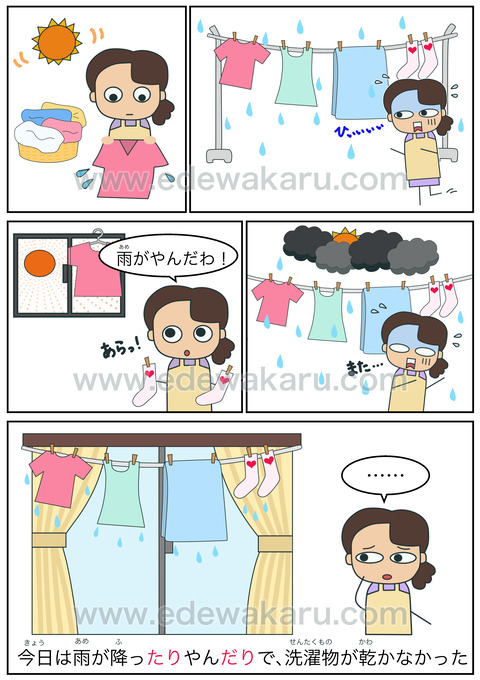
Meaning
Repeat A and B
Sometimes do A and sometimes don’t
How to use it
Verb/adjective [た-form] + たり + 〜たり
Explanation
“AたりBたり” is a sentence pattern meaning “repeat A and B.” In many cases, “A” and “B” are verbs that express opposites or verbs of a similar kind. It is also used to mean “sometimes do A and sometimes don’t.”
[Verbs often used for “A” and “B”]
・go up and down
・go out and come in
・stand and sit
・get on and get off
・sleep and wake up
・fly and hop
and so on
There is a similar sentence pattern, “〜たり〜たりする,” so review it 😊
[Related patterns]
In context 5 examples
今日は雨が降ったりやんだりで、洗濯物が乾かなかった
→「雨が降る」と「やむ」が繰り返されたIt kept raining and stopping today, so the laundry didn’t dry. → “Raining” and “stopping” kept repeating.
最近暑かったり、寒かったりでかぜをひいてしまった
→「暑い」と「寒い」を繰り返すIt’s been hot and cold lately, and I caught a cold. → “Hot” and “cold” keep repeating.
薬を飲んだり飲まなかったりしていたら治らないよ
→飲む場合と飲まない場合があると治らないよIf you sometimes take your medicine and sometimes don’t, you won’t get better. → You won’t get better if you sometimes take it and sometimes don’t.
A:赤ちゃんは泣いたり笑ったりしてかわいいね〜B:本当だね〜
→「泣く」と「笑う」を繰り返すA: Babies are so cute when they cry and laugh~ B: They really are~ → “Crying” and “laughing” keep repeating.
娘:お母さん、知らない人が家の前を行ったり来たりしているよ母:えっ!なんだかこわいわね…
→「行く」と「来る」を繰り返すDaughter: Mom, there’s a stranger walking back and forth in front of our house. Mother: Huh! That’s kind of scary… → “Going” and “coming” keep repeating.
Read the original source text
Meaning
〜と〜を繰り返す
〜する場合と〜しない場合がある
How to use it
動詞・形容詞[た形]+たり+〜たり
Explanation
「AたりBたり」は「AとBを繰り返す」という意味の文型です。多くの場合、「A」と「B」には反対を表す動詞や、似ている種類の動詞が入ります。また、「Aする場合とAしない場合がある」という意味でも使われます。
[「A」と「B」によく使われる動詞]
・上がっ
たり
下がっ
たり
・出
たり
入っ
たり
・立っ
たり
座っ
たり
・乗っ
たり
降り
たり
・寝
たり
起き
たり
・飛ん
だり
跳ね
たり
など
似ている文型に「〜たり〜たりする」がありますので、復習しておきましょう😊
【関連文型】
Usage 2
Read this source entry ↗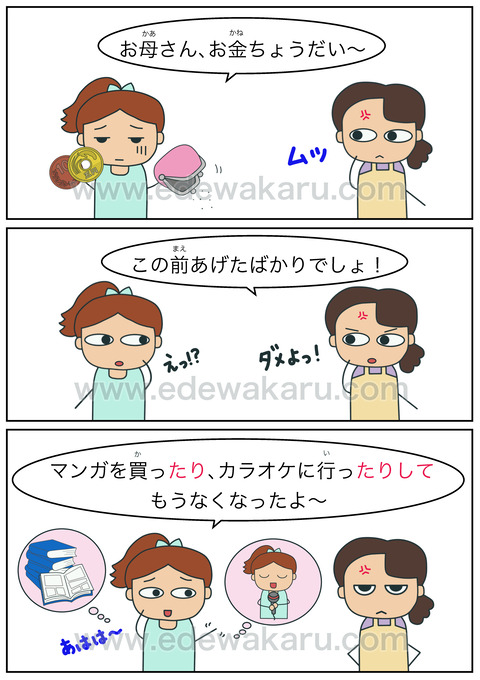
Meaning
Give examples.
How to use it
Verb/adjective/noun [た-form] + たり + 〜たりする
Explanation
“AたりBたりする” is a sentence pattern used to give examples. When there are several examples, it is used to mention “A” and “B” from among them. If giving three examples, you can also say “AたりBたりCたりする.” It is also used when giving just one example, as in “Aたりする.”
[Examples]
I like reading books, singing songs, and playing games.
I like reading books, for example.
“〜たり〜たりする” is often used in conversation, so review it 😊
[Related patterns]
In context 6 examples
娘:お母さん、お金ちょうだい〜母:この前あげたばかりでしょ!娘:マンガを買ったりカラオケに行ったりして、もうなくなったよ
Daughter: Mom, give me some money~ Mother: I just gave you some the other day, didn’t I! Daughter: I’ve already run out from buying manga, going to karaoke, and stuff.
A:日曜日は何をしたの?B:ゲームをしたり、カフェに行ったりしたよ
A: What did you do on Sunday? B: I played games, went to a cafe, and things like that.
本を読んだり、歌を歌ったりするのが好きです
I like reading books and singing songs, among other things.
日本に行ったら、お寿司を食べたりラーメンを食べたりしたい
When I go to Japan, I want to eat sushi and ramen, among other things.
最近忙しくて、本を読んだりテレビを見たりする時間がない
I’ve been busy lately and don’t have time to read books or watch TV.
クラスメートは、アメリカ人だったり、中国人(ちゅうごくじん)だったりします
My classmates are American, Chinese, and so on.
Read the original source text
Meaning
例をあげて言う
How to use it
動詞・形容詞・名詞[た形]+たり+〜たりする
Explanation
「AたりBたりする」は、例をあげて言う時に使われる文型です。いくつか例がある時に、その中から「A」と「B」をあげて言いたい時に使用されます。3つ例をあげる場合は「AたりBたりCたりする」ということもできます。また「Aたりする」というように、1つだけ例をあげる場合にも使われます。
[例]
本を読ん
だり、歌を歌っ
たり、ゲームをし
たりする
のが好きです
本を読ん
だりする
のが好きです
「〜たり〜たりする」は、会話でもよく使われますので復習をしておきましょう😊
【関連文型】
どんなときどう使う 日本語表現文型辞典
Usage 1
Meaning
repeatedly do …and…
How to use it
Vたり + Vたり + する
Explanation
たり~たりする〈反復〉
反対の動作・作用が反復することを表す言い方。二つの対立する動詞(出る・入る、行く・来る、上がる・下がるなど)を使う。
Shows repetition of opposite action or movement. Uses verb antonyms such as 出る/入る, 行く/来る, 上がる/下がる, etc.
In context 4 examples
退院してから1週間ぐらいは毎日寝たり起きたりしていました。
For about a week after I left the hospital, I spent every day lying down and getting up.
子どもたちがプールで、水から出たり入ったりして遊んでいます。
The children are playing in the pool, going in and out of the water.
あの人は門の前を行ったり来たりしています。どうしたのでしょう。
That person is pacing back and forth in front of the gate. I wonder what's wrong.
バスの運転手:バスの中では立ったりすわったりしないでください。危ないですから。
Bus driver: Please don't stand up and sit down while on the bus. It's dangerous.
Read the original source text
Meaning
repeatedly do …and…
How to use it
Vたり+Vたり+する
Explanation
たり~たりする〈反復〉
反対の動作・作用が反復することを表す言い方。二つの対立する動詞(出る・入る、行く・来る、上がる・下がるなど)を使う。
Shows repetition of opposite action or movement. Uses verb antonyms such as 出る/入る, 行く/来る, 上がる/下がる, etc.
Usage 2
Meaning
sometimes…and sometimes…
How to use it
Vたり + Vたり / イAかったり + イAかったり /
Explanation
たり~たりする〈不定〉
ナAだったり+ナAだったり/Nだったり+Nだったり+する
一定していないことを表す。動詞以外の品詞にも使う。 ❸ ❹ のように「たり~たりだ」の形で使うことも多い。
Shows unstable situation. Also used with parts of speech other than verbs. Often used in pattern ~たり~たりだ, as in sentences ❸ and ❹ .
In context 4 examples
庭のそうじは父がしたり、母がしたり、兄がしたりします。
My father, mother, and older brother take turns cleaning the garden.
うちでは夕食の時間は7時だったり8時だったりして、決まっていません。
At our house, dinner time varies between seven and eight o'clock; it's not fixed.
1週間に1度かならず来てください。来たり来なかったりでは困ります。
Please be sure to come once a week. It would be a problem if you came sometimes and didn't come other times.
このごろの天候は暑かったり寒かったりですから、風邪をひきやすいです。
The weather has been hot one moment and cold the next lately, so it's easy to catch a cold.
Read the original source text
Meaning
sometimes…and sometimes…
How to use it
Vたり+Vたり/イAかったり+イAかったり/
Explanation
たり~たりする〈不定〉
ナAだったり+ナAだったり/Nだったり+Nだったり+する
一定していないことを表す。動詞以外の品詞にも使う。 ❸ ❹ のように「たり~たりだ」の形で使うことも多い。
Shows unstable situation. Also used with parts of speech other than verbs. Often used in pattern ~たり~たりだ, as in sentences ❸ and ❹ .
Usage 3
Meaning
do…and do…
How to use it
Vたり + Vたり + する
Explanation
たり~たりする〈複数の行為〉
1)いろいろなことをするとき、またはいろいろなことが起こるとき、そのうちの2、3を取りあげて並べて示すときの言い方。 ❶ ❷ のように、一人がいろいろな動作をする場合と、 ❹ のように、複数の人がいろいろな動作をする場合がある。
2) ❺ のように「Vたり」を1回だけ使い、ほかにもあるということを暗示する言い方、また、 ❻ のように婉曲表現として使う場合もある。
2)When only one Vたり is used implies that other activities are being done as well, as in sentence ❺ . Can also be used euphemistically, as in sentence ❻ .
1)Lists up two or three activities or events among several. As in sentences ❶ and ❷ , describes one person doing several things, or as in sentence ❹ , several people doing several things.
In context 6 examples
日曜日には、本を読んだり、テレビを見たりします。
On Sundays, I read books, watch TV, and so on.
子どものころ、野球をしたり、魚をとったりして、よく外で遊びました。
When I was a child, I often played outside, playing baseball, catching fish, and so on.
去年は大雨が降ったり、地震が起きたりして、大変でした。
Last year was tough, with heavy rain and earthquakes occurring, among other things.
公園で子どもたちがボール投げをしたり、水遊びをしたりしています。
The children are playing catch and splashing in the water in the park.
もっと広い家に引っ越して犬を飼ったりしたい。
I want to move to a bigger house and get a dog, among other things.
たばこの吸いがらを道路に捨てたりしないでください。
Please don't throw cigarette butts onto the road.
Read the original source text
Meaning
do…and do…
How to use it
Vたり+Vたり+する
Explanation
たり~たりする〈複数の行為〉
1)いろいろなことをするとき、またはいろいろなことが起こるとき、そのうちの2、3を取りあげて並べて示すときの言い方。 ❶ ❷ のように、一人がいろいろな動作をする場合と、 ❹ のように、複数の人がいろいろな動作をする場合がある。
2) ❺ のように「Vたり」を1回だけ使い、ほかにもあるということを暗示する言い方、また、 ❻ のように婉曲表現として使う場合もある。
2)When only one Vたり is used implies that other activities are being done as well, as in sentence ❺ . Can also be used euphemistically, as in sentence ❻ .
1)Lists up two or three activities or events among several. As in sentences ❶ and ❷ , describes one person doing several things, or as in sentence ❹ , several people doing several things.
日本語文型辞典 英語版
Meaning
【たり】[N/Na だったり][A-かったり][V-たり]
Points out two or three representative acts among several. There are also cases where only one example is pointed out, but it implies that other examples exist too, as in
(3)
and
(4)
. The verb at the end of the sentence has たりするattached when the sentence ends with this pattern, as in ...たり...たりします/しました.
(×)きのうの休みにはビデオを見たり、散歩したり、手紙を書きました。
On the holiday yesterday I did things like watching videos, walking, and I wrote a letter.
(○)きのうの休みにはビデオを見たり、散歩したり、手紙を書いたりしました。
On the holiday yesterday I did things like watching videos, walking, and writing a letter.
Expresses a situation where a state or an act alternates repeatedly or there are two contrasting situations. Other expressions frequently used for contrasting situations include あったりなかったり (sometimes exists, and sometimes does not), 上がったり下がったり (going up and down), 泣いたり笑ったり (crying and laughing), 乗ったり降りたり (getting on and off), and 出たり入ったり (coming/going in and out).
Implies that there are other instances as well. Example
(2)
has almost the same meaning as 悪口を言ったらいけない, but the expression is softened by not saying the complete form.
B:約束、あしただったりして。
Maybe the appointment is tomorrow?
B:ひとりだけ先に行ってたりして。
Could she have already gone ahead by herself?
This is a way of focusing on one example. Implies that there are other possibilities, and is used when avoiding saying something directly. An indirect, bantering expression. Often used in colloquial speech by young people.
How to use it
1. ...たり...たりする
2. ...たり...たり
3. ...たり したら/しては
4. ...たりして
In context 16 examples
休みの日には、ビデオを見たり音楽を聞いたりしてのんびり過ごすのが好きです。
On my day off I like to relax―watching videos or listening to music.
コピーをとったり、ワープロを打ったり、今日は一日中いそがしかった。
I was busy all day today with photocopying and typing.
子供が大きくなって家族がそろうことはめったにないのですが、年に数回はいっしょに食事したりします。
My children have grown up so we seldom have the opportunity for the family to get together, but we do things like get together for dinner a couple times a year.
給料日前には昼食を抜いたりすることもある。
I sometimes skip lunch on the day before payday.
アルバイトで来ている学生は曜日によって男子学生だったり女子学生だったりしますが、みなよく働いてくれます。
Depending on the day, we can have men or women students working part-time, but they all work hard for us.
彼女の絵のモチーフは鳥だったり人だったりするが一貫して現代人の不安が描かれている。
Her paintings’ motifs may be persons or birds or whatever, but there’s always a common depiction of present-day anxiety.
何か心配なことでもあるのか彼は腕組をして廊下を行ったり来たりしている。
I don’t know if he’s worried about something, but he’s pacing up and down the corridor with his arms folded.
去年の秋は暑かったり寒かったりして秋らしい日は少なかった。
Last fall was sometimes hot and sometimes cold, without any real fall-like days.
父は近頃あまり具合いがよくなく、寝たり起きたりだ。
Father has not been very well lately, lying down and getting up again and again.
薬はきちんと飲まなければいけない。飲んだり飲まなかったりでは効果がない。
Medicine has to be taken properly; it has no effect if just taken sporadically.
くつを買おうと思うが、いいと思うと高すぎたり、サイズがあわなかったりで、なかなか気に入ったのが見つからない。
I want to buy a pair of shoes, but when I find a pair that I like they’re too expensive or the size doesn’t fit, so I just haven’t been able to get a pair that I like.
あすは山間部は晴れたり曇ったりの天気でしょう。
Tomorrow the mountains will be occasionally sunny and occasionally cloudy.
英語の生活にもずいぶん慣れたが、早口で話しかけられたりしたらわからなくて困ることも多い。
I’ve gotten pretty well used to living with English, but when people speak to me very quickly, I can often have problems.
その人のいないところで悪口を言ったりしてはいけない。
One mustn’t say bad things about a person when he is not around.
A:変だね、まだだれも来てないよ。
That’s strange—no one’s come yet.
A:佐野さん、遅いわね。
Sano-san is late.
Read the original source text
Meaning
【たり】[N/Na だったり][A-かったり][V-たり]
Points out two or three representative acts among several. There are also cases where only one example is pointed out, but it implies that other examples exist too, as in
(3)
and
(4)
. The verb at the end of the sentence has たりするattached when the sentence ends with this pattern, as in ...たり...たりします/しました.
(×)きのうの休みにはビデオを見たり、散歩したり、手紙を書きました。
On the holiday yesterday I did things like watching videos, walking, and I wrote a letter.
(○)きのうの休みにはビデオを見たり、散歩したり、手紙を書いたりしました。
On the holiday yesterday I did things like watching videos, walking, and writing a letter.
Expresses a situation where a state or an act alternates repeatedly or there are two contrasting situations. Other expressions frequently used for contrasting situations include あったりなかったり (sometimes exists, and sometimes does not), 上がったり下がったり (going up and down), 泣いたり笑ったり (crying and laughing), 乗ったり降りたり (getting on and off), and 出たり入ったり (coming/going in and out).
Implies that there are other instances as well. Example
(2)
has almost the same meaning as 悪口を言ったらいけない, but the expression is softened by not saying the complete form.
B:約束、あしただったりして。
Maybe the appointment is tomorrow?
B:ひとりだけ先に行ってたりして。
Could she have already gone ahead by herself?
This is a way of focusing on one example. Implies that there are other possibilities, and is used when avoiding saying something directly. An indirect, bantering expression. Often used in colloquial speech by young people.
How to use it
1. ...たり...たりする
2. ...たり...たり
3. ...たり したら/しては
4. ...たりして
AIUEO JLPT Grammar
Meaning
「たり・だり」is a conjunction used to list multiple actions or states as examples. It is generally used when several actions or conditions are mentioned, but sometimes can also be used with only one “たり・だり.”
How to use it
Verb た-form + たり or だり; Adjective た-form + たり; Adjectival noun だ + ったり; Noun だ + ったり
In context 5 examples
週末は家で読書をしたり、散歩をしたりします。
On weekends, I read books and go for walks at home.
会議では資料を確認したり、意見を交換したりします。
In the meeting, we will check the materials and exchange opinions.
災害に備えて、水を準備したりする必要があります。
In preparation for disasters, you need to prepare water.
このプロジェクトではデータを収集したり、分析したりします。
In this project, we will collect and analyze data.
コートを脱いだり着たりする。
Taking off and putting on a coat.
Read the original source text
Meaning
「たり・だり」is a conjunction used to list multiple actions or states as examples. It is generally used when several actions or conditions are mentioned, but sometimes can also be used with only one “たり・だり.”
How to use it
動詞た形+たりorだり形容詞た形+たり形容動詞だ+ったり名詞だ+ったり
Explanation · 日本語
「たり・だり」は、複数の動作や状態を例示するために使われる接続助詞です。通常、複数の行動や状態を並べて述べるときに使用されますが、場合によっては一つの「たり・だり」だけで使うこともできます。
Yokubi — The Common Grammar Guide (https://yoku.bi)
Explanation
We already saw in [Lesson 36](../Part3/Lesson36.md) it is possible to make **non-exhaustive** lists of verbs using the listing particle とか.
たり is another particle/conjugation that can be used in a similar way. It is actually more common and conversational to use it like this over とか.
The たり form of a verb is simply the past tense + り:
| Dictionary | Past | たり form |
|------------|--------|-----------|
| 食べる | 食べた | 食べたり |
| 飲む | 飲んだ | 飲んだり |
| 切る | 切った | 切ったり |
| 死ぬ | 死んだ | 死んだり |
At the end of a list of 〜たり actions, it is natural to attach the verb する which turns the entire block of verbs into a conjugable phrase that behaves like a giant verb.
Unlike chaining verbs using て form, たり does not assume any strict ordering or precedence of action. It simply states that any of those actions (and even other unstated ones) takes place in whatever order. AてB roughly means "Do A, then do B", while AたりBたりする means "do things like A and B".
Aside its most basic explanation, it has a few other specific idiomatic uses. It can be used to:
- soften a statement;
- add the nuance that what you're saying is meant to be surprising for the listener;
- state a common occurrence;
- state a likely possibility.
These idiomatic uses of たり sometimes overlap so it's not easy to pinpoint exactly which usage is which.
Just like other non-exhaustive listing particles, it can work with just a single element in the list.
〜たり〜たり can also be used to highlight two actions that happen repeatedly in alternation. In this usage, the two actions are often natural opposites, and the する verb is not used at the end of this たり group.
The ては conjugation can also be used in a similar manner.
In context 5 examples
手をつないだり、抱きしめあったり、キスをしたりしたいから。
Because I want to do things like holding hands, embracing each other, and kissing.
笑ったりしてごめんなさい。
I'm sorry for laughing.
実はそうだったりする
In fact, that's actually the case.
もしかしてお金が必要だったりするのだろうか?
Is it the case that you might be needing some money maybe?
大きくなったり小さくなったり。
It grew big, and then small, and then big, and then small...
IMABI
The Particle たり
Read this IMABI lesson ↗Explanation
The Particle たり
The particle たり shares the same changes in conjugation with ~た and ~て.
Positive Negative
Verbs 見る → 見たり 見ない → 見なかったり
変える → 変えたり 変えない → 変えなかったり
行く → 行ったり 行かない → 行かなかったり
書く → 書いたり 書かない → 書かなかったり
泳ぐ → 泳いだり 泳がない → 泳がなかったり
話す → 話したり 話さない → 話さなかったり
待つ → 待ったり 待たない → 待たなかったり
死ぬ → 死んだり 死なない → 死ななかったり
呼ぶ → 呼んだり 呼ばない → 呼ばなかったり
読む → 読んだり 読まない → 読まなかったり
帰る → 帰ったり 帰らない → 帰らなかったり
Adjectives 新しい → 新しかったり 新しくない → 新しくなかったり
きれいだ → きれいだったり きれいじゃない → きれいじゃなかったり
だ だ → だったり △ {では・じゃ}ない → {では・じゃ}なかったり △
Contraction Note: Sometimes the the negative form may be simplified to just なかったり. So, you may see ~たり~なかったり.
The Conjunctive Particle たり
~たり is most known for being in the common pattern ~たり~たりする. The pattern usually always ends in する. Sometimes in speaking, the する may get cut off, but its existence is nevertheless implied.
When used with verbs, the pattern shows two actions occurring back and forth. Or, with one or more verb or adjective, it shows examples of actions and or states. This pattern can also be used with the negative.
1. 彼女は立ったり座ったりした。
She stood up and down.
2. 「今週は何をしますか」「友達にメールをしたり、本を読んだりします」
“What will you do this week?” “I’ll do things like mail my friends and read a book”
3. 月が雲の合間あいまに見えたり、隠かくれたりした。
The moon came in and out of sight in the clouds.
4. 休日は読書どくしょをしたり散歩さんぽをしたりして過すごす。
As for holidays, I do thing such as read books or take walks to pass time.
5. 男が泣いたりして気持きもちが悪いなあ。
It’s a little creepy for a man to be crying.
6. 昼食の時間は早かったり遅かったりだ。
Lunch times goes from being early to being late.
7. 近所のお店のコーヒーは日によって濃かったり薄かったりします。
The neighborhood store’s coffee goes from being strong to being thin.
8. デパートに行ったり、ゲームをしたりした。
I did things like go to the department store and play games.
9. 掃除そうじ(を)したり洗濯せんたく(を)したりしました。
I was cleaning, doing laundry, etc.
10. 本を読んだりレポートを書いたりしていた。
I was reading books, writing reports, etc.
11. 株を買おうか迷ってるけど、日によって高かったり安かったりでいつ買うべきかよく分からないなぁ。
I’m wavering on whether to buy the stock, and because the price is expensive and cheap from day to day, I don’t know when I should buy.
Grammar Note: 買おう is the volitional form of 買う.
12. 500円といっても、人によって高く感じたり安く感じたりする。
Even though it may be 500 yen, it may feel expensive or cheap depending on the person.
13. ガソリンの値段が場所によって高かったり、安かったりするのは何故ですか?
Why is that gas prices are high and low depending on the place?
14. 映画を観みたり、本を読んだり、昼寝ひるねしたりする。
I do things like watch movies, read books, take naps, among other things.
15. 一週間雨が降ふったり止やんだりしていた。
The rain was intermittent throughout the week.
16. 日によって上手だったり下手だったりするのはプロとは言えない。
Going from awesome to bad makes you not a pro.
17. 日によって絵があったりなかったりします。
There are and aren’t paintings depending on the day.
Grammar Note: As you can see, the negative can be used with たり.
漢字 Note: 絵’s reading え is actually an 音読み.
18. 高かったり安かったりで安定あんていしない価格かかく
An unsteady price that goes back and forth from high to low
Grammar Note: The sentence above shows how the conjunctive particle たり can be used without ending in する. The copula is often used, and aside from this, when you use する, it can be used in other conjugations like the て形.
19. 暑かったり寒かったりしていた。
It was going from hot to cold.
20. マンションの部屋は広かったり狭かったり{だ・する}。
The condo rooms were wide and narrow.
Grammar Note: The use of だ injects more emotion whereas the use of する states things in a more objective fashion.
21. クマはおりの中で行ったり来たりしていた。
The bear was walking back and forth in its cage.
22. 女だと思ってよく見たら、男だったりする。
You think the person is a woman, but when you look, the person is a man.
23. 新品と思って買ったら、中古品だったりすることがよくある。
It’s often the case that one buys something thinking it’s new and finding out it’s used.
24. どれも似たり寄ったりだな。(Idiom)
Nothing really stands out.
25. 願ねがったり叶かなったりの好条件 (Set Phrase)
Favorable conditions that work out as desired
Grammar Note: You sometimes see ~たり~たりの in set phrases like above.
26. 飲み食い
Eating and drinking
Phrasing Note: The above phrase is an example of nominal phrases from verbs having similar meaning to ~たり. If 飲み食いする were paraphrased, you would get either 食べたり飲んだりする or 飲んだり食べたりする. Note that “drinking and eating” is far less frequent than “eating and drinking” in English, but in Japanese no such ordering other than in 飲み食い can be attested. But, for other pairings of verbs, certain orders may be expected, and they may not all be the same as in English. So, pay attention.
In context 26 examples
彼女は立ったり座ったりした。
She stood up and down.
「今週は何をしますか」「友達にメールをしたり、本を読んだりします」
“What will you do this week?” “I’ll do things like mail my friends and read a book”
月が雲の合間あいまに見えたり、隠かくれたりした。
The moon came in and out of sight in the clouds.
休日は読書どくしょをしたり散歩さんぽをしたりして過すごす。
As for holidays, I do thing such as read books or take walks to pass time.
男が泣いたりして気持きもちが悪いなあ。
It’s a little creepy for a man to be crying.
昼食の時間は早かったり遅かったりだ。
Lunch times goes from being early to being late.
近所のお店のコーヒーは日によって濃かったり薄かったりします。
The neighborhood store’s coffee goes from being strong to being thin.
デパートに行ったり、ゲームをしたりした。
I did things like go to the department store and play games.
掃除そうじ(を)したり洗濯せんたく(を)したりしました。
I was cleaning, doing laundry, etc.
本を読んだりレポートを書いたりしていた。
I was reading books, writing reports, etc.
株を買おうか迷ってるけど、日によって高かったり安かったりでいつ買うべきかよく分からないなぁ。
I’m wavering on whether to buy the stock, and because the price is expensive and cheap from day to day, I don’t know when I should buy.
500円といっても、人によって高く感じたり安く感じたりする。
Even though it may be 500 yen, it may feel expensive or cheap depending on the person.
ガソリンの値段が場所によって高かったり、安かったりするのは何故ですか?
Why is that gas prices are high and low depending on the place?
映画を観みたり、本を読んだり、昼寝ひるねしたりする。
I do things like watch movies, read books, take naps, among other things.
一週間雨が降ふったり止やんだりしていた。
The rain was intermittent throughout the week.
日によって上手だったり下手だったりするのはプロとは言えない。
Going from awesome to bad makes you not a pro.
日によって絵があったりなかったりします。
There are and aren’t paintings depending on the day.
高かったり安かったりで安定あんていしない価格かかく
An unsteady price that goes back and forth from high to low
暑かったり寒かったりしていた。
It was going from hot to cold.
マンションの部屋は広かったり狭かったり{だ・する}。
The condo rooms were wide and narrow.
クマはおりの中で行ったり来たりしていた。
The bear was walking back and forth in its cage.
女だと思ってよく見たら、男だったりする。
You think the person is a woman, but when you look, the person is a man.
新品と思って買ったら、中古品だったりすることがよくある。
It’s often the case that one buys something thinking it’s new and finding out it’s used.
どれも似たり寄ったりだな。(Idiom)
Nothing really stands out.
願ねがったり叶かなったりの好条件 (Set Phrase)
Favorable conditions that work out as desired
飲み食い
Eating and drinking
Copula Verbs
Read this IMABI lesson ↗Explanation
第04課: The Copula Verbs にあり(なり) & とあり(たり)
The copula なり may be archaic, but this has not stopped anyone from using it from time to time. You will also see another copula verb, たり, that was used to follow nominals. Also, unlike the modern である, all of the bases are used for the copula verbs in Classical Japanese.
にあり(なり)
The copula verb なり comes from the fusion of the case particle に and the ラ-変 irregular verb あり “to be.” The bases of the copula verb as as follows.
未然形 連用形 終止形 連体形 已然形 命令形
なら- なり・に- なり なる なれ- なれ
Before we learn about the differences between the two 連用形 bases, we will take a look at the six bases of conjugation.
未然形: The 未然形 is the “irrealis form” and is associated with endings that indicate actions that have not yet taken place: negation, desire, and hypothesis.
連用形: The 連用形 is the “continuative form” and is used with endings that indicate actions that are in the process of being carried out and the verb is either taken or taking place. This is why the 連用形 is used with conjunctive particles such as て and auxiliary verbs that express tense and politeness.
終止形: The 終止形 is the “terminal form” and is used to mark the end of a complete sentence. Actions are in the present if and only if there is not a temporal noun that tells otherwise. The 終止形 may still be followed by final and interjectory particles.
連体形: The 連体形 is the “attributive form” used when you want to use something as a participial when modifying a nominal phrase with an inflectional part of speech. So, as all endings have a 連体形, any state of time and purpose is possible. It is also used as the nominalized form of a verb.
已然形: The 已然形 is the “hypothetical form” but is viewed as the “perfective form” in Classical Japanese because it is with conjunctive particles such as ば to show reason. Thus, unlike now the 已然形 typically describes actions that have already occurred.
命令形: The 命令形 is the “imperative/command form“: this is pretty much explanatory.
Using なり
なり’s main usage is making declarative sentences. In the なる-連体形 it either shows location or name. When showing location, it indicates the place or direction that something is “located” at. This is equivalent to にある. When showing name, it is equivalent to the Modern という. This last usage appeared in the 漢文訓読 style of writing during the 江戸時代.
1.
吉野尓有 夏實之河乃 川余杼尓 鴨曾鳴成 山影尓之弖
吉野にある夏実の河かはの川淀かはよどに鴨そ鳴くなる山影にして
In the river pool of the Natsumi River in Yoshino, you can hear ducks cry in the shadowy mountains.
From the 『万葉集』.
Orthography Note: Notice in the 万葉仮名 that basic words such as 山影, 鴨, and 川 are written semantically whereas almost everything else is written phonetically.
2. この西なる家いへには何人なにびとの住むぞ。
What kind of person lives there as for this house located in the west?
From the 『源氏物語』.
The なり-連用形 is typically used, but there are two major instances where it isn’t. With the particle て, に is used.
3. 誰たれもいまだ都なれぬほどにてえ見つけず。
It was a time when no one was still used to the capital and none could find it.
From the 『更級日記』.
Grammar Notes:
1. なれぬ is the verb なれる “to get used to” with ~ず in the ぬ-連体形.
2. なり is in the に-連用形 with て to show parallelism and is then followed by the pattern for negative potential in Classical Japanese, え…-ず.
4. 父はなほ人にて 母なん藤原ふぢはらなりける。
The father was a normal person, and the mother was a Fujiwara.
From the 『伊勢物語』.
Grammar Notes:
1. In this sentence, にて is the に-連用形 of なり with て, and なりける is the なり-連用形 of なり with the recollection auxiliary verb けり in the ける-連体形.
2. Although sentences should end in the 終止形, there has always been a trend to end with the 連体形 for special emphasis which eventually lead to the fusion of the two bases.
Unlike Modern Japanese, conjugation is not as straightforward, and there are more auxiliary verbs. The primary thing that you should notice in the example sentences in this lesson is how the copula verbs are used in terms of meaning and bases and what they are used with. With that in mind, consider the following additional examples.
5. 天地之 分時従 神左備手 高貴寸 駿河有 布士能高嶺乎 天原 振放見者 度日之 陰毛隠比 照月乃 光毛不見 天地あめのつちの別れし時ゆ 神かみさびて 高く貴たふとき駿河するがなる富士ふじの高嶺たかねを 天あまの原振り放さけ見れば 渡る日の影も隠らひ照る月の光も見えず
Looking afar into the wide sky at Mount Fuji of Suruga, which has been a highly exalted and divine peak since the division of heaven and earth, you cannot even see the shining moon light for even the shadow of the passing sun is hidden.
From the 『万葉集』.
Word Notes:
1. There is notably not a single Sino-Japanese morpheme in this poem. A
2. The particle ゆ is an old case particle meaning “from”.
3. 天の原 is a 雅語.
4. 振りさく is a somewhat archaic verb equivalent to 遥かに仰ぐ.
5. The verb 隠らふ, 未然形 of 隠る (the Classical form of 隠れる) + the auxiliary verb -ふ, shows that the place is repetitively covered by clouds.
6. 我が敵は我にあり。
My enemy is myself.
7. たましきの都みやこのうちに棟むねを並ならべ 甍いらかを爭あらそへる高き賤いやしき人のすまひは 世々よよを經へて盡つきせぬものなれど これをまことかと尋たづぬれば 昔ありし家いへは稀なり。
In the jewel-strewn capital the houses lined up with the abodes of the noble and base competing with their roof tiles pass the generations everlastingly; however, when you ask if this is true, houses (that appear) from long ago are (actually) rare.
From the 『方丈記』.
Word Note: たましき is an epithet word that embellishes 都 which is used here to refer to 京都.
Particle Note: なれど is the 已然形 of なり with the conjunctive particle ど.
Historical Note: なり became だ as such. にて gave rise to で by first dropping the vowel “i”, which led to voicing of で. As voiced sounds were believed to have had pre-nasalization, it would have been treated as a single mora. Thus, で was born. Once あり changed to ある, である was formed. Then, である contracted to だ in the East and じゃ in the West. When 東京 became the capital, 東京弁 became standard and so did だ.
As for です, etymology is a little unclear. It’s clear that the で must have derived from にて, but the latter element has been interpreted in two primary ways. One theory of thought suggests that the predecessor of です was でございます, which is easy for Modern Japanese speakers and learners alike to understand. If one knew that でござんす was used a lot in the Edo Period in East Japan and that dialects in this region of Japan are known for truncating long phrases drastically, this relation is quite logical.
Another theory proposes that the predecessor is actually で候. 候, which is rendered as そうろう in Modern Orthography and さうらふ in Old Orthography, was a formal auxiliary used primarily in texts now understandably called 候文. There are truncated forms of 候 such as そろう. However, there needs to be a reason for why it is further truncated and why a vowel change happened after the truncation. Vowel changes on the individual word level are not uncommon in Japanese dialects. So, this is not impossible. However, the fact that です has always been associated with the “spoken language” makes the connection implausible from a social linguistic standpoint.
The Copula Verb たり
The copula たり, from the particle と + あり, appeared in the 平安時代 and was often used to emphasize the qualities of someone. It originally appeared in 漢文 and eventually become more influential in 軍記物 (warrior narratives), 説話 (anecdotes), and 和漢混淆 (Japanese-Chinese mixed style). The bases of たり are:
未然形 連用形 終止形 連体形 已然形 命令形
たら- たり・と- たり たる たれ- たれ
The 連用形 to is seen when used to make adverbial phrases. This is still this case in Modern Japanese with words such as 堂々と (magnificently).
Like なり, たり may be used for showing declaration. There are also four important patterns that involve たり when it is used in the 連体形.
…たると…たるとを問(と)はず No matter which regardless of Like どちらであっても関係(かんけい)なく in Modern Japanese.
….たるや Speaking of… Strongly emphasizes something
….たる者(もの) those who are (in the capacity of) Describes someone with the exquisite qualities of something regardless of how long he or she was as such.
何(なん)たる What Either used in astonishment or just as 何である.
Examples
8. 教師けうしたる者が賄賂わいろを要求えうきうするとは!
A person in the capacity of a teacher seeking a bribe!
9. 団体、または、公人たると私人たるとを問わず遵守じゆんしゆすべき。
(This) body, again, regardless of whether you are an officeholder or a private citizen, you should comply.
Modern Application Note: This example is an example how Classical Japanese grammar can still be applied today. So, the second line for かな shows it in 歴史仮名遣い simply for exposure.
10. その姿たるや、実に悲惨なものだった。
Speaking of the appearance (of it), it truly was a pitiful thing.
11. 君たれども臣おみたれども、だかひにこころざし深く隔へだつる思ひのなきは
Whether you are the lord or the vassal, if it were not feelings that mutually one’s motives are deeply distant
From the 『十訓抄』 (The Miscellany of Ten Maxims)
Nuance Change Note: 君 in Classical Japanese means “lord” and not the informal you as it does today. The opposite of 君 is 臣which is an old term that is equivalent to the modern 家臣かしん, which is less degrading.
12. しかるを忠盛ただもり備前守びぜんかみたりし時
Well, when Tadamori was the Governor of Bizen
From the 『平家物語』.
Name Note: 備前 was a former province of Japan and is now a part of Okayama Prefecture.
13. その故ゆゑはいにしへ清盛公 未だ安芸守たりしとき
The reason is that long ago when Lord Kiyomori was still the Governor of Aki
From the 『平家物語』.
Name Note: 安芸 is the former name of the 広島県.
14. かの隆海律師りうかいりつしの魚いをつりの童わらはとありけるとき
When the Buddhist Priest Ryuukai was a child working in fishery
From the 『今昔物語』.
15. 五日いつかのあかつきに せうとたる人 ほかより来て
On the dawn of the fifth day people that were brothers came from other places
From the 『蜻蛉日記』.
16. 清盛 嫡男ちやくなんたるによって其跡そのあとをつぐ
Since Kiyomori was the first son, he inherited that position.
From the 『平家物語』.
HISTORICAL NOTE: Once the copula だ became the main copula verb, both なり and たり fell out of use. たり, as mentioned earlier, is sometimes used in modern contexts as the auxiliary verb -たる in some lasting patterns.
Archaism Note: There are still instances where the auxiliary copula verb たり is still used in Modern Japanese. As it is more emphatic, it often serves a role in formal yet serious situations. One instance is 日本よ国家たれ! (Japan, be a nation!) and its derivations.
Exercises
1. Make a chart of the bases of the copula なり.
2. Make a chart of the bases of the copula たり.
3. Create a sentence with たるや.
4. In the following example sentence, find the copula verb and tell what base it is in.
はやても龍の吹かするなり
はやてもりうのふかするなり
Note: The copula verb is used like the Modern Japanese “no da” in the sentence above.
5. When did たり first appear and in what kind of writing?
6. How is 何たる used?
In context 28 examples
この西なる家いへには何人なにびとの住むぞ。
What kind of person lives there as for this house located in the west?
誰たれもいまだ都なれぬほどにてえ見つけず。
It was a time when no one was still used to the capital and none could find it.
なれぬ is the verb なれる “to get used to” with ~ず in the ぬ-連体形.
The father was a normal person, and the mother was a Fujiwara.
なり is in the に-連用形 with て to show parallelism and is then followed by the pattern for negative potential in Classical Japanese, え…-ず.
The father was a normal person, and the mother was a Fujiwara.
父はなほ人にて 母なん藤原ふぢはらなりける。
The father was a normal person, and the mother was a Fujiwara.
In this sentence, にて is the に-連用形 of なり with て, and なりける is the なり-連用形 of なり with the recollection auxiliary verb けり in the ける-連体形.
Unlike Modern Japanese, conjugation is not as straightforward, and there are more auxiliary verbs. The primary thing that you should notice in the example sentences in this lesson is how the copula verbs are used in terms of meaning and bases and what they are used with. With that in mind, consider the following additional examples.
Although sentences should end in the 終止形, there has always been a trend to end with the 連体形 for special emphasis which eventually lead to the fusion of the two bases.
Unlike Modern Japanese, conjugation is not as straightforward, and there are more auxiliary verbs. The primary thing that you should notice in the example sentences in this lesson is how the copula verbs are used in terms of meaning and bases and what they are used with. With that in mind, consider the following additional examples.
天地之 分時従 神左備手 高貴寸 駿河有 布士能高嶺乎 天原 振放見者 度日之 陰毛隠比 照月乃 光毛不見 天地あめのつちの別れし時ゆ 神かみさびて 高く貴たふとき駿河するがなる富士ふじの高嶺たかねを 天あまの原振り放さけ見れば 渡る日の影も隠らひ照る月の光も見えず
Looking afar into the wide sky at Mount Fuji of Suruga, which has been a highly exalted and divine peak since the division of heaven and earth, you cannot even see the shining moon light for even the shadow of the passing sun is hidden.
The particle ゆ is an old case particle meaning “from”.
My enemy is myself.
天の原 is a 雅語.
My enemy is myself.
振りさく is a somewhat archaic verb equivalent to 遥かに仰ぐ.
My enemy is myself.
The verb 隠らふ, 未然形 of 隠る (the Classical form of 隠れる) + the auxiliary verb -ふ, shows that the place is repetitively covered by clouds.
My enemy is myself.
我が敵は我にあり。
My enemy is myself.
たましきの都みやこのうちに棟むねを並ならべ 甍いらかを爭あらそへる高き賤いやしき人のすまひは 世々よよを經へて盡つきせぬものなれど これをまことかと尋たづぬれば 昔ありし家いへは稀なり。
In the jewel-strewn capital the houses lined up with the abodes of the noble and base competing with their roof tiles pass the generations everlastingly; however, when you ask if this is true, houses (that appear) from long ago are (actually) rare.
教師けうしたる者が賄賂わいろを要求えうきうするとは!
A person in the capacity of a teacher seeking a bribe!
団体、または、公人たると私人たるとを問わず遵守じゆんしゆすべき。
(This) body, again, regardless of whether you are an officeholder or a private citizen, you should comply.
その姿たるや、実に悲惨なものだった。
Speaking of the appearance (of it), it truly was a pitiful thing.
君たれども臣おみたれども、だかひにこころざし深く隔へだつる思ひのなきは
Whether you are the lord or the vassal, if it were not feelings that mutually one’s motives are deeply distant
しかるを忠盛ただもり備前守びぜんかみたりし時
Well, when Tadamori was the Governor of Bizen
その故ゆゑはいにしへ清盛公 未だ安芸守たりしとき
The reason is that long ago when Lord Kiyomori was still the Governor of Aki
かの隆海律師りうかいりつしの魚いをつりの童わらはとありけるとき
When the Buddhist Priest Ryuukai was a child working in fishery
五日いつかのあかつきに せうとたる人 ほかより来て
On the dawn of the fifth day people that were brothers came from other places
清盛 嫡男ちやくなんたるによって其跡そのあとをつぐ
Since Kiyomori was the first son, he inherited that position.
Make a chart of the bases of the copula なり.
4. In the following example sentence, find the copula verb and tell what base it is in.
Make a chart of the bases of the copula たり.
4. In the following example sentence, find the copula verb and tell what base it is in.
Create a sentence with たるや.
4. In the following example sentence, find the copula verb and tell what base it is in.
When did たり first appear and in what kind of writing?
When did たり first appear and in what kind of writing?
How is 何たる used?
How is 何たる used?
Read the original source text
Explanation
第04課: The Copula Verbs にあり(なり) & とあり(たり)
The copula なり may be archaic, but this has not stopped anyone from using it from time to time. You will also see another copula verb, たり, that was used to follow nominals. Also, unlike the modern である, all of the bases are used for the copula verbs in Classical Japanese.
にあり(なり)
The copula verb なり comes from the fusion of the case particle に and the ラ-変 irregular verb あり “to be.” The bases of the copula verb as as follows.
未然形 連用形 終止形 連体形 已然形 命令形
なら- なり・に- なり なる なれ- なれ
Before we learn about the differences between the two 連用形 bases, we will take a look at the six bases of conjugation.
未然形: The 未然形 is the “irrealis form” and is associated with endings that indicate actions that have not yet taken place: negation, desire, and hypothesis.
連用形: The 連用形 is the “continuative form” and is used with endings that indicate actions that are in the process of being carried out and the verb is either taken or taking place. This is why the 連用形 is used with conjunctive particles such as て and auxiliary verbs that express tense and politeness.
終止形: The 終止形 is the “terminal form” and is used to mark the end of a complete sentence. Actions are in the present if and only if there is not a temporal noun that tells otherwise. The 終止形 may still be followed by final and interjectory particles.
連体形: The 連体形 is the “attributive form” used when you want to use something as a participial when modifying a nominal phrase with an inflectional part of speech. So, as all endings have a 連体形, any state of time and purpose is possible. It is also used as the nominalized form of a verb.
已然形: The 已然形 is the “hypothetical form” but is viewed as the “perfective form” in Classical Japanese because it is with conjunctive particles such as ば to show reason. Thus, unlike now the 已然形 typically describes actions that have already occurred.
命令形: The 命令形 is the “imperative/command form“: this is pretty much explanatory.
Using なり
なり’s main usage is making declarative sentences. In the なる-連体形 it either shows location or name. When showing location, it indicates the place or direction that something is “located” at. This is equivalent to にある. When showing name, it is equivalent to the Modern という. This last usage appeared in the 漢文訓読 style of writing during the 江戸時代.
1.
吉野尓有 夏實之河乃 川余杼尓 鴨曾鳴成 山影尓之弖
吉野にある夏実の河かはの川淀かはよどに鴨そ鳴くなる山影にして
In the river pool of the Natsumi River in Yoshino, you can hear ducks cry in the shadowy mountains.
From the 『万葉集』.
Orthography Note: Notice in the 万葉仮名 that basic words such as 山影, 鴨, and 川 are written semantically whereas almost everything else is written phonetically.
2. この西なる家いへには何人なにびとの住むぞ。
What kind of person lives there as for this house located in the west?
From the 『源氏物語』.
The なり-連用形 is typically used, but there are two major instances where it isn’t. With the particle て, に is used.
3. 誰たれもいまだ都なれぬほどにてえ見つけず。
It was a time when no one was still used to the capital and none could find it.
From the 『更級日記』.
Grammar Notes:
1. なれぬ is the verb なれる “to get used to” with ~ず in the ぬ-連体形.
2. なり is in the に-連用形 with て to show parallelism and is then followed by the pattern for negative potential in Classical Japanese, え…-ず.
4. 父はなほ人にて 母なん藤原ふぢはらなりける。
The father was a normal person, and the mother was a Fujiwara.
From the 『伊勢物語』.
Grammar Notes:
1. In this sentence, にて is the に-連用形 of なり with て, and なりける is the なり-連用形 of なり with the recollection auxiliary verb けり in the ける-連体形.
2. Although sentences should end in the 終止形, there has always been a trend to end with the 連体形 for special emphasis which eventually lead to the fusion of the two bases.
Unlike Modern Japanese, conjugation is not as straightforward, and there are more auxiliary verbs. The primary thing that you should notice in the example sentences in this lesson is how the copula verbs are used in terms of meaning and bases and what they are used with. With that in mind, consider the following additional examples.
5. 天地之 分時従 神左備手 高貴寸 駿河有 布士能高嶺乎 天原 振放見者 度日之 陰毛隠比 照月乃 光毛不見 天地あめのつちの別れし時ゆ 神かみさびて 高く貴たふとき駿河するがなる富士ふじの高嶺たかねを 天あまの原振り放さけ見れば 渡る日の影も隠らひ照る月の光も見えず
Looking afar into the wide sky at Mount Fuji of Suruga, which has been a highly exalted and divine peak since the division of heaven and earth, you cannot even see the shining moon light for even the shadow of the passing sun is hidden.
From the 『万葉集』.
Word Notes:
1. There is notably not a single Sino-Japanese morpheme in this poem. A
2. The particle ゆ is an old case particle meaning “from”.
3. 天の原 is a 雅語.
4. 振りさく is a somewhat archaic verb equivalent to 遥かに仰ぐ.
5. The verb 隠らふ, 未然形 of 隠る (the Classical form of 隠れる) + the auxiliary verb -ふ, shows that the place is repetitively covered by clouds.
6. 我が敵は我にあり。
My enemy is myself.
7. たましきの都みやこのうちに棟むねを並ならべ 甍いらかを爭あらそへる高き賤いやしき人のすまひは 世々よよを經へて盡つきせぬものなれど これをまことかと尋たづぬれば 昔ありし家いへは稀なり。
In the jewel-strewn capital the houses lined up with the abodes of the noble and base competing with their roof tiles pass the generations everlastingly; however, when you ask if this is true, houses (that appear) from long ago are (actually) rare.
From the 『方丈記』.
Word Note: たましき is an epithet word that embellishes 都 which is used here to refer to 京都.
Particle Note: なれど is the 已然形 of なり with the conjunctive particle ど.
Historical Note: なり became だ as such. にて gave rise to で by first dropping the vowel “i”, which led to voicing of で. As voiced sounds were believed to have had pre-nasalization, it would have been treated as a single mora. Thus, で was born. Once あり changed to ある, である was formed. Then, である contracted to だ in the East and じゃ in the West. When 東京 became the capital, 東京弁 became standard and so did だ.
As for です, etymology is a little unclear. It’s clear that the で must have derived from にて, but the latter element has been interpreted in two primary ways. One theory of thought suggests that the predecessor of です was でございます, which is easy for Modern Japanese speakers and learners alike to understand. If one knew that でござんす was used a lot in the Edo Period in East Japan and that dialects in this region of Japan are known for truncating long phrases drastically, this relation is quite logical.
Another theory proposes that the predecessor is actually で候. 候, which is rendered as そうろう in Modern Orthography and さうらふ in Old Orthography, was a formal auxiliary used primarily in texts now understandably called 候文. There are truncated forms of 候 such as そろう. However, there needs to be a reason for why it is further truncated and why a vowel change happened after the truncation. Vowel changes on the individual word level are not uncommon in Japanese dialects. So, this is not impossible. However, the fact that です has always been associated with the “spoken language” makes the connection implausible from a social linguistic standpoint.
The Copula Verb たり
The copula たり, from the particle と + あり, appeared in the 平安時代 and was often used to emphasize the qualities of someone. It originally appeared in 漢文 and eventually become more influential in 軍記物 (warrior narratives), 説話 (anecdotes), and 和漢混淆 (Japanese-Chinese mixed style). The bases of たり are:
未然形 連用形 終止形 連体形 已然形 命令形
たら- たり・と- たり たる たれ- たれ
The 連用形 to is seen when used to make adverbial phrases. This is still this case in Modern Japanese with words such as 堂々と (magnificently).
Like なり, たり may be used for showing declaration. There are also four important patterns that involve たり when it is used in the 連体形.
…たると…たるとを問(と)はず No matter which regardless of Like どちらであっても関係(かんけい)なく in Modern Japanese.
….たるや Speaking of… Strongly emphasizes something
….たる者(もの) those who are (in the capacity of) Describes someone with the exquisite qualities of something regardless of how long he or she was as such.
何(なん)たる What Either used in astonishment or just as 何である.
Examples
8. 教師けうしたる者が賄賂わいろを要求えうきうするとは!
A person in the capacity of a teacher seeking a bribe!
9. 団体、または、公人たると私人たるとを問わず遵守じゆんしゆすべき。
(This) body, again, regardless of whether you are an officeholder or a private citizen, you should comply.
Modern Application Note: This example is an example how Classical Japanese grammar can still be applied today. So, the second line for かな shows it in 歴史仮名遣い simply for exposure.
10. その姿たるや、実に悲惨なものだった。
Speaking of the appearance (of it), it truly was a pitiful thing.
11. 君たれども臣おみたれども、だかひにこころざし深く隔へだつる思ひのなきは
Whether you are the lord or the vassal, if it were not feelings that mutually one’s motives are deeply distant
From the 『十訓抄』 (The Miscellany of Ten Maxims)
Nuance Change Note: 君 in Classical Japanese means “lord” and not the informal you as it does today. The opposite of 君 is 臣which is an old term that is equivalent to the modern 家臣かしん, which is less degrading.
12. しかるを忠盛ただもり備前守びぜんかみたりし時
Well, when Tadamori was the Governor of Bizen
From the 『平家物語』.
Name Note: 備前 was a former province of Japan and is now a part of Okayama Prefecture.
13. その故ゆゑはいにしへ清盛公 未だ安芸守たりしとき
The reason is that long ago when Lord Kiyomori was still the Governor of Aki
From the 『平家物語』.
Name Note: 安芸 is the former name of the 広島県.
14. かの隆海律師りうかいりつしの魚いをつりの童わらはとありけるとき
When the Buddhist Priest Ryuukai was a child working in fishery
From the 『今昔物語』.
15. 五日いつかのあかつきに せうとたる人 ほかより来て
On the dawn of the fifth day people that were brothers came from other places
From the 『蜻蛉日記』.
16. 清盛 嫡男ちやくなんたるによって其跡そのあとをつぐ
Since Kiyomori was the first son, he inherited that position.
From the 『平家物語』.
HISTORICAL NOTE: Once the copula だ became the main copula verb, both なり and たり fell out of use. たり, as mentioned earlier, is sometimes used in modern contexts as the auxiliary verb -たる in some lasting patterns.
Archaism Note: There are still instances where the auxiliary copula verb たり is still used in Modern Japanese. As it is more emphatic, it often serves a role in formal yet serious situations. One instance is 日本よ国家たれ! (Japan, be a nation!) and its derivations.
Exercises
1. Make a chart of the bases of the copula なり.
2. Make a chart of the bases of the copula たり.
3. Create a sentence with たるや.
4. In the following example sentence, find the copula verb and tell what base it is in.
はやても龍の吹かするなり
はやてもりうのふかするなり
Note: The copula verb is used like the Modern Japanese “no da” in the sentence above.
5. When did たり first appear and in what kind of writing?
6. How is 何たる used?
The Auxiliary Verbs ~たり & ~り
Read this IMABI lesson ↗Explanation
第015課: The Auxiliary Verbs ~たり & ~り
The auxiliary verbs ~き and ~けり are about recollection. ~ぬ and ~つ are about the perfective. The auxiliary verbs ~たり and ~り are about results, continuation, and the past tense. ~たり is the ancestor of ~た, the all for one ending that replaced all of these endings. Although ~り came first, we will start this discussion by talking about the most important of two endings, ~たり.
The Auxiliary Verb ~たり
~たり comes from ~てあり. In Modern Japanese, there is a difference between ~てある, ~ている, and ~た. However, in Classical Japanese, ~たり served all three of these purposes. ~たり first appeared way back in the 奈良時代, when the ending -り was prevalent for the same functions ~たり has. So, why did ~たり come to be? It is because ~り could only follow 四段 and サ変 verbs. As no such restriction was placed on ~たり, it led to its prevalence after the 奈良時代, resulting in ~た dominating over several other endings relating to the past.
~た began being used as early as the 鎌倉時代. However, it took until the 江戸時代 for the continuative and resultative functions of ~たり to be replaced by ~てある and ~ている. Now, let’s go into more detail about what these functions are.
First and foremost, the bases of ~たり, which follow a ラ変 conjugation, are as follows.
未然形 連用形 終止形 連体形 已然形 命令形
たら たり たり たる たれ たれ
The Six Functions of ~たり
Continuative: This is “-ing” in English and ~ている in Modern Japanese.
Resultative: This is “has been” in English and ~てある in Modern Japanese. This indicates that someone has already done something and that the result continues.
Past Tense: This is “-ed” in English and ~た in Modern Japanese.
Back-and-forth: This is classified as a conjunctive particle usage in Modern Japanese.
Future realization: “when…occurs”.
Urgent Command: This is now also carried out by ~た in Modern Japanese.
Examples
1. みな人ひとはおもき鎧よろひのうへに、おもき物を負うたり、抱いだひたりして入いればこそ沈しづめ。
On top of their heavy armor, they were bearing heavy things on their backs and holding them in their hands, so when they entered the water they sank.
From the 平家物語.
Sound Change Note: Two noticeable sound changes can be found in this sentence. ~たり follows 負う instead of 負ひ-, which is still common for ~た after similar verbs in Western Japan, and it follows 抱ひ- instead of 抱き-. This sound change is still used for all 五段 verbs that end in く in Modern Japanese. Also, the particle こそ makes the verb of the clause/sentence it is in in the 已然形.
2. 橋をひいたぞ。
They pulled up the bridge!
From the 平家物語.
3. いづくにもあれ、しばし旅立ちたるこそ、目覚さむる心ちすれ。
When one is on a trip for a while, it doesn’t matter where as one will certainly feel being awakened.
From the 徒然草.
4. 上うへは鞘巻さやまきの黒く塗りたりけるが
As for the surface, it was varnished black with a sayamaki.
From the 平家物語.
5. おもしろく咲きたる櫻さくらを長く折をりて 大きなる瓶かめにさしたるこそをかしけれ
Picking up beautifully blossomed cherry blossoms and placing them in a big vase is precisely zestful.
From the 枕草子.
6. 瓜うりにかきたる稚児ちごの顔かほ
The face of a child scratched onto a melon
From the Makura no Soushi.
7. さあ、どいたり、どいたり。(Old-fashioned Modern Japanese example)
Well, move it, move it!
The Auxiliary Verb ~り
As ~り is much older than ~たり, it never evolved in usage to be able to show parallel action nor future realization. ~り comes from あり, which attached itself to the 連用形 of verbs. This caused a merging of “-i+a” which lead to “e”. It was then treated as an auxiliary verb that followed the 已然形・命令形 of 四段 verbs as well as the 未然形 of サ変 verbs. It was very common in works from the 奈良時代 such as the 万葉集.
~り wasn’t completely abandoned however. It still survived in Japanese-Chinese style writing. ~り has the same resultative, continuative, and past tense functions as ~たり. It’s just that its lack of versatility in the kind of verbs that could follow is what caused its demise overall. The bases of ~り are:
未然形 連用形 終止形 連体形 已然形 命令形
ら り り る れ れ
8. 事すでに重畳ちようでふせり。
This has already piled up.
From the 平家物語.
9. おごれる心
Proud heart
From the 平家物語.
10. 生ける屍しかばね
Living corpse
11. 去年こぞ焼けて、今年ことし作れり。
(A house) burned last year, and this year it has been built again.
From the 方丈記.
12. 公園こうゑんの木の間あひだに小鳥ことりをあそべるをながめてしばし憩いこひけるかな。
Oh how I rested for a while looking at the small bird playing in the trees in the park.
By 石川啄木.
13. 金野乃 美草苅葺 屋杼礼里之 兎道乃宮子能 借五百礒所念 (原文)
秋の野の、み草刈かり葺ふき、宿れりし、宇治うぢの宮処みやこの、仮廬かりいほし思ほゆ。
I remember the thatching of the roof with grass only from the autumn field of the temporary inn we stayed at in the capital.
From the 万葉集.
14. 宇良々々尓 照流春日尓 比婆理安我里 情悲毛 (原文)
うらうらに、照れる春日はるひに、雲雀ひばり上がり、心悲しも。
On a spring day when the sun is shining gently, my heart is sad though the skylark dances above.
From the 万葉集.
Spelling Note: Notice the usage of 々 above in how the first doubled 宇 and the second doubled 良.
15. 人を遣りて見するに、おほかた逢へる者なし。
He sent a man and made him look, but there wasn’t a single person who had met (the demon).
From the 徒然草.
Modern Remnant Note: This item can be found alive in the set phrase 至れり尽くせり, which means “most gracious”, using the particle の to be used as an attribute.
16. 至れり尽くせりの持て成し
Most gracious hospitality
Exercises
1. Give the bases of -たり.
2. Give the bases of -り.
3. What is the difference between the copula verb たり and the auxiliary verb -たり? Illustrate.
4. Why did -り get replaced by -たり.
5. Why is it that you think -た replaced all of the other endings related to the past?
6. Think of the functions of -たり and -り. How are they differentiated in modern grammar?
7. Translate the following.
吉野の里に降れる白雪
8. Detail the sound changes discussed in this lesson.
9. What are -ぬ and -つ used to represent?
In context 23 examples
みな人ひとはおもき鎧よろひのうへに、おもき物を負うたり、抱いだひたりして入いればこそ沈しづめ。
On top of their heavy armor, they were bearing heavy things on their backs and holding them in their hands, so when they entered the water they sank.
橋をひいたぞ。
They pulled up the bridge!
いづくにもあれ、しばし旅立ちたるこそ、目覚さむる心ちすれ。
When one is on a trip for a while, it doesn’t matter where as one will certainly feel being awakened.
上うへは鞘巻さやまきの黒く塗りたりけるが
As for the surface, it was varnished black with a sayamaki.
おもしろく咲きたる櫻さくらを長く折をりて 大きなる瓶かめにさしたるこそをかしけれ
Picking up beautifully blossomed cherry blossoms and placing them in a big vase is precisely zestful.
瓜うりにかきたる稚児ちごの顔かほ
The face of a child scratched onto a melon
さあ、どいたり、どいたり。(Old-fashioned Modern Japanese example)
Well, move it, move it!
事すでに重畳ちようでふせり。
This has already piled up.
おごれる心
Proud heart
生ける屍しかばね
Living corpse
去年こぞ焼けて、今年ことし作れり。
(A house) burned last year, and this year it has been built again.
公園こうゑんの木の間あひだに小鳥ことりをあそべるをながめてしばし憩いこひけるかな。
Oh how I rested for a while looking at the small bird playing in the trees in the park.
金野乃 美草苅葺 屋杼礼里之 兎道乃宮子能 借五百礒所念 (原文)
金野乃 美草苅葺 屋杼礼里之 兎道乃宮子能 借五百礒所念 (Original text)
宇良々々尓 照流春日尓 比婆理安我里 情悲毛 (原文)
宇良々々尓 照流春日尓 比婆理安我里 情悲毛 (Original text)
人を遣りて見するに、おほかた逢へる者なし。
He sent a man and made him look, but there wasn’t a single person who had met (the demon).
至れり尽くせりの持て成し
Most gracious hospitality
Give the bases of -たり.
7. Translate the following.
Give the bases of -り.
7. Translate the following.
What is the difference between the copula verb たり and the auxiliary verb -たり? Illustrate.
7. Translate the following.
Why did -り get replaced by -たり.
7. Translate the following.
Why is it that you think -た replaced all of the other endings related to the past?
7. Translate the following.
Think of the functions of -たり and -り. How are they differentiated in modern grammar?
7. Translate the following.
What are -ぬ and -つ used to represent?
What are -ぬ and -つ used to represent?
Read the original source text
Explanation
第015課: The Auxiliary Verbs ~たり & ~り
The auxiliary verbs ~き and ~けり are about recollection. ~ぬ and ~つ are about the perfective. The auxiliary verbs ~たり and ~り are about results, continuation, and the past tense. ~たり is the ancestor of ~た, the all for one ending that replaced all of these endings. Although ~り came first, we will start this discussion by talking about the most important of two endings, ~たり.
The Auxiliary Verb ~たり
~たり comes from ~てあり. In Modern Japanese, there is a difference between ~てある, ~ている, and ~た. However, in Classical Japanese, ~たり served all three of these purposes. ~たり first appeared way back in the 奈良時代, when the ending -り was prevalent for the same functions ~たり has. So, why did ~たり come to be? It is because ~り could only follow 四段 and サ変 verbs. As no such restriction was placed on ~たり, it led to its prevalence after the 奈良時代, resulting in ~た dominating over several other endings relating to the past.
~た began being used as early as the 鎌倉時代. However, it took until the 江戸時代 for the continuative and resultative functions of ~たり to be replaced by ~てある and ~ている. Now, let’s go into more detail about what these functions are.
First and foremost, the bases of ~たり, which follow a ラ変 conjugation, are as follows.
未然形 連用形 終止形 連体形 已然形 命令形
たら たり たり たる たれ たれ
The Six Functions of ~たり
Continuative: This is “-ing” in English and ~ている in Modern Japanese.
Resultative: This is “has been” in English and ~てある in Modern Japanese. This indicates that someone has already done something and that the result continues.
Past Tense: This is “-ed” in English and ~た in Modern Japanese.
Back-and-forth: This is classified as a conjunctive particle usage in Modern Japanese.
Future realization: “when…occurs”.
Urgent Command: This is now also carried out by ~た in Modern Japanese.
Examples
1. みな人ひとはおもき鎧よろひのうへに、おもき物を負うたり、抱いだひたりして入いればこそ沈しづめ。
On top of their heavy armor, they were bearing heavy things on their backs and holding them in their hands, so when they entered the water they sank.
From the 平家物語.
Sound Change Note: Two noticeable sound changes can be found in this sentence. ~たり follows 負う instead of 負ひ-, which is still common for ~た after similar verbs in Western Japan, and it follows 抱ひ- instead of 抱き-. This sound change is still used for all 五段 verbs that end in く in Modern Japanese. Also, the particle こそ makes the verb of the clause/sentence it is in in the 已然形.
2. 橋をひいたぞ。
They pulled up the bridge!
From the 平家物語.
3. いづくにもあれ、しばし旅立ちたるこそ、目覚さむる心ちすれ。
When one is on a trip for a while, it doesn’t matter where as one will certainly feel being awakened.
From the 徒然草.
4. 上うへは鞘巻さやまきの黒く塗りたりけるが
As for the surface, it was varnished black with a sayamaki.
From the 平家物語.
5. おもしろく咲きたる櫻さくらを長く折をりて 大きなる瓶かめにさしたるこそをかしけれ
Picking up beautifully blossomed cherry blossoms and placing them in a big vase is precisely zestful.
From the 枕草子.
6. 瓜うりにかきたる稚児ちごの顔かほ
The face of a child scratched onto a melon
From the Makura no Soushi.
7. さあ、どいたり、どいたり。(Old-fashioned Modern Japanese example)
Well, move it, move it!
The Auxiliary Verb ~り
As ~り is much older than ~たり, it never evolved in usage to be able to show parallel action nor future realization. ~り comes from あり, which attached itself to the 連用形 of verbs. This caused a merging of “-i+a” which lead to “e”. It was then treated as an auxiliary verb that followed the 已然形・命令形 of 四段 verbs as well as the 未然形 of サ変 verbs. It was very common in works from the 奈良時代 such as the 万葉集.
~り wasn’t completely abandoned however. It still survived in Japanese-Chinese style writing. ~り has the same resultative, continuative, and past tense functions as ~たり. It’s just that its lack of versatility in the kind of verbs that could follow is what caused its demise overall. The bases of ~り are:
未然形 連用形 終止形 連体形 已然形 命令形
ら り り る れ れ
8. 事すでに重畳ちようでふせり。
This has already piled up.
From the 平家物語.
9. おごれる心
Proud heart
From the 平家物語.
10. 生ける屍しかばね
Living corpse
11. 去年こぞ焼けて、今年ことし作れり。
(A house) burned last year, and this year it has been built again.
From the 方丈記.
12. 公園こうゑんの木の間あひだに小鳥ことりをあそべるをながめてしばし憩いこひけるかな。
Oh how I rested for a while looking at the small bird playing in the trees in the park.
By 石川啄木.
13. 金野乃 美草苅葺 屋杼礼里之 兎道乃宮子能 借五百礒所念 (原文)
秋の野の、み草刈かり葺ふき、宿れりし、宇治うぢの宮処みやこの、仮廬かりいほし思ほゆ。
I remember the thatching of the roof with grass only from the autumn field of the temporary inn we stayed at in the capital.
From the 万葉集.
14. 宇良々々尓 照流春日尓 比婆理安我里 情悲毛 (原文)
うらうらに、照れる春日はるひに、雲雀ひばり上がり、心悲しも。
On a spring day when the sun is shining gently, my heart is sad though the skylark dances above.
From the 万葉集.
Spelling Note: Notice the usage of 々 above in how the first doubled 宇 and the second doubled 良.
15. 人を遣りて見するに、おほかた逢へる者なし。
He sent a man and made him look, but there wasn’t a single person who had met (the demon).
From the 徒然草.
Modern Remnant Note: This item can be found alive in the set phrase 至れり尽くせり, which means “most gracious”, using the particle の to be used as an attribute.
16. 至れり尽くせりの持て成し
Most gracious hospitality
Exercises
1. Give the bases of -たり.
2. Give the bases of -り.
3. What is the difference between the copula verb たり and the auxiliary verb -たり? Illustrate.
4. Why did -り get replaced by -たり.
5. Why is it that you think -た replaced all of the other endings related to the past?
6. Think of the functions of -たり and -り. How are they differentiated in modern grammar?
7. Translate the following.
吉野の里に降れる白雪
8. Detail the sound changes discussed in this lesson.
9. What are -ぬ and -つ used to represent?
文法
Meaning
An expression used to mention two or three representative examples from among several things.
How to use it
V1 (た-form) + り + V2 (た-form) + り
Notes
「たり」 can also be used on its own.
In context 10 examples
土曜日は買い物したり、映画を見たりしました。
On Saturday, I went shopping, watched a movie, and so on.
休みの日は、たいてい家でYouTubeを見たり、音楽を聞いたりしています。
On my days off, I usually watch YouTube, listen to music, and so on at home.
今度の夏休みは、花火を見たり、海へ泳ぎにいったりするつもりです。
This summer vacation, I plan to watch fireworks, go swimming in the sea, and so on.
学校生活は遠足があったり、体育祭があったりして、楽しかった。
School life was fun, with field trips, sports festivals, and so on.
留学中に現地の料理を食べたり、旅行したりしました。
While studying abroad, I ate local food, traveled, and so on.
今日は宿題をしたり、部屋の掃除をしたり、忙しいです。
Today I'm busy doing homework, cleaning my room, and so on.
カフェには勉強する人がいたり、仕事をする人がいたり、色々な人がいます。
There are all kinds of people at the café: some study, some work, and so on.
私は外国人の人と交流したり、外国語を学ぶのが好きです。
I like interacting with people from other countries, learning foreign languages, and so on.
宿題をしたり、手紙を書いたり、今日はとても忙しかった。
I was very busy today doing homework, writing letters, and so on.
見たり、聞いたりして感じたことを話してください。
Please talk about what you felt after seeing and hearing things.
Read the original source text
Meaning
複数ある事柄の中から代表的なものを2、3挙げて言う表現。
How to use it
V1(タ形)+ り + V2 (タ形)+ り
Notes
「たり」1つでも使うことができる。
日本語NET JLPT文法解説まとめ
Meaning
An expression used to mention two or three representative examples from among several things.
How to use it
V1 (た-form) + り + V2 (た-form) + り
Explanation
V1 and V2
An expression to mention two or three representative items from among several.
It can also be used with just one 「たり」.
In context 10 examples
土曜日は買い物したり、映画を見たりしました。
On Saturday, I went shopping, watched a movie, and so on.
休みの日は、たいてい家でYouTubeを見たり、音楽を聞いたりしています。
On my days off, I usually watch YouTube, listen to music, and so on at home.
今度の夏休みは、花火を見たり、海へ泳ぎにいったりするつもりです。
This summer vacation, I plan to watch fireworks, go swimming in the sea, and so on.
学校生活は遠足があったり、体育祭があったりして、楽しかった。
School life was fun, with field trips, sports festivals, and so on.
留学中に現地の料理を食べたり、旅行したりしました。
While studying abroad, I ate local food, traveled, and so on.
今日は宿題をしたり、部屋の掃除をしたり、忙しいです。
Today I'm busy doing homework, cleaning my room, and so on.
カフェには勉強する人がいたり、仕事をする人がいたり、色々な人がいます。
There are all kinds of people at the café: some study, some work, and so on.
私は外国人の人と交流したり、外国語を学ぶのが好きです。
I like interacting with people from other countries, learning foreign languages, and so on.
宿題をしたり、手紙を書いたり、今日はとても忙しかった。
I was very busy today doing homework, writing letters, and so on.
見たり、聞いたりして感じたことを話してください。
Please talk about what you felt after seeing and hearing things.
Read the original source text
Meaning
複数ある事柄の中から代表的なものを2、3挙げて言う表現。
How to use it
V1(タ形)+ り + V2 (タ形)+ り
Explanation
V1 and V2
An expression to mention two or three representative items from among several.
「たり」1つでも使うことができる。
NINJAL 日本語文型データベース
Meaning
[1] This is used to present several actions, events, states, or things as representative examples. It implies that there are other similar examples as well.
It can be used to list multiple actions, events, or states of one subject, or to list those of multiple subjects.
[2] This expresses that there are contrasting cases. It can also express performing opposing actions.
[3] This expresses two actions or events occurring alternately and repeatedly.
How to use it
Notes
[1] The two “〜” slots are filled by words from the same group. The words may be from different parts of speech as long as they belong to the same group.
It is often used in the form “〜たり〜たりする.” It can also be used in forms such as “〜たり〜たりだ・〜たり〜たりのN・〜たり〜たり(と)(いろいろ・さまざま・まちまち)だ.”
There are usually two instances of “〜たり” in a sentence, but there may be three or more. In casual speech, there may be only one.
[2] The two “〜” slots are filled by words with opposing meanings, such as “勝つ・負ける,” “暑い・寒い,” and “無料・有料.” The words do not have to be from the same part of speech as long as they have opposing meanings. The affirmative and negative forms of the same word (such as “食べる・食べない” and “高い・高くない”) can also occur. In addition, words describing actions with opposing viewpoints, such as “売る・買う,” can also occur.
It is often used in the form “〜たり〜たりする,” but it can also be used in forms such as “〜たり〜たりだ・〜たり〜たりのN.”
[3] The “〜” slots are filled by verbs with opposing meanings, such as “行く・来る” and “つく・消える.” A verb may also be paired with its passive form, as in “抜く・抜かれる.”
It often takes the form “〜たり〜たりする,” but when describing a state that occurs repeatedly, “〜たり〜たりだ” is also used.
In context 45 examples
私はインターネットでいろいろなことを調べたり、ネットショッピングをしたりする。
I look up all sorts of things on the internet and do online shopping.
明日は休みだから、買い物に行ったり運動したりしたいです。
Since tomorrow is a day off, I’d like to go shopping and exercise.
庭の花に水をやったり雑草を抜いたりするのが私の朝の日課だ。
Watering the flowers in the garden and pulling weeds are part of my morning routine.
公園で子どもたちがバドミントンをしたりブランコで遊んだりしていた。
The children were playing badminton and playing on the swings in the park.
空港では搭乗間際の乗客たちが、お土産を買ったりコーヒーを飲んだり飛行機を眺めたりして、搭乗時間が来るのを待っている。
At the airport, passengers about to board wait for boarding time by buying souvenirs, drinking coffee, looking at the planes, and so on.
強い台風で家のガラスが割れたり屋根が飛んだりする被害が出た。
The powerful typhoon caused damage such as windows in houses breaking and roofs being blown off.
昼ご飯は、お弁当を持っていったり、コンビニで買ったり、店で食べたり、日によってまちまちです。
For lunch, it varies by day: I bring a packed lunch, buy something at a convenience store, or eat at a restaurant.
「先週はパソコンが壊れたりして、いろいろ大変だったんだよ」
“Last week, my computer broke and all sorts of things went wrong.”
高齢者のためには、固かったり味が濃かったりする料理は好ましくない。
For older people, dishes that are hard or strongly flavored are undesirable.
時には楽しかったり、時にはうれしかったり、時には寂しかったりして、人の心はよく変わる。
Sometimes people are happy, sometimes delighted, sometimes lonely; people’s feelings change often.
ここには、大きかったり小さかったり、四角かったり細長かったりと、いろいろな種類の皿がある。
There are all kinds of plates here: big and small, square and elongated.
彼女のヘアスタイルはいつも個性的で、赤かったり青かったり、すごく短かったり、左右の長さが全然違ったりする。
Her hairstyles are always distinctive: sometimes red or blue, sometimes very short, sometimes with the two sides completely different in length.
離島では、近所に店が少なくて、値段が⾼かったり、買えるものが限られていたりすることもある。
On remote islands, there are few shops nearby, so prices may be high and the things you can buy may be limited.
父が作る料理は、極端に甘かったり、辛かったり、すっぱかったりで、ちょうどいいということがない。
My father’s cooking is extremely sweet, spicy, or sour, and is never just right.
祖父は頑固だったり不機嫌だったり弱気だったりして、家族は対応に苦心した。
My grandfather was sometimes stubborn, sometimes in a bad mood, sometimes timid, and the family struggled to deal with him.
あの子は魚が嫌いだったり野菜が嫌いだったりで、本当に困る。
That child dislikes fish and vegetables, and it’s really a problem.
小さい子どもの描く絵は粗雑だったり奇抜だったりするが、その子の心理的な発達段階を反映している。
Pictures drawn by small children may be crude or unconventional, but they reflect the child’s stage of psychological development.
うちでは夕食を作るのは、父だったり母だったり姉だったりする。
At our house, dinner is made by my father, my mother, or my older sister.
イベントの参加者は、高校生だったり子ども連れの母親だったり留学生だったりと、さまざまでした。
The event participants were diverse: high school students, mothers with children, international students, and so on.
朝飲むのは、コーヒーだったり紅茶だったりで、決まっていません。
What I drink in the morning varies between coffee and tea; there’s no set choice.
私は釣りが好きです。釣りに行く場所は近くの川だったり、遠くの海だったり、時には外国だったりします。
I like fishing. I go fishing in places like the nearby river, the distant sea, and sometimes even foreign countries.
株で儲かったり損をしたりするのは、よくあることだ。
It’s common to make and lose money in the stock market.
弟は、仕事の都合で朝早く起きたり、昼頃まで寝ていたりしているが、7時間の睡眠は確保しているようだ。
My younger brother sometimes gets up early and sometimes sleeps until around noon because of his work schedule, but it seems he gets seven hours of sleep.
今学期、私は授業に出席したりしなかったりして、とうとう出席日数が足りなくなってしまった。
This semester, I sometimes attended classes and sometimes didn’t, and in the end I didn’t have enough days of attendance.
すぐに返信が来たり、大事なメールなのにまったく返信が来なかったり、中川さんはどうも気まぐれだ。
Sometimes Nakagawa replies right away, and sometimes doesn’t reply at all even to important emails; he really is unpredictable.
一人暮らしの大学生にアンケートをしたところ、朝ご飯は食べたり食べなかったりの学生が多かった。
When a survey was conducted among university students living alone, many said that they sometimes ate breakfast and sometimes didn’t.
人は言葉によって、情報を伝えたり受け取ったりしている。
People use language to communicate and receive information.
貿易というのは、他国との間で、商品を売ったり買ったりすることです。
Trade means selling and buying goods between countries.
グループワークの良さは、他の学生に教えてもらったり教えてあげたりしながら学べることだ。
The great thing about group work is that you can learn while teaching other students and being taught by them.
あの人は、私に優しかったり冷たかったりする。どうしてだろう。
That person is sometimes kind to me and sometimes cold. I wonder why.
うちの庭で栽培しているいちごは、大きかったり小さかったりして、不ぞろいだ。
The strawberries grown in our garden are uneven in size, some large and some small.
最近野菜の値段は安かったり高かったりします。天候の影響でしょうか。
Vegetable prices have been sometimes low and sometimes high lately. I wonder if it’s because of the weather.
フリーランスの仕事の量は、安定していない。忙しかったり暇だったりだ。
The workload for freelancers isn’t stable. Sometimes they’re busy, sometimes they have nothing to do.
私のチャーハン、いつも同じように作ってるつもりなのに、おいしかったりあまりおいしくなかったりなんだ。
Even though I think I make my fried rice the same way every time, sometimes it’s delicious and sometimes it isn’t very good.
この辺りは学生が多いエリアなので、時期によってにぎやかだったり静かだったりする。
There are lots of students around here, so depending on the time of year, it can be lively or quiet.
海は穏やかだったり荒れ狂っていたりと、対照的な姿を見せる。
The sea shows contrasting faces: sometimes calm, sometimes raging.
「このごろ真美は元気だったり元気じゃなかったりだね。何かあったの?」
“Mami has been energetic sometimes and not so energetic at other times lately. Has something happened?”
私はコンサートによく行きます。チケットは有料だったり無料だったりですが、どちらの場合も思いきり楽しみます。
I often go to concerts. Sometimes tickets are paid and sometimes they’re free, but I enjoy myself to the fullest either way.
アルバイトをするのは、日中だったり夜だったり、特に決まっていない。
I work part-time at different times, sometimes during the day and sometimes at night; there’s no set schedule.
引っ越ししたいので家を探している。不動産屋に案内される家は新築だったり新築でなかったりするが、気に入る家がなかなか見つからない。
I want to move, so I’m looking for a house. The houses the real estate agent shows me may be newly built or not, but I just can’t find one I like.
部屋のドアを開けてあるので、猫がうろうろと出たり入ったりしている。
The room door is left open, so the cat keeps wandering in and out.
健はさっきから門の前を行ったり来たりして、みゆきさんの来るのを待っている。
Takeshi has been pacing back and forth in front of the gate for a while, waiting for Miyuki to arrive.
母「こら、立ったり座ったりしないで、早く食べなさい」
Mother: “Hey, stop getting up and sitting down, and hurry up and eat.”
マラソンの選手たちは抜いたり抜かれたりしながらゴールに向かっている。
The marathon runners are heading toward the finish line, overtaking one another.
祖父は退院後も、寝たり起きたりで、あまり調子が良くありません。
Even after being discharged from the hospital, my grandfather has been mostly in bed, getting up only occasionally, and he isn’t doing very well.
Read the original source text
Meaning
[1] 複数の動作や出来事・状態・事物を、何かの代表的な例として取り上げて示すときに使います。他にも同じような例があることを暗示します。
1つの主体の複数の動作や出来事・状態を並べる場合も、複数の主体の動作や出来事・状態を並べる場合もあります。
[2] 対照的な場合があることを表します。また、対立的な行為を行うことも表します。
[3] 2つの動作や出来事が交互に繰り返し起こることを表します。
How to use it
Notes
[1] 2つの「~」には、同じグループの言葉がきます。同じグループの言葉なら、品詞が同じではない場合もあります。
「~たり~たりする」の形で使うことが多いです。そのほか「〜たり〜たりだ・〜たり〜たりのN・〜たり〜たり(と)(いろいろ・さまざま・まちまち)だ」などの形で使うこともあります。
「〜たり」は1文中にふつう2つですが、3つ以上のこともあります。くだけた言い方では、1つのこともあります。
[2] 2つの「〜」には、「勝つ・負ける」「暑い・寒い」「無料・有料」など、対立する意味の言葉がきます。対立する意味の言葉なら、「〜」の品詞が同じでなくてもいいです。また、同じ言葉の肯定形・否定形(「食べる・食べない」「高い・高くない」など)もきます。さらに、「売る・買う」など、視点の対立がある行為を表す言葉もきます。
「〜たり〜たりする」の形で使うことが多いですが、そのほか「〜たり〜たりだ・〜たり〜たりのN」などの形で使うこともあります。
[3] 「〜」には、「行く・来る」「つく・消える」など、対立する意味の動詞がきます。「抜く・抜かれる」など、動詞とその受身の形の組み合わせになることもあります。
「〜たり〜たりする」の形になることが多いですが、繰り返し起こる状態を表す場合、「〜たり〜たりだ」も使います。