毎日のんびり日本語教師
Meaning
Just because…
How to use it
Noun + だからといって/だからって/だからとて
な-adjective + だからといって/だからって/だからとて
い-adjective + からといって/からって/からとて
Verb plain form + からといって/からって/からとて
Explanation
This expresses that the cause stated in the first clause alone is not enough to make the second clause hold true, or that this cannot be stated definitively.
The colloquial form is 「からって」, and the literary form is 「からとて」. They all have the same meaning.
Notes
Nothing in particular.
In context 10 examples
電車やバスで席を譲らなかったからといって、わざわざ批判されるようなことではない。
Just because you didn’t give up your seat on the train or bus, it’s not something you need to go out of your way to criticize someone for.
自分が好きだからって、相手にそれを押し付けるべきではない。
Just because you like something doesn’t mean you should force it on someone else.
数学では、解答を見て理解できるからとて自分で解けるとは限らない。
In math, just because you can understand a solution by looking at it doesn’t mean you can solve the problem yourself.
頑張ったからといって全ての人が必ず報われるわけではない。
Just because you worked hard doesn’t mean everyone will necessarily be rewarded.
暑いからといって、冷たいものは飲み過ぎないほうがいい。
Just because it’s hot, you shouldn’t drink too many cold beverages.
彼の障害があるからといって落ち込まないその姿に感動させられた。
I was moved by the way he doesn’t get discouraged despite his disability.
負けたからといって頭を抱える必要はない。 勝ったからといって大喜びする必要もない。 最善をつくしたならば。
There’s no need to clutch your head just because you lost. There’s no need to celebrate wildly just because you won, if you did your best.
学校での成績がよいからといって、社会で認められるとは限らない
Just because you get good grades at school doesn’t mean you’ll be recognized by society.
良い授業を受けたからといって、必ず成績が上がるわけでもない。
Just because you took a good class doesn’t necessarily mean your grades will improve.
考えたからといってすぐ答えが出るものではない。
Thinking about it doesn’t mean you’ll come up with an answer right away.
Read the original source text
Meaning
~だけの理由で
How to use it
名詞+だからといって/だからって/だからとて
な形容詞+だからといって/だからって/だからとて
い形容詞+からといって/からって/からとて
動詞普通形+からといって/からって/からとて
Explanation
前項で述べる原因一つだけでは、後項は十分に成り立たないこと、そうは言いきれないことを表します。
口語は「からって」、文語には「からとて」があります。全て同じ意味です。
Notes
特になし
DoJG 日本語文法辞典(全集)
Meaning
Just because; even if; even though
How to use it
Sinformal | からと言って | |
| 高いからと言って | Because/even if/even though it is expensive |
Explanation
A conjunction which introduces the reason for someone's action or for someone's having some idea, and conveys disapproval of the action or idea.
In context 10 examples
子供だからと言って許すわけにはいかない。
I cannot forgive him just because he is a child.
何も不平を言わないからと言って現状に満足しているわけではない。
Even though I don't complain, it doesn't mean that I'm satisfied with the present situation.
試験に受からなかったからと言ってそんなに悲観することはない。
You don't have to be so pessimistic because you didn't pass the exam.
弁償したからと言って済む問題ではない。
It is not a problem which will be solved because you have paid / will pay compensation.
上司の命令だからと言って黙って従うわけにはいかない。
I cannot obey the order without asking questions even if it is from my boss.
アメリカへ行ったからと言って勝手に英語が上手になるものではない。
Your English will not improve (itself / automatically) even if you go to America.
毎日授業に出ているからと言って真面目に勉強していることにはならない。
Even though he goes to class every day, it doesn't mean that he is studying seriously.
こんなことを言うからと言って別に批判しているわけではない。
Even though I tell you such a thing, it doesn't mean that I'm criticizing you.
自分の問題じゃないからと言って知らん顔をしているのはよくない。
It's not right for you to be indifferent just because it's not your problem.
女だからと言って侮ってはいけない。
Don't take her lightly just because she is a woman.
AIUEO JLPT Grammar
Meaning
This sentence pattern expresses that a reason or fact does not necessarily lead to a particular result or situation. It is often used with negations like “必ずしも〜ではない” or “〜とは限らない” to indicate exceptions.
How to use it
Ordinary sentence + から + と + いって
In context 5 examples
忙しいからといって、勉強を怠けてはいけない。
Just because you’re busy doesn’t mean you can neglect your studies.
寒いからといって、家にばかりいるわけにはいかない。
Just because it’s cold doesn’t mean you should stay home all the time.
彼が言ったからといって、それが正しいとは限らない。
Just because he said it doesn’t mean it’s true.
英語が話せるからといって、全ての仕事ができるわけではない。
Just because you can speak English doesn’t mean you can do all jobs.
他人がやっているからといって、自分もやっていいとは限らない。
Just because others are doing it doesn’t mean it’s okay for you to do it too.
Read the original source text
Meaning
This sentence pattern expresses that a reason or fact does not necessarily lead to a particular result or situation. It is often used with negations like “必ずしも〜ではない” or “〜とは限らない” to indicate exceptions.
How to use it
普通文から+と+いって
Explanation · 日本語
この文型は、ある理由や事実があっても、それが必ずしもある結果や状況に直結するわけではないことを表す表現です。この文型は、「必ずしも〜ではない」「〜とは限らない」などの否定的な内容とともに使われることが多いです。
文法
Meaning
Even if there is a reason such as ~
How to use it
Plain form + からといって
Notes
The sentence often ends with a partial negative expression such as 「〜とは限らない」, 「〜わけではない」, or 「〜とはいえない」.
In context 15 examples
海外に住んだからといって、英語がペラペラになるとは限らない。
Just because you live abroad doesn’t necessarily mean you’ll become fluent in English.
日本語が話せるからといって、日本語が教えられるとは限らない。
Just because you can speak Japanese doesn't mean you can teach Japanese.
10年以上車を運転しているからといって、事故を起こさないとは限らない。
Just because you’ve been driving for over ten years doesn’t necessarily mean you won’t have an accident.
大企業に入社できたからといって、幸せになれるとは限らない。
Just because you managed to get a job at a large company doesn’t necessarily mean you’ll be happy.
N1を持っているからといって、上手に話せるとは限らない。
Just because you have N1 doesn’t necessarily mean you can speak well.
N1に1回で合格できなかったからといって、そんなに落ち込む必要はないよ。私なんて3回目でやっと受かったんだから。
Just because you didn’t pass N1 on your first try, you don’t need to feel so down. It took me until my third try to finally pass.
いつも行列だからといって、美味しいとは限らない。
Just because there’s always a line doesn’t mean the food is delicious.
話題の映画だからといって、おもしろいとは限らない。
Just because it’s a much-talked-about movie doesn’t mean it’s interesting.
お金持ちだからといって、幸せだとは限らない。
Just because you’re rich doesn’t necessarily mean you’re happy.
日本人だからといって、正しく敬語を使えるとは限らない。
Just because someone is Japanese doesn’t mean they can use honorific language correctly.
有名大学を出たからといって、必ずしも頭が良いとは言えない。
Just because someone graduated from a famous university doesn’t necessarily mean they’re smart.
若いからといって、仕事ができないとは限らない。
Just because someone is young doesn’t mean they can’t do the job.
暑いからといって、毎日クーラーが効きすぎた部屋の中にいると健康によくないよ。
Just because it’s hot, staying in an overly air-conditioned room every day isn’t good for your health.
野菜が嫌いだからといって、食べないのはよくないよ。
Just because you dislike vegetables doesn’t mean you shouldn’t eat them.
間違えるのが怖いからといって、授業中に何も話さないのはよくないよ。
Just because you’re afraid of making a mistake, it’s not good to say nothing during class.
Read the original source text
Meaning
たとえ〜という理由があっても
How to use it
普通形 + からといって
Notes
文末には「〜とは限らない」や「〜わけではない」、「〜とはいえない」などの部分否定の表現使われることが多い。
Bunpro Grammar Reference
Meaning
Just because
How to use it
Verb + からといって
[い]Adjective + からといって
[な]Adjective + だからといって
Noun + だからといって
Nuance
A construction implying that from what is said about (A), (B). Often used to criticize.
Explanation
からといって is a grammar pattern in Japanese comprised of the conjunction particle から 'from', と, and the て-form of the う-Verb 言う 'to say'. It is usually translated to 'just because (A)', and will indicate that the underlying reason of (A) does not necessarily mean that (B) is also true, or that (B) is not good.
As this grammar structure often includes a negative statement in the (B) part of the sentence, the more literal translation is closer to 'from saying that (A), doesn't mean (B)'. This simply focuses the nuance on that (A) does not equal (B), despite what one may think.
からといって may appear after verbs and い-Adjectives, or な-Adjectives and nouns that are followed by だ.
たくさん勉強をしたからといって、テストに合格するとは限らない。
Just because you studied a lot doesn't mean that you will pass the test.
公園が広いからと言って、犬の放し飼いをしてもいいと言うわけではない。
Just because the park is spacious doesn't mean that dogs are allowed off leash.
丈夫だからといって、雑に扱えば必ず壊れます。
Just because it is sturdy, it will definitely break if you handle it roughly.
日本人だからといって、漢字を書けるとは限らない。
Just because someone is Japanese doesn't mean that they can write kanji.
In most cases, からといって will be used for giving strong opinions, or for criticism of someone's actions or behavior.
Caution
It is not rare to see からといって abbreviated as either からとて, which is more literary, or からって, which is more colloquial.
日本に2年間住んでいたからとて、日本語が話せるとは限らない。
Just because someone has lived in Japan for 2 years doesn't mean that they can speak Japanese.
暑いからって、そんなに休憩ばかりしていたら仕事が進まないだろ。
If you keep taking so many breaks just because it's hot, you will never get your job done.
In context 18 examples
- ご機嫌斜めだからといって、八つ当たりしないで。
Please don't burst out in anger, just because you are in a bad mood.
- たくさん勉強をしたからといって、テストに合格するとは限らない。
Just because you studied a lot doesn't mean that you will pass the test.
- 公園が広いからと言って、犬の放し飼いをしてもいいと言うわけではない。
Just because the park is spacious doesn't mean that dogs are allowed off leash.
- 丈夫だからといって、雑に扱えば必ず壊れます。
Just because it is sturdy, it will definitely break if you handle it roughly.
- 日本人だからといって、漢字を書けるとは限らない。
Just because someone is Japanese doesn't mean that they can write kanji.
- 丼物だからといって、安いとは限りません。
Just because it is 'donburi', doesn't confine it to being cheap.
- 慰められたからといって、すぐに気持ちは晴れない。
Just because I was comforted, doesn't mean that my mood will immediately improve.
- 懐かしいからといって、なんでもすぐに買うのはやめてください。
Please, stop buying stuff on a whim just because you find it nostalgic.
- 憎いからといって、人を殺していいわけないでしょ。
Just because you hate the person, that isn't a reason for it to be okay to kill them.
- トレーニングをしたからといって、必ず試合に勝てるわけではない。
Just because you trained, it doesn't mean that you are certain to win the match.
- 日課だからといって、機械的にやっていては成長しません。
Just because it is daily routine, doing it mechanically, you will not improve.
- 生意気だからといって、無下に扱うわけにはいかない。お客さんだから。
You can't afford to treat him coldly just because he is impertinent. He is a customer after all...
- 貧しいからといって人を差別することはこの学校で禁止されている。
Discriminating against someone just because they are poor is against our school policy.
- 入社できたからといって安心はできません。本番はこれからです。
Just because you were able to get into the company doesn't mean you can relax. The real work is from here on.
- お父さんはよく買い物に行き、安いからといって買いすぎてしまい、買った食べ物を腐らせている。
Dad often goes shopping, buys too much just because it is cheap, and the food ends up going spoiled.
- 近頃の人は便利だからといって不健康なファストフードを食べてばかり、いいことはないと思います。
Recently people are only eating unhealthy fast-food just because it is convenient. I think that is not a good thing.
- 日本に2年間住んでいたからとて、日本語が話せるとは限らない。
Just because someone has lived in Japan for 2 years doesn't mean that they can speak Japanese.
- 暑いからって、そんなに休憩ばかりしていたら仕事が進まないだろ。
If you keep taking so many breaks just because it's hot, you will never get your job done.
どんなときどう使う 日本語表現文型辞典
Meaning
just because…doesn't necessarily mean
How to use it
〔Plain form〕+からといって (just because; even if)
Explanation
~ということから当然考えられることとは違って
B:金持ちだからって、寄付をしてくれるとは限らないよ。
「~からといって」の形で、「~ということから当然考えられることとは違って」という意味を表す。文末にはほとんど否定の表現が来る。「とは限らない・わけではない・というわけではない」などの部分否定が来ることが多い。話す人の判断や、批判を言うときによく使う。くだけた会話では「からって」を使う。
Different from what is considered norm. Negative forms are usually found at the end of sentence. Often, negative endings such as とは限らない, わけではない, or というわけではない follow Often expresses speaker's judgment or criticism. Becomes からって in informal speech.
In context 5 examples
大学を出たからといって、必ずしも教養があるわけではない。
Just because someone graduated from university, it doesn't necessarily mean they are well educated.
アメリカに住んでいたからといって、英語がうまいとは限らない。
Just because someone lived in America doesn't mean they are necessarily good at English.
暑いからといって、クーラーの効いた部屋の中にばかりいると体によくないよ。
Just because it's hot, staying cooped up in an air-conditioned room all the time is bad for your health.
おいしいからって、アイスクリームばかり食べちゃだめだよ。
Just because it's delicious, you mustn't eat nothing but ice cream.
A:あの人はお金持ちだから、きっと寄付してくれるよ。
A: That person is rich, so I'm sure they'll donate.
Read the original source text
Meaning
just because…doesn't necessarily mean
How to use it
〔普通形〕+からといって
Explanation
~ということから当然考えられることとは違って
B:金持ちだからって、寄付をしてくれるとは限らないよ。
「~からといって」の形で、「~ということから当然考えられることとは違って」という意味を表す。文末にはほとんど否定の表現が来る。「とは限らない・わけではない・というわけではない」などの部分否定が来ることが多い。話す人の判断や、批判を言うときによく使う。くだけた会話では「からって」を使う。
Different from what is considered norm. Negative forms are usually found at the end of sentence. Often, negative endings such as とは限らない, わけではない, or というわけではない follow Often expresses speaker's judgment or criticism. Becomes からって in informal speech.
絵でわかる日本語
Meaning
No matter what reason there may be
Just because ~
How to use it
Verb・adjective・noun [plain form]+からといって
Explanation
「〜からといって」 is a sentence pattern meaning “even if there is a reason that ~” or “just because ~.” In many cases, it is used when you want to deny the claim that “because ~, it is only natural that ~” 😮
[Examples]
Just because you studied abroad in the United States doesn’t mean you’ll become fluent in English.
→ This denies the claim that “if you study abroad, it’s only natural that you’ll become fluent.”
Just because someone is Japanese doesn’t necessarily mean they can use honorific language properly.
→ This denies the claim that “because they’re Japanese, it’s only natural that they can use honorific language properly.”
Sentence patterns that warn the other person or express partial negation often follow it.
[Patterns often used after 「〜からといって」]
・〜からといって
〜はよくない
・〜からといって
〜ないほうがいい
・〜からといって
〜とは限らない
・〜からといって
〜わけではない
・からといって
〜とは言えない
and so on
Remember also that the colloquial form of 「〜からといって」 is 「〜からって」 😀
[Examples]
Just because it was cheap, you shouldn’t buy too much.
=Just because it was cheap, you shouldn’t buy too much.
Just because you like it, aren’t you eating too much?
=Just because you like it, aren’t you eating too much?
Just because you studied abroad in the United States, it doesn’t necessarily mean you can become fluent in English.
=Just because you studied abroad in the United States, it doesn’t necessarily mean you can become fluent in English.
Remember 「〜からといって・〜からって」 as one of the [sentence patterns containing 「から」] 😉
[The 「から」 series]
〜から〜にかけて
〜からする・〜からある・〜からの
〜からといって・〜からって
〜からなる
〜からには
〜てからでないと〜ない
〜てからというもの
In context 5 examples
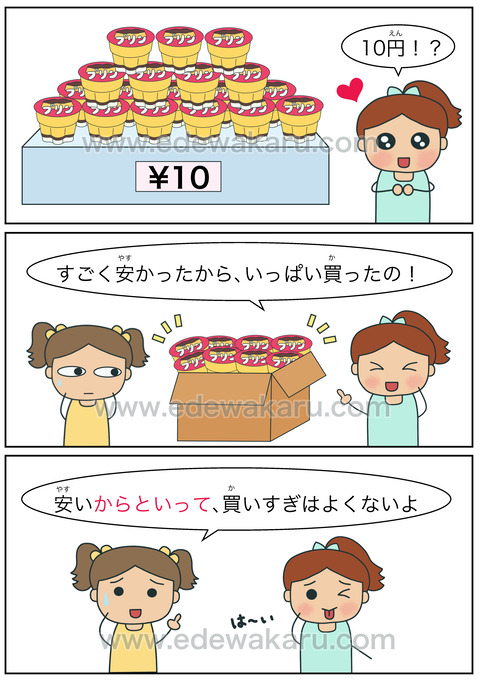
安かったからといって、買いすぎはよくないよ
→いくら安かったとしても、買いすぎはよくないよ(復習:〜すぎ(名詞化))Just because it was cheap, you shouldn’t buy too much. → Even if it was cheap, you shouldn’t buy too much. (Review: 〜すぎ (nominalization))
好きだからといって、食べすぎなんじゃない?
→いくら好きでも、食べすぎなんじゃない?(復習:〜すぎる)(復習:〜んじゃない・〜じゃない)Just because you like it, aren’t you eating too much? → Even if you like it, aren’t you eating too much? (Review: 〜すぎる) (Review: 〜んじゃない・〜じゃない)
アメリカに留学したからといって、英語がペラペラになれるわけではない
→ただアメリカに留学したというだけで、英語がペラペラになれるわけではない(復習:〜わけではない)Just because you studied abroad in the United States, it doesn’t mean you can become fluent in English. → Just because you studied abroad in the United States, it doesn’t mean you can become fluent in English. (Review: 〜わけではない)
日本人だからといって、ちゃんと敬語が使えるとは限らない日本人というだけで、ちゃんと敬語が使えるとは限らない(復習:〜とは限らない)
Just because someone is Japanese, it doesn’t necessarily mean they can use honorific language properly. Someone being Japanese alone doesn’t mean they can use honorific language properly. (Review: 〜とは限らない)
見た目が嫌いだからといって、食わず嫌いをしないほうがいい
→ただ見た目が嫌いという理由だけで、食わず嫌いをしないほうがいい(復習:食わず嫌い)(復習:〜ほうがいい)Just because you dislike how it looks, you shouldn’t refuse to try it. → Just because you dislike how it looks, you shouldn’t refuse to try it. (Review: 食わず嫌い) (Review: 〜ほうがいい)
Read the original source text
Meaning
いくら〜という理由があっても
ただ〜という理由だけで
How to use it
動詞・形容詞・名詞[普通形]+からといって
Explanation
「〜からといって」は「〜という理由があっても〜」「〜という理由だけで」という意味を表す文型です。多くの場合、
「〜だから〜は当然だ」と言われることを否定したい時
に使用されます😮
[例]
アメリカに留学した
からといって、英語がペラペラになれるわけではない
→「留学したらからペラペラになるのが当然」ということを否定
日本人だ
からといって、ちゃんと敬語が使えるとは限らない
→
「日本人だから、ちゃんと敬語が使えて当然」ということを否定
後ろには相手を注意する文型や、部分否定を表す文型がよく使われます
[「〜からといって」の後ろによく使われる文型]
・〜からといって
〜はよくない
・〜からといって
〜ないほうがいい
・〜からといって
〜とは限らない
・〜からといって
〜わけではない
・からといって
〜とは言えない
など
また、「〜からといって」の口語形は「〜からって」だと覚えておきましょう😀
[例]
安かった
からといって、買いすぎはよくないよ
=安かった
からって、買いすぎはよくないよ
好きだ
からといって、食べすぎなんじゃない?
=好きだ
からって、食べすぎなんじゃない?
アメリカに留学した
からといって、英語がペラペラになれるとは限らない
=アメリカに留学した
からって、英語がペラペラになれるとは限らない
「〜からといって・〜からって」は
【「から」がつく文型】
の1つとして、しっかりと覚えておきましょう😉
【「から」シリーズ】
〜から〜にかけて
〜からする・〜からある・〜からの
〜からといって・〜からって
〜からなる
〜からには
〜てからでないと〜ない
〜てからというもの
日本語文型辞典
Meaning
Basic information: N/Na だからといって; A/V からといって. Explanation: Used to quote a reason stated by someone else. Examples: ① She left partway through, saying she had something to do. ② Saying I might get hungry on the train, my mother, who came to see me off, is buying this and that at the kiosk.
Means “just for that reason alone.” It is followed by a negative expression and means that the proposition “XだからY” does not necessarily hold.
How to use it
…からといって+negative expression
In context 2 examples
手紙がしばらく来ないからといって、病気だとはかぎらないよ。
Just because no letter has come for a while doesn’t necessarily mean that they’re sick.
いくらおふくろだからといって、ぼくの日記を読むなんてゆるせない。
Even just because you’re my mother, I can’t forgive you for reading my diary.
Read the original source text
Meaning
基本情報N/Na だからといってA/V からといって…からといって説明他の人が述べた理由を引用するのに用いる。例文① 用事があるからと言って、彼女は途中で帰った。② 電車の中でおなかがすくといけないからと言って、見送りに来た母は売店であれこれ買っている。
「ただそれだけの理由で」という意味を表す。後ろには否定的表現をともなって「XだからY」ということは必ずしも成立しない、という意味となる。
How to use it
…からといって+否定的表現
日本語文型辞典 英語版
Meaning
【からといって】[N/Na だからといって][A/V からといって]
Used to quote a reason that another person has given.
Expresses “for this reason alone.” Followed by a negative expression and means that “X, thus Y” doesn’t always apply.
How to use it
1. ...からといって
2. ...からといって+否定的表現
In context 4 examples
用事があるからと言って、彼女は途中で帰った。
She said she had something to do and went home before it was over.
電車の中でおなかがすくといけないからと言って、見送りに来た母は売店であれこれ買っている。
My mother, who had come to see me off, bought me one thing after another at the stall, saying it would never do to go hungry on the train.
手紙がしばらく来ないからといって、病気だとはかぎらないよ。
Even though we haven’t had a letter for a while, it doesn’t necessarily mean he is sick.
いくらおふくろだからといって、ぼくの日記を読むなんてゆるせない。
I can’t forgive her for reading my diary, even if she is my mother.
Read the original source text
Meaning
【からといって】[N/Na だからといって][A/V からといって]
Used to quote a reason that another person has given.
Expresses “for this reason alone.” Followed by a negative expression and means that “X, thus Y” doesn’t always apply.
How to use it
1. ...からといって
2. ...からといって+否定的表現
くらべてわかる日本語表現文型辞典
Meaning
It is wrong to do B on the grounds that A; A does not make B acceptable.
How to use it
A からといって B (A からとて B)
[verb] からといって
[い-adjective plain form] からといって
[な-adjective だ / である / だった / ではない] からといって [Editorial note] The original book says “[な-adjective ③] + だ + からといって,” but ③ includes “だ / である / だった / ではない.” The extra “だ” has been removed from the connection pattern above.
[noun ではない / だ / だった] からといって
Explanation
[Contrast 1]
「A といっても B」 (Meaning 1, p. 161)
With 「A といっても B」, A is a fact, but B denies part of A, so A does not necessarily have to be a reason.
○若いといっても、彼ももう30歳です。 — Even though he is young, he is already 30.
×若いからといって、彼ももう30歳です。 — Just because he is young, he is already 30.
「A ものの B (A とはいうものの B)」 (Meaning 1, p. 312)
「A ものの B」 means that when one does A, C would normally follow as a natural result or course of events, but instead of C, B happened. B states a fact, whereas 「A からといって B」 states an opinion in B.
○一生懸命勉強しているものの、成績が伸びない。 — Although I am studying hard, my grades are not improving.
○一生懸命勉強しているからといって、成績は伸びるものではない。 — Just because I am studying hard, it does not mean my grades will improve.
「A とて B」 (Meaning 2, p. 180)
Notes
[Note 1]
・「A からとて B」 is an old-fashioned, formal expression.
In context 4 examples
何でも知っているからといって、大きな顔をするな。
Don’t act so self-important just because you know everything.
嫌いだからといって、野菜を食べないと体に悪いよ。
Just because you dislike vegetables, you shouldn’t avoid eating them; it’s bad for your health.
手紙がこないからといって、事故にあったとは限らない。
Just because no letter has arrived doesn’t mean there has been an accident.
古い本だからとて内容が古いわけではない。
Just because a book is old doesn’t mean its contents are outdated.
Read the original source text
Meaning
Aということを理由にBをするのはよくないことだ、Bにはならない。
How to use it
AからといってB(AからとてB)
[動詞]からといって
[イ形-普]からといって
[ナ形-だ/である/だった/ではない]からといって[校訂注]原書には「[ナ形容詞③]+だ+からといって」とあるが、③は「だ/である/だった/ではない」を含む。上の接続表記では余分な「だ」を除いた。
[名詞-ではない/だ/だった]からといって
Explanation
【対比1】
「AといってもB」(意味1 P.161)
「AといってもB」はAは事実であるが、そのAの一部分をBで否定する言い方であるため、Aが必ずしも理由にならなくてもいい。
○若いといっても、彼ももう30歳です。
×若いからといって、彼ももう30歳です。
「AもののB(AとはいうもののB)」(意味1 P.312)
「AもののB」はAをすると、当然の結果・流れとしてCになるはずなのに、CにはならずBとなったという意味であり、Bには事実を述べる文がくるが、「AからといってB」はBで意見を述べる。
○一生懸命勉強しているものの、成績が伸びない。
○一生懸命勉強しているからといって、成績は伸びるものではない。
「AとてB」(意味2 P.180)
Notes
【注意1】
・「AからとてB」は、古い、改まった表現。
日本語NET JLPT文法解説まとめ
Meaning
Even if there is a reason such as ~
How to use it
Plain form + からといって
Explanation
just because
The sentence often ends with a partial negative expression such as 「〜とは限らない」, 「〜わけではない」, or 「〜とはいえない」.
In context 4 examples
若いからといって、仕事ができないとは限らない。
Just because someone is young doesn’t mean they can’t do the job.
暑いからといって、毎日クーラーが効きすぎた部屋の中にいると健康によくないよ。
Just because it’s hot, staying in an overly air-conditioned room every day isn’t good for your health.
野菜が嫌いだからといって、食べないのはよくないよ。
Just because you dislike vegetables doesn’t mean you shouldn’t eat them.
間違えるのが怖いからといって、授業中に何も話さないのはよくないよ。
Just because you’re afraid of making a mistake, it’s not good to say nothing during class.
Read the original source text
Meaning
たとえ〜という理由があっても
How to use it
普通形 + からといって
Explanation
just because
文末には「〜とは限らない」や「〜わけではない」、「〜とはいえない」などの部分否定の表現使われることが多い。
NINJAL 日本語文型データベース
Meaning
This is used when one would normally expect a certain situation to result from ~, but sometimes it does not, or when one wants to say that the situation does not turn out exactly as expected. It expresses the speaker’s feeling that one should not draw a conclusion based on ~ alone.
How to use it
V plain form + からといって
i-A plain form + からといって
na-A plain form + からといって (「na-Aだ」 may also take the form 「na-Aである+からといって」)
N plain form + からといって (「Nだ」 may also take the form 「Nである+からといって」)
Notes
After 「〜からといって」 comes a sentence that denies what would be expected from 「〜」. Such sentences often use expressions like 「〜とは限らない・〜とはいえない・〜わけではない」.
In context 19 examples
平日の昼間に家にいるからといって、休んでいるわけではありません。家で仕事をしているんです。
Just because I’m at home during the day on a weekday doesn’t mean I’m taking time off. I’m working from home.
スポーツのルールを知っているからといって、実際にうまくできるかどうかは別の問題だ。
Knowing the rules of a sport and actually being able to play it well are two different things.
何も言わないからといって、自分の意見を持っていないとは限らない。
Just because someone doesn’t say anything doesn’t necessarily mean they don’t have an opinion of their own.
長く寝たからといって、疲れがとれるわけではない。
Just because you slept for a long time doesn’t mean your fatigue will go away.
今まで問題が起こらなかったからといって、これからも問題が起こらないとはいえない。
Just because no problems have arisen up to now doesn’t mean none will arise from now on.
値段が高いからといって、いい品物かどうかはわかりません。
Just because the price is high doesn’t tell us whether it’s a good-quality item.
人に嫌われたくないからといって、何でも人に合わせていたら疲れてしまうだろう。
If you cater to everyone just because you don’t want people to dislike you, you’ll probably get tired.
第一印象が悪かったからといって、本当に嫌な人とは限らないと思う。
I don’t think someone is necessarily a bad person just because they made a bad first impression.
買った本が面白くなかったからといって、返品することはできない。
You can’t return a book just because you didn’t find it interesting.
ラーメンが大好きだからといって、毎食ラーメンばかり食べたりはしない。
Just because I love ramen doesn’t mean I eat nothing but ramen at every meal.
今、健康であるからといって、ずっと不摂生を続けていても大丈夫なわけではありません。
Just because you’re healthy now doesn’t mean it’s all right to keep living an unhealthy lifestyle.
有名でないからといって、芸術作品として優れていないとはいえない。
Just because it isn’t famous doesn’t mean it can’t be an outstanding work of art.
学校の成績が優秀だったからといって、必ず立派な社会人になるとは限らない。
Just because someone got excellent grades at school doesn’t necessarily mean they’ll become an admirable member of society.
子どものころの私は、家が裕福じゃなかったからといって、惨めな思いをしたことはなかった。
When I was a child, I never felt miserable just because my family wasn’t wealthy.
金持ちだからといって、ぜいたくを好むとは限らない。
Just because someone is rich doesn’t mean they necessarily like luxury.
毎日会う同僚であるからといって、お互いの私生活についてよく知っているわけではない。
Just because we’re coworkers who see each other every day doesn’t mean we know much about each other’s private lives.
大した病気じゃないからといって、ドライアイの症状を放っておくのは目によくない。
Just because dry eye isn’t a serious illness, leaving its symptoms untreated is bad for your eyes.
昨日は私の誕生日だった。しかし、誕生日だったからといって、特に何か特別なことがあったわけではない。
Yesterday was my birthday. But just because it was my birthday doesn’t mean anything particularly special happened.
オリンピックで期待していた選手が金メダルじゃなかったからといって、責めるのはおかしい。
It’s wrong to blame an athlete just because the competitor we were rooting for at the Olympics didn’t win a gold medal.
Read the original source text
Meaning
〜ならある状況が成立するとふつうは考えるが、成立しない場合もある、または予想と全く同じ状況は成立しないと言いたいときに使います。〜だけで結論づけてはいけないという話し手の気持ちを表します。
How to use it
V普通形+からといって
i-A普通形+からといって
na-A普通形+からといって(「na-Aだ」→「na-Aである+からといって」の形になることもある)
N普通形+からといって(「Nだ」→「Nである+からといって」の形になることもある))
Notes
「〜からといって」の後には、「〜」から予想されることを否定する文がきます。「〜とは限らない・〜とはいえない・〜わけではない」などの表現を使った文が多いです。