Bunpro Grammar Reference
Meaning
Called, Said that (slang abbreviation)
How to use it
と̶い̶う̶ + つ or っつ
Nuance
A slang abbreviation pattern that is used in the same way as the standard quotation particle. Tends to sound aggressive in some situations.
Explanation
つ is a slang grammar pattern that originates from という, with the meaning of 'called (A)', 'that (A) that was said', or 'known as (A)'. Basically, it just quotes something that was previously said. つ may also be seen as っつ, or even つう.
Remember, という is just a combination of the quotation particle と, and 言う, the う-Verb meaning 'to say'.
As と is the quotation particle, つ can follow almost any statement or word type.
つーかなんでお前来たの。
By the way, why did you come?
そんな下手な説明じゃわからんっつーの。
I'm saying there's no way anyone would understand such a bad explanation.
何つうか覚えとらんけど、外国語っぽい名前だった気がする。
I don't remember what they were called, but I have a feeling that it was a foreign-language kinda name.
Although つ is very strong slang, it is very common. You can often hear native speakers saying という with various degrees of abbreviation, but つ being the shortest possible.
The pause in the っつ version may indicate that the speaker is annoyed or running out of patience, but this is not always the case.
だから、俺は何も知らないっつーの。
Because, I said don't know anything.
Caution
Just because 言う disappears when said as つ, it doesn't mean that standard conjugation rules also disappear. If you want to highlight that something 'was said' in past tense, or 'is being said' in progressive form, structures like つった or つってん will be used.
おい、今なんつった?
Oi, what'd you say just now?
で、そいつはなんつってんの?
And, what's he been saying?
ている becoming てん is explained more closely in the ん slang lesson.
Notes
Non-JLPT
In context 18 examples
- 彼は「もうすぐで来る」っつった。
He said 'I'll come soon'.
- だから、俺は何も知らないっつーの。
Because, I said don't know anything.
- そんな下手な説明じゃわからんっつーの。
I'm saying there's no way anyone would understand such a bad explanation.
- つーかなんでお前来たの。
By the way, why did you come?
- 何つうか覚えとらんけど、外国語っぽい名前だった気がする。
I don't remember what they were called, but I have a feeling that it was a foreign-language kinda name.
- あの人は「山田」つう男だ。
That person is a guy called Yamada.
- 「俺の話を聞け」つってんだよ。
I said 'Listen to what I have to say!'
- グランピングつうものをしてみたい。
I wanna try that thing called glamping.
- 「ここから立ち去れ」つってんだよ。
They said get up and get the heck out of here!
- ヤクザつう者は、どんな奴なんだい?
The people called Yakuza, what kind of guys are they?
- ディズニーつうものは凄く人気なんだね?
That place called Disney is super popular, right?
- 俺は泳げないつってんのに、泳がすな!
Despite saying I can't swim, don't get me to swim!
- 僕は元カノに「二度と連絡すんな」っつった。
I said 'don't ever contact me again' to my ex girlfriend.
- 先生つう者は、生徒を平等に扱わなければならない。
Someone called a teacher must treat students equally.
- あいつは「借金を返す」っつったのに、まだ返してない。
Despite him saying 'I will return the money I borrowed', he still hasn't returned it.
- 私と結婚するっつったのに、アイツは私の元から消えた。
Despite him saying he will marry me, that dude hit the road.
- おい、今なんつった?
Oi, what'd you say just now?
- で、そいつはなんつってんの?
And, what's he been saying?
Read the original source text
Meaning
Called, Said that (slang abbreviation)
How to use it
と̶い̶う̶ + つ or っつ
Nuance
A slang abbreviation pattern that is used in the same way as the standard quotation particle. Tends to sound aggressive in some situations.
Explanation
つ is a slang grammar pattern that originates from という, with the meaning of 'called (A)', 'that (A) that was said', or 'known as (A)'. Basically, it just quotes something that was previously said. つ may also be seen as っつ, or even つう.
Remember, という is just a combination of the quotation particle と, and 言う, the う-Verb meaning 'to say'.
As と is the quotation particle, つ can follow almost any statement or word type.
つーかなんでお前来たの。
By the way, why did you come?
そんな下手な説明じゃわからんっつーの。
I'm saying there's no way anyone would understand such a bad explanation.
何つうか覚えとらんけど、外国語っぽい名前だった気がする。
I don't remember what they were called, but I have a feeling that it was a foreign-language kinda name.
Although つ is very strong slang, it is very common. You can often hear native speakers saying という with various degrees of abbreviation, but つ being the shortest possible.
The pause in the っつ version may indicate that the speaker is annoyed or running out of patience, but this is not always the case.
だから、俺は何も知らないっつーの。
Because, I said don't know anything.
Caution
Just because 言う disappears when said as つ, it doesn't mean that standard conjugation rules also disappear. If you want to highlight that something 'was said' in past tense, or 'is being said' in progressive form, structures like つった or つってん will be used.
おい、今なんつった?
Oi, what'd you say just now?
で、そいつはなんつってんの?
And, what's he been saying?
ている becoming てん is explained more closely in the ん slang lesson.
Notes
Non-JLPT
Nuance · 日本語
標準的な引用の助詞と同じように使用される俗称の略語の形。場合によっては攻撃的に聞こえることがある。
どんなときどう使う 日本語表現文型辞典
Meaning
and; or; now…now
How to use it
Vます + つ + Vます + つ
Explanation
つ~つ
~たり~たり
後に来る動詞の動作や作用がどんな様子で行われるかを言う。「つ~つ」は二つの対立する動詞(浮く・沈むなど)に接続する。慣用的に使う。
Explains how verbal action following is carried out. Appends to two contrasting verbs, such as浮く (float), and沈む (sink). Used idiomatically.
In context 3 examples
マラソンの最後の500メートルで二人の選手は抜きつ抜かれつの競争になった。
Over the last 500 meters of the marathon, the two runners traded the lead back and forth.
風に飛ばされた赤いぼうしは木の葉のように浮きつ沈みつ川を流れていった。
The red hat blown away by the wind floated and sank like a leaf as it drifted down the river.
変な男の人がうちの前を行きつ戻りつしている。何をしているんだろう。
A strange man is pacing back and forth in front of our house. I wonder what he's doing.
Read the original source text
Meaning
and; or; now…now
How to use it
Vます+つ+Vます+つ
Explanation
つ~つ
~たり~たり
後に来る動詞の動作や作用がどんな様子で行われるかを言う。「つ~つ」は二つの対立する動詞(浮く・沈むなど)に接続する。慣用的に使う。
Explains how verbal action following is carried out. Appends to two contrasting verbs, such as浮く (float), and沈む (sink). Used idiomatically.
絵でわかる日本語
Meaning
~たり〜たり
How to use it
Verb [ます-form] +つ+Verb [ます-form] +つ
Explanation
「〜つ〜つ」 is a sentence pattern used to mean 「〜たり〜たり」. It is used to pair 【verbs expressing opposites】 or 【active and passive forms】 when you want to say that the two actions alternate 😊 These are all idiomatic expressions, so it is enough to memorize the commonly used ones 😉
【Verbs expressing opposites】
・行きつ戻りつ
→going back and forth
・見えつ隠れつ
→appearing and disappearing
・浮きつ沈みつ
→rising and sinking
【Active and passive forms】
・抜きつ抜かれつ
→overtaking and being overtaken
・押しつ押されつ
→pushing and being pushed
・追いつ追われつ
→chasing and being chased
・持ちつ持たれつ
→helping each other 【idiom】
・差しつ差されつ
→pouring sake for each other and having a friendly drink together 【idiom】
「〜つ〜つ」 is an N1 pattern, but it is only used with fixed expressions, so learn these as vocabulary 😀
In context 4 examples
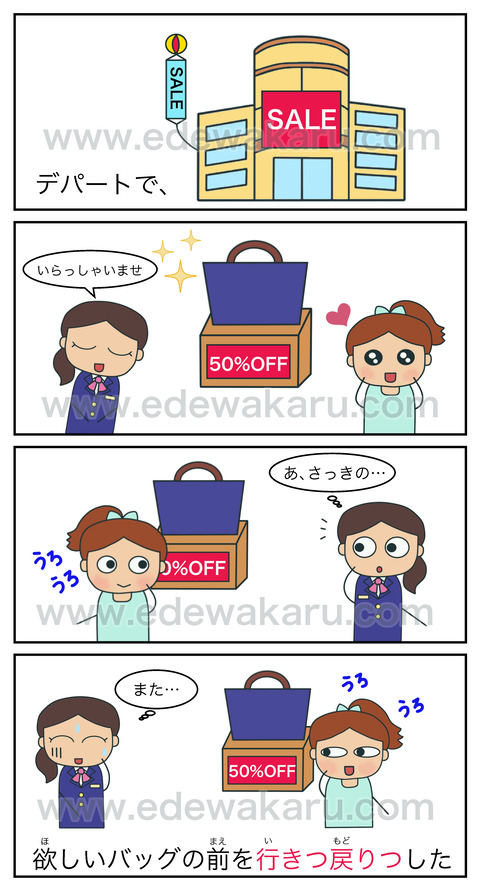
デパートで、欲しいバッグの前を行きつ戻りつした
→デパートで、欲しいバッグの前を行ったり戻ったりしたAt the department store, I went back and forth in front of the bag I wanted. →At the department store, I went back and forth in front of the bag I wanted.
昨日の野球の試合は、抜きつ抜かれつでおもしろかった
→昨日の野球の試合は、抜いたり抜かれたりでおもしろかったYesterday’s baseball game was exciting, with the lead changing back and forth. →Yesterday’s baseball game was exciting, with the lead changing back and forth.
毎朝、押しつ押されつ満員電車(まんいんでんしゃ)に乗っている
→毎朝、押したり押されたりして満員電車に乗っているEvery morning, I ride a packed train, getting pushed and pushing others. →Every morning, I ride a packed train, getting pushed and pushing others.
雲の間から、月が見えつ隠れつしている
→雲の間から、月が見えたり隠れたりしているThe moon keeps appearing and disappearing from behind the clouds. →The moon keeps appearing and disappearing from behind the clouds.
Read the original source text
Meaning
〜たり〜たり
How to use it
動詞[ます形]+つ+動詞[ます形]+つ
Explanation
「〜つ〜つ」は「〜たり〜たり」という意味で使われる文型です。
この文型は、
【反対を表す動詞】や【能動態と受動態】を並べて、その2つの動作が交互に行われると言いたい時に使われます
😊全て慣用的表現ですので、よく使われるものを暗記しておくだけでOKです😉
【反対を表す動詞】
・
行きつ戻りつ
→行ったり戻ったり
・
見えつ隠れつ
→見えたり隠れたり
・
浮きつ沈みつ
→浮いたり沈んだり
【能動態と受動態】
・
抜きつ抜かれつ
→抜いたり抜かれたり
・
押しつ押されつ
→押したり押されたり
・
追いつ追われつ
→追ったり追われたり
・
持ちつ持たれつ
→お互いに助け合うこと 【慣用句】
・
差しつ差されつ
→お互いにお酒をついだりつがれたりして仲良くお酒を飲むこと【慣用句】
「〜つ〜つ」はN1の文型ですが、
全て決まった単語にしか使われません
ので語彙として覚えてしまいましょう😀
くらべてわかる日本語表現文型辞典
Meaning
Expresses a situation or state in which one does A, has B done to oneself, or repeatedly alternates between doing A and B. An idiomatic expression of the form “AたりBたり.”
How to use it
Aつ Bつ
[Verb—ます-form] つ [Verb—ます-form/passive] つ
Notes
[Note 1]
・Because this is idiomatic, only fixed expressions are used.
In context 4 examples
犯人は車で逃走し、パトカーと追いつ追われつのカーチェイスを繰り広げた。
The suspect fled by car and engaged in a car chase with the patrol cars, alternately catching up and being pursued.
あの二人は成績において、常に抜きつ抜かれつしながら成長している。
Those two keep improving in their grades, constantly overtaking and being overtaken by each other.
問屋と商店は持ちつ持たれつの関係だ。
Wholesalers and retailers have a mutually dependent relationship.
彼は部屋に入ろうかと迷いながら、部屋の前を行きつ戻りつしていた。
Unsure whether to go into the room, he paced back and forth in front of it.
Read the original source text
Meaning
AをしたりBをされたり、AたりBたりを何度も繰り返すという状況や状態を表す。「AたりBたり」の慣用表現。
How to use it
AつBつ
[動詞-ます形]つ[動詞-ます形/受身]つ
Notes
【注意1】
・慣用的なので決まった表現しかない。
毎日のんびり日本語教師
How to use it
Verb ます-form + つ + verb ます-form + つ
Explanation
This uses verbs with opposite meanings to express that the actions are repeatedly performed in alternation.
It is limited to set expressions such as 「抜きつ抜かれつ」 (passing and being passed), 「持ちつ持たれつ」 (mutually helping one another), 「行きつ戻りつ」 (going back and forth), 「追いつ追われつ」 (chasing and being chased), 「押しつ押されつ」 (pushing and being pushed), and 「浮きつ沈みつ」 (floating and sinking).
Notes
Nothing in particular.
In context 7 examples
あれは抜きつ抜かれつの良い試合だった。
That was a good match, with the lead changing back and forth.
今夜の月は雲間から見えつ隠れつしている。
Tonight’s moon is appearing and disappearing through gaps in the clouds.
圧倒的な実力差のあるゲームは面白くない。追いつ追われつするシーソーゲームが最も見ごたえがある。
Games with an overwhelming difference in ability aren’t interesting. A seesaw game with the lead changing back and forth is the most exciting to watch.
猫と人の付き合いは一万年。持ちつ持たれつの関係だ。
Cats and humans have been together for ten thousand years. It’s a mutually beneficial relationship.
夢と現実を行きつ戻りつし、結局12時間寝続けた。
I drifted back and forth between dreams and reality, and ended up sleeping for twelve hours straight.
鍋の中で豆腐が浮きつ沈みつしている。
The tofu is bobbing up and down in the pot.
葉が水面を浮きつ沈みつ漂っている。
A leaf is drifting on the water’s surface, floating and sinking.
Read the original source text
How to use it
動ます形+つ+動ます形+つ
Explanation
正反対の意味を持つ動詞を用い、それらが繰り返し交互に行われることを表します。
「抜きつ抜かれつ」「持ちつ持たれつ」「行きつ戻りつ」「追いつ追われつ」「押しつ押されつ」「浮きつ沈みつ」など慣用的な表現に限られます。
Notes
特になし
IMABI
Native Numbers & The Counter ~つ
Read this IMABI lesson ↗Explanation
Native Numbers & The Counter ~つ
In this lesson, we will learn about the native set of numbers that coexist with their Sino-Japanese counterparts. In doing so, we will begin our journey of learning how to count things by introducing the most important counter in Japanese—~つ.
Native Numbers
和語系の数詞
Numbers existed in Japanese prior to Sino-Japanese words being incorporated into the language. In modern speech, only the native words for 1 through 10 are practically used given the extreme influence the Sino-Japanese numerals have had.
No. Native Number Sino-Japanese Number
1ひとイチ
2ふたニ
3みサン
4よ(ん)シ
5いつゴ
6むロク
7ななシチ
8やハチ
9ここのキュウ・ク
10とおジュウ
When counting in general, the counter ~つ attaches itself to the base number with exception to とお (10).
No.Native Number + ~つKanji SpellingArabic Numeral Spelling
1ひとつ一つ 1つ
2ふたつ二つ 2つ
3みっつ・みつ三つ 3つ
4よっつ・よつ四つ 4つ
5いつつ五つ 5つ
6むっつ・むつ六つ 6つ
7ななつ七つ 7つ
8やっつ・やつ八つ 8つ
9ここのつ九つ 9つ
10X (→ とお)十 10
? いくつ 幾つ
※The pronunciations that exclude っ are the traditional ones, but they have fallen out of use.
※”?” = いく stands for “how many?”
When counting, speakers may choose to use these phrases instead of Sino-Japanese numbers. This gives ひとつ, ふたつ, みっつ, etc. Interestingly, though, there is an abbreviated form for counting numbers that reduces to monosyllabic yet moraically elongated counterparts.
No. Abbreviations
1ひー
2ふー
3みー
4よー
5いー(いつ)
6 むー
7なー(なな)
8やー
9こー
10とー
When reciting these, they are often just left as one mora with 5 and 7 often being rendered irregularly as いつ and なな respectively, resulting in: ひ・ふ・み・よ・い(つ)・む・な(な)・や・こ・と.
Counting Things
First, it is important to understand what is meant by counting things. As straightforward as “one bird,” “two birds,” “three birds,” etc. might seem, in Japanese, you need to combine numbers with the counter for said object. Thus, you combine “1, 2, 3” with the counter for bird in this case. The counter aids the number in defining what is being counted.
Although the counter for “bird” is unfortunately not the native word for bird, native counters are often standalone nouns that bear the same meaning, which is very familiar to how such expressions are typically made in English.
1. ひと切れのパン (切れ = piece/slice)
A piece/slice of bread
2. ふた月 (月 = month)
Two months
3. ひと房のブドウ (房 = bundle)
A bundle of grapes
Though this correlation is not absolute, encountering new native counters is easier knowing this beforehand. Quantity words often function as counters, and when that word happens to be a native word, expect it to at least go with the first few numbers of the native sequence before switching over to Sino-Japanese numbers.
Knowing how Sino-Japanese numbers get interjected with native counters will be a future topic of discussion.
Counting with ~つ
Given that the majority of counters are also Sino-Japanese, it might seem counterproductive to start learning them from the native vocabulary route, but the reason for this is due to just how important the counter ~つ really is.
~つ can theoretically count anything and everything. The sheer scope of what it does generally count and its ability to replace the proper counter of an entity out of convenience or ignorance corroborate this notion.
How ~つ is generally used can be simplified to the following seven points. Note that in order to demonstrate how it competes with other (sometimes more proper) counters, those said counters are shown in parentheses as reference material and need not be studied until they are formally introduced.
1. Counting Three-Dimensional Items
Most physical items have a proper counter that is generally used to count it, but there is still a plethora of physical objects that are assigned to ~つ. When ~つ does replace another counter, it gives off a very colloquial tone.
4. 2つ下さい。
Please give me two (of them).
5. ブースは4つあります。
There are four booths.
6. オフィスにテーブルが5つあります。
There are five tables in the office.
7. 日本には、温泉はいくつ(→ 何か所)ありますか。
How many hot springs are there in Japan?
8. ベッドは5つ (→5床 ・5台)あります。
There are five beds.
9. 飴をひとつ(→ 1個)食べます。
I’ll eat one piece of candy.
2. Counting Things w/ Indeterminate Shapes
Not everything has a defined shape, and those entities are even more likely to be counted with ~つ.
10. タオルに黄色い染みが2つあります。
There are two yellow stains on the towel.
11. 洗面台の下に大きな水溜まりがひとつあります。
There is a large puddle beneath the washstand.
12. 影が3つありました。
There were three shadows.
3. Counting Abstract Things
Given how ~つ can be used to count things regardless of shape, it is only logical that it may count abstract things which have no physical shape.
13. 理由は6つあります。
There are six reasons.
14. ミッションは7つあります。
There are seven missions.
15. 条件は1つあります。
There is one condition.
16. 交わした十(じゅう)の約束はひとつも守らなかった。
You didn’t even protect one of the ten promises we made.
Grammar Note: Ex. 16 shows how once you count past 9 with an entity counted with ~つ, the pattern is halted and switches over to using Sino-Japanese numbers without a counter at all or Sino-Japanese numbers + the counter ~個, which is the Sino-Japanese equivalent of ~つ that we will learn about in the next lesson.
4. Replacing the Proper Counter
Given how ~つ is both generic and versatile, the reasons for why ~つ might replace the proper counter of an entity are also numerous. The speaker may not know the counter, the counter in question could be too obscure when spoken, or using ~つ is just simpler, case in point.
17. 金曜日に授業はいくつ(→ 何クラス)ありますか。
How many classes do you have on Friday?
18. 家の2つ前の駅で(→ 2駅前で)友達と待ち合わせました。
I met with a friend at the station two stations before my place.
Grammar Note: Something that will be emphasized more clearly in the following lesson is how counters may behave as adverbs, but how adverbial a counter is can differ on a case-by-case basis, which explains why more than just a counter swap occurs in Ex. 18. The option in parentheses treats “two stations” as a fully adverbial phrase, whereas 2つ前の駅 utilizes both a counter and the literal noun it is counting juxtaposed next to it.
5. Replacing Proper Counter in Orders
A sub-usage of Usage 4, it is very common for ~つ to replace the proper counter of something when ordering. One major reason for this is that when ordering various items, the proper counter for each may all be different, and to simplify ordering, assigning ~つ to everything would be the most efficient option.
19. チーズバーガー2つとLサイズのポテト3つ下さい。
Two cheese burgers and three large-sized orders of French fries, please.
20. ハムサンドイッチとコーヒーをひとつ下さい。
One ham sandwich and coffee, please.
21. アイスコーヒーを1つ(→ 1杯)下さい。
One iced coffee please.
22. アマゾンでゲーミングチェアを2つ注文した。
I ordered two gaming chairs on Amazon.
6. Counting Age (1-9, 20)
The phrase 何歳ですか meaning “how old are you?” is so basic that it might be tempting to suggest that using ~つ instead – producing (お)いくつですか – is another example of ~つ replacing the proper counter (~歳). However, ~つ has incidentally always been able to count age since way before Sino-Japanese vocabulary entered the language.
In practicality, this is only done for the numbers 1-9. However, it can also be seen for twenty-years-old in the phrase はたち, which combines the rare native number for 20 and ~ち, an alteration of ~つ seen with multiples of 10.
To express someone being X years older/younger than someone, all you do is follow the pattern #つ上(うえ)・下(した) accordingly.
23. うちの子は3つです。
My child is three.
24. 兄は8つ上です。
My older brother is eight years older.
25. 妹は五つ下です。
My younger sister is five years younger.
26. 僕は今年で8つになるんだ!
I’ll be 8 this year.
Grammar Note: 十(とお)may also be used to mean “ten-years-old.”
7. Use in Set Phrases
Given its versatility, it may come as no surprise that ~つ would be used in set phrases. When it does so, its use is obligatory as that is what is meant by it being in a set phrase. More often than not, ひとつ is frequently used in idioms, often to show solidarity.
27. 視聴者(たち)の心がひとつになったでしょう。
The hearts of the viewers surely became one.
28. こうして幼い頃から一つの屋根の下で育ちました。
This is the way (we) grew up under the same roof since (we) were little.
29. ひとつ聞いてもいいですか。
Can I ask you something?
Previous Lesson
Next Lesson
In context 29 examples
ひと切れのパン (切れ = piece/slice)
A piece/slice of bread
ふた月 (月 = month)
Two months
ひと房のブドウ (房 = bundle)
A bundle of grapes
2つ下さい。
Please give me two (of them).
ブースは4つあります。
There are four booths.
オフィスにテーブルが5つあります。
There are five tables in the office.
日本には、温泉はいくつ(→ 何か所)ありますか。
How many hot springs are there in Japan?
ベッドは5つ (→5床 ・5台)あります。
There are five beds.
飴をひとつ(→ 1個)食べます。
I’ll eat one piece of candy.
タオルに黄色い染みが2つあります。
There are two yellow stains on the towel.
洗面台の下に大きな水溜まりがひとつあります。
There is a large puddle beneath the washstand.
影が3つありました。
There were three shadows.
理由は6つあります。
There are six reasons.
ミッションは7つあります。
There are seven missions.
条件は1つあります。
There is one condition.
交わした十(じゅう)の約束はひとつも守らなかった。
You didn’t even protect one of the ten promises we made.
金曜日に授業はいくつ(→ 何クラス)ありますか。
How many classes do you have on Friday?
家の2つ前の駅で(→ 2駅前で)友達と待ち合わせました。
I met with a friend at the station two stations before my place.
チーズバーガー2つとLサイズのポテト3つ下さい。
Two cheese burgers and three large-sized orders of French fries, please.
ハムサンドイッチとコーヒーをひとつ下さい。
One ham sandwich and coffee, please.
アイスコーヒーを1つ(→ 1杯)下さい。
One iced coffee please.
アマゾンでゲーミングチェアを2つ注文した。
I ordered two gaming chairs on Amazon.
うちの子は3つです。
My child is three.
兄は8つ上です。
My older brother is eight years older.
妹は五つ下です。
My younger sister is five years younger.
僕は今年で8つになるんだ!
I’ll be 8 this year.
視聴者(たち)の心がひとつになったでしょう。
The hearts of the viewers surely became one.
こうして幼い頃から一つの屋根の下で育ちました。
This is the way (we) grew up under the same roof since (we) were little.
ひとつ聞いてもいいですか。
Can I ask you something?
The Case & Conjunctive Particles つ
Read this IMABI lesson ↗Explanation
The Case & Conjunctive Particles つ
The case particle つ is a fascinating example of an archaic grammatical feature that has somehow withstood all odds, despite having such a limited role even as long ago as Old Japanese.
Etymologically unrelated, we will also look at the conjunctive particle つ, which can be viewed as the predecessor to the particle たり when showing repetitive back and forth.
The Case Particle つ
Throughout the history of Japanese, the particles が・の have unilaterally been used to indicate attributes as well as the nominative case (主格). Yet, the case particle つ has only ever been used to indicate attributes (属格).
Although the sample size of instances of つ in Classical Japanese pales in comparison to how many examples can be found of が・の, significant overlap can be found, suggesting that at the very least, significant dialectal variation must have existed as to which which was preferred.
Words Commonly Paired with ~つ
While most instances of つ are archaisms, instances from the 万葉集 still sprinkle poetry in the modern era, so with that in mind, consider the words listed in the charts below, which are specifically chosen for showing up in modern dictionaries.
Morphemes pertaining to Place + ~つ
Attributive MorphemeMeaningExample WordMeaning
天(あま)heaven天つ印unsurpassable boundary in the heavens, a.k.a, the Milky Way
家house家つ鳥decorative word1 which appears with the word 鶏(かけ) meaning “chicken”
海sea海つ路sea route
沖offing沖つ風offshore wind
奥recesses奥つ城ancestral grave
上(かみ)up上つ瀬rapids upstream
国country国つ罪sins committed by those in the land (as opposed to sins committed by the gods)
島island島つ鳥cormorant
下(しも)below下つ方those of lower status
外(と)outside外つ国foreign land
中between中つ国Japan2
秀(ほ)leaf秀つ枝3upper branch
Morphemes pertaining to Time (Or Place)
Attributive MorphemeMeaningExample WordMeaning
先prior先つ年prior year
時time時つ風winds that blow at just the right time
常(とこ)forever常つ御門forever emperor
遠(とほ)distant遠つ神祖(かむおや)distant ancestors who were kami
元formerly元つ人person one was once close with
遠(をと)distant遠つ日4the year before last
Archaisms which Fit neither Scenario
While examples which pertain to location/time are the ones which have persisted in to the present, there are still many examples in Old Japanese which fall under neither category.
ArchaismMeaning
醜(しこ)つ翁(おきな)ugly old man
花つ月March (lunar calendar)
秀(ほ)つ鷹superb hawk
秀(ほ)つ手superb skill
斎(ゆ)つ磐群sacred rock formation
Complex Examples
Putting aside whether the phrase is moribund, some examples of つ are quite complex in meaning, suggesting that it had just as wide of a range as の・が, which is corroborated by those particles appearing after the same morphemes.
ArchaismMeaning
天つ空①the great skies above
②absent-mindedness
御食(みけ)つ国land in which the emperor provides his people food
棚機つ女・織女①female weaver
②Vega
Modern Usage of つ
Since Middle Japanese, つ has only appeared in fossilized compound nouns, but there are some examples such as 睫毛 (eyelash(es)) which have persisted as commonplace nouns5, although they are exceptionally rare.
1. 滝たきつ瀬せとは川の流れの激しいところだ。
A takitsuse is a place where the current of a river is violent.
2. しかも天日あまつひのごとく若くかがやかしく、悩みと憂いが兆しかけた眉は凛々りりしさを加え、豊葦原中国とよあしはらのなかつくににまた見ること叶わぬような美しい壮夫わかものであった。
Moreover, he was a beautiful, splendid man that she could never see with the likes of Toyoashihara no Nakatsukuni, though he was young and bright like the heavenly sun in addition to the chivalry in his eyebrows which foretold sorrow and grief.
From 『獅子・孔雀』 by 三島由紀夫.
3. どのような禍津日まがつひも、わたくし共の恋の樹を枯らす力は有もちませぬ。
No calamitous day could have the power to cut down our tree of love.
From 『獅子・孔雀 』by 三島由紀夫.
The Suffix ~づから
A fascinating use of the particle つ is its appearance, albeit voiced, in the suffix ~づから. If written in kanji, から would be best spelled as 柄. This suffix lives on in words like 自ら (myself) and 自ずから (of one’s own accord), but it can also be seen in 口づから (in one’s own words).
4. 御門の、御くちづからごて給へるなり。
The emperor had said this himself.
From the 『源氏物語』.
In Classical Japanese, this suffix could also still indicate “relationship” when attached to a noun related to human relationships—e.g. 従妹づから (cousin relationship).
The Conjunctive Particle つ
The conjunctive particle つ has been used throughout Japanese to indicate two repetitive actions which go back and forth. While it has since been replaced by the conjunctive particle たり in Modern Japanese, its occasional appearance in set expressions in Modern Japanese cannot be ignored. These phrases often exhibit extensive sound changes, which can get in the way of proper identification.
5. 元助は行きつ戻りつしながら待った。
Gensuke waited, walking to and fro.
6. 矯めつ6眇めつ眺める。
To take a good look at something.
7. 彰蔵はとつおいつ7思案する嫌いがある。
Shozo has the tendency to ponder over this and that.
8. 夢のなかではいつも父と追いつ追われつして、親雄が殺されるか父が殺されるかした。
In Chikao’s dreams, it was always a cat chase with his father, and it was either him or his father being killed.
From 『獅子』 by 三島由紀夫.
9. 浮きつ沈みつ
Floating up and down
10. 御米は依然として、のつそつ8床の中で動いていた。
Oyone was still stretching and crouching in her bed.
From 『門』 by 夏目漱石.
11. 組んず解れつ9の大乱闘
A major brawl, locked in a grapple
The Predecessor ~み~み
Just as the conjunctive particle たり has replaced つ in Modern Japanese, つ had replaced the conjunctive particle み in Old Japanese. Granted, in Old Japanese, the conjunctive particle み was largely confined to the pattern “連用形 of V + ~み + V~ず + ~み” to show alternating conditions between the affirmative and the negative.
12. 降りみ降らずみ (Old Japanese)
From raining to not raining
参照
上代日本語の属格「つ」と数詞についての仮説 by 平田裕.
枕詞 are figures of speech which are used as epithets in association with certain words. In this instance, 家つ鳥 literally means “domesticated bird in the home,” which is most certainly a great description of a chicken. ↩︎
中つ国 is interchangeable with 豊葦原中国. In Japanese mythology, “Japan” is the middle world between Yomi 黄泉 (the underworld) and Takamagahara 高天原 (the High Plain of Heaven). ↩︎
The word 秀つ枝, which is also spelled as 上枝, is etymologically fascinating, as it implies a phonological and etymological connection between the words 葉 (leaf) and 穂 (ear (of a cereal plant)), with ほ constituting an irregular case of /a/ → /o/, contributing to its disappearance in the modern lexicon. Interestingly, the antonym of ほつえ still remains as しづえ, which notably features a deletion of the syllable /ta/. However, as is apparent from the word forms した and しも, the base morpheme is /shi/, with /ta/ and /mo/ respectively being affixes whose functions have unfortunately been lost to time. ↩︎
Through several sound changes, this word gave rise to the Modern Japanese version おととい. ↩︎
Speculatively, some have suggested that the counter つ may actually derive from the case particle つ. See citation above. ↩︎
In this expression, 矯める has the meaning of “to correct/rectify,” and 眇める has the meaning of “to squint with one eye.” ↩︎
とつおいつ derives from the contraction of 取りつ置きつ, which itself describes taking something in one’s hands then putting it back down. ↩︎
のつそっつ is the contraction of のっつそっつ, which itself is a contraction of のりつ反りつ. In this expression, 伸る means “to stretch,” and 反る means “to arch (backward).” ↩︎
組んず解れつ derives from the contraction of 組みつ解れつ. In this expression, 組む means “to grapple” and 解れる means “to unravel.” ↩︎
In context 12 examples
滝たきつ瀬せとは川の流れの激しいところだ。
A takitsuse is a place where the current of a river is violent.
しかも天日あまつひのごとく若くかがやかしく、悩みと憂いが兆しかけた眉は凛々りりしさを加え、豊葦原中国とよあしはらのなかつくににまた見ること叶わぬような美しい壮夫わかものであった。
Moreover, he was a beautiful, splendid man that she could never see with the likes of Toyoashihara no Nakatsukuni, though he was young and bright like the heavenly sun in addition to the chivalry in his eyebrows which foretold sorrow and grief.
どのような禍津日まがつひも、わたくし共の恋の樹を枯らす力は有もちませぬ。
No calamitous day could have the power to cut down our tree of love.
御門の、御くちづからごて給へるなり。
The emperor had said this himself.
元助は行きつ戻りつしながら待った。
Gensuke waited, walking to and fro.
矯めつ6眇めつ眺める。
To take a good look at something.
彰蔵はとつおいつ7思案する嫌いがある。
Shozo has the tendency to ponder over this and that.
夢のなかではいつも父と追いつ追われつして、親雄が殺されるか父が殺されるかした。
In Chikao’s dreams, it was always a cat chase with his father, and it was either him or his father being killed.
浮きつ沈みつ
Floating up and down
御米は依然として、のつそつ8床の中で動いていた。
Oyone was still stretching and crouching in her bed.
組んず解れつ9の大乱闘
A major brawl, locked in a grapple
降りみ降らずみ (Old Japanese)
From raining to not raining
「完了」を示す「ぬ」・「つ」
Read this IMABI lesson ↗Explanation
第014課: The Auxiliary Verbs ~ぬ & ~つ
This lesson will introduce you to two auxiliary verbs in Classical Japanese which denote perfection/completion (完了). These endings are ~ぬ and ~つ, which are identical aside from which sort of verbs they are used with.
The Auxiliary Verb ~ぬ
The 終止形 of the auxiliary verb ~ぬ is identical in appearance to the 連体形 of the auxiliary verb ~ず; however, the functions of these two auxiliaries could not be any more different. ~ぬ attaches to the 連用形 of verbs, mostly being restricted to intransitive verbs or verbs not denoting volition.
Conjugation Class +~ぬ
上一段(to dry up) 干る → 干ぬ
下一段 (to kick) 蹴る → 蹴ぬ △1
上二段(to fall) 落つ → 落ちぬ
下二段(to end) 果つ → 果てぬ
四段 (to stand) 立つ → 立ちぬ
カ変 (to come) 来 → 来(き)ぬ
ラ変(to be/happen) あり → ありぬ
サ変(to do) す → しぬ
The auxiliary verb ~ぬ functions as a perfect tense ending used to denote the completion of natural events. When used in isolation, the event is understood as having occurred in the past, making it translate into Modern Japanese as ~た or ~てしまった.
1. 晴れたる空は夜に入(い)りて雨となりぬ。
The bright sky then went into night and turned to rain.
By 田山花袋.
2. 嗚呼、ブリンヂイシイの港を出でてより、早や二十日あまりを経ぬ。
Ah, around twenty days have already past so quickly since leaving Brindisi Harbor.
From 『舞姫』 by 森鴎外.
When combining ~ぬ with other auxiliaries as well as when using it in its other base forms, it retains its purpose as a perfect tense marker. As to whether the sentence should be interpreted as referring to a past, present, or future perfect construction depends on the overall verb phrase. First, let’s look at what its bases are. This ending conjugates as a ナ変 verb as follows:
未然形 連用形 終止形 連体形 已然形 命令形
な- に- ぬ- ぬる- ぬれ- ね-
The 未然形 な-
~ぬ is not used with negative auxiliaries, but that still leaves several potential auxiliaries that may attach to its 未然形. Endings that are frequently used with it include ~む, ~まし, ~まほし, and ~ば.
~なむ relates to the “future perfect” in English, translating to “will have (surely)… ” You may recognize ~む as being the volitional ending, but it also indicates likely future states. Because of how it translates to きっと…だろう in Modern Japanese, most 古文 resources define this as an example of ~ぬ expressing 強意 rather than a perfect tense because ~む could be used to express conjecture by itself, implying that ~ぬ is used together with it to enhance the overall meaning. Although this is true, that is also what is meant by the concept of “future perfect.” The future has yet to occur, but the speaker is certain the state in question will have transpired by then.
3. 盛りにならば、容貌(ようばう)もかぎりなくよく髪もいみじく長くなりなむ。
If I reach my prime, my features will have become exceedingly good and my hair will have become exceptionally long.
From the 『更級日記』.
~なまし utilizes the auxiliary verb ~まし, which is used to mark counterfactual supposition (反実仮想). Together, the phrase translates to きっと…ただろうに. At times, the situation is about the future under a circumstance that seems as if it’s true at that point.
4. 白玉か 何ぞと人の 問ひしとき 露と答へて 消なましものを。
“Is (that) a pearl?” asked her, to which I responded, “it’s dew,” but if only I had disappeared (like the dew along with her).
From the 『伊勢物語』.
5. けふ来ずは明日は雪とぞ降りなまし、消えずはありとも花と見ましや。
If you do not come today, (this cherry tree) will have scattered (its blossoms) come tomorrow. Even if they were to not disappear (like snow), would you still view (the blossoms) for the flowers (they are)?
From the 『伊勢物語』.
~なまほし equates to ~てしまいたい in Modern Japanese. In Ex. below, あくがる is the Classical Japanese form of the Modern Japanese verb 憧れる, but in this time period, it also had the meaning of さまよう (to wander about) in a quite vexed state of mind.
6. かう心憂ければこそ、今宵の風にもあくがれなまほしくはべりつれ。
Feeling so miserable like this is exactly why I wish I could just be taken away somewhere by tonight’s winds.
From the 『源氏物語』.
~なば equates to ~てしまったならば and exemplifies how ~ぬ functions as a perfect tense marker.
7. ただ今ゆくへなく飛び失(う)せなば、いかが思ふべき。
If I were to just leave somewhere without a clue, what would you think?
From the 『更級日記』.
The 連用形 に-
We have learned how ~ぬ in isolation translates to ~た or ~てしまった just as in the following.
8. 春来ぬと人は言へども鶯の鳴かぬ限りはあらじとぞ思ふ。
People say that spring has arrived, but I won’t believe it has so long as I don’t hear the nightingales chirp.
From the 『古今和歌集』.
The use of the present perfect tense in the English translation reflects how it is not just a past tense marker. In fact, ~ぬ frequently becomes paired with tense markers when used in the 連用形.
~にたり expresses a resultant state that is still ongoing. Thus, ~たり marks continuation (存続) in the same way ~ている would in Modern Japanese and ~ぬ remains a perfect tense marker, correlating to “past perfect” because of the following auxiliary indicates that the state did finalize in the past.
9. 身を変へたるがごとなりにたり。
It’s as if you’ve changed your status.
From the 『竹取物語』.
When used in ~にけり or ~にき, ~ぬ is often viewed as an intensifier (強意); ~にき refers to a past situation that one was witness to confirm whereas ~にけり refers to either past hearsay or a truth involving the past that one is now realizing (recollective past). In either situation, one could still view ~ぬ as a perfective ending.
10. 果てには朱雀門・大極殿・大学寮・民部省などまで移りて一夜のうちに塵灰となりにき。
Ultimately, (the fire) spread to Suzaku Gate, the Council Hall, The Daigaku-ryō, the Ministry of Popular Affairs, and elsewhere, and within the night, (those places) had been turned to dust and ashes.
From the 『方丈記』.
11. 明治廿一年の冬は来(き)にけり。
Just like that, the winter of Year 21 of the Meiji Era had arrived.
12. 舟こぞりて泣きにけり。(連用形)
Everyone had cried in unison.
From the 『伊勢物語』.
When ~む attaches to ~にけり, the resulting ~にけん is equivalent to the Modern Japanese expression ~てしまったんだろうか.
13. 故郷は見し世にも似ず、褪せにけり、いづち昔の人往きにけむ。
The place (I had once lived) resembled nothing like I saw (before), having fallen into ruin.
The 終止形 ぬ-
Aside from being used in isolation, the 終止形 of ~ぬ is frequently used with auxiliaries of supposition such as ~らし,~めり,~べし,and ~らむ.
14. けぶりあふにやあらむ、清見が関の波も高くなりぬべし。(終止形)
Perhaps it’s smoke rising (from boiling sea water), but the waves of Kiyomigaseki are surely tall.
From the 『更級日記』.
Sentence Note: The status of the waves is a recent result, and so one could still view this as a perfect tense construction regarding a present state.
15. ぬばたまの夜は更けぬらし玉くしげ二上山(ふたがみやま)に月傾(かたぶ)きぬ。
The night seems to have fallen, as dark as a blackberry lily seed; the moon has become titled above Mt. Futagamiyama.
From Poem 3955 of the 『万葉集』.
16. 日も暮れ方になりぬめり。
It would appear that the day has turned to dusk.
From the 『更級日記』.
~ぬらむ is an even far better example of the “present perfect.” ~らむ specifically indicates present conjecture (現在推量), so when it’s paired with ~ぬ, the speaker is emphatically questioning why something has become so. The matter at hand is undoubtedly a matter of the present.
17. 宿りせし花橘も枯れなくに、などほととぎすこゑ絶えぬらむ。
Why have the chirps of the cuckoos ceased though the flowering tachibana which they rest on have yet to wilt?
From the 『古今和歌集』.
18. 嶺(みね)の櫻は散りはてぬらむ。(終止形)
The cherry blossoms at the peak have probably completely scattered.
From the 『新古今和歌集』.
The 已然形 ぬれ-
The only endings that attach to the 已然形 of ~ぬ are ~ど and ~ば, and ~ぬ can be understood as referring to past perfect in any situation used with these endings.
19. 同郷人にさへ知られぬれば…
Since (our relationship) had become found out by the villagers of that same town…
From 『舞姫』 by 森鴎外.
20. 滝の音は絶えて久しくなりぬれど名こそ聞こえけれ。
Though it has been a long while since the sounds of the waterfall could be heard, its name can still be heard even now.
〇〇~ぬ〇〇~ぬ
A meaning which developed in the late-Middle Japanese period mirrors the use of 〇〇~たり〇〇~たり in Modern Japanese, still being limited to verbs involving natural occurrence.
21. みな紅(くれなゐ)の扇(あうぎ)の日いだしたるが、白波(しらなみ)の上(うへ)にただよひ、浮きぬ沈(しづ)みぬ揺られければ (終止形)
Since the fan with the sun drawn with gold in the crimson land floated on top of the white wave and swayed while floating and sinking……
From the 平家物語.
~ぬ’s Etymology
A common theory is that ~ぬ derives from the verb 去ぬ meaning “to leave (said place).” The meaning of “leaving away” into the distance, but more importantly, over time, would appear to coincide with something that has transpired, but does ~ぬ truly pertain to stating that something is “said and done”?
Point 1: tense w/ 去ぬ Itself
去ぬ itself is in the non-past tense, meaning it too could have and was used with ~ぬ to produce 去にぬ. Furthermore, given how ~ぬ was always2 used as a perfect tense marker up until late Middle Japanese when its third meaning of “back-and-forth action” (which still relies on the the actions being completed between alternations) developed, 去ぬ would have never been used in place of 去にぬ or other forms involving past tense markers such as 去にけり. Moreover, if ~ぬ were truly derived from 去ぬ, it would make 去ぬ utterly redundant in the following sentence.
22. そこより逃げて去にけり。
He then ran away and left the scene.
From the 『今昔物語集』.
23. 女をば草むらのなかに置きて、逃げにけり。
(The man) had fled after putting the woman among the grass.
From the 『伊勢物語』.
Point 2: No Fossilized Retention of Original Morpheme?
Typically, when a word takes on a grammatical function then builds upon that interpretation beyond the complexity of its original physical meaning, that original meaning is lost to time or is at least on the verge of being forgotten. An example of this in English is the article “a(n)” clearly sharing the same origin as the number “one.” However, the original meaning still serves as the mold for how the current meaning functions. If this were applied to ~ぬ, then one would at least expect these “past” situations which have become completed would be far “past” the speaker, but that is not the case. The situations described still affect the speaker at some level whether it be a “past perfect,” present perfect,” or “future perfect,” and the latter two definitions ought not have been possible had the ending been so obviously from 去ぬ to speakers at the time.
Point 3: Number of /-nu/-FInal Verbs is Irrelevant
3. Confusion between the auxiliary ~ぬ and verbs ending in ぬ is not plausible, as 去ぬ was not the only example of such verbs, though, admittedly, such instances are indeed limited.
Point 4: Other Potential Origins
Another issue is the likelihood of a perfect tense deriving from a verb meaning “to go (away)” as opposed to a copular expression as they did in Indo-European languages. With the Classical Japanese copular なり beginning in /n/ as well, it is likely that a basal /n/-initial copula expression is responsible for the birth of ~ぬ as the perfect tense marker.
The Auxiliary Verb ~つ
~つ is the transitive equivalent of ~ぬ, generally indicating deliberate actions that have been completed. As to be expected, its three usages are also parallel with those of ~ぬ.
1. Marking the completion of deliberate actions.
2. Expresses certainty that an action will be completed (deliberately by someone).
3. Back-and-forth parallel action with the paired verbs requiring an agent performing said actions willfully.
Although ~つ is primarily used with transitive verbs, it is more accurate to state that it is paired with either intransitive or transitive verbs whose agent (doer) is performing said action under one’s own volition.
~つ only survives in Modern Japanese in a handle of set phrases such as 矯めつ眇めつ meaning “to look at…with scrutiny.”
Conjugation Note: ~つ conjugates as a 下二段 verb. Below are its bases:
未然形 連用形 終止形 連体形 已然形 命令形
て- て- つ- つる- つれ- てよ-
Grammar Notes:
1. ~つ attaches to the 連用形 of the verbs it is paired with.
2. ~つ is never paired with auxiliary verbs expressing negation as it is positive in nature.
24. そこに日を暮らしつ。(終止形)
They ended up passing the day there.
From the 『更級日記』.
25. 僧都(そうづ)、乗っては降りつ、降りては乗っつ3。(終止形)
The priest went aboard, fell off, and came aboard.
From the 『平家物語』.
26. 年ごろ思ひつること (連体形)
What I had been thinking for years
From the 徒然草.
27. とまれかうまれ4、とく破やぶりてん。 (未然形)
Whatever the case may be, I will definitely tear it up.
From the 『土佐日記』.
28. この事をばまづ言ひてん。 (未然形)
This should end up being said above all.
From the 『徒然草』.
29. 命限りつと思ひ惑はる。(終止形)
I couldn’t help but panic thinking, “my life has definitely come to an end”.
From the 『更級日記』.
30. なよ竹のかぐや姫とつけつ。(終止形)
He ended up naming her Shining Princess of Supple Bamboo.
From the 『竹取物語』.
31. これにて魯西亜より帰り来んまでの費(つひ)えをば支えつべし。(終止形)
With this, he should end up sustaining the wasteful expenses up to coming home from Russia.
By 鷗外.
The verb 蹴る is both transitive and usually indicative of purposeful action, greatly restricting it from being used with ~ぬ, albeit not entirely impossible provided there were sufficient word play involved that presented the action as being incidental. ↩︎
The use of “always” is based on interpreting the 強意 function as iterations of perfect tenses. ↩︎
乗っつ is a contracted form of 乗りつ. ↩︎
とまれかうまれ is a contraction of とまれかくまれ. ↩︎
In context 34 examples
晴れたる空は夜に入(い)りて雨となりぬ。
The bright sky then went into night and turned to rain.
嗚呼、ブリンヂイシイの港を出でてより、早や二十日あまりを経ぬ。
Ah, around twenty days have already past so quickly since leaving Brindisi Harbor.
盛りにならば、容貌(ようばう)もかぎりなくよく髪もいみじく長くなりなむ。
If I reach my prime, my features will have become exceedingly good and my hair will have become exceptionally long.
白玉か 何ぞと人の 問ひしとき 露と答へて 消なましものを。
“Is (that) a pearl?” asked her, to which I responded, “it’s dew,” but if only I had disappeared (like the dew along with her).
けふ来ずは明日は雪とぞ降りなまし、消えずはありとも花と見ましや。
If you do not come today, (this cherry tree) will have scattered (its blossoms) come tomorrow. Even if they were to not disappear (like snow), would you still view (the blossoms) for the flowers (they are)?
かう心憂ければこそ、今宵の風にもあくがれなまほしくはべりつれ。
Feeling so miserable like this is exactly why I wish I could just be taken away somewhere by tonight’s winds.
ただ今ゆくへなく飛び失(う)せなば、いかが思ふべき。
If I were to just leave somewhere without a clue, what would you think?
春来ぬと人は言へども鶯の鳴かぬ限りはあらじとぞ思ふ。
People say that spring has arrived, but I won’t believe it has so long as I don’t hear the nightingales chirp.
身を変へたるがごとなりにたり。
It’s as if you’ve changed your status.
果てには朱雀門・大極殿・大学寮・民部省などまで移りて一夜のうちに塵灰となりにき。
Ultimately, (the fire) spread to Suzaku Gate, the Council Hall, The Daigaku-ryō, the Ministry of Popular Affairs, and elsewhere, and within the night, (those places) had been turned to dust and ashes.
明治廿一年の冬は来(き)にけり。
Just like that, the winter of Year 21 of the Meiji Era had arrived.
舟こぞりて泣きにけり。(連用形)
Everyone had cried in unison.
故郷は見し世にも似ず、褪せにけり、いづち昔の人往きにけむ。
The place (I had once lived) resembled nothing like I saw (before), having fallen into ruin.
けぶりあふにやあらむ、清見が関の波も高くなりぬべし。(終止形)
Perhaps it’s smoke rising (from boiling sea water), but the waves of Kiyomigaseki are surely tall.
ぬばたまの夜は更けぬらし玉くしげ二上山(ふたがみやま)に月傾(かたぶ)きぬ。
The night seems to have fallen, as dark as a blackberry lily seed; the moon has become titled above Mt. Futagamiyama.
日も暮れ方になりぬめり。
It would appear that the day has turned to dusk.
宿りせし花橘も枯れなくに、などほととぎすこゑ絶えぬらむ。
Why have the chirps of the cuckoos ceased though the flowering tachibana which they rest on have yet to wilt?
嶺(みね)の櫻は散りはてぬらむ。(終止形)
The cherry blossoms at the peak have probably completely scattered.
同郷人にさへ知られぬれば…
Since (our relationship) had become found out by the villagers of that same town…
滝の音は絶えて久しくなりぬれど名こそ聞こえけれ。
Though it has been a long while since the sounds of the waterfall could be heard, its name can still be heard even now.
みな紅(くれなゐ)の扇(あうぎ)の日いだしたるが、白波(しらなみ)の上(うへ)にただよひ、浮きぬ沈(しづ)みぬ揺られければ (終止形)
Since the fan with the sun drawn with gold in the crimson land floated on top of the white wave and swayed while floating and sinking……
そこより逃げて去にけり。
He then ran away and left the scene.
女をば草むらのなかに置きて、逃げにけり。
(The man) had fled after putting the woman among the grass.
Confusion between the auxiliary ~ぬ and verbs ending in ぬ is not plausible, as 去ぬ was not the only example of such verbs, though, admittedly, such instances are indeed limited.
Point 4: Other Potential Origins
~つ attaches to the 連用形 of the verbs it is paired with.
They ended up passing the day there.
~つ is never paired with auxiliary verbs expressing negation as it is positive in nature.
They ended up passing the day there.
そこに日を暮らしつ。(終止形)
They ended up passing the day there.
僧都(そうづ)、乗っては降りつ、降りては乗っつ3。(終止形)
The priest went aboard, fell off, and came aboard.
年ごろ思ひつること (連体形)
What I had been thinking for years
とまれかうまれ4、とく破やぶりてん。 (未然形)
Whatever the case may be, I will definitely tear it up.
この事をばまづ言ひてん。 (未然形)
This should end up being said above all.
命限りつと思ひ惑はる。(終止形)
I couldn’t help but panic thinking, “my life has definitely come to an end”.
なよ竹のかぐや姫とつけつ。(終止形)
He ended up naming her Shining Princess of Supple Bamboo.
これにて魯西亜より帰り来んまでの費(つひ)えをば支えつべし。(終止形)
With this, he should end up sustaining the wasteful expenses up to coming home from Russia.