くらべてわかる日本語表現文型辞典
Meaning
Meaning 1: Since A is the case, B is the natural result (a result appropriate to A). The emphasis on A also makes the reason stated strongly.
Meaning 2: Since A is the case, B is all the more so. All the more B because of A.
How to use it
AだけにB
[Verb] だけに
[i-adjective—plain form] だけに
[na-adjective—な/である/だった/ではない] だけに
[Noun—∅/ではない/だった/な] だけに
Explanation
【Contrast 1】
“AばかりにB” (Meaning 1, p. 280)
“AばかりにB” is close to “AからこそB” (Meaning 5, p. 83) in the sense that it excludes reasons other than A, and it states the reason strongly. With “AだけにB,” B is the result of A.
○彼はプライドが高いばかりに本当のことが言えなかったのだろう。 — It was probably precisely because he was so proud that he couldn’t tell the truth.
○彼はプライドが高いだけに本当のことが言えなかったのだろう。 — It was probably because he was so proud that he couldn’t tell the truth.
In addition to meaning that B happened precisely because of reason A, “AばかりにB” has a special outcome in B, something one normally would not do, whereas B with “AだけにB” is the natural consequence that follows from reason A.
○秘密がバレるのを恐れたばかりに殺人まで犯してしまった。 — He was so afraid the secret would be exposed that he even committed murder.
×秘密がバレるのを恐れるだけに殺人まで犯してしまった。 — Since he is afraid the secret will be exposed, he even commits murder.
“AだけあってB” (Meaning 1, p. 114)
“AとあってB” (Meaning 1, p. 150)
【Contrast 2】
“AだけあってB” (Meaning 1, p. 113)
Notes
【Note 1】
・This expression first acknowledges A according to a general, objective view, then presents as B a natural consequence or state accompanying it.
【Note 2】
・B often expresses an emotion or sensation.
【Notes 1 and 2】
・It does not attach to imperative or volitional sentences.
×大学進学をめざしているだけに、もっと努力しよう。 — Since I’m aiming to go on to university, I’ll work harder.
In context 8 examples
怠けていただけに結果は思わしくなかった。
Because he had been lazy, the result was unsatisfactory.
彼はさすがスポーツ選手だけに、体格がいい。
As you’d expect from an athlete, he has a good physique.
この問題は難しいだけに、正解率が低い。
Because this problem is difficult, the percentage of correct answers is low.
ガラス細工は繊細なだけに、取り扱いに注意がいる。
Glasswork is delicate, so it needs to be handled carefully.
合格を予想していなかっただけに、喜びもひとしおだ。
Because I hadn’t expected to pass, my joy is all the greater.
信じていただけに、裏切られたときはショックだった。
Because I trusted them, I was shocked when I was betrayed.
一度断られているだけに、言いにくい。
Because I’ve already been turned down once, it’s hard to ask.
風がないだけに、今日は暖かく感じられる。
Since there’s no wind, it feels warm today.
Read the original source text
Meaning
意味1:Aだから、当然(それにふさわしい結果)B。Aに重点があるため、理由を強く述べることにもなる。
意味2:Aだから、なおさらBだ。Aだからより一層Bだ。
How to use it
AだけにB
[動詞]だけに
[イ形-普]だけに
[ナ形-な/である/だった/ではない]だけに
[名詞-∅/ではない/だった/な]だけに
Explanation
【対比1】
「AばかりにB」(意味1 P.280)
「AばかりにB」はA以外の理由を排除するという意味で「AからこそB」(意味5 P.83)に近く、理由を強く述べる。「AだけにB」ではBはAの結果。
○彼はプライドが高いばかりに本当のことが言えなかったのだろう。
○彼はプライドが高いだけに本当のことが言えなかったのだろう。
「AばかりにB」にはAの理由があったからこそという意味に加え、Bに普通ではしないようなことをしてしまうという特別の結末がくるが、「AだけにB」のBには、Aの理由から導かれる当然の帰結がくる。
○秘密がバレるのを恐れたばかりに殺人まで犯してしまった。
×秘密がバレるのを恐れるだけに殺人まで犯してしまった。
「AだけあってB」(意味1 P.114)
「AとあってB」(意味1 P.150)
【対比2】
「AだけあってB」(意味1 P.113)
Notes
【注意1】
・一般的・客観的な見方によってまずAを認め、それに付随する当然の結果や状態がBにくる表現である。
【注意2】
・Bに感情・感覚の表現がくることが多い。
【注意1,2】
・命令文や意向形の文にはつかない。
×大学進学をめざしているだけに、もっと努力しよう。
DoJG 日本語文法辞典(全集)
Meaning
And as one would expect; so (naturally); because
How to use it
(i) Vinformal | だけに | |
| {教えている/教えていた}だけに | Someone is/was teaching and as one would expect |
(ii) Adjective い informal | だけに | |
| {若い/若かった}だけに | Someone is/was young and as one would expect |
(iii) Adjective な stem {な/だった} | だけに | |
| 上手{な/だった}だけに | Someone is/was good at something and as one would expect |
(iv) Noun {Ø/だった} | だけに | |
| 先生{Ø/だった}だけに | Someone is/was a teacher and as one would expect |
Explanation
A phrase that carries the idea "as one would expect".
In context 10 examples
ビルは元フットボール選手だけに足が速い。
Bill used be a football player and, as one would expect, he runs fast.
ホワイトさんは長い間日本に住んでいただけに日本のことをよく知っている。
Mr. White lived in Japan for a long time, so naturally he is very familiar with things related to Japan.
彼は元アナウンサーだけに声がよく通る。
He used to be an announcer, so naturally his voice carries well.
山内先生は英語の先生だっただけに英語の文法をよく知っている。
As one would expect from her having been an English teacher, Ms. Yamauchi is very knowledgeable about English grammar.
雅人は一人っ子だけについ甘やかしてしまう。
Masato is our only child and, as you might expect, we tend to spoil him (without meaning to).
孝夫は学生時代に相撲をやっていただけに体が大きい。
Takao was a sumo wrestler when he was a student, so naturally he is big.
チェンさんはアメリカの大学を卒業しただけに英語が上手だ。
Ms. Chen graduated from an American university, so naturally her English is good.
ハリスさんは日本の大学で長い間教えていただけに日本の大学の問題をよく知っている。
Mr. Harris taught at a university in Japan for a long time so, as one would expect, he knows a lot about the problems of Japanese universities.
春樹はジャズが何よりも好きなだけにジャズ・ミュージシャンの名前をよく知っている。
Haruki likes jazz more than anything, so naturally he knows the names of many jazz musicians.
彼女がとても忙しいことをよく知っているだけに、彼女にはこの仕事を頼みにくい。
Because we know she's very busy, it's hard to ask her to do this job.
絵でわかる日本語
Usage 1
Read this source entry ↗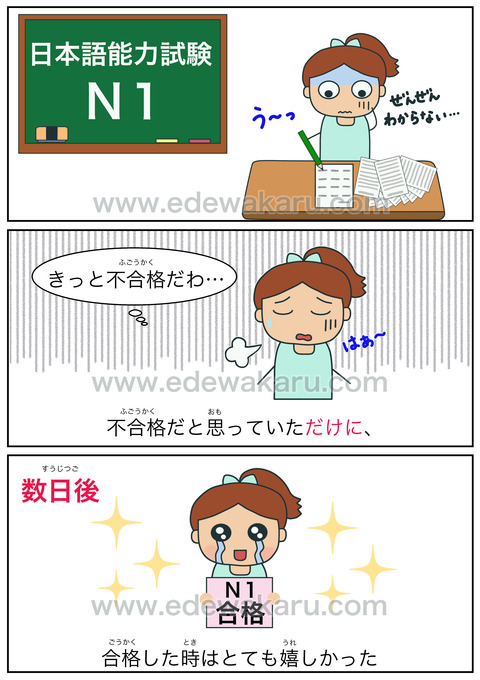
Meaning
Because 〜, it is all the more 〜
Even if it is 〜, because 〜, B is all the more 〜
How to use it
Verb/adjective/noun [plain form] + だけに
Explanation
「〜だけに」 is a sentence pattern meaning “Because 〜, it is all the more 〜” or “Even if it is 〜, because it is 〜, B is all the more 〜.” It expresses a reason and is often used when you want to emphasize “B is all the more 〜,” as in “Even if A is 〜, B is all the more 〜.”
[Examples]
① I had thought I would fail, so I was very happy when I passed.
→ Even someone who expected to pass would be happy upon passing, so someone who thought they would fail is all the more happy.
② Since she’s a girl, I’m worried about sending her to study abroad.
→ I’d be worried even if it were a boy, so I’d be all the more worried if it were a girl.
③ Since it’s a three-day weekend, Disneyland is extremely crowded.
→ Disney is always crowded, but because it’s a three-day weekend, it’s even more crowded.
④ It was a smartphone I bought after working hard at my part-time job, so I was shocked when it broke.
→ Because I bought it after working hard at my part-time job, I was all the more shocked.
Note that this 「〜だけに」 cannot be changed to 「〜だけあって」. 😉
(Review: 〜だけあって・〜だけのことはあって)
In context 4 examples
不合格だと思っていただけに、合格した時はとても嬉しかった
I had thought I would fail, so I was very happy when I passed.
女の子だけに、海外留学(かいがいりゅうがく)させるのは心配だ
Since she’s a girl, I’m worried about sending her to study abroad.
3連休だけに、ディズニーランドはすごく混んでいる(復習:〜ている(結果の状態))
Since it’s a three-day weekend, Disneyland is extremely crowded. (Review: 〜ている (resulting state))
がんばってバイトして買ったスマホだっただけに、壊れた時はショックだった
It was a smartphone I bought after working hard at my part-time job, so I was shocked when it broke.
Read the original source text
Meaning
〜だから、もっと〜だ
〜でも〜だから、〜はもっと〜だ
How to use it
動詞・形容詞・名詞[普通形]+だけに
Explanation
「〜だけに」は「〜だから、もっと〜だ」「〜でも〜だから、〜はもっと〜だ」という意味を表す文型です。これは理由を表す文型で、
「Aでも〜だから、Bはもっと〜だ」というように、「Bはもっと〜だ」と強調して言いたい場合
によく使われます。
[例]
①不合格だと思っていた
だけに、合格した時はとても嬉しかった
→合格だと思っていて合格した時でも嬉しいんだから、不合格だと思っていた時はもっと嬉しい
②女の子
だけに、海外留学にさせるのは心配だ
→男の子でも心配なんだから、女の子だったらもっと心配だ
③3連休
だけに、ディズニーランドはすごく混んでいる
→ディズニーはいつも混んでいるが、3連休だから更に混んでいる
④がんばってバイトして買ったスマホだった
だけに、壊れた時はショックだった
→がんばってバイトして買ったから、更にショックだった
この「〜だけに」は「〜だけあって」にチェンジすることができませんので注意しましょう😉
(復習:〜だけあって・〜だけのことはあって)
Usage 2
Read this source entry ↗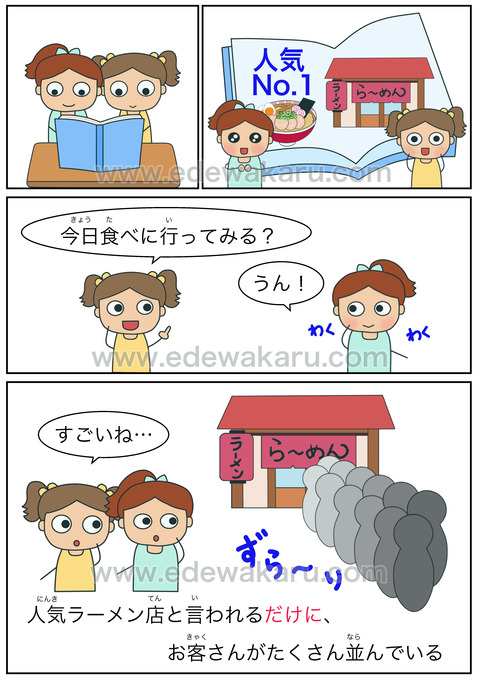
Meaning
Because 〜, naturally
To a degree befitting 〜
With an ability befitting 〜
With a value befitting 〜
How to use it
Verb/adjective/noun [plain form] + だけに
In context 5 examples
人気ラーメン店と言われるだけに、お客さんがたくさん並んでいる
→人気ラーメン店と言われるのにふさわしく、たくさんお客さんが並んでいる(復習:並ぶ・並べる)(復習:〜ている(結果の状態))Since it’s called a popular ramen restaurant, many customers are lining up. → Many customers are lining up, befitting a restaurant called a popular ramen restaurant. (Review: 並ぶ・並べる; 〜ている (resulting state))
あの先生は20年日本語教師(にほんごきょうし)をしているだけに、教え方が上手だ
→20年日本語教師をしているんだから、当然教え方が上手だ(復習:〜をしている)That teacher has been teaching Japanese for 20 years, so naturally they’re good at teaching. → Since they’ve taught Japanese for 20 years, they’re naturally good at teaching. (Review: 〜をしている)
彼女はアメリカに10年住んでいただけに、英語の発音がいい
→アメリカに10年住んでいたんだから、当然英語の発音がいいShe lived in America for 10 years, so naturally her English pronunciation is good. → Since she lived in America for 10 years, her English pronunciation is naturally good.
このアパートは、駅に近いだけに家賃が高い
→このアパートは駅に近いから、当然家賃が高いThis apartment is expensive because it’s close to the station. → Since this apartment is close to the station, naturally the rent is high.
妹は若いだけに、オールをしてもどうもないようだ
→妹は若いから、オールをしてもどうもないようだ(復習:オールする)(復習:どうもない)(復習:〜ようだ(五感推量))【説明】「〜だけに」は「〜だから当然〜」「〜にふさわしい程度・能力・価値あって〜」という意味で使われる文型です。「〜だけに」は、ほとんどの場合「価値」や「能力」について【いい評価】をする時に使われます😊また、この「〜だけに」は「〜だけあって」にチェンジすることができます😮(復習:〜だけあって・〜だけのことはあって)[例]人気ラーメン店と言われるだけに、お客さんがたくさん並んでいる=人気ラーメン店と言われるだけあって、お客さんがたくさん並んでいる「〜だけに」は「〜だけあって」 と一緒に覚えておくといいと思います😊Since my younger sister is young, she seems to be fine even after staying up all night. → Since my younger sister is young, she seems to be fine even after staying up all night. (Review: オールする; どうもない; 〜ようだ (inference based on the senses)) [Explanation] 「〜だけに」 is a sentence pattern meaning “Because 〜, naturally 〜” or “〜 in a degree, ability, or value befitting it, so 〜.” In most cases, it is used to give a [positive evaluation] of “value” or “ability.” 😊 Also, this 「〜だけに」 can be changed to 「〜だけあって」. 😮 (Review: 〜だけあって・〜だけのことはあって) [Example] Since it’s called a popular ramen restaurant, many customers are lining up. = Since it’s called a popular ramen restaurant, many customers are lining up, as you’d expect. I think it’s good to learn 「〜だけに」 together with 「〜だけあって」. 😊
Read the original source text
Meaning
〜だから当然
〜にふさわしい程度の
〜にふさわしい能力の
〜にあった価値の
How to use it
動詞・形容詞・名詞[普通形]+だけに
どんなときどう使う 日本語表現文型辞典
Usage 1
Meaning
precisely because; contrary to expectations
How to use it
〔Plain form〕(na-adjective な・na-adjective である/Noun・Noun である)+だけに
Explanation
だけに〈反予想〉
~ので、反対に…
「~だけに…」の形で、「~なので、普通以上
にもっと…」「~なので、
予想されることとは反対に」という意味で使う。 ❶ ❷ のように「かえって・なおさら」とよくともに使われる。
Something is certain way, more than usual, or contrary to expectations. Often used with かえって or なおさら as in sentences ❶ and ❷ .
In context 3 examples
田中さんは普段から体が丈夫なだけに、かえってがんの発見が遅れたのだそうだ。
Tanaka is usually so healthy that, ironically, they say his cancer was discovered late.
最近は体調が悪くてあきらめていただけに、今日の優勝はなおさらうれしい。
I’d given up because I haven’t been feeling well lately, so today’s victory makes me all the happier.
祖母は年を取っているだけに、やさしいきれいな色の服を着たいと言っている。
Because my grandmother is elderly, she says she wants to wear clothes in soft, pretty colors.
Read the original source text
Meaning
precisely because; contrary to expectations
How to use it
〔普通形〕(ナAな・ナである/N・Nである)+だけに
Explanation
だけに〈反予想〉
~ので、反対に…
「~だけに…」の形で、「~なので、普通以上
にもっと…」「~なので、
予想されることとは反対に」という意味で使う。 ❶ ❷ のように「かえって・なおさら」とよくともに使われる。
Something is certain way, more than usual, or contrary to expectations. Often used with かえって or なおさら as in sentences ❶ and ❷ .
Usage 2
Meaning
as befitting
How to use it
Noun/〔Plain form〕(na-adjective な・na-adjective である/Noun である)+だけに
Explanation
だけに〈ふさわしく〉
~ので、それにふさわしく
1)「~だけに、…」の形で、「~」で理由となることや状況などを言い、それにふさわしい結果として発生することや、推測されることを、「…」で言う。
2)「…」では評価や判断を言うことが多い。
3) ❷ のように「さすがに」とともに使うことも多い。
3)Often used with さすがに, as in sentence ❷ .
1)For explaining some suitable result generated from or guessed about based on some reason or condition.
2)Evaluations or judgments often follow.
In context 4 examples
快晴の大型連休だけに、道路は行楽地へ向かう車でいっぱいだ。
Because it’s a sunny long holiday weekend, the roads are full of cars heading to vacation spots.
山崎さんは経験20年のベテラン教師であるだけに、さすがに教え方が上手だ。
Since Yamazaki is a veteran teacher with 20 years of experience, it’s no wonder he teaches so well.
辻さんは子どものときからイギリスで教育を受けただけに、きれいな英語を話す。
Tsuji speaks beautiful English, having been educated in Britain since childhood.
静さんは若いだけに、のみこみが速い。
Shizuka is quick to catch on, as you’d expect from someone so young.
Read the original source text
Meaning
as befitting
How to use it
N/〔普通形〕(ナAな・ナAである/Nである)+だけに
Explanation
だけに〈ふさわしく〉
~ので、それにふさわしく
1)「~だけに、…」の形で、「~」で理由となることや状況などを言い、それにふさわしい結果として発生することや、推測されることを、「…」で言う。
2)「…」では評価や判断を言うことが多い。
3) ❷ のように「さすがに」とともに使うことも多い。
3)Often used with さすがに, as in sentence ❷ .
1)For explaining some suitable result generated from or guessed about based on some reason or condition.
2)Evaluations or judgments often follow.
日本語NET JLPT文法解説まとめ
Meaning
Because ~, all the more ... / Because ~, even more ...
How to use it
V(plain form) + だけに
イA(plain form) + だけに
ナAな/である/ だった + だけに
N(な / である)/ だった + だけに
In context 10 examples
GWなだけに、いつも以上に道が混んでいる。
Since it's Golden Week, the roads are more congested than usual.
新しいスマホを落としてしまいました。昨日買ったばかりなだけに、本当にショックだ。
I dropped my new smartphone. Since I had only bought it yesterday, I'm really upset.
初めての海外旅行なだけに、かなり心配だ。
Since it's my first trip abroad, I'm quite worried.
彼は帰国子女なだけに、英語がペラペラだ。
Since he grew up abroad as the child of Japanese parents, he's fluent in English.
彼らは若いだけに、オールをしても元気だ。
Since they're young, they're still energetic even after staying up all night.
このホテルは5つ星ホテルなだけに、サービスが充実している。
Since this is a five-star hotel, the service is comprehensive.
山下さんは日本語を20年教えているだけに、教え方がとても上手だ。
Since Mr. Yamashita has been teaching Japanese for 20 years, he's very good at teaching.
彼はアナウンサーなだけに、話し方がとても上手で聞きやすい。
Since he's an announcer, he's very good at speaking, and easy to understand.
彼は野球選手なだけに 、体格がいい。
Since he's a baseball player, he's well-built.
早く試験の準備をしただけに 、いい点が取れた。
Since I prepared for the exam early, I got a good score.
Read the original source text
Meaning
〜ので、もっと・・・だ。 / 〜ので、なおさら・・・だ。
How to use it
V(普通形) + だけに
イA(普通形) + だけに
ナAな/である/ だった + だけに
N(な / である)/ だった + だけに
毎日のんびり日本語教師
Usage 1
Read this source entry ↗How to use it
Verb plain form + だけに
な-adjective + である/なだけに
い-adjective + だけに
Noun (+ である/な) + だけに
Explanation
This pattern expresses a reason. It can be rephrased with the causal expressions 「から」 or 「ので」, but is used to emphasize the preceding reason more strongly than those expressions do. It is subjective and can introduce either a positive or a negative evaluation.
There are two usages.
① A conclusion or state that necessarily follows from the reason in the preceding clause
「なおさら」(all the more) may also occur in the following clause.
② A result that runs counter to expectations / an unexpected result
「かえって」(on the contrary) or 「逆に」(conversely) may also occur in the following clause.
In many cases, the following clause describes something contrary to one's expectations, so it often introduces an unfavorable outcome.
Notes
The 「だけ」series
In context 9 examples
駅が近いだけに家賃も高い。
Because it's close to the station, the rent is high.
あのチームは今季抜群の成績を残しているだけに、明日の試合も期待できるだろう。
Since that team has had an outstanding season, we can probably look forward to tomorrow's game too.
彼女がくれたネックレスだけに、肌身離さず身に付けていたい。
Because the necklace was a gift from her, I want to wear it all the time.
苦労して編んであげたマフラーだけに、彼氏が喜んでくれてよかった。
Because I put so much effort into knitting the scarf for him, I'm glad my boyfriend liked it.
発売をずっと待ち望んでいただけに、延期されてしまって残念だ。
I'd been looking forward to its release for so long, so I'm disappointed it was postponed.
彼はあまり姿を現さないだけに、どんな人か気になっている。
Because he rarely shows himself, I'm curious what kind of person he is.
震源が地元に近いだけに、早く被害状況が知りたい。
Since the epicenter is close to my hometown, I want to find out quickly how much damage there is.
とても安いだけにかえって心配になる。(正因为太便宜了反而有点担心。)
It's so cheap that it actually makes me worry.
いつも冷静なだけに、怒り出すと怖い。
Since she's always calm, it's scary when she gets angry.
Read the original source text
How to use it
動詞普通形+だけに
な形容詞+である/なだけに
い形容詞+だけに
名詞(+である/な)+だけに
Explanation
理由を表す文型です。理由の「から」や「ので」に言い換えることができますが、それらよりも前項の理由を強調する言い方として用いられます。主観的な表現で、良い評価も悪い評価も可能です。
用法は2つあります。
①前件の理由から必然的に導き出される結論や状態
「なおさら」が呼応することもあります。
②予想と結果の相反/意外な結果
「かえって」「逆に」が呼応することもあります。
多くの場合は自分の予想とは反する内容が後件で述べられるので、良くない内容が来やすいです。
Notes
「だけ」シリーズ
Usage 2
Read this source entry ↗How to use it
Verb dictionary form + だけ + verb
できるだけ(のことは)する (do whatever one can)
やれるだけ(のことは)やる (do all one can)
Explanation
The same verb is used twice in the construction, expressing that the action is performed to the degree the speaker considers sufficient.
A similar grammar pattern is 「【N1文法】~(ら)れるだけ~」, but it differs in expressing the greatest possible degree or amount.
Notes
The 「だけ」series
In context 5 examples
やるだけやった。あとは結果を待つだけだ。
I've done all I can. Now all that's left is to wait for the result.
ウイルスに感染しないようにできるだけのことはしてるけどやっぱり怖い。
I'm doing everything I can to avoid catching the virus, but I'm still scared.
試食品を食べるだけ食べて、商品を買っていかないお客もいる。
Some customers eat all the samples they want but don't buy any of the products.
相談したいことがあるんだけど、聞くだけ聞いてもらえる?
There's something I want to ask you about. Could you at least hear me out?
子供作るだけ作って、育児は祖母に任せる。
They have as many children as they can, then leave raising them to the grandmother.
Read the original source text
How to use it
動辞形+だけ+動詞
できるだけ(のことは)する
やれるだけ(のことは)やる
Explanation
同じ動詞を2回用いて接続し、その動作を話者が十分だと思う程度量行うことを表します。
似ている文法に「【N1文法】~(ら)れるだけ~」がありますが、こちらは可能な限りの最大の程度量を表す点で異なります。
Notes
「だけ」シリーズ
IMABI
だけに・だけ(のことは)あって
Read this IMABI lesson ↗Explanation
Given That: だけに・だけ(のことは)あって
In this lesson, we will learn about very similar grammar points which utilize the particle だけ that represent an inherent consequence/evaluation. Before delving into the grammar points at the core of this discussion, let’s first recap how だけ connects to various predicates1, but in the context of ~だけに.
Verbal Predicates連体形 + ~だけ
ex. するだけに
Adjectival Predicates 連体形 + ~だけ
ex. 高いだけに
Adjectival-Noun Predicates連体形 + ~だけ
ex. 有名なだけに
Bare2 Noun-PredicatesNoun + ~だけ
ex. 犬だけに
Non-Bare/Embedded Noun-PredicatesNoun + {な・である}だけ
ex. 場所が場所であるだけに
Generally speaking, ~だけ can follow any conjugation of these predicate types. This is particularly important to keep in mind for when and when not to use the copula with it for noun-predicates, but more of that dynamic will be discussed throughout this lesson.
~だけに
The basic function of ~だけに is as follows: Situation B is an expected result given Situation A. The expected result=outcome (Situation B) may be either a positive or negative outcome.
1. ここは有名ゆうめいなだけに、沢山たくさんの人が訪おとずれます。
With how famous this place is, lots of people visit it.
2. よく勉強しただけに、いい成績で合格しました。
I passed with a good grade as expected given how often I studied.
3. 彼は政治屋だけに口が巧うまいだろう。
He’s probably a good talker for being a politician.
4. 津波で町全体が荒らされただけに、一戸の建物さえ残っているのにびっくりしました。
Given how the entire town was devastated by the tsunami, I was surprised that just one building remained.
5. 民主党が勝手に頑固たる政策方針を結束して言い張り続けただけに、選挙戦に敗戦して自民党・公明党が当選を果たしたのだろう。
Given how the DJP continued to insist, in solidarity, on their stubborn policy stance as they pleased, they lost in the election battle and the LDP and Komeito won (as expected).
6. 敵の防壁を潔く突破しただけに、宮殿に入ってからすぐに殺されたという戦死の告知は母国に大嘘だと見なされた。
Given how (he) had gracefully burst through the enemy bulwark, the notice of his death in war after being killed once he had entered the palace was taken as a big lie in his homeland.
7. 台風の被害が大きかっただけに、都市の復興振ぶりには目を見張るものがあった。
Given how great the damage from the typhoon was, the state of the city’s reconstruction was quite something to behold.
8. それだけに3、1台当たりの単価が凄く高いんだ!
So that‘s precisely why the cost for 1 device is so expensive!
If the outcome is negative, the overall tone and word choices made throughout the sentence will often be abrasive. Moreover, the scale at which the outcome is bad directly reflects how bad the input (cause = Situation A) is.
9. 遊んでばかりで勉強しなかっただけに、さすがの俺も不合格だった。
It’s only natural that I, too, failed given how all I did was goof around and not study.
Non-Bare/Embedded Noun-Predicate
+{な・である・∅}だけに
Incidentally, while it is often the case that ~だけに directly attaches to “bare” noun-predicates like in Exs. 3 and 8, the copula may still overtly intervene4. As to be expected, if it does overtly intervene, it does so in the 連体形, in which case な・である5 are both viable, with な being the overwhelming choice, especially in the spoken language.
One situation in which the overt appearance of the copula usually occurs is when the noun predicate is composed of the same noun being duplicated in NがN fashion.
10. 場所が場所なだけに、トラブルに巻き込まれるのも想像に難くない。
Given the location is what it is, it’s not hard to imagine at all that one would get into trouble there.
11. 性格が性格なだけに、本音をはっきり言えないことが多い。
Given (their) personality, (they) often find themselves incapable of speaking (their) mind.
12. 話が話なだけに胸が苦しくなる。
Just talking about it makes my heart ache.
Literally: The discussion itself being what it is makes my heart ache.
When the noun-predicate can be viewed as a full-fledged embedded clause, for that clause to then modify ~だけに, the 連体形 of a verbal element MUST be present. To make this point obvious, [] will be used to demarcate these embedded clauses. Also note the use of the particle が and how は cannot appear inside said embedded clauses. However, a topicalized phrase can appear outside said embedded clause, including at the front of the sentence like in Exs. 14 and 15.
13. [婚約者というやつが、実にエゴイストで、嫌われ者である]だけに、なおさら観客の同情は彼女に集中する。
Given how her fiancé is truly an egoist and such a hated individual, the audience’s sympathy focuses on her all the more.
14. 母も[書道もあまりに身近な存在だった]だけに、客観視することができなかったのかもしれない。
Since mom also had too close of an existence with calligraphy too, she might not have been able to see (her work) from an objective point of view.
From『文藝春秋 2008 (2)』by 武田双雲.
15. 韓国は[儒教文化が残るとされる国]なだけに、パク・クネ氏が初めての女性として大統領選挙で選び出されたことは韓国社会の変化を象徴しているだけでなく、アジア諸国の社会変動も象徴しているのかもしれません。
Given how South Korea is considered a nation in which Confucian culture has held on, the election of Park Geun-hye as the first female president not only symbolizes change in Korean society, but it may also symbolize societal change in all of Asia.
Now, for non-embedded noun-predicates that take ~だけに, the absence of the copula can be explained by it simply not overtly being present, instead residing in the deep structure of this grammar point, with the heightened adverbial nature of the phrase triggering the copula’s ellipsis. Conversely, with any level of complexity in a noun-predicate triggering the presence of the copula, any noun-predicate outside the affirmative non-past and any noun-predicate with added modifiers would meet that threshold of complexity.
16. 亮君は普段から優しい性格なだけに、かえって6怒らせたらえらく怖いだろう。
Given how Ryo-kun is normally such a kind person, if you were to anger him, he’d probably be terribly scary.
As such, instead of limiting the appearance of the copula to “embedded” noun-predicates, the copula may appear to any “non-bare” noun-predicate, meaning any which exhibit any sort of modifiers (such as the modify shown in grey in Ex. 16).
~だけあって
While ~だけあって similarly indicates that Situation B is only expected given Situation A, it is only used for when said outcome (Situation B) is a positive situation. Not only is the outcome positive, but the scale of said outcome is a direct reflection of how outstanding the cause (Situation A) is.
17. ずいぶん遠くから通ってくる{だけあって X・だけに 〇}、よく遅刻しますね。
Given quite the distance you travel to commute here, you sure are often late.
18. インドネシアは赤道に近いだけあって、うだるように蒸し暑いですね。僕の親友がジャワ島に住んでいますから、訪ねるために身軽な服装を持っていかないといけないでしょう。
Given how Indonesia is close to the Equator, it would make sense that it’s so swelteringly hot, huh. Since my close friend lives on Java Island, I’ll probably have to take light clothing to visit.
19. ここは港町というだけあって、いつも船の出入りが多いね。
Given how this here is a port town, there are always so many ships coming and going.
The natural positive feel ~だけあって does beg the question as to how “positive” evaluations made with だけに really are in comparison. Consider the following:
20a. 毎日、産地から直送されてくるだけに、ここの料理はいつも美味しい。
20b. 毎日、産地から直送されてくるだけあって、ここの料理はいつも美味しい。
In Ex. 20a, ~だけに does state in a matter-of-fact tone that the deliciousness of the food is to be expected because of how ingredients are directly sent to the establishment on a daily basis, but the calmness behind how it would be uttered leaves much to be desired. Is there not more to the speaker’s evaluation. What about that act being a reflection of the management’s dedication? In a way, although Situation B is not a negative outcome, there is not as big of an emotional tug implied like there is with ~だけあって. In other words, ~だけあって is more suitable for implying genuine admiration/exhilaration.
Incidentally, in situations in which Situation B (outcome) would otherwise be negative but ~だけあって is still used, in theory, the sentence may still very well be grammatical. The difference, then, will be that the version with ~だけあって spins Situation B into a positive light as a joke or sarcasm.
21. 言語学者だけあって、セスさんの質問がやたら専門的すぎるんだよな。
As you’d expect from a linguist, Seth-san’s questions are way too technical, huh!
さすが(の)
The adverb(ial noun) さすが(の) often accompanies the structure ~だけあって whenever Situation A is simply a certain agent/subject being themselves/itself.
22. 串カツは、さすが田中さんだけあってどれも味がギュッと詰まっていた。
Just as you’d expect from Tanaka-san, his kushikatsu were all packed with flavor.
23. さすが評判の旅館7だけあって、料理もサービスもこの上なく素晴らしい。
Just as you’d expect of a highly rated inn, the food and service were utmost excellent.
Of course, さすが can also be used as a typical adverb with ~だけあって to further emphasize how obvious a scenario being so is to be expected.
24. さすが若いだけあってあっという間に習得するんだね。
(He)’s learning it in no time, just like you’d expect of someone as young as (him).
~だけ: Corresponding/Proportional Degree/Change ⇒ Natural Casual Relationship/Course of Events
While ~だけ’s basic function is to express extent like the English word “only,” this notion of “extent” can be extended over its ability to show “the corresponding extent of worth” behind whatever it follows. Consider the following sentences in which this is true that do not utilize だけに・だけあって.
25. 熱で寝込まないだけいつもよりましだ。
At least I’m not bedridden with a fever like I’d usually have.
26. 信奉者は、生きていけることだけでも家族が無事なだけでも十分神さまの恩恵を感じて幸福なのだろう。
Believers will surely feel blessed by God, happy for just being able to get by or for their families to be safe.
Of course, the exact interpretations of だけに・だけあって still require two situations in the picture: a cause and an effect. Contrast this with when だけ simply means “only,” in which case だけ is only delineating the extent of whatever it is following—a fact still true for the sentences we just saw.
27. 苺味を加えてやっただけだ。
All I did was add strawberry flavoring.
28. この身体が、愛する人のためだけに8穢されていく。
This body (of mine) is to be defiled purely for the sake of the one I love.
Now, as a bridging context, whenever you see the pattern V+~たいだけ+V, while there are not two scenarios, the degree≈value behind V being executed is as much as however the agent wants to do said verb.
29. 笑いたいだけ笑わせればいい。
Have (them) laugh however much (they) wish to laugh.
30. 一方、睡眠不足で不健康にはなっても、逆に寝たいだけ寝ても健康を害することはないという。
On the other hand, while lack of sleep can be detrimental to your health, sleeping as much as you want will not harm your health, as they say.
~だけのことはあって
~だけあって is actually a contraction of ~だけのことはあって. The purpose of having こと present in the structure was to more concretely refer to the value/worth/effect being positively evaluated. If that worth is readily ascertainable by Situation A, [のことは] may be omitted, but it turns out that if said valuable is not so apparent, [のことは] should not be omitted from the structure.
31. 値段{だけのことはあって 〇・だけあって △}、いいワインでしたね。
Given the price, it was a nice wine, huh.
32. カルロスさんは若いころからバルセロナに住んでいただけ(のことは)あって、さすがカタルーニャ語もうまいんだね。
Given how Carlos has lived in Barcelona since he was young, it’s no wonder he is also fluent in Catalan.
~だけ(のことは)ある
Having recapped だけ functions and learned about ~だけ(のことは)あって, it would only be natural ~だけ(のことは)ある may follow a predicate to indicate its worth/adequacy of fulfilling a goal. As this structure only covers the “cause,” the positive effect is understood in context.
32. 公費こうひを削減さくげんするだけのことはある。
Cutting public spending is worth it.
33. 高かっただけのことはあるな。
It was expensive but worth it.
34. さすが(に)大学に行っただけのことはある。
As expected, (he)’s what you’d expect of someone who went to college.
To conclude, when we think about what ~こと means in this structure, it would only make sense that こと can be replaced with a concrete word. It turns out that this is most definitely possible, as だけ’s ability to show sufficient extent can be attributed to nouns that are being positively assessed.
35. 日本代表には、W杯で何かを成し遂げるだけの力がある。
Those representing Japan have the power to accomplish something at the World Cup.
36. 山頂からの素晴らしい眺めは登るだけの価値がある。
The amazing view from the summit is very much worth the climb.
In this example, the concern is whether the view has enough value to go up the mountain, and the use of だけ indicates that it most certainly does, and that that assessment is only natural.
This lesson is not about how the adverbial particle ~だけ attaches to nouns (with or without case particles attached). Instead, it follows entire predicates with said predicates modifying it much like they would a noun, with the resultant phrase behaving much like an adverb. This is made possible by how ~だけ does ultimately derive from the noun 丈 meaning “length.” ↩︎
“Bare” in this context refers to exhibiting no modifiers on the noun that constitutes the Y in “X is Y.” ↩︎
Demonstratives gain their meaning via context, and this example of それだけに shows just how much semantic weight is being placed on それ—in this context, an entire Situation A (= “given all that”). ↩︎
Japanese resources, both in print and online, contradict each other as to whether they list “N + なだけに.” As this lesson showcases, what triggers the native mind to use な or not is not all that simple, even if its presence is never grammatically wrong, which is the likely reason for not mentioning its inclusion as a valid option. ↩︎
In the case of adjectival-noun predicates as well, である can be seen replacing な, but this is limited to formal, mostly written language in practice. ↩︎
The adverb かえって is often used with this pattern to emphasis how counterintuitively likely the opposite (bad) outcome would be so. ↩︎
While 評判の is a modifier, the resultant [評判の旅館] can be viewed as a compound noun. However, this does not negate the possibility of the copula overtly appearing. ↩︎
Instances of だけに like that found in Ex. 29 ought not be misconstrued for the grammar point ~だけに that follows predicates. ↩︎
In context 38 examples
ここは有名ゆうめいなだけに、沢山たくさんの人が訪おとずれます。
With how famous this place is, lots of people visit it.
よく勉強しただけに、いい成績で合格しました。
I passed with a good grade as expected given how often I studied.
彼は政治屋だけに口が巧うまいだろう。
He’s probably a good talker for being a politician.
津波で町全体が荒らされただけに、一戸の建物さえ残っているのにびっくりしました。
Given how the entire town was devastated by the tsunami, I was surprised that just one building remained.
民主党が勝手に頑固たる政策方針を結束して言い張り続けただけに、選挙戦に敗戦して自民党・公明党が当選を果たしたのだろう。
Given how the DJP continued to insist, in solidarity, on their stubborn policy stance as they pleased, they lost in the election battle and the LDP and Komeito won (as expected).
敵の防壁を潔く突破しただけに、宮殿に入ってからすぐに殺されたという戦死の告知は母国に大嘘だと見なされた。
Given how (he) had gracefully burst through the enemy bulwark, the notice of his death in war after being killed once he had entered the palace was taken as a big lie in his homeland.
台風の被害が大きかっただけに、都市の復興振ぶりには目を見張るものがあった。
Given how great the damage from the typhoon was, the state of the city’s reconstruction was quite something to behold.
それだけに3、1台当たりの単価が凄く高いんだ!
So that‘s precisely why the cost for 1 device is so expensive!
遊んでばかりで勉強しなかっただけに、さすがの俺も不合格だった。
It’s only natural that I, too, failed given how all I did was goof around and not study.
場所が場所なだけに、トラブルに巻き込まれるのも想像に難くない。
Given the location is what it is, it’s not hard to imagine at all that one would get into trouble there.
性格が性格なだけに、本音をはっきり言えないことが多い。
Given (their) personality, (they) often find themselves incapable of speaking (their) mind.
話が話なだけに胸が苦しくなる。
Just talking about it makes my heart ache.
[婚約者というやつが、実にエゴイストで、嫌われ者である]だけに、なおさら観客の同情は彼女に集中する。
Given how her fiancé is truly an egoist and such a hated individual, the audience’s sympathy focuses on her all the more.
母も[書道もあまりに身近な存在だった]だけに、客観視することができなかったのかもしれない。
Since mom also had too close of an existence with calligraphy too, she might not have been able to see (her work) from an objective point of view.
韓国は[儒教文化が残るとされる国]なだけに、パク・クネ氏が初めての女性として大統領選挙で選び出されたことは韓国社会の変化を象徴しているだけでなく、アジア諸国の社会変動も象徴しているのかもしれません。
Given how South Korea is considered a nation in which Confucian culture has held on, the election of Park Geun-hye as the first female president not only symbolizes change in Korean society, but it may also symbolize societal change in all of Asia.
亮君は普段から優しい性格なだけに、かえって6怒らせたらえらく怖いだろう。
Given how Ryo-kun is normally such a kind person, if you were to anger him, he’d probably be terribly scary.
ずいぶん遠くから通ってくる{だけあって X・だけに 〇}、よく遅刻しますね。
Given quite the distance you travel to commute here, you sure are often late.
インドネシアは赤道に近いだけあって、うだるように蒸し暑いですね。僕の親友がジャワ島に住んでいますから、訪ねるために身軽な服装を持っていかないといけないでしょう。
Given how Indonesia is close to the Equator, it would make sense that it’s so swelteringly hot, huh. Since my close friend lives on Java Island, I’ll probably have to take light clothing to visit.
ここは港町というだけあって、いつも船の出入りが多いね。
Given how this here is a port town, there are always so many ships coming and going.
毎日、産地から直送されてくるだけに、ここの料理はいつも美味しい。
Since the food here is delivered directly from the place of production every day, it is always delicious.
毎日、産地から直送されてくるだけあって、ここの料理はいつも美味しい。
As you would expect, the food here is always delicious, since it is delivered directly from the place of production every day.
言語学者だけあって、セスさんの質問がやたら専門的すぎるんだよな。
As you’d expect from a linguist, Seth-san’s questions are way too technical, huh!
串カツは、さすが田中さんだけあってどれも味がギュッと詰まっていた。
Just as you’d expect from Tanaka-san, his kushikatsu were all packed with flavor.
さすが評判の旅館7だけあって、料理もサービスもこの上なく素晴らしい。
Just as you’d expect of a highly rated inn, the food and service were utmost excellent.
さすが若いだけあってあっという間に習得するんだね。
(He)’s learning it in no time, just like you’d expect of someone as young as (him).
熱で寝込まないだけいつもよりましだ。
At least I’m not bedridden with a fever like I’d usually have.
信奉者は、生きていけることだけでも家族が無事なだけでも十分神さまの恩恵を感じて幸福なのだろう。
Believers will surely feel blessed by God, happy for just being able to get by or for their families to be safe.
苺味を加えてやっただけだ。
All I did was add strawberry flavoring.
この身体が、愛する人のためだけに8穢されていく。
This body (of mine) is to be defiled purely for the sake of the one I love.
笑いたいだけ笑わせればいい。
Have (them) laugh however much (they) wish to laugh.
一方、睡眠不足で不健康にはなっても、逆に寝たいだけ寝ても健康を害することはないという。
On the other hand, while lack of sleep can be detrimental to your health, sleeping as much as you want will not harm your health, as they say.
値段{だけのことはあって 〇・だけあって △}、いいワインでしたね。
Given the price, it was a nice wine, huh.
カルロスさんは若いころからバルセロナに住んでいただけ(のことは)あって、さすがカタルーニャ語もうまいんだね。
Given how Carlos has lived in Barcelona since he was young, it’s no wonder he is also fluent in Catalan.
公費こうひを削減さくげんするだけのことはある。
Cutting public spending is worth it.
高かっただけのことはあるな。
It was expensive but worth it.
さすが(に)大学に行っただけのことはある。
As expected, (he)’s what you’d expect of someone who went to college.
日本代表には、W杯で何かを成し遂げるだけの力がある。
Those representing Japan have the power to accomplish something at the World Cup.
山頂からの素晴らしい眺めは登るだけの価値がある。
The amazing view from the summit is very much worth the climb.
Read the original source text
Explanation
Given That: だけに・だけ(のことは)あって
In this lesson, we will learn about very similar grammar points which utilize the particle だけ that represent an inherent consequence/evaluation. Before delving into the grammar points at the core of this discussion, let’s first recap how だけ connects to various predicates1, but in the context of ~だけに.
Verbal Predicates連体形 + ~だけ
ex. するだけに
Adjectival Predicates 連体形 + ~だけ
ex. 高いだけに
Adjectival-Noun Predicates連体形 + ~だけ
ex. 有名なだけに
Bare2 Noun-PredicatesNoun + ~だけ
ex. 犬だけに
Non-Bare/Embedded Noun-PredicatesNoun + {な・である}だけ
ex. 場所が場所であるだけに
Generally speaking, ~だけ can follow any conjugation of these predicate types. This is particularly important to keep in mind for when and when not to use the copula with it for noun-predicates, but more of that dynamic will be discussed throughout this lesson.
~だけに
The basic function of ~だけに is as follows: Situation B is an expected result given Situation A. The expected result=outcome (Situation B) may be either a positive or negative outcome.
1. ここは有名ゆうめいなだけに、沢山たくさんの人が訪おとずれます。
With how famous this place is, lots of people visit it.
2. よく勉強しただけに、いい成績で合格しました。
I passed with a good grade as expected given how often I studied.
3. 彼は政治屋だけに口が巧うまいだろう。
He’s probably a good talker for being a politician.
4. 津波で町全体が荒らされただけに、一戸の建物さえ残っているのにびっくりしました。
Given how the entire town was devastated by the tsunami, I was surprised that just one building remained.
5. 民主党が勝手に頑固たる政策方針を結束して言い張り続けただけに、選挙戦に敗戦して自民党・公明党が当選を果たしたのだろう。
Given how the DJP continued to insist, in solidarity, on their stubborn policy stance as they pleased, they lost in the election battle and the LDP and Komeito won (as expected).
6. 敵の防壁を潔く突破しただけに、宮殿に入ってからすぐに殺されたという戦死の告知は母国に大嘘だと見なされた。
Given how (he) had gracefully burst through the enemy bulwark, the notice of his death in war after being killed once he had entered the palace was taken as a big lie in his homeland.
7. 台風の被害が大きかっただけに、都市の復興振ぶりには目を見張るものがあった。
Given how great the damage from the typhoon was, the state of the city’s reconstruction was quite something to behold.
8. それだけに3、1台当たりの単価が凄く高いんだ!
So that‘s precisely why the cost for 1 device is so expensive!
If the outcome is negative, the overall tone and word choices made throughout the sentence will often be abrasive. Moreover, the scale at which the outcome is bad directly reflects how bad the input (cause = Situation A) is.
9. 遊んでばかりで勉強しなかっただけに、さすがの俺も不合格だった。
It’s only natural that I, too, failed given how all I did was goof around and not study.
Non-Bare/Embedded Noun-Predicate
+{な・である・∅}だけに
Incidentally, while it is often the case that ~だけに directly attaches to “bare” noun-predicates like in Exs. 3 and 8, the copula may still overtly intervene4. As to be expected, if it does overtly intervene, it does so in the 連体形, in which case な・である5 are both viable, with な being the overwhelming choice, especially in the spoken language.
One situation in which the overt appearance of the copula usually occurs is when the noun predicate is composed of the same noun being duplicated in NがN fashion.
10. 場所が場所なだけに、トラブルに巻き込まれるのも想像に難くない。
Given the location is what it is, it’s not hard to imagine at all that one would get into trouble there.
11. 性格が性格なだけに、本音をはっきり言えないことが多い。
Given (their) personality, (they) often find themselves incapable of speaking (their) mind.
12. 話が話なだけに胸が苦しくなる。
Just talking about it makes my heart ache.
Literally: The discussion itself being what it is makes my heart ache.
When the noun-predicate can be viewed as a full-fledged embedded clause, for that clause to then modify ~だけに, the 連体形 of a verbal element MUST be present. To make this point obvious, [] will be used to demarcate these embedded clauses. Also note the use of the particle が and how は cannot appear inside said embedded clauses. However, a topicalized phrase can appear outside said embedded clause, including at the front of the sentence like in Exs. 14 and 15.
13. [婚約者というやつが、実にエゴイストで、嫌われ者である]だけに、なおさら観客の同情は彼女に集中する。
Given how her fiancé is truly an egoist and such a hated individual, the audience’s sympathy focuses on her all the more.
14. 母も[書道もあまりに身近な存在だった]だけに、客観視することができなかったのかもしれない。
Since mom also had too close of an existence with calligraphy too, she might not have been able to see (her work) from an objective point of view.
From『文藝春秋 2008 (2)』by 武田双雲.
15. 韓国は[儒教文化が残るとされる国]なだけに、パク・クネ氏が初めての女性として大統領選挙で選び出されたことは韓国社会の変化を象徴しているだけでなく、アジア諸国の社会変動も象徴しているのかもしれません。
Given how South Korea is considered a nation in which Confucian culture has held on, the election of Park Geun-hye as the first female president not only symbolizes change in Korean society, but it may also symbolize societal change in all of Asia.
Now, for non-embedded noun-predicates that take ~だけに, the absence of the copula can be explained by it simply not overtly being present, instead residing in the deep structure of this grammar point, with the heightened adverbial nature of the phrase triggering the copula’s ellipsis. Conversely, with any level of complexity in a noun-predicate triggering the presence of the copula, any noun-predicate outside the affirmative non-past and any noun-predicate with added modifiers would meet that threshold of complexity.
16. 亮君は普段から優しい性格なだけに、かえって6怒らせたらえらく怖いだろう。
Given how Ryo-kun is normally such a kind person, if you were to anger him, he’d probably be terribly scary.
As such, instead of limiting the appearance of the copula to “embedded” noun-predicates, the copula may appear to any “non-bare” noun-predicate, meaning any which exhibit any sort of modifiers (such as the modify shown in grey in Ex. 16).
~だけあって
While ~だけあって similarly indicates that Situation B is only expected given Situation A, it is only used for when said outcome (Situation B) is a positive situation. Not only is the outcome positive, but the scale of said outcome is a direct reflection of how outstanding the cause (Situation A) is.
17. ずいぶん遠くから通ってくる{だけあって X・だけに 〇}、よく遅刻しますね。
Given quite the distance you travel to commute here, you sure are often late.
18. インドネシアは赤道に近いだけあって、うだるように蒸し暑いですね。僕の親友がジャワ島に住んでいますから、訪ねるために身軽な服装を持っていかないといけないでしょう。
Given how Indonesia is close to the Equator, it would make sense that it’s so swelteringly hot, huh. Since my close friend lives on Java Island, I’ll probably have to take light clothing to visit.
19. ここは港町というだけあって、いつも船の出入りが多いね。
Given how this here is a port town, there are always so many ships coming and going.
The natural positive feel ~だけあって does beg the question as to how “positive” evaluations made with だけに really are in comparison. Consider the following:
20a. 毎日、産地から直送されてくるだけに、ここの料理はいつも美味しい。
20b. 毎日、産地から直送されてくるだけあって、ここの料理はいつも美味しい。
In Ex. 20a, ~だけに does state in a matter-of-fact tone that the deliciousness of the food is to be expected because of how ingredients are directly sent to the establishment on a daily basis, but the calmness behind how it would be uttered leaves much to be desired. Is there not more to the speaker’s evaluation. What about that act being a reflection of the management’s dedication? In a way, although Situation B is not a negative outcome, there is not as big of an emotional tug implied like there is with ~だけあって. In other words, ~だけあって is more suitable for implying genuine admiration/exhilaration.
Incidentally, in situations in which Situation B (outcome) would otherwise be negative but ~だけあって is still used, in theory, the sentence may still very well be grammatical. The difference, then, will be that the version with ~だけあって spins Situation B into a positive light as a joke or sarcasm.
21. 言語学者だけあって、セスさんの質問がやたら専門的すぎるんだよな。
As you’d expect from a linguist, Seth-san’s questions are way too technical, huh!
さすが(の)
The adverb(ial noun) さすが(の) often accompanies the structure ~だけあって whenever Situation A is simply a certain agent/subject being themselves/itself.
22. 串カツは、さすが田中さんだけあってどれも味がギュッと詰まっていた。
Just as you’d expect from Tanaka-san, his kushikatsu were all packed with flavor.
23. さすが評判の旅館7だけあって、料理もサービスもこの上なく素晴らしい。
Just as you’d expect of a highly rated inn, the food and service were utmost excellent.
Of course, さすが can also be used as a typical adverb with ~だけあって to further emphasize how obvious a scenario being so is to be expected.
24. さすが若いだけあってあっという間に習得するんだね。
(He)’s learning it in no time, just like you’d expect of someone as young as (him).
~だけ: Corresponding/Proportional Degree/Change ⇒ Natural Casual Relationship/Course of Events
While ~だけ’s basic function is to express extent like the English word “only,” this notion of “extent” can be extended over its ability to show “the corresponding extent of worth” behind whatever it follows. Consider the following sentences in which this is true that do not utilize だけに・だけあって.
25. 熱で寝込まないだけいつもよりましだ。
At least I’m not bedridden with a fever like I’d usually have.
26. 信奉者は、生きていけることだけでも家族が無事なだけでも十分神さまの恩恵を感じて幸福なのだろう。
Believers will surely feel blessed by God, happy for just being able to get by or for their families to be safe.
Of course, the exact interpretations of だけに・だけあって still require two situations in the picture: a cause and an effect. Contrast this with when だけ simply means “only,” in which case だけ is only delineating the extent of whatever it is following—a fact still true for the sentences we just saw.
27. 苺味を加えてやっただけだ。
All I did was add strawberry flavoring.
28. この身体が、愛する人のためだけに8穢されていく。
This body (of mine) is to be defiled purely for the sake of the one I love.
Now, as a bridging context, whenever you see the pattern V+~たいだけ+V, while there are not two scenarios, the degree≈value behind V being executed is as much as however the agent wants to do said verb.
29. 笑いたいだけ笑わせればいい。
Have (them) laugh however much (they) wish to laugh.
30. 一方、睡眠不足で不健康にはなっても、逆に寝たいだけ寝ても健康を害することはないという。
On the other hand, while lack of sleep can be detrimental to your health, sleeping as much as you want will not harm your health, as they say.
~だけのことはあって
~だけあって is actually a contraction of ~だけのことはあって. The purpose of having こと present in the structure was to more concretely refer to the value/worth/effect being positively evaluated. If that worth is readily ascertainable by Situation A, [のことは] may be omitted, but it turns out that if said valuable is not so apparent, [のことは] should not be omitted from the structure.
31. 値段{だけのことはあって 〇・だけあって △}、いいワインでしたね。
Given the price, it was a nice wine, huh.
32. カルロスさんは若いころからバルセロナに住んでいただけ(のことは)あって、さすがカタルーニャ語もうまいんだね。
Given how Carlos has lived in Barcelona since he was young, it’s no wonder he is also fluent in Catalan.
~だけ(のことは)ある
Having recapped だけ functions and learned about ~だけ(のことは)あって, it would only be natural ~だけ(のことは)ある may follow a predicate to indicate its worth/adequacy of fulfilling a goal. As this structure only covers the “cause,” the positive effect is understood in context.
32. 公費こうひを削減さくげんするだけのことはある。
Cutting public spending is worth it.
33. 高かっただけのことはあるな。
It was expensive but worth it.
34. さすが(に)大学に行っただけのことはある。
As expected, (he)’s what you’d expect of someone who went to college.
To conclude, when we think about what ~こと means in this structure, it would only make sense that こと can be replaced with a concrete word. It turns out that this is most definitely possible, as だけ’s ability to show sufficient extent can be attributed to nouns that are being positively assessed.
35. 日本代表には、W杯で何かを成し遂げるだけの力がある。
Those representing Japan have the power to accomplish something at the World Cup.
36. 山頂からの素晴らしい眺めは登るだけの価値がある。
The amazing view from the summit is very much worth the climb.
In this example, the concern is whether the view has enough value to go up the mountain, and the use of だけ indicates that it most certainly does, and that that assessment is only natural.
This lesson is not about how the adverbial particle ~だけ attaches to nouns (with or without case particles attached). Instead, it follows entire predicates with said predicates modifying it much like they would a noun, with the resultant phrase behaving much like an adverb. This is made possible by how ~だけ does ultimately derive from the noun 丈 meaning “length.” ↩︎
“Bare” in this context refers to exhibiting no modifiers on the noun that constitutes the Y in “X is Y.” ↩︎
Demonstratives gain their meaning via context, and this example of それだけに shows just how much semantic weight is being placed on それ—in this context, an entire Situation A (= “given all that”). ↩︎
Japanese resources, both in print and online, contradict each other as to whether they list “N + なだけに.” As this lesson showcases, what triggers the native mind to use な or not is not all that simple, even if its presence is never grammatically wrong, which is the likely reason for not mentioning its inclusion as a valid option. ↩︎
In the case of adjectival-noun predicates as well, である can be seen replacing な, but this is limited to formal, mostly written language in practice. ↩︎
The adverb かえって is often used with this pattern to emphasis how counterintuitively likely the opposite (bad) outcome would be so. ↩︎
While 評判の is a modifier, the resultant [評判の旅館] can be viewed as a compound noun. However, this does not negate the possibility of the copula overtly appearing. ↩︎
Instances of だけに like that found in Ex. 29 ought not be misconstrued for the grammar point ~だけに that follows predicates. ↩︎
文法
Meaning
Because ~, all the more ... / Because ~, even more ...
How to use it
V(plain form) + だけに
イA(plain form) + だけに
ナAな/である/ だった + だけに
N(な / である)/ だった + だけに
In context 10 examples
GWなだけに、いつも以上に道が混んでいる。
Since it's Golden Week, the roads are more congested than usual.
新しいスマホを落としてしまいました。昨日買ったばかりなだけに、本当にショックだ。
I dropped my new smartphone. Since I had only bought it yesterday, I'm really upset.
初めての海外旅行なだけに、かなり心配だ。
Since it's my first trip abroad, I'm quite worried.
彼は帰国子女なだけに、英語がペラペラだ。
Since he grew up abroad as the child of Japanese parents, he's fluent in English.
彼らは若いだけに、オールをしても元気だ。
Since they're young, they're still energetic even after staying up all night.
このホテルは5つ星ホテルなだけに、サービスが充実している。
Since this is a five-star hotel, the service is comprehensive.
山下さんは日本語を20年教えているだけに、教え方がとても上手だ。
Since Mr. Yamashita has been teaching Japanese for 20 years, he's very good at teaching.
彼はアナウンサーなだけに、話し方がとても上手で聞きやすい。
Since he's an announcer, he's very good at speaking, and easy to understand.
彼は野球選手なだけに 、体格がいい。
Since he's a baseball player, he's well-built.
早く試験の準備をしただけに 、いい点が取れた。
Since I prepared for the exam early, I got a good score.
Read the original source text
Meaning
〜ので、もっと・・・だ。 / 〜ので、なおさら・・・だ。
How to use it
V(普通形) + だけに
イA(普通形) + だけに
ナAな/である/ だった + だけに
N(な / である)/ だった + だけに
Bunpro Grammar Reference
Meaning
As might be expected, Because, All the more because, It's only natural
How to use it
Verb + だけに
[い]Adjective + だけに
[な]Adjective + な + だけに
Noun + だけに
Nuance
A structure that highlights that just with (A), (B) may be expected, or is only natural.
Explanation
だけに is a grammar pattern that is often translated as 'as might be expected of (A)', 'it's only natural due to (A)', or simply 'because of (A)'. Being a combination of だけ 'just', and に 'to', the literal meaning is 'just in that it's (A)', and is similar to the counterpart phrase in English.
だけに may be used when highlighting either positive or negative results that came about due to (A), and will appear after verbs, い-Adjectives, な-Adjectives that have been followed by な, or nouns.
トムさんは日本語を8年勉強しているだけに、日本語がペラペラだ。
Tom has been studying Japanese for 8 years and as one might expect, he is fluent in Japanese.
このアパートは東京駅に近いだけに、家賃が高い。
This apartment is very close to Tokyo station, and as one might expect, the rent is expensive.
このアプリは便利なだけに、どんどんとユーザーが増えてきています。
This application is becoming more and more popular just because it is so useful.
夏休みであるだけに、海水浴場には人がたくさんいる。
It is summer vacation and as one might expect, there are a lot of people at the beach.
Also, だけに may be used when highlighting that specifically because of (A), (B) is considered a level above what would usually be expected. This can be in terms of difficulty, emotional reaction, volume, or anything else that is quantifiable.
合格したと思っていただけに、不合格と知った時はとてもショックだった。
I was very shocked when I learned that I had been rejected because I thought I had passed.
普段は優しいだけに、彼女が怒っている姿を見た時はびっくりしました。
I was surprised to see her angry because she is usually so kind.
Fun-fact
With any of these meanings, the equivalent 'just in that it's (A)' English expression can be utilized as an accurate interpretation, as both it and だけに often just draw the listener's attention to (A), in order to show that (B) is noteworthy because of it.
彼は子供の頃からそろばんを習っているだけに、暗算がとてもうまい。
Just in that he has been learning the abacus since childhood, he is very good at mental math.
In context 19 examples
- この車は最新だけに、椅子のヒーターもあります。
This is a brand new car and as one might expect, it comes with heated seats.
- トムさんは日本語を8年勉強しているだけに、日本語がペラペラだ。
Tom has been studying Japanese for 8 years and as one might expect, he is fluent in Japanese.
- このアパートは東京駅に近いだけに、家賃が高い。
This apartment is very close to Tokyo station, and as one might expect, the rent is expensive.
- 合格したと思っていただけに、不合格と知った時はとてもショックだった。
I was very shocked when I learned that I had been rejected because I thought I had passed.
- 普段は優しいだけに、彼女が怒っている姿を見た時はびっくりしました。
I was surprised to see her angry because she is usually so kind.
- このアプリは便利なだけに、どんどんとユーザーが増えてきています。
This application is becoming more and more popular just because it is so useful.
- 夏休みであるだけに、海水浴場には人がたくさんいる。
It is summer vacation and as one might expect, there are a lot of people at the beach.
- 年を取ってきただけに、出来なくなったことが多い。
As one might expect with aging, there are a lot of things you can no longer do.
- 大工だけに、椅子くらいならすぐに作ってくれる。
As one might expect from a carpenter, if it is something like a chair, they can quickly make that for you.
- 寿司職人だけに、醤油へのこだわりがすごい。
As one might expect from a sushi craftsman, his particularity toward soy sauce is extensive.
- スチュワーデスだけに、身長が高く姿勢もいいですね。
As one might expect from a stewardess, she is tall and her posture is good.
- 消防署だけに、火の取り扱いはちゃんとしている。
As one might expect from a fire station, they properly handle fires.
- プロ棋士だけに、将棋との向き合い方が半端じゃない。
As one might expect from a professional shogi player, the way he approaches the game is not careless.
- 彼はスキーの上級者だけに、難しいコースでも難なく滑れる。
He is an advanced skier, so as one might expect, he can easily ski difficult courses.
- 賞金が高額なだけに、応募者が殺到しています。
As one might expect from the prize money being a large sum, applicants are flooding in.
- 知り合いだけに、あんな事件を起こすなんて残念でならない。
She is someone I know, so as one might expect, I can't help feeling disappointment at that she caused such an incident.
- 彼は経験が長いだけに、自信を持って演説ができた。
As one might expect from his extensive experience, he confidently gave the speech.
- 彼は有名な司会者だけに、臨機応変に対応できます。
As one might expect from him being a famous moderator, he can adapt himself to deal with it.
- 彼は子供の頃からそろばんを習っているだけに、暗算がとてもうまい。
Just in that he has been learning the abacus since childhood, he is very good at mental math.
NINJAL 日本語文型データベース
Meaning
This is used to state the speaker’s judgment that a situation is just as one would naturally infer from “〜.” It is also used to state the judgment that a certain state is all the more pronounced because of “〜.”
“NがNだけに” is used when you want to say that, because the nature of N is unusual, the situation is just as one would naturally infer.
How to use it
V plain form + だけに
i-A plain form + だけに
na-A plain form + だけに (however, “na-Aだ” → “na-Aな + だけに・na-Aである + だけに”)
N plain form + だけに (however, “Nだ” can also take the forms “N + だけに・Nである + だけに・Nな + だけに”)
Notes
After “〜だけに” comes a sentence describing a situation that the speaker naturally infers from “〜.” A sentence expressing the speaker’s hope or intention, or one prompting the other person to do something, does not follow.
The two instances of N in “NがNだけに” are the same noun.
In context 24 examples
趣味を仕事にすると義務感が生まれてつらいという話もよく聞くだけに、どんな仕事を選ぶべきか迷ってしまう。
I often hear people say that turning a hobby into a job creates a sense of obligation and makes it painful, so I’m unsure what kind of work I should choose.
世間から期待されているだけに、オリンピック選手たちが感じるプレッシャーは大きいはずだ。
Because the Olympic athletes are expected to perform well by the public, the pressure they feel must be great.
いつもは門限に厳しい父が、今日は何も言わないだけに逆に恐ろしい。
My father, who is usually strict about curfew, hasn’t said anything today, which makes it all the more frightening.
好きだったテレビ番組が今週で終わってしまった。毎週楽しみにしていただけに、とても残念だ。
My favorite TV show ended this week. I looked forward to it every week, so I’m very disappointed.
この会社では外国人を社員として採用するというのは前例がなかっただけに、マリーさんの採用にはやはり慎重な意見が多かったらしい。
Since this company had no precedent for hiring a foreigner as an employee, it seems there were many cautious opinions about hiring Marie.
家の外壁が汚れてきた。壁が白いだけに、汚れが目立つ。
The outside wall of the house has gotten dirty. Because the wall is white, the dirt stands out.
子どもは知識が少ないだけに、むしろ核心を突いた発言をすることがある。
Because children have little knowledge, they sometimes make remarks that get right to the heart of the matter.
不用意な発言が子どもに与える影響は小さくないだけに、小学校の先生は大変だと思う。
Because careless remarks can have a considerable effect on children, I think being an elementary school teacher is hard.
前作の評判がよかっただけに、森監督の新作映画には期待が集まっている。
Because the previous film was well received, expectations are high for director Mori’s new film.
このレストランは料理の味は悪くなかっただけに、店員の態度が残念だった。
The food at this restaurant wasn’t bad, which made the waitstaff’s attitude all the more disappointing.
この工場での仕事は作業が単調なだけに、楽しさを感じることができず辞めていく若者も多い。
Because the work at this factory is monotonous, many young people quit without finding it enjoyable.
この料理は味付けがシンプルなだけに、おいしく作るのはかえって難しい。
Because this dish is simply seasoned, it is actually difficult to make it taste good.
伊藤さんは優秀な人だが、ふだんから多忙であるだけに、さすがに新しいプロジェクトまで担当することは難しいだろう。
Mr. Ito is an excellent person, but since he is usually busy, it will probably be difficult even for him to take charge of a new project as well.
人前で話すのは得意ではないだけに、急にスピーチを頼まれると緊張で汗が止まらなくなってしまう。
Because I’m not good at speaking in front of people, when I’m suddenly asked to give a speech, I get so nervous that I can’t stop sweating.
当時は結婚したら仕事を辞めるのが一般的だっただけに、好きな仕事を続けようとした祖母はいろいろと苦労したらしい。
Since it was common at the time to quit work after getting married, my grandmother apparently went through various hardships trying to continue in the job she loved.
足の状態が万全ではなかっただけに、フルマラソンを走り切れたことがとてもうれしい。
Because my leg wasn’t in perfect condition, I’m very happy that I managed to finish the full marathon.
慌ただしい時代だけに、物事を丁寧に考えることを大切にするべきだ。
Because these are hectic times, we should make a point of thinking carefully about things.
母語を外国人に教えるのは簡単なことではない。普段使っている言葉だけに、分析的に説明しにくいのだ。
Teaching one’s native language to foreigners is not easy. Because it is a language we use every day, it is hard to explain it analytically.
親が教師であるだけに、私はかえって教師という職業を敬遠したくなった。
Because my parents were teachers, I actually came to want to avoid the teaching profession.
渡辺さんは雪国の出身なだけに、スキーはお手の物だ。
Since Watanabe is from a snowy region, skiing is second nature to him.
このところ日照り続きだっただけに、庭の草木はひどく元気がなくなってきた。
Because it has been sunny and dry for a long time lately, the plants in the garden have become extremely weak.
日頃暴力を振るったりするような生徒ではなかっただけに、彼が今回事件を起こしたことに周りの人々はみな衝撃を受けた。
Because he wasn’t the kind of student who was usually violent, everyone around him was shocked that he caused an incident this time.
深夜に電話が鳴って目が覚めた。時間が時間だけに何か緊急のことがあったのではないかと不安になりながら電話に出た。
A phone rang in the middle of the night and woke me up. Given the time, I answered it feeling anxious that something urgent might have happened.
その絵を一目見て欲しいと思ったが、値段が値段だけに即決はできなかった。
I wanted the moment I saw that painting, but given its price, I couldn’t decide right away.
Read the original source text
Meaning
〜から当然推測されるとおりの状態だという話し手の判断を述べるときに使います。また、〜だからいっそう、ある状態の程度が高いのだという判断を述べるときにも使います。
「NがNだけに」は、「Nの性質が普通ではないから当然、推測されるとおりの状態だと言いたいときに使います。
How to use it
V普通形+だけに
i-A普通形+だけに
na-A普通形+だけに(ただし、「na-Aだ」→「na-Aな+だけに・na-Aである+だけに」)
N普通形+だけに(ただし、「Nだ」→「N+だけに・Nである+だけに・Nな+だけに」の形になることもある)
Notes
「~だけに」の後には、「〜」から当然だと話し手が推測した状態を表す文がきます。話し手の希望・意向を表す文や相手への働きかけの文はきません。
「NがNだけに」の2つのNは同じ名詞です。