くらべてわかる日本語表現文型辞典
Meaning
An expression that adds B to A, meaning that there is B as well even though A alone is already enough.
How to use it
AうえにB (AうえB / そのうえB)
[Verb] うえに
[i-adjective—plain form] うえに
[na-adjective—な / である / だった / ではない] うえに
[Noun—の] うえに
Explanation
【Contrast 1】
“AさらにB”
“AさらにB” has a temporal progression in which B follows A, but “AうえにB” does not.
○彼は日本の大学を卒業し、さらに米国の大学院をめざしている。 — He graduated from a university in Japan and is now aiming to go on to graduate school in the United States.
×彼は日本の大学を卒業したうえに、米国の大学院をめざしている。 — He graduated from a university in Japan using うえに and is now aiming to go on to graduate school in the United States.
“AしかもB”
“AしかもB” can also be used when A and B are about the same topic and B explains A.
○彼は誕生日に指輪をくれた。しかも、それはダイヤモンドだった。 — He gave me a ring for my birthday. What’s more, it was a diamond.
×彼は誕生日に指輪をくれたうえに、それはダイヤモンドだった。 — He gave me a ring for my birthday, and on top of that, it was a diamond using うえに.
“AあげくB” (meaning 4, p. 27)
“AにくわえてB” (meaning 1, p. 227)
Notes
【Note 1】
・In “A.そのうえB,” “そのうえ” is a connective expression.
○警官に叱られた。そのうえ、反則金まで払わされた。 — The police scolded me. On top of that, they even made me pay a fine.
○警官に叱られたうえ、反則金まで払わされた。 — The police scolded me, and on top of that, they even made me pay a fine.
In context 4 examples
叱られたうえに反則金まで払わされた。
I was scolded and even made to pay a fine.
ご馳走になったうえに、お土産までもらった。
I was treated to a meal and even given a souvenir.
彼女は頭がよいうえ、実行力もあるからみんなに信頼されている。
She is smart and has initiative too, so everyone trusts her.
彼は仕事が完璧なうえに能力もあるので、上司に気に入られている。
He does his job perfectly and is capable too, so his boss likes him.
Read the original source text
Meaning
Aだけでも十分なのにまだBもあるとAにBを付け加える表現。
How to use it
AうえにB(AうえB/そのうえB)
[動詞]うえに
[イ形-普]うえに
[ナ形-な/である/だった/ではない]うえに
[名詞-の]うえに
Explanation
【対比1】
「AさらにB」
「AさらにB」はAの次にBが続くという時間的な流れがあるが、「AうえにB」はない。
○彼は日本の大学を卒業し、さらに米国の大学院をめざしている。
×彼は日本の大学を卒業したうえに、米国の大学院をめざしている。
「AしかもB」
「AしかもB」は、AとBが同じ主題について述べていて、BがAの説明である場合にも使える。
○彼は誕生日に指輪をくれた。しかも、それはダイヤモンドだった。
×彼は誕生日に指輪をくれたうえに、それはダイヤモンドだった。
「AあげくB」(意味4 P.27)
「AにくわえてB」(意味1 P.227)
Notes
【注意1】
・「A。そのうえB。」の「そのうえ」は接続表現である。
○警官に叱られた。そのうえ、反則金まで払わされた。
○警官に叱られたうえ、反則金まで払わされた。
DoJG 日本語文法辞典(全集)
Meaning
As well; in addition; besides; furthermore; moreover; not only ~ but also
How to use it
Sentence | 上(に) | The same as relative clause connection rules |
Explanation
上(に)A conjunction which introduces an additional, emphatic statement.
In context 10 examples
この映画は話の筋が面白い上(に)配役がいい。
Besides the fact that this movie has an interesting storyline, the cast is good.
彼は仕事を見つけてくれた上(に)お金まで貸してくれた。
Not only did he find me a job, he even lent me some money.
彼女はフランス語が専門の上(に)パリにしばらく住んでいたから、フランス語かペラペラだ。
She is fluent in French because she majored in French and, in addition, she lived in Paris for a while.
吉岡さんは奥さんに離婚された上(に)仕事まで失った。
Not only was Mr. Yoshioka divorced by his wife, he also (literally: even) lost his job.
私は年をとっている上(に)特に技能もないので、なかなか仕事が見つからない。
Because I am not only old but also have no special skills, it is hard to find a job.
この車は故障が少ない上(に)燃費がいいので、よく売れている。
This car sells well because (besides the fact that) it seldom needs repairs (literally: seldom has trouble) and furthermore it gets good mileage.
私のアパートは狭い上(に)家具が沢山あるので、お客さんが来た時、寝てもらう場所がない。
Besides being small, my apartment has a lot of furniture, so there is no space for guests to sleep when they come.
私のアパートは通勤に便利な上(に)家賃が安い。
My apartment is convenient for commuting to work and, furthermore, the rent is inexpensive.
田中先生は教え方が上手な上(に)学生の面倒をよく見るから、とても人気がある。
Ms. Tanaka is very popular because she is good not only at teaching but also at taking care of her students.
彼はスピード違反で捕まった時、無免許の上(に)酒に酔っていた。
When he was caught for speeding, he had no driver's license (i.e., he was not licensed) and, moreover, he was drunk.
絵でわかる日本語
Meaning
〜, and in addition 〜
〜, and furthermore 〜
How to use it
Verb or adjective [plain form] + 上に
Noun [〜である] + 上に
Explanation
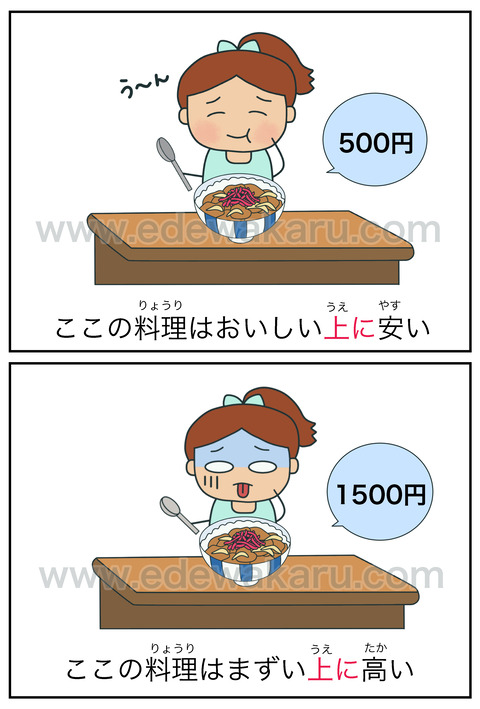
“〜上に” is a sentence pattern meaning “〜, and in addition 〜.” What you need to be careful about when using this pattern is that you must pair “a good thing with a good thing” and “a bad thing with a bad thing.” 😮
[Examples]
⭕️ The food here is delicious and cheap. [Delicious, cheap → good things]
⭕️ The food here is bad and expensive. [Bad → bad thing; expensive → bad thing]
❌ The food here is delicious and expensive. [Delicious → good thing; expensive → bad thing]
Also, the “に” in “〜上に” can be omitted.
[Examples]
The food here is delicious and cheap.
She is kind and cute.
There are several patterns that include “〜上,” so learn to distinguish them. 😀
In context 3 examples
ここの料理はおいしい上に安い
→ここの料理はおいしいし、それに安いThe food here is delicious and cheap. → The food here is delicious, and on top of that, it’s cheap.
彼女は優しい上にかわいい
→彼女は優しいし、それにかわいいShe is kind and cute. → She is kind, and on top of that, she’s cute.
山田さんはごちそうしてくれた上にお土産もくれた
→山田さんはごちそうしてくれたし、更にお土産もくれたYamada treated me to a meal and also gave me a souvenir. → Yamada treated me to a meal and, furthermore, gave me a souvenir.
Read the original source text
Meaning
〜し、それに〜
〜し、更に〜
How to use it
動詞・形容詞[普通形]+上に
名詞[ーである]+上に
Explanation
「〜上に」は「〜し、それに〜」という意味を表す文型です。この文型を使う時に注意しなければいけないことは
「いいことにはいいこと」を、「悪いことには悪いこと」
をプラスして言わなければいけないところです😮
[例]
⭕️ここの料理はおいしい
上に
安い【おいしい・安い→いいこと】
⭕️ここの料理はまずい
上に
高い【まずい→悪いこと 高い→悪いこと】
❌ここの料理はおいしい
上に
高い 【おいしい→いいこと 高い→悪いこと】
また
「〜上に」の「に」は省略することができます。
[例]
ここの料理はおいしい
上、安い
彼女は優しい
上、かわいい
「〜上」とつく文型はいくつかありますので区別して覚えておきましょう😀
NINJAL 日本語文型データベース
Meaning
Used when you want to say that, in addition to “〜,” something else unexpected also occurs.
How to use it
V plain form + 上に
i-A plain form + 上に
na-A plain form + 上に (however, “na-Aだ” → “na-Aな+上に・na-Aである+上に”)
Nの上に・N plain form + 上に (however, “Nだ” → “Nの+上に・Nである+上に”)
Notes
“〜” describes something that is easy to anticipate. After “〜上に,” a different thing follows that is harder to anticipate than “〜” and has the same evaluation (positive or negative) as “〜.” Sentences expressing the speaker’s intention or urging the other person to do something do not follow.
Sometimes “も” is added to the words expressing the things to be emphasized in the clauses before “〜” and after “〜上に,” as in “〜も〜上に、〜も〜.”
In context 23 examples
いつもお世話になっている上に、本日はおいしい果物まで送っていただきまして、本当にありがとうございます。
You are always so kind to us, and today you even sent us delicious fruit. Thank you very much.
私は楽天的に考えられない上に、過去のことにいつまでもこだわる癖がある。
I’m not only unable to think optimistically, but I also have a habit of dwelling on the past.
今日のドライブはさんざんだった。ひどい渋滞に巻き込まれた上に、大雨になり景色を楽しむこともできなかった。
Today’s drive was awful. We got caught in terrible traffic, and on top of that it began to rain heavily, so we couldn’t even enjoy the scenery.
昨日は食欲がなかった上に、何もやる気が出ない一日だった。
Yesterday, I had no appetite, and on top of that, it was a day when I couldn’t bring myself to do anything.
今日の入社試験では、筆記試験もよくできなかったうえに、面接でもうまく答えられなかった。
I didn’t do well on the written exam for today’s job interview, and on top of that, I couldn’t answer the questions well in the interview.
「この店はおいしい上に安くて、言うことないね」
“This restaurant is delicious and inexpensive, too. You can’t ask for more.”
当地は空気がいい上に静かで、別荘地としてはおすすめですよ。
The air is clean here, and on top of that it’s quiet, so I recommend it as a vacation-home area.
今日は私自身の体調がよくない上に、子どもも熱を出している。困ったなあ。
I’m not feeling well today, and on top of that, my child has a fever. This is a problem.
学生時代は経済的にきつかった。授業料が高かった上に、教材費もかなりかかった。
When I was a student, money was tight. Tuition was high, and on top of that, the cost of course materials was considerable.
今年の夏は猛暑の日が多くなかった上に、湿気もあまりなくて過ごしやすかった。
There weren’t many extremely hot days this summer, and on top of that, it wasn’t very humid, so it was comfortable.
その映画はストーリーが面白くなかったうえに長くて、私は途中で眠ってしまった。
The movie had an uninteresting story, and on top of that it was long, so I fell asleep partway through.
兄は生来、楽天的な上に世話好きなので、友人が多い。
My older brother has been optimistic by nature and is also helpful, so he has many friends.
この論文は論拠が明確でない上に、データの信頼性にも欠ける。
The reasoning in this paper is unclear, and on top of that, the data also lacks reliability.
今日のA議員の答弁は説明不十分だった上に感情的だった。明日の新聞で批判されることだろう。
Assembly member A’s response today was insufficiently explained and, on top of that, emotional. It will probably be criticized in tomorrow’s newspapers.
以前の私は論理的に話をするのが得意ではなかった上に、人の話に耳を傾けるのも苦手だった。就職してからこの欠点を直す努力をした。
In the past, I was not good at speaking logically, and on top of that, I was bad at listening to others. After starting work, I made an effort to correct these shortcomings.
彼は仕事がスピーディであるうえに非常に誠実なので、まわりの人から頼りにされている。
He works quickly and is also very sincere, so the people around him rely on him.
悪天候の上に災害にも見舞われて、今年のりんごの収穫量は大幅に減少した。
On top of bad weather, the apple crop was also hit by a disaster, and this year’s harvest fell sharply.
低賃金の上に見返りもない仕事を10年続けたが、嫌気がさしてきた。
I continued doing a job with low pay and no rewards for ten years, but I’ve started to get fed up.
私にとって、住宅ローンを払うのはかなりの負担である上に、物価が上がった不安も強い。なんとかならないものか。
Paying my mortgage is a considerable burden for me, and on top of that, I am very worried about rising prices. Is there anything that can be done?
ここに3分ぐらい車を止めていたら「駐車禁止」の紙を貼られてしまった。違反ではない上に歩道に倒れていた人を助けるためだったのに。
I left my car parked here for about three minutes and got a “No Parking” notice stuck on it. I wasn’t breaking any rules, and I was only helping someone who had fallen on the sidewalk.
冠婚葬祭は日常的なことではない上に、地域による違いも大きいので、細かいしきたりを覚えているのは大変だ。
Ceremonial occasions such as weddings, funerals, and other formal events are not part of everyday life, and on top of that, customs vary greatly by region, so it is difficult to remember all the detailed rules.
1人目の子は、難産だった上に未熟児だったので、大変だった。
My first child was difficult to deliver and, on top of that, was premature, so it was very hard.
運転中、事故を起こしてしまった。しかし、大事故ではなかったうえに、すぐに救急車が来てくれたので助かった。
I caused an accident while driving. However, it was not a serious accident, and on top of that, an ambulance arrived right away, so I was lucky.
Read the original source text
Meaning
〜のほかに、さらに予想外の他のことも重なると言いたいときに使います。
How to use it
V普通形+上に
i-A普通形+上に
na-A普通形+上に(ただし、「na-Aだ」→「na-Aな+上に・na-Aである+上に」
Nの上に・N普通形+上に(ただし、「Nだ」→「Nの+上に・Nである+上に」)
Notes
「~」には、予想しやすい事柄がきます。「~上に」の後には、「~」と同じ評価(プラス評価またはマイナス評価)の、「〜」より予想しにくい別の事柄がきます。話し手の意向を表す文や相手への働きかけの文はきません。
「~も~上に、~も~」のように、「〜」と「〜上に」の後の文の強調したい事柄を表す言葉に「も」をつけることもあります。