文法
Meaning
~ too / even ~
How to use it
N + すら
Notes
① It has the same meaning as 「〜さえ」, but 「〜すら」 is more literary.
② It is often used for undesirable things.
③ It conveys surprise or exasperation.
In context 10 examples
トムさんは10年も日本に住んでいるのに、挨拶すら日本語でできない。
Even though Tom has lived in Japan for 10 years, he can’t even greet people in Japanese.
田中さんはリンさんと仲がいいのに、電話番号すら知らないそうだ。
Even though Tanaka and Lin are close, apparently he doesn’t even know her phone number.
彼は酔っ払いすぎて、まともに話すことすらできない。
He’s so drunk that he can’t even speak properly.
10年以上、数学を教えている先生ですら、この問題を解けなかった。
Even a teacher who has taught math for over 10 years couldn’t solve this problem.
バイクで事故を起こしてしまい、いま歩くことすらできない状態だ。
I had a motorcycle accident, and now I’m in a state where I can’t even walk.
喉が痛くて、水すら飲めない
My throat hurts, and I can't even drink water.
彼は事故で記憶をなくしてしまい、妻である私の顔すら覚えていなかった。
He lost his memory in the accident and didn’t even recognize my face, though I’m his wife.
こんな問題、小学生すらわかるよ。
Even an elementary school student would understand a problem like this.
彼は海外はもちろん、他の県にすら行ったことがないらしい。
Apparently, he has never been overseas, or even to another prefecture.
今日はお客さんが多すぎて、ご飯を食べる時間すらなかった。
There were so many customers today that I didn’t even have time to eat.
Read the original source text
Meaning
〜も / 〜さえ
How to use it
N + すら
Notes
①「〜さえ」と意味は同じだが、「〜すら」の方が文語的。
②良くないことに使うことが多い。
③驚きや呆れた気持ちが含まれる。
どんなときどう使う 日本語表現文型辞典
Meaning
even
How to use it
Noun+すらW
Explanation
すら〈強調〉
~も/でも
特に極端な例を取り上げて「ほかはもちろん」という意味に使う。「さえ」と同じように使うが「さえ」より文語的な表現。 ❸ ❹ のように主格につく場合は、「ですら」となる場合が多い。
Gives extreme example of something and then adds that other factors naturally also exist. Used the same way as さえ, but is more literary. When appended to nominals, such as in sentences ❸ and ❹ , often becomes ですら.
In context 4 examples
高橋さんは食事をする時間すら惜しんで、研究している。
Takahashi is so devoted to research that he begrudges even the time it takes to eat.
腰の骨を傷めて、歩くことすらできない。
I injured a bone in my lower back and can’t even walk.
大学教授ですらわからないような数学の問題を10歳の子どもが解いたと評判になっている。
It has become a sensation that a ten-year-old child solved a math problem that even university professors couldn’t understand.
李さんは日本人ですら知らない日本語の古い表現をよく知っている。
Lee knows many old Japanese expressions that even Japanese people don’t know.
Read the original source text
Meaning
even
How to use it
N+すらW
Explanation
すら〈強調〉
~も/でも
特に極端な例を取り上げて「ほかはもちろん」という意味に使う。「さえ」と同じように使うが「さえ」より文語的な表現。 ❸ ❹ のように主格につく場合は、「ですら」となる場合が多い。
Gives extreme example of something and then adds that other factors naturally also exist. Used the same way as さえ, but is more literary. When appended to nominals, such as in sentences ❸ and ❹ , often becomes ですら.
日本語NET JLPT文法解説まとめ
Meaning
~ too / even ~
How to use it
N + すら
Explanation
even
① It has the same meaning as 「〜さえ」, but 「〜すら」 is more literary.
② It is often used for undesirable things.
③ It conveys surprise or exasperation.
① "Even ~" has the same meaning as "~すら", but "~すら" is more formal.
② Often used to indicate something undesirable.
③ Implies surprise or disbelief.
In context 10 examples
トムさんは10年も日本に住んでいるのに、挨拶すら日本語でできない。
Even though Tom has lived in Japan for 10 years, he can’t even greet people in Japanese.
田中さんはリンさんと仲がいいのに、電話番号すら知らないそうだ。
Even though Tanaka and Lin are close, apparently he doesn’t even know her phone number.
彼は酔っ払いすぎて、まともに話すことすらできない。
He’s so drunk that he can’t even speak properly.
10年以上、数学を教えている先生ですら、この問題を解けなかった。
Even a teacher who has taught math for over 10 years couldn’t solve this problem.
バイクで事故を起こしてしまい、いま歩くことすらできない状態だ。
I had a motorcycle accident, and now I’m in a state where I can’t even walk.
喉が痛くて、水すら飲めない。
My throat hurts so much I can’t even drink water.
彼は事故で記憶をなくしてしまい、妻である私の顔すら覚えていなかった。
He lost his memory in the accident and didn’t even recognize my face, though I’m his wife.
こんな問題、小学生すらわかるよ。
Even an elementary school student would understand a problem like this.
彼は海外はもちろん、他の県にすら行ったことがないらしい。
Apparently, he has never been overseas, or even to another prefecture.
今日はお客さんが多すぎて、ご飯を食べる時間すらなかった。
There were so many customers today that I didn’t even have time to eat.
Read the original source text
Meaning
〜も / 〜さえ
How to use it
N + すら
Explanation
even
①「〜さえ」と意味は同じだが、「〜すら」の方が文語的。
②良くないことに使うことが多い。
③驚きや呆れた気持ちが含まれる。
① "Even ~" has the same meaning as "~すら", but "~すら" is more formal.
② Often used to indicate something undesirable.
③ Implies surprise or disbelief.
IMABI
The Particles さえ, すら, & だに
Read this IMABI lesson ↗Explanation
The Particles さえ, すら, & だに
The particles さえ, すら, and だに are often interchangeable, but pay close attention to detail. There is some history involved, so try not to use these words anachronistically. Although they’re interchangeable with each other, there are subtle differences.
The Adverbial Particle すら
すら is the original particle for minimal example–“even…not to mention..”. Now it has evolved to show minimal expectation, which is showing an extreme (usually negative) example. So, it is equal to “(not) even”. It can be seen as ですら. すら is faded into literature and somehow survived to the present. Now, だに is ironically rarer than すら.
Using this with other particles is very tricky as there is historical and personal variation. For instance, using it with を isn’t wrong. However, many people just use すら. For when you do want to use it with を, をすら and すらを are both possible, but the latter is extremely old-fashioned. Even so, it still pops up.
1. なにしろ、警視庁みずから一般人の犯歴データを流していたことが問題になったばかりなのに、公の裁判所の正式決定すらをはねつけたんですからね。
Anyhow, although the Metropolitan Police themselves having been leaking out general people’s criminal record data has just become a problem, it’s because they even rejected a public court’s official decision.
From 明日はどっちだ! by 岡留安則.
The Adverbial Particle さえ
さえ comes from the verb 添ふ (to add), which has become 添える in Modern Japanese. So, the original meaning of this particle was “in addition to”. Eventually, さえ began to be used to show minimal example. Both usages survive today, but the latter can be alternatively expressed with でさえ, as is demonstrated in the example below. It is to note that both ですら and でさえ are only used after nouns! This is because the case particle で is in these expressions.
2. 今どき、男の子だったら、小学生でさえ知ってるよ。
These days even boys in elementary school know.
The meaning of X(で)さえY is this. Some X matter and some Y action/happening/condition are usually not connected in any one, yet when you bind them together, you emphasize a situation that is not the norm by any means. This is what minimal example means.
3. 虎でさえ彼を傷つけることはできない。
Not even a tiger can hurt him.4. 彼は食費{さえ・すら}惜しんだ。
He even begrudged taking the money for food.
It’s sometimes hard to tell which meaning is meant. Minimal example is often used in negative expressions, but when this is not the case, consider the context. “Even a kid can understand it” is minimum example. “In addition to us, even the dogs understand” shows addition. It doesn’t help that both English and Japanese are vague on this.
5. 雪どころか雨さえ降らなかった。
Not even rain fell, let alone snow.
6 初心者にさえできることだ。
It’s something even a beginner can do.
7a. 子供{(で){さえ・すら}・でも}(そのこと)知ってる(ことだ)よ。〇
7b. 子供もさえそんなこと知ってるよ。X
Even kids know that.
8. ただでさえ電車が遅れているのに、寄り道をしようだなんて。
Even under normal circumstances, hanging out along the way even when the train is late is just…
9a. ぼくは独りだから、君さえぼくの心の頼りだよ。X
9b. ぼくは独りだから、君だけがぼくの心の頼りだよ。〇
Because I’m all alone, you’re the only thing my heart relies on.
Particle Note:
1. さえ can be after other particles like に. をさえ is also possible, but を is usually dropped. In literature, however, をさえ is more common.
10. 秘密にしていたのに、三歳の子供にさえ気づかれてしまった。
Even though I was keeping it a secret, it was even found out by a three year old.
11. 自分はまだ生きているのだという実感をさえ持つことができたのだった。
I was able to have the realization that I myself was still alive.
From 光の雨 by 立松和平.
2. There is also さえも and さえもが. Both are more emphatic than さえ and show minimal example, but が implies new information and or surprise. If you understand も and が well enough, this shouldn’t be hard to visualize.
12. 死さえもが玉井にとっては安楽なのだ。
Even death was something which would be bring ease to Tamai.
From 光の雨 by 立松和平. 13. 子どもばっかりじゃなく、大人さえも悲鳴をあげたよ。
The children and even the adults screamed.
Important Patterns
Both さえ and すら can be after the 連用形 of verbs similar to は, や. etc. You can also use them after て. This creates a phrase that puts emphasis on the action rather than the noun. すら, again, is increasingly becoming rarer, so you will probably only see it with nouns. Here is a chart using the pattern さえ…ば (if only you~) to illustrate this grammar.
Noun + さえ + Verb + ば 薬さえ飲めば If you only drank this medicine (and no other)
Verb (連用形) + さえ + すれば 薬を飲みさえすれば If you only drink this medicine (and do nothing else)
Verb + て + さえ + いれば 薬を飲んでさえいれば If you are drinking this medicine (and doing nothing else)
Grammar Note: Verb+ている+さえすれば → Verb+ていさえすれば. In this case, it doesn’t matter that 連用形 of いる is left like that. Remember, this is not like ~ており、・・・.
14. 食べ((すぎ)さえし)なければ、もっとやせ(られる・るようになるよ)。
If you would only not eat, you would be able to lose more weight.
15. 幸せでありさえすればかまわないんだ。
I don’t care so long as you are happy.
16. 知ってさえいればな~。(Colloquial Spelling)
If only I had known!
17. 時間さえあれば、手伝うんだが。
If only I had time, I’d help.
18. 生きていさえすれば、何も要らない。
If you just live on, you won’t need anything.
19. 勉強さえすれば、試験はできるでしょう。
If you just study, you should be able to do the exam.
20. 一生懸命頑張りさえすれば、何でも好きなことができる。
If you just try with all your hardest, you should be able to do anything you like.
21. 分からない漢字は、調べさえすれば分かりますよ。
If you simply look up Kanji you don’t understand, you’ll understand them.
22. 日本語は、日本人と毎日話そうとしてさえいれば話せるようになります。
If you just try talking to Japanese people everyday, you’ll become able to speak in Japanese.
23. 病気は、この漢方薬さえ飲めば、よくなります。
If you drink just this herbal medicine, your sickness should become better.
24. 和書さえ読めれば、幸せです。
If I read just Japanese books, I’m happy.
25. これさえあれば、後は何も要らない。
If we only had this, we’d need nothing later.
Nuance Note: Again, these particles emphasize what they directly follow, so although there is some levity on where to place さえ in a sentence, be aware of this.
Speech Style Note: Though さえ may be used in the spoken language, it is more common in the written language.
26. しかしこの進学については、思い出すさえ忌々しい事情がある。
But, remembering about going onto university brought on annoying circumstances by just remembering.
From 金閣寺 by 三島由紀夫.
Grammar Note: さえ also rarely follows the 連体形 of verbs. This is essentially old-fashioned.
The Adverbial Particle だに
だに, not to be confused with the noun ダニ (tick), is used in both negative and positive sentences. It raises the most probable thing and negates it and anything aside from it. Originally, it showed minimal desire or want. In this sense it means “at the least”. This led to it being used to show minimal example just like さえ and すら. This is equivalent to だけで. It is the rarest of the three.
27a. 夢にだに思ったことはない。(かなり古風)
27b. 夢でさえ思ったこともない。(もっと一般的)
I have not thought of something in just a dream.
28. ネオンは錯綜し、吞み屋の大きな赤い提灯は微動だもしなかった。
The neon lights complicated things, and the bar’s big, red lantern didn’t even sway a bit.
From スタア by 三島由紀夫.
Grammar Note: だも is a contraction of だにも.
In context 30 examples
なにしろ、警視庁みずから一般人の犯歴データを流していたことが問題になったばかりなのに、公の裁判所の正式決定すらをはねつけたんですからね。
Anyhow, although the Metropolitan Police themselves having been leaking out general people’s criminal record data has just become a problem, it’s because they even rejected a public court’s official decision.
今どき、男の子だったら、小学生でさえ知ってるよ。
These days even boys in elementary school know.
虎でさえ彼を傷つけることはできない。
Even a tiger cannot hurt him.
雪どころか雨さえ降らなかった。
Not even rain fell, let alone snow.
子供{(で){さえ・すら}・でも}(そのこと)知ってる(ことだ)よ。〇
Even kids know that.
子供もさえそんなこと知ってるよ。X
Even kids know that.
ただでさえ電車が遅れているのに、寄り道をしようだなんて。
Even under normal circumstances, hanging out along the way even when the train is late is just…
ぼくは独りだから、君さえぼくの心の頼りだよ。X
Because I’m all alone, you’re the only thing my heart relies on.
ぼくは独りだから、君だけがぼくの心の頼りだよ。〇
Because I’m all alone, you’re the only thing my heart relies on.
さえ can be after other particles like に. をさえ is also possible, but を is usually dropped. In literature, however, をさえ is more common.
Even though I was keeping it a secret, it was even found out by a three year old.
秘密にしていたのに、三歳の子供にさえ気づかれてしまった。
Even though I was keeping it a secret, it was even found out by a three year old.
自分はまだ生きているのだという実感をさえ持つことができたのだった。
I was able to have the realization that I myself was still alive.
There is also さえも and さえもが. Both are more emphatic than さえ and show minimal example, but が implies new information and or surprise. If you understand も and が well enough, this shouldn’t be hard to visualize.
Even death was something which would be bring ease to Tamai.
死さえもが玉井にとっては安楽なのだ。
Even death was something which would be bring ease to Tamai.
食べ((すぎ)さえし)なければ、もっとやせ(られる・るようになるよ)。
If you would only not eat, you would be able to lose more weight.
幸せでありさえすればかまわないんだ。
I don’t care so long as you are happy.
知ってさえいればな~。(Colloquial Spelling)
If only I had known!
時間さえあれば、手伝うんだが。
If only I had time, I’d help.
生きていさえすれば、何も要らない。
If you just live on, you won’t need anything.
勉強さえすれば、試験はできるでしょう。
If you just study, you should be able to do the exam.
一生懸命頑張りさえすれば、何でも好きなことができる。
If you just try with all your hardest, you should be able to do anything you like.
分からない漢字は、調べさえすれば分かりますよ。
If you simply look up Kanji you don’t understand, you’ll understand them.
日本語は、日本人と毎日話そうとしてさえいれば話せるようになります。
If you just try talking to Japanese people everyday, you’ll become able to speak in Japanese.
病気は、この漢方薬さえ飲めば、よくなります。
If you drink just this herbal medicine, your sickness should become better.
和書さえ読めれば、幸せです。
If I read just Japanese books, I’m happy.
これさえあれば、後は何も要らない。
If we only had this, we’d need nothing later.
しかしこの進学については、思い出すさえ忌々しい事情がある。
But, remembering about going onto university brought on annoying circumstances by just remembering.
夢にだに思ったことはない。(かなり古風)
I have not thought of something in just a dream.
夢でさえ思ったこともない。(もっと一般的)
I have not thought of something in just a dream.
ネオンは錯綜し、吞み屋の大きな赤い提灯は微動だもしなかった。
The neon lights complicated things, and the bar’s big, red lantern didn’t even sway a bit.
Read the original source text
Explanation
The Particles さえ, すら, & だに
The particles さえ, すら, and だに are often interchangeable, but pay close attention to detail. There is some history involved, so try not to use these words anachronistically. Although they’re interchangeable with each other, there are subtle differences.
The Adverbial Particle すら
すら is the original particle for minimal example–“even…not to mention..”. Now it has evolved to show minimal expectation, which is showing an extreme (usually negative) example. So, it is equal to “(not) even”. It can be seen as ですら. すら is faded into literature and somehow survived to the present. Now, だに is ironically rarer than すら.
Using this with other particles is very tricky as there is historical and personal variation. For instance, using it with を isn’t wrong. However, many people just use すら. For when you do want to use it with を, をすら and すらを are both possible, but the latter is extremely old-fashioned. Even so, it still pops up.
1. なにしろ、警視庁みずから一般人の犯歴データを流していたことが問題になったばかりなのに、公の裁判所の正式決定すらをはねつけたんですからね。
Anyhow, although the Metropolitan Police themselves having been leaking out general people’s criminal record data has just become a problem, it’s because they even rejected a public court’s official decision.
From 明日はどっちだ! by 岡留安則.
The Adverbial Particle さえ
さえ comes from the verb 添ふ (to add), which has become 添える in Modern Japanese. So, the original meaning of this particle was “in addition to”. Eventually, さえ began to be used to show minimal example. Both usages survive today, but the latter can be alternatively expressed with でさえ, as is demonstrated in the example below. It is to note that both ですら and でさえ are only used after nouns! This is because the case particle で is in these expressions.
2. 今どき、男の子だったら、小学生でさえ知ってるよ。
These days even boys in elementary school know.
The meaning of X(で)さえY is this. Some X matter and some Y action/happening/condition are usually not connected in any one, yet when you bind them together, you emphasize a situation that is not the norm by any means. This is what minimal example means.
3. 虎でさえ彼を傷つけることはできない。
Not even a tiger can hurt him.4. 彼は食費{さえ・すら}惜しんだ。
He even begrudged taking the money for food.
It’s sometimes hard to tell which meaning is meant. Minimal example is often used in negative expressions, but when this is not the case, consider the context. “Even a kid can understand it” is minimum example. “In addition to us, even the dogs understand” shows addition. It doesn’t help that both English and Japanese are vague on this.
5. 雪どころか雨さえ降らなかった。
Not even rain fell, let alone snow.
6 初心者にさえできることだ。
It’s something even a beginner can do.
7a. 子供{(で){さえ・すら}・でも}(そのこと)知ってる(ことだ)よ。〇
7b. 子供もさえそんなこと知ってるよ。X
Even kids know that.
8. ただでさえ電車が遅れているのに、寄り道をしようだなんて。
Even under normal circumstances, hanging out along the way even when the train is late is just…
9a. ぼくは独りだから、君さえぼくの心の頼りだよ。X
9b. ぼくは独りだから、君だけがぼくの心の頼りだよ。〇
Because I’m all alone, you’re the only thing my heart relies on.
Particle Note:
1. さえ can be after other particles like に. をさえ is also possible, but を is usually dropped. In literature, however, をさえ is more common.
10. 秘密にしていたのに、三歳の子供にさえ気づかれてしまった。
Even though I was keeping it a secret, it was even found out by a three year old.
11. 自分はまだ生きているのだという実感をさえ持つことができたのだった。
I was able to have the realization that I myself was still alive.
From 光の雨 by 立松和平.
2. There is also さえも and さえもが. Both are more emphatic than さえ and show minimal example, but が implies new information and or surprise. If you understand も and が well enough, this shouldn’t be hard to visualize.
12. 死さえもが玉井にとっては安楽なのだ。
Even death was something which would be bring ease to Tamai.
From 光の雨 by 立松和平. 13. 子どもばっかりじゃなく、大人さえも悲鳴をあげたよ。
The children and even the adults screamed.
Important Patterns
Both さえ and すら can be after the 連用形 of verbs similar to は, や. etc. You can also use them after て. This creates a phrase that puts emphasis on the action rather than the noun. すら, again, is increasingly becoming rarer, so you will probably only see it with nouns. Here is a chart using the pattern さえ…ば (if only you~) to illustrate this grammar.
Noun + さえ + Verb + ば 薬さえ飲めば If you only drank this medicine (and no other)
Verb (連用形) + さえ + すれば 薬を飲みさえすれば If you only drink this medicine (and do nothing else)
Verb + て + さえ + いれば 薬を飲んでさえいれば If you are drinking this medicine (and doing nothing else)
Grammar Note: Verb+ている+さえすれば → Verb+ていさえすれば. In this case, it doesn’t matter that 連用形 of いる is left like that. Remember, this is not like ~ており、・・・.
14. 食べ((すぎ)さえし)なければ、もっとやせ(られる・るようになるよ)。
If you would only not eat, you would be able to lose more weight.
15. 幸せでありさえすればかまわないんだ。
I don’t care so long as you are happy.
16. 知ってさえいればな~。(Colloquial Spelling)
If only I had known!
17. 時間さえあれば、手伝うんだが。
If only I had time, I’d help.
18. 生きていさえすれば、何も要らない。
If you just live on, you won’t need anything.
19. 勉強さえすれば、試験はできるでしょう。
If you just study, you should be able to do the exam.
20. 一生懸命頑張りさえすれば、何でも好きなことができる。
If you just try with all your hardest, you should be able to do anything you like.
21. 分からない漢字は、調べさえすれば分かりますよ。
If you simply look up Kanji you don’t understand, you’ll understand them.
22. 日本語は、日本人と毎日話そうとしてさえいれば話せるようになります。
If you just try talking to Japanese people everyday, you’ll become able to speak in Japanese.
23. 病気は、この漢方薬さえ飲めば、よくなります。
If you drink just this herbal medicine, your sickness should become better.
24. 和書さえ読めれば、幸せです。
If I read just Japanese books, I’m happy.
25. これさえあれば、後は何も要らない。
If we only had this, we’d need nothing later.
Nuance Note: Again, these particles emphasize what they directly follow, so although there is some levity on where to place さえ in a sentence, be aware of this.
Speech Style Note: Though さえ may be used in the spoken language, it is more common in the written language.
26. しかしこの進学については、思い出すさえ忌々しい事情がある。
But, remembering about going onto university brought on annoying circumstances by just remembering.
From 金閣寺 by 三島由紀夫.
Grammar Note: さえ also rarely follows the 連体形 of verbs. This is essentially old-fashioned.
The Adverbial Particle だに
だに, not to be confused with the noun ダニ (tick), is used in both negative and positive sentences. It raises the most probable thing and negates it and anything aside from it. Originally, it showed minimal desire or want. In this sense it means “at the least”. This led to it being used to show minimal example just like さえ and すら. This is equivalent to だけで. It is the rarest of the three.
27a. 夢にだに思ったことはない。(かなり古風)
27b. 夢でさえ思ったこともない。(もっと一般的)
I have not thought of something in just a dream.
28. ネオンは錯綜し、吞み屋の大きな赤い提灯は微動だもしなかった。
The neon lights complicated things, and the bar’s big, red lantern didn’t even sway a bit.
From スタア by 三島由紀夫.
Grammar Note: だも is a contraction of だにも.
Adverbial Particles
Read this IMABI lesson ↗Explanation
第032課: Adverbial Particles
All of the particles that will be discussed in this lesson are those that you should already know from Modern Japanese. Essentially little has changed, which will hopefully make this an easy lesson. The particles that will be studied in this lesson are the following.
まで など し(も) ばかり
のみ だに すら さえ
The Particle まで
As you know, the particle まで created some sort of extent, and this is rather concrete, even when it is dealing with unexpected degree as opposed to other phrases like にかけて. As is the case in Modern Japanese, this particle may follow noun phrases and the 連体形. Just like in Modern Japanese it can be paired with either the particles から or より to create “from…to…”.
1. 明くるより暮るるまで、東の山ぎはを眺めて過ぐす。
From the time the sun came up till it went down, I passed the time by gazing at the edge of the eastern hills.
From the 更級日記.
2. 夜更くるまで酒飲み物語して、あるじの親王、酔ひて入りたまひなむとも。
The Prince of the household drank and talked until night and was completely drunk as he tried to enter (his bedroom).
From the 伊勢物語.
3. 武蔵の國まで惑ひ歩きけり。
He walked wandering as far as Musashi Province.
From the 伊勢物語.
4. わが宿は道もなきまで荒れにけり。
As for our house, it has been overrun to the point that the road has disappeared.
From the 古今和歌集.
5. 朝ぼらけ有明の月と見るまでに吉野の里に降れる白雪
It’s the white snow piled up in Yoshino village to the point that one mistakes it for the moon at dawn’s light shining across.
From the 古今和歌集.
The Particle など
The particle など first appeared in the 平安時代. Its primary function is to show example(s), implying similar items of such group are included as well. However, just as in Modern Japanese, it may just be used primarily to soften the sentence.
6. 雨など降るもをかし。
It is also charming when the rain and such falls.
From the 枕草子.
7. いみじううつくしきちごの、いちごなど食ひたる。
Extremely kids ate strawberries and such.
From the 枕草子.
8. いざ、いと心安き所にて、のどかに聞こえむなど語らひ給へば…
Since (Genji) said such things as “Well, let’s talk all relaxed somewhere very comfortable”,…
From the 源氏物語.
9. 閼伽棚に菊紅葉など折り散らしたる、さすがに住む人のあればなるべし。
The chrysanthemums and colored leaves bent and scattered on the water offering board is no doubt because people are living there.
From the 徒然草.
10. 大人、童、下衆なんど、かたちよし。
The adults, children, and low class people and such have beautiful appearances.
From the 宇津保物語.
11. 車の音すれば、若き者どもの覗きなどすべかめるに
It looked like the young (lady) attendants were looking for an opening of such when there was noise from a cart, but…
From the 源氏物語.
The Particle し(も)
Up until the 平安時代, the particle し was seen in all sorts of positions in a sentence, but it quickly became more commonly seen in combinations such as し…ば… or combined with bound particles. This is where the form しも comes to play, which is sometimes classified as a bound particle with there being も. The particle is quite emphatic and singles out a single item from a list of things, and thus, it is very limiting. Just like in Modern Japanese, this means it’s perfect for strengthening a negation.
12. 今し、かもめむれゐてあそぶ所あり。
Right now, there is a place where the seagulls are gathering and playing.
From the 土佐日記.
13. 折りしも雨風うしつづきて、心あわただしく散りすぎぬ。
The rain and wind unfortunately continued, and (the cherry blossoms) restlessly ended up scattering away.
From the 徒然草.
14. 飛鳥川の淵瀬常ならぬ世にしあれば
Since this is the world just like the rapids and abysses of the Asuka river ever changing
From the 徒然草.
15. 心には月見むとしも思はねどうきには空ぞながめられける。
Though in my heart, I didn’t have any thought of looking at the moon, in my sorrow I found myself gazing at the sky.
From the 後拾遺集.
The Particle ばかり
Just like in Modern Japanese, the primary usage of ばかり is to show approximation. This approximation deals with numbers, place, age, time, weight, etc. It can also show degree/extent. The use of “just”, which is also found in Modern Japanese, began in the 平安時代. This is pretty distinguishable from the other usage because it wouldn’t be used with a “counter/quantity noun”.
Now, the intense repetition usage found in things like 鳴いてばかりいる in Modern Japanese started out in the 鎌倉時代 as a final particle usage, but now it is the most important usage, with its use for “just” as a means of restriction being almost entirely given to だけ and its approximation usage fighting with くらい over minute semantics (Lesson 83).
Origin Note: The particle ばかり comes from the verb 計る. If you know that はかり・秤 means a “scale/weighing machine” even to this day, you can see the direct correlation it has with its fundamental meaning of showing approximation, which all of its other usages evolved from over time.
Sound Change Note: Starting in the 江戸時代, the particle underwent dialectical sound changes, of which some have survived into Modern Japanese as slang/colloquial variants. Those that are important include ばっかり, ばっかし, ばかし, and ばっか.
Base Note: ばかり goes after the 終止形 for approximation usages but after the 連体形 for limitation usages.
Examples
16. 廣瀬河袖衝許 淺乎也 心深目手 吾念有良武 (原文)
広瀬川袖つくばかり浅きをや 心深めて我が思へるらむ。
Just like the Hirose River being so shallow that my sleeves are wet,
I wonder why I’m taking it so deep to the heart.
From the 万葉集.
17. 如此許恋乍不有者高山之磐根四巻手死奈麻死物乎 (原文)
かくばかり恋ひつつあらずは高山の磐根し枕まきて死なましものを
Without yearning and suffering this much,
I want to end up dying upon the rocks as my pillow in that tall mountain.
From the 万葉集.
18. されど、なほ夕顔という名ばかりはをかし。
But after all, only the name of the evening face is charming.
From the 枕草子.
19. 頚もちぎるばかり引きたるに。
They pulled (his head) to the extent that his neck was almost torn off.
From the 徒然草.
20. 卯のときばかりにふねいだす。
We set out on the boat around the Hour of the Rabbit.
From the 土佐日記.
21. 人しれずおつる涙のつもりつつ數かくばかりなりにけるかな。
As my tears in secret piled up, I ended up at the point of writing down the number of tears in vain.
From the 拾遺和歌集.
22. 命あらば逢ふよもあらん世の中になど死ぬばかりおもふ心ぞ。
If I had life, I would probably have a time of being able to meet that person, but even so, why does my heart fret as if I’m going to die?
From the 金葉集.
Word Note: 世の中 in this passage has both the meaning of “male-female relationship” and “longevity”. This adds to the modern translation as referring to the speaker and the partner as well as the twist on “life”.
23. 吾屋前 芽子花咲有 見来益 今二日許 有者将落 (原文)
我が屋戸の萩が花咲けり見に来ませいま二日ばかりあらば散りなむ
The ogi flowers have bloomed at my yard. Come see them! Won’t they scatter away in two days?
From the 万葉集.
24. 有明のつれなく見えし別れより暁ほど憂きものはなし。
Nothing is better than the dawn from the day we parted as the dawn moonlight shined coldly above.
From the 古今和歌集.
25. かぞふれば年の残りもなかりけり老いぬるばかり悲しきはなし。
When you count, there is no remaining years. There is nothing more said that getting old.
From the 新古今和歌集.
26. 今来んと言ひしばかりに長月のありあけの月を待ちいでつるかな。
I wait for the moon of the dawn of the ninth month saying it will show now, but will it emerge?
From the 古今和歌集.
The Particle のみ
The particle のみ during the 奈良時代 was used far more frequently than ばかり, but ever since it has lost its steam, and even in Modern Japanese were it has survived to, it is used in a limited fashion in more literary/formal situations. Its use, just like today is to show “limitation” meaning “only”. Up until the 平安時代, it would be placed before particles like を and に, but the order switched to をのみ and にのみ respectively, as is the case to the present day.
27. ただ浪の白きのみぞ見ゆる。
The only thing that was visible was the white of the waves.
From the 土佐日記.
28. 秋の夜も名のみなりけり逢ふといへば事ぞともなく明けぬるものを。
The fall night was in name only. If I were to meet (my lover), I wish this night would end oh so soon.
From the 古今和歌集.
29. 筑波祢尓 可加奈久和之能 祢乃未乎可 奈伎和多里南牟 安布登波奈思尓 (原文)
筑波嶺に かか鳴く鷲の音のみをか 泣きわたりなむ 逢ふとはなしに。
Like the eagles crying at Tsukubane, I too shall cry for I can no longer see that child.
From the 万葉集.
30. 花は盛りに、月はくまなきをのみ見るものかは。
Should we look at the moon only when it is clear or at flowers only at their peak?
From the 徒然草.
The Particles だに, すら, & さえ
Except for some particle details, the original coverage of these particles almost completely applies here as well.
だに was used a lot in the 奈良時代 to primarily show minimal desire (せめて…でも), and then afterwards it began being used to show minimal example, eventually replacing すら. However, as we know, in Modern Japanese さえ took over all of them.
すら was used in the ancient period too, in which it showed minimal example. So, at least in the 奈良時代, the two particles weren’t really confused in function with each other. There wasn’t even any true consistency on how it was used with case particles. Combinations like をすら, すらを, すらに, にすら, etc. were all common. At one point it also appeared as そら, and managed to survive into Modern Japanese be being consistently used in writing.
さえ is slightly different in that it can mean “on top of that” and show minimal example. “Minimal example” in Modern Japanese can appear as でさえ(も) to distinguish the usages. It came from the verb “to add”, 添ふ. This shouldn’t be a surprise. It too was used in the ancient period. With the similar roles of だに, すら, and さえ, it’s not surprising that they’d be confused with each other and that one would become used more than the others as a result.
Examples
31. 今一度聲をだに聞かせ給へ。
Now let me hear your voice at least once.
From the 源氏物語.
32. かたみに打ちて、男をさへぞ打つめる。
They took turns hitting each other, and it appears that they even hit the men!
From the 枕草子.
33. 昇らんをだに見送り給へ。
At the very least, watch me ascend.
From the 竹取物語.
34. 言不問 木尚妹興兄 有云乎 直独子尓 有之苦者 (原文)
言問はぬ木すら妹いもと兄せありとふをただ独子ひとりごにあるが苦しさ。
They say that even the mute tree has sisters and brothers; oh how hard it must be as an only child!
From the 万葉集.
35. ひとつ子にさへありければ、いとかなしうし給ひけり。
In addition, since he was the only child, (the mother) was even more saddened.
From the 伊勢物語.
36. 星の光だに見えず暗きに。
It was dark and even the light of the stars wasn’t visible.
From the 更級日記.
37. 人所寝 味宿不寝 早敷八四 公目尚 欲嘆 (原文)
人の寝る 味眠は寝ずて愛はしきやし 君が目すらを欲りて嘆くも。
Having not had sweet sleep with someone, my dear, I sigh desiring at least a glimpse of you.
From the 万葉集.
In context 37 examples
明くるより暮るるまで、東の山ぎはを眺めて過ぐす。
From the time the sun came up till it went down, I passed the time by gazing at the edge of the eastern hills.
夜更くるまで酒飲み物語して、あるじの親王、酔ひて入りたまひなむとも。
The Prince of the household drank and talked until night and was completely drunk as he tried to enter (his bedroom).
武蔵の國まで惑ひ歩きけり。
He walked wandering as far as Musashi Province.
わが宿は道もなきまで荒れにけり。
As for our house, it has been overrun to the point that the road has disappeared.
朝ぼらけ有明の月と見るまでに吉野の里に降れる白雪
It’s the white snow piled up in Yoshino village to the point that one mistakes it for the moon at dawn’s light shining across.
雨など降るもをかし。
It is also charming when the rain and such falls.
いみじううつくしきちごの、いちごなど食ひたる。
Extremely kids ate strawberries and such.
いざ、いと心安き所にて、のどかに聞こえむなど語らひ給へば…
Since (Genji) said such things as “Well, let’s talk all relaxed somewhere very comfortable”,…
閼伽棚に菊紅葉など折り散らしたる、さすがに住む人のあればなるべし。
The chrysanthemums and colored leaves bent and scattered on the water offering board is no doubt because people are living there.
大人、童、下衆なんど、かたちよし。
The adults, children, and low class people and such have beautiful appearances.
車の音すれば、若き者どもの覗きなどすべかめるに
It looked like the young (lady) attendants were looking for an opening of such when there was noise from a cart, but…
今し、かもめむれゐてあそぶ所あり。
Right now, there is a place where the seagulls are gathering and playing.
折りしも雨風うしつづきて、心あわただしく散りすぎぬ。
The rain and wind unfortunately continued, and (the cherry blossoms) restlessly ended up scattering away.
飛鳥川の淵瀬常ならぬ世にしあれば
Since this is the world just like the rapids and abysses of the Asuka river ever changing
心には月見むとしも思はねどうきには空ぞながめられける。
Though in my heart, I didn’t have any thought of looking at the moon, in my sorrow I found myself gazing at the sky.
廣瀬河袖衝許 淺乎也 心深目手 吾念有良武 (原文)
廣瀬河袖衝許 淺乎也 心深目手 吾念有良武 (Original text)
如此許恋乍不有者高山之磐根四巻手死奈麻死物乎 (原文)
如此許恋乍不有者高山之磐根四巻手死奈麻死物乎 (Original text)
されど、なほ夕顔という名ばかりはをかし。
But after all, only the name of the evening face is charming.
頚もちぎるばかり引きたるに。
They pulled (his head) to the extent that his neck was almost torn off.
卯のときばかりにふねいだす。
We set out on the boat around the Hour of the Rabbit.
人しれずおつる涙のつもりつつ數かくばかりなりにけるかな。
As my tears in secret piled up, I ended up at the point of writing down the number of tears in vain.
命あらば逢ふよもあらん世の中になど死ぬばかりおもふ心ぞ。
If I had life, I would probably have a time of being able to meet that person, but even so, why does my heart fret as if I’m going to die?
吾屋前 芽子花咲有 見来益 今二日許 有者将落 (原文)
吾屋前 芽子花咲有 見来益 今二日許 有者将落 (Original text)
有明のつれなく見えし別れより暁ほど憂きものはなし。
Nothing is better than the dawn from the day we parted as the dawn moonlight shined coldly above.
かぞふれば年の残りもなかりけり老いぬるばかり悲しきはなし。
When you count, there is no remaining years. There is nothing more said that getting old.
今来んと言ひしばかりに長月のありあけの月を待ちいでつるかな。
I wait for the moon of the dawn of the ninth month saying it will show now, but will it emerge?
ただ浪の白きのみぞ見ゆる。
The only thing that was visible was the white of the waves.
秋の夜も名のみなりけり逢ふといへば事ぞともなく明けぬるものを。
The fall night was in name only. If I were to meet (my lover), I wish this night would end oh so soon.
筑波祢尓 可加奈久和之能 祢乃未乎可 奈伎和多里南牟 安布登波奈思尓 (原文)
筑波祢尓 可加奈久和之能 祢乃未乎可 奈伎和多里南牟 安布登波奈思尓 (Original text)
花は盛りに、月はくまなきをのみ見るものかは。
Should we look at the moon only when it is clear or at flowers only at their peak?
今一度聲をだに聞かせ給へ。
Now let me hear your voice at least once.
かたみに打ちて、男をさへぞ打つめる。
They took turns hitting each other, and it appears that they even hit the men!
昇らんをだに見送り給へ。
At the very least, watch me ascend.
言不問 木尚妹興兄 有云乎 直独子尓 有之苦者 (原文)
言不問 木尚妹興兄 有云乎 直独子尓 有之苦者 (Original text)
ひとつ子にさへありければ、いとかなしうし給ひけり。
In addition, since he was the only child, (the mother) was even more saddened.
星の光だに見えず暗きに。
It was dark and even the light of the stars wasn’t visible.
人所寝 味宿不寝 早敷八四 公目尚 欲嘆 (原文)
人所寝 味宿不寝 早敷八四 公目尚 欲嘆 (Original text)
Read the original source text
Explanation
第032課: Adverbial Particles
All of the particles that will be discussed in this lesson are those that you should already know from Modern Japanese. Essentially little has changed, which will hopefully make this an easy lesson. The particles that will be studied in this lesson are the following.
まで など し(も) ばかり
のみ だに すら さえ
The Particle まで
As you know, the particle まで created some sort of extent, and this is rather concrete, even when it is dealing with unexpected degree as opposed to other phrases like にかけて. As is the case in Modern Japanese, this particle may follow noun phrases and the 連体形. Just like in Modern Japanese it can be paired with either the particles から or より to create “from…to…”.
1. 明くるより暮るるまで、東の山ぎはを眺めて過ぐす。
From the time the sun came up till it went down, I passed the time by gazing at the edge of the eastern hills.
From the 更級日記.
2. 夜更くるまで酒飲み物語して、あるじの親王、酔ひて入りたまひなむとも。
The Prince of the household drank and talked until night and was completely drunk as he tried to enter (his bedroom).
From the 伊勢物語.
3. 武蔵の國まで惑ひ歩きけり。
He walked wandering as far as Musashi Province.
From the 伊勢物語.
4. わが宿は道もなきまで荒れにけり。
As for our house, it has been overrun to the point that the road has disappeared.
From the 古今和歌集.
5. 朝ぼらけ有明の月と見るまでに吉野の里に降れる白雪
It’s the white snow piled up in Yoshino village to the point that one mistakes it for the moon at dawn’s light shining across.
From the 古今和歌集.
The Particle など
The particle など first appeared in the 平安時代. Its primary function is to show example(s), implying similar items of such group are included as well. However, just as in Modern Japanese, it may just be used primarily to soften the sentence.
6. 雨など降るもをかし。
It is also charming when the rain and such falls.
From the 枕草子.
7. いみじううつくしきちごの、いちごなど食ひたる。
Extremely kids ate strawberries and such.
From the 枕草子.
8. いざ、いと心安き所にて、のどかに聞こえむなど語らひ給へば…
Since (Genji) said such things as “Well, let’s talk all relaxed somewhere very comfortable”,…
From the 源氏物語.
9. 閼伽棚に菊紅葉など折り散らしたる、さすがに住む人のあればなるべし。
The chrysanthemums and colored leaves bent and scattered on the water offering board is no doubt because people are living there.
From the 徒然草.
10. 大人、童、下衆なんど、かたちよし。
The adults, children, and low class people and such have beautiful appearances.
From the 宇津保物語.
11. 車の音すれば、若き者どもの覗きなどすべかめるに
It looked like the young (lady) attendants were looking for an opening of such when there was noise from a cart, but…
From the 源氏物語.
The Particle し(も)
Up until the 平安時代, the particle し was seen in all sorts of positions in a sentence, but it quickly became more commonly seen in combinations such as し…ば… or combined with bound particles. This is where the form しも comes to play, which is sometimes classified as a bound particle with there being も. The particle is quite emphatic and singles out a single item from a list of things, and thus, it is very limiting. Just like in Modern Japanese, this means it’s perfect for strengthening a negation.
12. 今し、かもめむれゐてあそぶ所あり。
Right now, there is a place where the seagulls are gathering and playing.
From the 土佐日記.
13. 折りしも雨風うしつづきて、心あわただしく散りすぎぬ。
The rain and wind unfortunately continued, and (the cherry blossoms) restlessly ended up scattering away.
From the 徒然草.
14. 飛鳥川の淵瀬常ならぬ世にしあれば
Since this is the world just like the rapids and abysses of the Asuka river ever changing
From the 徒然草.
15. 心には月見むとしも思はねどうきには空ぞながめられける。
Though in my heart, I didn’t have any thought of looking at the moon, in my sorrow I found myself gazing at the sky.
From the 後拾遺集.
The Particle ばかり
Just like in Modern Japanese, the primary usage of ばかり is to show approximation. This approximation deals with numbers, place, age, time, weight, etc. It can also show degree/extent. The use of “just”, which is also found in Modern Japanese, began in the 平安時代. This is pretty distinguishable from the other usage because it wouldn’t be used with a “counter/quantity noun”.
Now, the intense repetition usage found in things like 鳴いてばかりいる in Modern Japanese started out in the 鎌倉時代 as a final particle usage, but now it is the most important usage, with its use for “just” as a means of restriction being almost entirely given to だけ and its approximation usage fighting with くらい over minute semantics (Lesson 83).
Origin Note: The particle ばかり comes from the verb 計る. If you know that はかり・秤 means a “scale/weighing machine” even to this day, you can see the direct correlation it has with its fundamental meaning of showing approximation, which all of its other usages evolved from over time.
Sound Change Note: Starting in the 江戸時代, the particle underwent dialectical sound changes, of which some have survived into Modern Japanese as slang/colloquial variants. Those that are important include ばっかり, ばっかし, ばかし, and ばっか.
Base Note: ばかり goes after the 終止形 for approximation usages but after the 連体形 for limitation usages.
Examples
16. 廣瀬河袖衝許 淺乎也 心深目手 吾念有良武 (原文)
広瀬川袖つくばかり浅きをや 心深めて我が思へるらむ。
Just like the Hirose River being so shallow that my sleeves are wet,
I wonder why I’m taking it so deep to the heart.
From the 万葉集.
17. 如此許恋乍不有者高山之磐根四巻手死奈麻死物乎 (原文)
かくばかり恋ひつつあらずは高山の磐根し枕まきて死なましものを
Without yearning and suffering this much,
I want to end up dying upon the rocks as my pillow in that tall mountain.
From the 万葉集.
18. されど、なほ夕顔という名ばかりはをかし。
But after all, only the name of the evening face is charming.
From the 枕草子.
19. 頚もちぎるばかり引きたるに。
They pulled (his head) to the extent that his neck was almost torn off.
From the 徒然草.
20. 卯のときばかりにふねいだす。
We set out on the boat around the Hour of the Rabbit.
From the 土佐日記.
21. 人しれずおつる涙のつもりつつ數かくばかりなりにけるかな。
As my tears in secret piled up, I ended up at the point of writing down the number of tears in vain.
From the 拾遺和歌集.
22. 命あらば逢ふよもあらん世の中になど死ぬばかりおもふ心ぞ。
If I had life, I would probably have a time of being able to meet that person, but even so, why does my heart fret as if I’m going to die?
From the 金葉集.
Word Note: 世の中 in this passage has both the meaning of “male-female relationship” and “longevity”. This adds to the modern translation as referring to the speaker and the partner as well as the twist on “life”.
23. 吾屋前 芽子花咲有 見来益 今二日許 有者将落 (原文)
我が屋戸の萩が花咲けり見に来ませいま二日ばかりあらば散りなむ
The ogi flowers have bloomed at my yard. Come see them! Won’t they scatter away in two days?
From the 万葉集.
24. 有明のつれなく見えし別れより暁ほど憂きものはなし。
Nothing is better than the dawn from the day we parted as the dawn moonlight shined coldly above.
From the 古今和歌集.
25. かぞふれば年の残りもなかりけり老いぬるばかり悲しきはなし。
When you count, there is no remaining years. There is nothing more said that getting old.
From the 新古今和歌集.
26. 今来んと言ひしばかりに長月のありあけの月を待ちいでつるかな。
I wait for the moon of the dawn of the ninth month saying it will show now, but will it emerge?
From the 古今和歌集.
The Particle のみ
The particle のみ during the 奈良時代 was used far more frequently than ばかり, but ever since it has lost its steam, and even in Modern Japanese were it has survived to, it is used in a limited fashion in more literary/formal situations. Its use, just like today is to show “limitation” meaning “only”. Up until the 平安時代, it would be placed before particles like を and に, but the order switched to をのみ and にのみ respectively, as is the case to the present day.
27. ただ浪の白きのみぞ見ゆる。
The only thing that was visible was the white of the waves.
From the 土佐日記.
28. 秋の夜も名のみなりけり逢ふといへば事ぞともなく明けぬるものを。
The fall night was in name only. If I were to meet (my lover), I wish this night would end oh so soon.
From the 古今和歌集.
29. 筑波祢尓 可加奈久和之能 祢乃未乎可 奈伎和多里南牟 安布登波奈思尓 (原文)
筑波嶺に かか鳴く鷲の音のみをか 泣きわたりなむ 逢ふとはなしに。
Like the eagles crying at Tsukubane, I too shall cry for I can no longer see that child.
From the 万葉集.
30. 花は盛りに、月はくまなきをのみ見るものかは。
Should we look at the moon only when it is clear or at flowers only at their peak?
From the 徒然草.
The Particles だに, すら, & さえ
Except for some particle details, the original coverage of these particles almost completely applies here as well.
だに was used a lot in the 奈良時代 to primarily show minimal desire (せめて…でも), and then afterwards it began being used to show minimal example, eventually replacing すら. However, as we know, in Modern Japanese さえ took over all of them.
すら was used in the ancient period too, in which it showed minimal example. So, at least in the 奈良時代, the two particles weren’t really confused in function with each other. There wasn’t even any true consistency on how it was used with case particles. Combinations like をすら, すらを, すらに, にすら, etc. were all common. At one point it also appeared as そら, and managed to survive into Modern Japanese be being consistently used in writing.
さえ is slightly different in that it can mean “on top of that” and show minimal example. “Minimal example” in Modern Japanese can appear as でさえ(も) to distinguish the usages. It came from the verb “to add”, 添ふ. This shouldn’t be a surprise. It too was used in the ancient period. With the similar roles of だに, すら, and さえ, it’s not surprising that they’d be confused with each other and that one would become used more than the others as a result.
Examples
31. 今一度聲をだに聞かせ給へ。
Now let me hear your voice at least once.
From the 源氏物語.
32. かたみに打ちて、男をさへぞ打つめる。
They took turns hitting each other, and it appears that they even hit the men!
From the 枕草子.
33. 昇らんをだに見送り給へ。
At the very least, watch me ascend.
From the 竹取物語.
34. 言不問 木尚妹興兄 有云乎 直独子尓 有之苦者 (原文)
言問はぬ木すら妹いもと兄せありとふをただ独子ひとりごにあるが苦しさ。
They say that even the mute tree has sisters and brothers; oh how hard it must be as an only child!
From the 万葉集.
35. ひとつ子にさへありければ、いとかなしうし給ひけり。
In addition, since he was the only child, (the mother) was even more saddened.
From the 伊勢物語.
36. 星の光だに見えず暗きに。
It was dark and even the light of the stars wasn’t visible.
From the 更級日記.
37. 人所寝 味宿不寝 早敷八四 公目尚 欲嘆 (原文)
人の寝る 味眠は寝ずて愛はしきやし 君が目すらを欲りて嘆くも。
Having not had sweet sleep with someone, my dear, I sigh desiring at least a glimpse of you.
From the 万葉集.
AIUEO JLPT Grammar
Meaning
This sentence pattern is used to emphasize an extreme example to illustrate that the same applies to other matters. It often shows a minimum condition or surprising example and implies that if this applies, it must also hold true for other cases.
How to use it
Noun (+ で) + すら
In context 5 examples
彼は忙しくて、食事を取る時間すらない。
He is so busy that he doesn’t even have time to eat.
そんな簡単な問題ですら、彼は解決できなかった。
He couldn’t even solve such a simple problem.
彼女は返事すらできないほど疲れていた。
She was so tired that she didn't even have the strength to answer.
そんな大事なこと、子供ですら知っている。
Even children know something that important.
彼は、基本的な挨拶ですらできない。
He can’t even manage basic greetings.
Read the original source text
Meaning
This sentence pattern is used to emphasize an extreme example to illustrate that the same applies to other matters. It often shows a minimum condition or surprising example and implies that if this applies, it must also hold true for other cases.
How to use it
名詞 (+で)+すら
Explanation · 日本語
この文型は、極端な例を挙げて、他の事柄も同様であることを強調する表現です。通常、想定される最低限の条件や意外な例を示し、その例でさえそうであるなら、他のことも当然そうであるというニュアンスを含みます。
Bunpro Grammar Reference
Meaning
Even
How to use it
Noun + (Particle) + すら(も)
Nuance
A strong, formal expression, highlighting that even the extreme example of (A) applies to a statement, so is obviously true for other things.
Explanation
すら is an adverbial particle in Japanese that basically translates as 'even'. The primary difference between it and も is that すら tends to present far more extreme examples to which a specific rule applies, and therefore also applies to all other less extreme examples. In most cases すら will be used with a negative nuance.
As すら is an adverbial particle, it will be seen directly after nouns, or nouns followed by case-marking particles.
鉛筆すら持ってきてないの?本当にやる気あるの?
You didn't even bring a pencil? Do you actually want to do this?
子供ですらできることをできないのか。お前よくここまで生きてこれたな。
You can't do what even a child can do. How have you managed to live this long?
彼にすら話してないのに、親と話すわけがない。
I haven't even talked to my boyfriend about it, there is no way I'm telling my parents.
すら may also be followed by も in order to emphasize the point even further.
ガラケーすらも使えないのに、パソコンが使えるわけないじゃん。
I can't even use a flip phone, there is no way I can use a computer.
Caution
すら and さえ are relatively similar in terms of strength. However, すら is more formal and cannot be used in the さえ~ば construction. すら also tends to be the most extreme example from within a large group, while さえ places more emphasis on a specific individual.
そこさえ乗り越えれば、あとは楽になるよ。
If you can overcome that, everything will be a breeze.
そんなことさえ乗り越えることができないのなら、この先何もできませんよ。
If you can't even overcome something so simple, you won't be able to do anything beyond this point.
Fun Fact
は, も, さえ, and すら are all adverbial particles that share a linear relationship in regards to the way that they are used. This relationship refers to the intensity of how (A) fits into a group. This can be imagined as follows.
(A) は - (A) is as expected, and there is nothing surprising about it.
(A) も - (A) also fits the category of the main topic, but may or may not be surprising.
(A) さえ - (A) also fits the category of the main topic, but is quite surprising when examined individually.
(A) すら - (A) also fits the category of the main topic, but is the most extreme example possible, thus implying that anything below that level also applies.
In context 18 examples
- マンガの迷った主人公:「何日たったのかすら...」
A lost manga protagonist: 'I don't even (know) how many days have passed…'
- 鉛筆すら持ってきてないの?本当にやる気あるの?
You didn't even bring a pencil? Do you actually want to do this?
- 子供ですらできることをできないのか。お前よくここまで生きてこれたな。
You can't do what even a child can do. How have you managed to live this long?
- 彼にすら話してないのに、親と話すわけがない。
I haven't even talked to my boyfriend about it, there is no way I'm telling my parents.
- ガラケーすらも使えないのに、パソコンが使えるわけないじゃん。
I can't even use a flip phone, there is no way I can use a computer.
- 南極大陸では夏ですら気温が0度以下である。
In Antarctica, temperatures are below zero even in summer.
- 記事:「カラスは道具を使用する能力を示したことすらあります。」
Article: 'Crows have even demonstrated the ability to use tools.'
- ノベル、語り手:「負傷により、走るどころかベッドから立ち上がることすらもできない。」
A novel, narrator: 'Due to her injuries, let alone running, she can't even stand up out of bed.'
- ノベル、語り手:「友達どころか家族にすら説明せずに旅に出た。」
A novel, narrator: 'Without even explaining to his family, let alone friends he embarked on a journey.'
- ビジュアルノベル、キャラクターの紹介:「牧瀬紅莉栖。子供ですら知っている、この世界的研究者。」
Visual novel, character introduction: 'Kurisu Makise. The world-famous researcher, whom even children know.'
- まだ平仮名や片仮名すらうろ覚えなのに日本語能力試験を受けるのは無理があります。
There's no way you can take the JLPT, despite only having a vague grasp of even hiragana and katakana.
- 小学生ですら出来るような掛け算九九の計算を間違えてしまい、大恥をかいた。
Miscalculating a times table multiplication that can be done even by a primary school student was very embarrassing.
- 連絡先どころか本名すら知らないなんて、本当に彼女とは友達なんですか...?
Let alone her contact details, something like not even knowing her real name, is she even your friend?
- イギリスに十年も住んでいて日常会話すら出来ないなんて、今までどうやって生活をしていたの...?
Something like not even being able to have a daily conversation after 10 years of living in England. What kind of lifestyle have you been leading up until now…?
- あんなに元気だった祖母が今は家の中の掃除すら出来ないと聞き、老いる事に恐怖を感じています。
Hearing that my grandmother, who had been so energetic, can now not even do chores around the house, I am dreading getting old.
- ネイティブですら満点を取ることが出来ない試験を作るなんて、この言語能力試験の制作者は一体何を考えているのだろうか...。
Creating a language test that not even a native speaker can get a perfect score on, what on earth were the creators thinking…
- そこさえ乗り越えれば、あとは楽になるよ。
If you can overcome that, everything will be a breeze.
- そんなことすら乗り越えることができないのなら、この先何もできませんよ。
If you can't even overcome something so simple, you won't be able to do anything beyond this point.
Read the original source text
Meaning
Even
How to use it
Noun + (Particle)+ すら(も)
Nuance
A strong, formal expression, highlighting that even the extreme example of (A) applies to a statement, so is obviously true for other things.
Explanation
すら is an adverbial particle in Japanese that basically translates as 'even'. The primary difference between it and も is that すら tends to present far more extreme examples to which a specific rule applies, and therefore also applies to all other less extreme examples. In most cases すら will be used with a negative nuance.
As すら is an adverbial particle, it will be seen directly after nouns, or nouns followed by case-marking particles.
鉛筆すら持ってきてないの?本当にやる気あるの?
You didn't even bring a pencil? Do you actually want to do this?
子供ですらできることをできないのか。お前よくここまで生きてこれたな。
You can't do what even a child can do. How have you managed to live this long?
彼にすら話してないのに、親と話すわけがない。
I haven't even talked to my boyfriend about it, there is no way I'm telling my parents.
すら may also be followed by も in order to emphasize the point even further.
ガラケーすらも使えないのに、パソコンが使えるわけないじゃん。
I can't even use a flip phone, there is no way I can use a computer.
Caution
すら and さえ are relatively similar in terms of strength. However, すら is more formal and cannot be used in the さえ~ば construction. すら also tends to be the most extreme example from within a large group, while さえ places more emphasis on a specific individual.
そこさえ乗り越えれば、あとは楽になるよ。
If you can overcome that, everything will be a breeze.
そんなことさえ乗り越えることができないのなら、この先何もできませんよ。
If you can't even overcome something so simple, you won't be able to do anything beyond this point.
Fun Fact
は, も, さえ, and すら are all adverbial particles that share a linear relationship in regards to the way that they are used. This relationship refers to the intensity of how (A) fits into a group. This can be imagined as follows.
(A) は - (A) is as expected, and there is nothing surprising about it.
(A) も - (A) also fits the category of the main topic, but may or may not be surprising.
(A) さえ - (A) also fits the category of the main topic, but is quite surprising when examined individually.
(A) すら - (A) also fits the category of the main topic, but is the most extreme example possible, thus implying that anything below that level also applies.
Nuance · 日本語
(A)という極端な例であっても当てはまるので、他のものにも当然当てはまるということを強調する丁寧な表現。
Explanation · 日本語
「すら」は「さえ」と同じような意味で使われる副助詞です。「も」にも似ていますが、「すら」は「も」よりもっと極端な例を示すときに使われます。これは、グループの中で最も極端な例に当てはまるのだから、それ以下のものも当然当てはまる、といったニュアンスを含みます。主に否定的な文脈の中で使われるのが特徴です。
「すら」は副助詞なので、名詞や格助詞が付いた名詞の直後に置かれます。
鉛筆すら持ってきてないの?本当にやる気あるの?
You didn't even bring a pencil? Do you actually want to do this?
子供ですらできることをできないのか。お前よくここまで生きてこれたな。
You can't do what even a child can do. How have you managed to live this long?
彼にすら話してないのに、親と話すわけがない。
I haven't even talked to my boyfriend about it, there is no way I'm telling my parents.
さらに強調を強めたいときは、「すら」の後に「も」を付けることもできます。
ガラケーすらも使えないのに、パソコンが使えるわけないじゃん。
I can't even use a flip phone, there is no way I can use a computer.
注意点
「すら」と「さえ」はよく似ていますが、使い方にはいくつか違いがあります。まず「すら」は「さえ」よりも硬い表現です。また「さえ〜ば」のように「ば」を使う構文に「すら」は使えないので「すら〜ば」とは言えません。さらに「さえ」は個別の例に焦点を当てて使われるのに対し、「すら」はあるグループ全体で最も極端な例を取り上げるときに使われることが多いです。
そこさえ乗り越えれば、あとは楽になるよ。
If you can overcome that, everything will be a breeze.
そんなことさえ乗り越えることができないのなら、この先何もできませんよ。
If you can't even overcome something so simple, you won't be able to do anything beyond this point.
豆知識
「は」「も」「さえ」「すら」はどれも副助詞で、話し手がどの程度の意外性を感じているかによって使い分けられます。以下、大まかにですが整理してみましょう。
(A) は - 予想される内容を示す。意外性はない。
(A) も - 予想される範囲にあることを示す。意外性がある場合もない場合もある。
(A) さえ - 個別に見ると意外性のある例を示す。意外な (A) までそうなら、ほかもそうだろうというニュアンス。
(A) すら - 最も極端で意外な例を示す。それがそうなら、ほかは言うまでもないという強いニュアンス。
絵でわかる日本語
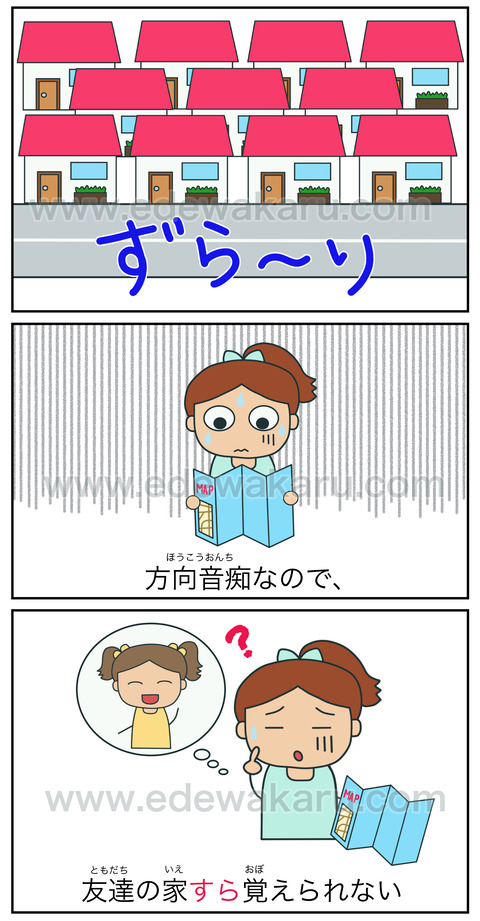
Explanation
「Aすら」 is a sentence pattern meaning “even A 〜” or “Even A 〜, so of course everything else 〜.” It is used when you give one extreme example and want to say “Even A 〜, so of course everything else is 〜.” 😊
[Examples]
I can’t even remember my friend’s house.
→ I can’t even remember my friend’s house, so of course I can’t remember other people’s houses.
Even though I’ve studied abroad in America, I can’t even manage everyday conversation.
→ I can’t even manage everyday conversation, so of course I can’t manage business English.
Even children know something like that.
→ Even children know it, so of course adults should know it.
「〜すら」 is an N1 pattern, but it is very similar to the N2 pattern 「〜さえ」, so I think it’s a good idea to learn them together. 😉
Read the original source text
Explanation
「Aすら」は「Aも〜」「Aも〜だから、他はもちろん〜」という意味を表す文型です。1つ極端な例をあげて、「Aも〜だから、他はもちろん〜だ」と言いたい時に使います😊
[例]
友達の家
すら
覚えられない
→友達の家
も
覚えられないの
だから、
他
の人の家
はもちろん
覚えられ
ない
アメリカに留学したことがあるのに、日常会話
すら
できない
→日常会話
も
できないの
だから、ビジネス英語
はもちろん
でき
ない
そんなこと、子供で
すら
知っているよ
→子供で
も
知っているの
だから、大人は
もちろん
知っていて当然だよ
「〜すら」はN1の文型ですが、N2の「〜さえ」にとてもよく似ていますので、一緒に覚えておくといいと思います😉
日本語文型辞典
Meaning
Basic information: Attaches to nouns and “noun + particle.” When attached to a subject, it often becomes “ですら.” A formal, written-style expression.
Means “さえ.” One example is singled out to say that even that is the case, implying that this is of course true of others as well. In ① it means “even children know it, let alone ordinary people.”
Means “さえ…ない.” A way of speaking that gives an extreme example and emphasizes that even that is impossible. In ③ it means “I can’t take any other day off, and I can’t even take Sunday off, when everyone else is off.”
How to use it
N (+ particle) すら
N (+ particle) すら…ない
In context 10 examples
そんなことは子供ですら知っている。
Even children know that.
むかし世話になった人の名前すら忘れてしまった。
I even forgot the name of someone who helped me in the past.
この寒さで、あの元気な加藤さんですら風邪を引いている。
In this cold, even the usually energetic Mr. Kato has caught a cold.
大企業はもちろんのこと、この辺の町工場ですら週休2日だという。
They say that not only large companies but even the small factories around here have a five-day workweek.
こういった確執はどんなにうまくいっている親子の間にすら存在する。
This kind of discord exists even between parent and child relationships that are going very well.
あまりに重すぎて、持ち上げることすらできない。
It is so heavy that I can’t even lift it.
そのことは親にすら言っていない。
I haven’t even told my parents about it.
仕事が忙しくて日曜日すら休めない。
I’m so busy with work that I can’t even take Sundays off.
40度の熱が出ている時ですら病院に行かなかった。
Even when I had a fever of 40 degrees, I didn’t go to the hospital.
入社してもう20年近くたったが、まだ課長ですらない。
I’ve been at the company for almost 20 years, but I’m not even a section chief yet.
Read the original source text
Meaning
基本情報説明名詞や「名詞+助詞」に付く。主格に付く時は、「ですら」になることが多い。かたい書きことば的な表現。
「さえ」の意味。一つの例をとりあげて、それでさえこうだということを述べ、その他はもちろんのことだという含みを持たせる。①は「ふつうのひとはもちろんのこと、子供でも知っている」の意味。
「さえ…ない」の意味。極端な例を出し、それができないことを強調する言い方。③は「ほかの曜日はもちろん休めないし、皆が休む日曜日も休めない」の意味。
How to use it
N(+助詞)すら
N(+助詞)すら…ない
日本語文型辞典 英語版
Meaning
【すら】Used with a noun or a noun + particle. When attached to a subject noun, it often changes to ですら. A formal expression with the feel of written language.
Means the same as さえ (even). Used by giving an example of something that is true even in the case of X, implying that it obviously holds true in other cases as well. Example
(1)
means “of course everyone knows that, even children.”
Means “not...even.” Used by giving an extreme example to emphasize that one can’t do something. Example
(3)
means “of course I can’t take time off work on other days of the week, and even on Sundays when everyone else is off, I can’t have a day off.”
How to use it
1. N(+ particle)すら
2. N(+ particle)すら...ない
In context 10 examples
そんなことは子供ですら知っている。
Even children know such a thing.
むかし世話になった人の名前すら忘れてしまった。
I can’t even remember the names of the people who helped me a long time ago.
この寒さで、あの元気な加藤さんですら風邪を引いている。
It’s so cold that even Kato-san, who’s usually very healthy, has a cold.
大企業はもちろんのこと、この辺の町工場ですら週休2日だという。
Even small-town factories in this area have two days off a week, not to mention large corporations.
こういった確執はどんなにうまくいっている親子の間にすら存在する。
This kind of discord can arise even between parents and children who are on good terms.
あまりに重すぎて、持ち上げることすらできない。
This is so heavy that I can’t even lift it.
そのことは親にすら言っていない。
I haven’t even told my parents about it.
仕事が忙しくて日曜日すら休めない。
I’m so busy at work that I can’t rest even on Sundays.
40度の熱が出ている時ですら病院に行かなかった。
I didn’t go to the hospital even when I had a forty-degree fever.
入社してもう20年近くたったが、まだ課長ですらない。
It’s been twenty years since I started working at this company, but I’m not even a section chief yet.
Read the original source text
Meaning
【すら】Used with a noun or a noun + particle. When attached to a subject noun, it often changes to ですら. A formal expression with the feel of written language.
Means the same as さえ (even). Used by giving an example of something that is true even in the case of X, implying that it obviously holds true in other cases as well. Example
(1)
means “of course everyone knows that, even children.”
Means “not...even.” Used by giving an extreme example to emphasize that one can’t do something. Example
(3)
means “of course I can’t take time off work on other days of the week, and even on Sundays when everyone else is off, I can’t have a day off.”
How to use it
1. N(+助詞)すら
2. N(+助詞)すら...ない
くらべてわかる日本語表現文型辞典
Meaning
An expression that gives A as an example and leads the listener to infer that since A is B, other things of the same kind as A are B too.
How to use it
A すら B (A (に・から・で・と・へ) すら B/A ようとすらしない)
[Verb—volitional form] + と + すら
[Noun—∅ (particle)] + すら
Explanation
【Contrast 1】
「A さえ B」(Meaning 1, p. 100)
「A すら B」 is an older expression than 「A さえ B」. They have the same meaning.
○事故後はショックのため、自分の名前さえ言えなかった。 — After the accident, the shock was so great that I couldn't even say my own name.
○事故後はショックのため、自分の名前すら言えなかった。 — After the accident, the shock was so great that I couldn't even say my own name.
「A だに B」(Meaning 1, p. 123)
Notes
【Note 1】
・The particle before 「すら」 changes depending on the verb that follows 「すら」.
In context 4 examples
彼は授業の予習はもちろん、宿題すらやってこない学生だ。
He is a student who not only doesn't prepare for class, but doesn't even do his homework.
これは小学生にすらわかる簡単な問題だ。
This is an easy problem that even an elementary school student can understand.
私は外国旅行どころか、国内旅行にすら行ったことがない。
Far from traveling abroad, I have never even traveled within the country.
父はどんなに体調が悪くなっても医者へ行こうとすらしない。
No matter how bad he feels, my father won't even try to go to the doctor.
Read the original source text
Meaning
Aを例としてあげ、そのAがBであるからA以外(Aと同種)のものもBだということを聞き手に推測させる表現。
How to use it
AすらB(A(に・から・で・と・へ)すらB/Aようとすらしない)
[動詞-意向形]+と+すら
[名詞-∅(助詞)]+すら
Explanation
【対比1】
「AさえB」(意味1 P.100)
「AすらB」は「AさえB」より古い表現。意味は同じ。
○事故後はショックのため、自分の名前さえ言えなかった。
○事故後はショックのため、自分の名前すら言えなかった。
「AだにB」(意味1 P.123)
Notes
【注意1】
・「すら」の前の助詞は、「すら」の後の動詞によって変わる。
毎日のんびり日本語教師
How to use it
Noun + (particle) + すら~ない
Verb te-form + すら~ない
Explanation
This grammar expresses a minimum standard.
In most cases, it is used for something bad.
It is characterized by conveying contempt or disregard for the subject, such as being unable to do even the bare minimum.
The following clause tends to be negative. (However, positive following clauses can also be found in the example sentences in this dictionary.)
Notes
Nothing in particular.
In context 12 examples
体調が悪くて水すら喉を通らない。(身体状况不好到连水都喝不下去。)
I feel so unwell that I can’t even swallow water.
謝りたいけど会ってすらくれなくなった。(想要道歉但是他连见一面都不肯。)
I want to apologize, but they won’t even meet with me anymore.
残業続きで寝る時間すら確保できない。
With all this overtime, I can’t even secure time to sleep.
本当に嫌いな奴には「嫌い」という言葉すら出ない。
When it comes to someone I truly hate, I can’t even bring myself to say the word “hate.”
眠くて足し算すらできない。(困得连加法都不会了。)
I’m so sleepy I can’t even do addition.
起きてからまだ着替えてもないし、顔も洗ってすらない。
I haven’t even gotten dressed since I woke up, and I haven’t even washed my face.
笑ってるところも可愛いが、怒っているところすら可愛い。
She’s cute when she smiles, but even when she’s angry, she’s cute.
私はスマホすら満足に使えない機械音痴だ。
I’m so bad with machines that I can’t even use a smartphone properly.
料理したことはないし、包丁すらも持ったことがない。
I’ve never cooked before, and I’ve never even held a kitchen knife.
冷静に話し合いすらできないようなら、交渉はできません。
If you can’t even discuss things calmly, then we can’t negotiate.
夢ですらモテない。(连做梦都不受欢迎。)
I’m not popular even in my dreams.
真面目にやっている人が損をするこの社会は、正直おかしいとすら思っている。
I even think it’s honestly wrong that we live in a society where people who work hard are the ones who lose out.
Read the original source text
How to use it
名詞+(助詞)+すら~ない
動て形+すら~ない
Explanation
最低限を表す文法です。
ほとんどの場合良くないことに用います。
最低限のことができない等、対象に対する蔑視や軽視の感情が含まれるのが特徴です。
後件には否定形が呼応する傾向があります。(ただし当辞書の例文にも肯定形の後件が見られます)
Notes
特になし