日本語文型辞典
Meaning
Used with verbs before and after it, indicating that the later action directly intervenes in the progress of the situation expressed by the preceding verb. The following verb is often one related to sight or discovery, such as 「見る」「見つける」「見つかる」「発見する」, or one related to stopping, capture, attack, or rescue, such as 「呼び止める」「捕まえる」「捕まる」「襲う」「助ける」. These verbs share the semantic feature of stopping or interrupting the preceding action or event.
Used as an expression of consideration for the other person's circumstances when asking them to do something unreasonable or inconveniencing them. It is often used as a preface, followed by a request, apology, or expression of gratitude. As in ⑥ and ⑦, the preceding matter may be referred to with a demonstrative in a form such as 「そこのところ」.
How to use it
Vところを…V
…ところ(を)
Nのところ(を)
Aところ(を)
R-ちゅうのところ(を)
In context 13 examples
お母さんは子供が遊んでいるところを家の窓から見ていた。
The mother was watching her child play from the window of the house.
こっそりタバコを吸っているところを先生に見つかった。
I was caught by the teacher secretly smoking.
駅前を歩いているところを警官に呼び止められた。
I was stopped by a police officer while walking in front of the station.
男は金庫からお金を盗み出そうとしているところを現行犯で逮捕された。
The man was arrested in the act while trying to steal money from the safe.
人々がぐっすり寝込んだところを突然の揺れが襲った。
A sudden tremor struck while everyone was fast asleep.
あやうく暴漢に襲われかけたところを見知らぬ男性に助けてもらった。
I was nearly attacked by a thug, but an unknown man came to my rescue.
お楽しみのところを恐縮ですが、ちょっとお時間を拝借できないでしょうか。
I'm sorry to interrupt your enjoyment, but could I borrow a little of your time?
ご多忙のところ、よくきてくださいました。
Thank you for coming despite your busy schedule.
お忙しいところを申し訳ありませんが、ちょっとお邪魔いたします。
I'm sorry to bother you when you're busy, but I'll just interrupt you for a moment.
お取り込み中のところを失礼します。
Excuse me for interrupting while you're in the middle of something.
お休み中のところをお電話してすみませんでした。
I'm sorry I called while you were resting.
難しいことは承知のうえですが、そこのところをちょっと無理して聞いていただけないでしょうか。
I know this is difficult, but could I ask you to make a little effort and hear me out?
A:最近ちょっと忙しくてB:そこんところを何とかよろしくお願いしますよ。
A: I've been a little busy lately. B: Please, I'm counting on you to do something about it.
Read the original source text
Meaning
前後に動詞を伴い、前の動詞によって表されている状況の進展に対して、直接的な働きかけを与えるような動作が後に続くことを表す。後続の動詞としては「見る」「見つける」「見つかる」「発見する」といった、視覚や発見の意味の動詞や、「呼び止める」「捕まえる」「捕まる」「襲う」「助ける」など、停止・捕捉・攻撃や救助といった意味のものが用いられる。これらは前の動作・出来事の進展を止めたりさえぎったりする意味上の共通点をもつものである。
相手に無理を言ったり、迷惑をかけたりするような場合に、相手の状況を配慮する表現として用いられる。前置き的に使われることが多く、依頼やおわび、感謝などの表現が後に続く。⑥⑦のように前のことがらを指示詞で受けて「そこのところ」のような形で用いられることもある。
How to use it
Vところを…V
…ところ(を)
Nのところ(を)
Aところ(を)
R-ちゅうのところ(を)
絵でわかる日本語
Usage 1
Read this source entry ↗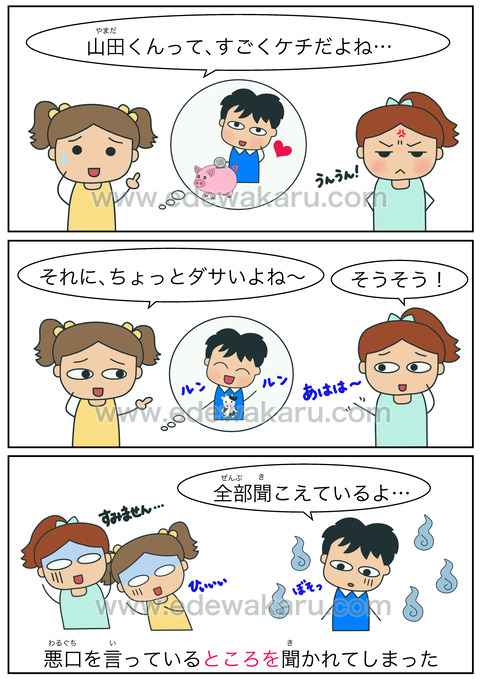
Meaning
A scene in which … is happening
It was a moment when … was happening, but …
How to use it
Verb[plain form]+ところを
Verb[ーている]+ところを
Verb[ーていた]+ところを
Explanation
“Aところを” is a sentence pattern meaning “B [happens] while A is happening” or “It was a time when A was happening, but B.” It is used to say “B happened unexpectedly while A was happening” or “B happened, unfortunately/fortunately, while A was in progress.” It is often used when something happens that prevents the preceding action from continuing.
[Examples]
悪口を言っている
ところを
聞かれてしまった
→Since the person heard me, I could no longer continue “speaking ill of them.”
カンニングしている
ところを
友達に見られた
→Since my friend saw me, I could no longer continue “cheating.”
警察は犯人が逃げようとしている
ところを
捕まえた
→Since the criminal was caught, they could no longer continue “trying to escape.”
“〜ところを” also has a usage that shows consideration for the other person’s circumstances, so learn that as well.
There are many sentence patterns that use “ところ,” so review them.
【List of “〇〇” series】
In context 5 examples
悪口を言っているところを聞かれてしまった
→悪口を言っている場面を、運悪く聞かれてしまったI was unfortunately overheard while speaking ill of someone. →I was unfortunately overheard in the middle of speaking ill of someone.
カンニングしているところを友達に見られた
→カンニングをしている場面を、運悪く友達に見られたMy friend saw me while I was cheating. →My friend unfortunately saw me in the middle of cheating.
お母さんは、子供たちが遊んでいるところをニコニコしながら見ていた
→子供たちが遊んでいる場面をニコニコしながら見ていたThe mother watched the children playing with a smile. →She watched the scene of the children playing with a smile.
困っているところを助けてもらった
→困っている場面を、運良く助けてもらったI was fortunately helped while I was in trouble. →I was fortunately helped in the middle of being in trouble.
警察は犯人が逃げようとしているところを捕まえた
→犯人が逃げようとしている場面を、運良く捕まえたThe police caught the criminal while they were trying to escape. →The police fortunately caught them in the middle of trying to escape.
Read the original source text
Meaning
〜ている場面を〜
〜ていた時だったが、〜
How to use it
動詞[普通形]+ところを
動詞[ーている]+ところを
動詞[ーていた]+ところを
Explanation
「Aところを」は「Aている場面をB」「Aていた時だったが、B」という意味の文型です。この文型は、「Aている時だったが、意外にもB」「Aている場面を、運悪くB/運良くB」と言いたい時に使われます。前の動作を続けられなくなるようなことが起こる時などによく使われます。
[例]
悪口を言っている
ところを
聞かれてしまった
→本人に聞かれたので、「悪口を言う」ことを続けられなくなった
カンニングしている
ところを
友達に見られた
→見られたので、「カンニング」を続けられなくなった
警察は犯人が逃げようとしている
ところを
捕まえた
→捕まったので、「逃げることを」を続けられなくなった
「〜ところを」には相手の状況を配慮する時に使われる用法もありますので、一緒に覚えておきましょう。
「ところ」がつく文型はたくさんありますので復習をしておきましょう。
【「〇〇シリーズ」リスト】
Usage 2
Read this source entry ↗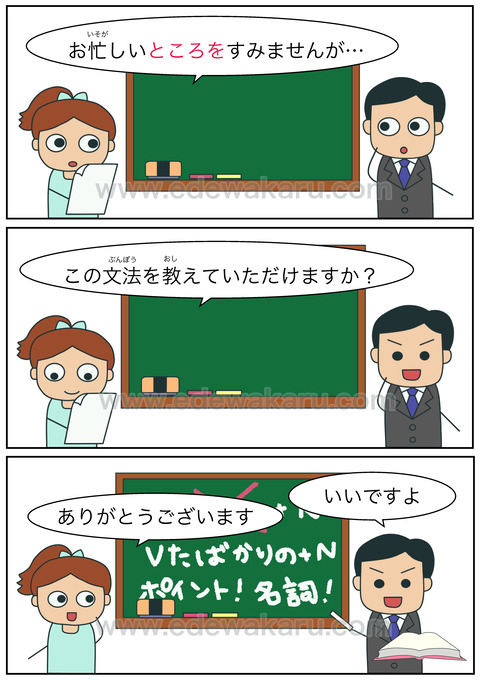
Meaning
Even though ~
Even though the situation is ~
How to use it
Verb [plain form] + ところ
Verb [ている] + ところ
Verb [ます-form] + 中のところ
い-adjective [dictionary form] + ところ
な-adjective [〜な] + ところ
Noun [dictionary form] + のところ
Explanation
“〜ところを” is a sentence pattern meaning “even though ~” or “even though the situation is ~.” It is often used when inconveniencing someone, and is followed by phrases of [apology], [gratitude], or [request]. In this usage, the を in “〜ところを” can be omitted.
① Student: I’m sorry to bother you when you’re busy, but could you teach me this grammar?
→I’m sorry to bother you when you’re busy, but could you teach me this grammar?
[Request]
② Thank you for coming today when you were busy.
→Thank you for coming even though you were busy.
[Gratitude]
③ We are very sorry that the train was delayed when you were in a hurry.
→We are sorry the train was delayed even though you were in a hurry.
[Apology]
④ I hate to bother you when you’re tired, but could you look this over?
→I hate to bother you when you’re tired, but could you look this over?
[Apology]
⑤ I’m sorry to bother you while you’re taking a break, but could you tell me where the meeting materials are?
→I’m sorry to bother you while you’re taking a break, but could you tell me where the materials are?
[Apology]
There is also the form “〜中のところを” 😀
[Examples]
I’m sorry to call while you’re resting.
I’m sorry to bother you while you’re enjoying yourself, but could I have a moment of your time?
It’s a good idea to remember common expressions using “〜ところを.”
[Common expressions]
・Thank you for taking the time when you’re busy.
・I’m sorry to bother you when you’re busy.
・Sorry to bother you, but…
・Thank you for taking the time when you’re busy.
“〜ところを” also has the meaning “someone/something in the middle of doing ~,” so remember that as well.
There are many sentence patterns containing “ところ,” so review them 😀
In context 5 examples
学生:お忙しいところをすみませんが、この文法を教えていただけますか?先生:いいですよ
Student: I’m sorry to bother you when you’re busy, but could you teach me this grammar? Teacher: Sure.
本日はお忙しいところ来ていただき、ありがとうございました
Thank you for coming today when you were busy.
お急ぎのところを電車が遅れてしまい、申し訳ございません
We are very sorry that the train was delayed when you were in a hurry.
お疲れのところを悪いんだけど、これに目を通してくれる?
I hate to bother you when you’re tired, but could you look this over?
休憩しているところを申し訳ないんだけど、会議の資料がどこにあるか教えてくれる?
I’m sorry to bother you while you’re taking a break, but could you tell me where the meeting materials are?
Read the original source text
Meaning
〜なのに
〜という状況なのに
How to use it
動詞[普通形]+ところ
動詞[ている]+ところ
動詞[ます形]+中のところ
い形容詞[辞書形]+ところ
な形容詞[ーな]+ところ
名詞[辞書形]+のところ
Explanation
「〜ところを」は「〜のに」「〜という状況なのに」という意味を表す文型です。この文型は、相手に迷惑をかけたりする場合などによく使われ、
後ろには【お詫び】【感謝】【依頼】などの文がきます。
この用法の場合は「〜ところを」の「を」を省略することができます。
①学生:お忙しい
ところを
すみませんが、この文法を教えていただけますか?
→お忙しいのにすみませんが、この文法を教えていただけますか?
【依頼】
②本日はお忙しい
ところ
来ていただき、ありがとうございました
→お忙しいのに来ていただき、ありがとうございました
【感謝】
③お急ぎの
ところを
電車が遅れてしまい、大変申し訳ございません
→お急ぎなのに電車が遅れてしまい、申し訳ございません
【お詫び】
④お疲れの
ところを
悪いんだけど、これに目を通してくれる?
→疲れているのに悪いんだけど、これに目を通してくれる?
【お詫び】
⑤休憩している
ところを
申し訳ないんだけど、会議の資料がどこにあるか教えてくれる?
→休憩しているのに申し訳無いんだけど、資料がどこにあるか教えてくれる?
【お詫び】
また、
この文型には「〜中のところを」という形もあります😀
[例]
お休み
中のところを
お電話してすみません
お楽しみ
中のところを
申し訳ありませんが、少しお時間をいただけますか?
この「〜ところを」はよく使われる形を覚えておくといいと思います。
[よく使われる形]
・〜ところをありがとうございます
・〜ところを申し訳ありません
・〜ところを悪いんだけど…
・〜ところをありがとうございます
「〜ところを」には「〜ている場面を」という意味もありますので、いっしょに覚えておきましょう。
「ところ」がつく文型はたくさんありますので、復習をしておきましょう😀
日本語NET JLPT文法解説まとめ
Meaning
“even though ... / despite being in the situation that ...”
An expression that takes the other person's situation into consideration.
How to use it
Plain form + ところ(を)
Explanation
"even though"
Expressions that take the other person's situation into consideration.
In context 4 examples
先生、お忙しいところすみません。ちょっと教えていただきたいことがあるんですが。
Teacher, I'm sorry to bother you when you're busy. There's something I'd like you to teach me.
田中くん、休んでいるところ悪いんだけど、この書類、誤字があったから訂正してくれる?
Tanaka, sorry to bother you while you're on break, but there are typos in these documents. Could you correct them?
本日はお忙しいところ、お時間を割いていただき、ありがとうございました。
Thank you for taking the time to meet with us today despite your busy schedule.
ただ今、人身事故による影響で電車が遅れております。お急ぎのところ申し訳ございません。
The train is currently delayed due to a personal injury accident. We apologize for the inconvenience when you're in a hurry.
Read the original source text
Meaning
”〜のに / 〜という状況なのに”
相手の状況を配慮した表現。
How to use it
普通形 + ところ(を)
Explanation
"even though"
Expressions that take the other person's situation into consideration.
毎日のんびり日本語教師
How to use it
Verb ta-form + ところを
Verb te-iru form + ところを
Explanation
This expresses an action in progress.
The following clause uses words such as 「見る」 (see), 「見つかる」 (be discovered), 「見つける」 (find), and 「発見する」 (discover), or describes something that stops the action in the first clause, using words such as 「捕まる」 (be caught), 「逮捕する」 (arrest), 「助ける」 (help), and 「呼び止める」 (call out to stop someone).
Notes
The 「ところ」 series
In context 8 examples
タバコを吸っているところを先生に見つかった。
I was caught by the teacher while I was smoking.
子どもが外を走り回っているところをずっと眺めていた。
I watched the children running around outside the whole time.
痴漢しているところをちょうど見ていたので、すぐに犯人を取り押さえた。
I happened to see him molesting someone, so I immediately pinned the perpetrator down.
歩いているところを警察に呼び止められた。(正在走路的时候被警察叫住了。)
I was stopped by the police while I was walking. (I was walking when the police called me over.)
困っているところを見知らぬ人に助けてもらった。
A stranger helped me when I was in trouble.
カバンに商品を入れるところを監視カメラは捉えていた。
The security camera captured the moment someone put merchandise into a bag.
店員に包丁を突きつけ金銭を要求していたところを、偶然居合わせた勇敢な客によって取り押さえられた。
He was subdued by a brave customer who happened to be there while he was pointing a kitchen knife at the clerk and demanding money.
女の人と一緒にいるところを彼女に見られた。(和女人在一起的时候被她看见了。)
She saw me while I was with a woman. (She saw me when I was with a woman.)
Read the original source text
How to use it
動た形+ところを
動ている形+ところを
Explanation
動作中を表します。
後件では「見る」「見つかる」「見つける」「発見する」などの語や、「捕まる」「逮捕する」「助ける」「呼び止める」など前件の動作を制止するような内容がきます。
Notes
「ところ」シリーズ
日本語文型辞典 英語版
Meaning
This pattern contains two verbs, with the second one denoting an action that exerts a direct effect on the development of the situation expressed by the first. The second verb is a verb of sight or discovery, such as 見る (see), 見つける (find), 見つかる (be found), or 発見する (discover), or a verb that denotes cessation, capture, attack, or rescue, such as 呼び止める (call to a halt), 捕まえる (catch/capture), 捕まる (be caught/be captured), 襲う (attack), or 助ける (save/help). These all share the meaning of halting or obstructing the development of the action or event denoted by the first verb.
B:そこんところを何とかよろしくお願いしますよ。
I know, but I still want to ask you to find some way to help me out.
Used by the speaker to express that s/he is taking the addressee’s situation into consideration when s/he is making a difficult or unreasonable request or causing inconvenience to the other person. Often used to preface requests, apologies, or expressions of gratitude. As in
(6)
and
(7)
, sometimes the previously-stated circumstances are referred to with a demonstrative, resulting in forms like そこのところ (regarding that point).
How to use it
1. Vところを...V
2. ...ところ(を)[Nのところ(を)][Aところ(を)][R-ちゅうのところ(を)]
In context 13 examples
お母さんは子供が遊んでいるところを家の窓から見ていた。
The mother was watching the children play, from the window of the house.
こっそりタバコを吸っているところを先生に見つかった。
I was sneaking a smoke when my teacher spotted me.
駅前を歩いているところを警官に呼び止められた。
She was walking in front of the station when she was stopped by the police.
男は金庫からお金を盗み出そうとしているところを現行犯で逮捕された。
Just as he was taking the money out of the safe, he was caught in the act and arrested.
人々がぐっすり寝込んだところを突然の揺れが襲った。
The people were sleeping soundly when all of a sudden there was a jolt.
あやうく暴漢に襲われかけたところを見知らぬ男性に助けてもらった。
Just as I was about to be assaulted by a thug, I got help from a man I had never seen before.
お楽しみのところを恐縮ですが、ちょっとお時間を拝借できないでしょうか。
I am sorry to disturb you while you’re having such a pleasant time, but could I please have a few moments of your time?
ご多忙のところ、よくきてくださいました。
Thank you so much for taking time out of your busy schedule to be here today.
お忙しいところを申し訳ありませんが、ちょっとお邪魔いたします。
I am very sorry to disturb you, but I’m going to have to interrupt.
お取り込み中のところを失礼します。
Please excuse me for intruding when you’re in the middle of something.
お休み中のところをお電話してすみませんでした。
I am sorry to be calling during your vacation.
難しいことは承知のうえですが、そこのところをちょっと無理して聞いていただけないでしょうか。
I am well aware of how difficult this is, but can’t I ask you to make a special effort to consider what I have to say?
A:最近ちょっと忙しくて...。
I am rather busy these days....
Read the original source text
Meaning
This pattern contains two verbs, with the second one denoting an action that exerts a direct effect on the development of the situation expressed by the first. The second verb is a verb of sight or discovery, such as 見る (see), 見つける (find), 見つかる (be found), or 発見する (discover), or a verb that denotes cessation, capture, attack, or rescue, such as 呼び止める (call to a halt), 捕まえる (catch/capture), 捕まる (be caught/be captured), 襲う (attack), or 助ける (save/help). These all share the meaning of halting or obstructing the development of the action or event denoted by the first verb.
B:そこんところを何とかよろしくお願いしますよ。
I know, but I still want to ask you to find some way to help me out.
Used by the speaker to express that s/he is taking the addressee’s situation into consideration when s/he is making a difficult or unreasonable request or causing inconvenience to the other person. Often used to preface requests, apologies, or expressions of gratitude. As in
(6)
and
(7)
, sometimes the previously-stated circumstances are referred to with a demonstrative, resulting in forms like そこのところ (regarding that point).
How to use it
1. Vところを...V
2. ...ところ(を)[Nのところ(を)][Aところ(を)][R-ちゅうのところ(を)]
AIUEO JLPT Grammar
Meaning
This sentence pattern expresses that, during a particular action or state, another event or action happens at the same time. It is often used in contexts such as gratitude, apology, or requests, and is typically used in interactions with others.
How to use it
Verb dictionary form + ところを; verb ta-form + ところを; verb te-form + いる + ところを
In context 5 examples
お忙しいところ、お時間をいただきありがとうございます。
Thank you for taking the time even though you are busy.
お休みのところ、わざわざ来ていただき恐縮です。
I’m sorry for making you come all the way here during your break.
急いでいるところを、わざわざ立ち寄っていただいてありがとうございます。
Thank you for stopping by even though you were in a hurry.
彼は映画を観ていたところを、急な仕事で呼び出された。
He was watching a movie when he was called away on urgent business.
彼は勉強していたところを、友達に誘われて外に出かけた。
He was studying when his friend invited him to go out.
Read the original source text
Meaning
This sentence pattern expresses that, during a particular action or state, another event or action happens at the same time. It is often used in contexts such as gratitude, apology, or requests, and is typically used in interactions with others.
How to use it
動詞辞書形+ところを動詞た形+ところを動詞て形+いる+ところを
Explanation · 日本語
この文型は、ある行動や状態が行われている最中や、そのタイミングで別の行動や出来事が発生することを表す表現です。多くの場合、相手の行動や状況に言及するときに使われ、感謝や謝罪、依頼などの文脈で用いられることが多いです。
Bunpro Grammar Reference
Meaning
When, While, In spite of (the circumstances), Regardless of (the circumstances)
How to use it
Verb + ところ(を)
[い]Adjective + ところ(を)
[な]Adjective + な + ところ(を)
Noun + の + ところ(を)
Nuance
A formal, polite construction, showing that the situation or place of (A) is something the speaker is intruding on. In spite of (A), (B).
Explanation
Being a combination of the noun ところ 'place' or 'situation', and the adverbial particle を, ところを is a grammar construction that will be used in order to express 2 primary meanings. The first is 'in spite of (A)', or 'regardless of (A)'. This nuance of ところ will be that the speaker is politely acknowledging the situation that someone else is in, and apologizing for interrupting them in that moment.
ところを may come after any structure that could pair with a noun. This means verbs in their standard forms, い-Adjectives, な-Adjectives followed by な, or nouns followed by の.
先輩、休んでいるところを申し訳ないんですけど、エクセルの使い方を教えてください。
Senpai, I'm sorry to bother you while you are on vacation, but could you please teach me how to use Excel?
お忙しいところをすみませんが、相談したいことがあるので少しだけお時間よろしいですか。
I am sorry to bother you while you are busy, but I want some advice. May I have some of your time?
ご多忙なところをご対応いただきありがとうございました。
Thank you for taking time out in spite of you being busy.
お急ぎのところを恐縮ですが、何時ぐらいに向こうに着くか教えてもらってもよろしいでしょうか。
I'm sorry to bother you when you are in a hurry, but may I ask what time you expect to arrive over there?
The second meaning that ところを is often used for will simply be 'when (A)', or 'at the time of (A)', with a focus on being a situation in which the action of (A) is interrupted by (B). This may have either a positive or negative nuance.
This use of ところを will appear exclusively after verbs in any of their standard forms.
警察に逃げるところを目撃された。
I was seen by the police while I was fleeing.
母に悪戯をしているところを見られてしまった。
My mother caught me while I was playing a prank.
彼は強盗をしていたところを周りの人に目撃されていたので、どこにも逃げられなかった。
Since he was seen when he was robbing the store, he had nowhere to run.
The を itself may be omitted when used to express either of these meanings.
Fun Fact
ところを is occasionally split into two different grammar points depending on the source. However, it is important to remember that the underlying meaning of both of these is the same. ところ marks the place or situation, while を marks how that situation is being utilized either positively or negatively. When it comes to apologizing, the speaker themselves is the one 'using' that moment with を, and is therefore acknowledging that.
In context 19 examples
- 先生からの返信のお礼を言う:「お忙しいところ、ご返信ありがとうございます。」
Expressing gratitude to a teacher for their reply: 'In spite of being busy, thank you for your reply.'
- 先輩、休んでいるところを申し訳ないんですけど、エクセルの使い方を教えてください。
Senpai, I'm sorry to bother you while you are on vacation, but could you please teach me how to use Excel?
- お忙しいところをすみませんが、相談したいことがあるので少しだけお時間よろしいですか。
I am sorry to bother you while you are busy, but I want some advice. May I have some of your time?
- ご多忙なところをご対応いただきありがとうございました。
Thank you for taking time out in spite of you being busy.
- 警察に逃げるところを目撃された。
I was seen by the police while I was fleeing.
- 彼は強盗をしていたところを周りの人に目撃されていたので、どこにも逃げられなかった。
Since he was seen when he was robbing the store, he had nowhere to run.
- 母に悪戯をしているところを見られてしまった。
My mother caught me while I was playing a prank.
- お急ぎのところを恐縮ですが、何時ぐらいに向こうに着くか教えてもらってもよろしいでしょうか。
I'm sorry to bother you when you are in a hurry, but may I ask what time you expect to arrive over there?
- 目上の人に尋ねる:「お急ぎのところ恐縮ですが、このプロジェクトについてのご意見をお聞かせ願えませんか。」
Asking a superior: 'I hate to trouble you when you are in such a hurry, but could you let me hear your opinion about this project?' (in spite of)
- メール:「ご病気中のところ恐れ入りますが、田中先生の携帯の番号を教えていただけますでしょうか。」
Email: 'I am awfully sorry to trouble you when you are ill, but could you tell me Mr. Tanaka's cell number?' (in spite of)
- 駅の放送:「この電車は、三分遅れて到着いたします。お急ぎのところ、ご迷惑をおかけいたします。」
Station announcement: 'This train will arrive three minutes late. We apologize for the inconvenience while you are in a rush.' (in spite of)
- 会議での冒頭の挨拶:「皆様、本日はご多忙のところお越しいただき、ありがとうございます。」
Greetings on the outset of a conference: 'Ladies and gentlemen, thank you very much for coming today despite being so busy.' (in spite of)
- 容疑者:「コロンボ警部、仕事中ですが・・・」
コロンボ警部:「そこのところ、もうすこしお話していただけませんか?」Suspect: 'Inspector Columbo, I am in the middle of work…' Inspector Columbo: 'Despite that, would you mind speaking with me a little further?' (in spite of)
- お楽しみのところ邪魔して申し訳ありませんが、何が原因で笑っているのですか?
I apologize for being a bother while you're having fun, but what's the cause of your laughter?
- お取り込み中のところ失礼だけど、何を必死になって望遠鏡を覗き込んでいるの?
Sorry for the impoliteness while you're in the middle of it, but why are you so frantically peering through your telescope?
- お休みのところを申し訳ございませんが、少々お話を聞いてもらっても良いですか?
I apologize for interrupting in spite of you resting, but do you mind if I have you tell me something quickly?
- 店長「お暑いところをこちらまでご来店頂き、誠に有難う御座います。」
Store manager: 'Thank you so terribly much for visiting this store when it is so hot!'
- ご多忙のところ恐縮ですが、私が先ほど言った件について考えてくれましたでしょうか?
I am being ashamed to interrupt you while you are busy, but I wonder if you have had time to consider the matter I spoke to you about some time ago?
- お忙しいところわざわざ私のために駅まで会いにきてくれて、本当に有難うね!
Expressly coming to the station to meet me while you are busy, thank you so much, really!
NINJAL 日本語文型データベース
Usage 1
Meaning
Used when you want to say that an action occurs which directly affects the situation “〜” in a sequence of actions or events.
When “〜” is in the dictionary form, it indicates the point just before the action or change “〜.”
In the ta-form, it indicates just after the action or change “〜” has been completed.
In the 「〜ている」 form, it indicates that the action or event “〜” is in progress at that point.
In the 「〜ていた」 form, it indicates that the action or event “〜” had been in progress up to that point.
How to use it
Vるところを・Vているところを・Vたところを・Vていたところを
Notes
The clause after 「〜ところを」 takes a verb sentence that uses 「を」 to indicate the object. It uses verbs relating to sight or discovery, such as 「見る・発見する」 (see, discover), or verbs that stop a situation, such as 「捕まえる・助ける・襲う」 (catch, rescue, attack).
In context 8 examples
コンビニで、客の男が棚の商品をこっそり自分のバッグに入れるところを見てしまった。
At a convenience store, I saw a male customer secretly put an item from the shelf into his bag.
コップが危うくテーブルから滑り落ちるところを慌てて押さえた。
I hurriedly caught the cup just as it was about to slide off the table.
この男性は腹痛のため道でうずくまっているところを通りかがりの人に発見され、病院に運ばれた。
This man was found by a passerby crouching on the road because of abdominal pain, and was taken to the hospital.
夜遅く駅から家に向かって歩いているところを暴漢に襲われそうになった。
I was nearly attacked by a thug while walking home from the station late at night.
たばこの吸い殻を道に捨てたところを見つかって、注意された。
I was caught throwing a cigarette butt onto the road and was reprimanded.
子猫が川に落ちたところを通りかかった人が救出した。
A person passing by rescued a kitten just as it fell into the river.
休日の朝、気持ちよく寝ていたところを子どもに起こされた。
On a holiday morning, my child woke me up while I was sleeping comfortably.
その俳優は、新しい恋人と会っていたところを写真に撮られた。
That actor was photographed while meeting with a new lover.
Read the original source text
Meaning
一連の動作・出来事の流れの中で、〜の状況に直接働きかけるような動作が生じると言いたいときに使います。
「〜」が動詞の辞書形の場合、~の動作・変化の直前の時点であることを表します。
タ形の場合、〜の動作・変化の完了直後であることを表します。
「〜ている」の形の場合、その時点で~の動作・出来事が進行中であることを表します。
「〜ていた」の形の場合、その時点まで〜の動作・出来事が進行中だったことを表します。
How to use it
Vるところを・Vているところを・Vたところを・Vていたところを
Notes
「〜ところを」の後には、対象を表す「を」を使う動詞の文がきます。「見る・発見する」など、視覚・発見の意味の動詞や「捕まえる・助ける・襲う」など、状況を止める意味の動詞を使います。
Usage 2
Meaning
Expresses doing something contrary to a certain situation, or entering a state that contradicts it. It is also often used in situations where the speaker is being considerate about inconveniencing someone.
How to use it
V plain form + ところを
i-A plain form + ところを
na-A plain form + ところを (however, 「na-Aだ」 becomes 「na-Aな+ところを・na-Aである+ところを」)
N plain form + ところを (however, 「Nだ」 becomes 「Nの+ところを・Nである+ところを」)
Notes
When expressing consideration for inconveniencing someone, “〜” often describes a situation involving the other person, and an expression of thanks or apology often follows 「〜ところを」.
In context 19 examples
うちから駅までいつもなら歩いていくところを、今日は時間がなかったのでバスに乗った。
I usually walk from home to the station, but today I took the bus because I didn’t have time.
今回の旅行ではどうしても見たいところがたくさんあって、日程に余裕がないところをなんとかつめこんだ。
There were many places I absolutely wanted to see on this trip, so I somehow squeezed them into an already tight schedule.
庭の花がせっかくきれいに咲きそろっていたところを、台風がめちゃめちゃに荒らしていった。
The typhoon wreaked havoc on the garden flowers just as they had finally all bloomed beautifully.
個人の力では解決できなかったところを、皆さんのご協力で乗り切ることができました。
We wouldn’t have been able to solve it on our own, but thanks to everyone’s cooperation, we managed to get through it.
本日はお忙しいところを多数お集まりいただき、誠にありがとうございます。
Thank you very much for gathering in such large numbers today despite your busy schedules.
このワインは生産量があまり多くないところを、特別に数量限定で入荷いたしました。この機会にぜひご賞味ください。
This wine is produced in limited quantities, but we have managed to obtain a special, limited-number shipment. Please take this opportunity to try it.
期日までの納品が難しかったところを、同僚たちが手伝ってくれてなんとか間に合った。
It was difficult to deliver by the deadline, but my colleagues helped, and we just managed to make it in time.
数学の成績がよくなかったところを、先輩のアドバイスで改善でき、無事志望校に合格しました。
My poor math grades improved with advice from a senior student, and I was able to get into the school I wanted.
父は病後の回復が不十分なところを、今日は無理して出勤したらしい。心配だ。
Apparently, my father went to work today despite not having fully recovered from his illness. I’m worried.
上司の指示に従っていれば無難であるところを、どうしても正しいと思えず反論してしまった。
I would have been better off following my supervisor’s instructions, but I just couldn’t believe they were right, so I argued back.
工事が順調だったところを、突然工事差し止めの指示が出された。何がどうなっているのか。
Just as the construction work was progressing smoothly, an order to halt it suddenly came down. What on earth is going on?
うちの会社は外国からの原材料導入にあまり積極的でなかったところを、最近、急に方向転換しようとしている。
Our company had not been very proactive about bringing in raw materials from overseas, but recently it has suddenly been trying to change course.
休日でお休みのところを、仕事の話でお邪魔してしまい失礼しました。
I’m sorry to have intruded with work matters when you were taking the day off.
ご多忙のところを大変丁寧に説明してくださって、ありがとうございました。
Thank you very much for explaining everything so carefully despite being so busy.
レシピではしょうゆが大さじ2のところを、間違えて大さじ3入れてしまった。
The recipe called for two tablespoons of soy sauce, but I accidentally added three.
下記の商品の賞味期限につきまして、正しくは2025年10月であるところを、誤って2024年10月と表記しておりました。
Regarding the expiration date of the product listed below, it should have been October 2025, but we mistakenly labeled it October 2024.
山本部長には、本来のご担当業務ではないところをお力添えいただき、誠に恐縮しております。
I am truly grateful to Department Head Yamamoto for lending me your support even though this is not part of your usual responsibilities.
手首の痛みが、どこの病院でもお手上げだったところを、この病院で診てもらって、すぐに完治した。
Hospitals everywhere had given up on treating my wrist pain, but after I was seen at this hospital, it was completely cured right away.
このソファはとても古いもので、ぼろぼろで使える状態ではなかったところを、布を張り替え、修理をして、蘇らせたのです。
This sofa was very old, so worn out that it was unusable, but we reupholstered and repaired it, bringing it back to life.
Read the original source text
Meaning
〜という状況があるのに、それに反する行動をすること、反する状態になることを表します。相手に迷惑がかかることへの気遣いを表す場面でもよく使います。
How to use it
V普通形+ところを
i-A普通形+ところを
na-A普通形+ところを(ただし、「na-Aだ」→「na-Aな+ところを・na-Aである+ところを」)
N普通形+ところを(ただし、「Nだ」→「Nの+ところを・Nである+ところを」)
Notes
相手に迷惑がかかることへの気遣いを表す場合、「〜」には相手に関係する状況を表す言葉、「〜ところを」の後にはお礼やおわびの表現がくることが多いです。
どんなときどう使う 日本語表現文型辞典
Meaning
even though
How to use it
〔plain form〕(ナAな/Nの)+ところを
Explanation
~のに/~だったのに
「~という状況なのに…した」と言いたいとき、相手の状況を配慮した表現。あいさつで、感謝の言葉を言うときの慣用的な表現が多い。「お休みのところを・ご多忙のところを」など。
Shows consideration for other party's situation and that speaker has done something regardless of that situation. Often used idiomatically in greetings to show gratitude. Also seen in お休みのところを, ご多忙のところを, etc.
In context 3 examples
お忙しいところをご出席くださり、ありがとうございました。
Thank you for attending despite being so busy.
黙っていてもいいところを彼は「わたしがやりました」と自分から正直に言った。
He could have kept quiet, but he honestly said of his own accord, “I did it.”
お疲れのところを、わざわざおいでくださり恐縮しております。
I’m grateful that you went out of your way to come despite being tired.
Read the original source text
Meaning
even though
How to use it
〔普通形〕(ナAな/Nの)+ところを
Explanation
~のに/~だったのに
「~という状況なのに…した」と言いたいとき、相手の状況を配慮した表現。あいさつで、感謝の言葉を言うときの慣用的な表現が多い。「お休みのところを・ご多忙のところを」など。
Shows consideration for other party's situation and that speaker has done something regardless of that situation. Often used idiomatically in greetings to show gratitude. Also seen in お休みのところを, ご多忙のところを, etc.