文法
Meaning
Means “because”; it is a formal, literary expression. It can also be used at the beginning of a sentence as a conjunction.
How to use it
Plain form + ゆえに
In context 5 examples
発展途上国では貧しさのゆえに、子供でも働かなければならないところもある。
Because of poverty, there are places in developing countries where even children have to work.
新しい職場では慣れぬゆえ、失敗することが多いです。
Because I’m not used to my new workplace, I often make mistakes.
日本語は経済大国であるゆえに、外国から働きに来る人も多い。
Because Japan is an economic powerhouse, many people also come from abroad to work there.
私が事業の問題点を指摘してしまったゆえに、対策を考えなければならなくなった。
Because I pointed out the problems with the business, I ended up having to think of countermeasures.
我思う、ゆえに我あり。
I think, therefore I am.
Read the original source text
Meaning
〜のために硬い表現で文語的である。接続詞として文頭に使うこともできる。
How to use it
普通形 + ゆえに
日本語NET JLPT文法解説まとめ
Meaning
because of ~
This is a formal, literary expression. It can also be used at the beginning of a sentence as a conjunction.
How to use it
Plain form + ゆえに
Explanation
on account of
In context 5 examples
発展途上国では貧しさのゆえに、子供でも働かなければならないところもある。
Because of poverty, there are places in developing countries where even children have to work.
新しい職場では慣れぬゆえ、失敗することが多いです。
Because I’m not used to my new workplace, I often make mistakes.
日本は経済大国であるゆえに、外国から働きに来る人も多い。
Because Japan is an economic power, many people also come from abroad to work there.
私が事業の問題点を指摘してしまったゆえに、対策を考えなければならなくなった。
Because I pointed out the problems with the business, I ended up having to think of countermeasures.
我思う、ゆえに我あり。
I think, therefore I am.
Read the original source text
Meaning
〜のために
硬い表現で文語的である。接続詞として文頭に使うこともできる。
How to use it
普通形 + ゆえに
Explanation
on account of
IMABI
~故, 所以, 謂れ, & 由
Read this IMABI lesson ↗Explanation
~故, 所以, 謂れ, & 由
This lesson largely revolves around the word ゆえ1, which is a JLPT N1 vocabulary word which serves a grammatical function of denoting reason, much like other words such as ため but, of course, with its own flare.
While we are at it, we will then divert our attention to the etymologically related ゆえん as well as other seldom used synonyms for denoting reason, those being 謂れ and 由.
The Noun 故
As a standalone noun, the most basic understanding of the word 故 is “reason,” predating the use of the word 理由 as its native equivalent. In Modern Japanese, it is still capable of being used in said capacity, albeit in set phrases.
1. 故あって同行どうこうすることになった。
We are to accompany each other owing to (unavoidable) circumstances.
2. 私だって故ない侮辱ぶじょくは致しませんよ。
I would never make a senseless insult.
3. そう批判ひはんされるのも故無しとしない。
Being criticized in that matter is not without its reason.
4. 地ちは何なんの故ゆえを以って東南とうなんに傾かたむくや。
Wherefore doth the Earth tilteth to the southeast?
5. その故ゆえありげな美うつくしい姿すがた、この世よのものではないようにも思おもえる。
That suggestive, beautiful appearance, it seems as if it’s not of this world.
In addition to meaning “reason,” 故 also has the meaning of “history” as in “having a distinguished background,” which could also be interpreted as reasons for being respected.
6. 故ある家の出
Member of a prestigious family
~(が)ゆえに
Following dependent clauses, ~(が)ゆえに appears almost exclusively in the written language, where it still remains quite old-fashioned yet highly formal, to denote reason much in the same way ~ため does in typical speech.
With ~(が)ゆえに following predicates, how it connects to each kind is fairly straightforward, but there are options.
Nominal Predicates語幹 + ゆえ(に)
語幹 + がゆえに
語幹 + のゆえに
語幹 + である(が)ゆえに
Adjectival Predicates連体形 + (が)ゆえに
Adjectival Noun Predicates語幹 +(が)ゆえに
語幹 + なゆえに
語幹 + である(が)ゆえに
Verbal Predicates連体形 + (が)ゆえに
As is evident from the chart, how the modifying predicate actually attaches to ゆえ itself fluctuates between several competing methods, each with its own degree of “archaic” tonality which the speaker/writer may choose to emulate.
The case particles が and の competed as equally viable attribute markers in Classical Japanese. As the latter won out in Modern Japanese, barring a handful of exceptions such as 我が, the use of ~が故 is deemed more old-fashioned, which ironically makes it the more common option for all predicate types.
The option of attaching 故 directly to the root of nouns/adjectives, bypassing the intervention of the attribute markers が・の as well as the copula な(る2)・である, is also available. This grammar is also quite archaic, but is ironically quite commonly used in modernity when a speaker/writer feels like using it.
Having ~が故に follow the 連体形 of adjectival/verbal predicates is a holdover from 漢文訓読, kanbun directly translated into Japanese. In this style of writing, Chinese syntax was preserved as much as possible, and while the 連体形 alone suffices to denote a modifier, ~が・の were frequently in between adjectival/verbal predicates and the modified noun despite being otherwise ungrammatical in vernacular speech.
While not listed, ~ます(が)ゆえ is also possible for verbal predicates, which, incidentally, is proof of how marking politeness in dependent clauses is far from being a modern neologism.
The dropping of the purpose marker に is limited in practice3 to when ~ゆえ directly attaches to nouns. However, when the nominalizer こと intervenes (see ことゆえ below), the ellipsis of に becomes obligatory.
~(が)ゆえに is possible with dependent clauses in the non-past and past.
As for the unique relationship that ~(が)ゆえに denotes, the resultant scenario detailed in the main clause is one that the speaker deems to be atypical in a negative way, often implying regret, self-derision, contempt, etc., but without lowering its highly formal tone. As such, the speaker still maintains a level-headed approach to the circumstance, nonetheless, which is how it may also be used in objective contexts. In academic settings, for instance, its typical “negative” appeal is largely nonexistent, instead used identically to “therefore.”
7. 未熟者みじゅくものゆえお許ゆるしください。
Please forgive me, for I am a novice.
The inexperience of the speaker has resulted in some unexpected result, a mistake no doubt, which is the reasoning for why the listener ought to forgive them.
8. 女おんなであるがゆえに受うける差別さべつの構造こうぞうを知しれば、もっと楽らくになると思おもい込こんでいる女性じょせいたちがいる。
There are women who are (incorrectly) convinced that things will get easier so long as they know about the framework of discrimination that they receive for being women.
9. 女おんなであるゆえに父親ちちおやの財産ざいさんを相続そうぞくできず貧まずしい暮くらしを強しいられる。
She is compelled to live in poverty, unable to inherit her father’s fortune, for being a woman.
In both Exs. 8 and 9, the writer is lamenting the fact that womanhood brings about the scenarios being described, and more likely than not, the writer is also a woman, in which case her partiality on the matter is felt regarding the unfair outcomes.
10. その美貌びぼうと若わかさのゆえに、誤あやまったイメージをもたれているように思おもわれる。
Because of her youth and beauty, there is an incorrect image of her.
11. 若わかいがゆえに悪性あくせいの病気びょうきであるとは思おもいもよらなかった。
Due to my being young, the thought of having a bad disease was inconceivable.
12. 男おとこゆえに敵てきが多おおい。
My enemies I do have for being a man.
13. 愛あいゆえに人ひとは苦くるしまねばならぬ。
For love people must suffer.
14. こういう静しずかなイケメンは、静しずかであるがゆえに、 多おおくの女性じょせいが見落みおとしている。
It is this kind of quiet good-looking guy that many women overlook due to his being quiet.
15. 生いき急いそぐゆえに”死し“が接近せっきんしていることに気きづかない。
It is because we live fast that we do not notice “death” approaching.
16. アライグマは、野生動物やせいどうぶつであるがゆえに、捕獲ほかくや事故じこを免まぬがれ、成獣せいじゅうになれる確率かくりつは極きわめて低ひくい。
Raccoons, because they are wild animals, have an extremely low probability of evading capture and accidents and becoming adults.
17. 離婚りこんが増ふえたがゆえに再婚さいこんも増ふえているという現実げんじつはあるが、だからといって誰だれもが簡単かんたんに次つぎの結婚けっこんを決きめられるわけではない。
Although there is the reality that remarrying is on the rise due to divorce having risen, it is not the case nonetheless that anyone can easily decide one’s next marriage.
18. それだけに、聡明そうめいなゆえに何なにかしらの違和感いわかんを持もちつつ毎日まいにちを過すごされているのでしょう。
For that reason alone, because you are wise, I’m sure you spend each feeling out of place somehow.
19. 日本にほんは、島国しまぐに(の)ゆえに他ほかから大おおきな侵略しんりゃくも受うけず、従したがって滅ほろびるかどうかという深刻しんこくな試練しれんにも遭あわずに生いきてこられた国こくである。
Japan, as a result of being an island nation, is a country that hasn’t ever sustained a large invasion from the outside, and as a result has lived without facing the serious tribulation of perishing.
20. 受うけ継ついだ罪つみのゆえに人ひとの心こころは弱よわく信仰しんこうが欠かけてしまう。
It is because of the sin man has inherited that the heart is weak and also why one’s faith is lacking.
21. 伝説でんせつの魔獣まじゅう(である)がゆえに、制御せいぎょできぬのである。
One cannot control it for it is a legendary beast.
22. 正義せいぎと愛あいがゆえに闘たたかう。
To fight for justice and love.
23. 糸いとが美うつくしいゆえに、その刺繍ししゅうは美うつくしい。
The embroidery is beautiful by virtue of the thread being beautiful.
24. 美少女びしょうじょは、美うつくしいがゆえに、悲惨ひさんな思おもいをすることがある。
Beautiful girls often experience tragedy owing to their beauty.
25. 美うつくしさゆえに愛あいするのなら、私わたしを愛あいさないでおくれよ。
If you are to love me by reason of my beauty, please do not live me.
As for when に ellipsis does occur with verbal/adjectival predicates, the speaker/writer is attempting to add objectivity to their otherwise subjective summation of the situation at hand.
26. 『日本』出身記者たちが民本主義を支持したのは、陸羯南の、国民の幸福によって日本の独自の文明的利点が保持されることによる世界文明への貢献という究極的な目標の達成ために、国家の独立と国民の統一とその手段としての政党内閣制を説いた国民主義を共有するがゆえ、政治の目的を国民の幸福とし、そのための国民の政治参加を説いた民本主義に共感したためであった。
Journalists from “Japan” supported “Minpon Shugi4,” identifying with the “Minpon Shugi” touted by Kuga Katsunan, which advocated that, to achieve the ultimate goal of contributing to world civilization by the maintaining of Japan’s unique cultural pros through the happiness of its people, since it shared the nationalistic stance of calling for national independence and national unity with a parliamentary cabinet system to that end, the happiness of the people would be the goal of politics and the participation of the people in said politics would achieve that aim.
From『大衆社会化と知識人』by 古川江里子
This objective-like representation of an otherwise subjective statement also affects how それゆえ(に) is used. In either case, それゆえ(に)translates to “therefore,” appearing as a conjunction at the start of a sentence, with それ standing for the aforementioned situation that provides the reason for its main clause. In Ex. 27 is an objective statement of reality, while Exs. 28-31 are technically subjective statements that are being presented in the utmost formal means possible, and it is this appeal to formal, objective-leaning speech that prompts the ellipsis of に.
27. 日本は、島国である。それゆえに、大陸の文化の影響を受けつつも、日本独自の文化が大きく発展していった。
Japan is an island nation. Therefore, Japan’s distinctive culture has developed significantly while also receiving influence from the cultures of mainland (Asia).
28. 人生において、成功するためには、自分がやりたいことをやり続けることが大切です。それゆえ、自分が本当にやりたいことを見つけることが重要です。
To succeed in life, it is important to continue doing what you want to do. Therefore, it is important to find out what it is that you truly want to do.
29. 長期的には、経済を安定させ、復興を果たすことが課題となるでしょう。それゆえ、我々は、長期復興計画には、経済をより耐性があり、包摂的で、低炭素な、持続可能なものとする施策が含まれるべきだと考えます。
In the long term, the challenge will be to stabilize the economy and achieve recovery; therefore, (we) believe that long-term recovery plans should include measures to make the economy more resilient, inclusive, low-carbon, and sustainable.
30. それゆえ、履歴書上りれきしょうえに、これまでの仕事しごとに関係かんけいするとは思おもえない脈絡みゃくらくのない資格しかくや免許めんきょが列挙れっきょされていたら、プラスになるどころか、マイナスにすらなりかねないのです。
Therefore, having a list of qualifications and licenses with seemingly no logical connection to the jobs you’ve had up to that point on your resume is likely to be a negative rather than a positive.
31. それゆえ男おとこはその父母ふぼを離はなれ、妻つまと結むすび合あい、二人ふたりは一体いったいとなるのである。
Therefore, shall a man leave his father and mother, and shall cleave unto his wife: and they shall be one flesh.
Incidentally, when ゆえに without それ begins as a sentence as a conjunction, に ellipsis is not possible. Resultant sentences are highly objective and also methodical, lending to its high frequency in papers.
32. 3角形ABCは2つの辺が等しい。ゆえに二等辺三角形である。
The triangle ABC has two equal sides. Therefore, it is an isosceles triangle.
33. 我思われおもう。故ゆえに、我わがあり。
I think. Therefore, I am.
34. 日本にっぽんの風景ふうけいは美うつくしい。ゆえに、日本にっぽんの歌うたは美うつくしい。
Japanese landscape is beautiful. Therefore, Japanese songs are beautiful.
The impetus to be more formal also explains how に ellipsis is practically obligatory when ~ゆえ follows the politeness marker ~ます, resulting in ~ますゆえ.
35. 以後充分いごじゅうぶんに気きをつけますゆえ、お許ゆるし下くださいまし。(近代日本語)
As I will pay attention moving forward, I ask that you please forgive me.
36. これを機会きかいに、役社員一同新やくしゃいんいちどうあらたな気持きもちで社業発展しゃぎょうはってんに全力ぜんりょくを尽つくす所存しょぞんでございますゆえ、何卒なにとぞご高承こうしょうの上うえ、より一層いっそうのご厚誼こうぎを賜たまわりますようお願ねがい申し上げます。
With this opportunity, we intend to do our utmost in the company’s development with a new sense of unity with all executive staff and works. As such, upon your kind affirmation, we ask that you bestow us with more of your kindness and support.
37. 年々様々ねんねんさまざまな食材しょくざいの値段ねだんが高騰こうとうする状況じょうきょうが続つづいておりますゆえ、全体的ぜんたいてきな価格かかくの見直みなおしをせざるをえない状況じょうきょうとなっております。
Due to the continued state of the prices of various foodstuffs steeply rising year by year, we are compelled to do an overall price revision.
~ことゆえ
Oddly enough, 事故 meaning “incident/accident” has a native equivalent, that being ことゆえ. This word explicitly conjures up the negative, atypical result that is so often the case with ~(が)ゆえに, as we have learned. While no longer used in Modern Japanese, in Classical Japanese it was often seen in the phrase ~ことゆゑなし (without incident).
38. 法師は、あまた所食はれながら、ことゆゑなかりけり。
While the priest was bitten all over, the bites were innocuous.
From the 『徒然草』.
Meanwhile, when ~ことゆえ is instead the nominalizer こと followed by ~ゆえ, how ~ゆえ is interpreted is no different as we have learned already. As for why こと appears, as is evident from the following examples, こと relates itself to circumstances.
39. 慣なれぬことゆえ、お稽古頑張けいこがんばって下ください。
As you are yet accustomed, please do your best in training.
40. 何分子供なにぶんこどものことゆえ、お赦ゆるしください。
Please forgive him as he is but a child.
41. 前世ぜんせに行いった悪しき事ことゆえに、そうした苦難くなんを経験けいけんするに値あたいすることになるのである。
One becomes deserving of experiencing such hardship due to bad deeds one committed in previous lives.
何故
Although no longer used in the spoken language, 何ゆえ is the equivalent of “wherefore.”
42. 世界せかいは何なにゆえ核かくの炎ほのおに包つつまれたのか
Why was it that the world was enveloped in the flames of nuclear weaponry?
43. 何なにゆえ小説しょうせつを書かくのか。
Wherefore does one write novels?
~がために
~がために is very similar to ~(が)ゆえに in that it denotes an atypical reason/cause that brings about an atypical result. This atypical result, unlike ~(が)ゆえに, is painted in a neutral light. Although this ought to make it more objective, because ~ために is already objective, the use of the particle が makes it more emphatic and consequently subjective. With ~がために, it is never the case that the speaker is speaking from experience or sense of sympathy, nor is it used with the first person. Due to its subjectivity, it is also not seen in academic settings.
44. 当選とうせんしたいがために看板かんばんを塗ぬり替かえる人ひとは信用しんようできない。
I cannot credit people who change their policies to get elected.
45. 若わかいがために、社会人しゃかいじんとしての経験けいけんが浅あさくなりがちです。
Because they are young, there is a tendency that their experiences as working adults is shallow.
所以
ゆえん, the contraction of ゆえなり, spelled in kanji as 所以, is a noun meaning “reason” as in “cause.” While not common in the spoken language, you may encounter it in the written language, often accompanied with neo-classical wording.
46. 所以ゆえんなど行方知ゆくえしらず。
Cause is nowhere to be found.
47. 職人しょくにんが「技術ぎじゅつは見みて盗ぬすめ」と言いう所以ゆえんだろう。
The worker would say to look at a technique and steal it.
48. 死しする所以ゆえんは即すなわち生しょうずる所以ゆえんなり。
The reason for dying, in other words, is the reason for living.
49. 人ひとの人ひとたる所以ゆえんを学まなぶ。
To study the reasons for people being people.
Unrelated, 由縁 is a Sino-Japanese word meaning “relation/affinity.”
50. 地名ちめいの由縁ゆえんを尋たずねる。
To ask about what’s related to the place name.
51. 地名ちめいの由縁ゆえんを知しることで、身みを守まもる第一歩だいいっぽになるかもしれない。
By knowing the affinity of place names, we might make the first step to protecting ourselves.
謂れ
謂れ comes from the 未然形 of 言われる, the passive form of the verb 言う. It is used to mean either “reason/cause” or “history/origin.” It is seen frequently in the expression ~いわれはない meaning “there is no reason for.”
52. 誰だれもこんな目めに遭あう謂れはない。
There is no reason for anyone to go through such suffering.
53. 私わたくしには、こんな運命うんめいを引ひき受じゅけなければならないいわれはない。
There is no reason for why I must accept such a fate as this.
54. 謂いわれのない噂うわさや悪質あくしつな書かき込こみによって誹謗中傷ひぼうちゅうしょうされる。
To be slandered by baseless rumors and malicious posts.
55. 周辺しゅうへんに点在てんざいしている史跡しせきや謂れのある土地とちを巡めぐりました。
I went around to see historical landmarks and places with history that dot the area.
由
由 is a multifaceted word whose basic meaning is also “reason/cause.” However, it may also mean “method” or even “piece of information.” In any event, the word is largely relegated to set phrases.
56. 由よしありげな問答もんどうを投なげかける。
To throw meaningful dialogue.
57. この由よし、お伝つたえください。
Please convey this (to the individual).
58. お元気げんきとの由よし、何なによりです。
I am glad to hear that you are doing well.
59. 知しる由よしもない。
There is no way of knowing.
In traditional kana orthography (歴史仮名遣い), 故 is spelled as ゆゑ. ↩︎
The predecessor of the 連体形 な- is なる-. ↩︎
Unlike ~ため, the ellipsis of に with predicates is exceptionally rare, although its ellipsis is possible. ↩︎
民本主義 is a political concept that describes a form of democracy based on monarchical sovereignty. ↩︎
In context 59 examples
故あって同行どうこうすることになった。
We are to accompany each other owing to (unavoidable) circumstances.
私だって故ない侮辱ぶじょくは致しませんよ。
I would never make a senseless insult.
そう批判ひはんされるのも故無しとしない。
Being criticized in that matter is not without its reason.
地ちは何なんの故ゆえを以って東南とうなんに傾かたむくや。
Wherefore doth the Earth tilteth to the southeast?
その故ゆえありげな美うつくしい姿すがた、この世よのものではないようにも思おもえる。
That suggestive, beautiful appearance, it seems as if it’s not of this world.
故ある家の出
Member of a prestigious family
未熟者みじゅくものゆえお許ゆるしください。
Please forgive me, for I am a novice.
女おんなであるがゆえに受うける差別さべつの構造こうぞうを知しれば、もっと楽らくになると思おもい込こんでいる女性じょせいたちがいる。
There are women who are (incorrectly) convinced that things will get easier so long as they know about the framework of discrimination that they receive for being women.
女おんなであるゆえに父親ちちおやの財産ざいさんを相続そうぞくできず貧まずしい暮くらしを強しいられる。
She is compelled to live in poverty, unable to inherit her father’s fortune, for being a woman.
その美貌びぼうと若わかさのゆえに、誤あやまったイメージをもたれているように思おもわれる。
Because of her youth and beauty, there is an incorrect image of her.
若わかいがゆえに悪性あくせいの病気びょうきであるとは思おもいもよらなかった。
Due to my being young, the thought of having a bad disease was inconceivable.
男おとこゆえに敵てきが多おおい。
My enemies I do have for being a man.
愛あいゆえに人ひとは苦くるしまねばならぬ。
For love people must suffer.
こういう静しずかなイケメンは、静しずかであるがゆえに、 多おおくの女性じょせいが見落みおとしている。
It is this kind of quiet good-looking guy that many women overlook due to his being quiet.
生いき急いそぐゆえに”死し“が接近せっきんしていることに気きづかない。
It is because we live fast that we do not notice “death” approaching.
アライグマは、野生動物やせいどうぶつであるがゆえに、捕獲ほかくや事故じこを免まぬがれ、成獣せいじゅうになれる確率かくりつは極きわめて低ひくい。
Raccoons, because they are wild animals, have an extremely low probability of evading capture and accidents and becoming adults.
離婚りこんが増ふえたがゆえに再婚さいこんも増ふえているという現実げんじつはあるが、だからといって誰だれもが簡単かんたんに次つぎの結婚けっこんを決きめられるわけではない。
Although there is the reality that remarrying is on the rise due to divorce having risen, it is not the case nonetheless that anyone can easily decide one’s next marriage.
それだけに、聡明そうめいなゆえに何なにかしらの違和感いわかんを持もちつつ毎日まいにちを過すごされているのでしょう。
For that reason alone, because you are wise, I’m sure you spend each feeling out of place somehow.
日本にほんは、島国しまぐに(の)ゆえに他ほかから大おおきな侵略しんりゃくも受うけず、従したがって滅ほろびるかどうかという深刻しんこくな試練しれんにも遭あわずに生いきてこられた国こくである。
Japan, as a result of being an island nation, is a country that hasn’t ever sustained a large invasion from the outside, and as a result has lived without facing the serious tribulation of perishing.
受うけ継ついだ罪つみのゆえに人ひとの心こころは弱よわく信仰しんこうが欠かけてしまう。
It is because of the sin man has inherited that the heart is weak and also why one’s faith is lacking.
伝説でんせつの魔獣まじゅう(である)がゆえに、制御せいぎょできぬのである。
One cannot control it for it is a legendary beast.
正義せいぎと愛あいがゆえに闘たたかう。
To fight for justice and love.
糸いとが美うつくしいゆえに、その刺繍ししゅうは美うつくしい。
The embroidery is beautiful by virtue of the thread being beautiful.
美少女びしょうじょは、美うつくしいがゆえに、悲惨ひさんな思おもいをすることがある。
Beautiful girls often experience tragedy owing to their beauty.
美うつくしさゆえに愛あいするのなら、私わたしを愛あいさないでおくれよ。
If you are to love me by reason of my beauty, please do not live me.
『日本』出身記者たちが民本主義を支持したのは、陸羯南の、国民の幸福によって日本の独自の文明的利点が保持されることによる世界文明への貢献という究極的な目標の達成ために、国家の独立と国民の統一とその手段としての政党内閣制を説いた国民主義を共有するがゆえ、政治の目的を国民の幸福とし、そのための国民の政治参加を説いた民本主義に共感したためであった。
Journalists from “Japan” supported “Minpon Shugi4,” identifying with the “Minpon Shugi” touted by Kuga Katsunan, which advocated that, to achieve the ultimate goal of contributing to world civilization by the maintaining of Japan’s unique cultural pros through the happiness of its people, since it shared the nationalistic stance of calling for national independence and national unity with a parliamentary cabinet system to that end, the happiness of the people would be the goal of politics and the participation of the people in said politics would achieve that aim.
日本は、島国である。それゆえに、大陸の文化の影響を受けつつも、日本独自の文化が大きく発展していった。
Japan is an island nation. Therefore, Japan’s distinctive culture has developed significantly while also receiving influence from the cultures of mainland (Asia).
人生において、成功するためには、自分がやりたいことをやり続けることが大切です。それゆえ、自分が本当にやりたいことを見つけることが重要です。
To succeed in life, it is important to continue doing what you want to do. Therefore, it is important to find out what it is that you truly want to do.
長期的には、経済を安定させ、復興を果たすことが課題となるでしょう。それゆえ、我々は、長期復興計画には、経済をより耐性があり、包摂的で、低炭素な、持続可能なものとする施策が含まれるべきだと考えます。
In the long term, the challenge will be to stabilize the economy and achieve recovery; therefore, (we) believe that long-term recovery plans should include measures to make the economy more resilient, inclusive, low-carbon, and sustainable.
それゆえ、履歴書上りれきしょうえに、これまでの仕事しごとに関係かんけいするとは思おもえない脈絡みゃくらくのない資格しかくや免許めんきょが列挙れっきょされていたら、プラスになるどころか、マイナスにすらなりかねないのです。
Therefore, having a list of qualifications and licenses with seemingly no logical connection to the jobs you’ve had up to that point on your resume is likely to be a negative rather than a positive.
それゆえ男おとこはその父母ふぼを離はなれ、妻つまと結むすび合あい、二人ふたりは一体いったいとなるのである。
Therefore, shall a man leave his father and mother, and shall cleave unto his wife: and they shall be one flesh.
3角形ABCは2つの辺が等しい。ゆえに二等辺三角形である。
The triangle ABC has two equal sides. Therefore, it is an isosceles triangle.
我思われおもう。故ゆえに、我わがあり。
I think. Therefore, I am.
日本にっぽんの風景ふうけいは美うつくしい。ゆえに、日本にっぽんの歌うたは美うつくしい。
Japanese landscape is beautiful. Therefore, Japanese songs are beautiful.
以後充分いごじゅうぶんに気きをつけますゆえ、お許ゆるし下くださいまし。(近代日本語)
As I will pay attention moving forward, I ask that you please forgive me.
これを機会きかいに、役社員一同新やくしゃいんいちどうあらたな気持きもちで社業発展しゃぎょうはってんに全力ぜんりょくを尽つくす所存しょぞんでございますゆえ、何卒なにとぞご高承こうしょうの上うえ、より一層いっそうのご厚誼こうぎを賜たまわりますようお願ねがい申し上げます。
With this opportunity, we intend to do our utmost in the company’s development with a new sense of unity with all executive staff and works. As such, upon your kind affirmation, we ask that you bestow us with more of your kindness and support.
年々様々ねんねんさまざまな食材しょくざいの値段ねだんが高騰こうとうする状況じょうきょうが続つづいておりますゆえ、全体的ぜんたいてきな価格かかくの見直みなおしをせざるをえない状況じょうきょうとなっております。
Due to the continued state of the prices of various foodstuffs steeply rising year by year, we are compelled to do an overall price revision.
法師は、あまた所食はれながら、ことゆゑなかりけり。
While the priest was bitten all over, the bites were innocuous.
慣なれぬことゆえ、お稽古頑張けいこがんばって下ください。
As you are yet accustomed, please do your best in training.
何分子供なにぶんこどものことゆえ、お赦ゆるしください。
Please forgive him as he is but a child.
前世ぜんせに行いった悪しき事ことゆえに、そうした苦難くなんを経験けいけんするに値あたいすることになるのである。
One becomes deserving of experiencing such hardship due to bad deeds one committed in previous lives.
世界せかいは何なにゆえ核かくの炎ほのおに包つつまれたのか
Why was it that the world was enveloped in the flames of nuclear weaponry?
何なにゆえ小説しょうせつを書かくのか。
Wherefore does one write novels?
当選とうせんしたいがために看板かんばんを塗ぬり替かえる人ひとは信用しんようできない。
I cannot credit people who change their policies to get elected.
若わかいがために、社会人しゃかいじんとしての経験けいけんが浅あさくなりがちです。
Because they are young, there is a tendency that their experiences as working adults is shallow.
所以ゆえんなど行方知ゆくえしらず。
Cause is nowhere to be found.
職人しょくにんが「技術ぎじゅつは見みて盗ぬすめ」と言いう所以ゆえんだろう。
The worker would say to look at a technique and steal it.
死しする所以ゆえんは即すなわち生しょうずる所以ゆえんなり。
The reason for dying, in other words, is the reason for living.
人ひとの人ひとたる所以ゆえんを学まなぶ。
To study the reasons for people being people.
地名ちめいの由縁ゆえんを尋たずねる。
To ask about what’s related to the place name.
地名ちめいの由縁ゆえんを知しることで、身みを守まもる第一歩だいいっぽになるかもしれない。
By knowing the affinity of place names, we might make the first step to protecting ourselves.
誰だれもこんな目めに遭あう謂れはない。
There is no reason for anyone to go through such suffering.
私わたくしには、こんな運命うんめいを引ひき受じゅけなければならないいわれはない。
There is no reason for why I must accept such a fate as this.
謂いわれのない噂うわさや悪質あくしつな書かき込こみによって誹謗中傷ひぼうちゅうしょうされる。
To be slandered by baseless rumors and malicious posts.
周辺しゅうへんに点在てんざいしている史跡しせきや謂れのある土地とちを巡めぐりました。
I went around to see historical landmarks and places with history that dot the area.
由よしありげな問答もんどうを投なげかける。
To throw meaningful dialogue.
この由よし、お伝つたえください。
Please convey this (to the individual).
お元気げんきとの由よし、何なによりです。
I am glad to hear that you are doing well.
知しる由よしもない。
There is no way of knowing.
DoJG 日本語文法辞典(全集)
Meaning
Because; because of; due to; therefore
How to use it
(i) {Noun(の)/Adjectiveなstem(な)} | 故(に) | |
| 天才(の)故(に) | Become someone is a genius |
| 便利(な) 故(に) | Because something is convenient |
(ii)Sinformal(が) | 故(に) | だ after Adjectiveなstem and Noun omitted |
| {間違いを/犯す/犯した}(が) 故(に) | Because someone commits/commited an error |
| {美しい/美しかった}(が) 故(に) | Because someone/something is/was beautiful |
| 便利{である/だった/であった}(が) 故(に) | Because something is/was convenient |
| 天才{である/だった/であった}(が) 故(に) | Because someone is/was a genius |
(iii) Sentence1(それ(が)/その) | 故に、Sentence2。 | |
| この議論は前提がおかしい。(それ(が)/その) 故に、結論も間違っている | This argument is based on a wrong premise. Therefore, the conclusion is also wrong |
Explanation
故に・ゆえに A conjunction that presents a reason or a cause.
In context 12 examples
彼女はその美貌(の)故(に)、悩みも多い。
Because of her good looks, she also has many things to worry about.
結果にこだわりすぎる(が)故(に)、小さなことに心を奪われることになる。
Because you want the end result to be perfect, you end up being distracted by little things.
これは極めてデリケートな問題だ。(それ(が)/その)故に、慎重に取り組む必要がある。
This is an extremely delicate problem; therefore, we must handle it very carefully.
彼の精神は大病の故に強靭になった。
His mind was strengthened because of his serious illness.
電子テキストは改変と公開が容易であるが、この特徴故に公開されている電子テキストは元データを追跡することが難しい。
Electronic texts are easy to revise and present to the public, but because of these characteristics, it is difficult to trace publicly-displayed electronic texts back to their original data.
携帯電話は便利故に、使い方を誤らないようにしなければならない。
Because cell phones are convenient, we have to be careful not to use them incorrectly.
山は高いが故に尊からず。
Mountains are not sacred just because they are tall.
日本列島は南北に伸びているが故に、温度差が大きい。
Because the Japanese archipelago extends north and south, the temperature difference (within Japan) is great.
アメリカでは今でも黒人であるが故に差別されるということがある。
In the United States even now there are cases in which someone is discriminated against because he or she is black.
「我思う、故に我あり。」ーデカルト
I think, therefore I am. -Descartes
人はきっとミスをする。故に、それを前提とした対策を考える必要がある。
People will certainly make mistakes; therefore, we need to think of countermeasures based on that assumption.
俳句は言葉が最小限に抑えられている。それ故に。表現されていないことを想像しなければならない。
Haiku use a bare minimum of words. Therefore, one has to imagine what is not expressed.
毎日のんびり日本語教師
How to use it
Noun / な-adjective stem + 故に
Noun / な-adjective stem + である故に
Noun / な-adjective stem + が故に
Noun / な-adjective stem + であるが故に
い-adjective plain form + 故に
い-adjective plain form + が故に
Verb plain form + 故に
Verb plain form + が故に
Explanation
Expresses a cause or reason.
A verb, adjective, or adverb follows “~故に.”
A noun follows “~故の.”
Also, 故に can be used by itself as a conjunction. It means the same as “だから” (“therefore”).
Since this expression comes from classical Japanese, it is formal.
Notes
Nothing in particular.
In context 8 examples
自分がモテないのは自分の容姿の悪さ故だ。(自己不受欢迎是因为自己容貌不好。)
The reason I’m not popular is my unattractive appearance. (I’m unpopular because I don’t look good.)
彼はよくからかわれているが、それも彼の人柄故だ。
He is often teased, but that is because of his personality.
『我思う、故に我在り』(我思故我在)
“I think, therefore I am.” (I think, therefore I am.)
電子レンジは食材を入れてチンするだけというその手軽さゆえに多くの家庭で重宝されている。
Because it is so easy to just put food in the microwave and heat it up, microwave ovens are prized in many households.
未成年も法で裁かれるべきだ。若さ故の過ちにも罰を与えなければならない。
Minors should also be held accountable under the law. Even mistakes made in one’s youth must be punished.
叱るという行為は相手を思う故の行為だ。
Scolding someone is an act born of concern for them.
この部署は専門性が高すぎるが故に人員補充が難しい。
Because this department requires such a high level of expertise, it is difficult to bring in additional staff.
貧しさ故に犯した罪は多少同情に値するが、決して許される行為ではないことには間違いない。
A crime committed out of poverty may deserve some sympathy, but there is no doubt that it is never an act that can be forgiven.
Read the original source text
How to use it
名詞/ナ形容詞語幹+故に
名詞/ナ形容詞語幹+である故に
名詞/ナ形容詞語幹+が故に
名詞/ナ形容詞語幹+であるが故に
イ形普通形+故に
イ形普通形+が故に
動詞普通形+故に
動詞普通形+が故に
Explanation
原因や理由を表します。
「~故に」には動詞や形容詞、副詞が後続します。
「~故の」には名詞が後続します。
また、「故に」自体は接続詞として単独で使用できます。意味は「だから」と同義。
古語由来の表現なので硬い表現です。
Notes
特になし
Bunpro Grammar Reference
Meaning
Because, The reason is, Due to, Therefore, So
How to use it
Noun + (の(1)) + ゆえ + (に)
Noun + (の(1)) + ゆえ + の + Noun
[な]Adjective + (な(1))+ ゆえ + (に)
[な]Adjective + (な(1))+ ゆえ + の + Noun
[い]Adjective + (が)+ ゆえ + (に)
[い]Adjective + (が)+ ゆえ + の + Noun
Verb + (が)+ ゆえ + (に)
Verb + (が)+ ゆえ + の + Noun
Phrase (A)。(その(2))+ ゆえ + に+Phrase (B)
(1) である、が、であるが
(2) それ、それが
Nuance
A formal structure, highlighting that something is due to (A). As a consequence of (A), (B).
Explanation
When the noun 故 'consequence' is paired with the case marking particle に, it will be used in formal situations to highlight reasons. This may be interpreted as 'because of (A)', 'due to (A)', or 'the reason is (A)'. However, 'consequently to (A)', or 'as a consequence of (A)' are also completely acceptable translations that may help to differentiate ゆえに from less formal structures.
As ゆえ itself is a noun, regular grammar rules such as being preceded by の will occasionally be observed when following another noun. Despite this, noun + の + 故 is actually quite uncommon in modern Japanese, and the の will usually just be omitted. In other cases, ゆえに will simply attach to the standard form of words.
お巡りさんたちが夜も眠らずにパトロールしているが故に、夜でも安心して散歩できる。
Due to the police officers patrolling the area at night without sleep, it makes it safe for us to go on walks at night.
私のおじいちゃんは目が悪いが故に、運転免許証を返納した。
My grandpa had to give up his driver's license because of his bad eyesight.
彼の接客は丁寧な故に、お客さんからの評判がいい。
His customer service is courteous and therefore well received by his customers.
日本ではまだ女性のゆえに差別されることがある。
In Japan, women are still discriminated against because of their gender.
ゆえに may also appear at the beginning of new sentences. When this happens, it expresses 'as a result of (A)', where (A) is the entire previous sentence.
あの国では高齢化が深刻な問題になってきている。ゆえに、海外から若者を呼び込み始めた。
Aging is becoming a serious problem in that country. Due to that, they have started to attract young people from abroad.
The に will need to be replaced with の when ゆえ is being connected to another noun and therefore modifying it.
若さゆえの過ちであったとしても必ず許さなければならないということでもない。
Just because something was done due to a young age, doesn't mean that it should be forgiven.
Caution
Just like 'as a consequence of' in English, ゆえに tends to be used far more frequently in regard to negative reasons than positive ones.
In context 18 examples
- ラテン語のフレーズ:「不合理故にわれ信ず 」
Latin phrase: 'I believe just because it is absurd.'
- 彼の接客は丁寧な故に、お客さんからの評判がいい。
His customer service is courteous and therefore well received by his customers.
- 日本ではまだ女性のゆえに差別されることがある。
In Japan, women are still discriminated against because of their gender.
- あの国では高齢化が深刻な問題になってきている。ゆえに、海外から若者を呼び込み始めた。
Aging is becoming a serious problem in that country. Due to that, they have started to attract young people from abroad.
- 若さゆえの過ちであったとしても必ず許さなければならないということでもない。
Just because something was done due to a young age, doesn't mean that it should be forgiven.
- お巡りさんたちが夜も眠らずにパトロールしているが故に、夜でも安心して散歩できる。
Due to the police officers patrolling the area at night without sleep, it makes it safe for us to go on walks at night.
- 私のおじいちゃんは目が悪いが故に、運転免許証を返納した。
My grandpa had to give up his driver's license because of his bad eyesight.
- 手紙:「季節の変わり目故、くれぐれもご自愛くださいませ。」
Letter: 'Since the seasons are changing, please take good care of yourself.' (due to)
- 小説:「ベンジャミンの若さ故の自信過剰も無知もミセス・ロビンソンの目からすれば、可愛らしい。」
Novel: 'From the perspective of Mrs. Robinson, Benjamin's overconfidence and naivety, due to his youthfulness, is charming.'
- A(エー)⇒(ならば)B(ビー)、B(ビー)⇒(ならば)C(シー)故にA(エー)⇒(ならば)C(シー) (A(エー)が真ならばB(ビー)も真、B(ビー)が真ならばC(シー)も真。故にA(エー)が真ならばC(シー)も真である)
A⇒B、B⇒C therefore A⇒C (If A, then B, if B then C. Therefore if A, then C)
- ファンタジー小説:「 ドワーフ族が滅んだのは富に対する飽くなき欲望故であった。」
Fantasy novel: 'The reason for the dwarves' undoing was their untiring desire for wealth.'
- セリアック病や小麦アレルギーを持っている故に菓子パンのような甘いものすら食べられない人も存在する。
There are some people who cannot even eat sweets like 'kashipan' because they have celiac disease or a wheat allergy.
- 友達の美春に彼氏が出来ないのは、彼女の自分勝手さ故である。
The reason my friend Miharu cannot get a boyfriend is her self-centeredness.
- 僕は旧友からからかわれる事が多いが、それは僕の人当たりの良さ故だ。
There are many things that I was made fun of by my old friends about, but they were due to my attitude.
- 叔母は完璧主義で理想が高すぎる故に、完璧ではない自分が嫌になり自殺してしまった。
As a consequence of my auntie's too-high ideals with perfectionism, she began to hate her imperfect self and unfortunately took her own life.
- 貧しさ故に窃盗を繰り返してしまう人を見る度に、この社会の不公平さが嫌になります。
Every time I see people that repeatedly burgle due to their poorness, I begin to dislike this society's injustice.
- 私はあなたを愛しているので、あなたが過去に若さ故の過ちを犯してしまった事を受け入れます。
Because I love you, I accept the things that were your indiscretions in the past as a consequence of your youth.
- 飛行機は船や車とは違って短時間で長距離を移動できるが故に、旅行シーズンになると多くの人に利用される。
Unlike things like boats or cars, as a consequence of planes being able to traverse long distances in a short time, they are utilized by many people in the travel season. (due to)
絵でわかる日本語
Meaning
Because 〜
Due to 〜
How to use it
Verb, adjective, or noun [plain form] + ゆえに
Explanation
“AゆえにB” is a pattern expressing [cause or reason], meaning “because A, B” or “due to A, B.” It can also come at the beginning of a sentence, as in “〜. ゆえに〜,” where it means “〜. Therefore, 〜.” When followed by a noun, the form is “〜ゆえの + noun.”
[Example]
A mistake of youth
“〜ゆえに” is a formal written expression. In kanji, it is written “〜故に.” Those taking the N1 exam should learn it well for the test 😊
In context 5 examples
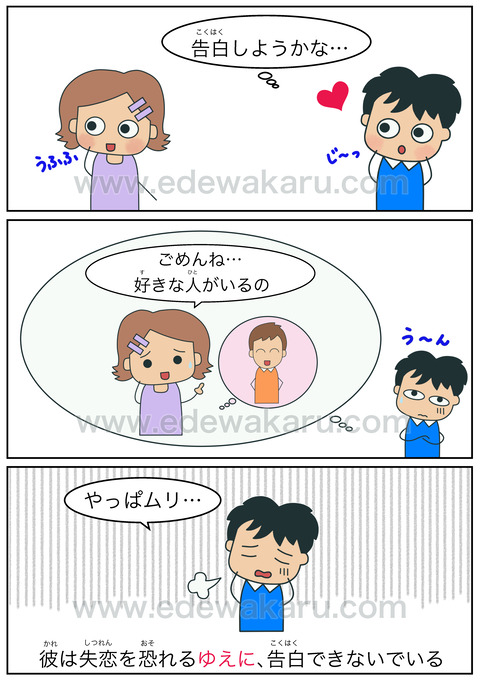
彼は失恋を恐れるゆえに、告白できないでいる
→失恋を恐れるために告白できないでいるHe can’t bring himself to confess because he is afraid of being rejected. →He can’t bring himself to confess because he is afraid of being rejected.
山田くんはケチゆえにモテないんだと思う…
→ケチなのでモテないんだと思う…I think Yamada isn’t popular because he’s stingy… →I think he isn’t popular because he’s stingy…
十分なお金がなかったゆえに、留学をあきらめなければいけなかった
→十分なお金がなかったために、留学をあきらめなければいけなかったBecause he didn’t have enough money, he had to give up studying abroad. →He had to give up studying abroad because he didn’t have enough money.
身長が低かったゆえに、CAになることができなかった
→身長が低かったために、CAになることができなかった*「CA」とは、キャビンアテンダントの略で客室乗務員(きゃくしつじょうむいん)のことBecause she was short, she couldn’t become a flight attendant. →She couldn’t become a flight attendant because she was short. *“CA” is short for “cabin attendant,” meaning a flight attendant.
今年は台風が多かったゆえに、野菜の値段は上がり続けている
→台風が多かったために、野菜の値段は上がり続けているBecause there were many typhoons this year, vegetable prices keep rising. →Vegetable prices keep rising because there were many typhoons.
Read the original source text
Meaning
〜だから
〜ために
How to use it
動詞・形容詞・名詞[普通形]+ゆえに
Explanation
「AゆえにB」は【原因・理由】を表す文型で、「AだからB」「AためにB」という意味で使われます。「〜。ゆえに〜」のように文頭にくることもあり、「〜。だから〜」という意味でも使用されます。後ろに名詞がくる場合は「〜ゆえの+名詞」になります。
[例]
若さ
ゆえの
過ち
「〜ゆえに」は、かたい書き言葉です。漢字で書くと「〜故に」です。N1を受ける人は、テストのためにしっかりと覚えておきましょう😊