絵でわかる日本語
Meaning
As if it were 〜
As if 〜
Like 〜
How to use it
Noun [dictionary form] + の + ごとし
Noun [dictionary form] + の + ごとく
Noun [dictionary form] + の + ごとき + noun
Explanation
「〜ごとし・〜ごとく・〜ごとき」 is a sentence pattern meaning “as if 〜,” “as if 〜ly,” or “like 〜.” These are very formal expressions used in writing. In modern usage, they are most often found in [proverbs] and [idioms]. 😊 The uses of 「〜ごとし・〜ごとく・〜ごとき」 are the same as 「〜ようだ・〜ように・〜ような」. It’s helpful to remember 「〜ごとし = 〜ようだ」「〜ごとく = 〜ように」「〜ごとき = 〜ような」. 😉
(Review: まるで〜)
(Review: 〜として)
(Review: 〜ておく)
[Examples]
〜ごとし.
〜ごとく + adjective or verb
〜ごとき + noun
Also, 「〜ごとし・〜ごとく・〜ごとき」 are written in kanji as 「〜如し・〜如く・〜如き」.
This pattern is classical Japanese, so it is very rarely used in conversation. 😅 In everyday conversation, 「〜ようだ・〜ように・〜ような」 are used in most cases, but people taking N1 should learn this as one of the important patterns. 😀
In context 6 examples
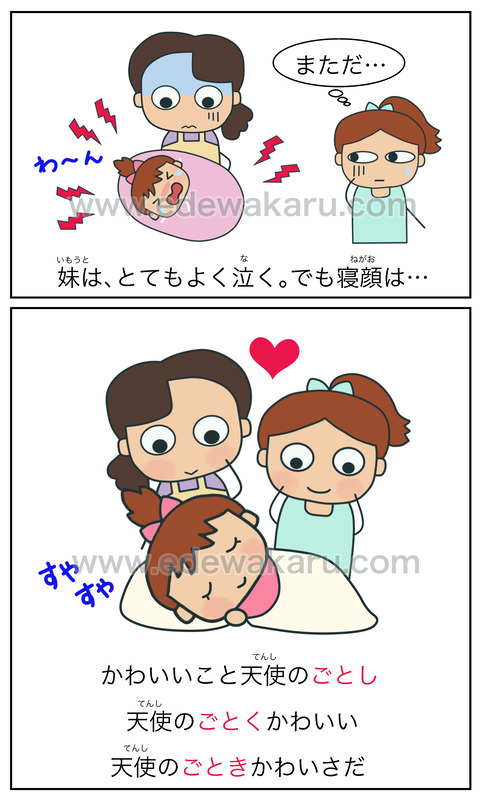
かわいいこと天使のごとし
→かわいいことまるで天使のようだShe is as cute as an angel. → She is cute, just like an angel.
天使のごとくかわいい
→まるで天使のようにかわいいCute like an angel. → Cute as if she were an angel.
天使のごときかわいさだ
→まるで天使のようなかわいさだShe has angel-like cuteness. → She has cuteness like an angel.
彼は、風のごとく速く走ることができる
→彼は、まるで風のように速く走ることができるHe can run fast like the wind. → He can run as fast as the wind.
社長に、鬼のごとき顔で怒られた
→社長に、まるで鬼のような顔で怒られたThe president scolded me with a face like a demon’s. → The president scolded me with a face as if he were a demon.
【ことわざ】光陰矢のごとし
→月日は矢のように速く経つ*「月日が経つのは速い」という意味[Proverb] Time flies like an arrow. → The days and months pass quickly like an arrow. *This means “time passes quickly.”
Read the original source text
Meaning
まるで〜のようだ
まるで〜のように
まるで〜のような
How to use it
名詞[辞書形]+の+ごとし
名詞[辞書形]+の+ごとく
名詞[辞書形]+の+ごとき+名詞
Explanation
「〜ごとし・〜ごとく・〜ごとき」は「まるで〜ようだ・〜ように・〜ような」という意味の文型です。「〜ごとし・〜ごとく・〜ごとき」はとてもかたい言い方で、書き言葉として使われます。現代では多くの場合【ことわざ】や【慣用句】で使用されます😊「〜ごとし・〜ごとく・〜ごとき」の使い方は、「〜ようだ・〜ように・〜ような」と同じです。「〜ごとし=〜ようだ」「〜ごとく=〜ように」「〜ごとき=〜ような」と覚えておくといいと思います😉
(復習:まるで〜)
(復習:〜として)
(復習:〜ておく)
[例]
〜ごとし。
〜ごとく+形容詞・動詞
〜ごとき+名詞
また
「〜ごとし・〜ごとく・〜ごとき」は漢字で書くと「〜如し・〜如く・〜如き」となります。
この文型は古語ですので、会話で使われることはとても少ないです😅
日常会話(にちじょうかいわ)では「〜ようだ・〜ように・〜ような」が使われることがほとんどです
が、N1を受ける人は大切な文型の1つとしてしっかりと覚えておきましょう😀
IMABI
Similarity II
Read this IMABI lesson ↗Explanation
Similarity II: ~ごとく, ~さながら, & ~しかず
This lesson introduces more difficult/less common phrases for showing similarity.
~ごとく
You may also seldom see 如ごと. ごと is 如くwhen used adverbially, 如き when used adjectivally in the 連体形, and 如し when used adjectivally in the 終止形. ごと is largely replaced by 如くだ. This is old-fashioned and often used for poetic reasons or in set expressions.
1. 月の如く
Like the moon
2. 天使の如く
Like an angel
3. 人生はあたかも春の夜の夢の如しということではないと思うんだ。
I don’t think that human life is as if it was like a dream of a spring night.
4. 我々ごときが坐っていてアンケートと本で調べた(だけでもないが)点に致命的弱味がある。
There is a fatal weak point in the like of us who sat and researched questionnaires and books (though that isn’t all we did).
From 大分方言 by 高田一彦.
Grammar Note: Notice how ごとき is used. It is not connected to 我々 with の, and it is treated as a nominal phrase. The reason for this is that in older forms of Japanese, the 連体形 of adjectives could take on case particles such as が to be used as nominal phrases. The result here is the very formal, written expression for “the like of us”.
5. 売れ行ゆき甚はなはだ振ふるわざるがごとし。(Classical)
It appears that sales are really not flourishing.
Word Notes: 売れ行き comes from the combination of 売れる (to be sold) and 行く.
~ざるがごとし is Classical Japanese for ~ないようだ.
~さながら
This is an infrequently used word that means “just like”. It is rather literary and is not really used in the spoken language. Even its Kanji spelling is not particularly known. However, it is a topic on the JLPT NI, so it is something that you need to take note of.
When さながら attaches to a noun, it shows that something is just as something else. In this sense, it is similar to 同然. In other contexts, it is an adverb meaning まるで. This, again, would not be something used in 話し言葉.
6. 本当の戦争さながら
Just as a real war
7. あの人の姿はさながら死骸のようだった。
That person’s figure was just like that of a dead body.
8. 王宛さながらの大歓迎
A royal welcome
~しかず
しかず, frequently spelled as 如かず, comes from an old verb no longer used anymore to show that something is the same thing as and or does not exceed a certain point. This, though, is not in a negative sense but in a good meaning. A similar phrase is ~には及ばない. Though 如かず is still used, it’s normally used in set phrases.
9. 百聞は一見に如かず。
Seeing is believing.
10. 尽く書を信ずれば則ち書なきに如かず。
If you believe what is in a book fully without hesitation, it is as if there is no book at all.
Set Phrase Note: This is a proverb from Mencius lecturing people that if they believed everything in the Book of History, 書経, without having any critical judgment on it, it would be best if the book didn’t exist at all.
In context 10 examples
月の如く
Like the moon
天使の如く
Like an angel
人生はあたかも春の夜の夢の如しということではないと思うんだ。
I don’t think that human life is as if it was like a dream of a spring night.
我々ごときが坐っていてアンケートと本で調べた(だけでもないが)点に致命的弱味がある。
There is a fatal weak point in the like of us who sat and researched questionnaires and books (though that isn’t all we did).
売れ行ゆき甚はなはだ振ふるわざるがごとし。(Classical)
It appears that sales are really not flourishing.
本当の戦争さながら
Just as a real war
あの人の姿はさながら死骸のようだった。
That person’s figure was just like that of a dead body.
王宛さながらの大歓迎
A royal welcome
百聞は一見に如かず。
Seeing is believing.
尽く書を信ずれば則ち書なきに如かず。
If you believe what is in a book fully without hesitation, it is as if there is no book at all.
どんなときどう使う 日本語表現文型辞典
Meaning
like; as
How to use it
〔Plain form〕(ナAな・ナAである/Nの・Nである)+ごとく (like; just as)
Explanation
~ように
同じ内容であることを表す。「ように」と意味・用法が同じで、古い書き言葉。 ❷ は「上記のように」、 ❸ は「次のような日程」の意味。
Indicates matching content. Same meaning and usage as ように. Old written form. In sentence ❷ , has connotation of "as written above;" sentence ❸ means "a schedule like what follows."
In context 4 examples
(父から息子への手紙)前回の手紙に書いたごとく、わたしも来年は定年だ。だから君にもそろそろ自分の将来のことを真剣に考えてもらいたい。
(A letter from a father to his son) As I wrote in my previous letter, I too will reach retirement age next year. So I want you to start thinking seriously about your own future soon.
上記のごとく、いったん納入したお金は返却されません。
As stated above, money once paid will not be refunded.
次のごとき日程で、研修会を行う。
The training seminar will be held according to the following schedule.
宇宙が無限であるごとく、人の想像力も無限だ。
Just as the universe is infinite, so is human imagination.
Read the original source text
Meaning
like; as
How to use it
〔普通形〕(ナAな・ナAである/Nの・Nである)+ごとくFW
Explanation
~ように
同じ内容であることを表す。「ように」と意味・用法が同じで、古い書き言葉。 ❷ は「上記のように」、 ❸ は「次のような日程」の意味。
Indicates matching content. Same meaning and usage as ように. Old written form. In sentence ❷ , has connotation of "as written above;" sentence ❸ means "a schedule like what follows."