くらべてわかる日本語表現文型辞典
Meaning
Meaning 1: A is so awful that one cannot continue doing it. The feeling associated with A is very strong.
Meaning 2: In the form “Aにたえる.” It is worthy of doing A or has the ability to withstand A.
How to use it
Aにたえない (AにたえるB / Aにたえる / AにたえないB)
[Verb – dictionary form / ている] にたえない
[Noun – ∅] にたえない
Explanation
【Contrast 1】
“Aにしのびない” (Meaning 2, p. 240)
In context 8 examples
事故現場の有様は、見るにたえなかった。
The scene of the accident was unbearable to look at.
派手な格好の男が、聞くにたえない下品な野次を飛ばしていた。
A flashy-looking man was shouting vulgar taunts that were unbearable to hear.
みんなの視線を浴びて黙って座っているにたえない雰囲気だった。
It was an atmosphere in which I couldn’t bear sitting silently under everyone’s gaze.
私たちのためにこのような盛大な会を開いていただき、感謝の念にたえない思いです。
I am filled with gratitude that you have held such a grand gathering for us.
近ごろは大人の鑑賞にたえる映画が少なくなった。
These days, there are fewer films that can withstand adult scrutiny.
この五つの作品のうちで、評価にたえるのはこれだけだ。
Of these five works, this is the only one worthy of praise.
古文書はみんな長期保存にたえる和紙に書かれている。
All of the old documents are written on washi paper that can withstand long-term storage.
宇宙や南極など厳しい環境での使用にたえる繊維が開発された。
A fiber that can withstand use in harsh environments such as outer space and Antarctica has been developed.
Read the original source text
Meaning
意味1:Aを続けることができないほどひどい。Aの気持ちがとても強い。
意味2:「Aにたえる」の形で。Aするだけの価値や力がある。
How to use it
Aにたえない(AにたえるB/Aにたえる/AにたえないB)
[動詞-る形/ている]にたえない
[名詞-∅]にたえない
Explanation
【対比1】
「Aにしのびない」(意味2 P.240)
日本語文型辞典
Meaning
It means that a state is so appalling that seeing or hearing about it is painful. It is used with only a limited set of verbs, such as 「見る」「読む」「正視する」.
Attached to a limited set of nouns, such as 「感謝」 and 「感激」, it is used to emphasize their meaning. It is normally used in formal words of greeting.
How to use it
V-るにたえない
Nにたえない
In context 5 examples
幼い子供が朝から晩まで通りで物乞いをしている姿は見るにたえない。
The sight of a young child begging in the street from morning to night is too painful to watch.
近ごろの週刊誌は暴露記事が多く、読むにたえない。
Modern weekly magazines contain many exposés and are unbearable to read.
地震のあと、町はパニック状態となった。暴徒が次々に商店をおそい、正視するにたえない光景が繰り広げられた。
After the earthquake, the town fell into a state of panic. Rioters attacked shops one after another, creating a scene too distressing to look at.
このようなお言葉をいただき、感謝の念にたえません。
I am deeply grateful to have received such kind words.
晩年近くなってボランティア活動を通じて若い人々とこのようなすばらしい出会いがあろうとは考えてもみないことであった。感激にたえない。
I had never imagined that, near the end of my life, I would have such a wonderful encounter with young people through volunteer work. I am overwhelmed with emotion.
Read the original source text
Meaning
あまりにひどい状態で、見たり聞いたりするのがつらいという意味を表す。「見る」「読む」「正視する」など、ごく限られた動詞しか使わない。
「感謝」「感激」などの限られた名詞に付いて、その意味を強調するのに用いる。かたい挨拶言葉として使うのが普通。
How to use it
V-るにたえない
Nにたえない
絵でわかる日本語
Usage 1
Read this source entry ↗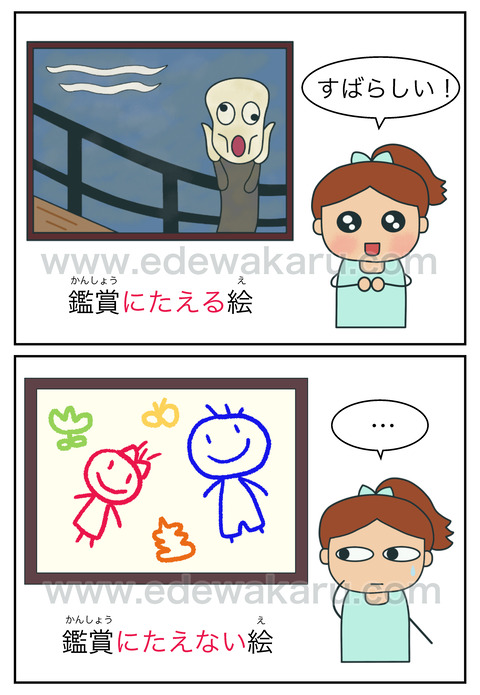
Meaning
be worth doing ~
not be worth doing ~
How to use it
Noun [dictionary form] +にたえる・にたえない
Verb [dictionary form] +にたえる・にたえない
Explanation
「〜にたえる」 and 「〜にたえない」 are sentence patterns meaning “be worth doing ~” and “not be worth doing ~.” There are only a few nouns and verbs used with them, so if you are taking N1, memorize them 😉
[Nouns and verbs used with 「〜にたえる」「〜にたえない」]
・鑑賞にたえる (be worth appreciating)
・批評にたえる (be worthy of criticism/evaluation)
・読むにたえる (be worth reading)
・見るにたえる (be worth seeing)
・聞くにたえる (be worth listening to)
【For those with time】
The negative form of 「〜にたえる」 is usually 「〜にたえない」, but with nouns, the form 「〜にたえるNではない」 is also possible 😮 Also, there is no form 「〜にたえられない」, so be careful 😨
[Examples]
⭕️鑑賞にたえない絵 (a painting not worth appreciating)
⭕️鑑賞にたえる絵ではない (not a painting worth appreciating)
❌鑑賞にたえられない絵 (a painting that cannot be appreciated)
「〜にたえる・〜にたえない」 have several meanings, and you may get confused if you do not learn them separately and in detail 😖 They may seem complicated, but learn them carefully one by one 😊
【Comparison】
① 「〜にたえない」 →
It is painful to do ~
(Review: 〜にたえない (Vにたえない))
② 「〜にたえない」 →
extremely ~
(Review: 〜にたえない (Nにたえない))
In context 4 examples
鑑賞にたえる絵
→鑑賞する価値がある絵A painting worth appreciating. →A painting worth appreciating.
鑑賞にたえない絵
→鑑賞する価値がない絵A painting not worth appreciating. →A painting not worth appreciating.
この本は子供向けだが、大人でも読むにたえる
→この本は子供向けだが、大人でも読む価値がある(復習:〜向け)This book is intended for children, but it is worth reading even for adults. →This book is intended for children, but it is worth reading even for adults (Review: 〜向け)
この美術館には見るにたえる作品がたくさんある
→この美術館には見る価値がある作品がたくさんあるThere are many works in this art museum that are worth seeing. →There are many works in this art museum worth seeing.
Read the original source text
Meaning
〜する価値がある
〜する価値がない
How to use it
名詞[辞書形]+にたえる・にたえない
動詞[辞書形]+にたえる・にたえない
Explanation
「〜にたえる」「〜にたえない」は「〜する価値がある」「〜する価値がない」という意味を表す文型です。
使われる名詞や動詞は少ないですので、N1を受ける人は暗記しておきましょう😉
[「〜にたえる」「〜にたえない」に使う名詞と動詞]
・
鑑賞
にたえる
・
批評
にたえる
・
読む
にたえる
・
見る
にたえる
・
聞く
にたえる
【余裕のある人へ】
「〜にたえる」の否定形は、ほとんどの場合「〜にたえない」が使われますが、名詞の場合は「〜にたえるNではない」という形もあります😮また、「〜にたえられない」という形はありませんので気をつけてください😨
[例]
⭕️鑑賞
にたえない
絵
⭕️鑑賞
にたえる
絵ではない
❌鑑賞
にたえられない
絵
「〜にたえる・〜にたえない」にはいろいろ意味があり、細かく分けて覚えておかないと混乱してしまいます😖複雑に感じるかもしれませんが、1つずつしっかりと覚えておきましょう😊
【比較】
①「〜にたえない」→
〜するのがつらい
(復習:〜にたえない(Vにたえない))
②「〜にたえない」→
とても〜だ
(復習:〜にたえない(Nにたえない))
Usage 2
Read this source entry ↗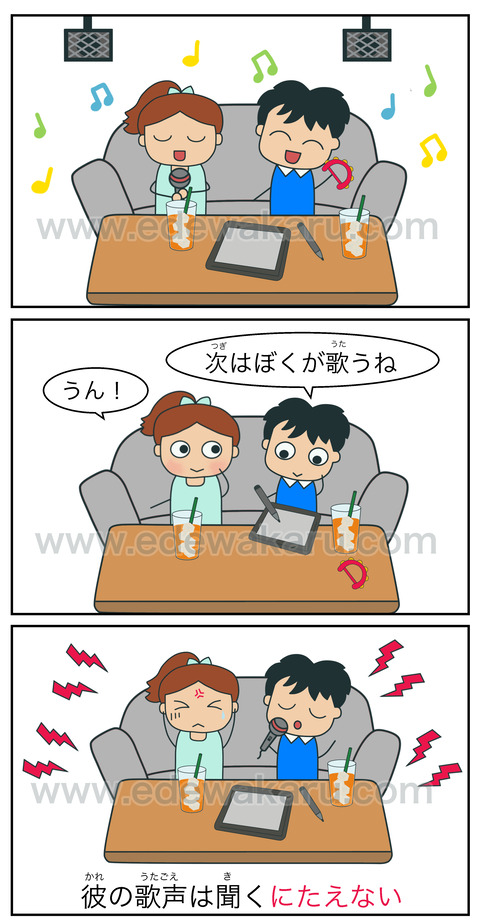
Meaning
(Because it is so awful,) doing ~ is painful
How to use it
Verb [dictionary form] +にたえない
Explanation
「〜にたえない」 is a sentence pattern used to mean “(because it is so awful) doing ~ is painful.” There are very few verbs used with it, such as 「見る」 and 「聞く」, so memorize them 😉
[Verbs used with 「〜にたえない」]
・聞くにたえない (too awful to listen to)
・見るにたえない (too awful to look at)
・読むにたえない (too awful to read)
・正視にたえない (too awful to look at directly)
・直視にたえない (too awful to face directly), etc.
N1 also has a pattern 「N+にたえない」 meaning “extremely ~”; learn to distinguish it so you don’t get confused 😊
(Review: 〜にたえない (Nにたえない))
In context 4 examples
彼の歌声は聞くにたえない
→彼の歌声はひどくて聞いているのがつらいHis singing voice is unbearable to listen to. →His singing voice is so awful that listening to it is painful.
子供が亡くなるニュースは見るにたえない
→子供が亡くなるニュースは見ているのがつらい(復習:「新聞」と「ニュース」の使い分け)The news about a child dying is unbearable to watch. →It is painful to watch news about a child dying (Review: distinguishing 「新聞」 and 「ニュース」)
ひどい災害があったという記事は読むにたえない
→ひどい災害があったという記事は読むのがつらいAn article about a terrible disaster is unbearable to read. →It is painful to read an article about a terrible disaster.
多くの人が苦しんでいる姿は正視するにたえない
→多くの人が苦しんでいる姿は正視するのがつらいThe sight of so many people suffering is unbearable to look at directly. →It is painful to look directly at the sight of so many people suffering.
Read the original source text
Meaning
(とてもひどくて)〜するのがつらい
How to use it
動詞[辞書形]+にたえない
Explanation
「〜にたえない」は「(とてもひどくて)〜するのがつらい」という意味で使われる文型です。「見る」や「聞く」など使われる動詞は、とても少ないですので暗記しておきましょう😉
[「〜にたえない」と使う動詞]
・
聞く
にたえない
・
見る
にたえない
・
読む
にたえない
・
正視
にたえない
・
直視
にたえない など
N1には「N+にたえない」で「とても〜」という文型もありますが、混乱しないように区別して覚えておきましょう😊
(復習:〜にたえない(Nにたえない))
Usage 3
Read this source entry ↗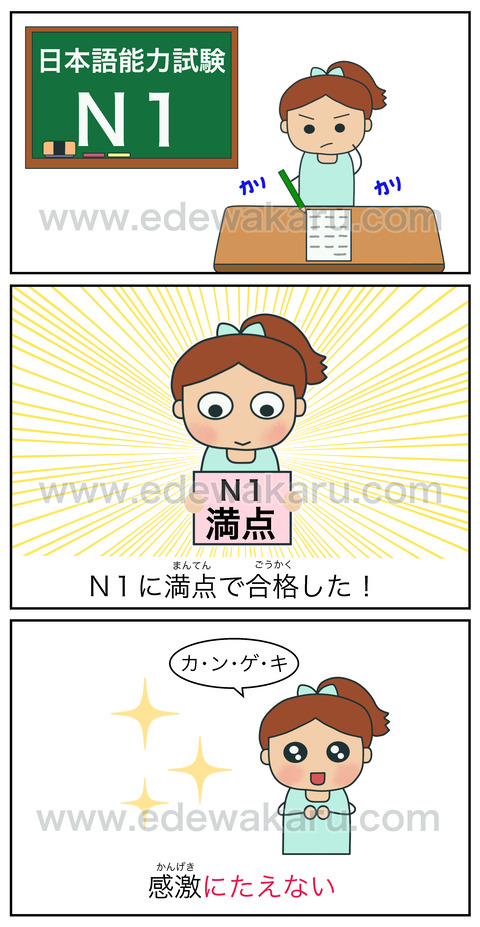
Meaning
extremely ~
very ~
How to use it
Noun [dictionary form] +にたえない
Explanation
「〜にたえない」 is a sentence pattern meaning “extremely ~” or “very ~.” It is used when you want to emphasize how strongly you feel that something is ~ 😊 The nouns used with this pattern are fixed, so if you are taking N1, memorize some of them 😉
[Nouns often used with 「〜にたえない」]
・感激にたえない (extremely moved)
・感謝にたえない (extremely grateful)
・後悔にたえない (filled with regret)
・喜びにたえない (overjoyed)
・悲しみにたえない (deeply saddened)
・同情にたえない (deserving of deep sympathy)
・無念にたえない (deeply regrettable)
・〜の念にたえない (filled with a feeling of ~)
・〜の思いにたえない (filled with thoughts of ~), etc.
「〜にたえない」 is a very formal expression, so it is almost never used in everyday conversation 😅 Also, N1 includes several patterns 「〜にたえない」 and 「〜にたえる」. They are easy to confuse, so distinguish and learn them carefully one by one 😀
(Review: 〜がちだ)
In context 4 examples
N1に満点で合格した!感激にたえない
→N1に満点で合格した!すごく感激しているI passed N1 with a perfect score! I’m incredibly moved. →I passed N1 with a perfect score! I’m so moved.
いつもお世話になり、感謝にたえません
→いつもお世話になり、とても感謝していますThank you for always taking care of me. I’m extremely grateful. →Thank you for always taking care of me. I’m very grateful.
あの先生は本当にすばらしい。尊敬の念にたえない
→あの先生は本当にすばらしい。とても尊敬しているThat teacher is truly wonderful. I can’t express how much I respect them. →That teacher is truly wonderful. I respect them very much.
勉強不足(べんきょうぶそく)で受験に失敗した。後悔にたえない
→勉強不足で受験にしっぱいした。とても後悔しているI failed the entrance exam because I didn’t study enough. I’m filled with regret. →I failed the entrance exam because I didn’t study enough. I regret it so much.
Read the original source text
Meaning
とても〜だ
すごく〜だ
How to use it
名詞[辞書形]+にたえない
Explanation
「〜にたえない」は「とても〜だ」「すごく〜だ」という意味を表す文型です。
「〜だ」と強く感じるというように、
強調して言いたい時
に使用します😊この文型は使う名詞が決まっていますので、N1を受ける人はいくつか暗記しておきましょう😉
[「〜にたえない」によく使う名詞]
・
感激
にたえない
・
感謝
にたえない
・
後悔
にたえない
・
喜び
にたえない
・
悲しみ
にたえない
・
同情
にたえない
・
無念
にたえない
・
〜の念
にたえない
・
〜の思い
にたえない など
「〜にたえない」はとてもかたい言い方ですので、日常会話(にちじょうかいわ)で使われることはほとんどありません😅また、N1には「〜にたえない」「〜にたえる」という文型がいくつかあります。混乱しがちですので1つずつしっかりと区別して覚えておきましょう😀
(復習:〜がちだ)
Usage 4
Read this source entry ↗Meaning
be worth doing ~
not be worth doing ~
How to use it
Noun [dictionary form] +にたえる・にたえない
Verb [dictionary form] +にたえる・にたえない
Explanation
「〜にたえる」 and 「〜にたえない」 are sentence patterns meaning “be worth doing ~” and “not be worth doing ~.” There are only a few nouns and verbs used with them, so if you are taking N1, memorize them 😉
[Nouns and verbs used with 「〜にたえる」「〜にたえない」]
・鑑賞にたえる (be worth appreciating)
・批評にたえる (be worthy of criticism/evaluation)
・読むにたえる (be worth reading)
・見るにたえる (be worth seeing)
・聞くにたえる (be worth listening to)
【For those with time】
The negative form of 「〜にたえる」 is usually 「〜にたえない」, but with nouns, the form 「〜にたえるNではない」 is also possible 😮 Also, there is no form 「〜にたえられない」, so be careful 😨
[Examples]
⭕️鑑賞にたえない絵 (a painting not worth appreciating)
⭕️鑑賞にたえる絵ではない (not a painting worth appreciating)
❌鑑賞にたえられない絵 (a painting that cannot be appreciated)
「〜にたえる・〜にたえない」 have several meanings, and you may get confused if you do not learn them separately and in detail 😖 They may seem complicated, but learn them carefully one by one 😊
【Comparison】
① 「〜にたえない」 →
It is painful to do ~
(Review: 〜にたえない (Vにたえない))
② 「〜にたえない」 →
extremely ~
(Review: 〜にたえない (Nにたえない))
In context 4 examples
鑑賞にたえる絵
→鑑賞する価値がある絵A painting worth appreciating. →A painting worth appreciating.
鑑賞にたえない絵
→鑑賞する価値がない絵A painting not worth appreciating. →A painting not worth appreciating.
この本は子供向けだが、大人でも読むにたえる
→この本は子供向けだが、大人でも読む価値がある(復習:〜向け)This book is intended for children, but it is worth reading even for adults. →This book is intended for children, but it is worth reading even for adults (Review: 〜向け)
この美術館には見るにたえる作品がたくさんある
→この美術館には見る価値がある作品がたくさんあるThere are many works in this art museum that are worth seeing. →There are many works in this art museum worth seeing.
Read the original source text
Meaning
〜する価値がある
〜する価値がない
How to use it
名詞[辞書形]+にたえる・にたえない
動詞[辞書形]+にたえる・にたえない
Explanation
「〜にたえる」「〜にたえない」は「〜する価値がある」「〜する価値がない」という意味を表す文型です。
使われる名詞や動詞は少ないですので、N1を受ける人は暗記しておきましょう😉
[「〜にたえる」「〜にたえない」に使う名詞と動詞]
・
鑑賞
にたえる
・
批評
にたえる
・
読む
にたえる
・
見る
にたえる
・
聞く
にたえる
【余裕のある人へ】
「〜にたえる」の否定形は、ほとんどの場合「〜にたえない」が使われますが、名詞の場合は「〜にたえるNではない」という形もあります😮また、「〜にたえられない」という形はありませんので気をつけてください😨
[例]
⭕️鑑賞
にたえない
絵
⭕️鑑賞
にたえる
絵ではない
❌鑑賞
にたえられない
絵
「〜にたえる・〜にたえない」にはいろいろ意味があり、細かく分けて覚えておかないと混乱してしまいます😖複雑に感じるかもしれませんが、1つずつしっかりと覚えておきましょう😊
【比較】
①「〜にたえない」→
〜するのがつらい
(復習:〜にたえない(Vにたえない))
②「〜にたえない」→
とても〜だ
(復習:〜にたえない(Nにたえない))
日本語文型辞典 英語版
Meaning
Expresses the meaning that it is hard to see or hear something because its state is dreadful. Can be used with a few specific types of verbs, such as 見る, 読む, and正視する.
With some limited types of nouns, such as 感謝 (gratitude) and 感激 ((the feeling of being) deeply moved), Nにたえない is used to emphasize the meaning of the noun. Usually used in formal speech.
How to use it
1. V-るにたえない
2. Nにたえない
In context 5 examples
幼い子供が朝から晩まで通りで物乞いをしている姿は見るにたえない。
It is unbearable to see young children begging on the street all day long.
近ごろの週刊誌は暴露記事が多く、読むにたえない。
I can’t stand reading recent weekly magazines because they have a lot of exposés.
地震のあと、町はパニック状態となった。暴徒が次々に商店をおそい、正視するにたえない光景が繰り広げられた。
After the earthquake, the whole town panicked. Mobs attacked shops one after another and an unbearable sight unfolded before our eyes.
このようなお言葉をいただき、感謝の念にたえません。
I cannot be grateful enough to you for giving me such a compliment.
晩年近くなってボランティア活動を通じて若い人々とこのようなすばらしい出会いがあろうとは考えてもみないことであった。感激にたえない。
I had never thought about such wonderful encounters with young people through volunteer work in my later years. It’s absolutely wonderful.
Read the original source text
Meaning
Expresses the meaning that it is hard to see or hear something because its state is dreadful. Can be used with a few specific types of verbs, such as 見る, 読む, and正視する.
With some limited types of nouns, such as 感謝 (gratitude) and 感激 ((the feeling of being) deeply moved), Nにたえない is used to emphasize the meaning of the noun. Usually used in formal speech.
How to use it
1. V-るにたえない
2. Nにたえない
IMABI
Can’t Help II
Read this IMABI lesson ↗Explanation
Can’t Help II: ~てならない, ~てやまない, ~てしかたがない, ~にたえない, & ~てたまらない
This lesson will continue coverage on phrases regarding “not being able to restrain” one’s emotions or feeling. The phrases here with exception to ~にたえない, which is brought up because of ~てこたらない, all use the て form to attach to verbs/adjectives, but be careful about what kind of words they can semantically be used with.
~てならない
~てならない is found primarily in the written language, though this doesn’t mean you can’t hear it be used in the spoken language, and its purpose is to show that a certain feeling can’t be helped being felt/thought. If the verb, though, does not refer to emotion or something spontaneous, it cannot be used. This pattern, also, does not attach to the negative form.
1. 不思議に思えてならない。
I can’t help but think it’s strange.
2. 悪化するように思えてならない。
I can’t help but think that it’s going to get worse.
3. もう10年も故郷ふるさとに帰っていないので、両親に会いたくてならない。
Since it’s already been 10 years since I haven’t been home at my hometown, I can’t help but want to meet my parents.
漢字 Note: 故郷 may also be read as こきょう.
4. 肘ひじが痛くてならない。
I can’t help but think about my hurting elbow.
5. 退屈たいくつな日本語の授業に出ていると、眠くてならない。
I can’t help but sleep when I’m at my boring Japanese class.
6. 毎日寂さびしくてならない。
I can’t help but be sad every day.
7. 日本語能力試験が心配でならない。
I can’t help but worry about the JLPT.
8. 失敗するような気がしてなりません。
I can’t help but have the feeling that I’m going to fail.
Warning Note: Do not confuse this with the must/must not pattern ~てはならない.
~てやまない
~てやまない is a somewhat 硬かたい phrase that is used to show that one will continue to be holding a strong feeling. You just won’t stop. It is used with verbs concerning emotion, but it is not used with emotional verbs that describe temporary states. The grammatical person is usually first person. Understandably, it is not appropriate to attach this phrase to the negative form.
9. この写真に写うつっているのは私が愛してやまない犬だ。
The thing in this picture is a dog that I shall always love.
10. 親は子供の将来を期待してやまないものだ。
Parents never stop hoping for their children;s future.
11. 愛犬が死んで悲しくてやまない。
I will continue to be sad over my beloved dog dying.
12. 皆さんの幸せを願ってやみません。
I will continue to wish for everyone’s happiness.
13. ご活躍かつやくを願ってやまない。
I can’t stop wishing for you to flourish.
~てしかたがない
~てしかたがない is very similar to ~てならない, but since it originally referred to there not being a way to withstand or conquer, it gives off a feeling that one can’t stand something while thinking at the same time that there is nothing else that could be done. Therefore, it is also very common in the spoken language. This is unlike ~てならない which is often felt to be quite old-fashioned.
~てならない and ~てしかたがない are different when the verb doesn’t express something spontaneous or emotional, in which case you use ~てしかたがない because nothing is predicated in its definition that it must be used with a verb of emotion. However, this does not mean that ~てしかたがない can’t be used with verbs of spontaneity and or emotion because it still can.
Variant Note: ~しようがない and ~てしょうがない are more casual versions with the latter being the most casual.
Examples
14. もう残念でしかたがない。
It’s no use that it’s already regrettable.
15. いくら着込んでも寒くてしょうねーな。
No matter how much I wear, I’m still cold!
16. 彼が言うと、僕を非難しているように聞こえて{ならない・しかたがない}。
Whenever he says (something), I can’t help but hear it that he’s criticizing me.
17. 朝っぱらからくそ犬めが鳴くんで、うるさくしょうがねーよ。(Vulgar)
Since the damn dog barks from early in the morning, it’s annoying as hell.
18.抽選ちゅうせんにもれたなんて、残念でしかたないね。
It can’t be helped that I’m disappointed that I didn’t get drawn.
~にたえる・~にたえない
耐える means ” to endure”. ~に耐える is seen after nouns and verbs of personal attention to show the worth of something. With する verbs, する is dropped. For example, it is used in contexts such as being worth to read, hear, criticize, applaud, value, etc.
~に耐えない, though, has two usages. When used with the 連体形, it means “cannot stand/endure to…”. When used after a noun, it shows a strong emotional reaction in which one can’t hold back such emotions. This may sound very similar to the first usage, but this usage is strictly used with nouns.
Spelling Note: The phrase can also be spelled as に堪えない.
Style/Word Choice Note: It is somewhat of a stiff phrase and used with a limited number of nouns such as 感謝, 感激, 慙愧ざんき(shame), 等.
Examples
19. 感謝に耐えません。
I can’t help but thank you.
20. 見るに耐えないOLだぞ。
She’s a butt-ugly office lady.
21. 慙愧ざんき(の念)に堪えない。
To be deeply ashamed of oneself.
22. お忙しいところを多くの方にお集まりいただき、感激に堪えません。(謙譲語)
I am overwhelmed with emotion from receiving all of you gathering while you are all busy.
23. 気の毒で同情に堪えない。
I am deeply sorry for you and sympathize with you.
24. 誠まことに慨嘆がいたんに堪えない。
It is truly a matter for great regret.
25. 父は聞くに耐えない歌たいぶりをする。
My dad has an awful manner of singing.
26. 鑑賞に耐えるものだ。
It is something worth appreciating.
Word Note: Again, this phrase is used with limited words such as 見る、聞く、批判、鑑賞かんしょう、議論、etc.
~てたまらない
Although usually left in かな, if you do see this pattern written in 漢字, don’t confuse the reading for the one in ~(に)堪えない. They’re not the same, of course. This is a very common phrase in the spoken language, unlike a lot of the phrases in this lesson, and it is a strong speech style meant to show that one can’t resist a certain emotion, sense, or want.
~てたまらない can’t be used with spontaneous verbs. This is contrast with things like ~てならない and ~てしかたがない. On the other hand, if you are using an adjective that shows an objective degree, ~てたまらない can be used but ~てならない・~てしかたがない can’t.
Examples
26. 日本へ帰りたくてたまらない。
I can’t stand but want to go back home to Japan.
27. 隣の車のマフラー音がうるさくて、たまらないよ。
The muffler of the car next to me is annoying, and I can’t stand it.
28. 隣の駐車場の車の音がうるさくて、たまりません。困ってますよ。
The car noise from the parking lot next to me is annoying, and I can’t stand it. I’m at a loss.
29. お兄さんは毎日退屈で堪らないそうです。
I hear that your older brother can’t stand him being bored every day?
In context 30 examples
不思議に思えてならない。
I can’t help but think it’s strange.
悪化するように思えてならない。
I can’t help but think that it’s going to get worse.
もう10年も故郷ふるさとに帰っていないので、両親に会いたくてならない。
Since it’s already been 10 years since I haven’t been home at my hometown, I can’t help but want to meet my parents.
肘ひじが痛くてならない。
I can’t help but think about my hurting elbow.
退屈たいくつな日本語の授業に出ていると、眠くてならない。
I can’t help but sleep when I’m at my boring Japanese class.
毎日寂さびしくてならない。
I can’t help but be sad every day.
日本語能力試験が心配でならない。
I can’t help but worry about the JLPT.
失敗するような気がしてなりません。
I can’t help but have the feeling that I’m going to fail.
この写真に写うつっているのは私が愛してやまない犬だ。
The thing in this picture is a dog that I shall always love.
親は子供の将来を期待してやまないものだ。
Parents never stop hoping for their children;s future.
愛犬が死んで悲しくてやまない。
I will continue to be sad over my beloved dog dying.
皆さんの幸せを願ってやみません。
I will continue to wish for everyone’s happiness.
ご活躍かつやくを願ってやまない。
I can’t stop wishing for you to flourish.
もう残念でしかたがない。
It’s no use that it’s already regrettable.
いくら着込んでも寒くてしょうねーな。
No matter how much I wear, I’m still cold!
彼が言うと、僕を非難しているように聞こえて{ならない・しかたがない}。
Whenever he says (something), I can’t help but hear it that he’s criticizing me.
朝っぱらからくそ犬めが鳴くんで、うるさくしょうがねーよ。(Vulgar)
Since the damn dog barks from early in the morning, it’s annoying as hell.
抽選ちゅうせんにもれたなんて、残念でしかたないね。
It can’t be helped that I’m disappointed that I didn’t get drawn.
感謝に耐えません。
I can’t help but thank you.
見るに耐えないOLだぞ。
She’s a butt-ugly office lady.
慙愧ざんき(の念)に堪えない。
To be deeply ashamed of oneself.
お忙しいところを多くの方にお集まりいただき、感激に堪えません。(謙譲語)
I am overwhelmed with emotion from receiving all of you gathering while you are all busy.
気の毒で同情に堪えない。
I am deeply sorry for you and sympathize with you.
誠まことに慨嘆がいたんに堪えない。
It is truly a matter for great regret.
父は聞くに耐えない歌たいぶりをする。
My dad has an awful manner of singing.
鑑賞に耐えるものだ。
It is something worth appreciating.
日本へ帰りたくてたまらない。
I can’t stand but want to go back home to Japan.
隣の車のマフラー音がうるさくて、たまらないよ。
The muffler of the car next to me is annoying, and I can’t stand it.
隣の駐車場の車の音がうるさくて、たまりません。困ってますよ。
The car noise from the parking lot next to me is annoying, and I can’t stand it. I’m at a loss.
お兄さんは毎日退屈で堪らないそうです。
I hear that your older brother can’t stand him being bored every day?
どんなときどう使う 日本語表現文型辞典
Meaning
can't bear
How to use it
V-dictionary form / N of a suru-verb + に耐えない
Explanation
~することに耐えられない
1)「不快感があって、見たり聞いたりすることに耐えられない」という意味を表す。
2)「見る・聞く」などの限られた動詞にしかつかない。
2)Only appends to limited verbs such as 見る and 聞く, etc.
1)Inability to bear seeing or hearing something unpleasant.
In context 3 examples
事故現場はまったく見るに耐えないありさまだった。
The scene of the accident was in a state that was completely unbearable to look at.
あの人の話はいつも人の悪口ばかりで、聞くに耐えない。
That person’s stories are always just about badmouthing people; they’re unbearable to listen to.
若い女性が電車の中で化粧をしているのは正視に耐えない光景だ。
Seeing young women putting on makeup on the train is an unbearable sight.
Read the original source text
Meaning
can't bear
How to use it
Vる/する動詞のN+に耐えない
Explanation
~することに耐えられない
1)「不快感があって、見たり聞いたりすることに耐えられない」という意味を表す。
2)「見る・聞く」などの限られた動詞にしかつかない。
2)Only appends to limited verbs such as 見る and 聞く, etc.
1)Inability to bear seeing or hearing something unpleasant.
毎日のんびり日本語教師
How to use it
Noun + にたえない
Explanation
Used with certain words such as 感謝 (gratitude), 感激 (being deeply moved), 喜び (joy), and ~の念 (a feeling of ~), this expresses being unable to contain that emotion.
It is a rather formal expression.
The kanji spelling is 「堪えない」.
Notes
Related grammar: “【N1 grammar】~にたえる(堪える)”
Related grammar: “【N1 grammar】~にたえない(堪えない)”
Related grammar: “【N1 grammar】~に値する/に値しない”
Related grammar: “【N1 grammar】~に足る/に足りる/に足りない/に足らない”
In context 14 examples
貴重なお話を聴くことができて感謝にたえません。
I cannot express enough gratitude for being able to hear such a valuable story.
皇后陛下ご臨席の下、表彰状を頂戴し、感激に堪えません。
I am deeply moved to have received this certificate of commendation in the presence of Her Majesty the Empress.
お忙しいところを多くの方にお集まりいただき、感激に堪えません。
I am deeply moved that so many people have gathered despite being busy.
誠に失礼なことを申し上げまして、後悔に堪えません。
I deeply regret having said something so terribly rude.
外国へ行っているとあなたが恋しくなり、一人で行ってしまったこと、今では後悔に堪えません。
When I am abroad, I miss you, and now I deeply regret having gone alone.
被害に遭われた方のお気持ちをお察ししますと、心より悲しく遺憾に堪えません。
When I imagine how those affected must feel, I am deeply saddened and cannot express how regrettable this is.
このような結論に至り、遺憾に堪えません。
I deeply regret that things have come to this conclusion.
皆様のご心労をお察しすると、同情に堪えません。
When I think of all the worry you have been through, I cannot help but feel deep sympathy.
全て私の不徳の致すところであり、反省の念に堪えません。
It is all due to my own shortcomings, and I cannot express how deeply I regret it.
日々ご尽力されている医療従事者の皆様には尊敬の念に堪えません。
I cannot help but feel the deepest respect for all the healthcare workers who devote themselves day after day.
お客様への対応が遅れてしまったことには慙愧の念に堪えません。
I am filled with shame and regret that our response to the customer was delayed.
突然の訃報に接し、悲しみの念に堪えません。
I am overcome with grief at the sudden news of their death.
御遺族の皆様の深い悲しみに思いを致しますと、誠に痛恨の極みであり、哀惜の念に堪えません。
When I think of the profound sorrow of the bereaved families, I feel the deepest regret and cannot express how mournful I am.
ご丁寧なアドバイスに感謝にたえません。用法② その状態を維持できない
I cannot thank you enough for your thoughtful advice. Usage ②: being unable to maintain that state
Read the original source text
How to use it
名詞+にたえない
Explanation
感謝、感激、喜び、~の念、などの特定の語につき、その感情を抑えることができないことを表します。
硬めの表現です。
漢字は「堪えない」です。
Notes
関連文法「【N1文法】~にたえる(堪える)」
関連文法「【N1文法】~にたえない(堪えない)」
関連文法「【N1文法】~に値する/に値しない」
関連文法「【N1文法】~に足る/に足りる/に足りない/に足らない」