くらべてわかる日本語表現文型辞典
Meaning
Meaning 1: Complete B after properly doing A, with the completion of A as a prerequisite for B.
Meaning 2: B expresses something that needs to be done before doing A.
Meaning 3: B happens while A is being carried forward, in the course of A.
Meaning 4: In the form “Aのうえでは.” B is true within the scope of A.
How to use it
AうえでB (AうえB / AうえではB)
Connection 1:
[Verb—た form] うえで
[Noun—の] うえで
Connections 2 and 3:
[Verb—る form] うえで
Connection 4:
[Noun—の] うえでは
Explanation
【Contrast 1】
“AてからB”
“AてからB” emphasizes that A comes first in time, whereas “AうえでB” means that B is done on the condition of A.
○私は朝ご飯を食べてから、歯をみがきます。 — I brush my teeth after eating breakfast.
×私は朝ご飯を食べたうえで、歯をみがきます。 — I brush my teeth after eating breakfast using うえで.
【Contrast 2】
“A際にB” (meaning 1, p. 100)
“A際にB” means that B happens when the action A is performed, whereas “AうえでB” means before entering the state A. Since both can mean “when,” some sentences can use either.
○共同生活をするうえで、わがままは禁物だ。 — When living communally, being selfish is forbidden.
○共同生活をする際に、わがままは禁物だ。 — When living communally, being selfish is forbidden.
○バスを降りる際には、足元に注意してください。 — When getting off the bus, please watch your step.
×バスを降りるうえでは、足元に注意してください。 — When getting off the bus using うえで, please watch your step.
“AにあたりB” (meaning 1, p. 212)
A in “AにあたりB” is something the speaker has decided, whereas A in “AうえでB” is viewed as not yet decided.
○採用していただくにあたり、こちらからお願いがあります。 — As you consider hiring me, I have a request.
×採用していただくうえで、こちらからお願いがあります。 — As you consider hiring me using うえで, I have a request.
【Contrast 4】
“A上B” (meaning 1, p. 107)
Notes
【Note 1】
・There are also set expressions such as the following.
○首になるのは覚悟のうえです。 — I am prepared to be fired.
○お怒りは承知のうえの行動です。 — I acted knowing that you would be angry.
【Note 4】
・There are also set expressions.
○酒のうえでの失敗を重ねる。 — Make repeated mistakes while drinking.
○仕事のうえでのつきあいだ。 — It is a work-related association.
In context 16 examples
ご予約のうえでご来店ください。
Please make a reservation before you visit.
申し込む際は、電話で確認のうえ、書類を提出してください。
When applying, please confirm by phone and then submit the documents.
商品を見たうえで、買うかどうか決めます。
I’ll decide whether to buy it after seeing the product.
利用目的を特定したうえで、個人情報を取り扱う。
Handle personal information after specifying the purpose of its use.
彼を我が社に採用するうえで、ひとつ難点がある。
There is one difficulty when it comes to hiring him at our company.
外国生活をするうえで、注意するべきことをいくつか述べます。
I will describe a few things to be careful about when living abroad.
この本には社会人になるうえで役立つ知識が多く載っている。
This book contains a lot of useful knowledge for entering the workforce.
ビルを建てるうえで必要な構造計算をしていなかった。
I had not done the structural calculations necessary for building the building.
子どもを育てていくうえで、親もさまざまなことを学ぶ。
Parents also learn various things as they raise children.
彼には事業を始めるうえで、ずいぶんお世話になった。
He was a great help to me when I started my business.
議論を重ねていくうえで、結論はおのずから見えてくる。
As discussions continue, the conclusion will naturally become clear.
反抗期は、人が成長していくうえで必ず通り抜ける関門だ。
Adolescence is a hurdle that everyone must pass through as they grow up.
校則のうえでは禁止となっているが、ほとんど守る学生はいなかった。
It is prohibited under the school rules, but hardly any students followed them.
まだ寒いけれども、暦のうえではもう春だ。
It is still cold, but according to the calendar, it is already spring.
彼とは書類のうえでは夫婦だが、実際には離婚しているのも同然です。
On paper, he and I are married, but in reality we are practically divorced.
成績のうえでは彼が一番だが、実力では彼女のほうが上だ。
In terms of grades, he is number one, but in ability, she is better.
Read the original source text
Meaning
意味1:Aをきちんとした後でB。Aが完了したことを前提にB。
意味2:Aをする前に必要となる事柄をBで表す。
意味3:Aを進めていく途中、過程でB。
意味4:「Aのうえでは」の形で。Aという範囲ではBである。
How to use it
AうえでB(AうえB/AうえではB)
接続1:
[動詞-た形]うえで
[名詞-の]うえで
接続2,3:
[動詞-る形]うえで
接続4:
[名詞-の]うえでは
Explanation
【対比1】
「AてからB」
「AてからB」は時間的にAが先であることを強調し、「AうえでB」はAを条件にBをすることになる。
○私は朝ご飯を食べてから、歯をみがきます。
×私は朝ご飯を食べたうえで、歯をみがきます。
【対比2】
「A際にB」(意味1 P.100)
「A際にB」はAの動作をするときBという意味で、「AうえでB」はAという状態になる前にという意味がある。ともに、「とき」を表す意味では同じなので、置き換え可能な文もある。
○共同生活をするうえで、わがままは禁物だ。
○共同生活をする際に、わがままは禁物だ。
○バスを降りる際には、足元に注意してください。
×バスを降りるうえでは、足元に注意してください。
「AにあたりB」(意味1 P.212)
「AにあたりB」のAは、話し手にとって確定したことで、「AうえでB」のAは、未確定としてとらえている。
○採用していただくにあたり、こちらからお願いがあります。
×採用していただくうえで、こちらからお願いがあります。
【対比4】
「A上B」(意味1 P.107)
Notes
【注意1】
・次のような慣用的表現もある。
○首になるのは覚悟のうえです。
○お怒りは承知のうえの行動です。
【注意4】
・慣用的表現もある。
○酒のうえでの失敗を重ねる。
○仕事のうえでのつきあいだ。
IMABI
Result
Read this IMABI lesson ↗Explanation
Result: ~結果, ~うえで, ~挙句, ~すえに, & ~始末だ
Though these patterns show result, they have their own special nuances. So, even when there is interchangeability, that doesn’t mean you are saying 100% the same thing.
~結果
~結果 utilizes the word for “result”. It is seen after nouns or the past tense of verbs. What follows is a result and what precedes is a cause. Whether it is in one sentence or two, this is how the pattern works. It is objective and 書き言葉的. It is preceded by verbs of thought/consideration and followed by verbs of result.
1. やるだけはやったのだから、静かに結果を待とう。
I’ve done just what to do, so I will quietly await the results.
2. 消防車しょうぼうしゃなど13台が消火にあたった結果、火はおよそ1時間半後に消し止められましたが、部屋は全焼しまし た。
As a result of 13 fire trucks fighting the fire, the fire was extinguished after approximately an hour and a half, but the room was completely burned.
From the NHK article 県営けんえい住宅焼け1人死亡1人重体じゅうたい on 2013年7月3日 2時11分.
3. 2日のロンドン外国為替かわせ市場は、ニューヨーク市場や東京市場で株価かぶかが上昇じょうしょうしたことなどを背景はいけいに、世界経済の先行さきゆきに対する懸念けねんがいくぶん和やわらぎ、ドルを買って円を売る動きが次第しだいに強まりました。その結果、円相場そうばは一時、先月上旬じょうじゅん以来およそ1か月ぶりに1ドル=100円台前半ぜんはんまで値下ねさがりしました。
The London Foreign Stock Exchange on the second, against the background of stocks having risen in the New York and Tokyo Exchanges, concerns towards the world economy’s future have somewhat eased, and the trend of buying dollars and selling yes has gradually strengthened.
As a result, the yen exchange rate for a moment dropped down to the low 1$ = 100\ mark after about a month since the first part of last month.
From the NHK article ロンドン市場 1か月ぶり100円台 on 2013年7月2日 21時36分.
4. この問題は、東日本大震災の復興予算ふっこうよさんが、自治体じちたいなどが管理する基金を通じて、被災地ひさいち以外の事業にも使われているという指摘してきが出ていたもので、政府は、財務省や復興庁など関係省庁しょうちょうを通じて実態調査じったいちょうさを進めてきました。その結果、調査の対象となった各自治体などが管理する16の基金には、およそ1兆1500億円の復興予算が配分され、その大半はすでに執行されていましたが、およそ1400億円がまだ使われていないことが分かりました。
As for this problem, with the indication having come out that the East Japan Great Earthquake Disaster Recovery Budget, through funds the municipalities manages are being used even in projects outside the devastated areas, the government has forwarded investigations into the actual circumstances through the ministries and offices concerned such as the Ministry of Office and the Recovery Agency.
As a result, in the 16 funds that each of the municipalities that have become the object of investigation manage, approximately 1 trillion 150 billion yen recovery budget has been allocated, and the great majority of which has already been administered, but it has been found out that approximately 140 billion yen has yet to be used.
From the NHK article未使用の復興予算 返還要請へんかんようせいへ on 2013年7月2日 12時48分.
~うえで
~うえで works grammaticality just like ~結果. It too is seen after nouns or the past tense of a verb. ~うえで shows a willful aspect in taking the next action based on the results of the present/clause or context. This makes it quite different for all of the other patterns in this lesson. It is preceded by verbs of thought/consideration, and then it is followed by verbs of conclusion. Adverbs frequently used in the first clause include よく and 十分(に).
5. 十分に事件を勘案かんあんしたうえで返事します。
I will reply after having sufficiently considered the matter.
6. 上司と詳くわしく相談したうえで、お返事いたします。
I will reply after having consulted in detail with my boss.
7. ASEAN=東南アジア諸国連合しょこくれんごうと、日本やアメリカ、それに北朝鮮も含む、27の国と国際機関の外相がいしょうなどが参加して、2日にブルネイで開かれたARFは、会議の締しめくくりとして議長声明を採択さいたくしました。
議長声明では、ほとんどの参加国の共通認識きょうつうにんしきとして、北朝鮮に核実験かくじっけんの停止ていしなどを求めた過去の国連安保理あんぽり決議と、北朝鮮による既存きそんの核計画の放棄ほうきなどを盛もり込こんだ、6か国協議の共同声明の義務を果はたすよう、北朝鮮に求めています。
そのうえで、「参加国のほとんどは朝鮮半島の非核化に向けた努力を支持する」としています。
ARF, which was opened in Brunei on the second with foreign ministers from 27 international organizations including ASEAN (Association of Southeast Asian Nations), Japan, America, as well as North Korea participating, adopted the chairman’s proclamation as the meeting’s close. With the chairman’s proclamation, as almost all of the participating nations’ common understanding, it is calling for North Korea to carry out its duties of the six nation conference joint statement, including things such as U.N Security Council Resolution of the past which sought the halt of nuclear tests in North Korea and the abandonment of current nuclear plans by North Korea.
Moreover, it is asserting that “almost all of the participating nations support the efforts towards the denuclearization of the Korean Peninsula”.
From the NHK Article ARF議長声明 朝鮮半島の非核化支持ひかくかしじ on 2013年7月3日 0時9分.
8. 新潟県にいがたけん知事「地元軽視けいしだ」
新潟県の泉田知事いずみだちじは「事前に連絡はなく、こんな地元軽視はない」と強い不快感ふかいかんを示しました。
そのうえで、「東京電力は福島第一原発の事故の際のTV会議の状況をすべて公開していないなど、検証けんしょうが不十分で事故の責任せきにんもとっていない。運転再開について議論を行う段階ではない」と東京電力の姿勢を改めて批判しました。
国も理解得る努力を茂木もてぎ経済産業大臣けいざいさんぎょうだいじんは、訪問中ほうもんちゅうのベトナムで「申請しんせいが出された段階で原子力規制委員会きせいいいんかいには厳正げんせいで速すみやかな審査しんさを行っていただきたい。そのうえで安全性が確認されたら東京電力任せではなくて国としても前面 ぜんめんに出て自治体などの理解を得るよう努力どりょくをしていきたい」と述べました。
Niigata Prefecture Governor “It’s local neglect”
Niigata Prefecture Governor Izumida demonstrated strong displeasure saying that “there isn’t local neglect like this without contact beforehand”.
Moreover, he again criticized the position of Tokyo Electric saying, “Tokyo Electric aren’t even taking responsibility for the accident, not completely making public the conditions of the TV meeting at the time of the Fukushima No. 1 Reactor accident and with the inspections being insufficient. This is not the stage to debates about the restart of operations”.
The Nation Too to Strive for Receiving Understanding
Ministry of Economy, Trade and Industry Motegi, stated while in Vietnam “I would like for a strict and speedy hearing in the Nuclear Energy Regulations Committee on the phase of having sent an application. Moreover, once safety is confirmed, not being left up to Tokyo Electric, but as a nation, I want us to come to the front and strive to seek the understanding of the municipalities.
From the NHK article柏崎刈羽原発かしわざきかりわげんぱつ 安全審査の申請決定 on 2013年7月2日 15時12分.
9.菅官房長官すがかんぼうちょうかんは、東京都内で講演こうえんし、参議院選挙さんぎいんせんきょでは自民・公明両党こうめいりょうとうで非改選ひかいせんも含め過半数を確保することが最低限の目標だとしたうえで、経済の再生を最優先さいゆうせんに掲かかげて選挙戦に臨みたいという考えを示しました。
そのうえで、菅官房長官は、参議院選挙で訴うったえる政策せいさくについて、「憲法けんぽう改正は、自民党の党是であり今回の選挙戦でも訴えることになる。しかし、今の状況での優先順位じゅんいは、国民やいろいろな人から話を聞いても、経済だ」と述べ、経済の再生を最優先に掲げて選挙戦に臨みたいという考えを示しました。
Chief Cabinet Secretary Suga held a lecture in Tokyo and suggested that they look forward to the election battle carrying the economy’s recover as their top priority, with both the Liberal Democratic Party and the Justice Party securing the majority including those not up for reelection in the House of Councilors election as a minimal goal.
Moreover, Chief Cabinet Secretary Suga, in regards to the policies they’re calling for in the election stated, “As for Constitution revision, it is the LDP’s party platform, and we are to call for it in this election battle as well. However, our current priority is on the economy no matte what we hear from citizens or others”, suggesting that carrying the economy’s recover is their top priority.
From the NHK article 菅氏「過半数目標 経済前面に」on 2013年7月2日 15時12分.
~挙句
挙句 あげく, normally negative, is used with a noun or the past tense of a verb to show that one spends a lot of effort on something but something else comes out of it with the outcome often being a last resort. 挙句 is close to “after a great deal of” and is often used with the adverb 散々さんざんmeaning “repeatedly”. Verbs that precede it entail thought/consideration, but they are mainly verbs with negative outcomes such as 悩む, 迷う, 議論する, 文句もんくをいう, etc. Passive and causative expressions are also common.
Expressions found in the latter clause involve result just like ~結果. However, again, it is usually negative, and even if the result isn’t totally bad, it definitely gives the sense that it’s not worth much. With that said, you are not likely to see it much in the news as the news is typically written in an objective fashion.
Orthography Note: 挙(げ)句 can also be spelled as 揚(げ)句.
Examples
10. 散々文句を言った挙句、出たばかりだよ。
After a great deal of repeatedly arguing, she just left!
11. 三人が酔よっ払ぱらった挙句の果てに高圧線こうあつせんに襲おそいかけて感電死かんでんししたという。
It’s said that after three men had gotten drunk that they crashed into a high-voltage line and were electrocuted to death.
12. 色々いろいろ勉強の揚句、地元の大学に入学することにしました。
After a great deal of various studies, I decided to enter a local college (although I tried for more).
13. 頑張った挙句の果てに諦あきらめただけさ。(Casual)
After trying my best, I just gave up.
~すえに
すえ is noun that literally refers to the “end/tip”. You see it in temporal phrases such as 7月の末. However, it also shares something in common with the speech modals of this lesson. Used in the same fashion as them, it shows a temporal conclusion in which “after a certain course of events has run its way, in the end it becomes as such”.
14. 夜を徹てっして議論した{△ 結果・〇 挙句・Xうえで・〇すえに}、白紙はくしに戻もどしてやり直すことになった。
After having debated all night, it became decided that we should redo and go back to the drawing board.
From 中級日本語文法と教え方のポイント by 市川保子.
From this sentence it resembles 挙句, but it is actually more objective. It also doesn’t have to seem negative. What they do share, though, is that they demonstrate a long trial of sorts.
15. 「コマキさん、楽器は何か演奏できる」
固い布団に横たわりながら、モウリさんが聞いた。長く逃げてきたすえ、よく知らない西の町の海辺に、部屋を借りているのだった。モウリさんは町のはずれにあるゴムの工場に勤めていた。三日に一回ある夜勤から帰った日だったかもしれない。窓の外が明るみはじめていた。
“Komaki, can you play any instrument?”, Mouri asked as she lay on the hard futon. After having ran away a long ways, we were renting a room on the shore in a town to the west we didn’t quite know. Mouri was working at a rubber factory at the edge of the town. It might have been the day she returned from a certain night shift once every three days. The outside from the window was beginning to brighten up.
From 溺レる by 川上弘美.
16. あの国は長年ながねんの紛争ふんそうを経へた{〇 結果・△ 挙句・Xうえで・〇 すえに}、ようやく反対デモもなく自主選挙じしゅせんきょを行なうことができた。
That nation after having gone through years of conflict was able to finally carry out voluntary elections without even any opposition demonstrations.
Finally: やっと, ようやく, ついに, Etc.
There are many adverbs that are translated as “finally”. If there are so many words, there must be differences between them. The sentence above shows a very typical instance of ようやく, but the sentence would sound unnatural to various degrees if you were to replace it with another synonymous phrase.
やっと: After one’s effort over a long period of time, something finally/narrowly realizes. やっと is a positive and shows considerable satisfaction. Whether it is a place, time, or money, after a narrow situation, there is a final realization/conclusion. If the speaker has gone through much trial/struggle in achieving a result that is positive yet contrary to original expectation, やっと can’t be used.
17. やっと安心して眠れる。
I’m finally able to sleep with ease.
18. やっとこさ全部片づいたよ。
I’ve finally finished it all.
Slang Note: In slang it can be seen as やっとこさ.
ついに・遂に: At the final stage of something, X either realizes or it doesn’t. The situation one has been in has lasted a long time (like やっと), and there is the potential that what you wanted ends up not happening at all (not like やっと). ついに can rather coldly state non-realization. If it is a positive outcome, it may have a light sense of happiness or relief. However, although やっと doesn’t foster an indifferent attitude, it usually implies that the speaker wished the good outcome would have come earlier.
19. 警察はついに犯人を逮捕した。
The police finally arrested the criminal.
ようやく・漸く: やっと and ついに capture the moment of realization, but ようやく places stress on the process. ようやく shows a positive, objective evaluation of planned change, and it expressed an effort that one has waited on. This is in relation to time and not something like money or physical labor. ようやく is inappropriate in showing one’s 本音 due to its objectivity.
20. ようやく分かった気がする。
I think I finally understand.
21. ようやく秋が来た。
Fall has finally come.
22. 寮での集団生活にようやく慣れました。
I have finally gotten used to group living in the dormitory.
23. 私は漸くほっとした心もちになって、巻煙草まきたばこに火をつけながら、始めて懶ものうい睚まぶたをあげて、前の席に腰を下していた小娘の顔を一瞥いちべつした。
I finally became relieved, and while I lit my cigar, I first started to raise my languid eyes and glanced at the little girl’s face, who was sitting in the seat in front of me.
From 蜜柑 by 芥川龍之介.
Form Note: It can be seen as ようよう・漸う in older language. ようやっと, the fusion of やっと and ようやく, also exists and is essentially the same as やっと with the time nuance of ようやく.
とうとう・到頭: This is similar to ようやく in that it places stress on the process rather than instant of realization. It is either used in positive or negative situations to show that after repeated efforts and over the course of a long time, an expected change either does or doesn’t happen. This is subjective rather than objective. If you were to use it or ついに instead of やっと in something like あっ、やっと電車が来た!, your statement would be quite hyperbolic.
24. 彼らはとうとう行っちゃったよ。
They finally left.
25. すると間もなく凄すさまじい音をはためかせて、汽車が隧道トンネルへなだれこむと同時に、小娘の開けようとした硝子戸がらすどは、とうとうばたりと下へ落ちた。
Then, in no time at all, the girl caused a fierce noise to flutter about, and at the same time the train plunged into the tunnel, the glass door that she had tried to open finally fell and plopped down below.
From 蜜柑 by 芥川龍之介.
辛うじて: This is a literary word that shows an extremely close-call situation in one’s favor. So, it is often translated as “barely”, but it is much like やっと. But, it doesn’t have the same requirement that it have the prerequisite of something going as planned. かろうじて can easily be used to refer to future event. If it is an nonfactual probability, it can’t be replaced with やっと or ようやく. It can be if it is a factual probability, but in this case ついに and とうとう aren’t good because they aren’t used with future expressions.
26. 辛うじて生きてろ!
Narrowly live!
27. 辛うじて手に入った。
I narrowly got a hold of it.
いよいよ・愈(々)・ 弥弥: This can be very similar to the above when it shows that after some time, an event reaches an important situation. In this sense it is very similar to ついに. It is not emotionally cold like ついに. However, it is more objective than the other options like やっと. It also has other meanings such as “more and more” in which it implies increase in momentum.
28. あの皸しわだらけの頬は愈いよいよ赤くなって、時々鼻洟はなをすすりこむ音が、小さな息の切れる声と一しょに、せわしなく耳へはいって来る。
Her wrinkle covered cheeks at last became red, and the occasional sound of her sniffling her nose along with the sound of her breath running out restlessly entered my ears.
From 蜜柑 by 芥川龍之介.
~始末だ
There are four simple meanings of 始末. The first is to mean “beginning and end”. It may mean “end result” in a negative fashion. As a noun or a verb with する, it means “clean up/get rid of”. Lastly, it can mean “thrifty” as a noun or as a verb with する.
29. 事の始末を語った。
He gave the story of it (an event) from beginning to end.
30. 彼はしまいに、逃げ出す始末だった。
He, in the end, had to run away (from there).
31. 不法滞在して国外追放になる始末だ。
Illegal overstaying in a country results in deportation.
32. 酔ようと始末に終えない。
Obstreperous.
33. 始末屋
A thrifty person
In context 33 examples
やるだけはやったのだから、静かに結果を待とう。
I’ve done just what to do, so I will quietly await the results.
消防車しょうぼうしゃなど13台が消火にあたった結果、火はおよそ1時間半後に消し止められましたが、部屋は全焼しまし た。
As a result of 13 fire trucks fighting the fire, the fire was extinguished after approximately an hour and a half, but the room was completely burned.
2日のロンドン外国為替かわせ市場は、ニューヨーク市場や東京市場で株価かぶかが上昇じょうしょうしたことなどを背景はいけいに、世界経済の先行さきゆきに対する懸念けねんがいくぶん和やわらぎ、ドルを買って円を売る動きが次第しだいに強まりました。その結果、円相場そうばは一時、先月上旬じょうじゅん以来およそ1か月ぶりに1ドル=100円台前半ぜんはんまで値下ねさがりしました。
The London Foreign Stock Exchange on the second, against the background of stocks having risen in the New York and Tokyo Exchanges, concerns towards the world economy’s future have somewhat eased, and the trend of buying dollars and selling yes has gradually strengthened.
この問題は、東日本大震災の復興予算ふっこうよさんが、自治体じちたいなどが管理する基金を通じて、被災地ひさいち以外の事業にも使われているという指摘してきが出ていたもので、政府は、財務省や復興庁など関係省庁しょうちょうを通じて実態調査じったいちょうさを進めてきました。その結果、調査の対象となった各自治体などが管理する16の基金には、およそ1兆1500億円の復興予算が配分され、その大半はすでに執行されていましたが、およそ1400億円がまだ使われていないことが分かりました。
As for this problem, with the indication having come out that the East Japan Great Earthquake Disaster Recovery Budget, through funds the municipalities manages are being used even in projects outside the devastated areas, the government has forwarded investigations into the actual circumstances through the ministries and offices concerned such as the Ministry of Office and the Recovery Agency.
十分に事件を勘案かんあんしたうえで返事します。
I will reply after having sufficiently considered the matter.
上司と詳くわしく相談したうえで、お返事いたします。
I will reply after having consulted in detail with my boss.
ASEAN=東南アジア諸国連合しょこくれんごうと、日本やアメリカ、それに北朝鮮も含む、27の国と国際機関の外相がいしょうなどが参加して、2日にブルネイで開かれたARFは、会議の締しめくくりとして議長声明を採択さいたくしました。
The ARF, held in Brunei on the 2nd with foreign ministers and other officials from 27 countries and international organizations—including ASEAN (the Association of Southeast Asian Nations), Japan, the United States, and North Korea—adopted a chair’s statement to conclude the meeting.
新潟県にいがたけん知事「地元軽視けいしだ」
Niigata Prefecture governor: “The local area was treated with disregard.”
菅官房長官すがかんぼうちょうかんは、東京都内で講演こうえんし、参議院選挙さんぎいんせんきょでは自民・公明両党こうめいりょうとうで非改選ひかいせんも含め過半数を確保することが最低限の目標だとしたうえで、経済の再生を最優先さいゆうせんに掲かかげて選挙戦に臨みたいという考えを示しました。
Chief Cabinet Secretary Suga gave a speech in Tokyo. He said that the minimum goal for the House of Councillors election was to secure a majority for the Liberal Democratic and Komeito parties, including seats not up for election, and expressed his intention to enter the election campaign with economic recovery as the top priority.
散々文句を言った挙句、出たばかりだよ。
After a great deal of repeatedly arguing, she just left!
三人が酔よっ払ぱらった挙句の果てに高圧線こうあつせんに襲おそいかけて感電死かんでんししたという。
It’s said that after three men had gotten drunk that they crashed into a high-voltage line and were electrocuted to death.
色々いろいろ勉強の揚句、地元の大学に入学することにしました。
After a great deal of various studies, I decided to enter a local college (although I tried for more).
頑張った挙句の果てに諦あきらめただけさ。(Casual)
After trying my best, I just gave up.
夜を徹てっして議論した{△ 結果・〇 挙句・Xうえで・〇すえに}、白紙はくしに戻もどしてやり直すことになった。
After having debated all night, it became decided that we should redo and go back to the drawing board.
「コマキさん、楽器は何か演奏できる」
“Komaki, can you play any musical instruments?”
あの国は長年ながねんの紛争ふんそうを経へた{〇 結果・△ 挙句・Xうえで・〇 すえに}、ようやく反対デモもなく自主選挙じしゅせんきょを行なうことができた。
That nation after having gone through years of conflict was able to finally carry out voluntary elections without even any opposition demonstrations.
やっと安心して眠れる。
I’m finally able to sleep with ease.
やっとこさ全部片づいたよ。
I’ve finally finished it all.
警察はついに犯人を逮捕した。
The police finally arrested the criminal.
ようやく分かった気がする。
I think I finally understand.
ようやく秋が来た。
Fall has finally come.
寮での集団生活にようやく慣れました。
I have finally gotten used to group living in the dormitory.
私は漸くほっとした心もちになって、巻煙草まきたばこに火をつけながら、始めて懶ものうい睚まぶたをあげて、前の席に腰を下していた小娘の顔を一瞥いちべつした。
I finally became relieved, and while I lit my cigar, I first started to raise my languid eyes and glanced at the little girl’s face, who was sitting in the seat in front of me.
彼らはとうとう行っちゃったよ。
They finally left.
すると間もなく凄すさまじい音をはためかせて、汽車が隧道トンネルへなだれこむと同時に、小娘の開けようとした硝子戸がらすどは、とうとうばたりと下へ落ちた。
Then, in no time at all, the girl caused a fierce noise to flutter about, and at the same time the train plunged into the tunnel, the glass door that she had tried to open finally fell and plopped down below.
辛うじて生きてろ!
Narrowly live!
辛うじて手に入った。
I narrowly got a hold of it.
あの皸しわだらけの頬は愈いよいよ赤くなって、時々鼻洟はなをすすりこむ音が、小さな息の切れる声と一しょに、せわしなく耳へはいって来る。
Her wrinkle covered cheeks at last became red, and the occasional sound of her sniffling her nose along with the sound of her breath running out restlessly entered my ears.
事の始末を語った。
He gave the story of it (an event) from beginning to end.
彼はしまいに、逃げ出す始末だった。
He, in the end, had to run away (from there).
不法滞在して国外追放になる始末だ。
Illegal overstaying in a country results in deportation.
酔ようと始末に終えない。
Obstreperous.
始末屋
A thrifty person
Read the original source text
Explanation
Result: ~結果, ~うえで, ~挙句, ~すえに, & ~始末だ
Though these patterns show result, they have their own special nuances. So, even when there is interchangeability, that doesn’t mean you are saying 100% the same thing.
~結果
~結果 utilizes the word for “result”. It is seen after nouns or the past tense of verbs. What follows is a result and what precedes is a cause. Whether it is in one sentence or two, this is how the pattern works. It is objective and 書き言葉的. It is preceded by verbs of thought/consideration and followed by verbs of result.
1. やるだけはやったのだから、静かに結果を待とう。
I’ve done just what to do, so I will quietly await the results.
2. 消防車しょうぼうしゃなど13台が消火にあたった結果、火はおよそ1時間半後に消し止められましたが、部屋は全焼しまし た。
As a result of 13 fire trucks fighting the fire, the fire was extinguished after approximately an hour and a half, but the room was completely burned.
From the NHK article 県営けんえい住宅焼け1人死亡1人重体じゅうたい on 2013年7月3日 2時11分.
3. 2日のロンドン外国為替かわせ市場は、ニューヨーク市場や東京市場で株価かぶかが上昇じょうしょうしたことなどを背景はいけいに、世界経済の先行さきゆきに対する懸念けねんがいくぶん和やわらぎ、ドルを買って円を売る動きが次第しだいに強まりました。その結果、円相場そうばは一時、先月上旬じょうじゅん以来およそ1か月ぶりに1ドル=100円台前半ぜんはんまで値下ねさがりしました。
The London Foreign Stock Exchange on the second, against the background of stocks having risen in the New York and Tokyo Exchanges, concerns towards the world economy’s future have somewhat eased, and the trend of buying dollars and selling yes has gradually strengthened.
As a result, the yen exchange rate for a moment dropped down to the low 1$ = 100\ mark after about a month since the first part of last month.
From the NHK article ロンドン市場 1か月ぶり100円台 on 2013年7月2日 21時36分.
4. この問題は、東日本大震災の復興予算ふっこうよさんが、自治体じちたいなどが管理する基金を通じて、被災地ひさいち以外の事業にも使われているという指摘してきが出ていたもので、政府は、財務省や復興庁など関係省庁しょうちょうを通じて実態調査じったいちょうさを進めてきました。その結果、調査の対象となった各自治体などが管理する16の基金には、およそ1兆1500億円の復興予算が配分され、その大半はすでに執行されていましたが、およそ1400億円がまだ使われていないことが分かりました。
As for this problem, with the indication having come out that the East Japan Great Earthquake Disaster Recovery Budget, through funds the municipalities manages are being used even in projects outside the devastated areas, the government has forwarded investigations into the actual circumstances through the ministries and offices concerned such as the Ministry of Office and the Recovery Agency.
As a result, in the 16 funds that each of the municipalities that have become the object of investigation manage, approximately 1 trillion 150 billion yen recovery budget has been allocated, and the great majority of which has already been administered, but it has been found out that approximately 140 billion yen has yet to be used.
From the NHK article未使用の復興予算 返還要請へんかんようせいへ on 2013年7月2日 12時48分.
~うえで
~うえで works grammaticality just like ~結果. It too is seen after nouns or the past tense of a verb. ~うえで shows a willful aspect in taking the next action based on the results of the present/clause or context. This makes it quite different for all of the other patterns in this lesson. It is preceded by verbs of thought/consideration, and then it is followed by verbs of conclusion. Adverbs frequently used in the first clause include よく and 十分(に).
5. 十分に事件を勘案かんあんしたうえで返事します。
I will reply after having sufficiently considered the matter.
6. 上司と詳くわしく相談したうえで、お返事いたします。
I will reply after having consulted in detail with my boss.
7. ASEAN=東南アジア諸国連合しょこくれんごうと、日本やアメリカ、それに北朝鮮も含む、27の国と国際機関の外相がいしょうなどが参加して、2日にブルネイで開かれたARFは、会議の締しめくくりとして議長声明を採択さいたくしました。
議長声明では、ほとんどの参加国の共通認識きょうつうにんしきとして、北朝鮮に核実験かくじっけんの停止ていしなどを求めた過去の国連安保理あんぽり決議と、北朝鮮による既存きそんの核計画の放棄ほうきなどを盛もり込こんだ、6か国協議の共同声明の義務を果はたすよう、北朝鮮に求めています。
そのうえで、「参加国のほとんどは朝鮮半島の非核化に向けた努力を支持する」としています。
ARF, which was opened in Brunei on the second with foreign ministers from 27 international organizations including ASEAN (Association of Southeast Asian Nations), Japan, America, as well as North Korea participating, adopted the chairman’s proclamation as the meeting’s close. With the chairman’s proclamation, as almost all of the participating nations’ common understanding, it is calling for North Korea to carry out its duties of the six nation conference joint statement, including things such as U.N Security Council Resolution of the past which sought the halt of nuclear tests in North Korea and the abandonment of current nuclear plans by North Korea.
Moreover, it is asserting that “almost all of the participating nations support the efforts towards the denuclearization of the Korean Peninsula”.
From the NHK Article ARF議長声明 朝鮮半島の非核化支持ひかくかしじ on 2013年7月3日 0時9分.
8. 新潟県にいがたけん知事「地元軽視けいしだ」
新潟県の泉田知事いずみだちじは「事前に連絡はなく、こんな地元軽視はない」と強い不快感ふかいかんを示しました。
そのうえで、「東京電力は福島第一原発の事故の際のTV会議の状況をすべて公開していないなど、検証けんしょうが不十分で事故の責任せきにんもとっていない。運転再開について議論を行う段階ではない」と東京電力の姿勢を改めて批判しました。
国も理解得る努力を茂木もてぎ経済産業大臣けいざいさんぎょうだいじんは、訪問中ほうもんちゅうのベトナムで「申請しんせいが出された段階で原子力規制委員会きせいいいんかいには厳正げんせいで速すみやかな審査しんさを行っていただきたい。そのうえで安全性が確認されたら東京電力任せではなくて国としても前面 ぜんめんに出て自治体などの理解を得るよう努力どりょくをしていきたい」と述べました。
Niigata Prefecture Governor “It’s local neglect”
Niigata Prefecture Governor Izumida demonstrated strong displeasure saying that “there isn’t local neglect like this without contact beforehand”.
Moreover, he again criticized the position of Tokyo Electric saying, “Tokyo Electric aren’t even taking responsibility for the accident, not completely making public the conditions of the TV meeting at the time of the Fukushima No. 1 Reactor accident and with the inspections being insufficient. This is not the stage to debates about the restart of operations”.
The Nation Too to Strive for Receiving Understanding
Ministry of Economy, Trade and Industry Motegi, stated while in Vietnam “I would like for a strict and speedy hearing in the Nuclear Energy Regulations Committee on the phase of having sent an application. Moreover, once safety is confirmed, not being left up to Tokyo Electric, but as a nation, I want us to come to the front and strive to seek the understanding of the municipalities.
From the NHK article柏崎刈羽原発かしわざきかりわげんぱつ 安全審査の申請決定 on 2013年7月2日 15時12分.
9.菅官房長官すがかんぼうちょうかんは、東京都内で講演こうえんし、参議院選挙さんぎいんせんきょでは自民・公明両党こうめいりょうとうで非改選ひかいせんも含め過半数を確保することが最低限の目標だとしたうえで、経済の再生を最優先さいゆうせんに掲かかげて選挙戦に臨みたいという考えを示しました。
そのうえで、菅官房長官は、参議院選挙で訴うったえる政策せいさくについて、「憲法けんぽう改正は、自民党の党是であり今回の選挙戦でも訴えることになる。しかし、今の状況での優先順位じゅんいは、国民やいろいろな人から話を聞いても、経済だ」と述べ、経済の再生を最優先に掲げて選挙戦に臨みたいという考えを示しました。
Chief Cabinet Secretary Suga held a lecture in Tokyo and suggested that they look forward to the election battle carrying the economy’s recover as their top priority, with both the Liberal Democratic Party and the Justice Party securing the majority including those not up for reelection in the House of Councilors election as a minimal goal.
Moreover, Chief Cabinet Secretary Suga, in regards to the policies they’re calling for in the election stated, “As for Constitution revision, it is the LDP’s party platform, and we are to call for it in this election battle as well. However, our current priority is on the economy no matte what we hear from citizens or others”, suggesting that carrying the economy’s recover is their top priority.
From the NHK article 菅氏「過半数目標 経済前面に」on 2013年7月2日 15時12分.
~挙句
挙句 あげく, normally negative, is used with a noun or the past tense of a verb to show that one spends a lot of effort on something but something else comes out of it with the outcome often being a last resort. 挙句 is close to “after a great deal of” and is often used with the adverb 散々さんざんmeaning “repeatedly”. Verbs that precede it entail thought/consideration, but they are mainly verbs with negative outcomes such as 悩む, 迷う, 議論する, 文句もんくをいう, etc. Passive and causative expressions are also common.
Expressions found in the latter clause involve result just like ~結果. However, again, it is usually negative, and even if the result isn’t totally bad, it definitely gives the sense that it’s not worth much. With that said, you are not likely to see it much in the news as the news is typically written in an objective fashion.
Orthography Note: 挙(げ)句 can also be spelled as 揚(げ)句.
Examples
10. 散々文句を言った挙句、出たばかりだよ。
After a great deal of repeatedly arguing, she just left!
11. 三人が酔よっ払ぱらった挙句の果てに高圧線こうあつせんに襲おそいかけて感電死かんでんししたという。
It’s said that after three men had gotten drunk that they crashed into a high-voltage line and were electrocuted to death.
12. 色々いろいろ勉強の揚句、地元の大学に入学することにしました。
After a great deal of various studies, I decided to enter a local college (although I tried for more).
13. 頑張った挙句の果てに諦あきらめただけさ。(Casual)
After trying my best, I just gave up.
~すえに
すえ is noun that literally refers to the “end/tip”. You see it in temporal phrases such as 7月の末. However, it also shares something in common with the speech modals of this lesson. Used in the same fashion as them, it shows a temporal conclusion in which “after a certain course of events has run its way, in the end it becomes as such”.
14. 夜を徹てっして議論した{△ 結果・〇 挙句・Xうえで・〇すえに}、白紙はくしに戻もどしてやり直すことになった。
After having debated all night, it became decided that we should redo and go back to the drawing board.
From 中級日本語文法と教え方のポイント by 市川保子.
From this sentence it resembles 挙句, but it is actually more objective. It also doesn’t have to seem negative. What they do share, though, is that they demonstrate a long trial of sorts.
15. 「コマキさん、楽器は何か演奏できる」
固い布団に横たわりながら、モウリさんが聞いた。長く逃げてきたすえ、よく知らない西の町の海辺に、部屋を借りているのだった。モウリさんは町のはずれにあるゴムの工場に勤めていた。三日に一回ある夜勤から帰った日だったかもしれない。窓の外が明るみはじめていた。
“Komaki, can you play any instrument?”, Mouri asked as she lay on the hard futon. After having ran away a long ways, we were renting a room on the shore in a town to the west we didn’t quite know. Mouri was working at a rubber factory at the edge of the town. It might have been the day she returned from a certain night shift once every three days. The outside from the window was beginning to brighten up.
From 溺レる by 川上弘美.
16. あの国は長年ながねんの紛争ふんそうを経へた{〇 結果・△ 挙句・Xうえで・〇 すえに}、ようやく反対デモもなく自主選挙じしゅせんきょを行なうことができた。
That nation after having gone through years of conflict was able to finally carry out voluntary elections without even any opposition demonstrations.
Finally: やっと, ようやく, ついに, Etc.
There are many adverbs that are translated as “finally”. If there are so many words, there must be differences between them. The sentence above shows a very typical instance of ようやく, but the sentence would sound unnatural to various degrees if you were to replace it with another synonymous phrase.
やっと: After one’s effort over a long period of time, something finally/narrowly realizes. やっと is a positive and shows considerable satisfaction. Whether it is a place, time, or money, after a narrow situation, there is a final realization/conclusion. If the speaker has gone through much trial/struggle in achieving a result that is positive yet contrary to original expectation, やっと can’t be used.
17. やっと安心して眠れる。
I’m finally able to sleep with ease.
18. やっとこさ全部片づいたよ。
I’ve finally finished it all.
Slang Note: In slang it can be seen as やっとこさ.
ついに・遂に: At the final stage of something, X either realizes or it doesn’t. The situation one has been in has lasted a long time (like やっと), and there is the potential that what you wanted ends up not happening at all (not like やっと). ついに can rather coldly state non-realization. If it is a positive outcome, it may have a light sense of happiness or relief. However, although やっと doesn’t foster an indifferent attitude, it usually implies that the speaker wished the good outcome would have come earlier.
19. 警察はついに犯人を逮捕した。
The police finally arrested the criminal.
ようやく・漸く: やっと and ついに capture the moment of realization, but ようやく places stress on the process. ようやく shows a positive, objective evaluation of planned change, and it expressed an effort that one has waited on. This is in relation to time and not something like money or physical labor. ようやく is inappropriate in showing one’s 本音 due to its objectivity.
20. ようやく分かった気がする。
I think I finally understand.
21. ようやく秋が来た。
Fall has finally come.
22. 寮での集団生活にようやく慣れました。
I have finally gotten used to group living in the dormitory.
23. 私は漸くほっとした心もちになって、巻煙草まきたばこに火をつけながら、始めて懶ものうい睚まぶたをあげて、前の席に腰を下していた小娘の顔を一瞥いちべつした。
I finally became relieved, and while I lit my cigar, I first started to raise my languid eyes and glanced at the little girl’s face, who was sitting in the seat in front of me.
From 蜜柑 by 芥川龍之介.
Form Note: It can be seen as ようよう・漸う in older language. ようやっと, the fusion of やっと and ようやく, also exists and is essentially the same as やっと with the time nuance of ようやく.
とうとう・到頭: This is similar to ようやく in that it places stress on the process rather than instant of realization. It is either used in positive or negative situations to show that after repeated efforts and over the course of a long time, an expected change either does or doesn’t happen. This is subjective rather than objective. If you were to use it or ついに instead of やっと in something like あっ、やっと電車が来た!, your statement would be quite hyperbolic.
24. 彼らはとうとう行っちゃったよ。
They finally left.
25. すると間もなく凄すさまじい音をはためかせて、汽車が隧道トンネルへなだれこむと同時に、小娘の開けようとした硝子戸がらすどは、とうとうばたりと下へ落ちた。
Then, in no time at all, the girl caused a fierce noise to flutter about, and at the same time the train plunged into the tunnel, the glass door that she had tried to open finally fell and plopped down below.
From 蜜柑 by 芥川龍之介.
辛うじて: This is a literary word that shows an extremely close-call situation in one’s favor. So, it is often translated as “barely”, but it is much like やっと. But, it doesn’t have the same requirement that it have the prerequisite of something going as planned. かろうじて can easily be used to refer to future event. If it is an nonfactual probability, it can’t be replaced with やっと or ようやく. It can be if it is a factual probability, but in this case ついに and とうとう aren’t good because they aren’t used with future expressions.
26. 辛うじて生きてろ!
Narrowly live!
27. 辛うじて手に入った。
I narrowly got a hold of it.
いよいよ・愈(々)・ 弥弥: This can be very similar to the above when it shows that after some time, an event reaches an important situation. In this sense it is very similar to ついに. It is not emotionally cold like ついに. However, it is more objective than the other options like やっと. It also has other meanings such as “more and more” in which it implies increase in momentum.
28. あの皸しわだらけの頬は愈いよいよ赤くなって、時々鼻洟はなをすすりこむ音が、小さな息の切れる声と一しょに、せわしなく耳へはいって来る。
Her wrinkle covered cheeks at last became red, and the occasional sound of her sniffling her nose along with the sound of her breath running out restlessly entered my ears.
From 蜜柑 by 芥川龍之介.
~始末だ
There are four simple meanings of 始末. The first is to mean “beginning and end”. It may mean “end result” in a negative fashion. As a noun or a verb with する, it means “clean up/get rid of”. Lastly, it can mean “thrifty” as a noun or as a verb with する.
29. 事の始末を語った。
He gave the story of it (an event) from beginning to end.
30. 彼はしまいに、逃げ出す始末だった。
He, in the end, had to run away (from there).
31. 不法滞在して国外追放になる始末だ。
Illegal overstaying in a country results in deportation.
32. 酔ようと始末に終えない。
Obstreperous.
33. 始末屋
A thrifty person
Occasion
Read this IMABI lesson ↗Explanation
Occasion: ~うえで, ~際に, ~折に, ~際して, ~に当たって, ~に先立って, ~を前に(して), ~を控えて, ~に臨んで, & ~に面して
There are several phrases in Japanese that relate to “on the occasion of”, but never are so many phrases in Japanese completely interchangeable. They do look similar. Writing style and nuances aid in distinguishing them. Don’t worry, though. Even if you get a lot of red after reading this lesson, at least your paper will be decorated.
~(の)うえで
~(の)うえで attaches to the 連体形 of verbs or to nouns to give a meaning of “on the occasion of”. Following it, a discussion concerning a point of concern is expected. Giving an explanation of a circumstance, it shows opinion/thought on an issue. When giving a meaning of ~ときに, ~際に and ~に際して become possible as well.
1. 研究を続けるうえで、中国に留学したほうがいいと判断した。
I have concluded that it is best for me to study abroad in China on the basis of continuing my studies.
2. 時間を守るということは、仕事{をする}うえで最低限さいていげんのマナーである。
Being punctual in the process of work is the minimum of manner.
From 中級日本語文法と教え方のポイント by 市川保子いちかわやすこ.
3. 住宅ローンを利用したいと思っているのですが、借りる{うえで・際(に)は・に際しては}どのようなことに注意し たらよいでしょうか。
I want to utilize a home loan, but on the occasion of borrowing, what sort of things would be good to pay attention to?
From 中級日本語文法と教え方のポイント by 市川保子いちかわやすこ.
~(の)際に
~(の)際(に) is like above in that it means “on the occasion of”. 際 grammatically behaves like any other noun. It is a rather hard and ceremonious phrase, and it has the nuance of coping well when encountering a particular incident.
4. 就任の際には、是非式に参加してください。
By all means, please participate in the ceremony on inauguration.
5. イースト菌はパンを膨ふくらませる際の作用剤さようざいだ。
Yeast is an agent that makes bread rise.
6. 地震の際はガスの元栓もとせんを閉めること。(Stern; 年齢的にも立場的にも上の人の言い方)
In case of an earthquake, turn off the gas at the main outlet.
~際に VS ~折に
~際に Shows a limit to one extraordinary time than other situations.
~折に Shows an opportunity that happens by a stroke of luck.
Remember that ~際に is used a lot as a formal version of ~とき, being used a lot in polite commands ~折に is very respectful and used a lot in letters and in set phrases such as 折りに触れて (on opportunity). If used in the spoken language, the speaker is most certainly old. Neither are appropriate in regular-place situations like ~とき is in the spoken language. Consider the following examples.
7. 出発の際に点呼てんこをとるから、全員、遅れないように、集合すること。
Since I will take roll call on our departure, everyone fall in so as to not be late!
8. お暇いとまな折にでも、お読みいただけましたら、幸甚こうじんに存じます。(手紙文)
I would be so obliged if you were to read this even during your spare time.
9. ひとしお残暑ざんしょの厳しき折、くれくれもご自愛くださいますように。(手紙文)
All the more in this heat of late summer, be sure to take good care of yourself.
Citation Note: These last three examples are from 日本語類義表現 使い分け辞典 by 泉原省二.
10. 一昨日、古本屋に寄った{際・折りに}、注文しておきましたわよ。
I ordered it [when/on the opportunity of] [I stopped/stopping] by at the old book store two days ago.
11. 見ない{〇とき・X 際・X 折}も、テレビを消してね。
Turn off the TV even when you’re not watching it.
~に際して
~に際して has the nuance of “in facing a certain circumstance, on the occasion of that…”. It is rather formal and is often used in the preface of a salutation message. Having said this, though, there are instances where it can be interchanged with ~際に. In such a case, you are merely switching out something that is more so just a very formal fashion of saying ~とき.
Formality Note: Of course, there are the variants ~に際し ~に際しまして
12. 出発に際して、一言ご挨拶申し上げます。
I will give a word of salutations when we depart.
13. 入学{に際して・の際に}寄附金きふきんが要ると聞いているんですが、本当ですか。
We have been hearing that a donation is needed on admission, but is that true?
14. この度の震災に際しまして
On the occasion of this earthquake disaster
Grammar Note: ~うえで is more “static” in showing abstract static processes than even ~に際して. You will see later in this lesson how static versus dynamic makes in comparing these phrases with ~に当たって. In this sense, ~うえで is perfect in situations where one is giving an explanation to the listener.
15a. 協議書きょうぎしょを交かわすに際して、互恵平等ごけいびょうどうの原則を確認しておきたい。
15b. 協議書を交わすうえで、互恵平等の原則を確認しておきたい。
On exchanging agreements, I want to confirm the principles of mutual impartiality.
From 日本語類義表現 使い分け辞典 by 泉原省二.
16.
ドアを開けると、吉田は部下を従えて、妙に媚びるような表情で立っていた。
「昨日の被疑者マルヒなんですが、森井さんじゃないと、話したくないと言い張っとるんです」
挨拶もそこそこに、吉田は昨日の青年について語り始めた。彼は、事情聴取に際して、是非とも勲に会いたいと言っているのだという。
「冗談じゃない、俺はもう警察とは無関係の人間だ」
「ところが、被害者マルガイにも来てもらってるんですけど、そっちの方も、そうなんです。『あのおじさんになら話す』ってね」
When he opened the door, Yoshida with his men was standing with a look like he was trying to oddly curry favor.
“About yesterday’s suspect, he insisted that if it’s not Mr. Morii, he wouldn’t want to talk.”
With some salutations, Yoshida began to talk about the youth from yesterday. He, on the occasion of the police interview, [the suspect] said that he by all means wanted to meet with Isao.
“No joke, I’m no longer a person involved with the police anymore”
“On the contrary, we’ve had the victim come too, and that person’s the same, “If it’s the old man, I’ll talk”.
警察隠語 Police Lingo
This passage from 冷たい誘惑 by 乃南アサ introduces some rather interesting police jargon. 被疑者 and 被害者 are typically read as ひぎしゃ and ひがいしゃ respectively, but the author decided to use the police terminology instead, given that one speaker is a current officer and the other is an ex-officer. Aside from these words, there are several other words used by policemen that are of benefit of you to know, especially if you like watching Japanese cop films.
警察用語 一般語 警察用語 一般語 警察用語 一般語
ヤサ 家 害者 被害者 PM 警察官
PC パトカー タタキ 強盗 レツ 共犯者
アカイヌ 放火 H ヘロイン シャブ 覚醒剤
飛ぶ 逃げる デカ 刑事 ハコ 交番
For more words, see http://sumim.no-ip.com/wiki/1167.
~に当たって
There is also interchangeability with ~に際して and ~に当たって in situations when A is positively received. For instance, just like the first example with ~に際して, you can also see something like the following.
17. 開会に{あたって・あたりまして・際し・際しまして}、一言ご挨拶申し上げます。
On the occasion of opening session, I will give a word of salutations.
18. 年頭に{あたって・際して}の今年の抱負は、何よりも禁煙、ただ禁煙あるのみ。
My ambition for this year marking the beginning of it is above all is not smoking, simply no smoking.
Usage Warning: A sentence like the last one would not be used in the spoken language. Due to the formality and direct tone of the speech modals, such phrases would be limited to journals or soliloquies where such statements are expected.
However, their exact meanings cause them to not be 100% interchangeable.
Aにあたって(の) The time right before A starts/Before the realization of a basis time B
Aに際して(の) The same time as A starts/The same time as the basis time B
For this comparison, more grammar-study terms are used to show the full implications of these two speech modals. The first simply states that there is a time that coincides with A. This time precedes A, and B is some defined time to happen and is not realized. However, with ~に際して these time are in unison.
Consider the examples we’ve seen with them. So, even when they’re interchangeable, this clear distinction holds. So, consider the example when giving salutations at departure.
19. 出発に際して一言ご挨拶申し上げます。
Allow me to say a few words as I/we depart.
You can vision the people leaving still giving their farewells as they, say, drive off or board a plane. Now, what would you end up saying if you rephrased it with に当たって?
20. 出発に当たって一言ご挨拶申し上げます。
Allow me to say a few words in lieu of my/our departure.
After all, there are very similar situations using words like 開会 where they are interchangeable. So, one would think that 出発 would be OK as well. It would, but you then describe a situation more like giving farewells right before departure. However, there are instances where one or the other is only right because of this minor detail.
21. 受刑者じゅけいしゃは、処刑しょけいに際し、牧師ぼくしに懺悔ざんげすることが許されている。→ にあたり X
Convicts are allowed to repent to a pastor on their execution.
From 日本語類義表現 使い分け辞典 by 泉原省二.
漢字 Note: 懺 is not a 常用漢字.
22. 明日の試合出場にあたって、チーム全員はすでに一丸いちがんとなっている。
All of the team members are in a body for the occasion of the game appearance tomorrow.
From 日本語類義表現 使い分け辞典 by 泉原省二.
Formality Note: As to be expected, ~に当たり (literary) and ~に当たりまして (very respectful) exist.
Another thing to note is that ~にあたって is dynamic whereas ~に際して is static. ~にあたって comes from 当たる, so a meaning of “coping/grasping with” is hidden. 際, which is also read as きわ in other instances, refers to when you have no choice but to put up with an extraordinary time of some sort.
23. 実験にあたっては、事故を起こさないように注意してください。
Please be careful to not cause an accident on the experiment.
From 日本語類義表現 使い分け辞典 by 泉原省二.
24. 実験に際しては、事故の起こらないように注意してください。
Please be careful to make sure that an accident is not caused during the experiment.
From 日本語類義表現 使い分け辞典 by 泉原省二.
Notice how the implications of these sentences change. The first sounds like the speaker is giving a verbal warning before a potentially risky experiment, but the second sounds like it is a more indirect yet important advice written down for during the experiment.
More Examples
25. 話の終わりに当たって、皆様方のご協力に感謝いたします。
Lastly, I want to thank all of you for your cooperation.
26. 発電所の建設に当たって多くの障害しょうがいに出くわす。
To meet many difficulties in building a power plant.
27. この施設しせつを利用するに当たって注意すべきこと!
You must be careful when utilizing this facility!
28. 別れに際して泣いた。
I cried at our parting.
29. 妻の死に際して
On the death of my wife
Phrase Note: ~に当たらない, on the other hand, is similar to “no” as in not hitting a certain degree.
30. 拒絶きょぜつは驚くに当たらなかった。
The refusal was not a surprise.
31. 驚くには当たらないと言わぬばかりに。
As if to say there is no use getting alarmed.
~に当たって VS ~うえで
~うえで is extremely indicative of the written language, which is not a characteristic of ~にあたって. For reiteration, ~うえで is used when stating a situation where “an important A, in the course from before you start it and till it ends, B may occur” and there is a “point of interest/necessary condition” that follows (the B).
Take the first example sentence of this lesson into second consideration.
32. 研究を続けるうえで、中国に留学したほうがいいと判断した。
I have concluded that it is best for me to study abroad in China on the basis of continuing my studies.
The event A is “continuing one’s studies”. The B can’t be just a statement of explanation. Rather, it must be a point of concern: 注意点、問題点, 重要ポイント, 必要条件, etc.
Style Note: As far as the distinction between 話し言葉 and 書き言葉 in regards to this usage of ~うえで, it’s not that it is a complete 0%/100% divide. In circumstances such as speaking to a professor, more literary expressions are common as there is an academic atmosphere. This, though, blurs the divide.
33.
A: 先生、論文を書くうえで、どのようなことに注意したらいいでしょうか。
B: まず、今までにどこまで研究されているかをしっかり摑つかむことだね。
From 中級日本語文法と教え方のポイント.
Here, Student A asks what to pay attention to in [writing his/her dissertation] (A). The 問題点 of writing the dissertation is the B (necessary condition/important contingency). The professor responds by stating that first he/she needs to fully grasp what he/she has studied up to that point. Other important things to notice in the dialogue are underlined.
34. 実験する{〇 にあたって・X/△ うえで}、危険物きけんぶつの扱あつかいには、十分に注意してください。(話し言葉)
On the experiment, be careful enough in the treatment of hazards.
From 日本語類義表現 使い分け辞典 by 泉原省二.
35. 実験するうえで、下記かきの薬品やくひんの取り扱いには、特に注意してください。(書き言葉)
On the experiment, pay special attention to the handling of the following chemicals.
From 日本語類義表現 使い分け辞典 by 泉原省二.
Although the first sentence meets the grammatical needs of using ~うえで, it is very unnatural at best because of style conflict. When rephrased to fix this, the unnaturalness goes away. Another major grammatical difference is that ~うえで is not limited to special circumstances like ~に際してand ~に当たって are. In such case, ~うえで becomes the only option, and as a consequence, is even common in the spoken language in this regard.
36. 数のうえでは圧倒的あっとうてきな状態だ。
It’s an overwhelming situation concerning the numbers.
37. 十分に事件を勘案かんあんしたうえで返事します。
I will reply after sufficiently considering the matter.
38. 年齢を重ねていくうえで、忘れてならないのは、友への感謝であろう。
As you age, what one must not forget is admiration towards friends.
From 日本語類義表現 使い分け辞典 by 泉原省二.
~に先立って
Just as with ~にあたって, you can see ~に先立って in situations such as the following.
39. 開会に先立ちまして、一言ご挨拶申し上げます。
In advance of the opening of session, I will give a word of salutations.
From 日本語類義表現 使い分け辞典 by 泉原省二.
Aに先立ってB gives a meaning of “carrying out B in the stage before the start of A, which is important and different than the norm”. Thus, it is seen a lot in speeches and articles. It is only used in situations where there is a “temporal ranking” of some sort. There is some sort of ritual order being expressed between A and B. Thus, the time before A and B is comparatively much larger than when using ~に当たって.
Given the meaning of 先立つ, to precede, it can be used to refer to the passing of someone when used in the passive.
40. 最愛の妻に先立たれた。
I was died on by my beloved wife.
Nuance Note: The translation has a more morbid tone that the original.
~を前に(して) & ~を控えて
These phrases are quite similar to each other, and they are even interchangeable when expressing a situation right before an event. However, they differ in two crucial aspects.
B~を前に(して)A Marks the realistic moment before the beginning of an event.
B~を控えてA Marks a psychological moment before with relative disregard to time.
Both are indicative of the written language and both describe a third person. If the speaker becomes the subject, then the speaker becomes the object of description.
Base Note: The 連体形 of these phrases are ~を前にした and ~を控えた respectively.
41. 筆記試験を終え、面接試験を{まえにした・控えた}応募者おうぼしゃは緊張きんちょうした面持ちだ。
Finishing the written examination, the applicants have a nervous face before the interview examination.
From 日本語類義表現 使い分け辞典 by 泉原省二.
42. 期末試験を控えて学生は忙しそうだ。
The students seemed busy with the final exam at hand.
The next sentence demonstrates that 控える doesn’t have to be used like above. It also has the meaning of “to hesitate/hold off”. Interchanging it, then, with ~を前に is then solely dependent on the logicality of the events and time.
43. 入試を一年後に{〇 控えて・X 前に(して)}ようやく世間並せけんなみの受験生じゅけんせいらしくなった。
After of holding off the entrance exam, I have finally become like a normal examinee.
From 日本語類義表現 使い分け辞典 by 泉原省二.
There are also instances when they are used with place, in which they are never interchangeable and therefore may even appear in the same sentence.
44. 彼の新居は、海岸をまえに、後ろに山脈さんみゃくを控えた高台に位置していた。
His new home was placed on top of an overlook with mountain chains close in the back and the shore before it.
~に臨んで & ~に面して
To finish off this lesson, consider the following speech modals: ~に臨んで, ~に面して.
Aに臨んで On the occasion of participation in a positive/negative A…
Aに面して On the occasion of an extreme, negative situation A faced…
They are basically interchangeable in emergency situations. Aに臨んで, however, shows that one is participating in an event A, whether it being present in that scene, going to such place, or forwarding oneself on.
Oppositely, ~に面して shows that one is suddenly or passively faced with a situation. So, with crisis situations concerning things like war, failure, etc., it is often the case that the former would demonstrate a strong person in spite of the crisis and the latter would give images of a weak person in the upset.
Base Note: The 連体形 of these phrases are ~に臨んだ and ~に面した respectively.
45. 母親の急死に{臨んで・面して}、それまで仲のよかった兄たちは、諍いさかいを始めた。
In facing our mother’s sudden death, my older brothers who had been cordial up till then began a quarrel.
46. 経済的危機に{〇面しても、X臨んでも}、冷静に適切な行動のとれる人を尊敬しています。
I respect those that take the appropriate actions calmly even while facing economic crisis.
47. 第一試合に{〇臨んで・X面して}、緊張を隠しきれなかった。
I couldn’t completely hide my nervousness in facing the first match.
48. 緊急事態に{臨めば臨む・面すれば面する}ほど、非凡ひぼんな力を発揮はっきする者がいる。
There are people that exercise extraordinary abilities the more they face state of emergencies.
49. 難に臨んで遽にわかに兵へいを鋳いる
Literally: To cast soldiers hastily in facing a crisis.
Phrase Note: This is a set phrase coming from the concept of making weapons quickly after a war has started. In a practical sense, it refers to situations where one doesn’t make it in time even if you hurriedly prepare after an incident has started.
In the location sense, the difference is from the speaker’s position. With the former, you are looking down at a vast space from above. With the latter, you are seeing before one’s eyes a space expanding on the front sides. So, no matter if you interchange them, the speaker’s visual position and the vertical direction of the scenery is different. Note, though, that when deviating from pinpointing direction, のぞむ is spelled as 望む to signify actually looking down.
50. そのホテルは、瀬戸内海海に臨んで、高台に立っている。
The hotel faces the Seto Inland Sea and stands on the height.
51. その高層ビルは、海に面して、遊歩道に立っている。
The high rise building faces the ocean and stands on the boardwalk.
52. 街を望む。
To look down at the street/town.
In context 50 examples
研究を続けるうえで、中国に留学したほうがいいと判断した。
I have concluded that it is best for me to study abroad in China on the basis of continuing my studies.
時間を守るということは、仕事{をする}うえで最低限さいていげんのマナーである。
Being punctual in the process of work is the minimum of manner.
住宅ローンを利用したいと思っているのですが、借りる{うえで・際(に)は・に際しては}どのようなことに注意し たらよいでしょうか。
I want to utilize a home loan, but on the occasion of borrowing, what sort of things would be good to pay attention to?
就任の際には、是非式に参加してください。
By all means, please participate in the ceremony on inauguration.
イースト菌はパンを膨ふくらませる際の作用剤さようざいだ。
Yeast is an agent that makes bread rise.
地震の際はガスの元栓もとせんを閉めること。(Stern; 年齢的にも立場的にも上の人の言い方)
In case of an earthquake, turn off the gas at the main outlet.
出発の際に点呼てんこをとるから、全員、遅れないように、集合すること。
Since I will take roll call on our departure, everyone fall in so as to not be late!
お暇いとまな折にでも、お読みいただけましたら、幸甚こうじんに存じます。(手紙文)
I would be so obliged if you were to read this even during your spare time.
ひとしお残暑ざんしょの厳しき折、くれくれもご自愛くださいますように。(手紙文)
All the more in this heat of late summer, be sure to take good care of yourself.
一昨日、古本屋に寄った{際・折りに}、注文しておきましたわよ。
I ordered it [when/on the opportunity of] [I stopped/stopping] by at the old book store two days ago.
見ない{〇とき・X 際・X 折}も、テレビを消してね。
Turn off the TV even when you’re not watching it.
出発に際して、一言ご挨拶申し上げます。
I will give a word of salutations when we depart.
入学{に際して・の際に}寄附金きふきんが要ると聞いているんですが、本当ですか。
We have been hearing that a donation is needed on admission, but is that true?
この度の震災に際しまして
On the occasion of this earthquake disaster
協議書きょうぎしょを交かわすに際して、互恵平等ごけいびょうどうの原則を確認しておきたい。
On exchanging agreements, I want to confirm the principles of mutual impartiality.
協議書を交わすうえで、互恵平等の原則を確認しておきたい。
On exchanging agreements, I want to confirm the principles of mutual impartiality.
開会に{あたって・あたりまして・際し・際しまして}、一言ご挨拶申し上げます。
On the occasion of opening session, I will give a word of salutations.
年頭に{あたって・際して}の今年の抱負は、何よりも禁煙、ただ禁煙あるのみ。
My ambition for this year marking the beginning of it is above all is not smoking, simply no smoking.
出発に際して一言ご挨拶申し上げます。
Allow me to say a few words as I/we depart.
出発に当たって一言ご挨拶申し上げます。
Allow me to say a few words in lieu of my/our departure.
受刑者じゅけいしゃは、処刑しょけいに際し、牧師ぼくしに懺悔ざんげすることが許されている。→ にあたり X
Convicts are allowed to repent to a pastor on their execution.
明日の試合出場にあたって、チーム全員はすでに一丸いちがんとなっている。
All of the team members are in a body for the occasion of the game appearance tomorrow.
実験にあたっては、事故を起こさないように注意してください。
Please be careful to not cause an accident on the experiment.
実験に際しては、事故の起こらないように注意してください。
Please be careful to make sure that an accident is not caused during the experiment.
話の終わりに当たって、皆様方のご協力に感謝いたします。
Lastly, I want to thank all of you for your cooperation.
発電所の建設に当たって多くの障害しょうがいに出くわす。
To meet many difficulties in building a power plant.
この施設しせつを利用するに当たって注意すべきこと!
You must be careful when utilizing this facility!
別れに際して泣いた。
I cried at our parting.
妻の死に際して
On the death of my wife
拒絶きょぜつは驚くに当たらなかった。
The refusal was not a surprise.
驚くには当たらないと言わぬばかりに。
As if to say there is no use getting alarmed.
実験する{〇 にあたって・X/△ うえで}、危険物きけんぶつの扱あつかいには、十分に注意してください。(話し言葉)
On the experiment, be careful enough in the treatment of hazards.
実験するうえで、下記かきの薬品やくひんの取り扱いには、特に注意してください。(書き言葉)
On the experiment, pay special attention to the handling of the following chemicals.
数のうえでは圧倒的あっとうてきな状態だ。
It’s an overwhelming situation concerning the numbers.
十分に事件を勘案かんあんしたうえで返事します。
I will reply after sufficiently considering the matter.
年齢を重ねていくうえで、忘れてならないのは、友への感謝であろう。
As you age, what one must not forget is admiration towards friends.
開会に先立ちまして、一言ご挨拶申し上げます。
In advance of the opening of session, I will give a word of salutations.
最愛の妻に先立たれた。
I was died on by my beloved wife.
筆記試験を終え、面接試験を{まえにした・控えた}応募者おうぼしゃは緊張きんちょうした面持ちだ。
Finishing the written examination, the applicants have a nervous face before the interview examination.
期末試験を控えて学生は忙しそうだ。
The students seemed busy with the final exam at hand.
入試を一年後に{〇 控えて・X 前に(して)}ようやく世間並せけんなみの受験生じゅけんせいらしくなった。
After of holding off the entrance exam, I have finally become like a normal examinee.
彼の新居は、海岸をまえに、後ろに山脈さんみゃくを控えた高台に位置していた。
His new home was placed on top of an overlook with mountain chains close in the back and the shore before it.
母親の急死に{臨んで・面して}、それまで仲のよかった兄たちは、諍いさかいを始めた。
In facing our mother’s sudden death, my older brothers who had been cordial up till then began a quarrel.
経済的危機に{〇面しても、X臨んでも}、冷静に適切な行動のとれる人を尊敬しています。
I respect those that take the appropriate actions calmly even while facing economic crisis.
第一試合に{〇臨んで・X面して}、緊張を隠しきれなかった。
I couldn’t completely hide my nervousness in facing the first match.
緊急事態に{臨めば臨む・面すれば面する}ほど、非凡ひぼんな力を発揮はっきする者がいる。
There are people that exercise extraordinary abilities the more they face state of emergencies.
難に臨んで遽にわかに兵へいを鋳いる
Literally: To cast soldiers hastily in facing a crisis.
そのホテルは、瀬戸内海海に臨んで、高台に立っている。
The hotel faces the Seto Inland Sea and stands on the height.
その高層ビルは、海に面して、遊歩道に立っている。
The high rise building faces the ocean and stands on the boardwalk.
街を望む。
To look down at the street/town.
DoJG 日本語文法辞典(全集)
Meaning
Upon ~; after ~
How to use it
(i) Vinformal past | 上で | |
| 読んだ上で | Upon reading |
| 研究した上で | Upon conducting research |
(ii) Noun | の上で | |
| 調査の上で | After investigating |
| 討議の上で | After discussion |
Explanation
(の)上で A compound particle that is used to express a preparatory action for a relatively important action.
In context 10 examples
よく考えた上で御返事いたします。
I will reply upon careful consideration.
話し合いの上で結論を出したいと思います。
I would like to draw a conclusion after discussion.
よく問題を話し合った上で決めたらどうでしょうか。
Why don't we decide after discussing the matter?
実験をした上で、理論の正しさを証明しなければならない。
We have to prove the correctness of the theory after conducting an experiment.
日本文学のスミス先生と相談した上で、修士論文の題目を決めました。
I decided the topic of my M.A. thesis after consulting with Japanese literature Professor Smith.
彼女とはお見合いをして、一年間交際した上で、結婚に踏み切りました。
I decided to get married after meeting her through an arranged match and dating her for one year.
日本の生活は高くつくと知った上で、日本へ留学した。
I went to Japan to study, knowing that life is expensive there.
十冊ぐらい本を読んだ上で、学期末のレポートを書き上げた。
I finished writing my term paper after having read about 10 books.
面談の上で、採否を決めます。
After an interview we will decide whether or not to approve the adoption.
二人は協議の上で離婚した。
The two got divorced after reaching an agreement.
どんなときどう使う 日本語表現文型辞典
Usage 1
Meaning
after having
How to use it
Vた/noun of a する verb の+上で
Explanation
まず~してから
1)「~上で…」の形で、まず「~」をした後で、それに基づいて「…」という次の行動をとる、という意味。
2)「うえで」の前後の動詞は、意志動詞が来る。
2)Verbs of volition precede or follow うえで.
1)After first doing one thing, another action based on the first will occur.
In context 4 examples
詳しいことはお目にかかった上で、説明いたします。
I will explain the details after we meet in person.
申込書の書き方をよく読んだ上で、記入してください。
Please fill it out after reading the instructions on how to complete the application form carefully.
どの大学を受験するか、両親との相談の上で、決めます。
I will decide which university to apply to after consulting with my parents.
これは一晩考えた上での決心だから、気持ちが変わることはない。
This is a decision I made after thinking it over all night, so I won't change my mind.
Read the original source text
Meaning
after having
How to use it
Vた/する動詞のNの+上で
Explanation
まず~してから
1)「~上で…」の形で、まず「~」をした後で、それに基づいて「…」という次の行動をとる、という意味。
2)「うえで」の前後の動詞は、意志動詞が来る。
2)Verbs of volition precede or follow うえで.
1)After first doing one thing, another action based on the first will occur.
Usage 2
Meaning
for, in order to
How to use it
Vる/noun of a する verb の+上で
Explanation
うえで〈目的〉
~のに
「~上で」の形で、「~」に積極的な目的を示し、後にその目的や目標に必要なこと、大切なことなどを述べる文が来る。行為を表す文は来ない。
◆ × 日本での生活の上でいろいろなものを買った。
After indicating a goal to actively work toward, second phrase explains what is necessary or important to achieve that goal or objective. Does not take verbs of action.
In context 5 examples
今度の企画を成功させる上で、ぜひみんなの協力が必要なのだ。
Everyone's cooperation is essential to making this project a success.
数学を学習する上で大切なことは、基礎的な事項をしっかり身につけることだ。
The important thing when studying mathematics is to firmly master the fundamentals.
有意義な留学生活を送る上での注意点は下記のとおりです。
The points to keep in mind for a meaningful study-abroad experience are as follows.
テレビは外国語の勉強の上でかなり役に立ちます。
Television is quite useful for studying a foreign language.
食料品の保存の上で、次のことに注意してください。
Please keep the following points in mind when storing food.
Read the original source text
Meaning
for, in order to
How to use it
Vる/する動詞のNの+上で
Explanation
うえで〈目的〉
~のに
「~上で」の形で、「~」に積極的な目的を示し、後にその目的や目標に必要なこと、大切なことなどを述べる文が来る。行為を表す文は来ない。
◆ × 日本での生活の上でいろいろなものを買った。
After indicating a goal to actively work toward, second phrase explains what is necessary or important to achieve that goal or objective. Does not take verbs of action.
絵でわかる日本語
Usage 1
Read this source entry ↗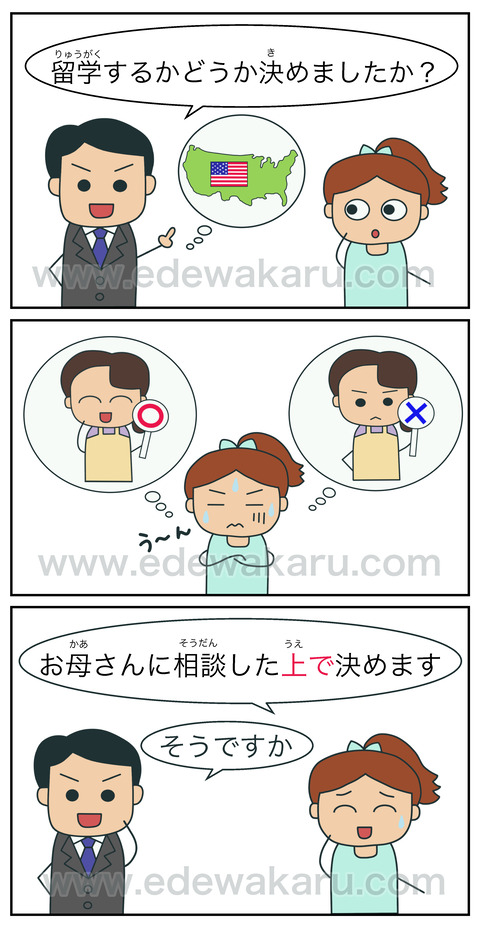
Meaning
First do 〜, then do 〜
Do 〜 first, and then do 〜
How to use it
Verb [た-form] + 上で
Explanation
“〜た上で” is a sentence pattern meaning “do 〜 first, then do 〜.” In the form “Aた上でBする,” it carries the sense that “in order to do B, you first have to do A.” 😮
[Examples]
① I’ll decide after consulting my mother.
[A] consult my mother
[B] decide whether or not to study abroad
→ In order to decide, I first have to consult my mother.
② I’ll contact you after thinking carefully about whether or not to buy this house.
[A] think carefully about whether or not to buy the house
[B] contact you about whether or not to buy the house
[For those with room to explore further]
“〜上で” can also connect to nouns, in the form “Nの上で.” In this case, you have to work out whether “〜上で” means “when doing 〜” or “do 〜 first, then do 〜.” 😨
[Examples]
I’ll decide after the interview.
= I’ll decide after conducting the interview.
Is there anything I should be careful about during the interview?
= Is there anything I should be careful about when being interviewed?
There are several sentence patterns containing “〜上,” so learn to distinguish between them. 😀
(Review: 〜上に)
(Review: 〜上で (Vる + 上で))
In context 4 examples
お母さんに相談した上で決めます
→まずお母さんに相談して、その後決めます(復習:「相談する」「相談にのる」)I’ll decide after consulting my mother. → I’ll consult my mother first, and then decide. (Review: “相談する” and “相談にのる”)
この家を買うかどうか、よく考えた上で連絡します
→この家を買うかどうか、まずよく考えてから連絡しますI’ll contact you after thinking carefully about whether or not to buy this house. → I’ll think carefully first about whether or not to buy this house, and then contact you.
よく考えた上で返事をください
→まずよく考えてから返事をくださいPlease think it over carefully before replying. → Please think it over carefully first, and then reply.
面接をした上で、誰を採用するか決定します
→まず面接をしてから、誰を採用するか決定しますWe’ll decide who to hire after conducting the interviews. → First we’ll conduct the interviews, and then decide who to hire.
Read the original source text
Meaning
まず〜をして、その後で〜する
まず〜をしてから〜する
How to use it
動詞[た形]+上で
Explanation
「〜た上で」は「まず〜してから、〜する」という意味を表す文型です。この文型は
「Aた上でBする」の形で「Bをするためには、まずAをしなければならない」というような意味が含まれます
😮
[例]
①お母さんに相談した
上で
決めます
【A】お母さんに相談する
【B】留学するかどうか決める
→決めるためには、まずお母さんに相談しなければならない
②この家を買うかどうか、よく考えた
上で
連絡します
【A】家を買うかどうか、よく考える
【B】家を買うかどうかを連絡する
【余裕のある人へ】
「〜上で」には名詞接続(めいしせつぞく)もあり、「Nの上で」の形で使われます。この場合、「〜上で」が「〜する場合」か「まず〜てから〜する」のどちらの意味かを考えなければなりません😨
[例]
面接
の上で
決定します
=面接し
た上で
決定します
面接
の上で
注意しなければいけないことはありますか?
=面接を受け
る上で
注意しなければいけないことはありますか?
「〜上」とつく文型はいくつかありますので区別して覚えましょう😀
(復習:〜上に)
(復習:〜上で(Vる+上で))
Usage 2
Read this source entry ↗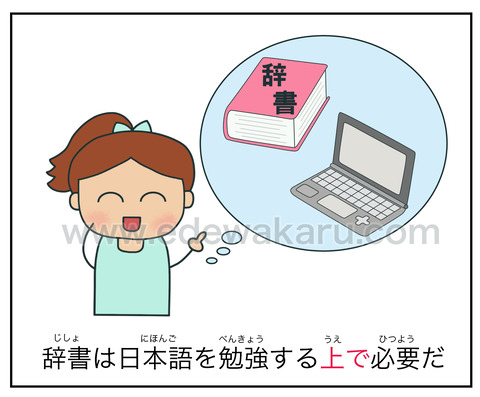
Meaning
when doing 〜
in the process of doing 〜
How to use it
Verb [dictionary form] + 上で
Noun [dictionary form] + の上で
Explanation
“〜上で” is a sentence pattern meaning “when doing 〜.” It is often used when you want to say what to pay attention to or be careful about in that 【situation】 or 【process】. 😊
There are several sentence patterns containing “〜上.” Some are read “うえ,” and others “じょう.” 😨 Also, their meanings differ depending on the particle that follows, so learn to distinguish them from other patterns to avoid confusion. 😉
(Review: 〜によって (distinction))
(Review: 〜上に)
In context 4 examples
辞書は日本語を勉強する上で必要だ
→辞書は日本語を勉強する場合に必要だA dictionary is necessary when studying Japanese. → A dictionary is necessary when studying Japanese.
海外旅行(かいがいりょこう)に行く上で注意しなくちゃいけないことって何?
→海外旅行に行く場合に注意しなくちゃいけないことって何?(復習:口語形「〜なくちゃ」)(復習:口語形「〜って」)What should I be careful about when traveling overseas? → What should I be careful about when traveling overseas? (Review: colloquial form “〜なくちゃ”) (Review: colloquial form “〜って”)
面接を受ける上で準備しなければいけないものはありますか?
→面接を受ける場合に準備しなければいけないものはありますか?(復習:「テストをする」「テストを受ける」)Is there anything I need to prepare when attending an interview? → Is there anything I need to prepare when attending an interview? (Review: “テストをする” and “テストを受ける”)
留学する上で気をつけなければいけないことはたくさんある
→留学する場合に気をつけなければいけないことはたくさんあるThere are many things you have to be careful about when studying abroad. → There are many things you have to be careful about when studying abroad.
Read the original source text
Meaning
〜する場合
〜する過程で
How to use it
動詞[辞書形]+上で
名詞[辞書形]+の上で
Explanation
「〜上で」は「〜する場合〜」という意味を表す文型です。その【場合】や【過程】で、注意することや気をつけることなどを言いたい時にとてもよく使います😊
「〜上」という文型はいくつかあります。読み方も
「うえ」
と読むものと
「じょう」
と読むものがあります😨また、
後ろにくる助詞によって意味が違います
ので、他の文型と混乱しないように区別して覚えておきましょう😉
(復習:〜によって(区別))
(復習:〜上に)
毎日のんびり日本語教師
How to use it
Verb dictionary form + 上で
Explanation
This pattern describes problems that arise when doing something.
The following part describes some kind of problem that arises, or how to deal with that problem.
Notes
The 「上」 series
In context 14 examples
中古車を買う上で注意しなければならないことは何ですか。
What should I be careful about when buying a used car?
企画を実施する上で、これは重要だ。
In carrying out the project, this is important.
西洋文化を理解する上で、キリスト教文化は欠かせない。
Christian culture is indispensable for understanding Western culture.
あの人は計画を遂行する上でどうしても必要な存在だ。
That person is absolutely essential to carrying out the plan.
成功する上で最も大切なのは己と成功者との距離だ。(成功最重要的是自己与成功者的距离。)
The most important thing for success is the distance between oneself and successful people. (The most important thing for success is the distance between oneself and successful people.)
目的を達成する上で足枷となるものを排除しなければならない。
We must eliminate anything that stands in the way of achieving our goal.
失敗は人間が成長する上で必ず通る道だ。
Failure is a road everyone must travel on the way to growing as a person.
お酒の場は本音が出やすく、仕事をする上で重要なことが得られるところだ。
Drinking occasions are places where people are more likely to speak their minds and where you can learn important things for work.
趣味を継続する上で他人に迷惑かけるなんていうのは以ての外。
It is absolutely out of the question to inconvenience others in order to keep up a hobby.
音楽はやっぱり生きていく上で不可欠だと思う。
I think music really is indispensable for living.
成長する上で素直さがあれば、知らないことに謙虚な姿勢で向き合い教えてもらうことができる。
If you are open-minded as you grow, you can approach what you don't know with humility and learn from others.
筋肉を付ける上で最も重要なのはたんぱく質だ。
Protein is the most important thing for building muscle.
経済を学ぶ上で、まず自国の経済を知っておくことは基本です。
When studying economics, it is basic to first learn about your own country's economy.
ホウレンソウは仕事の上での鉄則。(“菠菜”法制—报告联络商量是工作的准则。)
The “report, communicate, and consult” rule is fundamental at work.
Read the original source text
How to use it
動辞形+上で
Explanation
ある物事をする時に生じる問題について述べる文型です。
後件では何らかの問題が生じること、あるいはその問題に対する対応などが述べられます。
Notes
「上」シリーズ
NINJAL 日本語文型データベース
Usage 1
Meaning
Used when you want to say that you do the next action after “〜.” “〜” is often preparation for the next action, expressing that you proceed to the next action on the condition of “〜.”
It is also used in the form “〜上でのN.”
How to use it
Notes
The subject of the sentence before “〜” and the sentence after “〜上で” is the same. Both “〜” and the sentence after “上で” take expressions for intentional actions.
In context 14 examples
受験する大学は、両親とよく相談した上で決めたいです。
I want to decide which university to apply to after discussing it thoroughly with my parents.
試験のときは、問題の指示をよく読んだ上で解答してください。
During the exam, read the instructions for each question carefully before answering.
十分予習した上で授業に出席したほうがよく理解できるはずだ。
You should be able to understand better if you attend class after preparing thoroughly.
選挙では、候補者が訴える政策や主張をよく理解した上で投票するべきだ。
In an election, you should vote after carefully understanding the policies and positions advocated by the candidates.
周辺住民の方々の了解を得た上で、マンション建設工事に着工したいと考えております。
We are considering beginning construction of the apartment building after obtaining the understanding of the surrounding residents.
テニス初心者の方にも丁寧に指導いたします。実際にレッスンを体験なさった上で入会をご検討ください。
We provide careful instruction even for tennis beginners. Please try an actual lesson before considering enrollment.
間違い電話が増えておりますので、電話番号をよくお確かめの上でおかけください。
There have been more wrong-number calls, so please check the phone number carefully before calling.
入学の手続きにつきましては、下記の口座に入学金をお振り込みの上で、窓口に書類をお持ちください。
For enrollment procedures, please transfer the admission fee to the account below, then bring your documents to the counter.
取締役員会議で検討の上で、新規事業の立ち上げが決定された。
After consideration at the board of directors’ meeting, the launch of the new business was decided.
十分な在庫を確保の上で販売を行っておりますが、万一売り切れの際はご容赦ください。
We sell only after securing sufficient stock, but please understand that items may sell out.
本講座はオンラインで開催されますので、インターネットに接続可能なパソコンまたはスマートフォン・タブレット端末をご準備の上で、お申し込みください。
This course will be held online, so please prepare a computer, smartphone, or tablet that can connect to the internet before applying.
中古品であることは双方合意の上での取り引きだったのだから、それが後で問題になることはないはずだ。
Since both parties agreed that the item was secondhand before making the transaction, it should not become an issue later.
議長「最後に、これまでの意見を整理し、その上で採決をしたいと思います」
Chair: “Finally, I would like to organize the opinions expressed so far and then hold a vote.”
ウェブサイト制作のご注文にあたっては、まずプランをご選択ください。その上でご要望に合ったデザインを提案させていただきます。
When ordering website production, please first select a plan. After that, we will propose a design suited to your needs.
Read the original source text
Meaning
~の後で、次の行為をすると言いたいときに使います。「〜」が次の行為の準備であることが多く、「〜」を条件として次の行為に進むということを表します。
「〜上でのN」の形でも使います。
How to use it
Notes
「〜」と「〜上で」の後の文の主語は同じです。「〜」にも「上で」の後の文にも意志的な行為を表す言葉がきます。
Usage 2
Meaning
Used when you want to talk about things that must be considered for an important purpose such as “〜.”
It is also used in the form “〜上でのN.”
How to use it
Vる上で
Nの上で (N is a noun of a suru verb)
Notes
“〜” takes a verb expressing an intentional action. After “〜上で,” a sentence follows that describes what is necessary or important for it, or what presents a problem.
In context 11 examples
留学する上で、事前に何を準備しておけばいいか調べることは重要だ。
When studying abroad, it is important to find out in advance what you should prepare.
健康的な生活を送る上で、栄養バランスの取れた食事は欠かせない。
A nutritionally balanced diet is essential for living a healthy life.
この商談を成功させる上で、どうしてもあなたの協力が必要なんです。
Your cooperation is absolutely necessary to make this business negotiation a success.
過剰なプライドは、生きていく上で邪魔になることが多い。
Excessive pride often gets in the way of living.
これからのまちづくりを考える上では、公共交通機関のあり方を見直す必要がありそうだ。
When thinking about future community development, it seems necessary to reconsider the role of public transportation.
こちらの説明書には、この製品を安全にお使いいただく上での注意点が書かれていますので、ご一読ください。
This instruction manual lists points to keep in mind in order to use this product safely, so please read it.
今回発見された遺跡は、他国文明との比較の上で非常に注目される。
The ruins discovered this time are attracting considerable attention in comparison with the civilizations of other countries.
犯人逮捕の上で重要になってくるのは、証拠品の有無だ。
What becomes important in apprehending the criminal is whether there is physical evidence.
インタビュアー「海外進出の上で一番苦労されたのはどういった点でしょうか」社長「現地のスタッフとのコミュニケーションですね」
Interviewer: “What was the most difficult aspect of expanding overseas?” President: “Communicating with the local staff.”
学校生活の上では、勉強だけでなく友人との関係作りも大切だ。
In school life, building relationships with friends is important as well as studying.
減塩しながらおいしく食べるには、調理の上での工夫も必要だ。
To eat deliciously while reducing salt, ingenuity in cooking is also needed.
Read the original source text
Meaning
大切な〜という目的のためにどうしても考えるべきことなどを言いたいときに使います。
「〜上でのN」の形でも使います。
How to use it
Vる上で
Nの上で(Nは、する動詞のN)
Notes
「〜」には、意志的な行為を表す動詞がきます。「〜上で」の後には、そのために必要なこと・重要なこと・問題となることを表す文がきます。
Usage 3
Meaning
Used when you want to say what the judgment is when viewed from the perspective of “〜,” when making a judgment based on “〜,” or when considering something within the scope of “〜.”
It is also used in the form “〜上でのN.”
How to use it
Nの上で
In context 5 examples
どうしても勝ちたいという相手チームの気迫はすごかった。私たちのチームは、気持ちの上ですでに負けていた。
The opposing team’s determination to win at all costs was incredible. In terms of morale, our team had already lost.
健康診断でいろいろな検査をした。最近疲れやすいので気になっていたが、数値の上で問題はないらしい。
I had various tests during my health checkup. I was concerned because I have been getting tired easily lately, but apparently there is no problem with the numbers.
暦の上ではもう春ですが、肌寒い日が続いています。お元気ですか。
According to the calendar, it is already spring, but chilly days continue. How are you?
日本では、結婚後、戸籍の上では夫の姓だが、仕事では元の姓を名乗っている女性も多くなっている。
In Japan, after marriage, many women are increasing who use their husband’s surname on the family register but their original surname at work.
林田さんとは仕事の上でのつきあいだけで、プライベートで会ったことはない。
My relationship with Ms. Hayashida is strictly work-related; I have never met her privately.
Read the original source text
Meaning
~を見て判断すると・~を根拠として判断すると・~の範囲に限定して考えるとどうかを言いたいときに使います。
「〜上でのN」の形でも使います。
How to use it
Nの上で