くらべてわかる日本語表現文型辞典
Usage 1
Meaning
An expression stating that situation A is due to reason B.
How to use it
Aもの (Aもん)
[Sentence] もの
Notes
[Note 1]
・Often used at the end of sentences in women's and children's speech.
In context 4 examples
「よくそんなに何時間も本を読んでいられるわね。」
「これ、おもしろいんだもの。」“How can you keep reading books for hours and hours?” “Because this is interesting.”
「どうして人参を食べないの?」「だって、嫌いなんだもん。」
“Why don't you eat carrots?” “Because I don't like them.”
「これ、ほしくないの?」「私、同じものを持っているもの…。」
“You don't want this?” “I already have the same thing…”
あなたもやっと父親になったんだもの。しっかりしなければだめよ。
You've finally become a father, after all. You have to be responsible.
Read the original source text
Meaning
ある状況がAを理由にしていることを述べる表現。
How to use it
Aもの(Aもん)
[文]もの
Notes
【注意1】
・女性や子どもの会話の文末によく使われる。
Usage 2
Meaning
A number that the speaker considers large or high goes in A, expressing surprise.
How to use it
AものB
[Noun—no suffix] もの
Explanation
[Contrast 1]
“Aからある” (Meaning 1, p. 65)
“Aからある” means that A is the amount or state that exists now, while “AものB” means simply that the speaker considers the number large or the amount great.
○1000万からある借金をどうやって返すのか。 — How are you going to repay a debt of at least 10 million?
○1000万もの借金をどうやって返すのか。 — How are you going to repay a debt of as much as 10 million?
○彼は10時間もの手術に耐えた。 — He endured an operation lasting as long as 10 hours.
×彼は10時間からある手術に耐えた。 — He endured an operation lasting at least 10 hoursからある.
Notes
[Note 1]
・A is a numeral.
In context 4 examples
彼は1年で1000万もの金を貯めたらしい。
Apparently, he saved as much as 10 million in one year.
会場には5万人もの人が集まった。
As many as 50,000 people gathered at the venue.
遭難した子どもは1週間もの間、何も食べずに生き延びた。
The lost child survived for as long as a week without eating anything.
この半年で3人もの大臣が職を辞した。
As many as three ministers left office in the past six months.
Read the original source text
Meaning
Aには話し手が多い、大きいと思う数値がきて、驚きの気持ちを表す。
How to use it
AものB
[名詞-∅]もの
Explanation
【対比1】
「Aからある」(意味1 P.65)
「Aからある」は今、Aという状態があるという意味で、「AものB」は単にその数が多い、大きいと話し手が思っているという意味である。
○1000万からある借金をどうやって返すのか。
○1000万もの借金をどうやって返すのか。
○彼は10時間もの手術に耐えた。
×彼は10時間からある手術に耐えた。
Notes
【注意1】
・Aは数詞である。
日本語文型辞典
Meaning
Basic information: The kanji 「物」 is used in sense 1 when referring to a concrete object that can be grasped by hand; in other cases, it is usual to write 「もの」.
Used when referring in general, without specifying it, to an object or to something that exists independently of events occurring over time. The uses of 「もの」 and 「こと」 are often hard to distinguish, but the basic difference is whether the expression refers to something that occurs over time. When something concerns an action or event, use 「こと」 rather than 「もの」. For example, say 「話したいことがある」 (“There is something I want to talk about”), not 「話したいものがある」. Similarly, the correct expression is 「たいへんなことが起こった」 (“Something terrible happened”), not 「たいへんなものが起こった」.
Used with verbs such as 「言う」, 「見る」, and 「知る」. Depending on the verb, it means things such as “words,” “knowledge,” or “works.” Besides meaning “to speak,” 「ものを言う」 can also mean “to exert influence.”
「ものがわかる」 in ⑤ means “to have good powers of understanding.”
a. Nというもの
Used with nouns expressing abstract concepts such as 「愛情」 to present them emphatically.
b. Nというものは…だ
Attached to nouns such as 「人間」 and 「幸福」, used to make a general statement about their attributes or nature. The expression 「…というのは」 is also used. As in ③ and ④, the predicate can also be a verb sentence. Depending on the context, it can convey various feelings. In a noun sentence, it can be rephrased as 「…とは…だ」.
Used with the potential form 「V-れる」 or with verbs that carry a potential meaning, such as 「分かる」. An expression that emphasizes inability. Often used with 「…ても」.
Attached to the end of a sentence in casual conversation to give a reason. Often used to assert that the speaker is justified. 「もの」 is often used by young women and children. The even more casual form of 「もの」 is 「もん」, which is used by both men and women (especially younger people). As in ⑦–⑨, it is also often used with 「だって」. When used together with 「だって」, it gives the reason an indulgent, pleading tone. Used mainly by children and young women.
How to use it
もの【physical object】
もの【words, knowledge, works, etc.】
Nというもの
V-れないものはV-れない
…もの/…もん
In context 36 examples
この部屋にはいろいろな物がある。
There are various things in this room.
何かすぐ食べられる物があれば、それでいい。
Anything that can be eaten right away will do.
どうぞ、すきなものをとってください。
Please take whatever you like.
赤ちゃんは、動かないものには興味を示さない。
Babies show no interest in things that don't move.
買いたいものがあるので、帰りにデパートに寄る。
I have something I want to buy, so I'll stop by the department store on my way home.
この料理の本の中には、わたしにできるものはひとつもない。
There isn't a single dish in this cookbook that I can make.
古い蔵書の中でおもしろいものをみつけた。
I found something interesting among my old books.
この写真は彼女のものだ。
This photograph belongs to her.
不思議なものを見たような気がする。
I feel as though I saw something mysterious.
山のすそに、けむりのようなものが見えた。
I saw something like smoke at the foot of the mountain.
子供がものを言うようになった。
The child has started to speak.
あの人はあまりものを知らない。
That person doesn't know much.
学生のころから、ものを書くのがすきだった。
I've liked writing since I was a student.
かれとわたしとは、ものの考え方が違う。
He and I think about things differently.
市役所に苦情を持ち込んだら、たまたまもののわかる人がいて、すぐ解決してくれた。
When I took my complaint to city hall, there happened to be someone there who understood the matter, and they resolved it right away.
(例) 彼の肩書きがものを言う。
(Example) His title carries weight.
彼女は愛国心というものをもっていないのだろうか。
I wonder whether she has no sense of patriotism.
わたしは一度も愛情などというものを感じたことがない。
I have never felt anything like affection.
今まで彼は恐れというものを知らなかった。
Until now, he had known no fear.
人間というものは不可解だ。
Human beings are inscrutable.
男にとって、女というものはいつまでたっても謎だ。
To a man, women will always remain a mystery.
金というものは、なくても困るし、あり過ぎても因る。
Money is troublesome when you don't have any, and troublesome when you have too much.
幸福というものは、あまり続き過ぎると、感じられなくなる。
If happiness lasts too long, you stop being able to feel it.
時間というものは、だれに対しても平等だ。
Time is equal for everyone.
A:これだけお願いしてもだめですか。
B:いくら頼まれても、できないものはできないんだ。A: Even after asking this much, is it still no good? B: No matter how much you ask, what can't be done can't be done.
A:まだわかりませんか。
B:いくら言われても、わからないものはわからないんだ。A: You still don't understand? B: No matter how many times you tell me, what I don't understand, I don't understand.
A:本当にあしたまでに仕上がらないんですか。
B:急がされても、書けないものは書けないんです。A: Is it really impossible to finish by tomorrow? B: Even if you rush me, what I can't write, I can't write.
借りたお金は返しておきました。もらいっぱなしではいやだもの。
I paid back the money I borrowed. I don't like just taking things without giving anything back.
A:展覧会に出品する話は断ったんですか。
B:ええ。しめきりが早くて。わたし、そんなに速くかけないもの。A: Did you turn down the offer to submit a work to the exhibition? B: Yes. The deadline is so soon. I can't draw that fast.
わたし、姉ですもの。弟の心配をするのは当たり前でしょう。
I'm her older sister, after all. It's only natural that I worry about my younger brother.
A:寝坊したから、会社は休んだの。
B:これだもん。いやになるよな。A: You overslept, so you took the day off work? B: That's just how she is. It's so frustrating.
雪が降ったんだもの。行けるわけないでしょう。
It was snowing. There's no way I could go.
A:もうすこしいたら。
B:いっぱいやることがあるんだもの。帰らなくちゃ。A: Why don't you stay a little longer? B: I have so much to do. I have to go home.
A:また、出かけるの。
B:うん。だって、吉田さんも行くんだもの。A: You're going out again? B: Yeah. Because Yoshida is going too.
A:どうして抗議しないんだ。
B:だって仕方がないもの。A: Why don't you protest? B: Because there's nothing I can do about it.
A:冷蔵庫を空にしたの、よっちゃんでしょ。
B:うん、だってお腹すいちゃったんだもん。A: You emptied the refrigerator, didn't you, Yocchan? B: Yeah, because I got hungry.
Read the original source text
Meaning
基本情報説明漢字の「物」が使われるのは、1の中で具体的な手でつかめるような物体を表す場合で、それ以外は、「もの」とするのが普通。
物体、または、時間の過程の中で起こること(できごと)とはかかわりなく存在する何かを、特定せず、一般的にとらえるときに使う。「もの」と「こと」の用法は区別しにくいことが多いが、時間の過程の中で起こることを示すかどうかが基本的な違いとなる。動作やできごとにかかわる場合は「もの」ではなく、「こと」を用いる。たとえば、「話したいものがある」とは言わず、「話したいことがある」とする。同様に、「たいへんなものが起こった」ではなく、「たいへんなことが起こった」とするのが正しい。
「言う」「見る」「知る」などの動詞とともに用いる。動詞に応じて「言葉」「知識」「作品」などの意味を表す。「ものを言う」は、「話す」の外に、力を発揮するという意味の使い方もある。
⑤の「ものがわかる」は「理解力がある」の意味。
a. Nというもの
「愛情」など抽象的な概念を表す名詞を用いて、それを強調的に示すのに用いる。
b. Nというものは…だ
「人間」「幸福」などの名詞に付いて、その属性や性質などを、一般化して述べるのに用いる。「…というのは」という表現も使う。③④のように、動詞文の場合もある。文脈によっては、いろいろな感慨をこめることもある。名詞文の場合は「…とは…だ」に言いかえられる。
可能を表す「V-れる」の形や「分かる」のような可能の意味を持つ動詞を使う。できないことを強調する表現。「…ても」と共に使うことが多い。
くだけた会話中で文末につけて、理由を表す。自分の正当性を主張するために用いることが多い。「もの」は若い女性や子供が使うことが多い。「もの」のさらにくだけた形が「もん」だが、(年齢層の若い)男女とも使う。⑦~⑨のように「だって」とともに使うことも多い。「だって」を一緒に使うと、甘えた調子の理由表現になる。子供、若い女性が主として用いる。
How to use it
もの【物体】
もの【言葉・知識・作品など】
Nというもの
V-れないものはV-れない
…もの/…もん
絵でわかる日本語
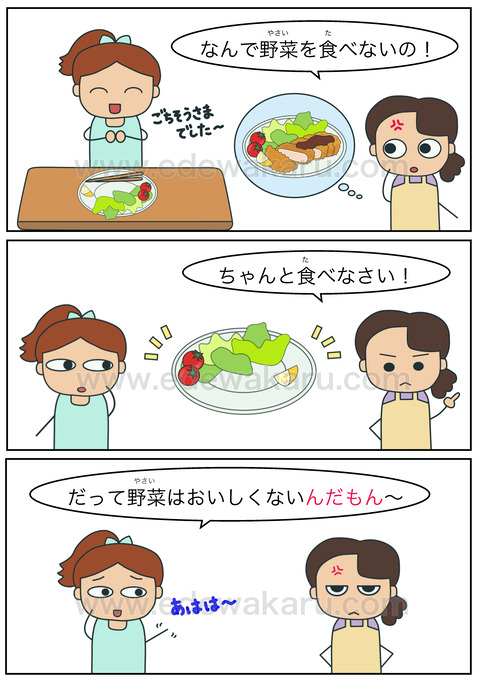
Meaning
Because 〜 / since 〜
How to use it
Verb / adjective / noun [plain form] + もの
* The present affirmative form of な-adjectives and nouns is “ーだもの” (Examples: きれいだもの・学生だもの)
Verb / adjective / noun [plain form] + んだもの
* The present affirmative form of な-adjectives and nouns is “ーなんだもの” (Examples: きれいなんだもの・学生なんだもの)
Explanation
“〜もの” and “〜んだもの” are sentence patterns that express [cause / reason] and mean “〜から・〜ので.” In general, “〜もの・〜んだもの” is used by women. “〜もん” and “〜んだもん” are colloquial forms used by both men and women, and are often used by children too. They are used in conversations with friends and family. “〜もの・〜んだもの” and “〜もん・〜んだもん” are often used together with “だって” or “なんで.”
There are many sentence patterns with “もの,” so review them 😉
[List of patterns that include “もの”]
In context 6 examples
母:なんで野菜を食べないの!?ちゃんと食べなさい娘:だっておいしくないんだもん
Mother: Why aren’t you eating your vegetables?! Eat them properly. Daughter: But they don’t taste good!
A:どうして遅刻したの?B:電車が遅れていたんだもの
A: Why were you late? B: Because the train was delayed.
彼氏:あの映画を見に行こうよ!彼女:嫌よ。だって、こわい映画は嫌いだもの
Boyfriend: Let’s go see that movie! Girlfriend: No. Because I don’t like scary movies.
A:えっ、そんなにたくさん買ったの?B:うん。すごく安かったんだもの
A: Huh, you bought that much? B: Yeah. Because it was really cheap.
A:ラーメンを3杯も食べたの!?B:だってお腹がぺこぺこだったんだもん
A: You ate three bowls of ramen?! B: But I was starving!
A:なんで食べないの?B:だって、このカレーは辛すぎるもん
A: Why aren’t you eating? B: But this curry is too spicy.
Read the original source text
Meaning
〜ので ・〜から
How to use it
動詞・形容詞・名詞[普通形]+もの
*な形容詞・名詞の現在肯定形は「ーだもの」(例:きれいだもの・学生だもの)
動詞・形容詞・名詞[普通形]+んだもの
*な形容詞・名詞の現在肯定形は「ーなんだもの」(例:きれいなんだもの・学生なんだもの)
Explanation
「〜もの」「〜んだもの」は[原因・理由]を表す文型で、「〜から・〜ので」という意味です。一般的に「〜もの・〜んだもの」は、女性が使用します。「
〜もん」「
〜んだもん」は話し言葉で男性にも女性も使われ、子供もよく使います。 友達や家族との会話で使われます。「〜もの・〜んだもの」「〜もん・〜んだもん」は、「
だって」や「
なんで」とよく一緒に使われます。
「もの」がつく文型は、たくさんありますので復習しておきましょう😉
【「もの」がつく文型リスト】
どんなときどう使う 日本語表現文型辞典
Meaning
because
How to use it
[plain form] + ものS
Explanation
から(だ)
学生 B:うん、あの先生の講義つまらないもの。
妹:だって、これ、好きなんだもん。
弟:うん、おなかがすいてるんだもん。
1)くだけた話し言葉。文の終わりにつけて、個人的な理由を言ったり、言い訳をしたりするときに使う。
2)親しい間柄の会話では、 ❸ ❹ のように「もん」が使われる。
3)「んだもん・だって~んだもん」の形がよく使われるが、甘えた感じのする言葉である。
2)In familiar circles, もん is used, as in sentences ❸ and ❹ .
3)Forms んだもん and だって~んだもん are often used but have feel of asking indulgence on part of listener.
1)Informal. Appends to sentence ending to express personal reasons or excuses.
In context 4 examples
A:新しい仕事の話は断ったんですか。B:ええ、今、忙しくて、9月末までにはできないもの。
A: Did you turn down the new job offer? B: Yes, I'm busy right now, so I can't get it done by the end of September.
学生A:今日の授業に出席してなかったね。
Student A: You weren't in class today.
姉:あっ、わたしのベストまた着てる。どうして、黙って着るの。
Older sister: Hey, you're wearing my vest again. Why do you wear it without asking?
(弟の食べ物を見て)姉:え、そんなにたくさん食べるの?
(Looking at her younger brother's food) Older sister: What, you're eating that much?
Read the original source text
Meaning
because
How to use it
〔普通形〕+ものS
Explanation
から(だ)
学生 B:うん、あの先生の講義つまらないもの。
妹:だって、これ、好きなんだもん。
弟:うん、おなかがすいてるんだもん。
1)くだけた話し言葉。文の終わりにつけて、個人的な理由を言ったり、言い訳をしたりするときに使う。
2)親しい間柄の会話では、 ❸ ❹ のように「もん」が使われる。
3)「んだもん・だって~んだもん」の形がよく使われるが、甘えた感じのする言葉である。
2)In familiar circles, もん is used, as in sentences ❸ and ❹ .
3)Forms んだもん and だって~んだもん are often used but have feel of asking indulgence on part of listener.
1)Informal. Appends to sentence ending to express personal reasons or excuses.
日本語NET JLPT文法解説まとめ
Meaning
Because ~
Casual spoken language. Often used by children.
How to use it
V (plain form) + もん
なAな + んだもん
Nな + んだもん
Explanation
”because”
This expression is informal and often used by children.
In context 4 examples
親:一口ちょうだい。
Parent: Give me a bite.
親:野菜もちゃんと食べなさい。
Parent: Make sure you eat your vegetables too.
親:ちょっと、お菓子の食べすぎよ。
Parent: Hey, you're eating too many snacks.
A:どうして、来なかったの?
A: Why didn't you come?
Read the original source text
Meaning
〜から
くだけた話し言葉。子供がよく使う。
How to use it
V(普) + もん
ナAな + んだもん
Nな + んだもん
Explanation
”because”
This expression is informal and often used by children.
毎日のんびり日本語教師
How to use it
(だって) + verb plain form + もの/もん
(だって) + verb plain form + のだもの/んだもの/んだもん
(だって) + verb plain form + のですもの/んですもの/んですもん
(だって) + い-adjective plain form + もの/もん
(だって) + い-adjective plain form + のだもの/んだもの/んだもん
(だって) + い-adjective plain form + のですもの/んですもの/んですもん
(だって) + な-adjective stem + だもの/だもん
(だって) + な-adjective stem + なのだもの/なんだもの/なんだもん
(だって) + な-adjective stem + なのですもの/なんですもの/なんですもん
(だって) + noun + だもの/だもん
(だって) + noun + ですもの/ですもん
(だって) + noun + なのだもの/なんだもの/なんだもん
(だって) + noun + なのですもの/なんですもの/なんですもん
Explanation
Expresses a subjective cause or reason.
もの/もん is an expression used relatively often by women and children.
だって commonly appears at the beginning of the preceding clause. In that case, it conveys the nuance of making a selfish excuse.
Men can also use it, but because it gives a young, childish impression, they rarely use it with anyone other than close acquaintances unless they are doing so deliberately.
もん is colloquial.
Notes
Nothing in particular.
In context 5 examples
早く大人になりたい。だって大人にならないとお姉ちゃんと結婚できないもん。
I want to grow up quickly. Because unless I grow up, I can’t marry my big sister.
諦めてもいいじゃん。だって辛いんだもん。(放弃也可以。因为很辛苦嘛。)
It’s okay to give up, isn’t it? Because it’s hard, you know.
最近ニュース見なくなった。同じ内容ばっかりで見る価値ないもん。
I’ve stopped watching the news lately. It’s always the same stuff, so it’s not worth watching.
このアニメずっと見ちゃう。だって面白いんだもん。
I keep watching this anime. Because it’s so interesting.
女の子大好き。だって男だもん。(最喜欢女孩子了。因为是男人嘛。)
I love girls. Because I’m a guy.
Read the original source text
How to use it
(だって)+動詞普通形+もの/もん
(だって)+動詞普通形+のだもの/んだもの/んだもん
(だって)+動詞普通形+のですもの/んですもの/んですもん
(だって)+イ形容詞普通形+もの/もん
(だって)+イ形容詞普通形+のだもの/んだもの/んだもん
(だって)+イ形容詞普通形+のですもの/んですもの/んですもん
(だって)+ナ形容詞語幹+だもの/だもん
(だって)+ナ形容詞語幹+なのだもの/なんだもの/なんだもん
(だって)+ナ形容詞語幹+なのですもの/なんですもの/なんですもん
(だって)+名詞+だもの/だもん
(だって)+名詞+ですもの/ですもん
(だって)+名詞+なのだもの/なんだもの/なんだもん
(だって)+名詞+なのですもの/なんですもの/なんですもん
Explanation
主観的な原因・理由を表します。
「もの/もん」は女性や子供の方が比較的よく使う表現です。
前項には「だって」がよく呼応します。その場合はわがままに言い訳するようなニュアンスを含みます。
男性でも用いることができますが、若く幼い印象を与えるため、わざとでもない限り親しい人以外に用いることは少ないです。
「もん」は口語です。
Notes
特になし
日本語文型辞典 英語版
Meaning
【もの】The Chinese character 物 is used in cases which show a concrete object which can be grasped in the hand. In other cases, it is usual to use もの.
Commonly used to describe any object, or some incident happening in a process, that exists without special connection to the speaker.
There are many difficult aspects in distinguishing between usage of もの and こと. However, a fundamental difference is whether it shows something that takes place within the process of a time period. In cases which relate to an action or event, こと rather than もの is used. For example, we don’t say 話したいものがある but rather 話したいことがある. Similarly, たいへんなことが起こった is correct, not たいへんなものが起こった.
Used together with such verbs as 言う, 見る, 知る. Depending on the verb this can mean such things as “words,” “knowledge,” or “works.” The phrase ものを言う, apart from meaning “to speak,” can also be used to mean “demonstrate ability.”
(例)彼の肩書きがものを言う。
His title speaks volumes.
ものがわかる in example
(5)
means “has the ability to understand.”
Used to emphasize nouns that express abstract concepts such as “love.”
b. Nというものは...だ
Attached to nouns such as “human beings” and “happiness,” this is used to express a generalization regarding the attributes or nature of that thing. The expression ...というのは is also used. As in examples
(3)
and
(4)
, it is also used in verb phrases. It expresses a variety of strong sentiments depending on the context. In noun phrases, ...とは...だ can be used in its place.
B:いくら頼まれても、できないものはできないんだ。
No matter how many times you ask, something that can’t be done simply can’t be done.
B:いくら言われても、わからないものはわからないんだ。
No matter how many times I’m told, I can’t understand something that I can’t.
B:急がされても、書けないものは書けないんです。
Even if I’m hurried, I can’t write what I can’t write.
Uses the form V-れる, which shows possibility, or verbs like 分かる which contain a notion of possibility. An expression which emphasizes that something cannot be done. Often used with ...ても.
B:ええ。しめきりが早くて。わたし、そんなに速くかけないもの。
Yes. The deadline was so soon. I’m not someone who can draw that fast.
B:これだもん。いやになるよな。
That’s it! You really annoy me.
B:いっぱいやることがあるんだもの。帰らなくちゃ。
I’ve got a lot of things to do so I’ve got to go home.
B:うん。だって、吉田さんも行くんだもの。
After all, Yoshida-san’s going, too.
B:だって仕方がないもの。
Because there’s no way around it.
B:うん、だってお腹すいちゃったんだもん。
Yeah, but I was starving!
Used as an ending for a sentence in casual conversation, this demonstrates a reason. Often used to insist upon the legitimacy (of what one is saying).
Often used by young women or children. Its more casual form is もん and is often used by both men and women in the younger age range. Can also be used with だって, as in examples
(7)
-
(9)
. Used with だって, it shows a reason given in a spoiled manner. It is mainly used by children and young women.
How to use it
1. もの〈thing〉
2. もの〈words, knowledge, works, etc.〉
3. Nというものa. Nというもの
4. V-れないものはV-れない
5. ...もの/...もん
In context 35 examples
この部屋にはいろいろな物がある。
There are various things in this room.
何かすぐ食べられる物があれば、それでいい。
If there is something I can eat quickly, that would be fine.
どうぞ、すきなものをとってください。
Please, take anything you like.
赤ちゃんは、動かないものには興味を示さない。
Babies show no interest in things that do not move.
買いたいものがあるので、帰りにデパートに寄る。
There’s something I want to buy, so I’ll drop by a department store on my way home.
この料理の本の中には、わたしにできるものはひとつもない。
There isn’t a single thing I can make in this cookbook.
古い蔵書の中でおもしろいものをみつけた。
I found something interesting in the collection of old books.
この写真は彼女のものだ。
This photograph is hers.
不思議なものを見たような気がする。
I feel like I have seen something mysterious.
山のすそに、けむりのようなものが見えた。
I could see something like smoke at the base of the mountain.
子供がものを言うようになった。
The child is now able to say things.
あの人はあまりものを知らない。
That person doesn’t know much about things.
学生のころから、ものを書くのがすきだった。
I have enjoyed writing things since I was a student.
かれとわたしとは、ものの考え方が違う。
My way and his way of thinking about things are different.
市役所に苦情を持ち込んだら、たまたまもののわかる人がいて、すぐ解決してくれた。
When I lodged my complaint with the city hall, by chance there was someone there who understood and quickly resolved it for me.
彼女は愛国心というものをもっていないのだろうか。
Doesn’t she have any patriotism?
わたしは一度も愛情などというものを感じたことがない。
I have never once felt anything like what is called love.
今まで彼は恐れというものを知らなかった。
Up until now, he had never known the thing called fear.
人間というものは不可解だ。
People are inscrutable things.
男にとって、女というものはいつまでたっても謎だ。
For a man, a woman will always remain an enigma.
金というものは、なくても困るし、あり過ぎても困る。
Money is a thing that is troubling when there is none, and troubling when there is too much.
幸福というものは、あまり続き過ぎると、感じられなくなる。
Happiness is a thing which, when it goes on for too long, you become unable to feel.
時間というものは、だれに対しても平等だ。
Time is something that is the same for everyone.
A:これだけお願いしてもだめですか。
Will you still refuse me if I only ask for this?
A:まだわかりませんか。
Do you still not understand?
A:本当にあしたまでに仕上がらないんですか。
Will you really not be finished by tomorrow?
借りたお金は返しておきました。もらいっぱなしではいやだもの。
I have paid back the money that I borrowed. I hate to be just on the receiving end.
A:展覧会に出品する話は断ったんですか。
Did you turn down the offer to place something in the exhibition?
わたし、姉ですもの。弟の心配をするのは当たり前でしょう。
I am an older sister. It’s natural that I should worry about my younger brother, right?
A:寝坊したから、会社は休んだの。
I overslept so I took the day off work.
雪が降ったんだもの。行けるわけないでしょう。
It has snowed. There is no way we can go.
A:もうすこしいたら。
Why don’t you stay a while longer?
A:また、出かけるの。
Are you going out again?
A:どうして抗議しないんだ。
Why don’t you object?
A:冷蔵庫を空にしたの、よっちゃんでしょ。
I bet it was you that emptied the refrigerator, Yotchan.
AIUEO JLPT Grammar
Usage 1
Meaning
「もの」is a formal noun used to refer to something specific or to represent a concrete object or thing.
How to use it
Verb + もの; adjective + もの; adjectival noun + な + もの; noun + の + もの
In context 5 examples
簡単なものがいいですね。
Something simple would be nice.
学生に役立つものを提供したい。
I want to provide something useful for the students.
健康に良いものを食べましょう。
Let’s eat something healthy.
旅行のとき、あると便利なものは何ですか。
What is something useful to have when traveling?
緊急用のものを準備しています。
I am preparing emergency supplies.
Read the original source text
Meaning
「もの」is a formal noun used to refer to something specific or to represent a concrete object or thing.
How to use it
動詞+もの形容詞+もの形容動詞な+もの名詞の+もの
Explanation · 日本語
「もの」は、名詞の代わりに使われる形式名詞で、何かを指し示すときや、具体的な事物を表すときに使われます。
Usage 2
Meaning
「もの・もん」is a sentence-ending particle used to express the speaker’s reasons or excuses. Compared to “もの,” “もん” is more casual and colloquial, especially used by women or children, but sometimes used by men in casual contexts.
How to use it
Verb (+ んだ) + もん or もの; adjective (+ んだ) + もん or もの; な-adjective (+ なん)だ + もん or もの; noun (+ なん)だ + もん or もの
In context 5 examples
だって、眠いんだもの。
But I’m sleepy!
行きたくないもの。
I don’t want to go.
彼女が好きなんだもん。
Because I like her!
彼が先生なんだもん。
Because he’s the teacher!
子供なんだもん、仕方ないよ。
He’s just a child, so it can’t be helped.
Read the original source text
Meaning
「もの・もん」is a sentence-ending particle used to express the speaker’s reasons or excuses. Compared to “もの,” “もん” is more casual and colloquial, especially used by women or children, but sometimes used by men in casual contexts.
How to use it
動詞 (+んだ)+もんorもの形容詞 (+んだ)+もんorもの形容動詞 (+なん)だ+もんorもの名詞 (+なん)だ+もんorもの
Explanation · 日本語
「もの・もん」は、話し手が自分の理由や言い訳を表すときに使う終助詞です。「もの」と比べ、「もん」はよりカジュアルで口語的な表現です。特に女性や子供の間で使われることが多いですが、男性もカジュアルな場面で使用することがあります。
Bunpro Grammar Reference
Meaning
Because, Cause
How to use it
Verb + (んだ) + もの(1)
い-Adj + (んだ) + もの(1)
な-Adj + (なん) + だ + もの(1)
Noun + (なん) + だ + もの(1)
(1) もん
Verb + (んです) + もの(1)
い-Adj + (んです) + もの(1)
な-Adj + (なん) + です + もの(1)
Noun + (なん) + です + もの(1)
(1) もん
Nuance
A feminine or childish way to express the cause or reason for something.
Explanation
もの, an extremely common noun in Japanese that means 'thing', can also be used as a sentence ending particle. In these cases, it adds a small amount of emotion to a statement, and presents it as a reason. Due to this, もの is usually translated as 'because', or 'cause'. Literally, it just means 'it's an (A) thing!'. もの is quite casual, so should be avoided in formal situations.
To use もの as 'because', attach it to the end of the plain form of any word.
あなたが言う事は何も信じられないわ。だって、あなたはいつも嘘をつくもの。
I can't believe anything you say. Cause you always lie.
だって、彼女が悪いんだもの。
Cause she is the one in the wrong.
これはあなたにあげられない。大切だもの。
I can't give this to you, cause it is important.
すぐ泣くに決まってるじゃん、まだこどもだもの。
Of course he will cry, cause he is still a child.
To emphasize もの even further, the explanatory んだ (after a verb or い-Adjective), or なんだ (after a な-Adjective or noun) will often be used.
エアコンをつけて寝ているよ。だって、暑くて寝れないんだもの。
I sleep with the A/C on. Cause it's so hot that I can't sleep, you see.
この子は失敗するに決まってるでしょう、まだ新人なんだもの。
Of course this kid will make mistakes. Cause he's still new here.
Caution
もの can be shortened to もん in its use as a sentence ending particle. However, this makes the statement sound far more 'cute' or 'childish'. Due to this, it should be avoided in standard conversation.
もうお腹いっぱいだもん。
Cause I'm already full.
いいよ、お前とはもう遊ばないもん!
It's all good! (Because) I'm not going to play with you anymore! (Showing mild anger/jokingly)
Fun Fact
Although it is not used regularly in standard Japanese, んですもの is a slightly more polite version of んだもの that appears frequently in anime, manga, and novels.
こんなものすぐに壊れるに決まっているじゃないですか、紙から出来てるんですもの。
Of course something like this will break instantly. (Because) it is made of paper.
しょうがないですよ、あの人は何も考えていないんですもの。
We can't help it. (Because) that person doesn't think about anything.
In context 22 examples
- まずいんだもん。
(Because) it tastes bad!
- エアコンをつけて寝ているよ。だって、暑くて寝れないんだもの。
I sleep with the A/C on. Cause it's so hot that I can't sleep, you see.
- だって、彼女が悪いんだもの。
Cause she is the one in the wrong.
- これはあなたにあげられない。大切だもの。
I can't give this to you, cause it is important.
- この子は失敗するに決まってるでしょう、まだ新人なんだもの。
Of course this kid will make mistakes. Cause he's still new here.
- あなたが言う事は何も信じられないわ。だって、あなたはいつも嘘をつくもの。
I can't believe anything you say. Cause you always lie.
- すぐ泣くに決まってるじゃん、まだこどもだもの。
Of course he will cry, cause he is still a child.
- 彼女は嘘をついているもの。
(Because) she is lying.
- 怒らないでね。子供なんだもん。
Don't be angry. (Because) he is just a kid.
- 寒いんだもん。風邪をひいてしまうよ。
(Because) it's freezing. I'm gonna catch a cold, man!
- 「食べすぎ!」って言われても…、美味しいんだもん!
Even if someone says 'you are eating too much!'... (Because) it's delicious! (so I can't help it)
- 僕はそう感じたんだもん。仕方ないじゃない?
(Because) that's how I felt. It can't be helped, right?
- A:「タマはもう一度カーペットにおしっこした!」
B:「だって子猫だもの。」A: 'Tama urinated on the carpet again!' B: '(Because) it's a kitten!'
- A:「どうしてそんなに遅くなったの?」
B:「渋滞が起きたんだもの。」A: 'Why are you so late?' B: '(Because) there was a traffic jam!'
- A:「どうしてあの時計を買わなかったの?」
B:「高すぎたんだもん。」A: 'Why didn't you buy that clock?' B: '(Because) it was too expensive.'
- A:「どうして彼と別れたの?」
B:「だって、ずっと嘘をついていたもの。」A: 'Why did you break up with him?' B: 'Why? (Because) he was lying all the time.'
- A:「どうしてコールしなかったの?」
B:「忙しかったもん。」A: 'Why didn't you call?' B: '(Because) I was busy.'
- A:「なんで何も食べないの? 」
B:「食べたくないもん。」A: 'Why aren't you eating anything?' B: '(Because) I don't want to eat.'
- もうお腹いっぱいだもん。
Cause I'm already full.
- いいよ、お前とはもう遊ばないもん!
It's all good! (Because) I'm not going to play with you anymore! (Showing mild anger/jokingly)
- こんなものすぐに壊れるに決まっているじゃないですか、紙から出来てるんですもの。
Of course something like this will break instantly. (Because) it is made of paper.
- しょうがないですよ、あの人は何も考えていないんですもの。
We can't help it. (Because) that person doesn't think about anything.
文法
Meaning
Because ~
Casual spoken language. Often used by children.
How to use it
V (plain form) + もん
な-adjective + な + んだもん
N + な + んだもん
In context 4 examples
親:一口ちょうだい。
子:やだ、これ、私の大好物だもん。Parent: Give me a bite. Child: No, this is my absolute favorite.
親:野菜もちゃんと食べなさい。
子:えー、だって嫌いなんだもん。Parent: Make sure you eat your vegetables, too. Child: Aww, but I don't like them.
親:ちょっと、お菓子の食べすぎよ。
子:だって、美味しいんだもん。Parent: Hey, you're eating too many sweets. Child: But they're delicious.
A:どうして、来なかったの?
B:だって、知らなかったんだもんA: Why didn't you come? B: Because I didn't know.
Read the original source text
Meaning
〜から
くだけた話し言葉。子供がよく使う。
How to use it
V(普) + もん
ナAな + んだもん
Nな + んだもん
NINJAL 日本語文型データベース
Meaning
This is used to give a reason for something from a personal point of view. It is often used to assert that something is justified because one cannot change the situation and there is nothing to be done about it. It is also used to express empathy by giving a reason that supports what the other person has said.
How to use it
V普通形+もの
i-A普通形+もの
na-A普通形+もの
N普通形+もの
その他
Notes
It is often used at the end of a sentence in the form 「〜もの。」. Usually, it gives a reason for what was said in the preceding sentence. It can also be used not at the end of a sentence, with a claim based on 「〜」 following 「〜もの、」.
It is also often used with 「〜んだ」 attached, in the form 「〜んだもの」.
「〜ものね」 is often used to give a reason expressing empathy with what the other person has said.
In context 25 examples
「ねえ、ご飯、まだ?」「そんなに早くしろって言われても、無理。すぐにはできないもの」
“Hey, is dinner ready yet?” “Even if you tell me to hurry up that much, it's impossible. I can't make it right away, you know.”
「今度の日曜日に由美の家に行くでしょう?」「行かないよ。誘われてないもの」
“You're going to Yumi's house this Sunday, right?” “I'm not going. I wasn't invited, you know.”
娘「首相が好きな食べ物? そんなのなんで知ってるの?」母「だって、テレビで言っていたもの」
Daughter: “The prime minister's favorite food? How would I know something like that?” Mother: “Because they said it on TV.”
姉「ゆきちゃん、明日の運動会に出たいって言ってるけど、無理だよね」母「インフルエンザだったら、出たくても出られないものね」
Older sister: “Yuki says she wants to take part in tomorrow's sports day, but she can't, right?” Mother: “If she has the flu, then even if she wants to participate, she can't, after all.”
美紀「あいつ、学歴、ごまかしていたんだよ。もう信じられない」由里「うん、美紀の気持ちわかる。私だって自分の彼に何回も嘘つかれて信じられなくなったもの」
Miki: “That guy lied about his education. I can't trust him anymore.” Yuri: “Yeah, I understand how you feel, Miki. My own boyfriend lied to me so many times that I stopped being able to trust him too.”
「週末、みんなで海へ行かない? 美香も誘って」「いいね! みんなで行けば楽しいものね」
“Why don't we all go to the beach this weekend? Let's invite Mika too.” “Sounds good! It'll be fun if we all go, after all.”
親「お昼は駅前のラーメン屋に食べに行こうよ」子「えー。別の店がいいな。あそこのラーメンあんまりおいしくないもの」
Parent: “Let's go eat lunch at the ramen shop in front of the station.” Child: “Aw, I'd rather go somewhere else. The ramen there isn't very good, you know.”
夫「早く寝たら」妻「そうだね。遅くまで起きてたら、体に悪いものね」
Husband: “Why don't you go to bed early?” Wife: “You're right. Staying up late is bad for your health, after all.”
「このアニメ、見てないの?」「見てないよ。だってそのアニメ、面白くないもの」
“You haven't watched this anime?” “No. That anime isn't interesting, you see.”
「去年の今頃は、この公園の池、ガチガチに凍ってたよね」「そうだった。去年はほんとに寒かったものね」
“Around this time last year, the pond in this park was frozen solid, wasn't it?” “That's right. It was really cold last year, after all.”
夫「今年の夏は、また北海道へ行こうね。ただ、ホテルは別のところにしよう」妻「そうね。去年泊まったホテル、よくなかったものね」
Husband: “Let's go to Hokkaido again this summer. But let's stay somewhere else.” Wife: “Right. The hotel we stayed at last year wasn't very good, after all.”
「キャッシュレスで払ってる?」「うん、だいたいキャッシュレスで払ってるよ。便利だもの」
“Do you pay cashlessly?” “Yeah, I usually pay cashlessly. It's convenient, after all.”
「駅前の喫茶店、いつも満席で入れないね」「ああ、あそこはケーキがおいしいって有名だもの」
“The coffee shop in front of the station is always full, so we can't get in.” “Yeah, it's famous for its delicious cakes, after all.”
「松田先輩、昨日のパーティー、来たと思ったらすぐ帰っちゃったね」「だって、昨日のパーティー退屈だったもの。時間の無駄って思ったんじゃない?」
“I thought Matsuda-senpai came to the party yesterday, but then he left right away.” “Well, yesterday's party was boring, after all. Don't you think he figured it was a waste of time?”
「あの人気タレント、離婚したんだってね」「ネット情報だけど、夫の方が誠実じゃなかったみたいだものね」
“I heard that popular entertainer got divorced.” “It's just something I read online, but it seems her husband wasn't very sincere, after all.”
母「お隣のおばさんにこの前もらったケーキのお礼、ちゃんと言っておいてよ」娘「社会人だもの、それぐらいわかってます」
Mother: “Make sure you properly thank the lady next door for the cake she gave you the other day.” Daughter: “I'm an adult, so I know at least that much.”
夫「明日の夕方、ご近所に引っ越しの挨拶に行ける?」妻「明日は行けない。仕事、休みじゃないもの」
Husband: “Can you go greet the neighbors about our move tomorrow evening?” Wife: “I can't go tomorrow. It's not my day off, after all.”
孫「僕、昨日、キャンプなかったんだ」祖母「昨日は朝から大雨だったものね。しょうがないね」
Grandson: “I didn't have camp yesterday.” Grandmother: “It was pouring from the morning yesterday, after all. It couldn't be helped.”
「昨日塾に行かなかったの?」「行かなかったよ。昨日は塾に行く日じゃなかったもの」
“You didn't go to cram school yesterday?” “No, I didn't. Yesterday wasn't a day I had to go, after all.”
「こんなにいっぱい注文して食べられるの?」「だって、おなかすいてるんだもの」
“Can you eat all that after ordering so much?” “Well, I'm hungry, after all.”
「何か私に怒ってる?」「貸した本を何回言っても返してくれないんだもの、ふつう怒るでしょ」
“Are you mad at me about something?” “You never return the book I lent you, no matter how many times I ask, so of course I'd be mad.”
親「何回言ったらわかるの。早く掃除しなさい」子「だって、今試験中で忙しいんだもの」
Parent: “How many times do I have to tell you before you understand? Hurry up and clean.” Child: “But I'm busy with exams right now, you know.”
「魚食べないの?」「だって、嫌いなんだもの」
“You're not eating fish?” “Well, I don't like it, you see.”
「どうしたの? 今日は学校へ行かないの?」「だって、いじめっ子がいて行きたくないんだもの」
“What's wrong? Aren't you going to school today?” “Well, there's a bully there, so I don't want to go, you see.”
姉「さっき、何笑ってたの?」妹「お姉ちゃんの格好、すごく変だったんだもの」
Older sister: “What were you laughing about just now?” Younger sister: “Because you looked really funny.”
Read the original source text
Meaning
個人的な観点で物事の理由づけを言うときに使います。自分では状況を変えられず、しかたがないという意味で正当性を主張するときに使うことが多いです。また、相手の発言を支える理由づけを示すことで共感を表すときにも使います。
How to use it
Ⅴ普通形+もの
i-A普通形+もの
na-A普通形+もの
N普通形+もの
その他
Notes
「〜もの。」の形で文末に使うことが多いです。ふつう「〜もの。」の前の文のことについての理由づけを述べます。また、文末に使うのではなく、「〜もの、」の後に、「〜」を理由とする主張を述べることもあります。
「〜んだ」をつけて「〜んだもの」の形でもよく使います。
相手の話に共感する理由づけを示すときは「〜ものね」をよく使います。
IMABI
Nominalizers: の, こと, & もの
Read this IMABI lesson ↗Explanation
Nominalizers: の, こと, & もの
This lesson formally introduces you to the topic of “nominalization,” and specifically through the use of three of the most common nominalizers. First, let’s define both “nominalization” and “nominalizer” for the purpose of this discussion:
Nominalization: The grammatical process of rendering one part of speech, such as a verb or adjective, or even entire phrases and abstract nouns, into a single nominal phrase that functions as a noun, which may be done out of grammatical necessity or for some other purpose.
Nominalizer: There are three primary morphemes which may be used to nominalize something: the particle の, こと, and もの. These morphemes are collectively referred to as dummy nouns (形式名詞).
The Nominalizers の and こと
The nominalizers の and こと are both used to nominalize predicates to have them rendered as nouns syntactically, although the degree to which the resultant “noun” is noun-like is limited. At a basic understanding, the nominalizers の and こと semantically differ largely on perceived objectivity/subjectivity of the resultant statement formed.
An objective perspective is one that is not influenced by personal emotions, static in its relationship to truth statements, whereas a subject perspective would (heavily) interject emotional appeal to whatever statement is being made.
Relating all this to these nominalizers, 事 as a standalone noun1, not to be confused with its dummy function used as a nominalizer, can be translated as “matter/thing,” but it can also be translated as “circumstance.” It is this latter translation that serves as a bridging context with its nominalizer function, which is why it appears in so many constructions involving nominalizing verbal/adjectival predicates for the purpose of denoting factual statements from an objective point of view.
1. 見ることは信ずる2ことである。
Seeing is believing.
Judging whether a statement is objective or subjective is not an “all-or-nothing” dynamic. Rather, certain grammatical structures lean one way or another, creating the syntactical and desired emotional framework for what the speaker is aiming to get across. Here, the underlying structure is XはYである. Here, X and Y must both be nouns, and a sense of grammatical parallelism is enforced to make the resultant definition of X as Y. While believing whether “seeing is believing” can be a subjective debate to be had, within the confines of this sentence, こと is used as opposed to の because 見ること and 信ずること are being treated as distinct entities=circumstances that can be defined.
Meanwhile, a more subjective-leaning construction will likely involve the nominalizer の. Although it does derive from the particle の, as a nominalizer, it functions as a dummy noun. just like こと.
2. お二人が会うのは初めてですか。
Is this the first time you two have met?
The speaker (one asking the question) does not know the nature of the meeting of the two people in question. Truly, [初めてですか] is an educated guess at best, which speaks to the subjectivity of the statement as a whole. Compare this with Ex. 3, which is objectively clear about the circumstance surrounding [会うこと].
3. 私自身マッチングアプリの男性と会うことは初めてで不安です。
It’s my first time meeting a guy on an dating app, and I’m anxious about it.
Subjectivity is not always about there being an emotional appeal in the sentence. Here, the speaker is speaking about their own experience in the making, and descriptions of one’s own emotions are a reflection of one’s reality. Conjecture regarding that reality would be subjective, but, as is a common theme when debating over whether to use こと or の, is irrelevant in the context of this sentence. In the next set of examples, however, the subjectivity behind the claim made in Ex. 5 starkly differs from the generic, objective statement of fact in Ex. 4.
4. カナダが寒いことに気づいた。(Objective)
I just noticed that Canada is cold.
5. カナダってペンギンも生きれるほど寒いのに気づいたんだ!(Subjective)
I realized that Canada is cold enough for penguins to even live!
Next, for Exs. 6-10, こと is the correct nominalizer. In each sentence, the predicate encased in [] is a concrete circumstance whose truth statement is not contingent on emotional biases.
6. [彼が有名ゆうめいな音楽家おんがくかだという]ことを知りませんでした。
I didn’t know that he is a famous musician.
7. [彼女が昨夜遅さくやおそく帰ってきた]ことを知ってた。
I’ve known that she came home late last night.
8. [新鮮しんせんな息いきを吸すう]ことは素晴すばらしい。
Breathing fresh air is wonderful.
9. [警察けいさつが今ここにある]ことは疑うたがえない。
You can’t doubt that there are police here now.
10. [歌う]ことは諦あきらめていただけに[偶然ぐうぜん(に)初舞台はつぶたいを踏ふめた]ことはとても嬉うれしかったです。
Since I had given up singing, being able to debut by chance was very delightful.
For Exs. 11-19, the correct nominalizer is の. The contexts in which の are used are actually more varied than with こと, which is thanks to not being limited to things that are objective statements of reality, which makes it perfect for personal observations that may still be faulty.
11. 恋人こいびとたちは一緒いっしょにサンバを踊おどるのをやめました。
The couple stopped dancing the samba together.
12. 教育を受けるのは当たり前だ。
Receiving an education is only natural.
13. 毎日散歩まいにちさんぽするのは健康けんこうにとてもいいようです。
It seems that going for a walk every day is very good for your health.
14. 容疑者ようぎしゃがその部屋から慌あわてて出てくるのを見ましたよ。
I saw the suspect come out flustered from the room.
15. 宿題をしないで授業じゅぎょうに来るのはよくないです。
It’s not good to come to class without having done our homework.
16. 彼女の電話番号を調べるのに時間がかかった。
It took a lot of time to find her phone number.
17. 日本が経済大国になれたのは、何と言ってもアメリカのおかげではないと思います。
No matter what they say, I don’t think that Japan was able to become an economic power thanks to America.
18. 単純労働でお金を稼ぐのは大変だ。
It is difficult to earn money by simple labor.
19. 明らかに情報をもう一度目を通すのは当然ですよ。
It’s evident that we clearly look over the information once more.
こと & の As Pronouns
A similar yet different environment in which こと vs の is also apparent is when they act more as pronouns as opposed to (dummy) nouns. Here, instead of objectivity/subjectivity being the deciding factor, how exactly they replace the referent noun is what distinguishes them.
By using the pronoun の, it is clear within context that it is replacing a concrete noun that is readily inferable in said context.
By using こと, while it is clear that it means “thing,” what “thing” in particular is in the air, and it is the context that seeks to provide that clarity.
The choice between the two can also affect what sort of structures are used in tandem and how predicates with multiple meanings are ultimately interpreted (Exs. 20-22b.).
20. ドライブ中に聞く曲は、どんなのを聞いていますか。
As for the songs you listen to while driving, what kinds have you been listening to?
21a. 「どんなことを聞きましたか」「亮太君が京都に行ったか聞きました」
“What sort of thing did you ask?” “I asked whether Ryota-kun went to Kyoto.”
22b. 「どんなことを聞きましたか」「亮太君が京都に行っていると聞きました」
“What sort of thing did you hear?” “I asked whether Ryota-kun had gone to Kyoto.”
23. 生うまれたのも育ったの3もニューヨークです。
I was born and raised in New York.
24. 生まれたのは中国だが、国籍はインドネシアだ。
I was born in China, but my nationality is Indonesian.
25. もう一つ君に尋たずねたいことがある。
There’s another thing I’d like to ask you about.
26. 先生、もう一つ伺いたいことがあるんですけれども(よろしいですか)。
Sensei, there is one other thing that I would like to ask about. (Is that okay?)
27. あたし、そんなことはいわんかったわ。(Feminine; dialectical)
I didn’t say anything like that!
28. (あなたが)見たことを話してくださいませんか。
Could you tell me what you saw?
29. 彼女のいうことを真まに受うけたな。
You took her at her word, didn’t you?
Noun + のこと
At a basic understanding, there are two different yet intertwined functions of こと. The first is to focus on a certain action or state as the object of attention. The other is to expand the scope of something to encompass the situation surrounding it. In this latter sense, it abstracts. At face value, this seems like the opposite of focusing. However, this isn’t really the case.
When こと attaches itself to verbs and adjectives, which in both cases could involve an entire sentence, こと packs up these expressions into a noun phrase, making it refer to the action/state at hand. This is the focusing aspect. When it follows a noun, however, it’s following something that is already concrete to some extent. By using こと, which literally means “matter/circumstance,” you are no longer literally talking about the physical entity at hand. Rather, you’re talking about its essence, which is truly the matter at hand.
30. あの事件のことをよく覚えています。
I remember that incident well.
Sentence Note: In this example, the speaker remembers a lot about the incident. If のこと were omitted, the speaker would still remember that the incident happened, but it would not necessarily sound that he/she knows much about the incident.
31. ピザのことをピッツァーと言う人がいます。
There are some people who pronounce “piza” as “pittsā.”
32. この文は現在のことを言っています。
This sentence is talking about the present.
33. 誰の事を指しているんですか。
Who are you referring to?
34. 私たちはまだまだこの大きな地球のことを理解していないのです。
We still do not understand this great planet of ours.
35. 自分のことをどのくらい知っていますか。
How much do you know about yourself?
36. これからのことを考えるのは賢いですね。
It sure is wise to think about the future?
37. 日本語を話せる人の間では常識のことだ。
It’s common sense among Japanese speakers.
38. 僕のことがすき?
Do you like me?
In Ex. 38, the speaker is asking the listener not just that the listener likes “him” in the mere sense of physical attraction. The speaker is asking if that individual likes him at a personal level as well. In the case of 好きだ and 嫌いだ, the use of のこと also helps solve semantic ambiguity between two possible interpretations. If the sentence were just 僕が好き?, it would normally be interpreted as “do you like me?” but it could also mean “Do I like…?” depending on the context. The use of のこと, thus, helps bring clarity to what is the object at hand.
Adverb + ~のこと
Oddly enough, when ~のこと follows adverbs, the resulting phrase is still an adverb, but the emphasis is heightened, as if making the implication of said adverb sound more like a “big deal” than it otherwise would be perceived as.
39. もちろん(のこと)、あいつは失敗した。
Of course that guy failed.]
Adjective + ~こと = Adverb?
長いこと
The phrase 長いこと, literally meaning “being a long (time)” in the context of time, can be used adverbially for a “long time,” much like how “great deal of time” can also be used adverbially in English for the same nuance.
40. 長いこと待つ。
To wait for a long time.
The Nominalizer もの
The nominalizer もの, also seen colloquially as もん, derives from the noun 物, which refers to any thing. Unlike the other nominalizers, the use of もの implies that the statement is undoubtedly true.
41. 油あぶらは水に浮うくものだ。
Oil floats on water.
42. 子犬になりたいものですわ!(Feminine)
I want to become a puppy!
You may also see the nominalizer もの in the pattern よく~たものだ, which is used to refer to habitual actions in the past that the speaker is reminiscing about.
43. よく金曜日に海で泳いだものだね。
I used to swim in the sea on Fridays, you know.
もの・物・者
もの can be anything. This もの can be in particle constructions like above. 物 is a tangible (and possibly living) thing or force, used in many set expressions. When specifically used to refer to people and written in kanji as 者, it is used in a very humble/condescending tone.
44. 物ものの怪けにとりつかれる。
To be possessed by an evil spirit.
45. 物も言いようで角かどが立つ。
People may be offended by the way you speak.
46. 物の数分もしないうちに
In no more than a few minutes.
47. 物言ものいえば唇くちびる寒さむし。(Proverb)
Least said, soonest mended.
48. 早い者もの勝がち。
First come, first served.
As a nominalizer, こと is usually spelled in hiragana. However, 事 is still preferred by a not-so-small minority of writers, and writing in kanji is more common the older the work you are reading is. For means of disambiguating, in this lesson, the nominalizer こと will not be spelled in kanji for easier identification. ↩︎
信ずる is the traditional 連体形 of the verb 信ず, which is the traditional 終止形 of the verb 信じる meaning “to believe.” These so-called zuru-verbs are the traditional equivalent of their modern jiru-verb equivalents. Both constitute a single group that corresponds to suru-verbs which involve the voicing of する upon being attached to the root Sino-Japanese morpheme. ↩︎
It may even be the case that の is used in place of a thing, person, or place. In this case の refers to the city that the speaker was raised in. ↩︎
In context 48 examples
見ることは信ずる2ことである。
Seeing is believing.
お二人が会うのは初めてですか。
Is this the first time you two have met?
私自身マッチングアプリの男性と会うことは初めてで不安です。
It’s my first time meeting a guy on an dating app, and I’m anxious about it.
カナダが寒いことに気づいた。(Objective)
I just noticed that Canada is cold.
カナダってペンギンも生きれるほど寒いのに気づいたんだ!(Subjective)
I realized that Canada is cold enough for penguins to even live!
[彼が有名ゆうめいな音楽家おんがくかだという]ことを知りませんでした。
I didn’t know that he is a famous musician.
[彼女が昨夜遅さくやおそく帰ってきた]ことを知ってた。
I’ve known that she came home late last night.
[新鮮しんせんな息いきを吸すう]ことは素晴すばらしい。
Breathing fresh air is wonderful.
[警察けいさつが今ここにある]ことは疑うたがえない。
You can’t doubt that there are police here now.
[歌う]ことは諦あきらめていただけに[偶然ぐうぜん(に)初舞台はつぶたいを踏ふめた]ことはとても嬉うれしかったです。
Since I had given up singing, being able to debut by chance was very delightful.
恋人こいびとたちは一緒いっしょにサンバを踊おどるのをやめました。
The couple stopped dancing the samba together.
教育を受けるのは当たり前だ。
Receiving an education is only natural.
毎日散歩まいにちさんぽするのは健康けんこうにとてもいいようです。
It seems that going for a walk every day is very good for your health.
容疑者ようぎしゃがその部屋から慌あわてて出てくるのを見ましたよ。
I saw the suspect come out flustered from the room.
宿題をしないで授業じゅぎょうに来るのはよくないです。
It’s not good to come to class without having done our homework.
彼女の電話番号を調べるのに時間がかかった。
It took a lot of time to find her phone number.
日本が経済大国になれたのは、何と言ってもアメリカのおかげではないと思います。
No matter what they say, I don’t think that Japan was able to become an economic power thanks to America.
単純労働でお金を稼ぐのは大変だ。
It is difficult to earn money by simple labor.
明らかに情報をもう一度目を通すのは当然ですよ。
It’s evident that we clearly look over the information once more.
ドライブ中に聞く曲は、どんなのを聞いていますか。
As for the songs you listen to while driving, what kinds have you been listening to?
「どんなことを聞きましたか」「亮太君が京都に行ったか聞きました」
“What sort of thing did you ask?” “I asked whether Ryota-kun went to Kyoto.”
「どんなことを聞きましたか」「亮太君が京都に行っていると聞きました」
“What sort of thing did you hear?” “I asked whether Ryota-kun had gone to Kyoto.”
生うまれたのも育ったの3もニューヨークです。
I was born and raised in New York.
生まれたのは中国だが、国籍はインドネシアだ。
I was born in China, but my nationality is Indonesian.
もう一つ君に尋たずねたいことがある。
There’s another thing I’d like to ask you about.
先生、もう一つ伺いたいことがあるんですけれども(よろしいですか)。
Sensei, there is one other thing that I would like to ask about. (Is that okay?)
あたし、そんなことはいわんかったわ。(Feminine; dialectical)
I didn’t say anything like that!
(あなたが)見たことを話してくださいませんか。
Could you tell me what you saw?
彼女のいうことを真まに受うけたな。
You took her at her word, didn’t you?
あの事件のことをよく覚えています。
I remember that incident well.
ピザのことをピッツァーと言う人がいます。
There are some people who pronounce “piza” as “pittsā.”
この文は現在のことを言っています。
This sentence is talking about the present.
誰の事を指しているんですか。
Who are you referring to?
私たちはまだまだこの大きな地球のことを理解していないのです。
We still do not understand this great planet of ours.
自分のことをどのくらい知っていますか。
How much do you know about yourself?
これからのことを考えるのは賢いですね。
It sure is wise to think about the future?
日本語を話せる人の間では常識のことだ。
It’s common sense among Japanese speakers.
僕のことがすき?
Do you like me?
もちろん(のこと)、あいつは失敗した。
Of course that guy failed.]
長いこと待つ。
To wait for a long time.
油あぶらは水に浮うくものだ。
Oil floats on water.
子犬になりたいものですわ!(Feminine)
I want to become a puppy!
よく金曜日に海で泳いだものだね。
I used to swim in the sea on Fridays, you know.
物ものの怪けにとりつかれる。
To be possessed by an evil spirit.
物も言いようで角かどが立つ。
People may be offended by the way you speak.
物の数分もしないうちに
In no more than a few minutes.
物言ものいえば唇くちびる寒さむし。(Proverb)
Least said, soonest mended.
早い者もの勝がち。
First come, first served.
Combination Particles with もの
Read this IMABI lesson ↗Explanation
Combination Particles with もの
This lesson is about the particle もの and the combination particles associated with it, not about the nouns 物 and 者, although all three words share the same origin.
The Particle もの: Because
The particle もの, colloquially as もん, may mean “because”. This usage is used extensively by women and small children as an alternative to から and may be used conjunction or as a final particle.
1. この景色けしきは懐なつかしいですね。私たちが若い時に出会ったところですもの。
This scenery is nostalgic isn’t it? It’s because this is the place we met when we young.
Sentence Note: Scenes like above would be commonly heard among old people.
2. ねぇ、ねぇ、あのビデオゲーム買ってよ。どうしてもあたしほしいんだもの。
Hey, hey, can you buy that video game? Cause I’ve got to have it.
The particle もの has several other usages.
1. Similar to “will”, it nominalizes a verb.
2. Used with -たい showing wish, it means “would like to do”.
3. Ought to.
4. “よくしたものだ” means “used to”.
3. よく泳いだもんだ。
I used to swim.
4. 丸木まるきは水に浮うくものだ。
A log will float in water.
5. 鯨くじらになりたいものです。
I wish I were a whale.
6. もっとご両親は敬うやまうものですよ。
You should be more respectful to your parents.
7. 私、成人せいじんになったんだもの、少しぐらいお酒を飲んでもいいでしょう。
I’m an adult now, so isn’t it alright for me to have a little liquor to drink?
Combination Particles
Below is a chart of combination particles with the conjunctive particle もの.
~もので Shows reason of action for what happened
~ものか Extremely emphatic negation.
~ないものか shows a feeling of expectation for the realization of an idea and ~たものか shows a sense of confusion.
~ものの “Even though,” signifies the unsatisfactory feeling of the speaker.
~からいいようなものの and ~ば・といいようなものの express “though it’s OK because” and “although it would be for the better if” respectively.
~ものを Although, if only
8. いくつかの欠点けってんはあるものの、彼は天才です。
Even though he has a few flaws, he’s a genius.
9 あんなやつに負けるもんかい。
Like I’d lose to that kind of guy!
10. 負ければ済すむものの、そこまで自分をおとしめることができなかった。
Although it would have ended better if he would have lost, he could not lower himself to such a degree.
11. あんまり嬉うれしかったもんで、何をしてるのかは忘れちまった。(Really casual)
I was so happy that I forgot what I was doing.
12. 一言だけ話せばよかったものを、しゃべりすぎたので、事件に巻まき込まれてしまった。
Although it would have been alright to speak just a word, I accidentally got involved into the matter because I chattered too much.
13. 聞いてくれればよかったものを。
If only he would have listened.
14. さっさと警察に届けりゃいいものを。
If only I had given it to the police promptly.
From 『冷たい誘惑』 by 乃南アサ.
Contraction Note: りゃ is the contraction of れば.
15. もっとうまくできないものか?
Can’t you do better?
16. この仕事は誰に頼たのんだものか。
To whom was this work entrusted?
17. 気づいたからいいようなものの、他の人がいたらどうしただろうか。
Though it is all right that I noticed, what would I do if there were other people?
18. 借金で困っていた友人を、助けようと思えば助けられたものを、見捨ててしまった。
If only I had thought to help my friend who was struggling with debt, I could have helped her, but I accidentally ran out on her.
19. 休めばよかったものを、無理をして働きすぎたので、病気になってしまったよ。
Although I would have been fine if I took a rest, I unreasonably worked too much, so I ended up getting ill.
20. あたしの気持ち、君にわかってたまるものか!
How could you ever know how I’m feeling!?
In context 21 examples
この景色けしきは懐なつかしいですね。私たちが若い時に出会ったところですもの。
This scenery is nostalgic isn’t it? It’s because this is the place we met when we young.
ねぇ、ねぇ、あのビデオゲーム買ってよ。どうしてもあたしほしいんだもの。
Hey, hey, can you buy that video game? Cause I’ve got to have it.
Used with -たい showing wish, it means “would like to do”.
3. Ought to.
“よくしたものだ” means “used to”.
I used to swim.
よく泳いだもんだ。
I used to swim.
丸木まるきは水に浮うくものだ。
A log will float in water.
鯨くじらになりたいものです。
I wish I were a whale.
もっとご両親は敬うやまうものですよ。
You should be more respectful to your parents.
私、成人せいじんになったんだもの、少しぐらいお酒を飲んでもいいでしょう。
I’m an adult now, so isn’t it alright for me to have a little liquor to drink?
いくつかの欠点けってんはあるものの、彼は天才です。
Even though he has a few flaws, he’s a genius.
負ければ済すむものの、そこまで自分をおとしめることができなかった。
Although it would have ended better if he would have lost, he could not lower himself to such a degree.
あんまり嬉うれしかったもんで、何をしてるのかは忘れちまった。(Really casual)
I was so happy that I forgot what I was doing.
一言だけ話せばよかったものを、しゃべりすぎたので、事件に巻まき込まれてしまった。
Although it would have been alright to speak just a word, I accidentally got involved into the matter because I chattered too much.
聞いてくれればよかったものを。
If only he would have listened.
さっさと警察に届けりゃいいものを。
If only I had given it to the police promptly.
もっとうまくできないものか?
Can’t you do better?
この仕事は誰に頼たのんだものか。
To whom was this work entrusted?
気づいたからいいようなものの、他の人がいたらどうしただろうか。
Though it is all right that I noticed, what would I do if there were other people?
借金で困っていた友人を、助けようと思えば助けられたものを、見捨ててしまった。
If only I had thought to help my friend who was struggling with debt, I could have helped her, but I accidentally ran out on her.
休めばよかったものを、無理をして働きすぎたので、病気になってしまったよ。
Although I would have been fine if I took a rest, I unreasonably worked too much, so I ended up getting ill.
あたしの気持ち、君にわかってたまるものか!
How could you ever know how I’m feeling!?