Bunpro Grammar Reference
Usage 1
Meaning
To be, Is
How to use it
Noun + だ
[な]Adjective + だ
Nuance
A casual determiner of what something is.
Explanation
For the most part, だ is the equivalent of 'is' in English. Its role is to strongly express determination or assertion. It is a casual grammar structure, which means that you won't see it in polite sentences.
Technically, だ is an auxiliary verb, a group of words that attach themselves to other words to give them meaning. です has the same role as だ, but です is the one that will be used in polite sentences, and is also one of the first Japanese grammar patterns many people are exposed to.
だ will always follow nouns, or words that behave like nouns, such as な-Adjectives.
アイスクリームだ。
It is ice cream.
お寺だ。
It is a temple.
危険だ。
It is dangerous.
大切だ。
It is important.
Caution
Although です, the polite equivalent of だ, can be seen following い-Adjectives, だ itself will never be used directly after an い-Adjective.
大きいだ。
It is big. (Unnatural Japanese)
大きいです。
It is big. (Natural Japanese)
Caution
While だ is often thought of as the 'casual form' of です, that is actually not entirely true. です is a polite speech word. The official 'formal version' of だ is である. We will learn this grammar point a bit later. である can often be seen in articles, and formal writing, while です is more common in polite speech.
In context 19 examples
- 私だ。
It is me.
- アイスクリームだ。
It is ice cream.
- 危険だ。
It is dangerous.
- 大切だ。
It is important.
- お寺だ。
It is a temple.
- 本だ。
It is a book.
- 猫だ。
(It) is a cat.
- 学生だ。
(I) am a student.
- 綺麗だ。
It is beautiful.
- 海だ。
It is the sea.
- 映画だ。
It is a movie.
- 好きだ。
It is liked.
- 家だ。
It is a house.
- 水だ。
It is water.
- 同じだ。
It is the same.
- 大変だ。
It is terrible.
- 質問だ。
It is a question.
- 大きいだ。
It is big. (Unnatural Japanese)
- 大きいです。
It is big. (Natural Japanese)
Read the original source text
Meaning
To be, Is
How to use it
Noun + だ
[な]Adjective + だ
Nuance
A casual determiner of what something is.
Explanation
For the most part, だ is the equivalent of 'is' in English. Its role is to strongly express determination or assertion. It is a casual grammar structure, which means that you won't see it in polite sentences.
Technically, だ is an auxiliary verb, a group of words that attach themselves to other words to give them meaning. です has the same role as だ, but です is the one that will be used in polite sentences, and is also one of the first Japanese grammar patterns many people are exposed to.
だ will always follow nouns, or words that behave like nouns, such as な-Adjectives.
アイスクリームだ。
It is ice cream.
お寺だ。
It is a temple.
危険だ。
It is dangerous.
大切だ。
It is important.
Caution
Although です, the polite equivalent of だ, can be seen following い-Adjectives, だ itself will never be used directly after an い-Adjective.
大きいだ。
It is big. (Unnatural Japanese)
大きいです。
It is big. (Natural Japanese)
Caution
While だ is often thought of as the 'casual form' of です, that is actually not entirely true. です is a polite speech word. The official 'formal version' of だ is である. We will learn this grammar point a bit later. である can often be seen in articles, and formal writing, while です is more common in polite speech.
Nuance · 日本語
何かが何であるかをカジュアルに限定する品詞。
Usage 2
Meaning
う - Verbs (Past tense)
How to use it
Examples:
[る5]Verb → 座る̶ + った
[う]Verb → 歌う̶ + った
[つ]Verb → 打つ̶ + った
[く]Verb → 歩く̶ + いた
[ぐ]Verb → 泳ぐ̶ + いだ
[ぬ]Verb → 死ぬ̶ + んだ
[ぶ]Verb → 飛ぶ̶ + んだ
[む]Verb → 休む̶ + んだ
[す]Verb → 話す̶ + した
Exceptions:
行く → 行った
する → した
くる → きた
問う → 問うた
請う → 請うた
Examples:
[る5]Verb → 座る̶ + りました
[う]Verb → 歌う̶ + いました
[つ]Verb → 打つ̶ + ちました
[く]Verb → 歩く̶ + きました
[ぐ]Verb → 泳ぐ̶ + ぎました
[ぬ]Verb → 死ぬ̶ + にました
[ぶ]Verb → 飛ぶ̶ + びました
[む]Verb → 休む̶ + みました
[す]Verb → 話す̶ + しました
Exceptions:
行く → 行きました
する → しました
くる → きました
問う → 問いました
請う → 請いました
Nuance
The past form of a multi-conjugation verb, in either its polite or casual variant.
Explanation
To make the past form of a う-Verb in Japanese, just like all other conjugations of う-Verbs, you will need to change the last kana, before adding the auxiliary verb た (casual), or ました (polite). This change in kana is a bit different to other conjugations of う-Verbs, so let's take a look at them for the casual form.
5キロ走った。5キロ走りました。
I ran 5 kilometers. (Example of a verb ending in る)
新しいペンを買った。新しいペンを買いました。
I bought a new pen. (Example of a verb ending in う)
昨日は駅で5分待った。昨日は駅で5分待ちました。
I waited for 5 minutes at the station yesterday. (Example of a verb ending in つ)
ノートに名前を書いた。ノートに名前を書きました。
I wrote my name on the notebook. (Example of a verb ending in く)
テイラーは池で泳いだ。テイラーは池で泳ぎました。
Taylor swam in the pond. (Example of a verb ending in ぐ)
去年、ペットの金魚が死んだ。去年、ペットの金魚が死にました。
My pet goldfish died last year. (Example of a verb ending in ぬ)
冷蔵庫を台所に運んだ。冷蔵庫を台所に運びました。
I carried the refrigerator to the kitchen. (Example of a verb ending in ぶ)
庭をフェンスで囲んだ。庭をフェンスで囲みました。
I surrounded my yard with a fence. (Example of a verb ending in む)
電気を消した。電気を消しました。
I turned off the lights. (Example of a verb ending in す)
As can be seen in these examples, the changes consist of った, いた, いだ, んだ, した (the same as the changes for て form, but using た instead). For the conjugations using だ in place of た, this is simply a sound change in the language that happened over the course of history, to make words easier/smoother to say. It is not the auxiliary verb だ.
For the polite past form of う-Verbs, the change in sound is far more consistent. This only requires a change from the う sound, to the い sound within the same column (from う to い, or from く to き, for example).
新しい漢字を習いました。
I learned a new kanji.
車が動きました。
The car moved.
When た is added to verbs (or any other word), it can have one of three possible meanings.
Past: 過去 - Happened at some point in the past. (Did/Was)
Completion: 完了 - An action that has finished 'happening'. (Done)
Continuation: 存続 - A new state of something that is continuing. (Has been done)
昨日、カラオケで歌を歌った。
I sang a song at karaoke yesterday. (An example of past)
今、コーヒーを頼んだ。
I ordered coffee (just) now. (An example of completion)
乗った自転車が壊れた。
The bike I rode broke, and is still broken. (An example of continuation)
Caution
With う-Verbs, there are a few verbs that are exceptions to the regular conjugation rules. Please check the structure guide for these.
In context 28 examples
- 昨日、本を読んだ。
昨日、本を読みました。I read a book yesterday.
- 車が動きました。
The car moved.
- 新しいペンを買った。新しいペンを買いました。
I bought a new pen. (Example of a verb ending in う)
- 昨日は駅で5分待った。昨日は駅で5分待ちました。
I waited for 5 minutes at the station yesterday. (Example of a verb ending in つ)
- ノートに名前を書いた。ノートに名前を書きました。
I wrote my name on the notebook. (Example of a verb ending in く)
- 電気を消した。電気を消しました。
I turned off the lights. (Example of a verb ending in す)
- 新しい漢字を習いました。
I learned a new kanji.
- 乗った自転車が壊れた。
The bike I rode broke, and is still broken. (An example of continuation)
- 昨日、カラオケで歌を歌った。
I sang a song at karaoke yesterday. (An example of past)
- 5キロ走った。5キロ走りました。
I ran 5 kilometers. (Example of a verb ending in る)
- 今、コーヒーを頼んだ。
I ordered coffee (just) now. (An example of completion)
- テイラーは池で泳いだ。テイラーは池で泳ぎました。
Taylor swam in the pond. (Example of a verb ending in ぐ)
- 庭をフェンスで囲んだ。庭をフェンスで囲みました。
I surrounded my yard with a fence. (Example of a verb ending in む)
- 去年、ペットの金魚が死んだ。去年、ペットの金魚が死にました。
My pet goldfish died last year. (Example of a verb ending in ぬ)
- 冷蔵庫を台所に運んだ。冷蔵庫を台所に運びました。
I carried the refrigerator to the kitchen. (Example of a verb ending in ぶ)
- 牛乳を飲んだ。
牛乳を飲みました。I drank milk.
- ロンドンへ飛んだ。
ロンドンへ飛びました。I flew to London.
- 私たちのチームは勝った!
私たちのチームは勝ちました!Our team won!
- メアリーは日本に帰った。
メアリーは日本に帰りました。Mary returned to Japan.
- ゆいはクッキーを買った。
ゆいはクッキーを買いました。Yui bought cookies.
- 彼は学校へ行った。
彼は学校へ行きました。He went to school.
- 勇者が死んだ!
勇者が死にました!The hero died!
- タイガさんはりゅうじさんと話した。
タイガさんはりゅうじさんと話しました。Taiga spoke with Ryuuji.
- 大学にカフェがあった。
大学にカフェがありました。There was a cafeteria at the university.
- 昨日、すばらしいニュースを聞いた。
昨日、すばらしいニュースを聞きました。Yesterday, I heard amazing news.
- コートを脱いだ。
コートを脱ぎました。I took off my coat.
- 行く → 行った
Went
- 行く → 行きました
Went
Usage 3
Meaning
な-Adjective (Predicate)
How to use it
[な]Adjective + (だ)
Examples:
静か + だ
元気 + だ
[な]Adjective + です
Examples:
静か + です
元気 + です
Nuance
A non-conjugating adjective form that often appears alone, or at the end of sentences when describing the subject.
Explanation
A predicate is a word that describes the topic/subject of a sentence. The Japanese equivalent of this is a 述語, which literally means 'statement word'. As a predicate, な-Adjectives can appear by themselves (when the word they are describing does not need to be stated), or they may be used at the end of a sentence.
It is important to remember that all な-Adjectives can also function as nouns, and therefore tend to sound more like a noun than an adjective, when used as a predicate.
素敵。
It's wonderful.
彼氏は素敵です。
My boyfriend is lovely.
When there are no other words apart from the adjective itself, it comes across similarly to 'It's pretty', or 'It's hated', and similar expressions in English. We just have to guess what the 'it' is from context.
Caution
Unlike い-Adjectives, な-Adjectives change form depending on where they are in the sentence. At the end of a sentence, they will always be followed by だ, or です (except in casual conversation where だ is omitted). However, when used before the word they are describing, they will always be followed by な. Hence the name な-Adjectives.
In many sentences, either は or が could be used to mark the word/words that the predicate is describing. Which one sounds more natural will depend on many factors. In general, if you are specifically pointing out something as being different from other things in the same category, が will be used.
有名な駅は汚いです。
Popular stations are dirty. (In general)
この有名な駅が汚いです。
This popular station is dirty. (Compared to other popular stations)
In this example, が is distinguishing a specific station as having a unique level of dirtiness compared to others. は would sound unnatural in this type of sentence.
Fun Fact
Most な-Adjectives are words of foreign (Chinese/English) origin.
In context 16 examples
- 夜の海は静かだ。
夜の海は静かです。The night sea is quiet.
- 素敵。
It's wonderful.
- 彼氏は素敵です。
My boyfriend is lovely.
- 有名な駅は汚いです。
Popular stations are dirty. (In general)
- この有名な駅が汚いです。
This popular station is dirty. (Compared to other popular stations)
- さいきさんは親切だ。
さいきさんは親切です。Saiki is kind.
- 彼は静かだ。
彼は静かです。He is quiet.
- 私は暇だ。
私は暇です。I am free.
- 海が綺麗だ。
海が綺麗です。The sea is beautiful.
- それは便利だ。
それは便利です。That is convenient.
- 子供たちは元気だ。
子供たちは元気です。The children are lively.
- 今日、レストランは賑やかだ。
今日、レストランは賑やかです。Today, the restaurant is bustling.
- これは簡単だ。
これは簡単です。This is easy.
- りゅうじの部屋は綺麗だ。
りゅうじの部屋は綺麗です。Ryuuji's room is clean.
- それは大変だ。
それは大変です。That is awful.
- 今、暇か。
今、暇ですか。Are you free right now?
Read the original source text
Meaning
な-Adjective (Predicate)
How to use it
[な]Adjective + (だ)
Examples:
静か + だ
元気 + だ
[な]Adjective + です
Examples:
静か + です
元気 + です
Nuance
A non-conjugating adjective form that often appears alone, or at the end of sentences when describing the subject.
Explanation
A predicate is a word that describes the topic/subject of a sentence. The Japanese equivalent of this is a 述語, which literally means 'statement word'. As a predicate, な-Adjectives can appear by themselves (when the word they are describing does not need to be stated), or they may be used at the end of a sentence.
It is important to remember that all な-Adjectives can also function as nouns, and therefore tend to sound more like a noun than an adjective, when used as a predicate.
素敵。
It's wonderful.
彼氏は素敵です。
My boyfriend is lovely.
When there are no other words apart from the adjective itself, it comes across similarly to 'It's pretty', or 'It's hated', and similar expressions in English. We just have to guess what the 'it' is from context.
Caution
Unlike い-Adjectives, な-Adjectives change form depending on where they are in the sentence. At the end of a sentence, they will always be followed by だ, or です (except in casual conversation where だ is omitted). However, when used before the word they are describing, they will always be followed by な. Hence the name な-Adjectives.
In many sentences, either は or が could be used to mark the word/words that the predicate is describing. Which one sounds more natural will depend on many factors. In general, if you are specifically pointing out something as being different from other things in the same category, が will be used.
有名な駅は汚いです。
Popular stations are dirty. (In general)
この有名な駅が汚いです。
This popular station is dirty. (Compared to other popular stations)
In this example, が is distinguishing a specific station as having a unique level of dirtiness compared to others. は would sound unnatural in this type of sentence.
Fun Fact
Most な-Adjectives are words of foreign (Chinese/English) origin.
Nuance · 日本語
一般的には単独、又は文末で主語の説明をするときに使われる形容動詞。
Usage 4
Meaning
To be, Am, Are, Is
How to use it
[な]Adjective + や
Noun + や
Nuance
The Kansai version of a casual determiner of what something is.
Explanation
One of the most basic changes that takes place in 関西弁 is that of the auxiliary verb だ. だ is replaced directly byや, with や keeping exactly the same meaning (asserting that something is true).
As や is a replacement for だ, it will follow all of the same conjugation rules. This means that it will mostly be seen after な-Adjectives, or nouns. It should not be attached to verbs or い-Adjectives, unless as part of a set expression.
や will regularly be seen in many of the same conjugation patterns as だ, meaning that it conjugates in the same way. A few examples of this are やろ(だろ), やったら(だったら), and やけど(だけど).
Caution
As with standard Japanese, particles are regularly dropped in 関西弁. This means that many sentences may appear almost exactly the same as they would in standard Japanese, purely due to omission of the particles that would be different.
Notes
Kansai dialect
In context 15 examples
- ここかそこだ。
ここかそこや。It is here or there.
- この靴可愛いやろ。
Don't you think these shoes are cute?
- やっぱりあの人は綺麗や。
Afterall, that person is beautiful. (Whenever I see that person, I am reminded of their beauty)
- あ、黒猫や!
Look, it's a black cat!
- 私が好きなパンはこれや。
This is the bread that I like.
- 明日やったら行けるよ。
If it's tomorrow, I can go.
- あんたの事が好きや。
I like you.
- 本当は仕事休みたいんやけど 、人手が足りないから全然休めない。
To be honest, I want a day off, but since we are shorthanded, I can't.
- これはあなたの本だ。
これはあなたの本や。This is your book.
- ここがいいだろう?
ここがいいやろう?Here is good, right? / Probably, here is good.
- 私は9時にバナナを食べるんだ。
私は9時にバナナを食べるんや。I eat a banana at 9 o'clock.
- いいえ、結構だ。
いいえ、結構や。No, thank you. (I'm good thank you)
- この中で一番好きな 食べ物は何だ?
この中で一番好きな 食べ物は何や?Out of these (options), what is your favorite food?
- 今日はいい天気だ。
今日はいい天気や。It is such a nice day today.
- 明日はテストだけど、勉強をせずに寝るん。
明日はテストやけど、勉強をせずに寝るんや。There will be a test tomorrow, but I am going to sleep without studying.
Read the original source text
Meaning
To be, Am, Are, Is
How to use it
[な]Adjective + や
Noun + や
Nuance
The Kansai version of a casual determiner of what something is.
Explanation
One of the most basic changes that takes place in 関西弁 is that of the auxiliary verb だ. だ is replaced directly byや, with や keeping exactly the same meaning (asserting that something is true).
As や is a replacement for だ, it will follow all of the same conjugation rules. This means that it will mostly be seen after な-Adjectives, or nouns. It should not be attached to verbs or い-Adjectives, unless as part of a set expression.
や will regularly be seen in many of the same conjugation patterns as だ, meaning that it conjugates in the same way. A few examples of this are やろ(だろ), やったら(だったら), and やけど(だけど).
Caution
As with standard Japanese, particles are regularly dropped in 関西弁. This means that many sentences may appear almost exactly the same as they would in standard Japanese, purely due to omission of the particles that would be different.
Notes
関西弁
Nuance · 日本語
関西でカジュアルに何かが何かであることを断定する際に使われる助動詞。
絵でわかる日本語
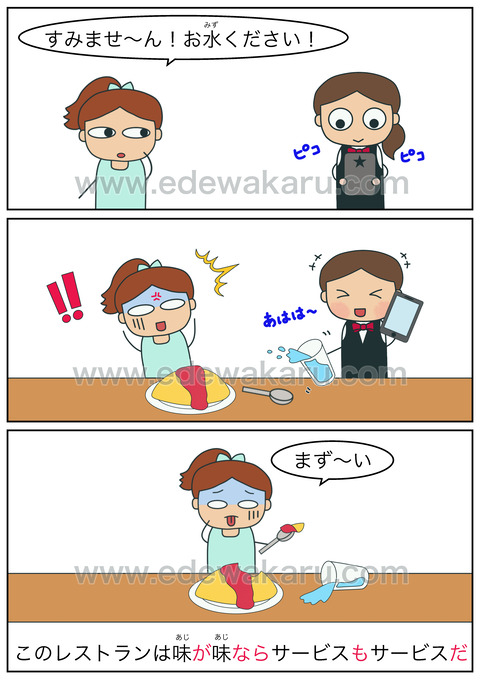
Meaning
Both ~ and ~ are bad
How to use it
Noun [dictionary form] + が + Noun [dictionary form] + なら + Noun [dictionary form] + も + Noun [dictionary form] + だ
Explanation
「AがAならBもBだ」 is a sentence pattern meaning “Both A and B are bad.”
A and B refer to people or things with a close relationship, such as a parent and child or a husband and wife. It is often used to criticize both A and B. 「AがAならBもBだ」 can also be changed to 「AもAならBもBだ」.
[Example]
If the food is bad,
then the service is bad, too.
→
The food is bad,
and the service is bad, too.
「〜が〜なら〜も〜だ」 is a commonly used pattern, so advanced learners should learn it 😉
In context 4 examples
このレストランは味が味ならサービスもサービスだ
→味もサービスも、どちらも最悪だAt this restaurant, the food is bad, and the service is bad, too. → Both the food and the service are terrible.
A:毎日遅刻して、先生に怒られないの?B:怒られないよ〜。先生も毎日遅れてくるしA:…。学生が学生なら、先生も先生ね…
→学生も先生も、どちらもよくないね…A: You’re late every day. Doesn’t the teacher get mad at you? B: No. The teacher is late every day, too. A: ... If the students are like that, and the teacher is like that, too... → Both the students and the teacher are bad...
A:お隣の奥さんは、何かにつけ文句を言ってくるの…B:聞いたところによると、旦那さんもそうらしいわよA:…。妻が妻なら、夫も夫だね
→妻も夫もどちらもよくないねA: The woman next door complains about everything... B: From what I hear, her husband is like that, too. A: ... If the wife is like that, and the husband is like that, too. → Both the wife and the husband are bad.
A:あの家の子は、すごく乱暴よね…B:うん。でも注意すると、母親がキレるんだってA:そうなんだ…親が親なら、子も子だね
→親も子供も、どちらもよくないんだねA: That family’s child is so rough... B: Yeah. But apparently, when someone tells them off, the mother loses her temper. A: I see... Like parent, like child. → Both the parent and the child are bad.
Read the original source text
Meaning
〜も〜も、どちらもよくない
How to use it
名詞[辞書形]+が+名詞[辞書形]なら+名詞[辞書形]+も+名詞[辞書形]だ
Explanation
「AがAならBもBだ」は「AもBもどちらもよくない」という意味の文型です。
「A」と「B」には、[親・子][夫・妻]など、関係が深い人やものが入ります。「A」と「B」の両方を批判する場合によく使われます。「AがAならBもBだ」は「AもAならBもBだ」にチェンジすることもできます。
[例]
味
が
味
なら
サービス
も
サービス
だ
→味
も
味
なら
サービス
も
サービス
だ
「〜が〜なら〜も〜だ」はよく使われる文型ですので、上級レベルの人は覚えておきましょう😉
Yokubi — The Common Grammar Guide (https://yoku.bi)
Explanation
Let's start from sentences in the shape of "A is B". Japanese has two basic "is" words. The grammar term for such words is "copula". Copulas have a dedicated term because they're special verb-like things.
The two copulas in Japanese are だ and です. です is more polite than だ. Despite both being copulas, their usage can be flexible and sometimes optional; you can omit them entirely while still implying an "A is B" type of relationship in your sentences. Especially だ is usually omitted at the end of conversational sentences in modern Japanese.
Unlike English, the state-of-being word goes **after** the word that you're using to describe something, rather than before it. We will see that this applies to most modifier words in Japanese: they apply to the word on their **left**.
The difference between だ and です is generally a matter of politeness and formality. One thing that is important to remember is that while です is the polite version of だ, the two aren't always interchangeable and have a lot of different uses. You cannot always freely replace だ for です (or vice-versa). You will learn some of those uses in later lessons.
Later you will also see です get used in places where English wouldn't allow "is". This is because it can even act just like a filler word with no added meaning.
To state that something is *not*, we turn the だ into ではない and です into ではありません. In speech the では gets slurred into じゃ so じゃない and じゃありません are more common. We will look at what this では does in a later lesson. There exists an alternative to ではありません which is just adding です after ではない/じゃない, the meaning is the same.
Japanese has two basic tenses: the plain tense and the past tense. Since dictionaries list verbs by their plain tense, it's also sometimes called the "dictionary form". In this context, "form" and "tense" are interchangeable.
The past form of だ is だった. The past form of です is でした.
The dictionary form is usually called the present tense or the non-past tense. It's important to remember that it can be used in a lot of situations. Present tense and non-past tense are reasonable names, but don't treat names like rules, sometimes names are confusing. This guide will be using these names interchangeably.
The plain form and past tense usually line up with the English present and past tenses, but they're not used in all the same places. Just remember that English and Japanese often use tenses in very different ways.
In Japanese, ordinary statements about the future use the plain form most of the time. This is where the name "non-past" comes from.
Sometimes the past tense can also be used for things that are already completed like "has become", even if they're hypothetical and haven't happened yet. You might also hear it called "completed tense" or "completed form".
In context 2 examples
ペンだ。
It's a pen.
オレだった!
It was me! (casual)
IMABI
The Copula Verb だ
Read this IMABI lesson ↗Explanation
The Copula Verb だ
断定助動詞(コピュラ)「だ」
The simplest sentence structure in most languages is “X is Y.” In grammar, this is known as a “copular sentence” or a “noun-predicate sentence” (名詞述語文). In Japanese, the copula verb is highly versatile and frequently used. By mastering this single grammar point, you will be able to start forming sentences right away.
Before we begin, to help you navigate this chapter more easily, let’s first cover some basic grammar terminology.
Subject: The person/thing that performs the action or exhibits the description found in the predicate.
Predicate: The part of a sentence that makes a statement about the subject.
Copula: A word used to link the subject and predicate of a sentence.
Noun: In its most basic definition, a word that refers to a person, place, thing, event, substance, or quality.
Auxiliary: An ending that helps construct verbal conjugations.
Plain Speech: Refers to the entire plain speech register in Japanese grammar.
Plain Style: Is the plain speech rendition of any given phrase.
Plain Form: The basic form of any given phrase.
Forms of “To Be” in English
In English, the copula verb is “to be,” and it manifests itself in various forms such as “am,” “are,” “is,” “was, “were,” etc.
i. The dog is a German shepherd.
ii. I am a banker.
iii. That was a fruit.
iv. They were not fossils.
v. Bats are not birds.
Similarly, the Japanese copula verb だ also has various forms, but its conjugations differ significantly from those in English. This is especially evident when it comes to tense.
Tense
In English, there are three primary tenses:
Past tense: Refers to an event or state that occurred in the past.
Present tense: Refers to a current event or state.
Future tense: Refers to an event or state that has yet to occur.
While Japanese does conjugate for tense, it does so very differently. Overall, tense distinctions are more context-dependent. This can largely be attributed to how Japanese only has two primary tenses:
Non-past tense: Refers to an ongoing event or state or one that has yet to occur.
Past tense: Refers to an event or state that occurred in the past.
Affirmation and Negation
Another dynamic that affects how conjugation differs between English and Japanese is how affirmation and negation are handled.
Affirmative sentence: A sentence that positively states that the premise (predicate) is the case.
Negative sentence: A sentence that rejects the premise (predicate).
Introducing Japanese Conjugation w/だ
The copula verb だ will be your first encounter with a conjugatable part of speech and Japanese, and what you will learn in this lesson will serve as an introduction to how Japanese’s base-ending conjugation system works.
The following terms will be used throughout this lesson and in future discussions on how to conjugate:
Base: One of the six forms that a conjugable part of speech (verb, adjective, auxiliary verb, etc.) may take which is then followed by endings (auxiliaries, etc.).
Terminal/Predicative Form: Known in Japanese as the 終止形, it marks the end of a complete sentence/the predicate.
Attributive Form: Known in Japanese as the 連体形, it is used to make a verb, adjective, etc. into a modifier that goes directly before a noun.
Basic Form: The basic form of any given phrase, in other words, is utilized in plain speech as well as in many grammatical circumstances. The basic form encompasses both the predicative and the attributive forms in the context of verbs and adjectives.
Continuative Form: Known in Japanese as the 連用形, it is used with endings pertaining to actions (being) carried out.
The Copula Verb だ
The basic form of the Japanese copula verb is だ1. When translated into English, it represents “to be,” “is,” “am,” “are,” as well as “will be” depending on the context.
In Japanese, the verb must appear at the end of the sentence in its predicative form (終止形). As a result, “X is Y” cannot be rendered as “XだY.” To create a grammatically sound sentence using だ, the correct pattern is XはYだ2.
1. コーヒーは飲み物だ。
Coffee is a drink.
Here, we see that the structure starts off with the subject (X) marked as the topic of discussion by the particle は (→ Lesson 13), followed by the predicate (Y). Predicates must be composed of a part of speech that can conjugate in Japanese, and to accomplish this, だ attaches to the noun that stands for Y.
The Non-Past Tense
非過去形
The non-past (非過去形), also known as the basic form (基本形), of the copula verb だ encompasses both the present and future tense forms3 as well as the base form of the English copula verb “to be.”
FormEnglishJapanese
Baseto beだ
Present Tenseam/are/isだ
Future Tensewill beだ
While the non-past tense in Japanese encompasses both the present tense and the future tense, it is not the case that both interpretations will make sense in any given context. The context will definitely make the interpretation obvious, with time phrases such as “tomorrow” being important for deciphering. As for determining how だ should be interpreted, though, its non-past form (Exs. 2-8) is usually interpreted as being in the present tense, with its future tense (Exs. 9-12) interpretation limited to specific contexts.
In these examples, だ is in its “predicative form,” appearing at the end of the sentence and constitutes the main clause (主節) of the sentence.
Non-Past = Present Tense
2. あれは寺だ。
That over there is a Buddhist temple.
3. それは嘘だ。
That is a lie.
4. これは事実だ。
This is the truth.
5. あの新人は大学生だ。
That newcomer is a college student.
6. あの人は韓国人だ。
That person is Korean.
7. 書道は芸術だ。
Calligraphy is art.
8. 彼はバカだ。
He is an idiot.
One notable observation from these examples is that だ conveys a very direct tone. While this level of directness is more common in written Japanese, it is less frequently heard in spoken conversation, particularly when discussing interpersonal matters. In fact, in conversations where one might use examples like Ex. 5 or Ex. 6, it is often more natural to omit だ altogether; this subtle adjustment reflects the more implicit and less direct style of spoken Japanese (see below).
Non-Past = Future Tense
As can be deduced from these examples, English also exhibits fluctuation between “is” and “will be” in the same contexts in which だ can be viewed as either or in its non-past form, particularly when referring to established dates, which are incidentally also “future” events. This parallels how だ encompasses both the present and future tense in Japanese.
9. 元日は月曜日だ。
New Year’s Day [is/will be] on Monday.
10. 開始日は明日だ。
The start date [is/will be] tomorrow.
11. パーティーは夜だ。
The party [is/will be] at night.
One situation in which the future tense interpretation of だ is obligatory is when a time phrase that only pertains to the future is used.
12. 明日は雨だ。
It will rain tomorrow.4
Omitting Xは
Omitting Xは from the pattern XはYだ is incredibly common. This is especially the case when the subject of the corresponding English sentence is the often meaningless pronoun “it.”
13. 明日だ。
[It’s/it’ll be] tomorrow.
14. あ、猫だ!
Ah, (it’s) a cat!
15. 時間だ。
(It’s) time.
In each of these sentences, “it” functions as a placeholder for the grammatical subject. As Japanese does not necessitate that X always be overtly present in a sentence, no such word exists for that same function. Instead, if X is to be used in Japanese, it must be a regular noun or pronoun. Luckily, if “it” appears in the same capacity as seen in Exs. 13-15 in English, it will correspond to nothing in Japanese.
Omitting だ in Exclamations
As has been stated, the copula だ itself may be dropped from the pattern XはY to avoid sounding too direct, even in the context of conversation had in plain speech. The presence of だ often creates a direct, firm, and at times, a more masculine tone.
Another common context for omitting だ is in exclamatory sentences. In such cases, even the copula verb is often omitted in English.
16. あ、ピカチュウ(だ)!
Ah, (it’s) (a) Pikachu!
17. 開始(だ)!
Start!
18. 動物園(だ)!
(It’s) [a/the] zoo!
19. 引き分け(だ)!
(It’s a) draw!
20. あ、カワウソ(だ)!
Ah, (it’s) an otter!
The Past Tense
過去形
The past tense form (過去形) is created by adding the auxiliary verb ~た to the continuative form (連用形) of a conjugatable part of speech. In the case of the copula verb だ, its continuative form is だっ, resulting in だった. The continuative form is used in this construction because of how it pertains to things (being) carried out, which includes situations that are already over.
FormConjugationBaseAuxiliary
Non-Pastだだ (predicative)n/a
Pastだっただっ (continuative)~た
21. さっきの言語はフランス語だった。
The language just now was French.
22. ここは学校だった。
This here was a school.
23. 正解はAだった。
The correct answer was A.
24. 昨日は水曜日だった。
Yesterday was Wednesday.
25. 彼は子供だった。
He was a child.
The Negative Form
否定形
The negative (non-past) form (否定形) of the copula verb だ is ではない, which translates into English as “is/am/are not.”
In this structure:
The continuative form of だ becomes で.
The negative auxiliary ~ない (not) is added, forming ではない.
It is important to note that で here differs from the continuative form だっ used for the past tense. Instead, で can be thought of as an adverbial form, where the noun-predicate marked by だ acts as an adverb modifying the negative ending. Essentially, this construction describes how X is not Y.
More grammatical peculiarities that can be noted from this structure include:
~ない as an Auxiliary Adjective:
Unlike its English counterpart “not,” which functions as an auxiliary verb, ~ない operates as an auxiliary adjective in Japanese grammar.
The Role of the Particle は:
The particle は appears between the adverbial continuative form で and the auxiliary adjective ~ない. This emphasizes the negative aspect of the sentence and sets a contrastive tone, distinguishing the statement from other possibilities.
FormConjugationBaseAuxiliary
Non-Pastだだ (predicative)n/a
Pastだっただっ (continuative)~た
Negativeではない
じゃない5で (adverbial)~ない
26. これはペンではない。
This is not a pen.
27. コウモリは鳥ではない。
Bats are not birds.
28. クジラは魚ではない。
Whales are not fish.
The Casual Form じゃない
You may have noticed the inclusion of the casual form じゃない, which corresponds to “isn’t/aren’t” in English, in the chart above. This is the casual contraction of ではない, and it is especially common in conversation and informal contexts.
29. 月は惑星じゃない。
The moon isn’t a planet.
30. あれは犬じゃない。
That isn’t a dog.
31. これはお茶じゃない。
This isn’t tea.
ではない vs でない vs じゃない vs じゃあない
As for whether は is absolutely necessary in ではない to make a grammatically correct sentence, especially given that じゃない has less of a contrastive tone than ではない, the short answer is no.
In fact, based on the understanding that は imposes a contrasting tone, でない ought to be viewed as the most basic negative form of the copula. Yet, in both the written language and the spoken language, でない is excessively rare when used in the predicative form (終止形), as it is deemed too stiff and direct. That is not to say a speaker will never intentionally go for this effect, such a speech style is generally avoided.
Contrary to this, でない becomes the default choice when used in the attributive form (連体形)6, with ではない becoming unnatural unless a highly contrastive tone is warranted. As for how one might reinsert the contrastive tone to じゃない, that would be done by rendering it as じゃあない, which you are more likely to hear spoken rather than see written down, but with a rather macho tone.
32a. そうでない星
32b. そうではない星
32a. A star that is not like that
32b. A star that is not like that
33. あの星はそうではない。
That star is not like that.
34. あの物体は星じゃあない。
That object is no~t a star.
The Negative-Past Form
過去の否定形
The negative-past form (過去の否定形) of the copula verb だ is ではなかった, which translates into English as “was not/were not.” In casual speech, this is often shortened to じゃなかった, which translates into English as “wasn’t/weren’t.”
This structure utilizes the past tense conjugation of the auxiliary adjective ~ない, which is ~なかった. While we will delve into adjective conjugation in detail in Lesson 14, the mechanics here are straightforward:
~た is attached to the continuative form of ~ない, which is ~なかっ.
FormConjugationBaseAuxiliar(ies)
Non-Pastだだ (predicative)n/a
Pastだっただっ (continuative)~た
Negativeではない
じゃないで (adverbial)~ない
Negative-Pastではなかった
じゃなかったではなかっ (continuative)~ない+~た
Note that the basis for why は appears in this structure is the same as with its non-past tense rendition discussed previously.
35. その代表は彼女ではなかった。
That representative was not her.
36. 原因は煙草ではなかった。
The cause was not tobacco.
37. あれは模擬試験ではなかった。
That was not a mock exam.
38. 彼は僕の友達じゃなかった。
He wasn’t my friend.
39. あれは水じゃなかった。
That wasn’t water.
40. それは嘘じゃなかった。
That wasn’t a lie.
Previous Lesson
Next Lesson
Contrary to the general norm in second-language Japanese education, the polite forms of the copula are to be discussed next as opposed to being mentioned first. The reasoning for this is that, while it is true that speech register—the level of politeness—affects every aspect of phrasing in the language, plain speech constitutes the basic form of any and all grammatical structures. In fact, polite speech requires that one add politeness markers to those very plain speech structures. By starting with the basic, plain speech conjugations of the copula verb, we are truly starting at ground zero. ↩︎
Technically, the particle が does mark the subject of all clauses, including these basic noun-predicates involving the copula verb, regardless of whether it is actually spoken. However, differentiating between XがYだ and XはYだ requires a deep understanding of the particles が and は themselves along with other grammatical concepts such as deep-sentence structures vs. overt sentence structures, which would all detract from learning how to say “X is Y” at a basic understanding. These particles are covered in Lessons 12-13. ↩︎
“Tense” in Japanese is 時制, whereas ~形 means “form.” When referring to which tense something is being used for, the terms 現在形 (present tense form) and 未来形 (future tense form) are used just as much as 非過去形 (non-past tense form) so as to better relate how a Japanese sentence ought to be interpreted back into English. ↩︎
While the English translation uses the verb “to rain,” the Japanese sentence literally translates as “As for tomorrow, there will be rain.” ↩︎
Casual speech is a subset of plain speech. Speakers are more likely to use casual forms in conversation rather than in writing, whereas plain speech itself more broadly refers to the basic grammatical rendition of grammar points and sentences, being stripped of any politeness markers. Casual forms tend to be contractions or dialectal, slangish, as well as informal derivatives of a common, basic rendition that would constitute as the ‘plain speech’ form. In formal writing, ではない is used as opposed to じゃない, as the latter is seen as an informal contraction; however, in the spoken language, while じゃない is still informal, ではない takes on a more contrastive tone. Additionally, じゃない itself has an even more informal variant: じゃねー, which is often seen in coarse men’s speech. ↩︎
The attributive form, as stated in its definition, enables conjugatable parts of speech to directly modify nominal phrases. However, as understanding how this truly works requires knowing how adjectival grammar and subordinate clauses work in Japanese, this will be the only mention of it in this lesson. ↩︎
In context 41 examples
コーヒーは飲み物だ。
Coffee is a drink.
あれは寺だ。
That over there is a Buddhist temple.
それは嘘だ。
That is a lie.
これは事実だ。
This is the truth.
あの新人は大学生だ。
That newcomer is a college student.
あの人は韓国人だ。
That person is Korean.
書道は芸術だ。
Calligraphy is art.
彼はバカだ。
He is an idiot.
元日は月曜日だ。
New Year’s Day [is/will be] on Monday.
開始日は明日だ。
The start date [is/will be] tomorrow.
パーティーは夜だ。
The party [is/will be] at night.
明日は雨だ。
It will rain tomorrow.4
明日だ。
[It’s/it’ll be] tomorrow.
あ、猫だ!
Ah, (it’s) a cat!
時間だ。
(It’s) time.
あ、ピカチュウ(だ)!
Ah, (it’s) (a) Pikachu!
開始(だ)!
Start!
動物園(だ)!
(It’s) [a/the] zoo!
引き分け(だ)!
(It’s a) draw!
あ、カワウソ(だ)!
Ah, (it’s) an otter!
さっきの言語はフランス語だった。
The language just now was French.
ここは学校だった。
This here was a school.
正解はAだった。
The correct answer was A.
昨日は水曜日だった。
Yesterday was Wednesday.
彼は子供だった。
He was a child.
これはペンではない。
This is not a pen.
コウモリは鳥ではない。
Bats are not birds.
クジラは魚ではない。
Whales are not fish.
月は惑星じゃない。
The moon isn’t a planet.
あれは犬じゃない。
That isn’t a dog.
これはお茶じゃない。
This isn’t tea.
そうでない星
32a. A star that is not like that
そうではない星
32a. A star that is not like that
あの星はそうではない。
That star is not like that.
あの物体は星じゃあない。
That object is no~t a star.
その代表は彼女ではなかった。
That representative was not her.
原因は煙草ではなかった。
The cause was not tobacco.
あれは模擬試験ではなかった。
That was not a mock exam.
彼は僕の友達じゃなかった。
He wasn’t my friend.
あれは水じゃなかった。
That wasn’t water.
それは嘘じゃなかった。
That wasn’t a lie.
Copula Verb Variants
Read this IMABI lesson ↗Explanation
Copula Verb Variants
Having already learned various forms of the copula such as だ and です, it is now time to look at the copula from a different specific, which is the variety of regional and formality-specific variants.
A Closer Look at である, だ, & です
である
である is quite ceremonious and normally used only in writing, but when it is used in the spoken language, it becomes an objective-sounding means of presenting something as fact. A comical example of this is the title of a famous book written by the renowned author 夏目漱石そうせき.
1. 我輩わがはいは猫ねこである。
I am a cat.
Word Note: わがはい is a very pompous, old-fashioned pronoun, and it is well-known from this title in and outside of Japan. Aside from this title, this pronoun is hardly ever used. It is certainly not used in everyday conversation, and even if it were, it would be for comedic relief.
2. 「あの君島という人は、そっちの会社の人なわけですね」
So, that Kimishima guy is someone from that company, no?
From 顔に降りかかる雨 by 桐野夏生.
Grammar Note: The reason why this example is cited is because of a peculiar avoidance of である due to the lack of a need to be formal. Typically, having a whole phrase be a participial for another noun simply involves な. At times, である can be used instead but usually in writing. In a way, it can be viewed as the non-contracted form of this grammar.
However, it is important to note that when you wish to use something like んだ・のだ, which is for explicit emphasis, to “nominalize” an entire phrase, な is obligatory after a noun if it is the final word. If you have それは魚 and want to add んだ, you say それは魚なんだ. These two grammatical situations demonstrate how である and な perform the same function but are not 100% interchangeable.
だ & です
As far as usage is concerned, both だ and です make a declarative sentence. Also, both can act as a final particle to strengthen an appeal to the listener.
3. 日本語は簡単です。
Japanese is easy.
4. 明日は休みだ。
Tomorrow is a break.
5. ぼくはアイスティー。
Note: This sentence can be interpreted differently depending on context. It could show that you want to drink iced tea, brought iced tea, etc.
6. げんき。
I’m fine.
Grammar Note: The omission of the copula is allowed, but the statement loses some of its assertiveness, which could be helpful to not sound rude or blunt in the case of だ.
7. まあ、宿題しゅくだいだ。
Well, it’s homework (time).
8. さあ、出発しゅっぱつです。
Well, it’s (time to) depart.
9. そこで(だ)、君きみは(だ)ね
So, (as for) you…
Grammar Note: The copula may be used as a filler word like in Ex. 9.
10. あっかんべーだ。
Sticking out your tongue.
Culture Note: あっかんべー is where you stick out your tongue while pulling down your eyelid.
11. 明日はですね。
So, tomorrow.
です can make some conjugations polite whereas だ doesn’t! だ is plain and the basic form of adjectives and verbs are already plain.
12a. 簡単ではないだ X
12b. 簡単ではないです。 〇
It’s not easy.
Variants of the Copula
The copula can look quite different depending on where you are and what speech style you are using. Aside from である, だ, and です, the following variants are important to keep in mind, but the only extra two that you will be immediately responsible for are や and じゃ. The honorific variants will be touched on at a later time.
Kansai Region や Southern Japan や、じゃ、ちゃ
Western Japan や、じゃ Colloquial っす
Older generations じゃ Classical にあり・なり
Plain Speech だ Polite Speech です
Respectful でいらっしゃいます Humble でございます
13. うそや。(Kansai)
That’s a lie.
14. 私は田中良治でございます。(Humble)
I am Ryoji Tanaka.
15. 黒木社長でいらっしゃいます。(Honorific)
(He) is President Kurogi.
16. 本当だ。(Plain)
It’s real.
17. 簡単っす。 (Colloquial)
It’s easy.
In context 18 examples
我輩わがはいは猫ねこである。
I am a cat.
「あの君島という人は、そっちの会社の人なわけですね」
So, that Kimishima guy is someone from that company, no?
日本語は簡単です。
Japanese is easy.
明日は休みだ。
Tomorrow is a break.
ぼくはアイスティー。
Note: This sentence can be interpreted differently depending on context. It could show that you want to drink iced tea, brought iced tea, etc.
げんき。
I’m fine.
まあ、宿題しゅくだいだ。
Well, it’s homework (time).
さあ、出発しゅっぱつです。
Well, it’s (time to) depart.
そこで(だ)、君きみは(だ)ね
So, (as for) you…
あっかんべーだ。
Sticking out your tongue.
明日はですね。
So, tomorrow.
簡単ではないだ X
It’s not easy.
簡単ではないです。 〇
It’s not easy.
うそや。(Kansai)
That’s a lie.
私は田中良治でございます。(Humble)
I am Ryoji Tanaka.
黒木社長でいらっしゃいます。(Honorific)
(He) is President Kurogi.
本当だ。(Plain)
It’s real.
簡単っす。 (Colloquial)
It’s easy.
Copula Ellipsis 「だ」の省略
Read this IMABI lesson ↗Explanation
Copula Ellipsis 「だ」の省略
The copula verb だ appears in nominal predicates, arguably the simplest kind of predicate grammatically speaking. In fact, so many sentences can be made by simply uttering Yだ and still get one’s point across.
i. 猫だ。
It’s a cat.
Yet, we also see nearly as many sentences that follow the basic sentence pattern XはYだ in which だ is notably absent.
ii. ううん、あれは猿よ。
No, that there is a monkey.
iii. セス先生が飼っているのは猫。
The (animal) Seth-sensei has as a pet is a cat.
Sociolinguistic motivations for dropping だ, such as the gender of the speaker in ii. being female, are certainly factors worth exploring, but they would only paint part of the picture, as iii. is indicative of a very normal yet still “incomplete” sentence.
This lesson serves to shed light on the mechanics behind だ ellipsis. In doing so, two misconceptions will be addressed:
Writing off “ellipsis” as mere “dropping/deleting” something from a sentence creates a misguided approach to how grammar operates. It is important to understand what surface level and deep level structures refer to and how differences may arise between them.
Ellipsis is not limited to colloquialisms. Other factors may be at play, and writing off “missing elements” as improper can lead to other grossly incorrect generalizations that can make other aspects of Japanese grammar hard to grasp.
What is だ Ellipsis?
As the name suggests, だ ellipsis1 is the omission of だ from a nominal predicate, including predicates that are nominal-like which pertain to “X is Y” statements. The examples below provide a wide array of such predicate types which exhibit だ ellipsis, at least in the sentence-final position.
1. ドラマになりそう。
(This) seems like it could turn into a drama.
2. 対象となるのは下記のとおり。
What (things) will be covered/affected are as follows:
3. 一応そういう感じ。
That’s pretty much it.
4. こんなご馳走は生まれて初めて!
I’ve never had such a feast (as this) in my life!
5. しかも、これは防腐剤なし2!
What’s more, this has zero preservatives!
6. 地震があったのは、午後4時ごろ。
The earthquake struck around 4 PM.
7. 消防当局によると、爆発が起きたのは12階のフードコート。
According to fire department, the explosion occurred in the food court on the 12th floor.
8. 入れるのはバカのみ。
Only idiots may enter.
9. キミはどのポケモンとそっくり?
Which Pokémon do you look like?
10. 赤ちゃんと一緒!
Together with (your) baby!
11. 人間は特別な生き物。
Humans are unique living beings.
12a. 人間も動物だ。〇
12b. 人間も動物。(△)
Humans are also animals.
While many instances of sentence-final ellipsis of だ do occur with Y being a noun (Exs. 3, 6-7, 11-12), many other similar parts of speech and grammar structures – adverbs (Ex. 4), adverbial particles attached to nouns (Ex. 8), adjectival-noun predicates (Exs. 9-10), defunct 終止形 for fossilized grammar (Ex. 5), adverbial nouns (Ex. 2), questions (Ex. 9), auxiliary verbs containing the copula (Ex. 1), etc. – can stand for Y.
There are also pragmatic environments in which the ellipsis of だ after Y, in context, may not be the most natural choice (Ex. 12b). To begin to understand why that is the case, let’s first go over five key properties that define what a “true” noun is in Japanese.
The ability to be the subject or object of a sentence.
The ability to become the predicate by being accompanied with the copula.
The ability to become a modifier via the particle の.
The ability to be modified via the 連体形 of a conjugatable part of speech.
The ability to become the focus of a cleft sentence3.
The alternative Y elements all at least exhibit 2 and most exhibit 3, while adverbs and defunct predicates are the least noun-like by failing to exhibit 1 – excluding, of course, metalinguistic4 scenarios.
13a. 生まれて初めてを経験しました。X
13b. 生まれて初めての経験をしました。〇
I had a first-in-a-lifetime experience.
14a. 砂糖なしを飲んでいました。X
14b. 砂糖なしのを飲んでいました。〇
I was drinking the one that was no-sugar.
As for the Y with 100% noun-likeness, that would, of course, go to true nouns such as 感じ and 動物, but as has been noted, some contextual limitation on ellipsis appears to affect “true nouns” that, ironically, does not seem to affect the non-true nouns.
Now, let’s return to Exs. 11-12 from earlier.
11a. 人間は特別な生き物だ。
11b. 人間は特別な生き物。
Humans are unique living beings.
12a. 人間も動物だ。〇
12b. 人間も動物。(△)
Humans are also animals.
Here, we see two very similar nouns for Y: 生き物 (living thing/being/creature) and 動物 (animals). As for the nature of the statements made, at first glance, the two claims seem very similar. Both sentences pertain to people, and both sentences pertain to people being alive. Yet, in both languages, there is a peculiar difference as to the perceived perception of truth behind the two statements, with the presence of だ cluing us in to a state of mind different than just saying “X is Y.”5
This discrepancy touches on the notion of modality, which is the way in which a language expresses various relationships pertaining to reality and/or what is perceived as the truth. In other words, the choice to go ahead and use だ to assert a statement is, arguably, a statement in and of itself. This “assertive” flare can then be described as its modality.
“Surface Structure” vs “Deep Structure”
While this lesson is about when it is possible to ellipse だ, in answering that case, figuring out how だ works overall, and in light of modality, is quintessential.
The affirmative nature of だ is undeniable, as a declarative sentence by definition is a statement of fact. Even so, other aspects of Japanese grammar such as “が vs は” greatly impact why and how basic statements are made and perceived.
That being said, to begin let’s take one more step back and disambiguate “surface structures” from “deep structures.”
The “surface structure” of a sentence is the way it is actually spoken and/or written, while the “deep structure” of a sentence represents its underlying syntactic structure prior to any transformative operations (devices) are implemented which then affect how the “surface structure” manifests and is then ultimately interpreted by speakers.
Native speakers are such natural experts at the pragmatic interpretation of the final product (surface structures) that the existence of the innerworkings behind it become a blur or even bizarre at times. As an example of how different “deep structures” and “surface structures” are with basic English, consider the following:
a. Do you not speak Japanese? (surface structure)
b. You no speak Japanese? (deep structure)
Through a transformative process called “do-raising” inserts the auxiliary verb “do” to carry tense and agreement features. So, if say past tense were added to the sentence on top of the interrogative function placed on “do,” we would get “did you not speak Japanese?” as opposed to “you no spoke Japanese?”
So, how does this all tie to the use of だ? Its presence in nominal predicates tells us that at a basic understanding of declarative sentences in Japanese, its roll as “to be” ought to be accounted for in the basic sentence structure for said sentence type.
Deep StructurePossible Surface Structures
XがYだXがYだ
XはYだ
XはY
XがY
Yだ
Y
From just one deep structure, we can produce an array of possible surface structures, each possessing its own nuancing based on the individual transformative process(es) undergone. Most importantly, the existence of surface structures without だ does not exclude its presence in the deep structure.
The next misnomer to get out of the way is the exclusion of だ in the deep structure of non-nominal-predicates in Japanese somehow negating its grammatical necessity overall. Consider the following examples.
15a. チョコレートは甘いだか?X
15b. チョコレートは甘い?〇
15c. チョコって甘いの?◎
Intended: Is “chocolate” sweet?
16a. リーさんが日本語を学んでいるだか?XX
16b. リーさんは日本語を学んでいるんですか?
Intended: Is Lee-san learning Japanese?
Neither adjectival nor verbal predicates call for the presence of the copular verb in their deep structures, resulting in the grammaticality judgments of Ex. 15a and Ex, 16a. Worse even, Ex. 16a is given “XX,” a degree of bad to which it has no merit due to other transformative processes being ignored. For both examples, the degree to which every aspect of Japanese phraseology combines and produces a natural sentence is equally important – everything ultimately builds on each other.
To compare, in English, the copula verb “to be” is both present and obligatory with adjectival predicates.
c. Airi is a cat. (Nominal Predicate)
d. Airi is furry. (Adjectival Predicate)
Given the simplistic nature of both predicate types, and without knowledge of other languages, it would appear as though this might be an example of a “universal,” a feature found across all languages. In reality, this is not the case, as many languages throughout the world do not utilize copular elements with adjectival(-like) predicates.
While it may seem that mentioning this is meant to play the devil’s advocate, the opposite is true. Just because something is not a universal does not mean that universals are nonexistent. In other words, the use of “to be” with adjectives in English has no bearing on how だ is not used with Japanese adjectives or pertinent to how it is used entirely.
There is also the issue of each modal expression in a language being unique. If modality helps speakers express how they feel toward stating relationships, then it would be suffice to say that no two modal expressions are exactly the same, even those that are etymologically related. If anything, being etymologically related would make it easier to relate the two as such expressions as a starting point for comparison. All this is being mentioned because of how です, the polite form of だ, has independently evolved the ability to mark politeness in adjectival predicates.
17. 愛莉ちゃんは可愛いです。
Airi-chan is cute.
Whereas だ has both a syntactic role of meaning “to be” and can denote modality by emphasizing the speaker’s affirmation about stating the fact at hand, the use of です after adjectival predicates in this way is purely for expressing modality – in this case, the need to express a statement in a polite manner.
With an objective view of how surface structures and deep structures may differ from each other, we now have bigger and better questions to ask ourselves as we get to the bottom of how to use だ, including when to ellipse it.
The Distribution of だ
To investigate how だ truly works, there are two questions to keep in mind:
How does ellipsing だ affect the grammaticality of a sentence?
What does the interchangeability or lack thereof だ with です tell us about the modality of だ?
Despite all the examples from earlier in which だ could be ellipsed, we have only seen this occur in sentence-final position, creating a huge bias as to whether ellipsis is the norm for だ or not. Additionally, the interchangeability of だ・です may also aid us in understanding the modality behind だ.
Because modality may manifest differently for male/female speakers, as well as between the spoken and written language, example sentences moving forward will be labeled for these environmental factors. Without further ado, let’s answer both questions in respect to three locations だ may appear in a sentence: initial, medial, and final position.
Sentence-Initial6 だ
When だ appears at the start of a sentence, it does so as a conjunction. The resultant conjugations can be categorized by whether だ can be replaced with です.
だ≓ですだ≠です
だから = ですからだと{すると・したら・すれば}
だが = ですがだって
だけど = ですけど
The group of conjunctions to the left all allow interchangeability with です, as each respective conjunctive particle may follow the 終止形 of both copulas. As for why です cannot replace だ in the conjunctions to the right, that can be explained by other grammatical limitations such as politeness markers not appearing in indirect quotation clauses (marked by と) and だって being a contraction.
18. だが、僕の記録が再び高校新記録を超えることはなかった。
But, my score would never beat the high school record again.
19. だから、言ったじゃないですか?
Didn’t I tell you?
20. だって、時間がなかったの!
That’s what I’m saying, I didn’t have time!
21. ですから、ご自由にお入り頂いて問題ありません。
So, feel free to come in.
22. だとすると、犯人は一体誰でしょう?
If that’s the case, who could the culprit be?
As for whether だ can be ellipsed in sentence-initial position, that is only possible with some of these conjugations.
23. 所有主たる主人すら時々は痛い事もある。がそこが訓練である7。
Even my owner, someone who very much has (a beard of his own), has an awful time with it from time to time; but, that’s where discipline comes in.
From 『吾輩は猫である』by 夏目漱石.
While it is possible to use が without だ to mean “however,” this is practically only seen in very stiff writing. Arguably, this instance of だ ellipsis has become rather dated at best.
24. お酒を飲むといい気分になる。けど、飲みすぎると身体に悪いよね。
Drinking alcohol makes you feel good, but drinking too much is bad for your body, you know.
Starting a sentence with けど is not particularly rare, but rather than connecting two independent clauses together, the clause before けど sounds more like a dependent clause in relation to the independent clause that follows, hinting at a semantic difference between が and けど when だ ellipsis occurs.
Note that だ ellipsis is also possible for けど’s uncontracted forms けれど・けれども・けども. It is also worth noting that けど・けども are considered colloquial. Furthermore, all instances of だ ellipsis with all these forms are considered inappropriate for the written language.
25. 韓国語の読み書きは少しできます。けれども、話すことはできません。
I can read and write Korean a little, but I can’t speak it.
だ ellipsis from だと{すると・したら・すれば} , in contrast, is fairly common, but when ellipsis does occur, the balance of emphasis placed on both sides of the conjunction appears to shift to the latter part – potentially offsetting the structural lack of repetition of the prior sentence via だ as a placeholder.
26. 寝ても眠い。だとしたら、寝ても意味ないな。
I’m sleepy even after sleeping. If that’s the case, then there’s no point in even sleeping.
27.「大きな台風が近づいてきてるそうだよ」「だとすれば、今週末の旅程は台無しになるかも!」
“They’re saying a a big typhoon is approaching.” “If that’s the case, that could ruin our trip this weekend!”
28.「セスさんは就職7年目だそうだ。」「とすると今31か。」
“They’re saying Seth has been working here for seven years.” “That makes him 31 now, huh.”
Overall, the pertinence of making it clear that the previous context is understand and maintained as a factor in the phrasing of the continuation of the thought is the deciding factor as to whether だ ellipsis is natural in this environment. Meaning, its ellipsis is predicated on whether its functionality is readily retrievable. The translations provided are also good litmus test for assessing this. When だ is present, “if that’s so” tends to be used, and when だ is ellipsed, “then/if so” tends to be used.
Sentence-Medial だ
The environments in which the copula だ may appear in sentence-medial position are quite varied, with five unique environments for us to investigate.
Environment 1: ~だの~だの & ~だか~だか
だ Ellipsis?: NO
です InterchangEability?: NO
(Partially) grammaticalized8 as part of metalinguistic parallel particles, following any part of speech in said fashion, だ contributes itself to だの, だか, and even だとか. While the exact nuancing and stipulations behind these individual metalinguistic parallel particles differ, だ’s presence makes the listener direct attention to the possible truth statements being posed by the speaker ever more distinctly.
29. 同棲したばかりの彼だが、ここ最近、私の料理には、味が薄いだの、見た目が悪いだの、色々と文句ばかりつけてくる。
So, my boyfriend and I’ve just started living together, but as of late, he’s been constantly complaining about my cooking, saying it’s bland, doesn’t look good, and all sorts of other things.
30. 雨が降るんだか晴れるんだかはっきりしない天気だね。
It’s hard to tell if it’s going to rain or be sunny these days, huh.
31. 運命だとか未来だとか、ってことがどれだけでも、伸ばそうとしても届かない。
No matter how hard I try to think of stuff like my “future” or “destiny,” they’re always so out of reach.
Some worthy observations that can be gleaned from these examples includes ~だか~だか being alternated with ~のだか~のだか to further emphasize the frustration behind “which is it…” This hints at how ~のだ is rather different but similar to だ in terms of modality. We can also see in Ex. 31 how だとか implies that the agent is rambling on about those big topic things in their head and how that rambling [運命だとか未来だとか] itself is encased in a quotation via って.
There is so much more than can be said about how these parallel particle structures work, but that will be left for a future discussion.
ENVIRONMENT 2: Within Quotations
だ ELlipsis?: No/Yes
です Interchangeability: DIRECT QUOTES ONLY
Following up on what the metalinguistic parallel particles from above demonstrate, だ’s copular functionality of presenting matters means that it may also appear in quotes that also do just that. In other words, any declarative statement is a conceptualized notion, and that declarative statement can then be formulated into a quote with one’s citation verb of choice as to the origin and/or nature of the thought.
First, it is important to remember what the difference between a “direct quote” and an “indirect quote.” If a copula is present, great. If not, oh well. In the case of a direct quote, the exact phrasing of what someone has said or being quoted for is replicated, which is also in metalinguistic fashion. Meanwhile, indirect quotes are paraphrases at best. No matter how detailed they are, if they are not precisely the words that came out of the person’s mouth, it is not a direct quote.
32. 委員長を務める東京大学の平田直名誉教授は一連の地震の要因について「さまざまな意見があるものの、調査委員会としては『分からない』というのが答えだ」と説明した上で「個人的な考えとしては悪石島の北側に活火山があり、一帯は火山列である。活火山の深いところでマグマによる活動が発生し、そうした活動でうまれた流体が地震を起きやすくしているのではないか」と指摘しました。(Indirect Quote)
The committee chair, Professor Emeritus Naoshi Hirata of the University of Tokyo explained what the causes of the series of earthquakes occurring by saying, “while there are various opinions (as to why), our answer as to why as the investigation committee is that ‘we don’t know.'” He also added, “as for my personal thoughts on the matter, there is an active volcano to the north of Akusekijima, and the area is part of a volcanic chain. Perhaps the magma activity deep within the active volcano and the fluid dynamics from that activity is making it easier for earthquakes to occur.”
From NHK 7/4/25
33. 平田直名誉教授は、「3日や1週間ではなくてですね、残念ながら、もう少し様子を見ないと、この活動が終息していくかどうかはまあ、わからない。で、一旦静かになってもですね、また活発化するという例はこれまでにもありますから、まあ、そこは十分に備えをしていただきたいと思います」と述べました。
(Direct Quote)
Professor Emeritus Naoshi Hirata stated, “Unfortunately, we won’t know whether this (earthquake) activity will last for (just) three more days to a week; until we observe the situation a little longer, we really won’t know whether (the earthquakes) will, um, subside. And, even if they do die down for a while, there have been cases in the past of increased activity, so, um, I would like for (everyone) to be fully prepared for that.”
From NHK 7/4/25
As is evident from the direct quote, true spoken language is quite different even from written recreations of it (which constitute the majority of example sentences for any discussion in Japanese education), exhibiting plenty of interjections and unique grammatical quirks. Most notably, we even see the copula, albeit the polite copula です, interjected after dependent clauses, but we will return to that oddity in just a bit.
Now, back in our coverage of the citation particle と, we learned that when と inherits copula-like functionality, translating as “as” in contexts in which it does not coexist well with だ due to both overlapping functionality and lowered modality on the grounds of affirmation, だ does not tend to appear. In contexts like Ex. 34, this game of semantics can be quite significant.
34. 現時点で台湾を独立国とみなしてる国は13ヶ国ある。
Currently, there are 13 countries which view Taiwan as an independent country.
This phenomenon largely occurs with nominal predicates, affecting adjectival noun predicates so long as its predicative role is inferable. Otherwise, a morphological restraint is triggered due to だ not being fully indivisible from the root, structurally speaking.
35. 綺麗{だ 〇・∅ (△)9}という女性
Intended: A woman one would call pretty
36. 「やさしい日本語」というのは、普段使われている言葉を、外国人にも分かるように配慮した、簡単な日本語のことです。簡単(だ)といっても、実はけっこう難しいのです。
“Simplified Japanese” is uncomplicated Japanese which uses everyday words in a way that foreigners may comprehend. Although we may call it “easy,” in practice, it is still quite difficult.
With the grammar point ~といっても, だ ellipsis is fairly common for both nominal and adjectival noun predicates, triggered by the declarative nature of だ being a nuance that may be something worth toning down. As we will touch on later as well, while だ is structurally part of these predicates, they can be still inferred as predicates even in its absence.
The desire to tone down the assertive tone of a declarative sentence touches on what is meant by ” low modality in terms of affirmation,” leading to the ellipsis of だ in objective, level-headed grammar patterns which utilize quotative verbs. This allows the speaker to not be overbearing in stating what, hopefully, is factually sound. Common examples include:
~ものと思われる: “to suppose, believe/expect that…”
~のこと10と思う: “to hope that…”
~ものと思われる directly follows predicates of all types. As for how it connects to nominal predicates, の・である usually connect this grammar point to the Y element, with な appearing in highly casual, spoken language.
While ~ことと思う also follows predicates, the particle の is predominantly used to connect it with the Y element of a nominal predicate as well as with adjectival noun predicates, as opposed to using either of the 連体形 available (な・である) – Ex. 38. This helps capture the sense that the speaker is inferring with a certain degree of certainty that what they hope is true is true. We also see similar replacement of the typical predicative portion with verbal predicates like in Ex. 39 in which the honorific form of する, なさる・になる, is replaced with の. This replacement is another layer of tone leveling on top of だ ellipsis.
37. 記憶がないのでかなり前に冷凍したものと思われます。
I have no recollection of it, and so I expect that I would have frozen it quite a while ago.
38. ご無事のことと思います。
I hope you are safe and sound.
39. ご承知のことと思いますが、がんは早期発見し、早期に適切な治療を行うことが大切です。
As I hope you are aware, it is important to detect cancer early and receive proper treatment as soon as possible.
While all of this is true, this only describes declarative, or “light declarative,” quotations. There are still interrogative quotations which utilize か and other quotative particles other than と that affect why or why not だ would appear.
40. この猫の飼い主が誰{だか・か}知らない。
I don’t know who this cat’s owner is.
While we will return to the incompatibility of だ with か in sentence-final position later, it is important to mention how they are compatible in sentence-medial position provided that an interrogative pronoun is in the sentence. Granted, while だ is not “necessary” in the surface iteration, its presence is inherently emphatic, making it sound as though the speaker’s lack of knowing the answer to the question is very much the case but not their problem.
41. サンタが魔法使いだなんて聞いたことないね。
Huh, I’ve never heard of Santa being a wizard.
Here, なんて can be viewed as an emphatic quotative particle, highlighting the fact that the speaker has never heard of [サンタが魔法使いだ] being a thing. In other instances, though, it functions more like an emphatic version of など (Ex. 37a), which ought not be confused with its quotative function (Ex. 37b).
42a. カタルーニャ語なんて聞いたことなあ。
42b. カタルーニャ語だなんて聞いたことなあ。
42a. Huh, I’ve never heard of Catalan before.
42b. Huh, I’ve never heard of (that) being Catalan.
Contexts such as those in Ex. 42 are fairly straightforward examples of how だ clearly functions as the copula of its clause when said function is called for, but this ironically gets overshadowed by its metalinguistic application which pops up again with emphatic quotative particles, though notably not grammaticalized with them per se.
43. こんなに美味しい(だ)11なんて知らなかった!
Learners are just as complexed by だ’s optional12 appearance in this context as natives are complexed in how to explain it, as “metalinguistic utterances” are hardly ever touched on outside of linguistic discussions. This has led to considerable confusion on, ironically, how to define だ. Suffice to say, though, the metalinguistic rephrasing onset by だ is a device in and of itself to help better conceptualize the matter at hand as being worth such an emotional response.
Conceptualization is awfully akin to nominalization. Indeed, metalinguistic expressions, regardless of what composes them, do exemplify the characteristics of a noun that were mentioned earlier provided the metalinguistic statement is clearly of that vein. This would also help explain why だ appears after predicate types it would otherwise not.
ENVIRONMENT 3: Followed by a Conjunctive Particle
だ Ellipsis?: NO
です InterchangEability?: YES
When the copula だ appears at the end of a dependent clause, whether it be in its te-form or followed by a conjunctive particle like が or し, it cannot be ellipsed, but it does exhibit interchangeability with です for the latter scenario with conjunctive particles, as we already saw when going over how such combinations may appear in sentence-initial position.
44. 爆発が起きたのは、肉を焼く、炭を熾すための「炭場」と呼ばれるスペースで、19日の正午ごろ、従業員1人が炭を熾していたことが分かっています。
The explosion occurred in an area known as the “charcoal area,” where meat is grilled and fires are started with charcoal, and what is known (so far) is that an employee was lighting charcoal around noon on the 19th.
From NHK 5/20/25.
45. 日本は面白いし、綺麗{だ・です}し、大好きです。
Japan is so fascinating and pretty, I love it.
46. きょうは思い切り遊ぶぞと言いたいところ{だ・です}が、明日から試験{だ・です}から、我慢して勉強することにしました。
As much as I would love to say, “I’m gonna have all the fun I can today,” since I have a test tomorrow, I’ve chosen to just deal with it and study.
While there is observable だ ellipsis in this environment when placed in sentence-initial position, albeit minor, this is not possible here, as だ is what allows the preceding nominal predicate to connect to the following independent clause, and so its declarative functionality cannot be ignored.
Incidentally, だ is so prevalent with conjunctive particles that it even appears with those partially derived from dummy nouns in which the 連体形 な would normally be used. In addition to だもんで mentioned earlier, there is also だのに, which although not allowed in prescriptive grammar, is fairly common in the wild13.
47. 責任の有無もしくはたれに責任があるのかという論議はまず憲法論からはじめられるべきだのに、それが怠られているように思えるのは、私のひがめだろうか。
Is it just my bias for it seeming to me as though argumentation on whether there is onus on anyone, or who is liable, should first begin with constitutional theory yet that is precisely what is being neglected?
From 『この国のかたち』by 司馬遼太郎.
It also just so happens that Ex. 47 shows how だ cannot be ellipsed mid-sentence even when followed by a conjunctive particle when it itself is a part of an auxiliary verb.
Environment 4: As An Interjection
だ EllipSIS?: NOT ELLiPSIS BUT OPTIONAL
です InterchangeabilitY?: YES
Deriving from its metalinguistic application, there are contexts in which だ is undeniably interjectory in nature, and in this capacity, the speaker is directed to what exactly has just been uttered. In this context, it is a dependent clause being highlighted, most often but not exclusively composed of just a conjunction.
48. ところがだ、ネタがないんだよ!
Nevertheless, we have no material!
49. 「大丈夫だとは思うが、勘違いしないでほしいから、言っておく。これはだね、脇毛だよ?」
While I’m sure everything is fine, I’ll just say this since I don’t want there to be any misunderstanding, this is armpit hair, you hear?
50. それに、だ・・・たとえ知っていたとしても 話すことは決してないだろうな。
Besides… even if (he) were to have known about this, (he)’d never talk about it.
The interjectory nature of this usage of だ is very similar to that of a final particle14, and as seen in Ex. 49, final particles may be used in tandem, but because of its interchangeability with です in this environment, outright labeling it as such is insufficient, as final particles do not change form based on speech register. If anything, many final particles are nearly absent in entire registers (most notably honorific speech).
Sociolinguistic Note: The interjectory use of だ is typical of male speech, whereas the interjectory use of です is unisexual.
Environment 5: InVerted Clauses
だ Ellipsis?: NOT ELLIPSIS BUT OPTIONAL
です Interchangeability?: YES
When a dependent clause is inverted and stated last, the “now” sentence-final dependent clause can be optionally followed by だ, and its interchangeability with です is upheld, albeit with a softened tone in the case of the latter.
51. 死んでも君を守る、何があってもだ!
I’ll protect you even if it means dying, no matter what!
The same can also be said if the independent clause that would normally follow but is ellipsed. In this scenario, we see that だ・です retain their copular function, making it clear that their opinion stands with the condition left dangling.
52a. 男は絶対的に女を殴ってはならないと思う。[何があっても]だ。
52b. 男は絶対的に女を殴ってはならないと思う。[何があっても]です。
I believe men should absolutely never hit women. No matter what.
Incidentally, with the predicate being omitted and replaced with だ・です, the element encased in [] acts awfully like yet another thing Y can stand for in XはYだ, with the preceding sentence acting an awful lot like X. Keep this in mind.
Sentence-Final だ
Going full circle now, we return once more to Ex. 12 as our starting point for getting to the bottom of だ ellipsis in its respective sentence-final position.
12a. 人間も動物だ。〇
12b. 人間も動物。(△)=〇/△
Humans are also animals.
You may notice how the grammaticality judgment of 12b. has been slightly altered to make it clear that (△)= 〇/△. This is important because the grammaticality of だ’s ellipsis hinges on the modality of the statement.
When there is no added layer of nuance provided by modality and the sentence is simply a statement of “X is Y,” the ellipsis of だ is allowed and not necessary in the surface structure. We gravitate to the surface structure because this is where modality manifests. This is, though, where △ comes in for 12b. Modality cannot be ignored if the meaning it provides is contextually significant. Even with as small as “X is Y” statements are, nuances reliant on modality can still be easily inferred.
Considering how だ works overall, it is apparent that だ does fill the “copula” slot in a nominal predicate/adjectival noun predicate, and even arguably so in its metalinguistic applications, and it is also evident in both sentence-medial and sentence-final positions that its ellipsis is triggered by low modality15.
At least in the spoken language, the choice to use だ or not is always a reflection of modality. When it is low, だ is highly subject to disappear, but when it is not low, a lot of sociolinguistic factors come into play, which also affect how its modality is interpreted.
Firstly, the sentence-final だ appears in the following environments:
Environment 1: だ ellipsed with nothing following.
Environment 2 : だ not ellipsed with nothing following.
Environment 3: だ not ellipsed + final particle(s)
Environment 4: だ ellipsed + final particle(s)
Environment 5: だ fused in ~のだ
Environment 6: だ after other dummy nouns.
For the remainder of this lesson, we will discuss the pragmatic effects of using/ellipsing だ in these respective environments. As for Environment 5, however, that discussion will be deferred to our coverage on ~のだ, as its innerworkings is highly complex in and of itself.
Environment 1: だ Ellipsed w/ Nothing Following
A feature that nominal predicates and adjectival noun predicates share which adjectival and verbal predicates do not is that the predicate can be inferred without being stated. In other words, だ being removed does not inhibit understanding of the statement itself, whereas if you remove the main adjective or verb from a sentence, inferring it is not impossible but rather difficult.
This feature of nominal predicates, which for this discussion will include adjectival noun predicates, is so inherent that something as simple as Ex. 53 can be easily understood.
53. これ、鉛筆。
This, pencil.
Even in English, putting aside any connotation to the speaker’s competence and how infantile of a means to create a declarative sentence this may sound, the sentence is still understandable. While it may be tempting to conclude from this that だ is not integral to “X is Y” if at an infantile understanding it is not needed to make said statements, this again ignores deep sentence structure and ignores the fact that inference necessitates something to infer. Furthermore, whether we can infer what structures are at play or should or could be present speaks all the more to their existence, and not to throwing the grammar out the window.
As far as how modality might play a role in this environment, it is worth noting that “X, Y” is not inherently infantile in tone as its English equivalent is. If anything, one could imagine someone pointing incessantly at what Y is to get the listener to put two and two together. That, too, would be a reflection of their conviction and the tone that they are setting, all tying back to the notion that “low modality” is not the same thing as “no modality.”
Environment 2: だ Not Ellipsed w/ Nothing Else
When sentence-final だ is not ellipsed and nothing else follows it, it can express a wide variety of modality-based nuances, which can then be further analyzed by whether male and female speakers would be likely to sound that way.
Applications Used by Men & Women
①Emotional Outbursts
Often with dragged-out intonation, emotional outbursts utilizing だ help portray a range of emotional responses, including but not limited to disbelief, dismay, shock, etc.
54. 嘘だ!
No way!
55. もう、だめだ。
It’s no use!
56. ホントだ!
It really is!
57. ああ、もう時間だ!
Ugh, time’s already run out!
②Discontent/Criticism
Not to be confused with outright discontent/criticism, which would still be well within だ’s realm of utility but not necessarily unisex in tonality, often when preceded by pause, だ can be used to objectify discontent/criticism directed at someone else as a means of confirming what the deal is.
58 ざまあみろ(、)だ。
That would be what (they) get.
③Discovery
The more shocked a speaker is at finding something and realizes that what they have discovered and/or witnessing is real, the likelier だ might be used in this context to capture the moment.
59. おっ、滝だ!
Wow, it’s a waterfall!
60. うわあ、熊だ!
Oh no, it’s a bear!
61. あった!これだ!
Aha, here it is! This is it!
④Epiphanies
While epiphanies are a form of discovery, of the nuances we have gone over so far, だ would be least likely ellipsed in this scenario. This can be contributed to
62. あ、そうだ!ねえ、セスさんのこと覚えてる?
Ah, that’s it! Hey, do you remember Seth-san?
⑤Ellipsed Predicates in Questions
When predicates are ellipsed and replaced by だ・です, questions can be made as follows to find out that information.
63a. 何をですか?
63b. 何をだ?
63c. 何を?
Do what?
While the use of です in this context is unisexual, the tone would be rather rude and stereotypical of men to utilize だ (Ex. 63b), but we also see that だ・です need not even intervene (Ex. 63c) as the presence of a predicate is still inferable.
Largely Male Applications
①Assertion/Insistence/Contention/Underscoring
Whether it be to just go out there and make a claim with utmost confidence or brutally correct someone, だ’s concise tone can be very straightforward, so much so that female speakers in these same situations would likely ellipse it.
64. これが料理だ!
Now, this is cooking!
65. 「捜してあげるよ。セスさんってどんな人?」「若い白人だ、知らんのか」
“I’ll help look for him. So, who is this “Seth-san”?” “He’s a young, white guy. You don’t know who he is?”
66. 「ねえ、韓国語の音楽が大好きなの」「これは中国語だ」
“Hey, I really love Korean music.” “This is Chinese.”
②Declaration
Male speakers are more likely to boisterous, and that is certainly true when making announcements that they want everyone to hear.
67. 明日から休みだ!丸一か月戻らないぞ!
I’m on vacation starting tomorrow! I won’t be back for a whole month!
③Commands
だ endows nouns with verbal commands that are either inferred or readily deduced from possible verbal morphology that it is in place of16. In other words, this utilization is highly contextual, and without proper context, the command will not be substantiated.
68. 水だ!
Get water!
69. 我慢だ、待ってろ。
Patience! Keep waiting.
70. 練習だ!
Get to practicing!
④Questions
Predicated that there is an interrogative pronoun present in the question, the question is substantiated by the interrogative, allowing for か to be absent so that だ can set the desired tone.
71. どういうことだ?
What’s the meaning of this?
72. おい、小僧、年はいくつだ?
Hey, kid, how old are ya?
⑤Repeating
Very much in a “seriously?” kind of tone, the speaker repeats what someone has just said to that effect as a rhetorical question. What だ may follow is the full spectrum of what may stand for Y, including as Ex. 66 demonstrates even a command.
73. 「早くしろ!」「早くしろ、だ?」
“Hurry up!” “‘Hurry up'”?”
74. 「それ、おかしいと思わない?」「何がだ?」
“Don’t you think that’s strange?” “What about it (is strange)?”
Though not grammatically necessary, this use of だ is often followed by the quotative particles と・って to amplify the disbelief/anger portrayed.
75. 郊外に怪獣が出現している!」「『怪獣』が出現してるだと!?」
“Kaiju have appeared in the outskirts of town!” ‘Kaiju’ have appeared?!”
Environment 3 &4: だ NOT Ellipsed W/ Final Particles
Ex. 75 is a great segue into discussing contexts in which sentence-final だ accompanies final particles.
Putting aside metalinguistic or final particle-like functionality of だ itself, the true final particles at hand here go after the 終止形 of a predicate. As for how they interact with だ, the chart that follows categorizes final particles by whether だ is always, never, or sometimes ellipsed.
だ Ellipsis Obligatoryだ Ellipsis Neverだ Ellipsis OK
さ・じゃん・か・のぞ・ぜ・な・わ・っけ・と・って・とも・こと・もの・もん・いよ・ね
Grammar Notes:
1. The use of さ as a final particle is characteristic of Eastern Japanese dialects and has since been incorporated into Standard Japanese speech. While ~ださ is not allowed in standardized speech, it may be present in isolated dialects throughout East Japan.
2. The final particle じゃん is itself a form of the copula, thus using it in combination with だ would be grammatically redundant.
3. While だ would still be expected in the deep sentence structure, ~だか is not grammatical in the surface sentence structure in sentence-final position. This may be due to か playing a copular role but for interrogative sentences in independent clauses. If so, this would imply at some level that です functions less as a copula verb and more as a politeness marker in ですか even when paired with nominal predicates17.
4. The only way for the final particle の to attach to だ is by means of its 連体形 な. The final particle の atypically derives from a dummy noun, preventing a typical relationship with だ. It is worth noting, though, that ですの is possible in female speech.
For those in the third column, だ ellipsis is notably only present in female speech. As for the male/female speech dichotomy for the combinations which never exhibit だ ellipsis, ぞ・ぜ are particularly characteristic of male speech and わ18 is stereotypical of female speech, intonation and context permitting – Ex. 78 is a unisex example.
76. あ~、幸せ(だ X)さ!
Aah, this is happiness!
77. 本当だって!
I told yeah it was true!
78. ごめんだわ。
Yeah, I’m not having it.
Curriculum Note: For more examples of these final particles, please refer to their individual lessons.
Environment 6: だ After Dummy Nouns
While the の in ~のだ is also a dummy noun, だ is not fused to other dummy nouns in this manner, and its tendency to be ellipsed is by and large no different than with other nouns – males typically not ellipsing だ as often as females. In either case, adding final particle(s) like よ is typical.
79. さっきも言ったはず(だ)。
That I would’ve told you earlier, too.
80. 男らしいわけよ!(Feminine)
(That)’s what makes (that) masculine!
81. 仲直りしたみたいだね。
It looks like you (two) have patched things up.
82. ああ、ホント死にそう・・・
Ugh, really feel like I might die…
83. 判決が先ほど下されたそう{だ 〇・∅ X}。19
I’m hearing that the verdict came down a few moments ago.
【参照】
言語行動における「だ」の用法の分析 by 藤沢伸介
助動詞「だ」と助詞「か」の結びつきをめぐって by 三枝令子
While this should be obvious, to be abundantly clear, だ ellipsis pertains only to だ and not its other forms that include additional morphology, including but not excluded to tense (だった), negation (ではない), modality (だろう), or even politeness (です). This discussion is also solely about だ in its 終止形. ↩︎
In Modern Japanese, なし meaning “for there to not be…” is rendered as なしだ, as ~し is no longer a valid 終止形 for adjectival predicates unless Classical Japanese-esque language is intended overall. ↩︎
A cleft sentence (分裂文) is a complex sentence that has a meaning that could be just as easily be expressed by a simple sentence. Clefts place particular emphasis on a certain element of the sentence as its focus (焦点). In Japanese, a common cleft-sentence rewording can be had via XはYをZ being transformed into YをZのはXだ:
iv. →お金がないのはお前だ。
It is you who has no money. ↩︎
Any morpheme/phrase can be analyzed in isolating, but such references in speech are known as being “metalinguistic” in nature. For instance, the article “the” must always be followed by a noun in English, but if we want to talk about the article “the” itself, that restriction is naturally lifted for that very purpose. ↩︎
Some researchers such as メイナー(2000) have proposed to denote the copular function of だ as 情報の「だ」and its modal function as 情意の「だ」, and in this bifurcated model, だ is a part of the statement (命題) when it plays an informative role but not when it portrays the modality of the utterance. The use of the word 命題 is akin to denoting what counts as integral components to the surface level of the sentence. ↩︎
Though “sentence initial” in a practical sense, these copula-initial instances technically stand for the previous context. ↩︎
The use of である in this sentence matches the use of sentence-final だ in male speech for highlighting an assertion. Compare with Ex. 59. ↩︎
Of the three, だの has a higher degree of grammaticalization, and thanks to that property, it is understood that two sides of the same coin are being juxtaposed, and in a not so favorable light at that. Meanwhile, だか presents such a high degree of uncertainty that the speaker has already more or less ruled them out, of course, from a metalinguistic angle. Then, there is だとか which tosses up thought bubbles in the air, essentially, that all pertain to some conundrum in the forefront of the speaker’s mind that they are trying to explicate. ↩︎
With proper linguistic cues such as intonation to ascertain the mood of the speaker, the ellipsis of だ in this example is by no means X. However, structural ambiguity as to the nature of the adjectival noun would arise. The interpretation of this example in which 綺麗 is not viewed as a predicate would be “woman called “Kirei” with 綺麗 sounding more like a form of address, which also happens to be well within reason and not too far off in meaning to being told that she is pretty. ↩︎
~ことと思う is more inferential in nature and politer in comparison to the related ~こと{だろう・でしょう}. ↩︎
Under no circumstances should this metalinguistic use of だ be misconstrued to allow for the grammaticality of clearly incorrect sentences such as:
iv. 僕は日本に行くだと思う。X ↩︎
While だ is optional in this context, this is not quite the same as ellipsis, as “metalinguistic” context adds a layer beyond the notion of what the “simple sentence” iteration of the wording would be. However, this context still provides more insight to the modality of だ as a whole. ↩︎
Outside of dialectal speech, だのに is also more likely in the speech of older men, at least in the context of Standard Japanese. ↩︎
Incidentally, in some dialects such as 静岡弁, だ can outright behave as a final particle for emphasizing a declarative sentence, following all predicate types.
v. 飲んでるだ!
(They)’re drinkin’!
While it is tempting to translate this back into Standard Japanese with ~んだ, the latter is ironically more nuanced and subject to extraneous factors. ↩︎
When going back to how English modality works, this is where many people, including Japanese researchers, get lost in semantics. In English, a simple “X is Y” statement is viewed as displaying no modality and is referred to as the “indicative mood.” In a Japanese frame of mind, though, in everyday speech, the choice to use だ or not is always a reflection of modality. In the written language as well as stereotypical robotic speech, the presence of だ as a reflection of the “indicative mood” in English hints at “no modality” not being the same as the “low modality” which triggers its ellipsis. ↩︎
A similar phenomenon can be seen with the 終止形 of verbs.
vi. もっと牛肉を食べる!
Eat more beef! ↩︎
[COPULA]+[MODALITY=POLITENESS][QUESTION] is still a possibly gloss for the etymological breakdown of ですか. Via this route, why sentence-final ~だか is ungrammatical may still boil down to inherent redundancy, given that provided the right context, だ alone can form questions. ↩︎
In the context of Standard Japanese with rising intonation. ↩︎
The distinction between “no modality” and “low modality” also explains why ellipsis cannot occur with the hearsay auxiliary ~そうだ, as the statement of hearsay alone says nothing about the level of conviction the speaker may have. ↩︎
In context 98 examples
ドラマになりそう。
(This) seems like it could turn into a drama.
対象となるのは下記のとおり。
What (things) will be covered/affected are as follows:
一応そういう感じ。
That’s pretty much it.
こんなご馳走は生まれて初めて!
I’ve never had such a feast (as this) in my life!
しかも、これは防腐剤なし2!
What’s more, this has zero preservatives!
地震があったのは、午後4時ごろ。
The earthquake struck around 4 PM.
消防当局によると、爆発が起きたのは12階のフードコート。
According to fire department, the explosion occurred in the food court on the 12th floor.
入れるのはバカのみ。
Only idiots may enter.
キミはどのポケモンとそっくり?
Which Pokémon do you look like?
赤ちゃんと一緒!
Together with (your) baby!
人間は特別な生き物。
Humans are unique living beings.
人間も動物だ。〇
Humans are also animals.
人間も動物。(△)
Humans are also animals.
生まれて初めてを経験しました。X
I had a first-in-a-lifetime experience.
生まれて初めての経験をしました。〇
I had a first-in-a-lifetime experience.
砂糖なしを飲んでいました。X
I was drinking the one that was no-sugar.
砂糖なしのを飲んでいました。〇
I was drinking the one that was no-sugar.
人間は特別な生き物だ。
Humans are unique living beings.
チョコレートは甘いだか?X
Intended: Is “chocolate” sweet?
チョコレートは甘い?〇
Intended: Is “chocolate” sweet?
チョコって甘いの?◎
Intended: Is “chocolate” sweet?
リーさんが日本語を学んでいるだか?XX
Intended: Is Lee-san learning Japanese?
リーさんは日本語を学んでいるんですか?
Intended: Is Lee-san learning Japanese?
愛莉ちゃんは可愛いです。
Airi-chan is cute.
だが、僕の記録が再び高校新記録を超えることはなかった。
But, my score would never beat the high school record again.
だから、言ったじゃないですか?
Didn’t I tell you?
だって、時間がなかったの!
That’s what I’m saying, I didn’t have time!
ですから、ご自由にお入り頂いて問題ありません。
So, feel free to come in.
だとすると、犯人は一体誰でしょう?
If that’s the case, who could the culprit be?
所有主たる主人すら時々は痛い事もある。がそこが訓練である7。
Even my owner, someone who very much has (a beard of his own), has an awful time with it from time to time; but, that’s where discipline comes in.
お酒を飲むといい気分になる。けど、飲みすぎると身体に悪いよね。
Drinking alcohol makes you feel good, but drinking too much is bad for your body, you know.
韓国語の読み書きは少しできます。けれども、話すことはできません。
I can read and write Korean a little, but I can’t speak it.
寝ても眠い。だとしたら、寝ても意味ないな。
I’m sleepy even after sleeping. If that’s the case, then there’s no point in even sleeping.
「大きな台風が近づいてきてるそうだよ」「だとすれば、今週末の旅程は台無しになるかも!」
“They’re saying a a big typhoon is approaching.” “If that’s the case, that could ruin our trip this weekend!”
「セスさんは就職7年目だそうだ。」「とすると今31か。」
“They’re saying Seth has been working here for seven years.” “That makes him 31 now, huh.”
同棲したばかりの彼だが、ここ最近、私の料理には、味が薄いだの、見た目が悪いだの、色々と文句ばかりつけてくる。
So, my boyfriend and I’ve just started living together, but as of late, he’s been constantly complaining about my cooking, saying it’s bland, doesn’t look good, and all sorts of other things.
雨が降るんだか晴れるんだかはっきりしない天気だね。
It’s hard to tell if it’s going to rain or be sunny these days, huh.
運命だとか未来だとか、ってことがどれだけでも、伸ばそうとしても届かない。
No matter how hard I try to think of stuff like my “future” or “destiny,” they’re always so out of reach.
委員長を務める東京大学の平田直名誉教授は一連の地震の要因について「さまざまな意見があるものの、調査委員会としては『分からない』というのが答えだ」と説明した上で「個人的な考えとしては悪石島の北側に活火山があり、一帯は火山列である。活火山の深いところでマグマによる活動が発生し、そうした活動でうまれた流体が地震を起きやすくしているのではないか」と指摘しました。(Indirect Quote)
The committee chair, Professor Emeritus Naoshi Hirata of the University of Tokyo explained what the causes of the series of earthquakes occurring by saying, “while there are various opinions (as to why), our answer as to why as the investigation committee is that ‘we don’t know.'” He also added, “as for my personal thoughts on the matter, there is an active volcano to the north of Akusekijima, and the area is part of a volcanic chain. Perhaps the magma activity deep within the active volcano and the fluid dynamics from that activity is making it easier for earthquakes to occur.”
平田直名誉教授は、「3日や1週間ではなくてですね、残念ながら、もう少し様子を見ないと、この活動が終息していくかどうかはまあ、わからない。で、一旦静かになってもですね、また活発化するという例はこれまでにもありますから、まあ、そこは十分に備えをしていただきたいと思います」と述べました。
(Direct Quote)
現時点で台湾を独立国とみなしてる国は13ヶ国ある。
Currently, there are 13 countries which view Taiwan as an independent country.
綺麗{だ 〇・∅ (△)9}という女性
Intended: A woman one would call pretty
「やさしい日本語」というのは、普段使われている言葉を、外国人にも分かるように配慮した、簡単な日本語のことです。簡単(だ)といっても、実はけっこう難しいのです。
“Simplified Japanese” is uncomplicated Japanese which uses everyday words in a way that foreigners may comprehend. Although we may call it “easy,” in practice, it is still quite difficult.
記憶がないのでかなり前に冷凍したものと思われます。
I have no recollection of it, and so I expect that I would have frozen it quite a while ago.
ご無事のことと思います。
I hope you are safe and sound.
ご承知のことと思いますが、がんは早期発見し、早期に適切な治療を行うことが大切です。
As I hope you are aware, it is important to detect cancer early and receive proper treatment as soon as possible.
この猫の飼い主が誰{だか・か}知らない。
I don’t know who this cat’s owner is.
サンタが魔法使いだなんて聞いたことないね。
Huh, I’ve never heard of Santa being a wizard.
カタルーニャ語なんて聞いたことなあ。
42a. Huh, I’ve never heard of Catalan before.
カタルーニャ語だなんて聞いたことなあ。
42a. Huh, I’ve never heard of Catalan before.
こんなに美味しい(だ)11なんて知らなかった!
I never knew it could be this delicious!
爆発が起きたのは、肉を焼く、炭を熾すための「炭場」と呼ばれるスペースで、19日の正午ごろ、従業員1人が炭を熾していたことが分かっています。
The explosion occurred in an area known as the “charcoal area,” where meat is grilled and fires are started with charcoal, and what is known (so far) is that an employee was lighting charcoal around noon on the 19th.
日本は面白いし、綺麗{だ・です}し、大好きです。
Japan is so fascinating and pretty, I love it.
きょうは思い切り遊ぶぞと言いたいところ{だ・です}が、明日から試験{だ・です}から、我慢して勉強することにしました。
As much as I would love to say, “I’m gonna have all the fun I can today,” since I have a test tomorrow, I’ve chosen to just deal with it and study.
責任の有無もしくはたれに責任があるのかという論議はまず憲法論からはじめられるべきだのに、それが怠られているように思えるのは、私のひがめだろうか。
Is it just my bias for it seeming to me as though argumentation on whether there is onus on anyone, or who is liable, should first begin with constitutional theory yet that is precisely what is being neglected?
ところがだ、ネタがないんだよ!
Nevertheless, we have no material!
「大丈夫だとは思うが、勘違いしないでほしいから、言っておく。これはだね、脇毛だよ?」
While I’m sure everything is fine, I’ll just say this since I don’t want there to be any misunderstanding, this is armpit hair, you hear?
それに、だ・・・たとえ知っていたとしても 話すことは決してないだろうな。
Besides… even if (he) were to have known about this, (he)’d never talk about it.
死んでも君を守る、何があってもだ!
I’ll protect you even if it means dying, no matter what!
男は絶対的に女を殴ってはならないと思う。[何があっても]だ。
I believe men should absolutely never hit women. No matter what.
男は絶対的に女を殴ってはならないと思う。[何があっても]です。
I believe men should absolutely never hit women. No matter what.
人間も動物。(△)=〇/△
Humans are also animals.
これ、鉛筆。
This, pencil.
嘘だ!
No way!
もう、だめだ。
It’s no use!
ホントだ!
It really is!
ああ、もう時間だ!
Ugh, time’s already run out!
おっ、滝だ!
Wow, it’s a waterfall!
うわあ、熊だ!
Oh no, it’s a bear!
あった!これだ!
Aha, here it is! This is it!
あ、そうだ!ねえ、セスさんのこと覚えてる?
Ah, that’s it! Hey, do you remember Seth-san?
何をですか?
Do what?
何をだ?
Do what?
何を?
Do what?
これが料理だ!
Now, this is cooking!
「捜してあげるよ。セスさんってどんな人?」「若い白人だ、知らんのか」
“I’ll help look for him. So, who is this “Seth-san”?” “He’s a young, white guy. You don’t know who he is?”
「ねえ、韓国語の音楽が大好きなの」「これは中国語だ」
“Hey, I really love Korean music.” “This is Chinese.”
明日から休みだ!丸一か月戻らないぞ!
I’m on vacation starting tomorrow! I won’t be back for a whole month!
水だ!
Get water!
我慢だ、待ってろ。
Patience! Keep waiting.
練習だ!
Get to practicing!
どういうことだ?
What’s the meaning of this?
おい、小僧、年はいくつだ?
Hey, kid, how old are ya?
「早くしろ!」「早くしろ、だ?」
“Hurry up!” “‘Hurry up'”?”
「それ、おかしいと思わない?」「何がだ?」
“Don’t you think that’s strange?” “What about it (is strange)?”
郊外に怪獣が出現している!」「『怪獣』が出現してるだと!?」
“Kaiju have appeared in the outskirts of town!” ‘Kaiju’ have appeared?!”
The use of さ as a final particle is characteristic of Eastern Japanese dialects and has since been incorporated into Standard Japanese speech. While ~ださ is not allowed in standardized speech, it may be present in isolated dialects throughout East Japan.
The use of さ as a final particle is characteristic of Eastern Japanese dialects and has since been incorporated into Standard Japanese speech. While ~ださ is not allowed in standardized speech, it may be present in isolated dialects throughout East Japan.
The final particle じゃん is itself a form of the copula, thus using it in combination with だ would be grammatically redundant.
The final particle じゃん is itself a form of the copula, so using it together with だ would be grammatically redundant.
While だ would still be expected in the deep sentence structure, ~だか is not grammatical in the surface sentence structure in sentence-final position. This may be due to か playing a copular role but for interrogative sentences in independent clauses. If so, this would imply at some level that です functions less as a copula verb and more as a politeness marker in ですか even when paired with nominal predicates17.
While だ would still be expected in the deep sentence structure, ~だか is ungrammatical in the surface sentence structure when it occurs sentence-finally. This may be because か plays a copular role in interrogative sentences in independent clauses. If so, this would imply at some level that です functions less as a copula verb and more as a politeness marker in ですか, even when paired with nominal predicates17.
The only way for the final particle の to attach to だ is by means of its 連体形 な. The final particle の atypically derives from a dummy noun, preventing a typical relationship with だ. It is worth noting, though, that ですの is possible in female speech.
The only way for the final particle の to attach to だ is through its 連体形 な. The final particle の atypically derives from a dummy noun, preventing a typical relationship with だ. It is worth noting, though, that ですの is possible in female speech.
あ~、幸せ(だ X)さ!
Aah, this is happiness!
本当だって!
I told yeah it was true!
ごめんだわ。
Yeah, I’m not having it.
さっきも言ったはず(だ)。
That I would’ve told you earlier, too.
男らしいわけよ!(Feminine)
(That)’s what makes (that) masculine!
仲直りしたみたいだね。
It looks like you (two) have patched things up.
ああ、ホント死にそう・・・
Ugh, really feel like I might die…
判決が先ほど下されたそう{だ 〇・∅ X}。19
I’m hearing that the verdict came down a few moments ago.
Read the original source text
Explanation
Copula Ellipsis 「だ」の省略
The copula verb だ appears in nominal predicates, arguably the simplest kind of predicate grammatically speaking. In fact, so many sentences can be made by simply uttering Yだ and still get one’s point across.
i. 猫だ。
It’s a cat.
Yet, we also see nearly as many sentences that follow the basic sentence pattern XはYだ in which だ is notably absent.
ii. ううん、あれは猿よ。
No, that there is a monkey.
iii. セス先生が飼っているのは猫。
The (animal) Seth-sensei has as a pet is a cat.
Sociolinguistic motivations for dropping だ, such as the gender of the speaker in ii. being female, are certainly factors worth exploring, but they would only paint part of the picture, as iii. is indicative of a very normal yet still “incomplete” sentence.
This lesson serves to shed light on the mechanics behind だ ellipsis. In doing so, two misconceptions will be addressed:
Writing off “ellipsis” as mere “dropping/deleting” something from a sentence creates a misguided approach to how grammar operates. It is important to understand what surface level and deep level structures refer to and how differences may arise between them.
Ellipsis is not limited to colloquialisms. Other factors may be at play, and writing off “missing elements” as improper can lead to other grossly incorrect generalizations that can make other aspects of Japanese grammar hard to grasp.
What is だ Ellipsis?
As the name suggests, だ ellipsis1 is the omission of だ from a nominal predicate, including predicates that are nominal-like which pertain to “X is Y” statements. The examples below provide a wide array of such predicate types which exhibit だ ellipsis, at least in the sentence-final position.
1. ドラマになりそう。
(This) seems like it could turn into a drama.
2. 対象となるのは下記のとおり。
What (things) will be covered/affected are as follows:
3. 一応そういう感じ。
That’s pretty much it.
4. こんなご馳走は生まれて初めて!
I’ve never had such a feast (as this) in my life!
5. しかも、これは防腐剤なし2!
What’s more, this has zero preservatives!
6. 地震があったのは、午後4時ごろ。
The earthquake struck around 4 PM.
7. 消防当局によると、爆発が起きたのは12階のフードコート。
According to fire department, the explosion occurred in the food court on the 12th floor.
8. 入れるのはバカのみ。
Only idiots may enter.
9. キミはどのポケモンとそっくり?
Which Pokémon do you look like?
10. 赤ちゃんと一緒!
Together with (your) baby!
11. 人間は特別な生き物。
Humans are unique living beings.
12a. 人間も動物だ。〇
12b. 人間も動物。(△)
Humans are also animals.
While many instances of sentence-final ellipsis of だ do occur with Y being a noun (Exs. 3, 6-7, 11-12), many other similar parts of speech and grammar structures – adverbs (Ex. 4), adverbial particles attached to nouns (Ex. 8), adjectival-noun predicates (Exs. 9-10), defunct 終止形 for fossilized grammar (Ex. 5), adverbial nouns (Ex. 2), questions (Ex. 9), auxiliary verbs containing the copula (Ex. 1), etc. – can stand for Y.
There are also pragmatic environments in which the ellipsis of だ after Y, in context, may not be the most natural choice (Ex. 12b). To begin to understand why that is the case, let’s first go over five key properties that define what a “true” noun is in Japanese.
The ability to be the subject or object of a sentence.
The ability to become the predicate by being accompanied with the copula.
The ability to become a modifier via the particle の.
The ability to be modified via the 連体形 of a conjugatable part of speech.
The ability to become the focus of a cleft sentence3.
The alternative Y elements all at least exhibit 2 and most exhibit 3, while adverbs and defunct predicates are the least noun-like by failing to exhibit 1 – excluding, of course, metalinguistic4 scenarios.
13a. 生まれて初めてを経験しました。X
13b. 生まれて初めての経験をしました。〇
I had a first-in-a-lifetime experience.
14a. 砂糖なしを飲んでいました。X
14b. 砂糖なしのを飲んでいました。〇
I was drinking the one that was no-sugar.
As for the Y with 100% noun-likeness, that would, of course, go to true nouns such as 感じ and 動物, but as has been noted, some contextual limitation on ellipsis appears to affect “true nouns” that, ironically, does not seem to affect the non-true nouns.
Now, let’s return to Exs. 11-12 from earlier.
11a. 人間は特別な生き物だ。
11b. 人間は特別な生き物。
Humans are unique living beings.
12a. 人間も動物だ。〇
12b. 人間も動物。(△)
Humans are also animals.
Here, we see two very similar nouns for Y: 生き物 (living thing/being/creature) and 動物 (animals). As for the nature of the statements made, at first glance, the two claims seem very similar. Both sentences pertain to people, and both sentences pertain to people being alive. Yet, in both languages, there is a peculiar difference as to the perceived perception of truth behind the two statements, with the presence of だ cluing us in to a state of mind different than just saying “X is Y.”5
This discrepancy touches on the notion of modality, which is the way in which a language expresses various relationships pertaining to reality and/or what is perceived as the truth. In other words, the choice to go ahead and use だ to assert a statement is, arguably, a statement in and of itself. This “assertive” flare can then be described as its modality.
“Surface Structure” vs “Deep Structure”
While this lesson is about when it is possible to ellipse だ, in answering that case, figuring out how だ works overall, and in light of modality, is quintessential.
The affirmative nature of だ is undeniable, as a declarative sentence by definition is a statement of fact. Even so, other aspects of Japanese grammar such as “が vs は” greatly impact why and how basic statements are made and perceived.
That being said, to begin let’s take one more step back and disambiguate “surface structures” from “deep structures.”
The “surface structure” of a sentence is the way it is actually spoken and/or written, while the “deep structure” of a sentence represents its underlying syntactic structure prior to any transformative operations (devices) are implemented which then affect how the “surface structure” manifests and is then ultimately interpreted by speakers.
Native speakers are such natural experts at the pragmatic interpretation of the final product (surface structures) that the existence of the innerworkings behind it become a blur or even bizarre at times. As an example of how different “deep structures” and “surface structures” are with basic English, consider the following:
a. Do you not speak Japanese? (surface structure)
b. You no speak Japanese? (deep structure)
Through a transformative process called “do-raising” inserts the auxiliary verb “do” to carry tense and agreement features. So, if say past tense were added to the sentence on top of the interrogative function placed on “do,” we would get “did you not speak Japanese?” as opposed to “you no spoke Japanese?”
So, how does this all tie to the use of だ? Its presence in nominal predicates tells us that at a basic understanding of declarative sentences in Japanese, its roll as “to be” ought to be accounted for in the basic sentence structure for said sentence type.
Deep StructurePossible Surface Structures
XがYだXがYだ
XはYだ
XはY
XがY
Yだ
Y
From just one deep structure, we can produce an array of possible surface structures, each possessing its own nuancing based on the individual transformative process(es) undergone. Most importantly, the existence of surface structures without だ does not exclude its presence in the deep structure.
The next misnomer to get out of the way is the exclusion of だ in the deep structure of non-nominal-predicates in Japanese somehow negating its grammatical necessity overall. Consider the following examples.
15a. チョコレートは甘いだか?X
15b. チョコレートは甘い?〇
15c. チョコって甘いの?◎
Intended: Is “chocolate” sweet?
16a. リーさんが日本語を学んでいるだか?XX
16b. リーさんは日本語を学んでいるんですか?
Intended: Is Lee-san learning Japanese?
Neither adjectival nor verbal predicates call for the presence of the copular verb in their deep structures, resulting in the grammaticality judgments of Ex. 15a and Ex, 16a. Worse even, Ex. 16a is given “XX,” a degree of bad to which it has no merit due to other transformative processes being ignored. For both examples, the degree to which every aspect of Japanese phraseology combines and produces a natural sentence is equally important – everything ultimately builds on each other.
To compare, in English, the copula verb “to be” is both present and obligatory with adjectival predicates.
c. Airi is a cat. (Nominal Predicate)
d. Airi is furry. (Adjectival Predicate)
Given the simplistic nature of both predicate types, and without knowledge of other languages, it would appear as though this might be an example of a “universal,” a feature found across all languages. In reality, this is not the case, as many languages throughout the world do not utilize copular elements with adjectival(-like) predicates.
While it may seem that mentioning this is meant to play the devil’s advocate, the opposite is true. Just because something is not a universal does not mean that universals are nonexistent. In other words, the use of “to be” with adjectives in English has no bearing on how だ is not used with Japanese adjectives or pertinent to how it is used entirely.
There is also the issue of each modal expression in a language being unique. If modality helps speakers express how they feel toward stating relationships, then it would be suffice to say that no two modal expressions are exactly the same, even those that are etymologically related. If anything, being etymologically related would make it easier to relate the two as such expressions as a starting point for comparison. All this is being mentioned because of how です, the polite form of だ, has independently evolved the ability to mark politeness in adjectival predicates.
17. 愛莉ちゃんは可愛いです。
Airi-chan is cute.
Whereas だ has both a syntactic role of meaning “to be” and can denote modality by emphasizing the speaker’s affirmation about stating the fact at hand, the use of です after adjectival predicates in this way is purely for expressing modality – in this case, the need to express a statement in a polite manner.
With an objective view of how surface structures and deep structures may differ from each other, we now have bigger and better questions to ask ourselves as we get to the bottom of how to use だ, including when to ellipse it.
The Distribution of だ
To investigate how だ truly works, there are two questions to keep in mind:
How does ellipsing だ affect the grammaticality of a sentence?
What does the interchangeability or lack thereof だ with です tell us about the modality of だ?
Despite all the examples from earlier in which だ could be ellipsed, we have only seen this occur in sentence-final position, creating a huge bias as to whether ellipsis is the norm for だ or not. Additionally, the interchangeability of だ・です may also aid us in understanding the modality behind だ.
Because modality may manifest differently for male/female speakers, as well as between the spoken and written language, example sentences moving forward will be labeled for these environmental factors. Without further ado, let’s answer both questions in respect to three locations だ may appear in a sentence: initial, medial, and final position.
Sentence-Initial6 だ
When だ appears at the start of a sentence, it does so as a conjunction. The resultant conjugations can be categorized by whether だ can be replaced with です.
だ≓ですだ≠です
だから = ですからだと{すると・したら・すれば}
だが = ですがだって
だけど = ですけど
The group of conjunctions to the left all allow interchangeability with です, as each respective conjunctive particle may follow the 終止形 of both copulas. As for why です cannot replace だ in the conjunctions to the right, that can be explained by other grammatical limitations such as politeness markers not appearing in indirect quotation clauses (marked by と) and だって being a contraction.
18. だが、僕の記録が再び高校新記録を超えることはなかった。
But, my score would never beat the high school record again.
19. だから、言ったじゃないですか?
Didn’t I tell you?
20. だって、時間がなかったの!
That’s what I’m saying, I didn’t have time!
21. ですから、ご自由にお入り頂いて問題ありません。
So, feel free to come in.
22. だとすると、犯人は一体誰でしょう?
If that’s the case, who could the culprit be?
As for whether だ can be ellipsed in sentence-initial position, that is only possible with some of these conjugations.
23. 所有主たる主人すら時々は痛い事もある。がそこが訓練である7。
Even my owner, someone who very much has (a beard of his own), has an awful time with it from time to time; but, that’s where discipline comes in.
From 『吾輩は猫である』by 夏目漱石.
While it is possible to use が without だ to mean “however,” this is practically only seen in very stiff writing. Arguably, this instance of だ ellipsis has become rather dated at best.
24. お酒を飲むといい気分になる。けど、飲みすぎると身体に悪いよね。
Drinking alcohol makes you feel good, but drinking too much is bad for your body, you know.
Starting a sentence with けど is not particularly rare, but rather than connecting two independent clauses together, the clause before けど sounds more like a dependent clause in relation to the independent clause that follows, hinting at a semantic difference between が and けど when だ ellipsis occurs.
Note that だ ellipsis is also possible for けど’s uncontracted forms けれど・けれども・けども. It is also worth noting that けど・けども are considered colloquial. Furthermore, all instances of だ ellipsis with all these forms are considered inappropriate for the written language.
25. 韓国語の読み書きは少しできます。けれども、話すことはできません。
I can read and write Korean a little, but I can’t speak it.
だ ellipsis from だと{すると・したら・すれば} , in contrast, is fairly common, but when ellipsis does occur, the balance of emphasis placed on both sides of the conjunction appears to shift to the latter part – potentially offsetting the structural lack of repetition of the prior sentence via だ as a placeholder.
26. 寝ても眠い。だとしたら、寝ても意味ないな。
I’m sleepy even after sleeping. If that’s the case, then there’s no point in even sleeping.
27.「大きな台風が近づいてきてるそうだよ」「だとすれば、今週末の旅程は台無しになるかも!」
“They’re saying a a big typhoon is approaching.” “If that’s the case, that could ruin our trip this weekend!”
28.「セスさんは就職7年目だそうだ。」「とすると今31か。」
“They’re saying Seth has been working here for seven years.” “That makes him 31 now, huh.”
Overall, the pertinence of making it clear that the previous context is understand and maintained as a factor in the phrasing of the continuation of the thought is the deciding factor as to whether だ ellipsis is natural in this environment. Meaning, its ellipsis is predicated on whether its functionality is readily retrievable. The translations provided are also good litmus test for assessing this. When だ is present, “if that’s so” tends to be used, and when だ is ellipsed, “then/if so” tends to be used.
Sentence-Medial だ
The environments in which the copula だ may appear in sentence-medial position are quite varied, with five unique environments for us to investigate.
Environment 1: ~だの~だの & ~だか~だか
だ Ellipsis?: NO
です InterchangEability?: NO
(Partially) grammaticalized8 as part of metalinguistic parallel particles, following any part of speech in said fashion, だ contributes itself to だの, だか, and even だとか. While the exact nuancing and stipulations behind these individual metalinguistic parallel particles differ, だ’s presence makes the listener direct attention to the possible truth statements being posed by the speaker ever more distinctly.
29. 同棲したばかりの彼だが、ここ最近、私の料理には、味が薄いだの、見た目が悪いだの、色々と文句ばかりつけてくる。
So, my boyfriend and I’ve just started living together, but as of late, he’s been constantly complaining about my cooking, saying it’s bland, doesn’t look good, and all sorts of other things.
30. 雨が降るんだか晴れるんだかはっきりしない天気だね。
It’s hard to tell if it’s going to rain or be sunny these days, huh.
31. 運命だとか未来だとか、ってことがどれだけでも、伸ばそうとしても届かない。
No matter how hard I try to think of stuff like my “future” or “destiny,” they’re always so out of reach.
Some worthy observations that can be gleaned from these examples includes ~だか~だか being alternated with ~のだか~のだか to further emphasize the frustration behind “which is it…” This hints at how ~のだ is rather different but similar to だ in terms of modality. We can also see in Ex. 31 how だとか implies that the agent is rambling on about those big topic things in their head and how that rambling [運命だとか未来だとか] itself is encased in a quotation via って.
There is so much more than can be said about how these parallel particle structures work, but that will be left for a future discussion.
ENVIRONMENT 2: Within Quotations
だ ELlipsis?: No/Yes
です Interchangeability: DIRECT QUOTES ONLY
Following up on what the metalinguistic parallel particles from above demonstrate, だ’s copular functionality of presenting matters means that it may also appear in quotes that also do just that. In other words, any declarative statement is a conceptualized notion, and that declarative statement can then be formulated into a quote with one’s citation verb of choice as to the origin and/or nature of the thought.
First, it is important to remember what the difference between a “direct quote” and an “indirect quote.” If a copula is present, great. If not, oh well. In the case of a direct quote, the exact phrasing of what someone has said or being quoted for is replicated, which is also in metalinguistic fashion. Meanwhile, indirect quotes are paraphrases at best. No matter how detailed they are, if they are not precisely the words that came out of the person’s mouth, it is not a direct quote.
32. 委員長を務める東京大学の平田直名誉教授は一連の地震の要因について「さまざまな意見があるものの、調査委員会としては『分からない』というのが答えだ」と説明した上で「個人的な考えとしては悪石島の北側に活火山があり、一帯は火山列である。活火山の深いところでマグマによる活動が発生し、そうした活動でうまれた流体が地震を起きやすくしているのではないか」と指摘しました。(Indirect Quote)
The committee chair, Professor Emeritus Naoshi Hirata of the University of Tokyo explained what the causes of the series of earthquakes occurring by saying, “while there are various opinions (as to why), our answer as to why as the investigation committee is that ‘we don’t know.'” He also added, “as for my personal thoughts on the matter, there is an active volcano to the north of Akusekijima, and the area is part of a volcanic chain. Perhaps the magma activity deep within the active volcano and the fluid dynamics from that activity is making it easier for earthquakes to occur.”
From NHK 7/4/25
33. 平田直名誉教授は、「3日や1週間ではなくてですね、残念ながら、もう少し様子を見ないと、この活動が終息していくかどうかはまあ、わからない。で、一旦静かになってもですね、また活発化するという例はこれまでにもありますから、まあ、そこは十分に備えをしていただきたいと思います」と述べました。
(Direct Quote)
Professor Emeritus Naoshi Hirata stated, “Unfortunately, we won’t know whether this (earthquake) activity will last for (just) three more days to a week; until we observe the situation a little longer, we really won’t know whether (the earthquakes) will, um, subside. And, even if they do die down for a while, there have been cases in the past of increased activity, so, um, I would like for (everyone) to be fully prepared for that.”
From NHK 7/4/25
As is evident from the direct quote, true spoken language is quite different even from written recreations of it (which constitute the majority of example sentences for any discussion in Japanese education), exhibiting plenty of interjections and unique grammatical quirks. Most notably, we even see the copula, albeit the polite copula です, interjected after dependent clauses, but we will return to that oddity in just a bit.
Now, back in our coverage of the citation particle と, we learned that when と inherits copula-like functionality, translating as “as” in contexts in which it does not coexist well with だ due to both overlapping functionality and lowered modality on the grounds of affirmation, だ does not tend to appear. In contexts like Ex. 34, this game of semantics can be quite significant.
34. 現時点で台湾を独立国とみなしてる国は13ヶ国ある。
Currently, there are 13 countries which view Taiwan as an independent country.
This phenomenon largely occurs with nominal predicates, affecting adjectival noun predicates so long as its predicative role is inferable. Otherwise, a morphological restraint is triggered due to だ not being fully indivisible from the root, structurally speaking.
35. 綺麗{だ 〇・∅ (△)9}という女性
Intended: A woman one would call pretty
36. 「やさしい日本語」というのは、普段使われている言葉を、外国人にも分かるように配慮した、簡単な日本語のことです。簡単(だ)といっても、実はけっこう難しいのです。
“Simplified Japanese” is uncomplicated Japanese which uses everyday words in a way that foreigners may comprehend. Although we may call it “easy,” in practice, it is still quite difficult.
With the grammar point ~といっても, だ ellipsis is fairly common for both nominal and adjectival noun predicates, triggered by the declarative nature of だ being a nuance that may be something worth toning down. As we will touch on later as well, while だ is structurally part of these predicates, they can be still inferred as predicates even in its absence.
The desire to tone down the assertive tone of a declarative sentence touches on what is meant by ” low modality in terms of affirmation,” leading to the ellipsis of だ in objective, level-headed grammar patterns which utilize quotative verbs. This allows the speaker to not be overbearing in stating what, hopefully, is factually sound. Common examples include:
~ものと思われる: “to suppose, believe/expect that…”
~のこと10と思う: “to hope that…”
~ものと思われる directly follows predicates of all types. As for how it connects to nominal predicates, の・である usually connect this grammar point to the Y element, with な appearing in highly casual, spoken language.
While ~ことと思う also follows predicates, the particle の is predominantly used to connect it with the Y element of a nominal predicate as well as with adjectival noun predicates, as opposed to using either of the 連体形 available (な・である) – Ex. 38. This helps capture the sense that the speaker is inferring with a certain degree of certainty that what they hope is true is true. We also see similar replacement of the typical predicative portion with verbal predicates like in Ex. 39 in which the honorific form of する, なさる・になる, is replaced with の. This replacement is another layer of tone leveling on top of だ ellipsis.
37. 記憶がないのでかなり前に冷凍したものと思われます。
I have no recollection of it, and so I expect that I would have frozen it quite a while ago.
38. ご無事のことと思います。
I hope you are safe and sound.
39. ご承知のことと思いますが、がんは早期発見し、早期に適切な治療を行うことが大切です。
As I hope you are aware, it is important to detect cancer early and receive proper treatment as soon as possible.
While all of this is true, this only describes declarative, or “light declarative,” quotations. There are still interrogative quotations which utilize か and other quotative particles other than と that affect why or why not だ would appear.
40. この猫の飼い主が誰{だか・か}知らない。
I don’t know who this cat’s owner is.
While we will return to the incompatibility of だ with か in sentence-final position later, it is important to mention how they are compatible in sentence-medial position provided that an interrogative pronoun is in the sentence. Granted, while だ is not “necessary” in the surface iteration, its presence is inherently emphatic, making it sound as though the speaker’s lack of knowing the answer to the question is very much the case but not their problem.
41. サンタが魔法使いだなんて聞いたことないね。
Huh, I’ve never heard of Santa being a wizard.
Here, なんて can be viewed as an emphatic quotative particle, highlighting the fact that the speaker has never heard of [サンタが魔法使いだ] being a thing. In other instances, though, it functions more like an emphatic version of など (Ex. 37a), which ought not be confused with its quotative function (Ex. 37b).
42a. カタルーニャ語なんて聞いたことなあ。
42b. カタルーニャ語だなんて聞いたことなあ。
42a. Huh, I’ve never heard of Catalan before.
42b. Huh, I’ve never heard of (that) being Catalan.
Contexts such as those in Ex. 42 are fairly straightforward examples of how だ clearly functions as the copula of its clause when said function is called for, but this ironically gets overshadowed by its metalinguistic application which pops up again with emphatic quotative particles, though notably not grammaticalized with them per se.
43. こんなに美味しい(だ)11なんて知らなかった!
Learners are just as complexed by だ’s optional12 appearance in this context as natives are complexed in how to explain it, as “metalinguistic utterances” are hardly ever touched on outside of linguistic discussions. This has led to considerable confusion on, ironically, how to define だ. Suffice to say, though, the metalinguistic rephrasing onset by だ is a device in and of itself to help better conceptualize the matter at hand as being worth such an emotional response.
Conceptualization is awfully akin to nominalization. Indeed, metalinguistic expressions, regardless of what composes them, do exemplify the characteristics of a noun that were mentioned earlier provided the metalinguistic statement is clearly of that vein. This would also help explain why だ appears after predicate types it would otherwise not.
ENVIRONMENT 3: Followed by a Conjunctive Particle
だ Ellipsis?: NO
です InterchangEability?: YES
When the copula だ appears at the end of a dependent clause, whether it be in its te-form or followed by a conjunctive particle like が or し, it cannot be ellipsed, but it does exhibit interchangeability with です for the latter scenario with conjunctive particles, as we already saw when going over how such combinations may appear in sentence-initial position.
44. 爆発が起きたのは、肉を焼く、炭を熾すための「炭場」と呼ばれるスペースで、19日の正午ごろ、従業員1人が炭を熾していたことが分かっています。
The explosion occurred in an area known as the “charcoal area,” where meat is grilled and fires are started with charcoal, and what is known (so far) is that an employee was lighting charcoal around noon on the 19th.
From NHK 5/20/25.
45. 日本は面白いし、綺麗{だ・です}し、大好きです。
Japan is so fascinating and pretty, I love it.
46. きょうは思い切り遊ぶぞと言いたいところ{だ・です}が、明日から試験{だ・です}から、我慢して勉強することにしました。
As much as I would love to say, “I’m gonna have all the fun I can today,” since I have a test tomorrow, I’ve chosen to just deal with it and study.
While there is observable だ ellipsis in this environment when placed in sentence-initial position, albeit minor, this is not possible here, as だ is what allows the preceding nominal predicate to connect to the following independent clause, and so its declarative functionality cannot be ignored.
Incidentally, だ is so prevalent with conjunctive particles that it even appears with those partially derived from dummy nouns in which the 連体形 な would normally be used. In addition to だもんで mentioned earlier, there is also だのに, which although not allowed in prescriptive grammar, is fairly common in the wild13.
47. 責任の有無もしくはたれに責任があるのかという論議はまず憲法論からはじめられるべきだのに、それが怠られているように思えるのは、私のひがめだろうか。
Is it just my bias for it seeming to me as though argumentation on whether there is onus on anyone, or who is liable, should first begin with constitutional theory yet that is precisely what is being neglected?
From 『この国のかたち』by 司馬遼太郎.
It also just so happens that Ex. 47 shows how だ cannot be ellipsed mid-sentence even when followed by a conjunctive particle when it itself is a part of an auxiliary verb.
Environment 4: As An Interjection
だ EllipSIS?: NOT ELLiPSIS BUT OPTIONAL
です InterchangeabilitY?: YES
Deriving from its metalinguistic application, there are contexts in which だ is undeniably interjectory in nature, and in this capacity, the speaker is directed to what exactly has just been uttered. In this context, it is a dependent clause being highlighted, most often but not exclusively composed of just a conjunction.
48. ところがだ、ネタがないんだよ!
Nevertheless, we have no material!
49. 「大丈夫だとは思うが、勘違いしないでほしいから、言っておく。これはだね、脇毛だよ?」
While I’m sure everything is fine, I’ll just say this since I don’t want there to be any misunderstanding, this is armpit hair, you hear?
50. それに、だ・・・たとえ知っていたとしても 話すことは決してないだろうな。
Besides… even if (he) were to have known about this, (he)’d never talk about it.
The interjectory nature of this usage of だ is very similar to that of a final particle14, and as seen in Ex. 49, final particles may be used in tandem, but because of its interchangeability with です in this environment, outright labeling it as such is insufficient, as final particles do not change form based on speech register. If anything, many final particles are nearly absent in entire registers (most notably honorific speech).
Sociolinguistic Note: The interjectory use of だ is typical of male speech, whereas the interjectory use of です is unisexual.
Environment 5: InVerted Clauses
だ Ellipsis?: NOT ELLIPSIS BUT OPTIONAL
です Interchangeability?: YES
When a dependent clause is inverted and stated last, the “now” sentence-final dependent clause can be optionally followed by だ, and its interchangeability with です is upheld, albeit with a softened tone in the case of the latter.
51. 死んでも君を守る、何があってもだ!
I’ll protect you even if it means dying, no matter what!
The same can also be said if the independent clause that would normally follow but is ellipsed. In this scenario, we see that だ・です retain their copular function, making it clear that their opinion stands with the condition left dangling.
52a. 男は絶対的に女を殴ってはならないと思う。[何があっても]だ。
52b. 男は絶対的に女を殴ってはならないと思う。[何があっても]です。
I believe men should absolutely never hit women. No matter what.
Incidentally, with the predicate being omitted and replaced with だ・です, the element encased in [] acts awfully like yet another thing Y can stand for in XはYだ, with the preceding sentence acting an awful lot like X. Keep this in mind.
Sentence-Final だ
Going full circle now, we return once more to Ex. 12 as our starting point for getting to the bottom of だ ellipsis in its respective sentence-final position.
12a. 人間も動物だ。〇
12b. 人間も動物。(△)=〇/△
Humans are also animals.
You may notice how the grammaticality judgment of 12b. has been slightly altered to make it clear that (△)= 〇/△. This is important because the grammaticality of だ’s ellipsis hinges on the modality of the statement.
When there is no added layer of nuance provided by modality and the sentence is simply a statement of “X is Y,” the ellipsis of だ is allowed and not necessary in the surface structure. We gravitate to the surface structure because this is where modality manifests. This is, though, where △ comes in for 12b. Modality cannot be ignored if the meaning it provides is contextually significant. Even with as small as “X is Y” statements are, nuances reliant on modality can still be easily inferred.
Considering how だ works overall, it is apparent that だ does fill the “copula” slot in a nominal predicate/adjectival noun predicate, and even arguably so in its metalinguistic applications, and it is also evident in both sentence-medial and sentence-final positions that its ellipsis is triggered by low modality15.
At least in the spoken language, the choice to use だ or not is always a reflection of modality. When it is low, だ is highly subject to disappear, but when it is not low, a lot of sociolinguistic factors come into play, which also affect how its modality is interpreted.
Firstly, the sentence-final だ appears in the following environments:
Environment 1: だ ellipsed with nothing following.
Environment 2 : だ not ellipsed with nothing following.
Environment 3: だ not ellipsed + final particle(s)
Environment 4: だ ellipsed + final particle(s)
Environment 5: だ fused in ~のだ
Environment 6: だ after other dummy nouns.
For the remainder of this lesson, we will discuss the pragmatic effects of using/ellipsing だ in these respective environments. As for Environment 5, however, that discussion will be deferred to our coverage on ~のだ, as its innerworkings is highly complex in and of itself.
Environment 1: だ Ellipsed w/ Nothing Following
A feature that nominal predicates and adjectival noun predicates share which adjectival and verbal predicates do not is that the predicate can be inferred without being stated. In other words, だ being removed does not inhibit understanding of the statement itself, whereas if you remove the main adjective or verb from a sentence, inferring it is not impossible but rather difficult.
This feature of nominal predicates, which for this discussion will include adjectival noun predicates, is so inherent that something as simple as Ex. 53 can be easily understood.
53. これ、鉛筆。
This, pencil.
Even in English, putting aside any connotation to the speaker’s competence and how infantile of a means to create a declarative sentence this may sound, the sentence is still understandable. While it may be tempting to conclude from this that だ is not integral to “X is Y” if at an infantile understanding it is not needed to make said statements, this again ignores deep sentence structure and ignores the fact that inference necessitates something to infer. Furthermore, whether we can infer what structures are at play or should or could be present speaks all the more to their existence, and not to throwing the grammar out the window.
As far as how modality might play a role in this environment, it is worth noting that “X, Y” is not inherently infantile in tone as its English equivalent is. If anything, one could imagine someone pointing incessantly at what Y is to get the listener to put two and two together. That, too, would be a reflection of their conviction and the tone that they are setting, all tying back to the notion that “low modality” is not the same thing as “no modality.”
Environment 2: だ Not Ellipsed w/ Nothing Else
When sentence-final だ is not ellipsed and nothing else follows it, it can express a wide variety of modality-based nuances, which can then be further analyzed by whether male and female speakers would be likely to sound that way.
Applications Used by Men & Women
①Emotional Outbursts
Often with dragged-out intonation, emotional outbursts utilizing だ help portray a range of emotional responses, including but not limited to disbelief, dismay, shock, etc.
54. 嘘だ!
No way!
55. もう、だめだ。
It’s no use!
56. ホントだ!
It really is!
57. ああ、もう時間だ!
Ugh, time’s already run out!
②Discontent/Criticism
Not to be confused with outright discontent/criticism, which would still be well within だ’s realm of utility but not necessarily unisex in tonality, often when preceded by pause, だ can be used to objectify discontent/criticism directed at someone else as a means of confirming what the deal is.
58 ざまあみろ(、)だ。
That would be what (they) get.
③Discovery
The more shocked a speaker is at finding something and realizes that what they have discovered and/or witnessing is real, the likelier だ might be used in this context to capture the moment.
59. おっ、滝だ!
Wow, it’s a waterfall!
60. うわあ、熊だ!
Oh no, it’s a bear!
61. あった!これだ!
Aha, here it is! This is it!
④Epiphanies
While epiphanies are a form of discovery, of the nuances we have gone over so far, だ would be least likely ellipsed in this scenario. This can be contributed to
62. あ、そうだ!ねえ、セスさんのこと覚えてる?
Ah, that’s it! Hey, do you remember Seth-san?
⑤Ellipsed Predicates in Questions
When predicates are ellipsed and replaced by だ・です, questions can be made as follows to find out that information.
63a. 何をですか?
63b. 何をだ?
63c. 何を?
Do what?
While the use of です in this context is unisexual, the tone would be rather rude and stereotypical of men to utilize だ (Ex. 63b), but we also see that だ・です need not even intervene (Ex. 63c) as the presence of a predicate is still inferable.
Largely Male Applications
①Assertion/Insistence/Contention/Underscoring
Whether it be to just go out there and make a claim with utmost confidence or brutally correct someone, だ’s concise tone can be very straightforward, so much so that female speakers in these same situations would likely ellipse it.
64. これが料理だ!
Now, this is cooking!
65. 「捜してあげるよ。セスさんってどんな人?」「若い白人だ、知らんのか」
“I’ll help look for him. So, who is this “Seth-san”?” “He’s a young, white guy. You don’t know who he is?”
66. 「ねえ、韓国語の音楽が大好きなの」「これは中国語だ」
“Hey, I really love Korean music.” “This is Chinese.”
②Declaration
Male speakers are more likely to boisterous, and that is certainly true when making announcements that they want everyone to hear.
67. 明日から休みだ!丸一か月戻らないぞ!
I’m on vacation starting tomorrow! I won’t be back for a whole month!
③Commands
だ endows nouns with verbal commands that are either inferred or readily deduced from possible verbal morphology that it is in place of16. In other words, this utilization is highly contextual, and without proper context, the command will not be substantiated.
68. 水だ!
Get water!
69. 我慢だ、待ってろ。
Patience! Keep waiting.
70. 練習だ!
Get to practicing!
④Questions
Predicated that there is an interrogative pronoun present in the question, the question is substantiated by the interrogative, allowing for か to be absent so that だ can set the desired tone.
71. どういうことだ?
What’s the meaning of this?
72. おい、小僧、年はいくつだ?
Hey, kid, how old are ya?
⑤Repeating
Very much in a “seriously?” kind of tone, the speaker repeats what someone has just said to that effect as a rhetorical question. What だ may follow is the full spectrum of what may stand for Y, including as Ex. 66 demonstrates even a command.
73. 「早くしろ!」「早くしろ、だ?」
“Hurry up!” “‘Hurry up'”?”
74. 「それ、おかしいと思わない?」「何がだ?」
“Don’t you think that’s strange?” “What about it (is strange)?”
Though not grammatically necessary, this use of だ is often followed by the quotative particles と・って to amplify the disbelief/anger portrayed.
75. 郊外に怪獣が出現している!」「『怪獣』が出現してるだと!?」
“Kaiju have appeared in the outskirts of town!” ‘Kaiju’ have appeared?!”
Environment 3 &4: だ NOT Ellipsed W/ Final Particles
Ex. 75 is a great segue into discussing contexts in which sentence-final だ accompanies final particles.
Putting aside metalinguistic or final particle-like functionality of だ itself, the true final particles at hand here go after the 終止形 of a predicate. As for how they interact with だ, the chart that follows categorizes final particles by whether だ is always, never, or sometimes ellipsed.
だ Ellipsis Obligatoryだ Ellipsis Neverだ Ellipsis OK
さ・じゃん・か・のぞ・ぜ・な・わ・っけ・と・って・とも・こと・もの・もん・いよ・ね
Grammar Notes:
1. The use of さ as a final particle is characteristic of Eastern Japanese dialects and has since been incorporated into Standard Japanese speech. While ~ださ is not allowed in standardized speech, it may be present in isolated dialects throughout East Japan.
2. The final particle じゃん is itself a form of the copula, thus using it in combination with だ would be grammatically redundant.
3. While だ would still be expected in the deep sentence structure, ~だか is not grammatical in the surface sentence structure in sentence-final position. This may be due to か playing a copular role but for interrogative sentences in independent clauses. If so, this would imply at some level that です functions less as a copula verb and more as a politeness marker in ですか even when paired with nominal predicates17.
4. The only way for the final particle の to attach to だ is by means of its 連体形 な. The final particle の atypically derives from a dummy noun, preventing a typical relationship with だ. It is worth noting, though, that ですの is possible in female speech.
For those in the third column, だ ellipsis is notably only present in female speech. As for the male/female speech dichotomy for the combinations which never exhibit だ ellipsis, ぞ・ぜ are particularly characteristic of male speech and わ18 is stereotypical of female speech, intonation and context permitting – Ex. 78 is a unisex example.
76. あ~、幸せ(だ X)さ!
Aah, this is happiness!
77. 本当だって!
I told yeah it was true!
78. ごめんだわ。
Yeah, I’m not having it.
Curriculum Note: For more examples of these final particles, please refer to their individual lessons.
Environment 6: だ After Dummy Nouns
While the の in ~のだ is also a dummy noun, だ is not fused to other dummy nouns in this manner, and its tendency to be ellipsed is by and large no different than with other nouns – males typically not ellipsing だ as often as females. In either case, adding final particle(s) like よ is typical.
79. さっきも言ったはず(だ)。
That I would’ve told you earlier, too.
80. 男らしいわけよ!(Feminine)
(That)’s what makes (that) masculine!
81. 仲直りしたみたいだね。
It looks like you (two) have patched things up.
82. ああ、ホント死にそう・・・
Ugh, really feel like I might die…
83. 判決が先ほど下されたそう{だ 〇・∅ X}。19
I’m hearing that the verdict came down a few moments ago.
【参照】
言語行動における「だ」の用法の分析 by 藤沢伸介
助動詞「だ」と助詞「か」の結びつきをめぐって by 三枝令子
While this should be obvious, to be abundantly clear, だ ellipsis pertains only to だ and not its other forms that include additional morphology, including but not excluded to tense (だった), negation (ではない), modality (だろう), or even politeness (です). This discussion is also solely about だ in its 終止形. ↩︎
In Modern Japanese, なし meaning “for there to not be…” is rendered as なしだ, as ~し is no longer a valid 終止形 for adjectival predicates unless Classical Japanese-esque language is intended overall. ↩︎
A cleft sentence (分裂文) is a complex sentence that has a meaning that could be just as easily be expressed by a simple sentence. Clefts place particular emphasis on a certain element of the sentence as its focus (焦点). In Japanese, a common cleft-sentence rewording can be had via XはYをZ being transformed into YをZのはXだ:
iv. →お金がないのはお前だ。
It is you who has no money. ↩︎
Any morpheme/phrase can be analyzed in isolating, but such references in speech are known as being “metalinguistic” in nature. For instance, the article “the” must always be followed by a noun in English, but if we want to talk about the article “the” itself, that restriction is naturally lifted for that very purpose. ↩︎
Some researchers such as メイナー(2000) have proposed to denote the copular function of だ as 情報の「だ」and its modal function as 情意の「だ」, and in this bifurcated model, だ is a part of the statement (命題) when it plays an informative role but not when it portrays the modality of the utterance. The use of the word 命題 is akin to denoting what counts as integral components to the surface level of the sentence. ↩︎
Though “sentence initial” in a practical sense, these copula-initial instances technically stand for the previous context. ↩︎
The use of である in this sentence matches the use of sentence-final だ in male speech for highlighting an assertion. Compare with Ex. 59. ↩︎
Of the three, だの has a higher degree of grammaticalization, and thanks to that property, it is understood that two sides of the same coin are being juxtaposed, and in a not so favorable light at that. Meanwhile, だか presents such a high degree of uncertainty that the speaker has already more or less ruled them out, of course, from a metalinguistic angle. Then, there is だとか which tosses up thought bubbles in the air, essentially, that all pertain to some conundrum in the forefront of the speaker’s mind that they are trying to explicate. ↩︎
With proper linguistic cues such as intonation to ascertain the mood of the speaker, the ellipsis of だ in this example is by no means X. However, structural ambiguity as to the nature of the adjectival noun would arise. The interpretation of this example in which 綺麗 is not viewed as a predicate would be “woman called “Kirei” with 綺麗 sounding more like a form of address, which also happens to be well within reason and not too far off in meaning to being told that she is pretty. ↩︎
~ことと思う is more inferential in nature and politer in comparison to the related ~こと{だろう・でしょう}. ↩︎
Under no circumstances should this metalinguistic use of だ be misconstrued to allow for the grammaticality of clearly incorrect sentences such as:
iv. 僕は日本に行くだと思う。X ↩︎
While だ is optional in this context, this is not quite the same as ellipsis, as “metalinguistic” context adds a layer beyond the notion of what the “simple sentence” iteration of the wording would be. However, this context still provides more insight to the modality of だ as a whole. ↩︎
Outside of dialectal speech, だのに is also more likely in the speech of older men, at least in the context of Standard Japanese. ↩︎
Incidentally, in some dialects such as 静岡弁, だ can outright behave as a final particle for emphasizing a declarative sentence, following all predicate types.
v. 飲んでるだ!
(They)’re drinkin’!
While it is tempting to translate this back into Standard Japanese with ~んだ, the latter is ironically more nuanced and subject to extraneous factors. ↩︎
When going back to how English modality works, this is where many people, including Japanese researchers, get lost in semantics. In English, a simple “X is Y” statement is viewed as displaying no modality and is referred to as the “indicative mood.” In a Japanese frame of mind, though, in everyday speech, the choice to use だ or not is always a reflection of modality. In the written language as well as stereotypical robotic speech, the presence of だ as a reflection of the “indicative mood” in English hints at “no modality” not being the same as the “low modality” which triggers its ellipsis. ↩︎
A similar phenomenon can be seen with the 終止形 of verbs.
vi. もっと牛肉を食べる!
Eat more beef! ↩︎
[COPULA]+[MODALITY=POLITENESS][QUESTION] is still a possibly gloss for the etymological breakdown of ですか. Via this route, why sentence-final ~だか is ungrammatical may still boil down to inherent redundancy, given that provided the right context, だ alone can form questions. ↩︎
In the context of Standard Japanese with rising intonation. ↩︎
The distinction between “no modality” and “low modality” also explains why ellipsis cannot occur with the hearsay auxiliary ~そうだ, as the statement of hearsay alone says nothing about the level of conviction the speaker may have. ↩︎
AIUEO JLPT Grammar
Meaning
This sentence pattern is a casual expression used to state that noun 1 is noun 2. It is primarily used in conversations with close friends or family and in casual settings. It is also seen in written language when stating facts concisely in reports or papers, but it is not suitable for formal situations where politeness is required. For situations requiring respect or addressing superiors, it is appropriate to use 「です」. Similar to "… is ...” in English.
How to use it
Noun 1 は + Noun 2 だ
In context 5 examples
私は学生だ。
I am a student.
彼は先生だ。
He is a teacher.
彼女は医者だ。
She is a doctor.
これは本だ。
This is a book.
彼の趣味は音楽だ。
His hobby is music.
Read the original source text
Meaning
This sentence pattern is a casual expression used to state that noun 1 is noun 2. It is primarily used in conversations with close friends or family and in casual settings. It is also seen in written language when stating facts concisely in reports or papers, but it is not suitable for formal situations where politeness is required. For situations requiring respect or addressing superiors, it is appropriate to use 「です」. Similar to "… is ...” in English.
How to use it
名詞1は+名詞2だ
Explanation · 日本語
この文型は、名詞1が名詞2であることを述べるカジュアルな表現です。主に親しい友人や家族との会話、カジュアルな場面で使われます。また、書き言葉では論文や報告書などで事実を簡潔に述べるときにも見られますが、丁寧さが求められる場合には適していません。礼儀を重んじる場面や目上の人に対しては「です」を使うのが適切です。
文法
Meaning
A concise way to say “〜ていらっしゃる.”
How to use it
お + V (ます-form)ます + だ
In context 4 examples
どのようなお部屋をお探しですか。
What kind of room are you looking for?
貸出カード(図書カード)をお持ちですか。
Do you have a library card?
部長、○○商事の木村様がお見えです。
Manager, Mr. Kimura from XX Trading is here to see you.
ロビーで木村様がお待ちです。
Mr. Kimura is waiting in the lobby.
Read the original source text
Meaning
「〜ていらっしゃる」の簡潔な言い方
How to use it
お+ V(ます形)ます+ だ
日本語NET JLPT文法解説まとめ
Meaning
A concise way to say “〜ていらっしゃる.”
How to use it
お + V (ます-form)ます + だ
In context 4 examples
どのようなお部屋をお探しですか。
What kind of room are you looking for?
貸出カード(図書カード)をお持ちですか。
Do you have a library card?
部長、○○商事の木村様がお見えです。
Manager, Mr. Kimura from XX Trading is here to see you.
ロビーで木村様がお待ちです。
Mr. Kimura is waiting in the lobby.
Read the original source text
Meaning
「〜ていらっしゃる」の簡潔な言い方
How to use it
お+ V(ます形)ます+ だ