DoJG 日本語文法辞典(全集)
Usage 1
Meaning
Because
How to use it
(i) だって{V/Adjective い} | Informal んだ({もの/もん}) | |
だって{V/Adjective い} | Informal {もの/もん} | |
| だって{食べる/食べた}んだ({もの/もん}) | Because someone eats/ate something |
| だって{食べる/食べた}{もの/もん} | Because someone eats/ate something |
| だって{面白い/面白かった}んだ({もの/もん}) | Because something is/was interesting |
| だって{面白い/面白かった}{もの/もん} | Because something is/was interesting |
(ii) だって{Noun/Adjective な stem} | {な/だった}んだ({もの/もん}) | |
だって{Noun/Adjective な stem} | {な/だった}{もの/もん} | |
| だって学生{な/だった}んだ({もの/もん}) | Because someone is/was a student |
| だって学生{な/だった}{もの/もん} | Because someone is/was a student |
| だって変{な/だった}んだ({もの/もん}) | Because something/someone is/was strange |
| だって変{な/だった}{もの/もん} | Because something/someone is/was strange |
Explanation
だって (1) A conjunction that indicates a reason.
In context 7 examples
A:どうして会ってくれないの?B:だって、僕、今日忙しいんだ。
A: Why won't you see me? B: 'Cause I'm busy today.
A:母:さや、どうしてもっとご飯食べないの。B:さや:だっておなか、空いていないもん。
Mother: Saya, how come you aren't eating more? Saya: 'Cause I'm not hungry.
A:妻:健太さん、今日はどうしてゴルフに行かないの。B:夫:だって、今日は客と銀座で昼食をとらなきゃならないんだ。
Wife: Kenta, how come you're not going golfing today? Husband: 'Cause I have to have lunch with a client in Ginza.
A:路子、笑い事じゃないよ。B:だって二人の話しているのを聞いていると面白いんだもん。
A: Michiko, it's no laughing matter! B: But it's so funny just listening to you guys talk.
もう35度じゃ驚かないね。だって連日気温は35度、36度、37度が当たり前の状態なんだもの。
35°(C) isn't anything surprising, because the temperature is normally 35°(C), 36°(C), 37°(C) every day.
A:なんで、僕だけ烏龍茶なんですか? B:だって、お前はまだ未成年だろう?
A: How come you put oolong tea only in my glass? B: Because you are not an adult yet, are you?
彼がいるはずの店にやってきたが、入るべきかどうか迷っていた。だって、ここに来るとろくなことがない。
I came to the restaurant where I knew he'd be, but I wondered whether I should go in or not, because something bad always occurs there.
Usage 2
Meaning
Too; also; (not) ~ either; even; any; no matter what/who/how/etc.
How to use it
(i) だって{V/Adjective い} | Informal んだ({もの/もん}) | |
だって{V/Adjective い} | Informal {もの/もん} | |
| だって{食べる/食べた}んだ({もの/もん}) | Because someone eats/ate something |
| だって{食べる/食べた}{もの/もん} | Because someone eats/ate something |
| だって{面白い/面白かった}んだ({もの/もん}) | Because something is/was interesting |
| だって{面白い/面白かった}{もの/もん} | Because something is/was interesting |
(ii) だって{Noun/Adjective な stem} | {な/だった}んだ({もの/もん}) | |
だって{Noun/Adjective な stem} | {な/だった}{もの/もん} | |
| だって学生{な/だった}んだ({もの/もん}) | Because someone is/was a student |
| だって学生{な/だった}{もの/もん} | Because someone is/was a student |
| だって変{な/だった}んだ({もの/もん}) | Because something/someone is/was strange |
| だって変{な/だった}{もの/もん} | Because something/someone is/was strange |
Explanation
だって (2) A particle meaning "too" or "even".
In context 19 examples
この翻訳なら私にだってできます。
Even I can do this translation.
I could do this translation, too. (literally: If it's this translation, I can do it, too. (ii) Even I could do this translation. (literally: If it's this translation, even I can do it.
I could do this translation, too. (literally: If it's this translation, I can do it, too. (ii) Even I could do this translation. (literally: If it's this translation, even I can do it.
数多いお客さんの中には難しい人だっている。
In a large group of customers, there will be difficult people(, too).
今からだって遅くないから、彼に電話してみたら?
It's not too late now (literally: It is not late, even from now), so why don't you call him?
そんないい仕事だったら誰だってやりたい。
Anyone would want a good job like that.
君だって子供のことは考えているだろう。
Even you are thinking about your children, aren't you?
You're thinking about your children, too, aren't you? (ii) Even you are thinking about your children, aren't you?
You're thinking about your children, too, aren't you? (ii) Even you are thinking about your children, aren't you?
それは部長だって知らないことだ。
Even the department head doesn't know that.
This is something the division head doesn't know, either. (ii) This is something even the division head doesn't know.
This is something the division head doesn't know, either. (ii) This is something even the division head doesn't know.
最近は忙しいので日曜だって休めないことが多い。
Since I've been busy lately, I often can't even take Sundays off.
Because I have been very busy recently, often I haven't been able to take a day off on Sunday, either. (ii) Because I've been very busy recently, often I haven't even taken Sunday off.
Because I have been very busy recently, often I haven't been able to take a day off on Sunday, either. (ii) Because I've been very busy recently, often I haven't even taken Sunday off.
もういい加減に許してやれよ。彼だって悪気があってやったわけじゃないんだから。
Why don't you forgive him now? He didn't mean anything bad when he did it.
これからだって彼には色々頼まないといけないんだから、そんなに彼のことを悪く言うもんじゃないよ。
We're going to have to ask a lot of favours from him from now on, too, so don't talk so ill of him.
この間だってそうだ。僕のノートを借りたまま言われるまで返さないんだ。
It happened the other day, too. He borrowed my notebook and didn't return it until I asked him to.
一度だって僕が君に嘘をついたことがあるかい。
Have I ever lied to you, even once?
それだけ日本語を知っていたら一人だってできるからやってごらん。
If you know that much Japanese, you can do it even on your own, so give it a try.
私は子供が欲しがるものは何だって買い与えた。今から思えばそれは間違いだったかもしれない。
I bought my child anything he wanted. When I think about it now, I feel that might have been the wrong thing to do.
どっちだって同じだろう。早く決めちゃえよ。
lt's the same either way, isn't it (literally: Any one of which is the same, isn't it)? Make up your mind, quick.
いつだってあなたのやりたいことを優先してきたじゃないの。
Haven't I always given priority to what you want to do?
Read the original source text
Meaning
Too; also; (not) ~ either; even; any; no matter what/who/how/etc.
How to use it
(i) だって{V/Adjective い} | Informal んだ({もの/もん}) | |
だって{V/Adjective い} | Informal {もの/もん} | |
| だって{食べる/食べた}んだ({もの/もん}) | Because someone eats/ate something |
| だって{食べる/食べた}{もの/もん} | Because someone eats/ate something |
| だって{面白い/面白かった}んだ({もの/もん}) | Because something is/was interesting |
| だって{面白い/面白かった}{もの/もん} | Because something is/was interesting |
(ii) だって{Noun/Adjective な stem} | {な/だった}んだ({もの/もん}) | |
だって{Noun/Adjective な stem} | {な/だった}{もの/もん} | |
| だって学生{な/だった}んだ({もの/もん}) | Because someone is/was a student |
| だって学生{な/だった}{もの/もん} | Because someone is/was a student |
| だって変{な/だった}んだ({もの/もん}) | Because something/someone is/was strange |
| だって変{な/だった}{もの/もん} | Because something/someone is/was strange |
Explanation
だって (2) A particle meaning "too" or "even".
日本語文型辞典
Usage 1
Meaning
Repeats what the other person said verbatim to express surprise or exasperation. It can also express displeasure. Spoken with rising intonation. Casual conversational speech; the polite form …ですって also exists, but can only be used with someone of lower status or someone close to the speaker.
To express strong surprise, expressions such as なんですって and なんだと are also used, in addition to なんだって in ⑤.
⇾ って 5
⇾ って 5
How to use it
. …だって [questioning]
…んだって
…なんだって
In context 5 examples
A:あっ、地震だ。
B:地震だって?ちがうよ。ダンプカーが通っただけだよ。A: Oh, an earthquake! B: An earthquake, you say? No, it was just a dump truck going by.
A:あの人、男よ。
B:男だって?ぜったいに女だよ。A: That person is a man. B: A man, you say? She’s definitely a woman.
A:太郎、テストどうだった?
B:おもしろかったよ。A:おもしろかっただって?むずかしかったとか、やさしかったけど問題が多かったとかほかに答えようがあるだろう。A: Taro, how was the test? B: It was interesting. A: “Interesting,” you say? You could have said something else, like that it was difficult, or easy but had a lot of questions.
A:福田さん、美人コンテストに出るらしいよ。
B:美人コンテストですって?今ごろそんな時代遅れのコンテストなんかどこでやってるのよ。A: I hear Ms. Fukuda is entering a beauty pageant. B: A beauty pageant, you say? Where are they holding such an outdated pageant these days?
A:ヘリコプターがまだ到着しないんですが。
B:なんだって?そりゃ大変だ。A: The helicopter still hasn’t arrived. B: What? That’s serious.
Read the original source text
Meaning
相手の言ったことをそのまま繰り返して驚いたり、あきれたりする気持ちを表す。不快の感情を表現することもある。上がり調子のイントネーションになる。くだけた話しことばで、丁寧な形の「…ですって」もあるが、目下や親しい人に対してしか使えない。強い驚きを表すのには⑤の「なんだって」のほかに「なんですって」「なんだと」などの表現がある。
⇾って5
⇾って5
How to use it
.…だって【問い】
…んだって
…なんだって
Usage 2
Meaning
Basic information
N だって
Explanation
Means “also” or “even.” In ①, ②, and ③, an extreme example is given to mean “even.” In ④, ⑤, ⑥, and similar examples, things of the same kind are listed, as in “not only A, but also B and C.” Casual conversational speech.
Examples
① Even children know that much.
② Even teachers make mistakes.
③ Even doctors catch colds.
④ You’re not the only one having a hard time. Asada, Sakata, everyone is putting up with it.
⑤ I’m not a picky eater. I’m fine with fish, meat, anything.
⑥ That child has been coming home late lately. Yesterday too, they were past 11.
⑦ Everyone has one or two secrets.
Read the original source text
Meaning
基本情報Nだって説明「でも」という意味。①②③は極端な例を出して「でさえ」の意になり、④⑤⑥などは「Aだけではなく、BもCも」と同じ程度のものを例に出す言い方。くだけた話しことば。例文① それぐらいのことは子供だって知っている。② 先生だって間違うことはある。③ 医者だって風邪ぐらいひくよ。④ つらいのはあなただけじゃない。浅田さんだって、坂田さんだってみんながまんしてるんです。⑤ 好き嫌いはありません。魚だって肉だってなんだって大丈夫です。⑥ あの子はこのごろ帰りが遅い。きのうだって11時過ぎていた。⑦ だれにだって一つや二つは秘密がある。
Usage 3
Meaning
Basic information
Used as an answer to a question about the reason, meaning “the reason is…” It can also be used without the reason being explicitly asked, as in ② and ③. In particular, children use it to talk back with the phrase だって…もの/もん. Adults sometimes use it too. Casual conversational speech.
Examples
① A: Why don’t you play outside?
B: Because it’s cold.
② A: Eat your carrots properly; don’t leave any.
B: But I hate them.
③ A: I wonder if the evening paper is here yet.
B: But today’s Sunday, right? It won’t come.
④ A: Why didn’t you wait for me yesterday?
B: Because that café was so crowded that I felt uncomfortable there.
Read the original source text
Meaning
基本情報説明理由を聞かれたときの答えとして「どうしてかというと」の意。②③のように理由がはっきり問われなくても使える。特に子供が口答えするときに「だって…もの/もん」という言い方で使う。大人も使うことがある。くだけた話しことば。例文① A:どうして外で遊ばないの。
B:だって寒いんだもん。② A:にんじん、残さずにちゃんと食べなさい。
B:だってきらいだもん。③ A:夕刊まだかな。
B:だってこ今日は日曜日でしょ、来ないわよ。④ A:きのうはどうして待ってくれなかったの。
B:だってあそこの喫茶店、人が多くて居ずらかったんだよ。
絵でわかる日本語
Usage 1
Read this source entry ↗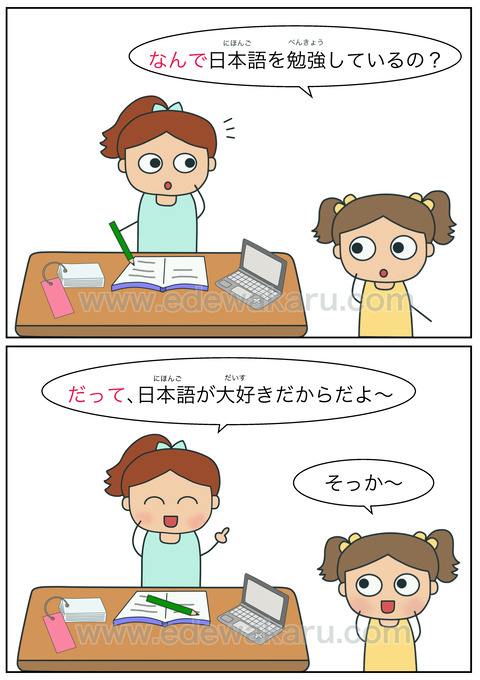
In context 4 examples
A:なんで日本語を勉強しているの?→なぜ日本語を勉強しているの?B:だって日本が大好きだからだよ! →なぜかというと、日本が大好きだからだよ!
A: Why are you studying Japanese? →Why are you studying Japanese? B: Because I love Japan so much! →The reason is that I love Japan so much!
A:なんでパーティーに行かなかったの?→なぜパーティーに行かなかったの?B:だって昨日は寒かったから…→なぜかというと、昨日は寒かったから…
A: Why didn’t you go to the party? →Why didn’t you go to the party? B: Because it was cold yesterday… →The reason is that it was cold yesterday…
A:なんで食べないの?→どうして食べないの?B:だって辛いんだもの(〜もの・〜んだもの) →どうしてかというと辛いからだよ
A: Why aren’t you eating? →Why aren’t you eating? B: Because it’s spicy. →The reason is that it’s spicy.
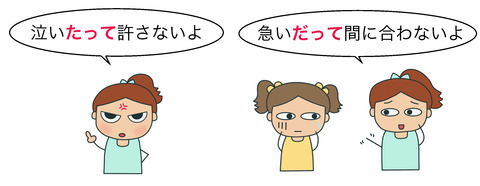
A:昨日はなんで学校を休んだの?→なぜ昨日は学校を休んだの?B:だって頭が痛かったんだもん(〜もん・〜んだもん) →なぜかというと、頭が痛かったからだよこの口語形「なんで」は「なぜ・どうして」の意味で、相手に原因や理由を聞く表現です。「だって」は理由を聞かれた時の答えとして「なぜかというと・どうしてかというと」の意味で使われます😀A:なんで〜?B:だって〜から・ので・もの・んだものどちらも家族や友達の間で使われるもので、ほとんどの場合上のようにセットで使用されます😄「だって」の後ろには「〜から・〜ので・〜もの・〜んだもの」など、原因理由を表すものがくるというのも覚えておくといいですね😉口語形「たって・だって」とは違う「だって」ですので、区別して覚えてください😊
A: Why were you absent from school yesterday? →Why were you absent from school yesterday? B: Because my head hurt. →The reason is that my head hurt. This colloquial form 「なんで」 means “why” and is used to ask someone about a cause or reason. 「だって」 is used in reply to a question about the reason and means “because” or “the reason is” 😀 A: Why〜? B: Because〜から・ので・もの・んだもの Both are used among family and friends, and in most cases they are used together as above 😄 Remember also that 「だって」 is followed by an expression of cause or reason, such as 「〜から」「〜ので」「〜もの」「〜んだもの」 😉 This is a different 「だって」 from the colloquial forms 「たって・だって」, so be sure to distinguish them 😊
Read the original source text
Usage 3
Read this source entry ↗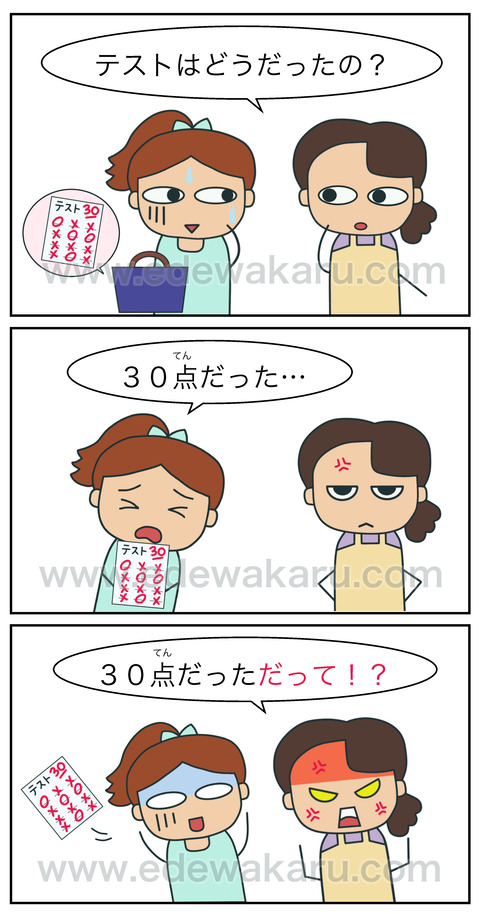
Meaning
Repeat the question to express surprise or anger
(Review: 〜を込めて・〜を込めた)
How to use it
Verb/adjective/noun [plain form] + だって?
Explanation
「〜だって?」 is a sentence pattern where you repeat exactly what the other person said to express surprise or anger.
[Examples]
① Mother: How was the test?
Daughter: I got 30 points…
Mother: You got 30 points, you say!?
[Anger]
② A: Why were you late?
B: Because it was raining…
A: Because it was raining, you say!?
[Anger]
[Exasperation]
③ Daughter: I don’t want to go to school today.
Mother: You don’t want to go to school, you say?
Why?
Daughter: Because it’s cold.
[Surprise]
[Anger]
When using 「〜だって?」, raising your voice at the end makes it sound natural 😉
[Examples]
① You got 30 points, you say!?
(↑)
② Because it was raining, you say!?
(↑)
③ You don’t want to go to school, you say!?
(↑)
[For those who want to learn more]
If you want to express even stronger surprise or anger than 「〜だって!?」, you can use 「なんだって!?」, 「なんですって!?」 (women only), or 「なんだと!?」 (men only) 😮
[Example]
Mother: How was the test?
Daughter: I got 30 points…
Mother: What did you say!?
「〜だって!?」「なんだって!?」「なんですって!?」「なんだと!?」 are often used in dramas and anime, so it would be good to learn them 😀
In context 3 examples
お母さん:テストはどうだったの?娘:30点だった…お母さん:30点だっただって!?
Mother: How was the test? Daughter: I got 30 points… Mother: You got 30 points, you say!?
A:なんで遅刻したの?B:雨が降ってたから…A:雨が降ってたからだって!?(復習:〜てる・〜でる)(復習:なんで?)
A: Why were you late? B: Because it was raining… A: Because it was raining, you say!? (Review: 〜てる・〜でる; Review: なんで?)
娘:今日は学校に行きたくないお母さん:学校に行きたくないですって?どうして?娘:だって寒いんだもん(復習:だって)(復習:〜もの・〜んだもの)
Daughter: I don’t want to go to school today. Mother: You don’t want to go to school, you say? Why? Daughter: Because it’s cold. (Review: だって; Review: 〜もの・〜んだもの)
Read the original source text
Meaning
驚き・怒りの気持ちを込めて聞き返す
(復習:〜を込めて・〜を込めた)
How to use it
動詞・形容詞・名詞[普通形]+だって?
Explanation
「〜だって?」は相手が言ったことをそのまま繰り返して言い、驚きや怒っている気持ちを表す文型です。
[例]
①お母さん:テストはどうだったの?
娘:30点だった…
お母さん:30点だった
だって!?
【怒っている気持ち】
②A:なんで遅刻したの?
B:雨が降ってたから…
A:雨が降ってたから
だって!?
【怒っている気持ち】
【あきれている気持ち】
③娘:今日は学校に行きたくない
お母さん:学校に行きたくない
ですって?
どうして?
娘:だって寒いんだもん
【驚き】
【怒っている気持ち】
また「〜だって?」を使う場合は、
最後を上げて言うと、きれいに聞こえます
😉
[例]
①30点だった
だって!?
(
↑)
②雨が降ってたから
だって!?
(
↑)
③学校に行きたうくない
ですって!?
(
↑)
【余裕がある人へ】
「〜だって!?」よりももっと強い驚きや、怒っている気持ちを表したい場合は「なんだって!?」「なんですって!?」(女性限定)「なんだと!?」(男性限定)などが使われます😮
[例]
お母さん:テストはどうだったの?
娘:30点だった…
お母さん:
なんですって!?
「〜だって!?」「なんだって!?」「なんですって!?」「なんだと!?」
は、ドラマやアニメでもよく使われていますので、覚えておくといいと思います😀
日本語文型辞典 英語版
Meaning
B:地震だって? ちがうよ。ダンプカーが通っただけだよ。
Earthquake, you say? No, that was just a dump truck passing by.
B:男だって? ぜったいに女だよ。
A man, you say? No, definitely a woman.
B:おもしろかったよ。
It was fun.
A:おもしろかっただって? むずかしかったとか、やさしかったけど問題が多かったとかほかに答えようがあるだろう。
Fun? There are other ways to answer, you know, like it was hard, or it was easy but there were lots of questions, or something like that.
B:美人コンテストですって? 今ごろそんな時代遅れのコンテストなんかどこでやってるのよ。
A beauty contest? Where can they be having such an out-of-date contest in this day and age?
B:なんだって? そりゃ大変だ。
What? That’s awful.
Used to express a feeling of surprise or shock by repeating what the other person has just said. Sometimes expresses a sense of displeasure. Used with rising intonation.
An informal, spoken language expression. The polite equivalent is ...ですって, but this can only be used with a person of lower status or a person you are close to. In addition to なんだって in
(5)
, other expressions used to indicate strong surprise include なんですって and なんだと.
5
【って】5
【だって2】[Nだって]
Means “even someone/something” and is similar to でも. In
(1)
,
(2)
, and
(3)
, an extreme or contrasting example X is given to express “even X....” In
(4)
and
(5)
, a number of similar examples are listed and the meaning conveyed is “not only A, but also B and C.” Informal spoken language.
B:だって寒いんだもん。
Because it’s cold.
B:だってきらいだもん。
But I don’t like them!
B:だって、今日は日曜日でしょ、来ないわよ。
Well, today is Sunday, so we’re not going to get a paper.
B:だってあそこの喫茶店、人が多くて居づらかったんだよ。
Because that café was so crowded I felt uncomfortable staying there.
Used by the speaker to reply when asked the reason for something and means “it is because....” Can be used even when the reason is not asked explicitly, as in
(2)
and
(3)
. Children, especially, use it in the form だって...もの/もん when they talk back. Adults sometimes use it, too. Informal spoken language.
How to use it
1. ...だって〈inquiry〉
2. ...んだって→
3. ...なんだって→
In context 16 examples
A:あっ、地震だ。
Oh! It’s an earthquake.
A:あの人、男よ。
That person is a man.
A:太郎、テストどうだった
How was the test, Taro?
A:福田さん、美人コンテストに出るらしいよ。
Apparently Fukuda-san is going to be in a beauty contest.
A:ヘリコプターがまだ到着しないんですが。
The helicopter hasn’t arrived yet.
それぐらいのことは子供だって知っている。
Even kids know that sort of thing.
先生だって間違うことはある。
Even teachers can make mistakes.
医者だって風邪ぐらいひくよ。
Even doctors can catch a cold.
つらいのはあなただけじゃない。浅田さんだって、坂田さんだってみんながまんしてるんです。
You’re not the only one having a hard time. Asada-san, Sakata-san—everyone is having to put up with this.
好き嫌いはありません。魚だって肉だってなんだって大丈夫です。
I have no likes or dislikes concerning food. Fish or meat or anything else is all OK for me.
あの子はこのごろ帰りが遅い。きのうだって 11 時過ぎていた。
Recently that kid has been coming home late. Yesterday it was after eleven o’clock.
だれにだって一つや二つは秘密がある。
Everyone has a secret or two.
A:どうして外で遊ばないの。
Why aren’t you playing outside?
A:にんじん、残さずにちゃんと食べなさい。
Eat all your carrots and don’t leave any on your plate.
A:夕刊まだかな。
I wonder if the evening paper has come yet.
A:きのうはどうして待ってくれなかったの。
Why didn’t you wait for me yesterday?
Read the original source text
Meaning
B:地震だって? ちがうよ。ダンプカーが通っただけだよ。
Earthquake, you say? No, that was just a dump truck passing by.
B:男だって? ぜったいに女だよ。
A man, you say? No, definitely a woman.
B:おもしろかったよ。
It was fun.
A:おもしろかっただって? むずかしかったとか、やさしかったけど問題が多かったとかほかに答えようがあるだろう。
Fun? There are other ways to answer, you know, like it was hard, or it was easy but there were lots of questions, or something like that.
B:美人コンテストですって? 今ごろそんな時代遅れのコンテストなんかどこでやってるのよ。
A beauty contest? Where can they be having such an out-of-date contest in this day and age?
B:なんだって? そりゃ大変だ。
What? That’s awful.
Used to express a feeling of surprise or shock by repeating what the other person has just said. Sometimes expresses a sense of displeasure. Used with rising intonation.
An informal, spoken language expression. The polite equivalent is ...ですって, but this can only be used with a person of lower status or a person you are close to. In addition to なんだって in
(5)
, other expressions used to indicate strong surprise include なんですって and なんだと.
5
【って】5
【だって2】[Nだって]
Means “even someone/something” and is similar to でも. In
(1)
,
(2)
, and
(3)
, an extreme or contrasting example X is given to express “even X....” In
(4)
and
(5)
, a number of similar examples are listed and the meaning conveyed is “not only A, but also B and C.” Informal spoken language.
B:だって寒いんだもん。
Because it’s cold.
B:だってきらいだもん。
But I don’t like them!
B:だって、今日は日曜日でしょ、来ないわよ。
Well, today is Sunday, so we’re not going to get a paper.
B:だってあそこの喫茶店、人が多くて居づらかったんだよ。
Because that café was so crowded I felt uncomfortable staying there.
Used by the speaker to reply when asked the reason for something and means “it is because....” Can be used even when the reason is not asked explicitly, as in
(2)
and
(3)
. Children, especially, use it in the form だって...もの/もん when they talk back. Adults sometimes use it, too. Informal spoken language.
How to use it
1. ...だって〈inquiry〉
2. ...んだって→
3. ...なんだって→
AIUEO JLPT Grammar
Meaning
This sentence pattern is indicating that all possibilities within the scope of the interrogative word are applicable.
How to use it
Interrogative word (+ particle) + だって
In context 5 examples
誰だって間違えることはあるよ。
Anyone can make mistakes.
どうだっていいから、早く決めて!
It doesn’t matter how, just decide quickly!
いつだって君を助けるよ。
I’ll help you anytime.
どれだって好きに選んでいいよ。
You can choose whichever one you like.
どこだって行けるさ。
I can go anywhere.
Read the original source text
Meaning
This sentence pattern is indicating that all possibilities within the scope of the interrogative word are applicable.
How to use it
疑問詞 (+助詞)+だって
Explanation · 日本語
この文型は、範囲を制限せずに全ての内容が適用されることを強調する表現です。話し言葉でよく使われ、カジュアルなニュアンスがあります。
Bunpro Grammar Reference
Meaning
I heard/was said, Because, But, Even or also, Even if or even though
How to use it
Noun + (なん) + だって
だって + Phrase
Nuance
A very casual expression used to give reasons, say but, or sometimes even to relay things heard from others.
Explanation
だって is a colloquial combination of the auxiliary verb だ, and the adverbial particle とて in Japanese (a combination of the particles と, and て). It has a wide range of uses, but primarily exclaims that something is the 'premise' for whatever has been said, or will be said next. This 'exclamation' is usually translated as 'I heard', 'cause', 'but', or 'even if'. The meaning that will be conveyed is determined primarily by where だって appears in a sentence.
When placed at the beginning of a sentence, だって highlights the speaker's (usually) displeasure about something that has just been said, before following it with an explanation or counterpoint. This だって is quite similar to でも.
え〜 行きたくないよ。だって、俺の元カノも誘ったんでしょう?
Awwww maaaan I don't want to go. It's because you also invited my ex-girlfriend, right?
だって、サメとか怖いもん。
It's because I'm afraid of things like sharks.
At the end of a sentence, だって is used to express hearsay, in a similar way to 'I heard that', or 'it was said that', in English. In these cases it will be preceded by なん. なんだって always appears after a noun, or a phrase that has been nominalized (with の or こと).
レムの実家は農家なんだって。
I heard that Rem's family owns a farm.
キリコは明日から一週間休みなんだって。
I hear that Kiriko will be on break for a week starting tomorrow.
Caution
When used directly after a noun, だって has a similar nuance to the だって that appears at the beginning of sentences (emphasizing what has come before it, in order to explain further). This comes across as でも, and may not be used with なん.
俺だって行きたくないよ。
Even I don't want to go.
そんなこと言ったら、誰だって傷つくよ。
If you say something like that, anyone would get hurt.
Fun Fact
The adverbial particle とて itself is an abbreviation of expressions like と言って, and と思って. だとて (the full construction) may also be used, but is almost always replaced by だって, as it is far easier to say.
Fun Fact
When used at the beginning of a sentence, もん or もの will often come at the end of that sentence, in order to strengthen the opinion given by the speaker. This is more commonly used by women and children.
私もそんなもの食べたくないよ。だって、不味いもん。
I also don't want to eat something like that. It's because it tastes bad.
今日は家から出ません。だって、今日は暑いもの。
I am not going to leave my house today. Cause it is hot today.
In context 18 examples
- 全員合格だってよ。
It is said that everyone had passed the exam.
- え〜 行きたくないよ。だって、俺の元カノも誘ったんでしょう?
Awwww maaaan I don't want to go. It's because you also invited my ex-girlfriend, right?
- だって、サメとか怖いもん。
It's because I'm afraid of things like sharks.
- レムの実家は農家なんだって。
I heard that Rem's family owns a farm.
- キリコは明日から一週間休みなんだって。
I hear that Kiriko will be on break for a week starting tomorrow.
- だって、全然知らないんだもん。
Because, I have no idea.
- 彼だって落ち込むこともあるよ。
Even he gets depressed from time to time.
- 「たけしさん、海外旅行だって?」
'Is it true (what I have heard) that Takeshi is on vacation abroad?'
- 月にだって行けるかもしれない。
You can probably even go to the moon.
- 今から体育なんだって。
I heard that we have P.E. from now.
- 父親だって、たまには一人でのんびりしたいときもある。
Even my father wants to occasionally relax by himself.
- アイスクリームだって薬になる。食べ過ぎなければ。
Even ice cream, it can do you good. That is, if you don't eat too much.
- めがねちゃん:「どうして遅れたの?」
ヤンキーくん:「だって、 家の手伝いをしなきゃいけなかったんだ。」Megane-chan: 'Why are you late?' Yankee-kun: 'Because I had to help with house work.'
- 「彼は競馬に行ったらしい。」
「競馬だって?またお金を全部失うよ。」'I heard that he has gone horse racing.' 'Horse racing you say? He will lose all his money again.'
- それは恋だって。表情を見れば分かります。
Like they say, it is love. I can tell just from the look on your face.
- 私達は出かけなかった。だって悪い天気だったから。
We didn't go out. Because the weather was bad.
- 俺だって行きたくないよ。
Even I don't want to go.
- そんなこと言ったら、誰だって傷つくよ。
If you say something like that, anyone would get hurt.
Read the original source text
Meaning
I heard/was said, Because, But, Even or also, Even if or even though
How to use it
Noun + (なん) + だって
だって + Phrase
Nuance
A very casual expression used to give reasons, say but, or sometimes even to relay things heard from others.
Explanation
だって is a colloquial combination of the auxiliary verb だ, and the adverbial particle とて in Japanese (a combination of the particles と, and て). It has a wide range of uses, but primarily exclaims that something is the 'premise' for whatever has been said, or will be said next. This 'exclamation' is usually translated as 'I heard', 'cause', 'but', or 'even if'. The meaning that will be conveyed is determined primarily by where だって appears in a sentence.
When placed at the beginning of a sentence, だって highlights the speaker's (usually) displeasure about something that has just been said, before following it with an explanation or counterpoint. This だって is quite similar to でも.
え〜 行きたくないよ。だって、俺の元カノも誘ったんでしょう?
Awwww maaaan I don't want to go. It's because you also invited my ex-girlfriend, right?
だって、サメとか怖いもん。
It's because I'm afraid of things like sharks.
At the end of a sentence, だって is used to express hearsay, in a similar way to 'I heard that', or 'it was said that', in English. In these cases it will be preceded by なん. なんだって always appears after a noun, or a phrase that has been nominalized (with の or こと).
レムの実家は農家なんだって。
I heard that Rem's family owns a farm.
キリコは明日から一週間休みなんだって。
I hear that Kiriko will be on break for a week starting tomorrow.
Caution
When used directly after a noun, だって has a similar nuance to the だって that appears at the beginning of sentences (emphasizing what has come before it, in order to explain further). This comes across as でも, and may not be used with なん.
俺だって行きたくないよ。
Even I don't want to go.
そんなこと言ったら、誰だって傷つくよ。
If you say something like that, anyone would get hurt.
Fun Fact
The adverbial particle とて itself is an abbreviation of expressions like と言って, and と思って. だとて (the full construction) may also be used, but is almost always replaced by だって, as it is far easier to say.
Fun Fact
When used at the beginning of a sentence, もん or もの will often come at the end of that sentence, in order to strengthen the opinion given by the speaker. This is more commonly used by women and children.
私もそんなもの食べたくないよ。だって、不味いもん。
I also don't want to eat something like that. It's because it tastes bad.
今日は家から出ません。だって、今日は暑いもの。
I am not going to leave my house today. Cause it is hot today.
Nuance · 日本語
理由を述べる時や、「けど」と言う時、人から聞いたことを他の誰かに伝える時に使われるカジュアルな表現。
Explanation · 日本語
「だって」は、助動詞の「だ」と副助詞「とて」(「と」+「て」)からできている表現で、会話で使われることが多いです。使い方はいろいろありますが、基本的には、前に述べられたことに、話し手が主張を加えるときに使われます。「だって」は、文のどこで使われるかによって、「なぜなら」「~と聞いた(伝聞)」「でも」など、意味が変わります。
文の始まりの「だって」は、主に話し手が前に述べられた内容に不満を持っていて、それに反対の意見を述べたり、理由を伝えたりするときに使われます。この「だって」は、「でも」や「なぜなら」に似ています。
え〜 行きたくないよ。だって、俺の元カノも誘ったんでしょう?
Awwww maaaan I don't want to go. It's because you also invited my ex-girlfriend, right?
だって、サメとか怖いもん。
It's because I'm afraid of things like sharks.
文の終わりの「だって」は、伝聞を表します。この「だって」には、「なん」が付きます。「なんだって」は名詞のあとや「の」や「こと」で名詞化された文のあとで使われます。
レムの実家は農家なんだって。
I heard that Rem's family owns a farm.
キリコは明日から一週間休みなんだって。
I hear that Kiriko will be on break for a week starting tomorrow.
注意点
名詞の直後に置かれた「だって」は、「でも」と似た意味で使われて、「(A) も同じこと」や「(A) も例外ではない」ことを表します。この「だって」の前には、「なん」は付きません。
俺だって行きたくないよ。
Even I don't want to go.
そんなこと言ったら、誰だって傷つくよ。
If you say something like that, anyone would get hurt.
豆知識
副助詞の「とて」は、「と⾔(い)って」や「と思って」を短くしたものです。「だとて」という言い方もありますが、「だって」の方が言いやすいので、ふつうは「だって」が使われます。
豆知識
「だって」から始まる文では、その終わりに「もん」や「もの」が付くことがあります。これは、話し手が理由を強く伝えるときの言い方です。自分は悪くないというニュアンスで、主に女性や子どもが使います。
私もそんなもの食べたくないよ。だって、不味いもん。
I also don't want to eat something like that. It's because it tastes bad.
今日は家から出ません。だって、今日は暑いもの。
I am not going to leave my house today. Cause it is hot today.
Yokubi — The Common Grammar Guide (https://yoku.bi)
Explanation
Beyond the simple quote usage of (だ)って there are two more. One of them is an extension of the quote one, but the other is historically unrelated.
The exclamatory だって appears in front of a sentence and is used like an adversative interjection similar to a casual しかし or as an explanation/logical continuation from the previous sentence.
The other だって is a more casual version of も/でも when used after nouns in the meaning of "even".
This だって can also replace the ても conjugation of verbs and adjectives in the form of たって. It sounds very casual.
In context 2 examples
だっておかしいじゃないですか。
I mean, don't you find it weird?
そんなことは俺だって分かっている。
Even I understand that
NINJAL 日本語文型データベース
Meaning
This is used to give an example of “〜” and say that, therefore, other cases are naturally the same.
How to use it
Nだって
Notes
“〜” is an extreme example.
In context 5 examples
「10年前のモデルのスマホは、千円だって高いと思うよ」
“Even one thousand yen is too much for a smartphone model from ten years ago.”
「この本は内容が簡単だから、子どもだって読めるよ」
“This book is easy to understand, so even children can read it.”
100万円あれば、世界一周旅行だってできるかもしれない。
With one million yen, you might even be able to travel around the world.
マヨネーズさえあれば、嫌いな野菜だっておいしく食べられる。
As long as you have mayonnaise, you can even enjoy eating vegetables you dislike.
「感染症がはやっていたときは、家族だって病院の面会に行けなかったよ」
“When the infectious disease was spreading, even family members couldn’t visit patients in the hospital.”
Read the original source text
Meaning
~の例を挙げて、だから他の場合は当然そうだと言いたいときに使います。
How to use it
Nだって
Notes
「~」には極端な例がきます。
IMABI
The Particles って, たって, & だって
Read this IMABI lesson ↗Explanation
The Particles って, たって, & だって
In this lesson we will learn about the particles って, たって, and だって which are necessary in improving your colloquial Japanese skills.
The Particle って
The Case Particle って: Colloquial Citation
This is a very important feature of casual Japanese. The particle と is very frequently seen as って in spoken Japanese. Although it originally came from the contraction of という, it has since taken on と’s function as a citation particle.
1. 難しいって思った。
I thought it was difficult.
2. 負けたよって言われてもなあ。
Even if you would have said you lost.
3. お母さんにどうぞよろしくって伝えてくださいね。
Please say nice to meet you to her mother.
4. 田中さんって知ってる?
Do you know Mr. Tanaka?
気にしなくてもいいってことだ。
It’s nothing you may need to be worried about.
“…の…の(と)” is used to list things in contrast or emphatically and “…の…ないの(って)” shows excess. As is noted, sometimes using it may be uncommon or even old-fashioned.
5. 何なんのかんのと文句もんくをつける。
To complain of what and that.
6. 死ぬの生きるのと大騒おおさわぎだ。
Dying and living is all turmoil.
7. うるさいのなんのって、耳が聞こえなくなったほどだ。
It’s so loud to the point I’ve lost my hearing.
8. 無職むしょくになるの、離婚りこんするの、散々さんざんな目にあったな。(Not so common)
Becoming unemployed and divorced, I’ve met a lot of terrible things hasn’t it!
9. 寒いの暑いのと言っていないで、ジョギングは毎朝まいあさしなさい。
Don’t complain about it being hot or cold, you must go jogging every day.
10. 痛いたいの痛くないのと、飛とび上あがってしまったよ。(古い言い方)
It hurt so bad I accidentally jumped up.
The Adverbial Particle って: Emphatic
It takes up the subject with slight exclamation and is equivalent to というのは. It’s also used in repeating what someone said.
11. オレって、なんてバカなんだ。
I’m such an idiot.
12. 誰かに出会える時っていつもこうだ。
Meeting someone is always the same way.
13. したくないって、どういう意味だ。
You don’t want to do it, what do you mean?
14. 誰が{殺人・殺人者・人殺し・犯人}かって、あいつに決まってるよ。
It’s settled that who the, um, murderer is that guy over there.
Word Note: 殺人者 is a rather formal word and not used much in actual conversation, although it is common in books. 人殺し is a graphic word that bring images of the bloody crime scene. So, it is considered a sensitive word and often avoided. 犯人, although it only means “criminal”, it is the most likely word to use in this situation, and most people would realize automatically that the sentence is about murder anyways.
The Final Particle って: All of the Above
15. すぐ帰れってさ。
He said like to hurry home.
16. 間に合うだろうって。
They said they would probably make it on time.
With a high intonation, it shows confirmation.
17. 離婚するんですって。
You’re getting divorced?
18. 病気だったんですってねー。
It was sickness, right?
In a downward intonation, it passes down an assertion strongly. It is often used to (re)assure someone like in Ex. 19.
19. 大丈夫だって。
It’s OK.
20. きっと合格するって。
I’ll surely pass.
The Conjunctive Particle って
1. When used with ~た.
Even if you; no matter how.
っていい, ってかまわない, and って差し支つかえない to show permission.
21a. どう叫んだって、聞こえない。(Less common)
21b. どれほど叫んだって聞こえない。
Even if you somehow shout, he can’t hear.
22. どう見えたって、校長は校長だ。
No matter how you look at it, the principal is the principal.
23. やったっていいじゃん。
Isn’t it OK to do it?
Grammar Note: When used with ん, って is often changed to て. It’s also common as ってー.
The Particle たって
For the most part, たって is ~た + って. However, there is one usage of たって that makes it unique.
The Conjunctive Particle たって
Often with a 促音そくおん, it is used as a colloquial variant of the phrase といっても meaning “even if you say that”. There are several set expressions that accompany this.
Tense Meaning
Non-past Even though (pronoun)…
Past Even if you (past tense verb)…
Volitional Even if (pronoun) going to…
Adjectives Even if you…
24. ハワイに行こうったって、どこも満員だよ。
Even if we’re going to Hawaii, everywhere is full.
25. 無くったって、生きてはゆけるだろう?
Even if you don’t have it, wouldn’t you still go on living?
26. そうだと思ったとしても、そうと決まったわけじゃないだろ。
Even if you thought that, that doesn’t mean that it’s supposed to still occur that way you know.
Grammar Note: Of course, there are some situations in which たって would be unnatural.
The Particle だって
At times だって is merely a combination of だ and って or the voiced version of the particle だって. However, だって is also seen in unique situations.
The Adverbial Particle だって
1. It presents something with an added feeling of rebuttal in response to an assumption and is equivalent to もまた–“even (does)”.
27. 犬だってそれくらい分かるだろう!?
Even a dog should understand that!?
28. 僕だって辛つらいのだ。
Even I’m bitter (about it).
29. 乞食こじきにだって言い分ぶんはある。
Even a beggar has one’s say.
2. “AだってBだって” arranges like things with the hint that other things are applicable as well.
30. 学校だって、大学だって、同じところじゃないか。
Isn’t it the same place, whether it’s school or college?
31. ペットを飼うなら犬だって猫だって同じようなもんじゃないか。
If you’re going to raise a pet, isn’t a dog or cat the same?
32. イルカだってクジラだって哺乳類なんだよ。
Whether a dolphin or a whale, it’s still a mammal.
33. 子どもだって大人だって遊びたいときは思いっきり遊ぶんだよ。
Whether a kid or an adult, when people want to play, they play with all their heart.
34. 宝石だって着物だって買う。
To buy things whether it is jewelry or clothing.
3. With a feeling of rebuttal and attached to a phrase showing high value, it strengthens the meaning of a sentence and is equivalent to さえも meaning “even also”.
35. うそ(だ)、決定的な証拠だってあるぞ。
Lie, there’s even definitive evidence.
36. クラスにはピアニストだっているよ。
There’s even a pianist in the classroom.
4. Attached to a phrase showing the “smallest” of something and followed by a negative expression, it is used to show complete negation.
37. いとこにとってはこんな大学は一日だって我慢がまんできないだろう。
My cousin wouldn’t last in this kind of a college for even a day.
38. 僅わずかだって許されない。
Not even a little bit will be forgiven.
5. Attached to an interrogative, it is used to mean “all without exception”, and is equivalent to “interrogative + でも”.
39. いつだっていいさ。
Anytime is good.
40. 誰だってそんなこと{は・を}したく(は)ないね。
Nobody wants to do a thing like that.
6. 何だって asks for a reason with a feeling of criticism–why”.
41. 何だってそんなことをしたんだ。
Why did you do even such a thing as that?
The Final Particle だって
1. Directly quotes the words of someone of which one thought to be unsuitable and is equivalent to だと.
42. 彼は、金を貸さなかったんだって。
He said, I didn’t lend any money.
43. 知らなかったんだって。
You didn’t know?
44. 遊びたくないだって?
You don’t want to play?
Phrase Note: This usage is a contraction of だとて.
2. のだって quotes what someone said.
45. あの田中さん、行いきたくないんだって。
Mr. Tanaka says he don’t want to go.
46. あいつは来るんだって。
He’s coming?
3. Asks about the information of something passed down when attached to a phrase of question or doubt.
47. 何だって?
What was it?
48. 食費はいくらって?
How much was the food expenses?
Variant Note: だって may be changed to ですって in polite context.
In context 57 examples
難しいって思った。
I thought it was difficult.
負けたよって言われてもなあ。
Even if you would have said you lost.
お母さんにどうぞよろしくって伝えてくださいね。
Please say nice to meet you to her mother.
田中さんって知ってる?
Do you know Mr. Tanaka?
何なんのかんのと文句もんくをつける。
To complain of what and that.
死ぬの生きるのと大騒おおさわぎだ。
Dying and living is all turmoil.
うるさいのなんのって、耳が聞こえなくなったほどだ。
It’s so loud to the point I’ve lost my hearing.
無職むしょくになるの、離婚りこんするの、散々さんざんな目にあったな。(Not so common)
Becoming unemployed and divorced, I’ve met a lot of terrible things hasn’t it!
寒いの暑いのと言っていないで、ジョギングは毎朝まいあさしなさい。
Don’t complain about it being hot or cold, you must go jogging every day.
痛いたいの痛くないのと、飛とび上あがってしまったよ。(古い言い方)
It hurt so bad I accidentally jumped up.
オレって、なんてバカなんだ。
I’m such an idiot.
誰かに出会える時っていつもこうだ。
Meeting someone is always the same way.
したくないって、どういう意味だ。
You don’t want to do it, what do you mean?
誰が{殺人・殺人者・人殺し・犯人}かって、あいつに決まってるよ。
It’s settled that who the, um, murderer is that guy over there.
すぐ帰れってさ。
He said like to hurry home.
間に合うだろうって。
They said they would probably make it on time.
離婚するんですって。
You’re getting divorced?
病気だったんですってねー。
It was sickness, right?
大丈夫だって。
It’s OK.
きっと合格するって。
I’ll surely pass.
When used with ~た.
Even if you; no matter how.
どう叫んだって、聞こえない。(Less common)
Even if you somehow shout, he can’t hear.
どれほど叫んだって聞こえない。
Even if you somehow shout, he can’t hear.
どう見えたって、校長は校長だ。
No matter how you look at it, the principal is the principal.
やったっていいじゃん。
Isn’t it OK to do it?
ハワイに行こうったって、どこも満員だよ。
Even if we’re going to Hawaii, everywhere is full.
無くったって、生きてはゆけるだろう?
Even if you don’t have it, wouldn’t you still go on living?
そうだと思ったとしても、そうと決まったわけじゃないだろ。
Even if you thought that, that doesn’t mean that it’s supposed to still occur that way you know.
It presents something with an added feeling of rebuttal in response to an assumption and is equivalent to もまた–“even (does)”.
Even a dog should understand that!?
犬だってそれくらい分かるだろう!?
Even a dog should understand that!?
僕だって辛つらいのだ。
Even I’m bitter (about it).
乞食こじきにだって言い分ぶんはある。
Even a beggar has one’s say.
“AだってBだって” arranges like things with the hint that other things are applicable as well.
Isn’t it the same place, whether it’s school or college?
学校だって、大学だって、同じところじゃないか。
Isn’t it the same place, whether it’s school or college?
ペットを飼うなら犬だって猫だって同じようなもんじゃないか。
If you’re going to raise a pet, isn’t a dog or cat the same?
イルカだってクジラだって哺乳類なんだよ。
Whether a dolphin or a whale, it’s still a mammal.
子どもだって大人だって遊びたいときは思いっきり遊ぶんだよ。
Whether a kid or an adult, when people want to play, they play with all their heart.
宝石だって着物だって買う。
To buy things whether it is jewelry or clothing.
With a feeling of rebuttal and attached to a phrase showing high value, it strengthens the meaning of a sentence and is equivalent to さえも meaning “even also”.
Lie, there’s even definitive evidence.
うそ(だ)、決定的な証拠だってあるぞ。
Lie, there’s even definitive evidence.
クラスにはピアニストだっているよ。
There’s even a pianist in the classroom.
いとこにとってはこんな大学は一日だって我慢がまんできないだろう。
My cousin wouldn’t last in this kind of a college for even a day.
僅わずかだって許されない。
Not even a little bit will be forgiven.
Attached to an interrogative, it is used to mean “all without exception”, and is equivalent to “interrogative + でも”.
Anytime is good.
いつだっていいさ。
Anytime is good.
誰だってそんなこと{は・を}したく(は)ないね。
Nobody wants to do a thing like that.
何だって asks for a reason with a feeling of criticism–why”.
Why did you do even such a thing as that?
何だってそんなことをしたんだ。
Why did you do even such a thing as that?
Directly quotes the words of someone of which one thought to be unsuitable and is equivalent to だと.
He said, I didn’t lend any money.
彼は、金を貸さなかったんだって。
He said, I didn’t lend any money.
知らなかったんだって。
You didn’t know?
遊びたくないだって?
You don’t want to play?
のだって quotes what someone said.
Mr. Tanaka says he don’t want to go.
あの田中さん、行いきたくないんだって。
Mr. Tanaka says he don’t want to go.
あいつは来るんだって。
He’s coming?
何だって?
What was it?
食費はいくらって?
How much was the food expenses?