IMABI
~てしまう
Read this IMABI lesson ↗Explanation
~てしまう
~てしまう is an extremely important ending. It is often described as showing perfected actions or things done on accident, but what does this actually mean and is there more to it? This lesson will discuss the nuances that it has as well as important variants used in every speech of it.
~てしまう
Spelling and Other Meanings
The verb しまう either means “to end” or “to keep/put back”. In 漢字, you might see it spelled as 仕舞う, 終う, or 了う. As you can imagine, the latter two spellings are perfect fits for its meaning of “to end”. The only time when you should take this verb literally when after て is when there is an intentional pause. Then, you have to be careful about what other possible homophonous phrases fit–especially when listening.
Take for instance this classic demonstration in Japanese linguistics concerning this very thing.
1. 変態な本を読んで、しまった。
I read a perverted book, and (then) I put it up.
2. 変態な本を読んでしまった。
I accidentally read a perverted book.
The 3 Nuances of ~てしまう
So, what is ~てしまう? It sadly doesn’t have one meaning. There are basically three ways it is used. Intonation plays a role in discerning whether しまう is supplementary or not. When supplementary, you get the pattern ~てしまう, which has one of the three meanings below.
1. To show a sense of regret/surprise when you did have volition in doing something, but it turned out to be bad to do. This can also be sarcastically and cleverly used in a positive attitude while still being natural. Sexual relations come to mind.
2. To show perfective/punctual achievement. This shows that an action has been completed. It should not be used with something like ~そうだ, which is a nonfactual speech modal.
3. To show unintentional action–“accidentally”. Often used with adverbs like うっかり (absentmindedly) and ぐうぜんに (unexpectedly).
Clarification Notes:
1. Statives (verbs that show state not action) can be used with ~てしまう too. However, they are not perfective in any sense. When put together, the perfective is never expressed. Rather, it goes back to point 1.
2. It’s important to view these usages as instances of the same thing interpreted differently in context because there are cases where more than one reading is possible. At times, all three can be meant together. In “うっかり花瓶を割ってしまった”, the act of breaking the vase is perfective. It could have been accidentally broken. Plus, you could feel regret over having broken it.
Examples
1. スープは冷さめてしまっている。
My soup has gotten cold.
2. あの子供はのろのろと椅子いすから立ち上がった後、突然倒とつぜんたおれてしまったよ。
That kid over there suddenly collapsed after he rose up sluggishly from the chair.
3. 恋人こいびとたちは二人でサンバを踊おどらなくなってしまった。
The couple ended up not dancing the samba together.
4. 花瓶かびんを壊こわしてしまって、罰ばつを逃のがれたい。
I accidentally broke the vase, and I hope I don’t get punished.
More literally: I accidentally broke the vase, and I want to escape punishment.
5. 窓を閉めなかったので、風邪を引いてしまいました。
I didn’t close the window, and so I caught a cold.
6. 夏服なつふくを押入おしいれにしまった。
I put my summer clothes in the closet.
7. 明日までにレポートを書いてしまいます。
I’ll finish writing the report by tomorrow.
8. お金を使ってしまった。
I regrettably used the money.
Practice: Translate the following.
1. 宿題をしてしまいました。
2. I ate them all.
3. 僕の車が故障してしまった。
4. 眠ってしまった。
5. To keep information back.
~ちゃう & ~じゃう
~てしまう may be contracted to -ちゃう (playful) or -ちまう (vulgar/mature men). These forms are voiced as ~じゃう and ~じまう respectively when て is used with certain 五段 verbs.
食べてしまう → 食べちゃう 見てしまう → 見ちゃう 呼んでしまう → 呼んじゃう
読んでしまう → 読んじゃう 死んでしまう → 死んじゃう ばれてしまう → ばれちゃう
着てしまう → 着ちゃう 切ってしまう → 切っちゃう してしまう → しちゃう
Grammar Note: The use of slang and polite speech is usually improper, but there are times when these casual forms are used in familiar polite speech, but this would be most common by children and women than men.
Examples
9, 見る見るうちに老人ろうじんになっちゃった!
In the blink of an eye, I turned into an old person!
10. ガソリンが切れちゃった。最寄もよりの(ガソリン)スタンドまで引ひっ張ぱっててもらえる?
I ran out of gas. Could you tow me to the nearest gas station?
11. その本を読んじゃいました。
I finished reading that book.
12. 犬が狂くるっちゃった。
The dog went crazy.
13. 中国語かと思っちゃった。
I mistook it for Chinese.
14. 財布さいふを忘れちゃったよ。
I forgot my wallet.
15. どうして空き地にし{てしま・ちゃ}わないのか。
Why won’t they make it into an empty lot?
16. 不注意ふちゅういからカップを落おとしちゃった。
I accidentally spilled the cup due to carelessness.
17. とても熱かったから、口を火傷やけどしちゃった。
Because it was very hot, I accidentally scalded my mouth.
関西弁: ~て(し)もた
The 関西弁 version is so commonly seen in manga and anime that not mentioning it would do you a disservice. しまった and しもた share the same origin. ~た instead attached to the 終止形. This produced しまうた. The vowel sequence au simplified to a long o in Western dialects, and this was then shortened in this phrase and many others. The し is then dropped in even more colloquial speech.
18. 忘れて(し)もた!
I completely forgot!
19. 買うて(し)もた。
I accidentally bought it.
関西弁の音便 (Kansai Dialect Sound Change): かって → こうて.
はめになる
This phrase is equivalent to “end up; wind up; (come down) to”. はめ may be written in 漢字 as 羽目 or 破目. はめ in this case actually means “bind” as in an awkward situation.
20. 彼は言いなりになるはめになった。
He ended up giving in to him.
21. 僕は罰金ばっきんを支払しはらうはめになった。
I ended up paying a fine.
22. ねずみは溺おぼれるはめになった。
The mouse ended up drowning.
23. 疑うはめになる。
To come to suspect.
Key
Practice
1. I (have) completed by homework.
2. 全部食べてしまった。
3. My car broke down.
4. I accidentally slept.
5. 情報をしまっておく。
In context 33 examples
変態な本を読んで、しまった。
I read a perverted book, and (then) I put it up.
変態な本を読んでしまった。
I accidentally read a perverted book.
To show perfective/punctual achievement. This shows that an action has been completed. It should not be used with something like ~そうだ, which is a nonfactual speech modal.
Clarification Notes:
To show unintentional action–“accidentally”. Often used with adverbs like うっかり (absentmindedly) and ぐうぜんに (unexpectedly).
Clarification Notes:
Statives (verbs that show state not action) can be used with ~てしまう too. However, they are not perfective in any sense. When put together, the perfective is never expressed. Rather, it goes back to point 1.
Examples
It’s important to view these usages as instances of the same thing interpreted differently in context because there are cases where more than one reading is possible. At times, all three can be meant together. In “うっかり花瓶を割ってしまった”, the act of breaking the vase is perfective. It could have been accidentally broken. Plus, you could feel regret over having broken it.
Examples
スープは冷さめてしまっている。
My soup has gotten cold.
あの子供はのろのろと椅子いすから立ち上がった後、突然倒とつぜんたおれてしまったよ。
That kid over there suddenly collapsed after he rose up sluggishly from the chair.
恋人こいびとたちは二人でサンバを踊おどらなくなってしまった。
The couple ended up not dancing the samba together.
花瓶かびんを壊こわしてしまって、罰ばつを逃のがれたい。
I accidentally broke the vase, and I hope I don’t get punished.
窓を閉めなかったので、風邪を引いてしまいました。
I didn’t close the window, and so I caught a cold.
夏服なつふくを押入おしいれにしまった。
I put my summer clothes in the closet.
明日までにレポートを書いてしまいます。
I’ll finish writing the report by tomorrow.
お金を使ってしまった。
I regrettably used the money.
宿題をしてしまいました。
2. I ate them all.
僕の車が故障してしまった。
5. To keep information back.
眠ってしまった。
5. To keep information back.
ガソリンが切れちゃった。最寄もよりの(ガソリン)スタンドまで引ひっ張ぱっててもらえる?
I ran out of gas. Could you tow me to the nearest gas station?
その本を読んじゃいました。
I finished reading that book.
犬が狂くるっちゃった。
The dog went crazy.
中国語かと思っちゃった。
I mistook it for Chinese.
財布さいふを忘れちゃったよ。
I forgot my wallet.
どうして空き地にし{てしま・ちゃ}わないのか。
Why won’t they make it into an empty lot?
不注意ふちゅういからカップを落おとしちゃった。
I accidentally spilled the cup due to carelessness.
とても熱かったから、口を火傷やけどしちゃった。
Because it was very hot, I accidentally scalded my mouth.
忘れて(し)もた!
I completely forgot!
買うて(し)もた。
I accidentally bought it.
彼は言いなりになるはめになった。
He ended up giving in to him.
僕は罰金ばっきんを支払しはらうはめになった。
I ended up paying a fine.
ねずみは溺おぼれるはめになった。
The mouse ended up drowning.
疑うはめになる。
To come to suspect.
全部食べてしまった。
3. My car broke down.
情報をしまっておく。
Put the information away for safekeeping.
Read the original source text
Explanation
~てしまう
~てしまう is an extremely important ending. It is often described as showing perfected actions or things done on accident, but what does this actually mean and is there more to it? This lesson will discuss the nuances that it has as well as important variants used in every speech of it.
~てしまう
Spelling and Other Meanings
The verb しまう either means “to end” or “to keep/put back”. In 漢字, you might see it spelled as 仕舞う, 終う, or 了う. As you can imagine, the latter two spellings are perfect fits for its meaning of “to end”. The only time when you should take this verb literally when after て is when there is an intentional pause. Then, you have to be careful about what other possible homophonous phrases fit–especially when listening.
Take for instance this classic demonstration in Japanese linguistics concerning this very thing.
1. 変態な本を読んで、しまった。
I read a perverted book, and (then) I put it up.
2. 変態な本を読んでしまった。
I accidentally read a perverted book.
The 3 Nuances of ~てしまう
So, what is ~てしまう? It sadly doesn’t have one meaning. There are basically three ways it is used. Intonation plays a role in discerning whether しまう is supplementary or not. When supplementary, you get the pattern ~てしまう, which has one of the three meanings below.
1. To show a sense of regret/surprise when you did have volition in doing something, but it turned out to be bad to do. This can also be sarcastically and cleverly used in a positive attitude while still being natural. Sexual relations come to mind.
2. To show perfective/punctual achievement. This shows that an action has been completed. It should not be used with something like ~そうだ, which is a nonfactual speech modal.
3. To show unintentional action–“accidentally”. Often used with adverbs like うっかり (absentmindedly) and ぐうぜんに (unexpectedly).
Clarification Notes:
1. Statives (verbs that show state not action) can be used with ~てしまう too. However, they are not perfective in any sense. When put together, the perfective is never expressed. Rather, it goes back to point 1.
2. It’s important to view these usages as instances of the same thing interpreted differently in context because there are cases where more than one reading is possible. At times, all three can be meant together. In “うっかり花瓶を割ってしまった”, the act of breaking the vase is perfective. It could have been accidentally broken. Plus, you could feel regret over having broken it.
Examples
1. スープは冷さめてしまっている。
My soup has gotten cold.
2. あの子供はのろのろと椅子いすから立ち上がった後、突然倒とつぜんたおれてしまったよ。
That kid over there suddenly collapsed after he rose up sluggishly from the chair.
3. 恋人こいびとたちは二人でサンバを踊おどらなくなってしまった。
The couple ended up not dancing the samba together.
4. 花瓶かびんを壊こわしてしまって、罰ばつを逃のがれたい。
I accidentally broke the vase, and I hope I don’t get punished.
More literally: I accidentally broke the vase, and I want to escape punishment.
5. 窓を閉めなかったので、風邪を引いてしまいました。
I didn’t close the window, and so I caught a cold.
6. 夏服なつふくを押入おしいれにしまった。
I put my summer clothes in the closet.
7. 明日までにレポートを書いてしまいます。
I’ll finish writing the report by tomorrow.
8. お金を使ってしまった。
I regrettably used the money.
Practice: Translate the following.
1. 宿題をしてしまいました。
2. I ate them all.
3. 僕の車が故障してしまった。
4. 眠ってしまった。
5. To keep information back.
~ちゃう & ~じゃう
~てしまう may be contracted to -ちゃう (playful) or -ちまう (vulgar/mature men). These forms are voiced as ~じゃう and ~じまう respectively when て is used with certain 五段 verbs.
食べてしまう → 食べちゃう 見てしまう → 見ちゃう 呼んでしまう → 呼んじゃう
読んでしまう → 読んじゃう 死んでしまう → 死んじゃう ばれてしまう → ばれちゃう
着てしまう → 着ちゃう 切ってしまう → 切っちゃう してしまう → しちゃう
Grammar Note: The use of slang and polite speech is usually improper, but there are times when these casual forms are used in familiar polite speech, but this would be most common by children and women than men.
Examples
9, 見る見るうちに老人ろうじんになっちゃった!
In the blink of an eye, I turned into an old person!
10. ガソリンが切れちゃった。最寄もよりの(ガソリン)スタンドまで引ひっ張ぱっててもらえる?
I ran out of gas. Could you tow me to the nearest gas station?
11. その本を読んじゃいました。
I finished reading that book.
12. 犬が狂くるっちゃった。
The dog went crazy.
13. 中国語かと思っちゃった。
I mistook it for Chinese.
14. 財布さいふを忘れちゃったよ。
I forgot my wallet.
15. どうして空き地にし{てしま・ちゃ}わないのか。
Why won’t they make it into an empty lot?
16. 不注意ふちゅういからカップを落おとしちゃった。
I accidentally spilled the cup due to carelessness.
17. とても熱かったから、口を火傷やけどしちゃった。
Because it was very hot, I accidentally scalded my mouth.
関西弁: ~て(し)もた
The 関西弁 version is so commonly seen in manga and anime that not mentioning it would do you a disservice. しまった and しもた share the same origin. ~た instead attached to the 終止形. This produced しまうた. The vowel sequence au simplified to a long o in Western dialects, and this was then shortened in this phrase and many others. The し is then dropped in even more colloquial speech.
18. 忘れて(し)もた!
I completely forgot!
19. 買うて(し)もた。
I accidentally bought it.
関西弁の音便 (Kansai Dialect Sound Change): かって → こうて.
はめになる
This phrase is equivalent to “end up; wind up; (come down) to”. はめ may be written in 漢字 as 羽目 or 破目. はめ in this case actually means “bind” as in an awkward situation.
20. 彼は言いなりになるはめになった。
He ended up giving in to him.
21. 僕は罰金ばっきんを支払しはらうはめになった。
I ended up paying a fine.
22. ねずみは溺おぼれるはめになった。
The mouse ended up drowning.
23. 疑うはめになる。
To come to suspect.
Key
Practice
1. I (have) completed by homework.
2. 全部食べてしまった。
3. My car broke down.
4. I accidentally slept.
5. 情報をしまっておく。
AIUEO JLPT Grammar
Usage 1
Meaning
This sentence pattern is used to express that something was done unintentionally or without noticing, often with connotations of regret, self-reflection, or light excuses.
How to use it
つい + verb te-form + しまう; つい + verb te-form + ちゃう or じゃう
In context 5 examples
お菓子を食べてはいけないのに、つい食べてしまった。
Although I knew I couldn’t eat snacks, I still couldn’t help eating them.
いつもついテレビを見てしまいます。
I always end up watching TV.
彼には秘密を話さないつもりだったのに、つい言ってしまった。
I didn’t intend to tell him the secret, but I ended up telling him.
つい無駄遣いしてしまいました!
I ended up wasting my money!
家を出る前に鍵を確認したはずなのに、つい忘れてしまった。
I thought I had checked the keys before leaving home, but I ended up forgetting them.
Read the original source text
Meaning
This sentence pattern is used to express that something was done unintentionally or without noticing, often with connotations of regret, self-reflection, or light excuses.
How to use it
つい+動詞て形+しまうつい+動詞て形+ちゃうorじゃう
Explanation · 日本語
この文型は、意図せずに、または気がつかないうちに何かをしたことを表す表現で、後悔や反省、軽い言い訳を含むニュアンスを伴うことが多いです。
Usage 2
Meaning
「〜てしまう」is used to express the completion of an action or the unintended completion of an action. In colloquial speech, it is often shortened to 「〜ちゃう」 or 「〜じゃう」.
How to use it
Verb て-form + しまう; Verb て-form + ちゃう(じゃう)
In context 5 examples
書類を無くしてしまうと困ります。
It would be a problem if you lost the documents.
申し訳ありませんが、手違いでご注文をキャンセルしてしまいました。
I am sorry, but your order was canceled by mistake.
その計画は中止されてしまった。
The plan has been canceled.
財布を家に忘れちゃった。
I forgot my wallet at home.
間違った薬を飲んじゃった。
I took the wrong medicine.
Read the original source text
Meaning
「〜てしまう」is used to express the completion of an action or the unintended completion of an action. In colloquial speech, it is often shortened to 「〜ちゃう」 or 「〜じゃう」.
How to use it
動詞て形+しまう動詞て形+ちゃう(じゃう)
Explanation · 日本語
「〜てしまう」は、動作が完了したことや、意図せずに行ってしまったことを表す表現です。また、口語では「〜てしまう」が「〜ちゃう」、「〜でしまう」が「〜じゃう」に短縮されることがあります。
文法
Usage 1
Meaning
Unconsciously does something one thinks one should not do. Carries a sense of regret.
How to use it
つい + V (て-form) + しまう
In context 11 examples
勉強しなければいけないと思っているが、ついアニメを見てしまう。
I know I have to study, but I end up watching anime.
ダイエット中だが、チョコレートを見ると、つい食べてしまう。
I’m on a diet, but when I see chocolate, I can’t help eating it.
Facebookばかり見るのは良くないとわかっているが、つい見てしまう。
I know it’s not good to look at Facebook all the time, but I end up checking it.
人の秘密を聞くと、つい誰かに話してしまう。
When I hear someone’s secret, I end up telling someone else.
お酒を勧められると、つい飲んでしまう。
When someone offers me alcohol, I end up drinking it.
タバコをやめたいと思いつつも、つい吸ってしまうんだよな。
Even though I want to quit smoking, I can’t help smoking.
特にやりたいことがあるわけではないけど、ついスマホを触っちゃう。
It’s not that there’s anything in particular I want to do, but I can’t help fiddling with my phone.
節約しているが、給料日はつい何か買ってしまう。
I’m trying to save money, but on payday I end up buying something.
思い通りにいかず、ついイライラしてしまうことがある。
Things don’t go as I want, and sometimes I can’t help getting irritated.
腹が立って、つい怒鳴ってしまった。
I got angry and ended up shouting.
上司に怒られるのが怖かったので、つい嘘の報告をしてしまった。
I was afraid my boss would get angry, so I ended up giving a false report.
Read the original source text
Meaning
してはいけないと思っていることを無意識にしてしまう。 後悔の意味。
How to use it
ついV(テ形) + しまう
Usage 2
Meaning
① Completion: Expresses completing an action fully.
② Regret: Used when you perform an action unintentionally and want to say that you regret it or feel sorry about it.
How to use it
V (て-form) + しまう
In context 14 examples
昨日、友達に借りた漫画を全部読んでしまった。
Yesterday, I read all the manga I borrowed from my friend.
この映画のシリーズは1日で全部見てしまいました。
I watched the entire movie series in one day.
夏休みの宿題は1週間で全部終わらせてしまいました。
I finished all my summer vacation homework in one week.
明日までに、第25課まで終わらせてしまいましょう。
Let's finish everything through Lesson 25 by tomorrow.
昨日は宿題をやらずに寝てしまった。
Yesterday, I went to bed without doing my homework.
家に宿題を忘れて来てしまった。
I left my homework at home and came here.
料理をしている時に、指を切ってしまった。
I cut my finger while cooking.
どこかで財布を落としてしまった。
I dropped my wallet somewhere.
目覚まし時計をセットしたのに、朝寝坊してしまった。
Even though I set my alarm clock, I overslept.
道を間違えてしまった。
I took the wrong road.
ちょっとしたことで、彼女と喧嘩してしまった。
I ended up fighting with my girlfriend over a little thing.
気をつけていたけど、服を汚してしまった。
I was being careful, but I got my clothes dirty.
友達に借りたカメラを壊してしまった。どうしよう。
I broke the camera I borrowed from my friend. What should I do?
急いでいて、教科書を持ってくるのを忘れてしまった。
I was in a hurry and forgot to bring my textbook.
Read the original source text
Meaning
①完了:ある行為を完全に完了することを表す。
②後悔:意図せずある行為を行い、残念だ、後悔していると言いたい時に使う。
How to use it
V(て形) + しまう
どんなときどう使う 日本語表現文型辞典
Usage 1
Meaning
do the whole thing; end up
How to use it
Vて+しまう
Explanation
てしまう〈完了〉
B:ええ、もうぜんぶ読んでしまいましたから、どうぞ。
B:いえ、始まるのは7時ですから、先に食事をしてしまってください。
B:このお皿、洗っちゃうから、ちょっと待って。
1)「全部、完全に、早く」…を済ませる(済ませた)ということを特に心理的に強調したいときに使う。強調する必要がないときに使うと不自然である。
◆ × もう東西大学に合格してしまいました。
→○東西大学に合格しました。/
× (説明を聞いた後で)もうわかってしまいました。
→○わかりました。
2) ❸ のように、未来のことにも使える。
3) ❹ のように、話す人の意外な気持ちを表すときにも使う。
4)話し言葉では ❺ のように、「Vてしまう→Vちゃう」となる。
◆ × もう東西大学に合格してしまいました。
→○東西大学に合格しました。/
× (説明を聞いた後で)もうわかってしまいました。
→○わかりました。
4)In spoken language, Vてしまう becomes Vちゃう, as in sentence ❺ .
1)Emphasizes psychologically total and quick completion. When emphasis is not necessary sounds forced.
2)Can be used for future, as in sentence ❸ .
3)Used for surprise on speaker's part, as in sentence ❹ .
In context 5 examples
A:あの本、読み終わりましたか。
A: Have you finished reading that book?
そうじやせんたくなどの家事は、いつも土曜日にやってしまいます。そして、土曜日の夜や日曜日はゆっくりします。
I always do household chores such as cleaning and laundry on Saturdays. Then I take it easy on Saturday evenings and Sundays.
A:ミーティング、始まるんですか。
A: Is the meeting going to start?
この仕事はもっと時間がかかると思いましたが、30分でできてしまいました。
I thought this job would take longer, but I got it done in 30 minutes.
A:そろそろ出かけようか。
A: Shall we get going soon?
Read the original source text
Meaning
do the whole thing; end up
How to use it
Vて+しまう
Explanation
てしまう〈完了〉
B:ええ、もうぜんぶ読んでしまいましたから、どうぞ。
B:いえ、始まるのは7時ですから、先に食事をしてしまってください。
B:このお皿、洗っちゃうから、ちょっと待って。
1)「全部、完全に、早く」…を済ませる(済ませた)ということを特に心理的に強調したいときに使う。強調する必要がないときに使うと不自然である。
◆ × もう東西大学に合格してしまいました。
→○東西大学に合格しました。/
× (説明を聞いた後で)もうわかってしまいました。
→○わかりました。
2) ❸ のように、未来のことにも使える。
3) ❹ のように、話す人の意外な気持ちを表すときにも使う。
4)話し言葉では ❺ のように、「Vてしまう→Vちゃう」となる。
◆ × もう東西大学に合格してしまいました。
→○東西大学に合格しました。/
× (説明を聞いた後で)もうわかってしまいました。
→○わかりました。
4)In spoken language, Vてしまう becomes Vちゃう, as in sentence ❺ .
1)Emphasizes psychologically total and quick completion. When emphasis is not necessary sounds forced.
2)Can be used for future, as in sentence ❸ .
3)Used for surprise on speaker's part, as in sentence ❹ .
Usage 2
Meaning
ended up
How to use it
Vて+しまう
Explanation
てしまう〈残念〉
B:すみません、いつものバスに遅れてしまったんです。
1)話す人の「失敗した・残念だ・困った」などという気持ちを表す。
2) ❺ のように、未来のことにも使える。
3)話し言葉では ❺ ❻ のように、「Vてしまう→Vちゃう」となる。
3)In speech, Vてしまう becomes Vちゃう as in sentences ❺ and ❻ .
1)Speaker's feelings of failure, regret, vexation.
2)Can also be used for future, as in sentence ❺ .
In context 6 examples
A:けさは遅かったですね。
A: You were late this morning, weren’t you?
買ったばかりの時計が壊れてしまった。
The watch I had just bought broke.
銀行のカードをなくしてしまって、困っています。
I lost my bank card, and I’m in trouble.
ライトをつけないで自転車に乗っていたので、警官に注意されてしまいました。
I was riding my bicycle without turning on the light, so a police officer stopped me and warned me.
かぎをそんなところに置いておくと、また忘れちゃうよ。かばんの中に入れなさい。
If you leave your keys somewhere like that, you’ll forget them again. Put them in your bag.
今日もまた、お酒を飲んじゃった。今週は飲み過ぎた。
I drank again today. I’ve had too much to drink this week.
Read the original source text
Meaning
ended up
How to use it
Vて+しまう
Explanation
てしまう〈残念〉
B:すみません、いつものバスに遅れてしまったんです。
1)話す人の「失敗した・残念だ・困った」などという気持ちを表す。
2) ❺ のように、未来のことにも使える。
3)話し言葉では ❺ ❻ のように、「Vてしまう→Vちゃう」となる。
3)In speech, Vてしまう becomes Vちゃう as in sentences ❺ and ❻ .
1)Speaker's feelings of failure, regret, vexation.
2)Can also be used for future, as in sentence ❺ .
日本語NET JLPT文法解説まとめ
Usage 1
Read this source entry ↗Meaning
Unconsciously does something one thinks one should not do. Carries a sense of regret.
How to use it
つい + V (て-form) + しまう
Explanation
carelessly V, without thinking V
(Used to express that you unconsciously do or have done something that you don't think is right. It conveys regret.)
In context 11 examples
勉強しなければいけないと思っているが、ついアニメを見てしまう。
I know I have to study, but I end up watching anime.
ダイエット中だが、チョコレートを見ると、つい食べてしまう。
I’m on a diet, but when I see chocolate, I can’t help eating it.
Facebookばかり見るのは良くないとわかっているが、つい見てしまう。
I know it’s not good to look at Facebook all the time, but I end up checking it.
人の秘密を聞くと、つい誰かに話してしまう。
When I hear someone’s secret, I end up telling someone else.
お酒を勧められると、つい飲んでしまう。
When someone offers me alcohol, I end up drinking it.
タバコをやめたいと思いつつも、つい吸ってしまうんだよな。
Even though I want to quit smoking, I can’t help smoking.
特にやりたいことがあるわけではないけど、ついスマホを触っちゃう。
It’s not that there’s anything in particular I want to do, but I can’t help fiddling with my phone.
節約しているが、給料日はつい何か買ってしまう。
I’m trying to save money, but on payday I end up buying something.
思い通りにいかず、ついイライラしてしまうことがある。
Things don’t go as I want, and sometimes I can’t help getting irritated.
腹が立って、つい怒鳴ってしまった。
I got angry and ended up shouting.
上司に怒られるのが怖かったので、つい嘘の報告をしてしまった。
I was afraid my boss would get angry, so I ended up giving a false report.
Read the original source text
Meaning
してはいけないと思っていることを無意識にしてしまう。 後悔の意味。
How to use it
ついV(テ形) + しまう
Explanation
carelessly V, without thinking V
(Used to express that you unconsciously do or have done something that you don't think is right. It conveys regret.)
Usage 2
Read this source entry ↗Meaning
① Completion: Expresses completing an action fully.
② Regret: Used when you perform an action unintentionally and want to say that you regret it or feel sorry about it.
How to use it
V (て-form) + しまう
Explanation
① the action has been completed.
② do negative action unintentionally. / something regrettable happens.
In context 14 examples
昨日、友達に借りた漫画を全部読んでしまった。
Yesterday, I read all the manga I borrowed from my friend.
この映画のシリーズは1日で全部見てしまいました。
I watched the entire movie series in one day.
夏休みの宿題は1週間で全部終わらせてしまいました。
I finished all my summer vacation homework in one week.
明日までに、第25課まで終わらせてしまいましょう。
Let's finish everything through Lesson 25 by tomorrow.
昨日は宿題をやらずに寝てしまった。
Yesterday, I went to bed without doing my homework.
家に宿題を忘れて来てしまった。
I left my homework at home and came here.
料理をしている時に、指を切ってしまった。
I cut my finger while cooking.
どこかで財布を落としてしまった。
I dropped my wallet somewhere.
目覚まし時計をセットしたのに、朝寝坊してしまった。
Even though I set my alarm clock, I overslept.
道を間違えてしまった。
I took the wrong road.
ちょっとしたことで、彼女と喧嘩してしまった。
I ended up fighting with my girlfriend over a little thing.
気をつけていたけど、服を汚してしまった。
I was being careful, but I got my clothes dirty.
友達に借りたカメラを壊してしまった。どうしよう。
I broke the camera I borrowed from my friend. What should I do?
急いでいて、教科書を持ってくるのを忘れてしまった。
I was in a hurry and forgot to bring my textbook.
Read the original source text
Meaning
①完了:ある行為を完全に完了することを表す。
②後悔:意図せずある行為を行い、残念だ、後悔していると言いたい時に使う。
How to use it
V(て形) + しまう
Explanation
① the action has been completed.
② do negative action unintentionally. / something regrettable happens.
日本語文型辞典
Meaning
Basic information: In casual spoken language, it often takes the form “...ちゃう,” as in “言っちゃう” and “来ちゃう.”
It expresses the completion of an action. With verbs expressing continuous actions, as in ①–③, it has a meaning close to “R-おわる.” Depending on the verb’s meaning, it can also express reaching a certain state, as in ⑥ and ⑦. ⑥ means “ended up in a state of having caught a cold.”
Depending on the context, it is used with various feelings, such as regret or remorse. It can also add the nuance that “something irretrievable has happened.” Passive expressions are also possible, as in ⑥ and ⑦.
It expresses something that had already been completed at a point in the past. “...ていた” can also be used, but “...てしまっていた” strengthens the sense of completion, meaning “had been completely finished,” or adds the nuance that “something irretrievable had happened.”
How to use it
V-てしまう【completion】
V-てしまう【feeling】
V-てしまっていた
In context 17 examples
この本はもう読んでしまったから、あげます。
I’ve already read this book, so you can have it.
A:でかけますよ。
B:ちょっと、この手紙を書いてしまうから、待ってください。A: I’m heading out. B: Wait a moment, please. I’ll just finish writing this letter.
この宿題をしてしまったら、遊びにいける。
Once I finish this homework, I can go out to play.
仕事は、もう全部完成してしまった。
The work has already been completely finished.
あの車は売ってしまったので、もうここにはない。
I sold that car, so it’s no longer here.
雨の中を歩いて、かぜをひいてしまった。
I walked in the rain and ended up catching a cold.
朝早くから働いていたので、もうすっかり疲れてしまって、動けない。
I’d been working since early morning, so I’m completely exhausted and can’t move.
酔っ払って、ばかな事を言ってしまったと後悔している。
I regret that I got drunk and said something stupid.
新しいカメラをうっかり水の中に落としてしまった。
I accidentally dropped my new camera in the water.
電車の中にかさを忘れて来てしまった。
I left my umbrella on the train.
だまっているのはつらいから、本当のことを話してしまいたい。
It’s painful keeping quiet, so I want to just tell the truth.
知ってはいけないことを知ってしまった。
I ended up finding out something I shouldn’t have known.
彼は、友達に嫌われてしまったと言う。
He says his friends ended up disliking him.
アルバイトの学生にやめられてしまって、困っている。
The part-time student quit on me, and I’m in a bind.
わたしが電話したときには、彼女はもう家を出てしまっていた。
By the time I called, she had already left home.
友達が手伝いに来たときには、ほとんどの荷造りは終わってしまっていた。
By the time my friend came to help, most of the packing had already been finished.
警察がかけつけたときには、犯人の乗った飛行機は離陸してしまっていた。
By the time the police arrived, the plane carrying the criminal had already taken off.
Read the original source text
Meaning
基本情報説明くだけた話しことばでは、「言っちゃう」「来ちゃう」のように「…ちゃう」の形になることが多い。
動作の過程が完了することを表す。①~③のように、継続する動作を表す動詞の場合は、「R-おわる」に近い意味になる。また、⑥⑦のように、動詞の意味によっては、「ある状態に至った」という意味を表す。⑥は「かぜをひいた状態になった」という意味。
文脈によって、残念、後悔など、いろいろな感慨をこめて使われる。「とりかえしがつかないことがおこった」というニュアンスが加わることもある。⑥⑦のように、受身の表現もできる。
過去の時点で完了していることを表す。「…ていた」を用いることもできるが、「…てしまっていた」を使うと、「すっかり完了していた」と完了の意を強めたり、「とりかえしのつかないことがおこった」というニュアンスが加わったりする。
How to use it
V-てしまう【完了】
V-てしまう【感慨】
V-てしまっていた
絵でわかる日本語
Usage 1
Read this source entry ↗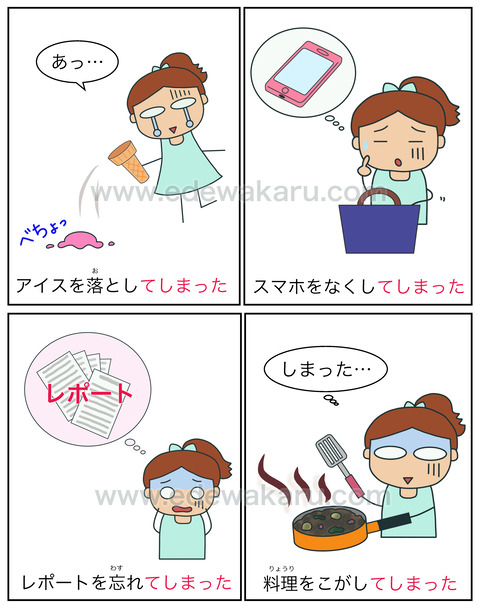
Meaning
Carelessly do〜even though you shouldn’t
How to use it
Verb [て-form] + てしまう
Explanation
“〜てしまう” is a sentence pattern meaning “carelessly did〜even though you shouldn’t.” It is used with feelings such as [regret] and [remorse] 😊 It is often used with words like “うっかり” (carelessly).
(Review: 〜を込めて・〜を込めた)
[Expressions often used with “〜てしまう”]
・Carelessly do〜てしまう
・Accidentally do〜てしまう
・Do〜てしまう unconsciously, etc.
[For those with time to spare]
The colloquial forms of “〜てしまう” are “〜ちゃう・〜じゃう.” They are often used in conversation, so I think it’s a good idea to practice using them well 😉
(Review: 〜ちゃう・〜じゃう)
[Examples]
① I dropped my ice cream.
→I dropped my ice cream by accident.
② I lost my phone.
→I lost my phone by accident.
③ I forgot my report.
→I forgot my report by accident.
④ Please don’t burn the food.
→Please don’t burn the food by accident.
⑤ I hear that even though they’re dieting, they ate cake.
→I hear that even though they’re dieting, they ate cake.
(Review: 〜って (hearsay))
⑥ When I think I have to study, I end up getting sleepy…
→When I think I have to study, I end up getting sleepy…
(Review: 〜てしまう can also express [completion], in addition to [regret / remorse], so review that usage too 😀
[Related patterns]
In context 6 examples
アイスを落としてしまった
→うっかりアイスを落とした(復習:落ちる・落とす)I accidentally dropped my ice cream. →I dropped my ice cream by accident (Review: 落ちる・落とす).
スマホをなくしてしまった
→うっかりスマホをなくしたI accidentally lost my phone. →I lost my phone by accident.
レポートを忘れてしまった
→うっかりレポートを忘れたI accidentally forgot my report. →I forgot my report by accident.
料理をこがしてしまった
→うっかり料理をこがしたI accidentally burned the food. →I burned the food by accident.
ダイエット中なのに、ケーキを食べてしまった
→ダイエット中なのに、ケーキを食べた(復習:〜中)Even though I’m dieting, I ate cake. →Even though I’m dieting, I ate cake (Review: 〜中).
勉強しなくちゃと思うと、眠くなってしまう
→勉強しなくちゃと思うと、眠くなる(復習:〜なくちゃ)When I think I have to study, I end up getting sleepy. →When I think I have to study, I get sleepy (Review: 〜なくちゃ).
Read the original source text
Meaning
〜してはいけないのに、うっかり〜する
How to use it
動詞[て形]+てしまう
Explanation
「〜てしまう」は「〜してはいけないのに、うっかり〜した」という意味を表す文型です。これは
【残念】【後悔】
などの気持ちを込めて使われます😊 「うっかり」などとよく一緒に使われます。
(復習:〜を込めて・〜を込めた)
[「〜てしまう」とよく使う表現]
・
うっかり
〜てしまう
・
つい
〜てしまう
・
無意識に
〜てしまう など
【余裕がある人へ】
「〜てしまう」の口語形は「〜ちゃう・〜じゃう」です。会話でとてもよく使われますので、上手に使えるように練習しておくといいと思います😉
(復習:〜ちゃう・〜じゃう)
[例]
①アイスを落とし
てしまった
→アイスを落とし
ちゃった
②スマホをなくし
てしまった
→スマホをなくし
ちゃった
③レポートを忘れ
てしまいました
→レポートを忘れ
ちゃいました
④料理をこがし
てしまわないでください
→料理をこがしちゃわないでください
⑤ダイエット中なのに、ケーキを食べ
てしまったんだって
→ダイエット中なのに、ケーキを食べ
ちゃったんだって
(復習:〜って(伝聞))
⑥勉強しなくちゃと思うと、眠くなっ
てしまうんだ
よね…
→勉強しなくちゃと思うと、眠くなっ
ちゃうんだ
よね…
「〜てしまう」には
【残念・後悔】
以外に、
【完了】
を表すものもありますので復習をしておきましょう😀
【関連文型】
Usage 2
Read this source entry ↗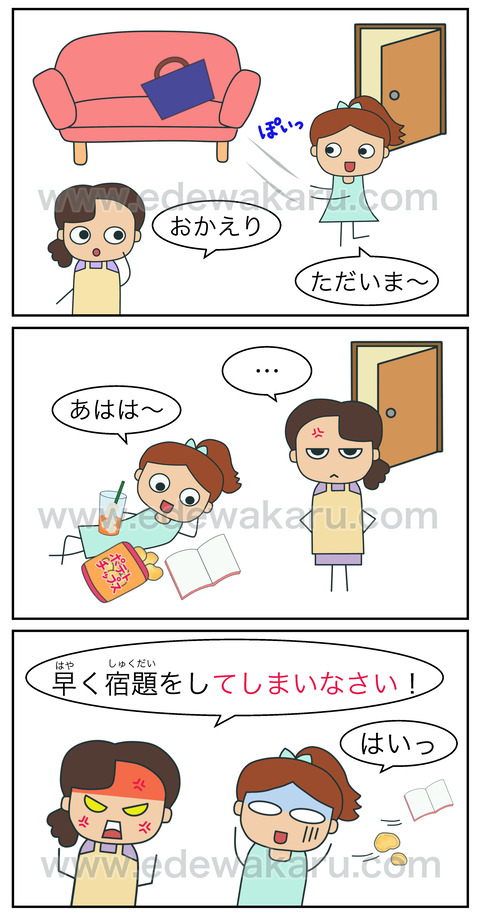
Meaning
Finish doing〜
Become〜
How to use it
Verb [て-form] + てしまう
Explanation
“〜てしまう” is a sentence pattern that expresses [completion], meaning “finish doing〜” or “become〜.”
With verbs that express an action, it means “finish doing〜”; with verbs that express a state, it means “become〜” 😊
[Meaning “finish doing〜”]
① Finish doing homework
→The action “do homework” is finished.
② Finish reading a book
→The action “read a book” is finished.
③ Finish writing a report
→The action “write a report” is finished.
[Meaning “become〜”]
① My foot ends up hurting.
→It becomes the state “my foot hurts.”
② I end up catching a cold.
→It becomes the state “catch a cold.”
[For those with time to spare]
The colloquial forms of “〜てしまう” are “〜ちゃう・〜じゃう.” They are also very often used in conversation, so I think it’s a good idea to remember them 😉
(Review: 〜ちゃう・〜じゃう)
① Finish your homework.
→Finish your homework.
② I finished reading the book.
→I finished reading the book.
③ Let’s finish writing the report.
→Let’s finish writing the report.
④ My foot ended up hurting.
→My foot ended up hurting.
⑤ I ended up catching a cold.
→I ended up catching a cold.
“〜てしまう” is a beginner-level pattern, but it’s very important. Be sure to review it well 😊
[Related articles]
In context 5 examples
早く宿題をしてしまいなさい
→早く宿題をしなさいFinish your homework quickly. →Do your homework quickly.
A:この本、もう読んでしまったから貸してあげるわB:ありがとう〜
→この本、もう読んだから貸してあげるわ(復習:貸す・借りる)A: I’ve already finished reading this book, so I’ll lend it to you. B: Thanks! →I’ve already read this book, so I’ll lend it to you (Review: 貸す・借りる).
レポートは、昨日書いてしまったよ〜
→レポートは、昨日書いたよ〜I finished writing the report yesterday! →I wrote the report yesterday!
2時間も立ちっぱなしだったので、足が痛くなってしまった
→2時間も立ちっぱなしだったので、足が痛くなった(復習:〜っぱなし)I was standing for as long as two hours, so my feet ended up hurting. →I was standing for as long as two hours, so my feet hurt (Review: 〜っぱなし).
ここのところ寒かったので、かぜをひいてしまった
→ここのところ寒かったので、かぜをひいた(復習:〜ところ(Nのところ))It’s been cold around here lately, so I ended up catching a cold. →It’s been cold around here lately, so I caught a cold (Review: 〜ところ (Nのところ)).
Read the original source text
Meaning
〜するのがおわる
〜という状態になる
How to use it
動詞[て形]+てしまう
Explanation
「〜てしまう」は「〜するのがおわる」「〜という状態になる」という意味で、【完了】を表す文型です。
動作を表す動詞は
「〜するのがおわる」
の意味で使われ、状態を表す動詞は
「〜という状態になる」
という意味で使います😊
[「〜するのがおわる」という意味]
①宿題をし
てしまう
→「宿題をする」 という動作がおわる
②本を読ん
でしまう
→「本を読む」という動作がおわる
③レポートを書い
てしまう
→「レポートを書く」という動作がおわる
[「〜という状態になる」という意味]
①足が痛くなっ
てしまう
→「足が痛い」という状態になる
②かぜをひい
てしまう
→「かぜをひく」という状態になる
【余裕がある人へ】
「〜てしまう」の口語形は「〜ちゃう・〜じゃう」です。会話でもとてもよく使いますので、覚えておくといいと思います😉
(復習:〜ちゃう・〜じゃう)
①宿題をし
てしまいなさい
→宿題をし
ちゃいなさい
②本を読ん
でしまいました
→本を読ん
じゃいました
③レポートを書い
てしまおう
→レポートを書い
ちゃおう
④足が痛くなっ
てしまった
→足が痛くなっ
ちゃった
⑤かぜをひい
てしまいました
→かぜをひい
ちゃいました
「〜てしまう」は初級の文型ですが、とても大切です。しっかりと復習をしておきましょう😊
【関連記事】
Usage 3
Read this source entry ↗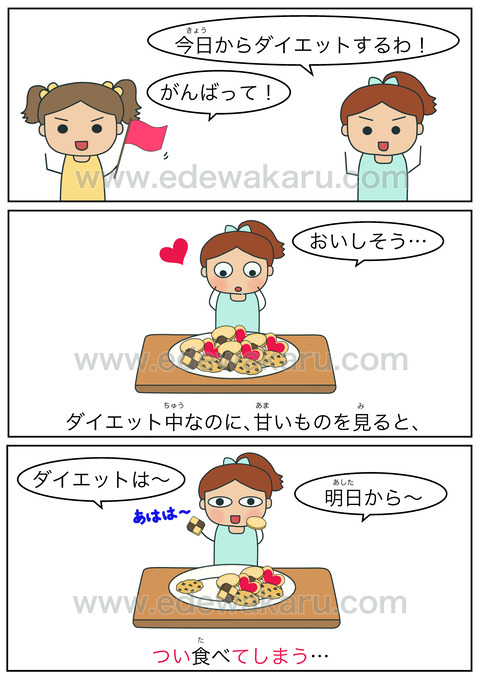
Meaning
Without intending to do 〜, you do it unconsciously
Even if you don’t mean to, you end up doing 〜
How to use it
つい + verb [て-form] + てしまう
Explanation
“ついAてしまう” is a sentence pattern meaning “you do A unconsciously even though you don’t mean to” or “you end up doing A even when you don’t intend to.” In most cases, it expresses regret or disappointment, as in “I thought I shouldn’t do A, but I did it unconsciously.”
Be sure to review “〜てしまう” and its colloquial forms “〜ちゃう・〜じゃう” 😊
[Related articles]
In context 5 examples
ダイエット中なのに、甘いものを見るとつい食べてしまう…
→甘いものを見ると、食べるつもりがなくても食べてしまうEven though I’m dieting, whenever I see sweets, I can’t help eating them… → Whenever I see sweets, I eat them even though I don’t mean to.
かわいいものを見ると、つい買ってしまう
→買おうと思っていなくても、買ってしまうWhen I see cute things, I can’t help buying them. → I end up buying them even though I didn’t intend to.
うまくいかないと、ついイライラしてしまう
→イライラするつもりがなくても、イライラしてしまうWhen things don’t go well, I can’t help getting irritated. → I get irritated even though I don’t mean to.
学校をサボっているところをお母さんに見つかり、ついうそをついてしまった
→うそをつくつもりがなかったのに、うそをついてしまったMy mother caught me skipping school, so I ended up lying without thinking. → I ended up lying even though I hadn’t meant to.
「ここだけの話だよ」と言われると、つい誰かに話してしまう…
→話そうと思っていなくても、誰かに話してしまう…When someone says, “This is just between us,” I can’t help telling someone… → I end up telling someone even though I didn’t mean to…
Read the original source text
Meaning
〜しようと思っていないのに、無意識に〜してしまう
〜つもりがなくても、〜してしまう
How to use it
つい+動詞[て形]+てしまう
Explanation
「ついAてしまう」は「Aしようと思っていないのに、無意識にAしてしまう」「Aするつもりがなくても、Aしてしまう」という意味の文型です。ほとんどの場合は、「Aしてはいけないと思っていたが、無意識にAしてしまった」というように後悔したり、残念に思う気持ちを表します。
「〜てしまう」
と、「〜てしまう」の口語形の
「〜ちゃう・〜じゃう」
の復習をしておきましょう😊
【関連記事】
毎日のんびり日本語教師
How to use it
Verb in て-form + しまう
Verb in て-form’s 「テ」 + ちゃう/じゃう
Explanation
There are two meanings.
① Completion
② Regret or frustration
In colloquial speech, 「ちゃう/じゃう」is used.
Notes
Nothing in particular.
In context 8 examples
昔のことは忘れてしまった。(把以前的事情忘了。)
I’ve forgotten what happened in the past.
ほかの人はみんな行ってしまった。(其他人都走了。)
Everyone else has gone.
一生分の運を使い切っちゃった気がする。
I feel like I’ve used up all the luck I’ll ever have.
分からなくて諦めてしまった。(不明白就放弃了。)
I gave up because I didn’t understand.
見てはいけないものを見てしまった。
I saw something I wasn’t supposed to see.
罪を犯してしまった。(犯了罪。)
I ended up committing a crime.
よく行くお店だったのに、閉店してしまった。
It was a shop I often went to, but it has closed down.
フラれちゃった。(被甩了。)
I got dumped.
Read the original source text
How to use it
動て形+しまう
動て形の「テ」+ちゃう/じゃう
Explanation
二つの意味があります。
①完了
②後悔、悔しさ
口語は「ちゃう/じゃう」を用います。
Notes
特になし
日本語文型辞典 英語版
Meaning
【てしまう】In casual spoken language, this often takes the form ...ちゃう, as in 言っちゃう and 来ちゃう.
B:ちょっと、この手紙を書いてしまうから、待ってください。
Umm, give me a little time to finish writing this letter.
Expresses completion of an action that is a process. When used with a verb that expresses a continuing action, as in
(1)
-
(3)
, its meaning is close to that of the R-おわる form. Depending on the meaning of the verb, V-てしまう may also express “ending up in a certain condition” (
(6)
and
(7)).
(6)
means “was in the condition of having a cold.”
Used to express a variety of strong feelings, such as remorse and regret, depending on the context. Sometimes conveys the nuance of an irrevocable result.
(6)
and
(7)
show the usage of てしまう with the passive voice.
Expresses the completion of an action at a point in the past. While ...ていた can be used, ...てしまっていた emphasizes the completed aspect of the action (i.e. “completely finished”) and/or conveys the nuance of an irrevocable result.
How to use it
1. V-てしまう〈completion〉
2. V-てしまう〈strong feeling〉
3. V-てしまっていた
In context 17 examples
この本はもう読んでしまったから、あげます。
I’ve already finished reading this book, so I’ll give it to you.
A:でかけますよ。
I’m leaving.
この宿題をしてしまったら、遊びにいける。
I can go out and play after I’m finished this homework.
仕事は、もう全部完成してしまった。
I’ve already finished all my work.
あの車は売ってしまったので、もうここにはない。
We’ve sold that car, so it’s not here anymore.
雨の中を歩いて、かぜをひいてしまった。
I caught a cold from walking in the rain.
朝早くから働いていたので、もうすっかり疲れてしまって、動けない。
I’ve been working since early this morning, so I’m completely exhausted and can’t move an inch.
酔っ払って、ばかな事を言ってしまったと後悔している。
I regret saying something stupid when I was drunk.
新しいカメラをうっかり水の中に落としてしまった。
I accidentally dropped my new camera into the water.
電車の中にかさを忘れて来てしまった。
I forgot my umbrella on the train.
だまっているのはつらいから、本当のことを話してしまいたい。
It’s hard to keep quiet, so I want to tell the whole truth.
知ってはいけないことを知ってしまった。
I found out something I had no business knowing.
彼は、友達に嫌われてしまったと言う。
He says he is thoroughly disliked by his friends.
アルバイトの学生にやめられてしまって、困っている。
I’m in a real fix because my part-time student went and quit on me.
わたしが電話したときには、彼女はもう家を出てしまっていた。
When I telephoned, she had already left home.
友達が手伝いに来たときには、ほとんどの荷造りは終わってしまっていた。
We were just about finished packing by the time my friend came to help.
警察がかけつけたときには、犯人の乗った飛行機は離陸してしまっていた。
By the time the police arrived, the plane the criminal was on had already taken off.
Bunpro Grammar Reference
Meaning
To do something by accident, To finish completely・totally, Unfortunately
How to use it
Verb[て]+ しまう
Verb[て̶] + ちゃう(1)
(1) じゃう(*)
(*) Used when Verb[て]ends with で
Verb[て]+ しまいます
Verb[て̶] + ちゃいます(1)
(1) じゃいます(*)
(*) Used when Verb[て]ends with で
Nuance
A structure that expresses that (A) is done completely, or unfortunately.
Explanation
By combining the conjunction particle て, with the verb しまう (sometimes written as 終う), you are able to express that something was done 'by accident', 'completely', or 'unfortunately'. These meanings may seem quite different, but we will discuss their similarities in a moment. Let's look at a few examples of てしまう first.
私はすぐに道に迷ってしまう。
Unfortunately, I easily get lost.
家にお菓子がいっぱいあると全部食べてしまうのでお菓子を買わないようにしている。
When there are a lot of snacks in my house, I completely eat them all, so I try not to buy them.
メニューにアイスクリームがあると頼んでしまう。
When there is ice-cream on the menu, I unfortunately order it.
私はよく舌を噛んでしまう。
I accidentally bite my tongue often.
As we can see, verbs that usually take で instead of て will be no different when using てしまう.
Sometimes, てしまう or でしまう will be shortened to a more casual form, which are often used in speech. These forms are as follows:
てしまう will become ちゃう
でしまう will become じゃう
最近運動をしてないから太っちゃう。
Recently, I haven't been exercising, so I'm totally going to get fat.
花が死んじゃうから、花を踏むな。
Since the flowers will unfortunately die, don't step on them.
Fun Fact
While て終う is most frequently written in hiragana, て仕舞う may also be seen. There is a slight nuance difference between these two kanji structures, but the primary meaning of しまう will always be that 'something has come to the point where ending/ending up in a specific state cannot be avoided'. This 'no turning back point' may be temporary (likely to be written as 仕舞う), or it may be permanent (likely to be written as 終う).
Due to this 'cannot be avoided' nuance, しまう often comes across as 'totally', as in 'ah… I totally left the chicken in the oven for too long'. In these cases, it is simply expressing the speaker's exasperation that something is 'too late' to change. However, despite regularly being used negatively, てしまう can also be used positively. In these cases it still has the nuance of 'no turning back'.
ゲームを始める前に宿題を終わらせてしまおう!
Let's completely finish my homework before I start playing video games! (I'm going to completely finish my homework before I start playing video games)
青木先輩、定時までに社長に頼まれたレポートを完成させてしまいましょうよ。
Aoki senpai, let's completely finish the report that our boss has asked us to do before work is over.
In context 20 examples
- 傘を忘れてしまった。
I unfortunately forgot my umbrella. (I totally forgot my umbrella)
- 花が死んじゃうから、花を踏むな。
Since the flowers will unfortunately die, don't step on them.
- 私はよく舌を噛んでしまう。
I accidentally bite my tongue often.
- 私はすぐに道に迷ってしまう。
Unfortunately, I easily get lost.
- 家にお菓子がいっぱいあると全部食べてしまうのでお菓子を買わないようにしている。
When there are a lot of snacks in my house, I completely eat them all, so I try not to buy them.
- メニューにアイスクリームがあると頼んでしまう。
When there is ice-cream on the menu, I unfortunately order it.
- 最近運動をしてないから太っちゃう。
Recently, I haven't been exercising, so I'm totally going to get fat.
- 友達は私のケーキを食べてしまった。
My friend finished off my cake. (eaten completely)・(totally)
- お皿が割れてしまった。
(Someone) accidentally broke a plate. (unfortunately・totally)
- 今出ないと遅れてしまうよ。
If you don't leave now, you will unfortunately be late. (totally)
- ごめん!卵を全部使ってしまった。
Sorry! I completely used all the eggs. (Sorry! I totally used all the eggs)
- スノーボードに行ったとき、腰を痛めてしまった。
I unfortunately hurt my lower back when I went snowboarding. (totally)
- あっ、鉛筆を持ってくるのを忘れてしまった。
Ah, I totally forgot to bring a pencil. (Ah, I totally forgot to bring a pencil)
- よし!誰も食べないなら、僕が食べてしまおう。
Alright! Since no one is going to eat it, I will finish (eating) it off. (eat completely・totally)
- あまりお腹が空いていなかったのに、ケーキをほとんど食べてしまった。
Even though I wasn't that hungry, I unfortunately ate most of the cake. (totally)
- 今日は冬休みの宿題を全部してしまおう。
Today I shall completely finish (doing) all of the homework for winter break. (totally finish)
- そんな大きい声を出さないで!子供が起きてしまうでしょう。
Please don't be so loud! You are totally going to wake up the kid. (unfortunately)
- あの人は信頼出来ると聞いたから、言ったことを全部信じてしまった。
Since I heard that that person could be trusted, I totally believed everything I heard (from him). (unfortunately)
- ゲームを始める前に宿題を終わらせてしまおう!
Let's completely finish my homework before I start playing video games! (I'm going to completely finish my homework before I start playing video games)
- 青木先輩、定時までに社長に頼まれたレポートを完成させてしまいましょうよ。
Aoki senpai, let's completely finish the report that our boss has asked us to do before work is over.
Yokubi — The Common Grammar Guide (https://yoku.bi)
Explanation
てしまう indicates that something is "complete" or "done completely". It's also used when things "end up" in such a "complete" state, like after mistakes. A good way to remember this is to think about "it's done" and "now I've done it". It can often have a nuance of regret.
てしまう can also be ちまう or ちゃう in speech (or じゃう for voiced verb conjugations like 死んでしまう \-\> 死んじゃう).
Once something is done with てしまう, the implication is that it cannot be taken back.
ておく means to do something and then leave it untouched/leave it alone with the expectation that it will bear fruit in the future. This is often described as "do something in preparation" because practically speaking that's what it often implies. It can also be used metaphorically to mean "do something and then put it out of mind". ておく is often contracted as とく
NINJAL 日本語文型データベース
Meaning
[1] Used when you want to say that you will finish something quickly, completely, or in its entirety. Used when you want to express the desire to deal with something quickly before doing something else. Also used when you feel that nothing is weighing on your mind or bothering you.
[2] Used when you want to say that the speaker causes an unfortunate event, or that something causes the speaker to feel regret.
How to use it
Vてしまう
Notes
[1] Can be used for past, present, and future events.
In context 11 examples
私はいつも寝る前に翌日の朝ご飯の準備をしてしまう。
I always prepare the next morning's breakfast before going to bed.
次の仕事に取りかかる前に、このメールに返信を出してしまおう。
I'll reply to this email before starting the next task.
「早くご飯を食べてしまいなさい。学校に遅れるよ」
“Finish your dinner quickly. You'll be late for school.”
あの人とはもう別れてしまいたい。その方がすっきりする。
I want to end things with that person once and for all. I'll feel better that way.
先に段取りを決めてしまえば、あとの作業は楽だ。
If you decide on the arrangements in advance, the work afterward will be easy.
あの学生は問題を解くのが早い。試験のときもあっという間に答えを全部書いてしまって、暇そうにしていた。
That student solves problems quickly. During exams, too, he would finish writing all the answers in no time and then look bored.
私はよく人の名前を忘れてしまう。
I often forget people’s names.
新しいシャツにコーヒーをこぼしてしまった。
I spilled coffee on my new shirt.
「すみません。筆記用具を忘れてしまったんですが、貸していただけませんか」
“Excuse me. I forgot my writing utensils. Could I borrow some?”
詐欺にご用心。だます方がもちろん悪いけれど、だまされてしまう方も不注意だ。
Beware of fraud. The person doing the deceiving is of course in the wrong, but the person who gets deceived is careless too.
いつも買っていた豆腐屋が閉店してしまって、とても残念だ。
The tofu shop I always went to closed down, and I’m really disappointed.
Read the original source text
Meaning
[1] あることを早く・完全に・全部終わらせると言いたいときに使います。何かをする前に早く処理したいという気持ちを表したい場合に使います。心理的に残っているものがなく、気になることがないと感じるときにも使います。
[2] 話し手自身が残念な出来事を引き起こす、または、ある事柄が話し手の残念に思う気持ちを引き起こすと言いたいときに使います。
How to use it
Vてしまう
Notes
[1] 過去のことにも、現在のことにも、未来のことにも使えます。