AIUEO JLPT Grammar
Meaning
This sentence pattern expresses initiating new actions or changes triggered by a specific event or opportunity. It emphasizes taking advantage of a situation to move forward or act.
How to use it
Noun を + 機に
In context 5 examples
今回の転職を機に、仕事のやり方を変えることにした。
I decided to change the way I work, taking this job change as an opportunity.
結婚を機に、田舎に引っ越すことにした。
I decided to move to the countryside on the occasion of my marriage.
昇進を機に、もっと責任のある仕事を任されるようになった。
I was entrusted with more responsibilities on the occasion of my promotion.
留学を機に、さまざまな国の文化に触れることができた。
I was able to experience the cultures of various countries by studying abroad.
異動を機に、新しいスキルを学び始めた。
I started learning new skills, taking my transfer as an opportunity.
Read the original source text
Meaning
This sentence pattern expresses initiating new actions or changes triggered by a specific event or opportunity. It emphasizes taking advantage of a situation to move forward or act.
How to use it
名詞を+機に
Explanation · 日本語
この文型は、何かを契機にして、新しい行動や変化を起こすことを表現する表現です。特定の出来事や機会を利用して、新しい方向に進む、または行動を起こすときに使われます。
Bunpro Grammar Reference
Meaning
Opportunity, Occasion
How to use it
Verb + の + を機に(して)
Noun + を機に(して)
Nuance
An expression meaning an opportunity is actively made of a specific event, or that (A) is the mechanism for achieving it.
Explanation
When used as a noun, 機 ‘opportunity’ indicates a time that is being used as suitable chance to do something. It is slightly formal and will usually be translated as ‘on the occasion of (A), (B)’. However, due to this grammar point being a construction of the adverbial particle を, 機, and the case-marking particle に, it is indicating that the speaker is actively making use of the opportunity of (A)’. Due to this, it can be understood as ‘taking advantage of (A), (B)’, or ‘taking advantage of the time of (A), (B)’ on many occasions.
を機に will directly follow nouns marking (A), before going on to explain how that (A) was utilized as an opportunity.
妻の妊娠を機にタバコを止めることにした。
Taking advantage of the time of my wife’s pregnancy, I have decided to quit smoking.
車検を機に、新しい車を買うことにした。
On the occasion of my car inspection, I have decided to buy a new car. (Due to being told that the current car is probably beyond repair)
彼氏と別れたのを機に、新しいバッグを買った。
Making the most of the breakup with my boyfriend, I bought a new bag. (In order to feel new and fresh)
7年間使っていた携帯がとうとう壊れた。これを機に機種変更することにした。
My cell phone, which I had been using for 7 years, finally broke. I decided to take this opportunity to change the model.
を機に tends to be used most frequently when (B) is an action that the speaker is choosing to take primarily with (A) as the enabling factor, or being a good excuse.
In context 10 examples
- 小説:「3ヶ月目にやっと病気が完治し、これを機に、入院後初めて退院することができた。」
Novel: 'In the third month, she was finally completely cured of her illness, and this opportunity allowed her to leave the hospital for the first time since hospitalization.'
- 妻の妊娠を機にタバコを止めることにした。
Taking advantage of the time of my wife’s pregnancy, I have decided to quit smoking.
- 車検を機に、新しい車を買うことにした。
On the occasion of my car inspection, I have decided to buy a new car. (Due to being told that the current car is probably beyond repair)
- 彼氏と別れたのを機に、新しいバッグを買った。
Making the most of the breakup with my boyfriend, I bought a new bag. (In order to feel new and fresh)
- 7年間使っていた携帯がとうとう壊れた。これを機に機種変更することにした。
My cell phone, which I had been using for 7 years, finally broke. I decided to take this opportunity to change the model.
- 伝記:「大学卒業を機に大阪へ移り、プログラミングの職を得ることができました。」
Biography: 'On the opportunity of graduation, I moved to Osaka and was able to land a programming job.'
- 演説:「今回の訪問を機に、より多くのアメリカ人が日本で働くことに興味を持つことを願っています。」
Speech: 'We hope that this visit will provide an opportunity for more Americans to be interested in working in Japan.'
- 小説:「結婚を機にたまひこは東京を離れ、千葉の町でゆずきとふたりの新生活を始じめた。」
Novel: 'On the opportunity of getting married, Tamahiko left Tokyo and started a new life with Yuzuki in the town of Chiba.'
- 伝記:「ひろしは56歳の時故郷へ戻ったのを機に、両親の墓参りに行った。」
Biography: 'When Hiroshi returned to his hometown at the age of 56, he took the opportunity to visit his parent's graves.'
- この橋はアニメのエピソードに登場したことで有名になった。これを機に、近隣からだけでなく全国から、大勢の人が訪れるようになった。
This bridge became famous when it appeared in an episode of an anime. This opportunity led to a large number of visitors, not only from surrounding areas, but from all over the country.
Read the original source text
Meaning
Opportunity, Occasion
How to use it
Verb + の + を機に(して)
Noun + を機に(して)
Nuance
An expression meaning an opportunity is actively made of a specific event, or that (A) is the mechanism for achieving it.
Explanation
When used as a noun, 機 ‘opportunity’ indicates a time that is being used as suitable chance to do something. It is slightly formal and will usually be translated as ‘on the occasion of (A), (B)’. However, due to this grammar point being a construction of the adverbial particle を, 機, and the case-marking particle に, it is indicating that the speaker is actively making use of the opportunity of (A)’. Due to this, it can be understood as ‘taking advantage of (A), (B)’, or ‘taking advantage of the time of (A), (B)’ on many occasions.
を機に will directly follow nouns marking (A), before going on to explain how that (A) was utilized as an opportunity.
妻の妊娠を機にタバコを止めることにした。
Taking advantage of the time of my wife’s pregnancy, I have decided to quit smoking.
車検を機に、新しい車を買うことにした。
On the occasion of my car inspection, I have decided to buy a new car. (Due to being told that the current car is probably beyond repair)
彼氏と別れたのを機に、新しいバッグを買った。
Making the most of the breakup with my boyfriend, I bought a new bag. (In order to feel new and fresh)
7年間使っていた携帯がとうとう壊れた。これを機に機種変更することにした。
My cell phone, which I had been using for 7 years, finally broke. I decided to take this opportunity to change the model.
を機に tends to be used most frequently when (B) is an action that the speaker is choosing to take primarily with (A) as the enabling factor, or being a good excuse.
Nuance · 日本語
特定の出来事が機会を生み出している、又は(A)がそれを達成させるためのメカニズムだと言うことを示す表現。
Explanation · 日本語
名詞の「機」を含む「を機に」は、何かを行うのに適したタイミングやチャンスを表す、やや改まった表現です。一般的には「(A) をきっかけに (B)」という意味で使われますが、この文型は副助詞「を」、名詞「機」、格助詞「に」からできており、話し手が (A) を積極的に利用する・(A) のタイミングをうまく活かすというニュアンスがあります。
「を機に」は、(A) を表す名詞の直後に置かれ、その出来事を良い機会として (B) のような行動を起こしたときに使われます。
妻の妊娠を機にタバコを止めることにした。
Taking advantage of the time of my wife’s pregnancy, I have decided to quit smoking.
車検を機に、新しい車を買うことにした。
On the occasion of my car inspection, I have decided to buy a new car. (Due to being told that the current car is probably beyond repair)
彼氏と別れたのを機に、新しいバッグを買った。
Making the most of the breakup with my boyfriend, I bought a new bag. (In order to feel new and fresh)
7年間使っていた携帯がとうとう壊れた。これを機に機種変更することにした。
My cell phone, which I had been using for 7 years, finally broke. I decided to take this opportunity to change the model.
この表現は、特に (A) が動機や口実となって、話し手が自ら (B) することを選んだ場合に使われることが多いです。
絵でわかる日本語
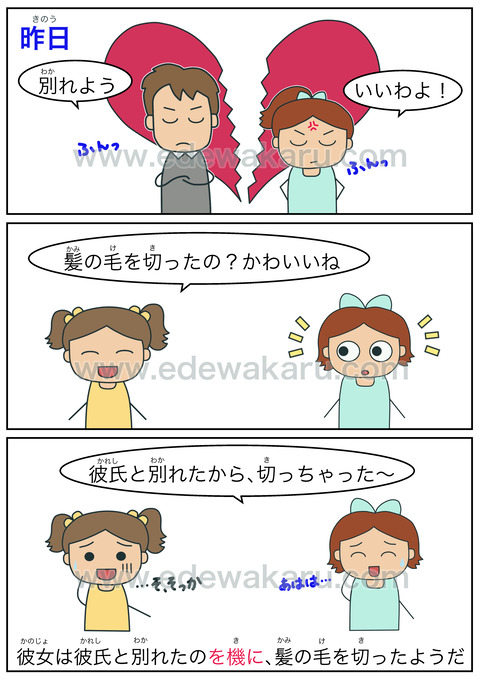
Meaning
Because ~ happened, ~ came to happen
~ became an occasion for ~
How to use it
Noun [dictionary form] + を機に
Verb [plain form] + のを機に
Explanation
「Aを機にB」 is a sentence pattern meaning “Because A happened, B came to happen” or “A became an occasion for B.” It is used to say that A became a motive or opportunity for starting something new, B.
[Examples]
① She seems to have cut her hair after breaking up with her boyfriend.
【Motive/opportunity】Breaking up with her boyfriend
【Something new】Cutting her hair short
→ The heartbreak motivated her to cut her hair.
② He bought a new house on the occasion of getting married.
【Motive/opportunity】Marriage
【Something new】Buying a house
→ Getting married gave him the opportunity to buy a new house.
③ I decided to quit my job after becoming pregnant.
【Motive/opportunity】Pregnancy
【Something new】Quitting her job
→ Her pregnancy became the occasion for deciding to quit her job.
④ He stopped drinking after becoming ill.
【Motive/opportunity】Illness
【Something new】Coming not to drink alcohol
→ His illness prompted him to stop drinking.
⑤ I decided to take English conversation lessons after an overseas trip.
【Motive/opportunity】An overseas trip
【Something new】Starting English conversation lessons
→ The overseas trip prompted me to decide to take English conversation lessons.
Let’s review similar sentence patterns to 「〜を機に」 😉
【Similar patterns】
In context 5 examples
彼女は彼氏と別れたのを機に、髪の毛を切ったらしい
She seems to have cut her hair after breaking up with her boyfriend.
彼は、結婚を機に新しい家を買った
He bought a new house on the occasion of getting married.
妊娠を機に、会社を辞めることにしました
I decided to quit my job after becoming pregnant.
彼は病気を機に、お酒を飲まないようになった
He stopped drinking after becoming ill.
海外旅行(かいがいりょこう)を機に、英会話を習うことに決めた
After an overseas trip, I decided to take English conversation lessons.
Read the original source text
Meaning
〜があったから、〜するようになった
〜を機会に〜になった
How to use it
名詞[辞書形]+を機に
動詞[普通形]+のを機に
Explanation
「Aを機にB」は「Aがあったから、Bするようになった」「Aを機会に、Bになった」という意味の文型です。「Aが動機や機会となって、Bという新しいことをするようになった」と言いたい時に使われます。
[例]
①彼女は彼氏と別れた
のを機に、髪の毛を切ったらしい
【動機・機会】彼氏と別れる
【新しいこと】髪の毛を短くする
→失恋したのが動機になって、髪の毛を切った
②彼は、結婚
を機に
新しい家を買った
【動機・機会】結婚
【新しいこと】家を買う
→結婚が機会になって、新しい家を買った
③妊娠
を機に、会社を辞めることにしました
【動機・機会】妊娠
【新しいこと】会社を辞める
→妊娠が機会にとなって、会社を辞めることにした
④彼は病気
を機に、お酒を飲まないようになった
【動機・機会】病気
【新しいこと】お酒を飲まないようになる
→病気がきっかけになって、お酒を飲まないようになった
⑤海外旅行
を機に、英会話を習うことに決めた
【動機・機会】海外旅行
【新しいこと】英会話を始める
→海外旅行がきっかけになって、英会話を習うことに決めた
「〜を機に」の類似文型(るいじぶんけい)を復習しておきましょう😉
【類似文型】
毎日のんびり日本語教師
How to use it
Noun + を機に
Noun + を契機に
Verb plain form + のを機に
Verb plain form + のを契機に
Explanation
Indicates the starting point at which something new begins. The first part states that starting point, and the latter part describes what happens afterward. It can be rephrased as 「~をきっかけに」, which is often used in spoken language. By contrast, 「~を機に/を契機に」 is somewhat formal.
This pattern cannot be used when the actions in the first and latter parts are of the same kind. It is used when they describe entirely different actions, and the first action serves as an opportunity or motivation for the latter one.
✕
大阪への旅行を機に、京都にも旅行した。
◯
大阪への旅行を皮切りに、京都にも旅行した。
In a case like this, 「~を皮切りに」 can be used.
Notes
Similar grammar: 「[N1 grammar] ~を皮切りに(して)/~を振り出しに(して)」
With 「~をきっかけに」 and 「~を機に/を契機に」, the actions in the first and latter parts must be completely different actions.
With 「~を皮切りに」 and 「~を振り出しに」, the first and latter parts describe actions of the same kind. They also differ in that they indicate those actions continue to be carried out one after another from that point on.
In context 8 examples
失恋を機に髪をばっさり切った。(以失恋为契机剪短了头发。)
After a breakup, I cut my hair short. (I cut my hair short as a result of the breakup.)
出産・育児を機に離職する女性が増えているという。
It is said that more women are leaving their jobs upon giving birth or raising children.
駅のゴミ箱に爆弾が仕掛けられていたらしい。これを機に警備を強化してほしいと思う。
Apparently, a bomb had been planted in the station trash can. I hope they strengthen security in response to this.
パソコンが壊れたが、修理すると逆に高いので、これを機に新しいのを買うつもりだ。
My computer broke, but repairing it would actually cost more, so I plan to use this as an opportunity to buy a new one.
新年度なので、これを機に何か新しいことに挑戦してみようと思う。
It’s the start of a new fiscal year, so I think I’ll take this opportunity to try something new.
女性は結婚を機に家事と育児に追われるようになる。
After getting married, women come to find themselves busy with housework and childcare.
出産を機に10キロほど太った。(以生孩子为契机胖了10公斤左右。)
I gained about 10 kilograms after giving birth. (I gained about 10 kilograms as a result of giving birth.)
父は大病を患ったのを契機に、健康に気を遣うようになった。
After my father suffered a serious illness, he began to take care of his health.
Read the original source text
How to use it
名詞+を機に
名詞+を契機に
動普通形+のを機に
動普通形+のを契機に
Explanation
新しい事柄が始まるその起点を表します。前項にはその起点、後項にはその後の行為を述べます。「~をきっかけに」に言い換えることができますが、こちらは口語でよく用いられる表現です。一方、「~を機に/を契機に」はやや硬めな表現です。
前項と後項が同種の行為の時、この文型は使えません。前項と後項は全く異なる行為を述べ、前項が機会や動機となって後項とするという時に使えます。
✕
大阪への旅行を機に、京都にも旅行した。
◯
大阪への旅行を皮切りに、京都にも旅行した。
このような場合は「~を皮切りに」が使えます。
Notes
似ている文法「【N1文法】~を皮切りに(して)/~を振り出しに(して)」
「~をきっかけに」と「~を機に/を契機に」は、前項と後項の行為が全く別の行為でなければいけません。
「~を皮切りに」と「~を振り出しに」は、前項と後項で同種の行為を述べます。また、それらの行為はそれ以後も次々を行われていく様子を表す点で異なります。