日本語文型辞典
Meaning
Basic information: V-てください
An expression used to request, instruct, or order someone to do something for the speaker (or someone on the speaker's side). It is more polite than “V-てくれ,” but is only used in situations where it is natural to expect the other person to do it. Used toward someone of lower or equal status.
Examples
① Please submit your resume by the end of this week.
② Please read this book by next week.
③ Take this medicine three times a day, after each meal.
④ Please try not to be late for class.
⑤ I'm begging you, please don't get in the way.
Read the original source text
Meaning
基本情報V-てください説明話し手(または話し手側の人)のために誰かが何かの行為をするよう依頼したり、指示したり、命令したりする表現。「V-てくれ」よりは丁寧だが、相手がそうするのが当然であるような状況でしか使われない。目下や同等の人に対して使う。例文① 今週中に履歴書を出してください。② 来週までにこの本を読んでおいてくださいね。③ この薬は1日3回、毎食後に飲んでください。④ 授業はできるだけ遅刻しないでください。⑤ 頼むから、邪魔しないでくださいよ。
絵でわかる日本語
Usage 1
Read this source entry ↗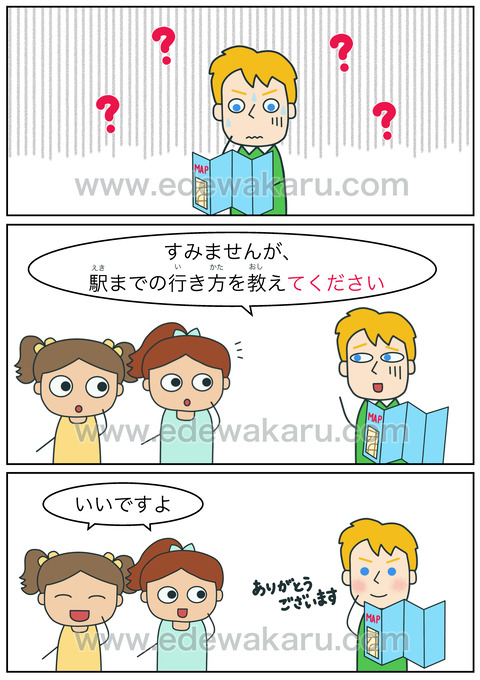
Meaning
Expresses a request
How to use it
Verb [て-form] + てください
Explanation
“〜てください” is a sentence pattern expressing a [request]. It is used to make a polite request in the form “すみませんが、〜てください” (“Excuse me, but please 〜”). When asking someone senior to do something, however, it’s a good idea to use a more polite request expression such as “〜てくださいませんか” or “〜ていただけませんか.”
[Examples]
Student: Teacher, excuse me, but could you please teach me this grammar?
Subordinate: Division Manager, I’m sorry to trouble you, but could you please come with me?
“〜てください” has other uses besides [requests], so review them 😉
In context 7 examples
A:すみませんが、駅までの行き方を教えてくださいB:いいですよ
A: Excuse me, could you tell me how to get to the station? B: Sure.
A:すみません、ちょっとここで待っていてくださいB:はい
A: Excuse me, could you wait here for a moment? B: Yes.
A:すみませんが、もう少しゆっくり話してくださいB:あ、すみません。わかりました
A: Excuse me, but could you speak a little more slowly? B: Oh, sorry. I understand.
A:すみませんが、もう一度言ってくださいB:はい
A: Excuse me, but could you say that one more time? B: Yes.
A:すみませんが、ちょっと手伝ってくださいB:いいですよ
A: Excuse me, but could you help me for a moment? B: Sure.
今日は、本当にすみませんでした。どうか許してください…
I’m truly sorry about today. Please forgive me…
すみませんが、ペンを貸してください
Excuse me, but could I borrow your pen?
Read the original source text
Meaning
依頼を表す
How to use it
動詞[て形]+てください
Explanation
「〜てください」は、[依頼]を表す文型です。「すみませんが、〜てください」の形で、丁寧に依頼をする場合に使われますが、目上の人に何かを頼む場合は「〜てくださいませんか」「〜ていただけませんか」など、丁寧な依頼表現を使うようにするといいと思います。
[例]
学生:先生、すみませんがこの文法を教え
てくださいませんか?
部下:部長、申し訳ありませんが、一緒に来
ていただけませんか?
「〜てください」には[依頼]の他にも用法がありますので、復習をしておきましょう😉
Usage 2
Read this source entry ↗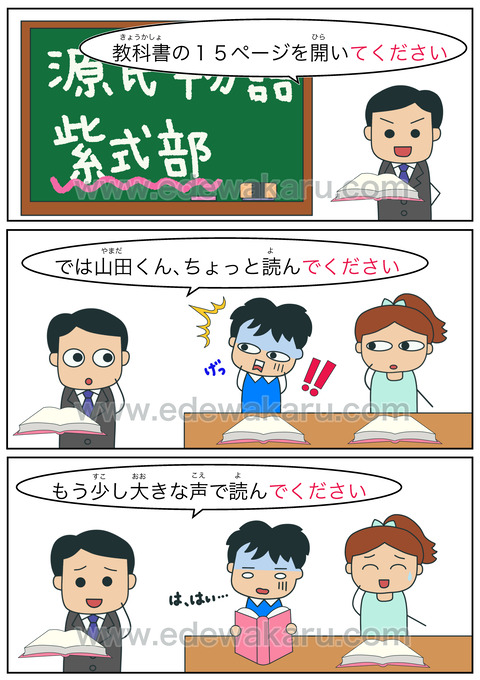
Meaning
Expresses an instruction.
How to use it
Verb [て-form] + てください
Explanation
“〜てください” is a sentence pattern that expresses an [instruction]. It is used when the speaker gives an instruction to the listener. This pattern is used when “it is taken for granted that the listener will do as the speaker instructs.” In response to “〜てください” used as an [instruction], expressions such as “はい” and “はい、わかりました” are often used. Be careful, because using “〜てください” as an [instruction] with someone of higher status may be considered rude.
[Examples]
❌Student: Teacher, please come over here.
❌Subordinate: President, please sit here.
“〜てください” is also very commonly used in everyday conversation, so it has meanings other than [instruction]. Review them as well 😉
In context 7 examples
教科書の15ページを開いてください
Please open your textbook to page 15.
先生:山田くん、例文を読んでください山田:はい先生:もう少し大きな声で読んでください山田:はい
Teacher: Yamada, please read the example sentence. Yamada: Yes. Teacher: Please read a little louder. Yamada: Yes.
先生:金曜日までにレポートを書いてきてください学生:はい
Teacher: Please write the report and bring it in by Friday. Student: Yes.
医者:ごはんを食べた後に、この薬を飲んでください患者:はい
Doctor: Please take this medicine after eating. Patient: Yes.
A:ここに名前を書いてくださいB:はい、わかりました
A: Please write your name here. B: Yes, understood.
客:東京駅(とうきょうえき)まで行ってくださいタクシー:はい、わかりました
Customer: Please take me to Tokyo Station. Taxi driver: Yes, understood.
暗くなってきたので、電気をつけてください
It’s getting dark, so please turn on the light.
Read the original source text
Meaning
指示を表す
How to use it
動詞[て形]+てください
Explanation
「〜てください」は[指示]を表す文型です。話し手が聞き手に対して指示する場合に使われます。この文型は、
「聞き手が話し手の指示の通りにするのが当然だ」という場合
に使用されます。[指示]の「〜てください」に答える表現として、「はい」「はい、わかりました」などがよく使われます。[指示]の「〜てください」は目上の人に対して使うと、失礼だと思われますので注意が必要です。
[例]
❌学生:先生、こっちに来
てください
❌部下:社長、ここに座っ
てください
「〜てください」は、日常会話(にちじょうせいかつ)でもとてもよく使われます。[指示]以外の意味もありますので、復習をしておきましょう😉
Usage 3
Read this source entry ↗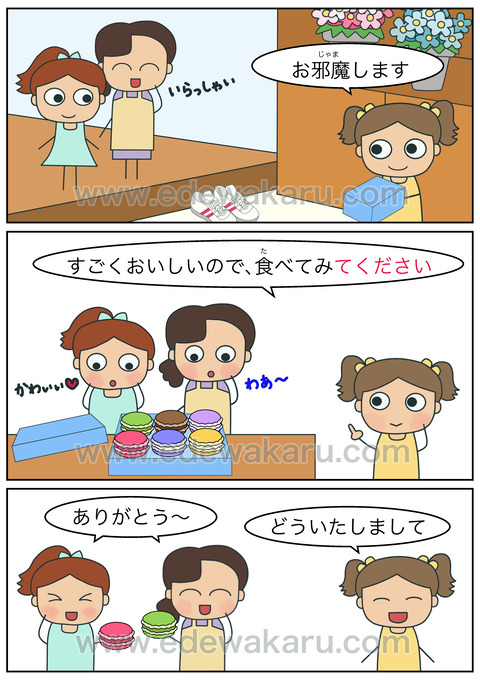
Meaning
Recommend something to the other person
How to use it
Verb [て-form] + てください
Explanation
“〜てください” is a sentence pattern expressing a [recommendation]. It is used when recommending something to someone. The form “どうぞ〜てください” is often used.
“〜てください” also has uses that express [instructions] and [requests], so remember those as well 😉
In context 6 examples
A:これ、すごくおいしいんです。どうぞ食べてみてくださいB:わあ、ありがとう〜
A: This is really delicious. Please, try some. B: Wow, thanks!
A:いらっしゃい!どうぞゆっくりしていってくださいねB:ありがとうございます
A: Welcome! Please take your time and stay a while. B: Thank you.
A:この本を読んでみてください。すごくおもしろいですよ!B:へえ〜。じゃあ、読んでみようかな〜
A: Please try reading this book. It’s really interesting! B: Oh, is it? Then maybe I’ll give it a read.
A:ちょっと遅れますので、先に飲み始めていてくださいB:は〜い
A: I’ll be a little late, so please go ahead and start drinking. B: Okaaay.
学生:今年はN1を受けることにしました先生:そうですか。がんばってくださいね!!
Student: I’ve decided to take N1 this year. Teacher: I see. Good luck!!
大切に預かりますので、安心してくださいね
I’ll take good care of it, so please don’t worry.
Read the original source text
Meaning
相手に何かを勧める
How to use it
動詞[て形]+てください
Explanation
「〜てください」は[勧め]を表す文型です。相手に何かを勧める場合に使われます。「どうぞ〜てください」という形がよく使用されます。
「〜てください」には[指示][依頼]を表す用法もありますので、一緒に覚えておきましょう😉
どんなときどう使う 日本語表現文型辞典
Meaning
please do…
How to use it
Vて/Vないで+ください
Explanation
1) ❶ ~ ❹ は、人に依頼したり、勧めたり、軽く指示したりする言い方。
2) ❺ ~❽は、禁止したり、人に何かをしないように頼む言い方。
1)In sentences ❶ to ❹ , てください is used to ask favors, make recommendations, or casually instruct someone.
2)In sentences ❺ to ❽, is used to ask someone to refrain from something or prohibit them from doing something.
In context 8 examples
あのう、もう少しゆっくり言ってください。
Um, please speak a little more slowly.
疲れたでしょう。ここでどうぞゆっくり休んでください。
You must be tired. Please take your time and rest here.
ここに名前を書いて、事務所に出してください。
Please write your name here and submit it to the office.
(教室で)キムさん、15ページを読んでください。
(In the classroom) Kim, please read page 15.
(立て札)ここにごみを捨てないでください。
(Sign) Please do not dump trash here.
すみません、そこに荷物を置かないでください。
Excuse me, please don’t put your luggage there.
(カラオケで)ぼくは歌がへただけど、笑わないでくださいね。
(At karaoke) I’m not good at singing, but please don’t laugh, okay?
ご用のない方は、ここに車を止めないでください。
If you have no business here, please don’t park your car here.
Read the original source text
Meaning
please do…
How to use it
Vて/Vないで+ください
Explanation
1) ❶ ~ ❹ は、人に依頼したり、勧めたり、軽く指示したりする言い方。
2) ❺ ~❽は、禁止したり、人に何かをしないように頼む言い方。
1)In sentences ❶ to ❹ , てください is used to ask favors, make recommendations, or casually instruct someone.
2)In sentences ❺ to ❽, is used to ask someone to refrain from something or prohibit them from doing something.
毎日のんびり日本語教師
How to use it
Verb in て-form + ください/ちょうだい
Verb in ない-form + ないでください/ないでちょうだい
Explanation
Expresses a request, instruction, or command to someone.
More polite expressions include 「~てくださいませんか」「~て頂けますか」「~て頂けませんか」「~ないでくださいませんか」「~ないで頂けますか」「~ないで頂けませんか」, among others.
「~てください/ないでください」is polite, but care is needed because using it with someone of higher status can sound rude.
「~ください」is also sometimes written with the kanji 「~下さい」.
「~てくれ」「~ないでくれ」are used by someone of higher status to someone of lower status.
Also, 「~てちょうだい」「~ないでちょうだい」are expressions used in close relationships, such as between a mother and child, family members, or friends.
Notes
Nothing in particular.
In context 10 examples
安心して下さい。
Please don’t worry.
テスト頑張ってください。
Good luck on the test.
期待しないでください。
Please don’t get your hopes up.
明日8時に集合してください。
Please gather at 8 tomorrow morning.
気にしないでください。
Please don’t worry about it.
不要不急の外出はできるだけしないでください。
Please avoid nonessential outings as much as possible.
早く教えてくれ。(快点告诉我。)
Tell me quickly.
少し待っていただけませんか。(可以稍微等一下吗?)
Could you wait a little?
醤油取ってちょうだい。
Pass me the soy sauce, please.
危ないから包丁には触らないでちょうだい。
It’s dangerous, so please don’t touch the kitchen knife.
Read the original source text
How to use it
動て形+ください/ちょうだい
動ない形+ないでください/ないでちょうだい
Explanation
相手に対する要求、指示、命令を表します。
より丁寧な表現に「~てくださいませんか」「~て頂けますか」「~て頂けませんか」「~ないでくださいませんか」「~ないで頂けますか」「~ないで頂けませんか」等があります。
「~てください/ないでください」は丁寧な表現ではありますが、目上の人に使うと失礼な感じを与えますので注意が必要です。
「~ください」は漢字で「~下さい」と書かれることもあります。
「~てくれ」「~ないでくれ」は目上から目下に使われます。
また、「~てちょうだい」「~ないでちょうだい」は母親と子供、家族間、友達間など、親密な間柄で用いられる表現です。
Notes
特になし
日本語文型辞典 英語版
Meaning
【てください】[V-てください]
Expresses requests or orders that something be done for the benefit of the speaker (or someone associated with the speaker).
This is more formal than V-てくれ but is only used when it is natural or expected for the listener to do the action. Used when addressing someone equal or junior in position or age.
In context 5 examples
今週中に履歴書を出してください。
Please submit your CV by the end of this week.
来週までにこの本を読んでおいてくださいね。
Please read this book by the end of next week, OK?
この薬は1日3回、毎食後に飲んでください。
Please take this medicine after each meal three times a day.
授業はできるだけ遅刻しないでください。
Please make every effort not to be late for class.
頼むから、邪魔しないでくださいよ。
I beg you not to disturb me.
AIUEO JLPT Grammar
Meaning
This sentence pattern is a polite expression used when making a request or giving instructions. It is used when the verb in the te-form is followed by「ください」to encourage the listener to take action. Additionally, if「でください」is used with a verb in the negative form, it means requesting the listener not to do something.
How to use it
Verb て-form + ください; Verb ない-form で + ください
In context 5 examples
ちょっと手伝ってください。
Please help me a little.
それをしないでください。
Please don’t do that.
こちらにサインをしてください。
Please sign here.
ここではタバコを吸わないでください。
Please do not smoke here.
安全に注意してください。
Please be careful about safety.
Read the original source text
Meaning
This sentence pattern is a polite expression used when making a request or giving instructions. It is used when the verb in the te-form is followed by「ください」to encourage the listener to take action. Additionally, if「でください」is used with a verb in the negative form, it means requesting the listener not to do something.
How to use it
動詞て形+ください動詞ない形で+ください
Explanation · 日本語
この文型は、相手に何かを依頼したり、指示を出したりする際に使われる丁寧な表現です。動詞のて形に「ください」を付けることで、相手に行動を促すときに使用されます。また、動詞のない形に「でください」を付けると、何かをしないように依頼する意味になります。
Bunpro Grammar Reference
Meaning
Please do (Polite request)
How to use it
Verb[て]+ ください
Politeness Levels
Nuance
A polite expression for requesting that something be done.
Explanation
てください is a polite expression that is used for asking people to do something. It is most often translated as 'please do (A)'.
手を洗ってください。
Please wash your hands.
これを見てください。
Please look at this.
ください is actually classified as honorific language, a type of polite speech that is used to refer to the actions of other people. くださる itself is the base form of this verb. While ください is exclusively used for making requests. くださる is the honorific language equivalent of くれる.
In friendly conversation, ください can be omitted from this expression, and the て form itself can be used as a very casual way of saying 'please do (A)'.
ちょっとテレビを消して。
Hey, can you turn off the TV? (ちょっと is often used simply to get the attention of the listener)
クッキーを作ったから食べて。
Because I made cookies, you can eat them.
In context 15 examples
- この本を読んでください。
Please read this book.
- 手を洗ってください。
Please wash your hands.
- これを見てください。
Please look at this.
- クッキーを作ったから食べて。
Because I made cookies, you can eat them.
- ちょっとテレビを消して。
Hey, can you turn off the TV? (ちょっと is often used simply to get the attention of the listener)
- 食べてください。
Please eat.
- やめてください。
Please stop.
- このえんぴつを使ってください。
Please use this pencil.
- ここから、写真を撮ってください。
Please take the photo from here.
- 授業に出てください。
Please attend class.
- 洗濯ものをしてください。
Please do the laundry.
- そこで待っていてください。
Please be waiting there.
- 今から、掃除してください。
Please clean starting now.
- 部屋から出てください。
Please leave the room.
- 誕生日プレゼントを買ってください。
Please buy a birthday present.
Yokubi — The Common Grammar Guide (https://yoku.bi)
Explanation
The て form can also be used to make a simple command or order. When we add ください after the て form, we are politely asking someone to do something (for us), effectively giving them an order. This usage is so common that the ください part can be completely omitted and still maintain an imperative sense to the statement. Dropping ください makes it more casual and can come across as more direct (potentially rude).
It can also be used with negative verbs in the form of ないでください to express a soft prohibition or negative request.
ください can also be used as standalone verb, rather than an auxiliary. In this case, it means "please give me". You can use it to order stuff in shops.
It is worth noting there are other ways to make orders and imperative commands in Japanese. The て(ください) form is a rather weak and fairly soft order. It's closer to a polite request rather than a straight up command.
This brings us to the fourth common verb stem, the imperative form. This is a "true" imperative form, rather than the simple request made by using てください alone. Be aware that the imperative form often sounds rude.
You make the imperative of ichidan verbs with ろ, and of godan verbs by replacing the u sound with the e sound.
There is also an alternative imperative for ichidan verbs, but you can ignore it for now. It sounds archaic and pompous. Just remember that it exists:
In context 1 examples
野菜を食べてください
Please eat your veggies
NINJAL 日本語文型データベース
Meaning
Used to ask or direct someone to do something, or to make a suggestion. It is a way of making a request without asking what the other person wants.
How to use it
Vてください
In context 5 examples
読み終わった本は、元の場所に戻してください。元の場所に戻せないときは、この台の上に置いてください。
Please return books you've finished reading to their original place. If you can't put them back where they belong, please place them on this table.
「あの、この辺に郵便局はありますか」「ありますよ。次の角を右に曲がってください。少し行くと、左にありますよ」
“Excuse me, is there a post office around here?” “Yes. Please turn right at the next corner. Go a little farther, and it'll be on your left.”
「新しいアルバイトの方ですか。わからないことがあったら、何でも聞いてください」
“Are you the new part-time employee? If there's anything you don't understand, please ask me anything.”
「どうぞ、遠慮しないで、たくさん食べてくださいね」
“Please, don't be shy; help yourself to plenty.”
ご両親は、お子さんの学校での様子をよく聞いてあげてください。親子の対話が子どものコミュニケーション能力を育てます。
Parents, please make a point of asking your children about what happens at school. Parent-child conversations develop children's communication skills.
Read the original source text
Meaning
相手に〜することを頼んだり、指示したり、勧めたりするときに使います。相手の意向を尋ねないで要求する言い方です。
How to use it
Vてください