AIUEO JLPT Grammar
Meaning
「〜たまえ」is an imperative expression used with the polite stem of verbs, often used in a somewhat old-fashioned or dignified way. It is used primarily by men, especially when giving commands to subordinates, or jokingly in close relationships.
How to use it
Verb ます-stem + たまえ
In context 5 examples
この手紙を彼に届けたまえ。
Please deliver this letter to him.
このことは誰にも言わないでおいてくれたまえ。
Please don’t tell anyone about this.
ここで待っていたまえ。
Please wait here.
忘れ物を確認したまえ。
Please check if you’ve forgotten anything.
もっとよく考えたまえ。
Please think it over more carefully.
Read the original source text
Meaning
「〜たまえ」is an imperative expression used with the polite stem of verbs, often used in a somewhat old-fashioned or dignified way. It is used primarily by men, especially when giving commands to subordinates, or jokingly in close relationships.
How to use it
動詞ます形+たまえ
Explanation · 日本語
「〜たまえ」は、動詞のます形に接続して使われる命令形の表現です。話し手が相手に対して何かをするように指示するときに使われますが、現代ではあまり使われず、古風で威厳のある言い方とされています。主に男性が使用し、上位者が下位者に対して命令する時や、非常に親しい関係で冗談っぽく使われることがあります。
Bunpro Grammar Reference
Meaning
(Please) do!, Ask to, Beg to, (Order somebody to do something)
How to use it
Verb[stem]+ たまえ
Nuance
A formal, strong phrase used to ask favors or give commands to those below you.
Explanation
Originally coming from the う-Verb 給う 'to give', or 'to bestow', the imperative form たまえ may be seen attached to the ます-stem of verbs, in order to create a light order. It is often translated simply as 'please do (A)'.
Despite this, たまえ is a structure that is only used to someone of lower status than the speaker, and primarily only by men. This 'lower status relationship' is usually one that is obvious between both the speaker and the listener, such as a boss and subordinate.
まあまあ、とりあえず座りたまえ。
Well, please, take a seat.
何か言いたそうな顔をしている君!考えてる事を言いたまえ!
You look like you want to say something! Please say what you are thinking!
遠慮せずどんどん食べたまえ。
Please eat as much as you want without holding back.
Fun-fact
In the past, たまえ was sometimes used to ask for favors or for wishes to be granted in prayers. However, this use will primarily only be seen in books in the modern era.
我らに罪を犯す者を、我らが許すごとく、我らの罪をも許したまえ。
Forgive us our trespasses as we forgive those who trespass against us.
In context 16 examples
- 勉強をやりたまえ。
Study! (bossy command)
- まあまあ、とりあえず座りたまえ。
Well, please, take a seat.
- 何か言いたそうな顔をしている君!考えてる事を言いたまえ!
You look like you want to say something! Please say what you are thinking!
- 遠慮せずどんどん食べたまえ。
Please eat as much as you want without holding back.
- 上司:「これを、明日までに終えたまえ。」
Boss: 'Finish this by tomorrow.' (bossy command)
- 「神様、豊穣の願いをかなえたまえ。」
'God, please grant us an abundant harvest!' (outdated way of asking a favor/praying・can also be a command)
- オフィスの中で:「次の人、入りたまえ。」
In the office: 'Next person, come in.' (bossy command)
- A(エー):「何て、言ったの。」B(ビー):「お前にうんざりだ!うちの会社をとっとと辞めたまえ!って言ったんだよ。」
A: 'What did he say?' B: 'He said: 'I am fed up with you. Leave my company at once!'' (bossy command)
- 上司、部下に:「現状について語ってくれたまえ。」
Boss, to subordinate: 'Tell me about the current state of things.' (bossy command)
- 「オレの目を見ながら、事実を全部語ってくれたまえ。」
'Please, tell me the whole truth while looking straight into my eyes.' (command mostly found in literature)
- 「あなたの部下には慌てて計画の実装を終えるように命じてくれたまえ。」
'Please, tell your people to finish implementing the plans in haste.' (command mostly found in literature)
- 怒った上司:「何かを実行する前にまず少し考えたまえ!」
Angry boss: 'Before you do something, think a little first!' (bossy command)
- 「君たち、やめたまえ!」は、昔の真面目な学級委員なんかが悪い奴や不良に言っているようです。
'You guys, STOP!' seems like something an honest class representative in old times would say to bad guys. (Bossy command)
- 上司、部下に:「皆、期限が間近に迫っているので今週末、会社に来てくれたまえ。」
Boss, to subordinates: 'Everyone, the deadline is approaching, so please come to the office this weekend.' (bossy command)
- 怒った上司:「会社からすぐ出て行きたまえ! 君はクビだ!」従業員:「もっといい案がありますよ。オレを社外コンサルタントとして今の給与のまま雇って下さい。」
Angry boss: 'Get out of the company! You are fired!' Employee: 'I have a better idea. You keep me as is, with my current salary as an outside consultant.' (bossy command)
- 我らに罪を犯す者を、我らが許すごとく、我らの罪をも許したまえ。
Forgive us our trespasses as we forgive those who trespass against us.
Read the original source text
Meaning
(Please) do!, Ask to, Beg to, (Order somebody to do something)
How to use it
Verb[stem]+ たまえ
Nuance
A formal, strong phrase used to ask favors or give commands to those below you.
Explanation
Originally coming from the う-Verb 給う 'to give', or 'to bestow', the imperative form たまえ may be seen attached to the ます-stem of verbs, in order to create a light order. It is often translated simply as 'please do (A)'.
Despite this, たまえ is a structure that is only used to someone of lower status than the speaker, and primarily only by men. This 'lower status relationship' is usually one that is obvious between both the speaker and the listener, such as a boss and subordinate.
まあまあ、とりあえず座りたまえ。
Well, please, take a seat.
何か言いたそうな顔をしている君!考えてる事を言いたまえ!
You look like you want to say something! Please say what you are thinking!
遠慮せずどんどん食べたまえ。
Please eat as much as you want without holding back.
Fun-fact
In the past, たまえ was sometimes used to ask for favors or for wishes to be granted in prayers. However, this use will primarily only be seen in books in the modern era.
我らに罪を犯す者を、我らが許すごとく、我らの罪をも許したまえ。
Forgive us our trespasses as we forgive those who trespass against us.
Nuance · 日本語
頼み事をするときや、下の人間に命令する時に使う丁寧で強めの表現。
Explanation · 日本語
一段動詞「給う」の命令形である「給え」は、動詞のマス形に付けて、軽い命令を表す表現です。意味は「(A) してください」と同じです。
「たまえ」は話し手よりも目下の人に使われます。この表現が使われるのはたいてい、話し手と相手の間に上司と部下のような、明らかな上下関係がある場合です。また、これは基本的に男性が使う表現です。
まあまあ、とりあえず座りたまえ。
Well, please, take a seat.
何か言いたそうな顔をしている君!考えてる事を言いたまえ!
You look like you want to say something! Please say what you are thinking!
遠慮せずどんどん食べたまえ。
Please eat as much as you want without holding back.
豆知識
昔は「たまえ」が祈りの中で願いや望みを述べるときに使われることもありました。しかし、現代では、この使い方は基本的に本の中でしか見られません。
我らに罪を犯す者を、我らが許すごとく、我らの罪をも許したまえ。
Forgive us our trespasses as we forgive those who trespass against us.
絵でわかる日本語
Meaning
Do ~ for me.
Please ~.
How to use it
Verb [ます-form] + たまえ
Explanation
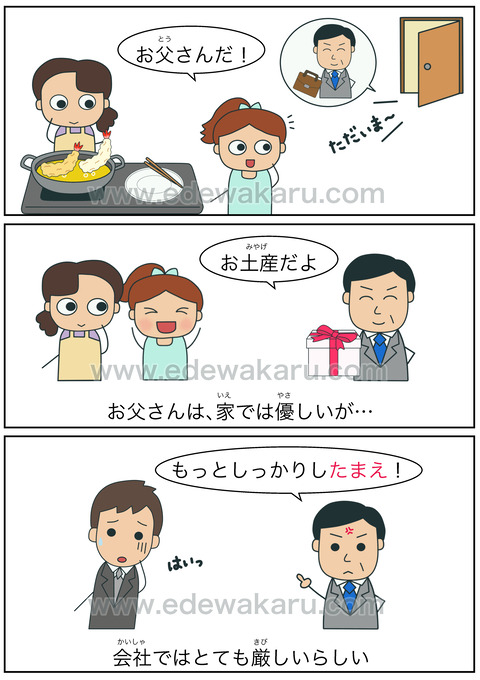
「〜たまえ」 is a sentence pattern meaning “do ~ for me” or “please ~.” It is used by men when speaking to someone of lower status. In most cases, it conveys a command like “do ~ for me.” The pattern 「〜てちょうだい」 has the same meaning, so learn them together 😀
[Example]
Pull yourself together
たまえ
[masculine speech]
= Pull yourself together
てちょうだい
[feminine speech]
= Please pull yourself together
てください
[okay for men and women]
It is probably helpful to remember that 「〜たまえ」 is mostly used from a boss to a subordinate 😊
In context 5 examples
もっとしっかりしたまえ
→もっとしっかりしてくれPull yourself together. →Pull yourself together for me.
なぜ失敗したのか、説明したまえ!
→なぜ失敗したのか、説明してくれ!Explain why you failed! →Explain why you failed for me!
次はがんばりたまえ
→次はがんばってくれ!Do your best next time. →Do your best next time for me!
食べたいだけ食べたまえ
→食べたいだけ食べてくれEat as much as you like. →Eat as much as you like for me.
君たち、静かにしたまえ!
→君たち、静かにしてくれ!You lot, be quiet! →You lot, be quiet for me!
Read the original source text
Meaning
〜てくれ
〜てください
How to use it
動詞[ます形]+たまえ
Explanation
「〜たまえ」は「〜てくれ」「〜てください」という意味を表す文型です。これは男性が使う文型で、目上の人から目下の人に使われます。ほとんどの場合は「〜てくれ」というように[命令]の意味を表します。「〜たまえ」と同じ意味の文型に
「〜てちょうだい」
がありますので、一緒に覚えておきましょう😀
[例]
もっとしっかりし
たまえ
【男言葉】
=もっとしっかりし
てちょうだい
【女言葉】
=もっとしっかりし
てください
【男女OK】
「〜たまえ」は、ほとんどの場合
「上司→部下」
に使われると覚えておくといいと思います😊
毎日のんびり日本語教師
Meaning
Please do ~ (commanding tone)
Do ~.
How to use it
Verb, masu-stem + たまえ
Explanation
It has the same meaning as 「~てください」「~てちょうだい」「~てくれ」 and similar expressions, but in many cases it expresses a command to the other person.
It is not as forceful as a direct command such as 「~しなさい」, but 「~たまえ」 still carries a degree of coercion.
It is masculine language used by a superior to someone below them.
Notes
Nothing in particular.
In context 4 examples
持っていきたければ持っていきたまえ。(你想带就带吧)
If you want to take it, go ahead and take it.
せいぜい頑張りたまえ。(好好加油吧)
Do your best, for all you’re worth.
静まりたまえ。
Quiet down.
言葉を慎みたまえ。
Mind your words.
Read the original source text
Meaning
~してください(命令調)
~しなさい
How to use it
動ます形+たまえ
Explanation
「~てください」「~てちょうだい」「~てくれ」などと同じ意味ですが、多くの場合は相手に対する命令を表します。
「~しなさい」などのはっきりした命令よりは強くないのですが、「~たまえ」にはそれなりの強制力があります。
目上から目下へ使う男言葉です。
Notes
特になし