Bunpro Grammar Reference
Meaning
Accidentally, Unconsciously, Against one's better judgement
How to use it
つい + Phrase
Nuance
A sentence starter indicating that (A) unfortunately happened due to a lapse in time, thought, or judgement.
Explanation
Appearing most frequently at the beginning of sentences, つい is an adverb that may be translated as 'accidentally', 'unconsciously', 'absentmindedly', or 'against one's better judgment'. つい will often be paired with statements that use てしまう, to emphasize that something was unintentional.
ごめんタケシ君のクッキーが目の前にあったからつい食べてしまった。
Sorry Takeshi-kun, your cookie was right in front of me, so I absentmindedly ate it.
先生に怒られると、つい笑っちゃうんだよね。
When I am being scolded by the teacher, I unconsciously laugh.
運転中に携帯を使ったらだめなのは分かっているんだけど、メールが来るとつい携帯を見ちゃう。
I know that I shouldn't use my phone while driving, but when I get a text I unconsciously look at my phone.
Fun Fact
Although 'accidentally' is the most common meaning of つい, it actually may be used to convey three different nuances. These are as follows:
はからず - Something that is uncalculated.
思わず - Something that is not thought about.
距離がわずかなさま - A small gap/interval.
In each of these meanings, つい keeps a sense of time being the most important factor. Due to this, つい will give the impression that whatever resulted in the 'accidental' action, will be something that happened momentarily. This is very close to the meaning of 'lapse' in English. 'a lapse in time', 'a lapse in judgment', 'a lapse in forethought'.
メガネがない。ついさっきまでここにあったと思うんだけど…。
I don't have my glasses. I think only a bit of time has lapsed since they were just here but...
電車が遅れると、ついイライラしてしまう。
When the train is late, I'll get angry due to a lapse in judgment.
お腹が空いていなくても、目の前に食べ物があるとつい食べてしまう。
Even if I am not hungry, if there is food in front of me, I will eat it due to a lapse of forethought.
In context 18 examples
- つい楽な方に流されてしまう。
I always end up unconsciously taking the easy route.
- 先生に怒られると、つい笑っちゃうんだよね。
When I am being scolded by the teacher, I unconsciously laugh.
- 運転中に携帯を使ったらだめなのは分かっているんだけど、メールが来るとつい携帯を見ちゃう。
I know that I shouldn't use my phone while driving, but when I get a text I unconsciously look at my phone.
- ごめんタケシ君のクッキーが目の前にあったからつい食べてしまった。
Sorry Takeshi-kun, your cookie was right in front of me, so I absentmindedly ate it.
- 運転中、ついよそ見をしてしまう。
I sometimes accidentally look away while driving.
- 運動を始めると、ついやり過ぎてしまう。
When I start doing exercises, I always end up accidentally overdoing it.
- 笑ってはいけないのに、つい笑ってしまう。
Since I am not supposed to laugh, it feels like I might accidentally laugh.
- 「つい食べ過ぎてしまう」なんて言い訳だ。
Saying things like: 'I unconsciously eat too much' is just an excuse.
- 100円ショップに行くとつい買い過ぎてしまいます。
I always accidentally buy too much when I go to 100 yen stores.
- ダイエット中なのに、ついアイスクリームを食べてしまう。
Against my better judgment, I eat ice cream while on a diet.
- そんなにおもしろくない番組でもつい見てしまいます。
Against my better judgment, I end up watching TV programs that aren't even that interesting.
- 思い通りにいかないとついイライラしてしまう。
Against my better judgment, I always get irritated when something doesn't go as I imagined.
- 赤ちゃんを見るとつい頬が緩んでしまう。
I can't keep myself from unconsciously smiling whenever I see babies.
- 失敗した時、つい人のせいにしたくなる。
Against my better judgment, I find myself wanting to blame someone else when I make a mistake.
- 仕事中でもついスマホをいじってしまう。
I always find myself unconsciously fiddling with my smartphone while I am working.
- メガネがない。ついさっきまでここにあったと思うんだけど…。
I don't have my glasses. I think only a bit of time has lapsed since they were just here but...
- 電車が遅れると、ついイライラしてしまう。
When the train is late, I'll get angry due to a lapse in judgment.
- お腹が空いていなくても、目の前に食べ物があるとつい食べてしまう。
Even if I am not hungry, if there is food in front of me, I will eat it due to a lapse of forethought.
Read the original source text
Meaning
Accidentally, Unconsciously, Against one's better judgement
How to use it
つい + Phrase
Nuance
A sentence starter indicating that (A) unfortunately happened due to a lapse in time, thought, or judgement.
Explanation
Appearing most frequently at the beginning of sentences, つい is an adverb that may be translated as 'accidentally', 'unconsciously', 'absentmindedly', or 'against one's better judgment'. つい will often be paired with statements that use てしまう, to emphasize that something was unintentional.
ごめんタケシ君のクッキーが目の前にあったからつい食べてしまった。
Sorry Takeshi-kun, your cookie was right in front of me, so I absentmindedly ate it.
先生に怒られると、つい笑っちゃうんだよね。
When I am being scolded by the teacher, I unconsciously laugh.
運転中に携帯を使ったらだめなのは分かっているんだけど、メールが来るとつい携帯を見ちゃう。
I know that I shouldn't use my phone while driving, but when I get a text I unconsciously look at my phone.
Fun Fact
Although 'accidentally' is the most common meaning of つい, it actually may be used to convey three different nuances. These are as follows:
はからず - Something that is uncalculated.
思わず - Something that is not thought about.
距離がわずかなさま - A small gap/interval.
In each of these meanings, つい keeps a sense of time being the most important factor. Due to this, つい will give the impression that whatever resulted in the 'accidental' action, will be something that happened momentarily. This is very close to the meaning of 'lapse' in English. 'a lapse in time', 'a lapse in judgment', 'a lapse in forethought'.
メガネがない。ついさっきまでここにあったと思うんだけど…。
I don't have my glasses. I think only a bit of time has lapsed since they were just here but...
電車が遅れると、ついイライラしてしまう。
When the train is late, I'll get angry due to a lapse in judgment.
お腹が空いていなくても、目の前に食べ物があるとつい食べてしまう。
Even if I am not hungry, if there is food in front of me, I will eat it due to a lapse of forethought.
Nuance · 日本語
文の初めに、時間が経ち過ぎた、考えや決断が遅れたせいで(A)が起こってしまったということを示す表現。
Explanation · 日本語
「つい」は、文の頭で使われることが多い副詞です。「それを意識せずに」や「それはよくないと思いながらも(我慢できずに)」のような意味を表します。文法「てしまう」と一緒に使うと、「そうするつもりはなかったのに、そうしてしまった」という意味を強調して表すことができます。
ごめんタケシ君のクッキーが目の前にあったからつい食べてしまった。
Sorry Takeshi-kun, your cookie was right in front of me, so I absentmindedly ate it.
先生に怒られると、つい笑っちゃうんだよね。
When I am being scolded by the teacher, I unconsciously laugh.
運転中に携帯を使ったらだめなのは分かっているんだけど、メールが来るとつい携帯を見ちゃう。
I know that I shouldn't use my phone while driving, but when I get a text I unconsciously look at my phone.
豆知識
「つい」は、三つのニュアンスを表すことができます。
はからず(するつもりがなかったことを、意識せずにしてしまうこと)
思わず(するつもりがなかったことを、欲や状況に流されて、または勢いでよく考えずにしてしまうこと)
ほんの少しの時間や距離
例文はそれぞれ「意識せずに一時的にすること」「短い時間のあいだに間違った判断をすること」「短い時間や距離そのもの」を表しています。そのため、どの意味においても、「つい」を見たら「時間の短さ」をイメージするといいかもしれません。
メガネがない。ついさっきまでここにあったと思うんだけど…。
I don't have my glasses. I think only a bit of time has lapsed since they were just here but...
電車が遅れると、ついイライラしてしまう。
When the train is late, I'll get angry due to a lapse in judgment.
お腹が空いていなくても、目の前に食べ物があるとつい食べてしまう。
Even if I am not hungry, if there is food in front of me, I will eat it due to a lapse of forethought.
DoJG 日本語文法辞典(全集)
Meaning
Unintentionally; without being able to control onself; without meaning to; carelessly; involuntarily; in spite of oneself; just; only
How to use it
(i) つい | Verb | |
| つい居眠りをする | Someone dozes carelessly/unintentionally |
(ii) つい | Adverb | (time) |
| つい最近 | Just recently |
Explanation
An adverb used to describe someone doing something without being able to control himself/herself or used to indicate the closeness of a time or a place.
In context 11 examples
楽しかったので、つい飲みすぎてしまった。
Because I had such a good time, I ended up drinking too much (without meaning to).
ついさっきまで山口さんが来ていたんです。
Mr. Yamaguchi was here until just a little while ago.
人のお金を使うのは悪いとは知りながら、つい使ってしまった。
I know it's a bad thing to use someone else's money but I just couldn't control myself (and used it).
安かったのでつい買ってしまった。
It was cheap, so I just bought it (even though I didn't mean to).
恵美につい亜紀の秘密を話してしまった。
I carelessly told Aki's secret to Emi.
彼の仕事を見ているとじれったいのでつい手を貸してしまう。
I feel impatient when I see him doing his work, so, without intending to, I end up extending a hand.
あの人は面白いのでついからかいたくなる。
He's so funny it's hard to resist teasing him (literally: I come to want to tease him without meaning to).
この店は感じがいいのでつい入ってみたくなる。
This shop has such a good atmosphere that I can't help wanting to go in.
ついこの間、新年を祝ったと思ったら今日はもうバレンタインデーだ。
It feels like we just celebrated New Year's the other day, and here it is Valentine's Day already.
彼女からは、つい2、3日前にメールをもらった。
I received an email from her only two or three days ago.
ついそこに喫茶店がありますからそこで話しましょう。
There's a tea house just over there, so let's talk there.
絵でわかる日本語
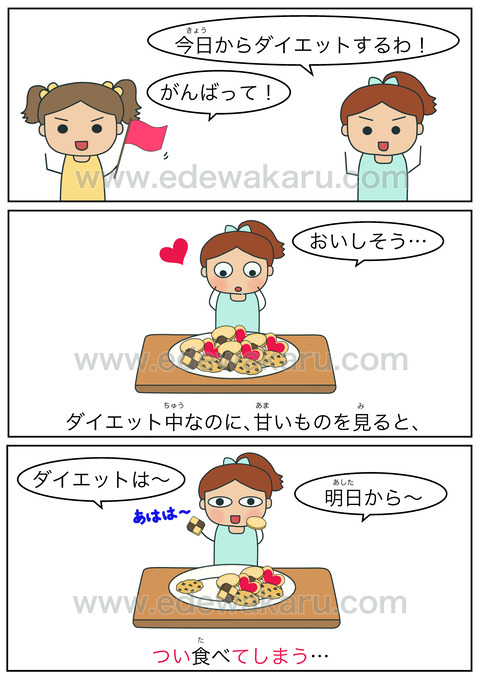
Meaning
Without intending to do 〜, you do it unconsciously
Even if you don’t mean to, you end up doing 〜
How to use it
つい + verb [て-form] + てしまう
Explanation
“ついAてしまう” is a sentence pattern meaning “you do A unconsciously even though you don’t mean to” or “you end up doing A even when you don’t intend to.” In most cases, it expresses regret or disappointment, as in “I thought I shouldn’t do A, but I did it unconsciously.”
Be sure to review “〜てしまう” and its colloquial forms “〜ちゃう・〜じゃう” 😊
[Related articles]
In context 5 examples
ダイエット中なのに、甘いものを見るとつい食べてしまう…
→甘いものを見ると、食べるつもりがなくても食べてしまうEven though I’m dieting, whenever I see sweets, I can’t help eating them… → Whenever I see sweets, I eat them even though I don’t mean to.
かわいいものを見ると、つい買ってしまう
→買おうと思っていなくても、買ってしまうWhen I see cute things, I can’t help buying them. → I end up buying them even though I didn’t intend to.
うまくいかないと、ついイライラしてしまう
→イライラするつもりがなくても、イライラしてしまうWhen things don’t go well, I can’t help getting irritated. → I get irritated even though I don’t mean to.
学校をサボっているところをお母さんに見つかり、ついうそをついてしまった
→うそをつくつもりがなかったのに、うそをついてしまったMy mother caught me skipping school, so I ended up lying without thinking. → I ended up lying even though I hadn’t meant to.
「ここだけの話だよ」と言われると、つい誰かに話してしまう…
→話そうと思っていなくても、誰かに話してしまう…When someone says, “This is just between us,” I can’t help telling someone… → I end up telling someone even though I didn’t mean to…
Read the original source text
Meaning
〜しようと思っていないのに、無意識に〜してしまう
〜つもりがなくても、〜してしまう
How to use it
つい+動詞[て形]+てしまう
Explanation
「ついAてしまう」は「Aしようと思っていないのに、無意識にAしてしまう」「Aするつもりがなくても、Aしてしまう」という意味の文型です。ほとんどの場合は、「Aしてはいけないと思っていたが、無意識にAしてしまった」というように後悔したり、残念に思う気持ちを表します。
「〜てしまう」
と、「〜てしまう」の口語形の
「〜ちゃう・〜じゃう」
の復習をしておきましょう😊
【関連記事】
日本語文型辞典
Meaning
Basic information. Description: Means doing something one thinks one should not do, or tries not to do, because one cannot restrain oneself. It is often used with “V-てしまう.”
Examples: ① Knowing it would make me gain weight, I couldn’t resist eating the cake because it looked so delicious. ② I thought I’d quit drinking, but when it’s right in front of me, I end up reaching for it. ③ I’d been told to keep it secret, but I let it slip and said it anyway. ④ We were having such a good time chatting that I accidentally stayed late. ⑤ People often complain that I speak too loudly, so I try to be careful, but when I get excited my voice involuntarily gets louder.
Read the original source text
Meaning
基本情報説明してはいけないと思っていることとか、自分でしないようにしていることを抑制がきかずにしてしまうという意味を表す。「V-てしまう」と一緒に使う事が多い。例文① 太るとわかっていながら、あまりおいしそうなケーキだったので、つい食べてしまった。② お酒はやめたはずだが、目の前にあると、つい手が出る。③ そのことは口止めされていたのに、つい口をすべらせて言ってしまった。④ おしゃべりが楽しくてつい遅くなってしまった。⑤ よく周りから声が大きいと苦情がでるので気をつけてはいるのだが、興奮するとつい声が高くなる。
日本語文型辞典 英語版
Meaning
Expresses the meaning that one can’t help doing something which one feels that one shouldn’t do or should try not to do. Often used together with V-てしまう.
In context 5 examples
太るとわかっていながら、あまりおいしそうなケーキだったので、つい食べてしまった。
I knew I would put weight on, but the cake looked so good that I ended up eating it all.
お酒はやめたはずだが、目の前にあると、つい手が出る。
I’m supposed to have given up alcohol, but when I see it in front of me, I just have to take some.
そのことは口止めされていたのに、つい口をすべらせて言ってしまった。
I was told not to say it to anyone, but it just slipped out.
おしゃべりが楽しくてつい遅くなってしまった。
It was so much fun visiting that I didn’t notice it had gotten late.
よく周りから声が大きいと苦情がでるので気をつけてはいるのだが、興奮するとつい声が高くなる。
People often complain that I have a loud voice. I am careful, but when I get excited, my voice starts booming.