絵でわかる日本語
Meaning
After time has passed since ~ [time]
Having experienced ~ [experience]
Passing through ~ [place]
Through the state/process of ~ [process]
How to use it
Noun [dictionary form] + を経て
Explanation
“Aを経てB” is a sentence pattern meaning “B by way of A.” A is a word expressing [time], [experience], or [place].
[Time]
→after time has passed since ~
[Experience]
→having experienced ~
[Place]
→passing through ~
[Examples]
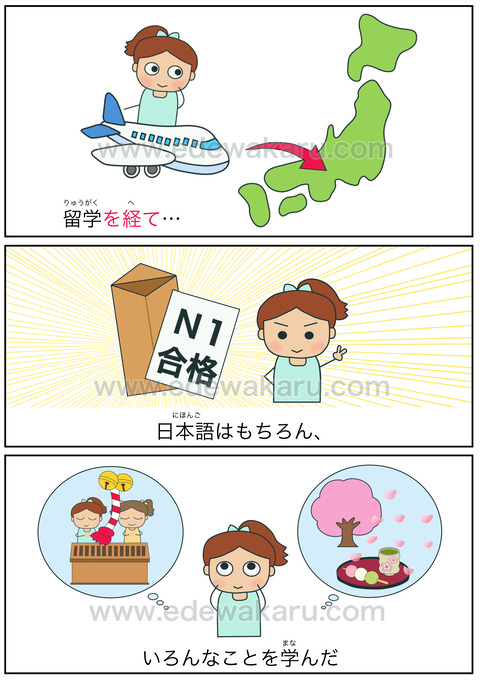
① Having studied abroad, I learned many things, including Japanese.
→Having experienced studying abroad, I learned many things, including Japanese.
② Apparently, my mom and dad got married after dating for ten years.
→Apparently, they got married after a period of ten years had passed.
③ We went from Japan to France via South Korea.
→We went to France via South Korea.
④ After a three-month training period, I became a full-time employee.
→After a period of three months had passed, I became a full-time employee.
⑤ People grow through various experiences.
→Having had various experiences, people grow.
Remember that “〜を経て” is often used with [time] and [place] 😀
In context 5 examples
留学を経て日本語はもちろん、いろんなことを学んだ
Having studied abroad, I learned many things, including Japanese.
うちのお父さんとお母さんは、10年間の交際を経て結婚したらしい
Apparently, my mom and dad got married after dating for ten years.
日本から、韓国を経てフランスに行きました
We went from Japan to France via South Korea.
3か月の研修期間(けんしゅうきかん)を経て、正社員になりました
After a three-month training period, I became a full-time employee.
いろんな経験を経て、人は成長していくものだ
People grow through various experiences.
Read the original source text
Meaning
〜の時間が経ったあとで[時間]
〜を経験して[経験]
〜を通って[場所]
〜の状態を通して[過程]
How to use it
名詞[辞書形]+を経て
Explanation
「Aを経てB」は「Aを通ってB」という意味を表す文型です。「A」には[時間][経験][場所]を表す言葉が入ります。
「時間」
→
〜の時間が経ったあとで
「経験」
→
〜を経験して
「場所」
→
〜を通って
[例]
①留学
を経て
日本語はもちろん、いろんなことを学んだ
→留学
を経験して
日本語はもちろん、いろんなことを学んだ
②うちのお父さんとお母さんは、10年間の交際
を経て
結婚したらしい
→10年
の期間が経ったあとで、結婚したらしい
③日本から、韓国
を経て
フランスに行きました
→韓国
を通って
フランスに行きました
④3か月の研修期間
を経て、正社員になりました
→3か月
の期間が経ったあとで、正社員になりました
⑤いろんな経験
を経て、人は成長していくものだ
→いろんな
経験をして、人は成長していくものだ
「〜を経て」は、[時間]や[場所]によく使われると覚えておきましょう😀
毎日のんびり日本語教師
How to use it
Noun + を経て
Explanation
Indicates passing through a place (a stopover), time, or means.
Notes
Similar grammar: 「[N2 grammar] ~を通じて(つうじて)/を通して(とおして)」
「~通じて/通して」 cannot be used for a stopover. 「を経て」 can be used to indicate a stopover.
✕
韓国を通じて日本に行く。
◯
韓国を経て日本に行く。
In context 8 examples
韓国を経て日本に行く。
I’m going to Japan via Korea.
2年という長い道のりを経て司法試験にようやく合格することができた。
After the long two-year journey, I was finally able to pass the bar exam.
たくさんの別れと出会いを経て、今の私がある。
The person I am today is the result of many partings and meetings.
彼女とは紆余曲折を経てよりを戻すことになった。
After many twists and turns, she and I got back together.
こうした体験を経て、人は成長していく。
People grow through experiences like these.
わずらわしい手続きや申請を経て、ようやく認可が下りた。
After going through troublesome procedures and applications, approval was finally granted.
数々の失敗を経て気づいた。
I realized it after going through many failures.
国民投票を経て得られた民意を蔑ろにしてはいけない。
The will of the people expressed through a national referendum must not be disregarded.
Read the original source text
How to use it
名詞+を経て
Explanation
場所(経由地)や時間、手段などの経由を表します。
Notes
似ている文法「【N2文法】~を通じて(つうじて)/を通して(とおして)」
「~通じて/通して」は経由地に使うことができません。経由地を表す場合は「を経て」が使えます。
✕
韓国を通じて日本に行く。
◯
韓国を経て日本に行く。