絵でわかる日本語
Meaning
Because [something] happened, [someone] came to…
[Something] became the motivation for…
How to use it
Noun [dictionary form] + をきっかけに
Noun [dictionary form] + をきっかけにして
Noun [dictionary form] + をきっかけとして
Verb [plain form] + のをきっかけに
Explanation
“〜をきっかけに・〜をきっかけにして・〜をきっかけとして” are sentence patterns meaning “because [something] happened, [someone] came to…” or “[something] became the motivation for…” They are used in the form “AをきっかけにB,” expressing the motivation for coming to do B, as in “A happened, so [someone] came to do B” or “A was done, so [someone] came to do B” 😊
“〜をきっかけに” can be changed to “〜をきっかけにして” or “〜をきっかけとして.”
[Example]
I started learning English after a trip abroad.
= I started learning English using a trip abroad as the impetus.
= I started learning English on the occasion of a trip abroad.
When used with a verb, the form “Verb + のをきっかけに” is used.
[Example]
I stopped smoking after I got sick.
= I stopped smoking after getting sick.
= I stopped smoking, using getting sick as the impetus.
= I stopped smoking on the occasion of getting sick.
[For advanced learners]
There is an N1 sentence pattern “〜を皮切りに・〜を皮切りにして.” It means “starting with…, one after another (the same thing happens)” and expresses [the occurrence of similar actions]. It is easy to confuse with “〜をきっかけに,” so be sure to learn to distinguish them 😀
[Related sentence patterns]
In context 5 examples
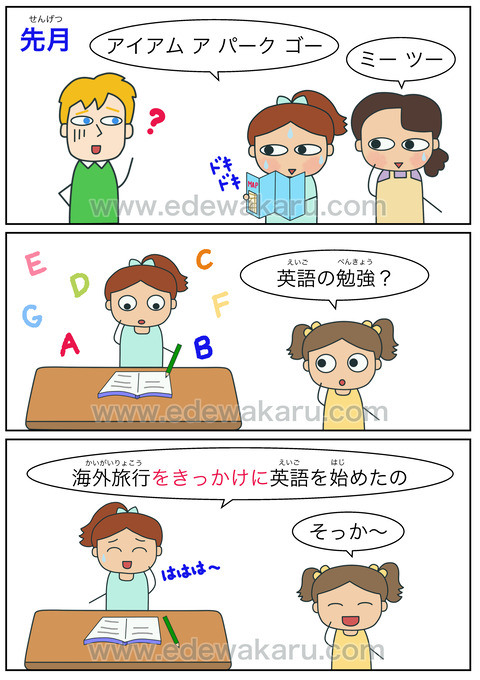
海外旅行(かいがいりょこう)をきっかけに、英語を始めたの
→海外旅行をして、英語を勉強するようになったI started learning English after a trip abroad. →I went on a trip abroad and then came to study English.
日本のアニメを見たのをきっかけに、日本へ留学したいと思うようになりました
→日本のアニメを見て、日本へ留学したいと思うようになったAfter watching Japanese anime, I came to want to study abroad in Japan. →I watched Japanese anime and came to want to study abroad in Japan.
お父さんは、病気をきっかけにタバコを吸わなくなった
→病気になったということがあったから、タバコを吸わなくなったMy father stopped smoking after he got sick. →He stopped smoking because he got sick.
彼女は、結婚をきっかけに仕事を辞めた
→結婚をして、仕事を辞めたShe quit her job after getting married. →She got married and then quit her job.
あの俳優は、あの映画をきっかけに有名になった
→あの映画に出てから、有名になったThat actor became famous after appearing in that movie. →He became famous after appearing in that movie.
Read the original source text
Meaning
〜があったから、〜するようになった
〜が動機になって〜
How to use it
名詞[辞書形]+をきっかけに
名詞[辞書形]+をきっかけにして
名詞[辞書形]+をきっかけとして
動詞[普通形]+のをきっかけに
Explanation
「〜をきっかけに・〜をきっかけにして・〜をきっかけとして」は「〜があったから〜するようになった」「〜が動機になって〜」という意味を表す文型です。「AをきっかけにB」の形で使われ
「AがあったからBするようになった」「AしたからBするようになった」
というように、「B」をするようになった動機を表します😊
「〜をきっかけに」は「〜をきっかけにして」「〜をきっかけとして」にチェンジすることができます。
[例]
海外旅行
をきっかけに、英語を始めた
=海外旅行
をきっかけにして、英語を始めた
=海外旅行
をきっかけとして、英語を始めた
また、動詞と使う場合は「動詞+のをきっかけに」という形が使われます。
[例]
病気
をきっかけに
タバコを吸わなくなった
=病気になった
のをきっかけに
タバコを吸わなくなった
=病気になった
のをきっかけにして
タバコを吸わなくなった
=病気になった
のをきっかけとして
タバコを吸わなくなった
【上級レベルの人へ】
N1の文型に
「〜を皮切りに・〜を皮切りにして」
という文型があります。これは「〜から始まって、次々に(同じことが起きる)」という意味で【同類行為(どうるいこうい)の発生】を表します。「〜をきっかけに」と混乱しがちですが、しっかりと区別をして覚えておきましょう😀
【関連文型】
IMABI
Opportunity
Read this IMABI lesson ↗Explanation
Opportunity: きっかけ & 契機
The nouns きっかけ and 契機 both indicate taking advantage of a situation in a positive light to bring about what follows.
きっかけ
きっかけ can literally be translated as “chance/cue/motive/occasion” or more loosely translated as “trigger/prompt.” Although 機会 and チャンス both translate as “chance,” they are one-time opportunities that one does not wish to miss out on, whereas きっかけ is the “chance” to start something that is long lasting.
Orthography Note: きっかけ is only seldom spelled in kanji as 切っ掛け.
1. 日本語を勉強し始めたきっかけは何ですか。
What was it that triggered you to start studying Japanese?
2. 自分磨きのきっかけと過程とその結果
The motive to improve myself, the course of doing so, and the results
3. 英語ができるようになったきっかけや過程は人それぞれですが、共通点はいくつかあります。
The motive and process for how one becomes able to speak English differs from person to person, but there are several points of commonality.
~をきっかけ【に(して)・として】
In the grammar pattern ~をきっかけ【に(して)・として】, it is translated as “taking advantage of…/inspired by…” What follows is something that the speaker/agent is now actively doing.
4. この事件をきっかけに、一般の警察官が持つ銃器に関して大きな見直しが迫られた。
Prompted by this case, major revision regarding the weapons that regular officers possess became pressing.
5. 事故をきっかけに家族の愛情に気づき、家族との結束も強まった。
With the accident as a start, I realized the love my family had for me, and my solidarity with them strengthened.
6. 結婚をきっかけに(して)転職した。
I took advantage of getting married to change jobs.
7. 若者たちがSNSをきっかけとして犯罪に巻き込まれている。
Young people are being involved in crimes with social media as their motive.
You may also see the pattern ~がきっかけで, which indicates that something happens due to a trigger. It is most appropriate in contexts regarding happenstance.
8. その一言がきっかけで、彼の理性は完全に崩壊した。
That single comment was what prompted his sense of reasoning to completely collapse.
9. ポケモンがきっかけで日本語に興味を持ちました。
I became interested in Japanese with Pokemon as the motive.
契機
The noun 契機 meaning “opportunity” is a rather formal word that is usually only seen in the written language. Similarly to きっかけ, it can be seen in the pattern ~を契機【に(して)・として】.
The use of として over に(して) is both a matter of formality and semantics. While the former is more formal by default, it also implies that the action bringing brought about is the final solution that the speaker/agent is working towards. On the other hand, に(して)will imply that the action bringing brought about is ongoing and still may change given the right (change in) motive.
10. 言論の弾圧を契機に(して)暴動が起きています。
Violence is occurring over the suppression of speech.
11. テロを契機として警備が一層強化された。
Taking the (act of) terrorism as a motivation, security has been greatly enhanced.
In context 11 examples
日本語を勉強し始めたきっかけは何ですか。
What was it that triggered you to start studying Japanese?
自分磨きのきっかけと過程とその結果
The motive to improve myself, the course of doing so, and the results
英語ができるようになったきっかけや過程は人それぞれですが、共通点はいくつかあります。
The motive and process for how one becomes able to speak English differs from person to person, but there are several points of commonality.
この事件をきっかけに、一般の警察官が持つ銃器に関して大きな見直しが迫られた。
Prompted by this case, major revision regarding the weapons that regular officers possess became pressing.
事故をきっかけに家族の愛情に気づき、家族との結束も強まった。
With the accident as a start, I realized the love my family had for me, and my solidarity with them strengthened.
結婚をきっかけに(して)転職した。
I took advantage of getting married to change jobs.
若者たちがSNSをきっかけとして犯罪に巻き込まれている。
Young people are being involved in crimes with social media as their motive.
その一言がきっかけで、彼の理性は完全に崩壊した。
That single comment was what prompted his sense of reasoning to completely collapse.
ポケモンがきっかけで日本語に興味を持ちました。
I became interested in Japanese with Pokemon as the motive.
言論の弾圧を契機に(して)暴動が起きています。
Violence is occurring over the suppression of speech.
テロを契機として警備が一層強化された。
Taking the (act of) terrorism as a motivation, security has been greatly enhanced.