文法
Meaning
I just did ~
Used when you want to say, “I had no special intention; I simply did ~.”
How to use it
V(past form)
In context 4 examples
人として正しいことをしたまでだ。
I just did what was right as a person.
お世辞じゃないよ。本当のことを言ったまでだよ。
I'm not flattering you. I just told the truth.
当然のことをしたまでなので、お礼などは要りません。
I just did what was expected, so there's no need to thank me.
A:お母さん、どうしたの?着信履歴見たら10件以上もあったけど。
B:ちょっと帰りが遅く、心配だったから電話したまでよ。
A:ごめん。友達と映画見てたから電源切ってた。今から帰るね。A: Mom, what's wrong? I checked my missed calls, and there were more than ten. B: You were late coming home, and I was worried, so I just called. A: Sorry. I was watching a movie with my friends, so I turned my phone off. I'm coming home now.
Read the original source text
Meaning
〜しただけのことだ
「特別な意図はなく、単に〜しただけだ」と言いたい時に使う。
How to use it
V(タ形)
Bunpro Grammar Reference
Meaning
Just, Merely, Simply, Only
How to use it
Verb[た]+ まで(1) + だ
(1) までのこと
Verb[た]+ まで(1) + です
(1) までのこと
Nuance
A construction emphasizing the reason for an action. Doing up until (A) was the only motive. Merely (A).
Explanation
In comparison to ~るまでだ, the grammar pattern expressing that 'one can only but (A)', ~たまでだ works in a similar way, with the past tense of the verb indicating that 'doing (A) was all it was'. This emphasis is usually translated as 'I simply (A)', or 'I only (A)', with nuance on the action not being something especially big.
Like ~るまでだ, ~たまでだ may be replaced with ~たまでのことだ, depending on what the speaker is trying to emphasize.
なんで俺が悪者扱いされないといけないんだ?俺はただ自分の意見を言ったまでだ。
Why do I have to get blamed for this? I only expressed my opinions.
お婆さんが困った顔をしていたから、助けたまでだ。
I just helped because the old lady looked like she needed help.
最近学校にも行かないし部屋からも出ないから、聞いたまでのことだ。
I merely asked because recently, you haven't left your room and haven't gone to school.
そんなお礼とかはやめてください、人として当たり前のことをしたまでです。
Please, don't thank me. I just did something expected as a human.
As this structure emphasizes that (A) is not a big deal, it will often be used in order to modestly highlight that one only did the bare minimum, and therefore praising them is unnecessary.
Caution
Both ~るまでだ and ~たまでだ are only used in reference to one's own personal actions, or the actions of a group they are affiliated with.
彼は私が困っていたから、助けてくれたまでだ。
Because I looked like I was in need, he merely helped me. (Unnatural Japanese)
In context 17 examples
- なんで怒っているの?私の意見を言ったまでのことだ。
Why are you angry? I merely stated my opinion.
- 最近学校にも行かないし部屋からも出ないから、聞いたまでのことだ。
I merely asked because recently, you haven't left your room and haven't gone to school.
- そんなお礼とかはやめてください、人として当たり前のことをしたまでです。
Please, don't thank me. I just did something expected as a human.
- なんで俺が悪者扱いされないといけないんだ?俺はただ自分の意見を言ったまでだ。
Why do I have to get blamed for this? I only expressed my opinions.
- お婆さんが困った顔をしていたから、助けたまでだ。
I just helped because the old lady looked like she needed help.
- A(エー):「助けてくれてありがとうございます!」
B(ビー):「いや、当然のことをしたまでのことです。」A: 'Thank you very much for helping me!' B: 'Not at all. It was just the obvious thing.'
- A(エー):「わぁ、日本語上手だね!」
B(ビー):「ただ趣味で勉強してたまでのことで、まだまだだけどね。」A: 'Wow, your Japanese is good!' B: 'I was merely learning it as a hobby. I still have a ways to go.'
- 僕はただ伝言を頼まれたから伝えたまでで、それは僕の考えではないからね!
Since I was just requested to have a word with you, that's merely all I did, it's not like they were my thoughts.
- 真実を話したまでのことなのに、なぜかクラスメイトから嘘つきと言われてしまいました。
When I just told the truth, I was accused by my classmate of being a liar for some reason.
- 夫:「君は本当に世界で一番美しいよ。」
妻:「もう、お世辞はやめてよ!」
夫:「本心を言ったまでのことだよ。」Husband: 'You are honestly the most stunning woman in the world.' Wife: 'Ok, ok, quit it with the lip service!' Husband: 'I just spoke my mind is all.'
- 娘:「どうしてそんな事を聞くの?」
父:「ちょっと気になったから聞いたまでのことだ。」Daughter: 'Why would you ask such a thing?' Dad: 'It was bothering me, so I just asked.'
- 彼女:「あなたは本当に優しいね。」
彼氏:「そうかな?彼が困っていたから助けたまでだ。」Girlfriend: 'You are honestly so nice!' Boyfriend: 'You think? He was in trouble, so I simply helped.'
- お年寄りを助けるという基本的な事をしたまでのことなのでお礼は要りません。
Since I just did something as fundamental as helping the elderly, thanks is not required.
- 気分が悪い人を助けるという人として当然の事をしたまでのことです。褒めないで下さい。
As someone that would help a person feeling ill, it is just the obvious thing to do. Please don't praise me for it.
- 香奈:「どうして秘密をバラしたりなんかしたの?」
由紀恵:「聞かれたから答えたまでだよ。」Kana: 'Why did you have to do something like spill secrets?' Yukie: 'Because I was asked, I simply answered.'
- どうして怒っているんだい?君が本音を聞かせてと言うからそうしたまでのことだ!
Why are you mad? Because you always ask to let you hear my real opinion, I did just that.
- 彼は私が困っていたから、助けてくれたまでだ。
Because I looked like I was in need, he merely helped me. (Unnatural Japanese)
Read the original source text
Meaning
Just, Merely, Simply, Only
How to use it
Verb[た]+ まで(1) + だ
(1)までのこと
Verb[た]+ まで(1) + です
(1)までのこと
Nuance
A construction emphasizing the reason for an action. Doing up until (A) was the only motive. Merely (A).
Explanation
In comparison to ~るまでだ, the grammar pattern expressing that 'one can only but (A)', ~たまでだ works in a similar way, with the past tense of the verb indicating that 'doing (A) was all it was'. This emphasis is usually translated as 'I simply (A)', or 'I only (A)', with nuance on the action not being something especially big.
Like ~るまでだ, ~たまでだ may be replaced with ~たまでのことだ, depending on what the speaker is trying to emphasize.
なんで俺が悪者扱いされないといけないんだ?俺はただ自分の意見を言ったまでだ。
Why do I have to get blamed for this? I only expressed my opinions.
お婆さんが困った顔をしていたから、助けたまでだ。
I just helped because the old lady looked like she needed help.
最近学校にも行かないし部屋からも出ないから、聞いたまでのことだ。
I merely asked because recently, you haven't left your room and haven't gone to school.
そんなお礼とかはやめてください、人として当たり前のことをしたまでです。
Please, don't thank me. I just did something expected as a human.
As this structure emphasizes that (A) is not a big deal, it will often be used in order to modestly highlight that one only did the bare minimum, and therefore praising them is unnecessary.
Caution
Both ~るまでだ and ~たまでだ are only used in reference to one's own personal actions, or the actions of a group they are affiliated with.
彼は私が困っていたから、助けてくれたまでだ。
Because I looked like I was in need, he merely helped me. (Unnatural Japanese)
Nuance · 日本語
行動の理由を強調する表現。(A)という地点にたどり着くことだけが目的だった。(A)だけ。
Explanation · 日本語
「~たまでだ」は「〜るまでだ」(意味:(A) するだけだ・(A) するしかない)と同じように使われる文型ですが、過去形になっている点が異なります。そのため、「(A) するだけだ」ではなく「(A) しただけだ」という意味を表します。「~たまでだ」は、話し手が (A) という行為が大したことではないと思っていたり、特別な意図を持って (A) をしたわけではないと言いたいときに、「ただ (A) しただけで、それ以上でもそれ以下でもない」というニュアンスで使われます。
「~たまでだ」は、「〜るまでだ」と同様に、話し手が強調しようとしている内容に応じて、「~たまでのことだ」と言い換えられることがあります。
なんで俺が悪者扱いされないといけないんだ?俺はただ自分の意見を言ったまでだ。
Why do I have to get blamed for this? I only expressed my opinions.
お婆さんが困った顔をしていたから、助けたまでだ。
I just helped because the old lady looked like she needed help.
最近学校にも行かないし部屋からも出ないから、聞いたまでのことだ。
I merely asked because recently, you haven't left your room and haven't gone to school.
そんなお礼とかはやめてください、人として当たり前のことをしたまでです。
Please, don't thank me. I just did something expected as a human.
この文型は「(A) は大したことではない」ということを強調するので、話し手が「最低限のことしかできませんでしたし、褒めていただく必要はありません」と謙遜するときにもよく使われます。
注意点
「〜るまでだ」と「~たまでだ」は、どちらも自分自身の個人的な行動や、自分が所属しているグループの行動に対してのみ使われます。
彼は私が困っていたから、助けてくれたまでだ。
Because I looked like I was in need, he merely helped me. (Unnatural Japanese)
絵でわかる日本語
Meaning
I only did ~
How to use it
Verb [た-form] + までだ
Verb [た-form] + までのことだ
Explanation
“〜たまでだ・〜たまでのことだ” is a sentence pattern meaning “I only did ~.” It is used when you want to say, “The only reason I did ~ was because of ~; I had no other purpose” 😊
[Examples]
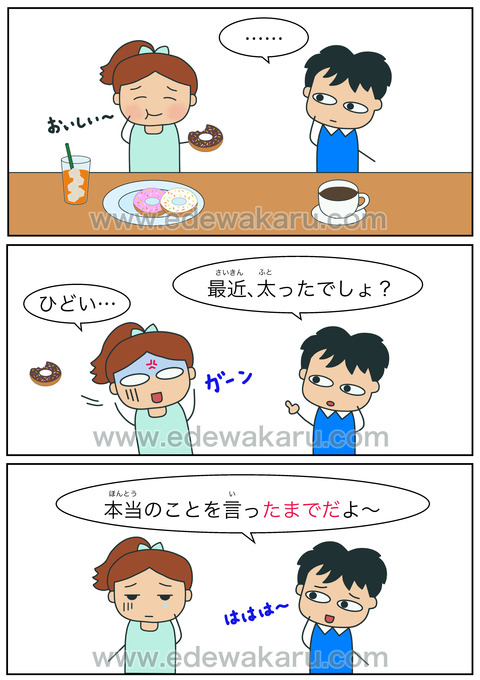
① A: You’ve gained weight lately, haven’t you?
B: That’s mean…
A: I only told the truth.
→I just told the truth.
② A: Thanks for helping me.
B: I only did what anyone would do.
→I just did what anyone would do.
③ A: Why did you tell Yamada about that?
B: I only told him because he asked.
→I just told him because he asked.
④ A: Why did you do something like that?
B: I did it only because you told me to!
→I did it just because you told me to!
Also, “〜たまでのことだ” emphasizes “〜たまでだ,” so they can be used interchangeably 😮
[Example]
I only told the truth.
=I only told the truth.
Remember “〜たまでだ・〜たまでのことだ” together with “〜までだ・〜までのことだ (V dictionary form + までだ)” 😉
[Patterns containing “まで”]
〜たまでだ・〜たまでのことだ
〜たらそれまでだ・〜ばそれまでだ
〜ないまでも
〜に至るまで
〜までして
〜までだ・〜までのことだ(V辞+までだ)
〜までに
〜までになる
〜までもない
In context 4 examples
A:最近太ったでしょ?B:ひどい…A:本当のことを言ったまでだよ(復習:〜でしょ?・〜だろ?)
A: You’ve gained weight lately, haven’t you? B: That’s mean… A: I only told the truth. (Review: 〜でしょ?・〜だろ?)
A:助けてくれてありがとうB:当然のことをしたまでだよ
A: Thanks for helping me. B: I only did what anyone would do.
A:なんであのことを山田くんに話したの?B:聞かれたから話したまでだよ(復習:なんで?)
A: Why did you tell Yamada about that? B: I only told him because he asked. (Review: Why?)
A:どうしてそんなことをしたんだB:あなたがやれって言ったからやったまでよ!
A: Why did you do something like that? B: I only did it because you told me to!
Read the original source text
Meaning
ただ〜しただけだ
How to use it
動詞[た形]+までだ
動詞[た形]+までのことだ
Explanation
「〜たまでだ・〜たまでのことだ」は「ただ〜しただけだ」という意味を表す文型です。この文型は、
「〜したのは、ただ〜だからで、他に目的はない」
と言いたい時に使われます😊
[例]
①A:最近太ったでしょ?
B:ひどい…
A:本当のことを言った
までだ
よ
→
ただ
本当のことを言った
だけだ
②A:助けてくれてありがとう
B:当然のことをした
までだ
よ
→
ただ、当然のことをした
だけだ
よ
③A:なんであのことを山田くんに話したの?
B:聞かれたから話した
までだ
よ
→聞かれたから話しただけだよ
④A:どうしてそんなことをしたんだ
B:あなたがやれって言ったからやった
まで
よ!
→あなたがやれって言ったからやった
だけ
よ!
また「〜たまでのことだ」は「〜たまでだ」を強調した言い方ですので、チェンジすることができます😮
[例]
本当のことを言った
までだ
よ
=本当のことを言った
までのことだ
よ
「〜たまでだ・〜たまでのことだ」は「〜までだ・〜までのことだ(V辞+までだ)」と一緒に覚えておきましょう😉
【「まで」がつく文型】
〜たまでだ・〜たまでのことだ
〜たらそれまでだ・〜ばそれまでだ
〜ないまでも
〜に至るまで
〜までして
〜までだ・〜までのことだ(V辞+までだ)
〜までに
〜までになる
〜までもない
日本語NET JLPT文法解説まとめ
Meaning
"I only did ~"
Used when you want to say, "I had no special intention; I simply did ~."
V(past form)
How to use it
V(past form)
Explanation
"I just did ~" / "I did ~ just because"
Used to indicate that something was done simply because there was no other option or because it was a matter of course.
Read the original source text
Meaning
"〜しただけのことだ"
「特別な意図はなく、単に〜しただけだ」と言いたい時に使う。
How to use it
V(タ形)
Explanation
"I just did ~" / "I did ~ just because"
Used to indicate that something was done simply because there was no other option or because it was a matter of course.