絵でわかる日本語
Meaning
Must ~
How to use it
Verb [ない-form] + ねば
Verb [ない-form] + ねばならない
Verb [ない-form] + ねばならぬ
Explanation
「〜ねば」 means 「〜なければ」 (“must ~”). 「〜ねば」 is a shortened form of 「〜ねばならない」 and 「〜ねばならぬ」; all three mean the same thing. 😀 All three are characteristic of written language and are rarely used in conversation. 😮 「〜ねばならぬ」 is especially old-fashioned, and I don’t think you’ll hear it in modern everyday conversation. 😅 You may have a chance to hear it in NHK historical dramas or dramas featuring samurai. 😉
In context 3 examples
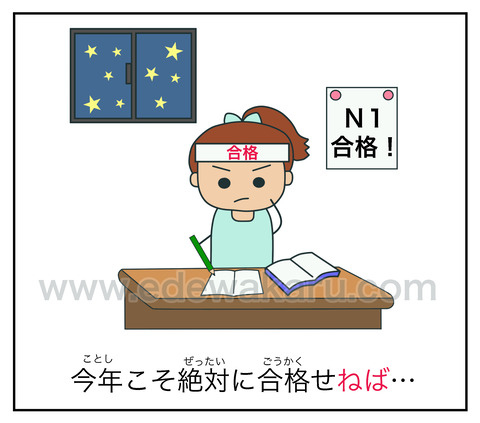
今年こそ絶対に合格せねば…(復習:〜こそ)
→今年こそ絶対に合格しなければ…This year, of all years, I absolutely must pass… (Review: 〜こそ) →This year, of all years, I must pass.
優勝できるようにがんばらねばならない
→優勝できるようにがんばらなければならないI have to work hard so that I can win. →I have to work hard so that I can win.
明日、江戸へ参らねばならぬのだ【時代劇や侍が登場するドラマで…】
→明日、江戸(今の東京)へ行かなければならないのだI must go to Edo tomorrow. [In a period drama or a drama featuring samurai…] →I must go to Edo (present-day Tokyo) tomorrow.
Read the original source text
Meaning
〜なければならない
How to use it
動詞[ない形]+ねば
動詞[ない形]+ねばならない
動詞[ない形]+ねばならぬ
Explanation
「〜ねば」は「〜なければ」という意味を表します。「〜ねば」は「〜ねばならない」「〜ねばならぬ」の省略形で全て意味は同じです
😀3つ全て書き言葉的で、会話ではあまり使われません😮その中でも「〜ねばならぬ」はとても古い言い方で現代の日常会話で聞くことはないと思います😅NHKの大河ドラマや侍が登場するドラマなどでは聞く機会があると思います😉