AIUEO JLPT Grammar
Meaning
This sentence pattern acknowledges the importance of the first matter while emphasizing that the subsequent matter is even more significant. It conveys a polite and formal tone and is often used in written language or speeches.
How to use it
Noun も + さることながら
In context 5 examples
彼女の歌唱力もさることながら、表現力には感心させられる。
Her singing ability is impressive, but her expressive power is even more remarkable.
このレストランは料理の味もさることながら、サービスが素晴らしい。
Not only is the food delicious at this restaurant, but the service is also excellent.
彼の経歴もさることながら、その謙虚な態度が多くの人に好感を与えた。
Not only his career, but also his humble attitude impressed many people.
彼女の技術力もさることながら、常に向上心を持っている点が評価されている。
Her technical skills are impressive, but her constant desire to improve is even more commendable.
このイベントは、内容の充実もさることながら、多くの人々が参加したことが成功の要因だった。
The content of the event was excellent, but the high participation was the key to its success.
Read the original source text
Meaning
This sentence pattern acknowledges the importance of the first matter while emphasizing that the subsequent matter is even more significant. It conveys a polite and formal tone and is often used in written language or speeches.
How to use it
名詞も+さることながら
Explanation · 日本語
この文型は、前半で述べた事柄も重要であることを認めつつ、後半で述べる事柄の方がさらに重要であることを強調します。丁寧でフォーマルな印象があり、書き言葉やスピーチなどでよく使われます。
文法
Meaning
~ is naturally so, but in addition, ...
How to use it
N + もさることながら
Notes
What comes after it in the sentence is emphasized.
In context 6 examples
彼のプレゼンは内容もさることながら、話し方がわかりやすくとても素晴らしいものだった。
His presentation was excellent: the content was strong, of course, but his clear way of speaking was also wonderful.
このレストランは5つ星ということもあって料理の見た目もさることながら、味も素晴らしい。
This restaurant is a five-star place, and not only does the food look wonderful, it tastes great too.
日本の車は質もさることながら、燃費もいい。
Japanese cars are high quality, and they also have good fuel economy.
最近の携帯電話はデザインもさることながら、カメラの性能がとても良い。
Recent mobile phones have great camera performance, quite apart from their design.
このバンドはメロディーもあることながら、歌詞もいい。
This band has good melodies, and its lyrics are good too.
日本語は私にとって漢字もさることながら、文法も難しい。
For me, Japanese grammar is difficult, quite apart from kanji.
Read the original source text
Meaning
〜は当然そうだが、その他にも・・・だ
How to use it
N + もさることながら
Notes
文の後の内容が強調される。
Bunpro Grammar Reference
Meaning
It is a fact that, But, Even more than, It goes without saying, Not only but also,
How to use it
Noun + もさることながら
Nuance
A formal grammar point, highlighting that while (A) is true, (B). Even while that sort of (A) is the case, (B).
Explanation
もさることながら is a construction in Japanese that is often translated as 'it goes without saying that (A), but (B)', or 'not only (A), but (B) too'. This expression is a combination of the adverbial particle も, the pre-noun adjectival さる 'particular', or 'certain', the noun 事 'thing', and the conjunction particle ながら 'while'. Due to this, the more literal translation is simply 'while (A) is also of particular merit, (B)'. This literal translation will be helpful to remember, as もさることながら will always present (A) as important, but (B) as even more important than that.
もさることながら will be attached to the end of nouns and noun phrases.
あのブランドが出す商品もさることながら、マーケティングも素晴らしい。
It is a fact that the products that the brand produces are amazing, but also how they market them.
このパソコンは機能もさることながら、デザインもいい。
It is a fact that the features of this computer are good, but so is the design.
日本語を勉強するにおいて漢字もさることながら、文法も勉強しなくてはいけない。
When it comes to studying Japanese, it is a fact that you need to study not only kanji, but also grammar too.
As (B) is being emphasized in sentences that use this grammar structure, it is common to see other expressions of emphasis combined with もさることながら. Some examples include さらに 'additionally', なにより 'more than anything', and 以上 'above that'.
In context 15 examples
- モナ・リザは美しい画もさることながら、やはり目を引くのは神秘的な微笑である。
It is a fact that Mona Lisa is a beautiful painting, but it is the mysterious smile that attracts the attention after all.
- 日本語を勉強するにおいて漢字もさることながら、文法も勉強しなくてはいけない。
When it comes to studying Japanese, it is a fact that you need to study not only kanji, but also grammar too.
- あのブランドが出す商品もさることながら、マーケティングも素晴らしい。
It is a fact that the products that the brand produces are amazing, but also how they market them.
- このパソコンは機能もさることながら、デザインもいい。
It is a fact that the features of this computer are good, but so is the design.
- 日頃の心がけもさることながら、今回は運が味方してくれたようだ。
Even more than my usual efforts, it would seem luck was on my side this time.
- 見た目もさることながら性格も素晴らしい彼がモテるのは当然のことです。
It’s only natural that he’s popular, given that not only his appearance but also his personality is wonderful.
- 歌詞もさることながらメロディーもいいのだから、この曲はやっぱり最高だ。
Even more than the lyrics, since the melody is good too, this song is really the best.
- 美味しさもさることながら見た目も凄いこのフレンチレストランは、大人気です。
While it is a fact that the food is delicious, since the look of this French restaurant is awesome too, it’s super popular.
- リーダーの発表は、内容がまとまっているのもさることながら、パワーポイントが見やすい。
While it’s a fact that the content of the leader’s announcement is organized, the power point is also easy to see.
- 体の柔軟さもさることながらスタミナまであるその体操選手の演技は、圧巻である。
Even more than their flexibility, since that gymnast’s performance is also full of energy, it is superb.
- 日本語を勉強するとき、熱心さもさることながら、長い目で見て一貫性も重要な要素である。
When learning Japanese, it is a fact that enthusiasm is an important factor, but in the long term - consistency too.
- 入学試験を受けることは、当人の苦痛もさることながら、家族にも、大きな心理的負担を与えます。
It is a fact that taking an entrance exam is stressful for the person concerned, but it also places a psychological burden on the family.
- 小説:「だが、この国の強さは、自国の単独力量もさることながら、同盟国の多さにある。」
Novel: 'However, it is a fact that the strength of this country lies in its power, but it also has numerous allies.'
- 伝記:「選手としての彼の素晴らしい才能もさることながら、何より信望や指導力が成功の要因となった。」
Biography: 'It is a fact that he has great ability as a player, but more than anything, his popularity and leadership skills were the cause of his success.'
- 経営会議、社長:「競争が激しいからマーケティング予算を上げよう。」
部長:「マーケティングもさることながら製品品質も重要なのではないでしょうか?」Management meeting, company president: 'The competition is intense, so we will increase the marketing budget.' Head director: 'It is a fact that marketing is important, but isn't the product quality too?'
Read the original source text
Meaning
It is a fact that, But, Even more than, It goes without saying, Not only but also,
How to use it
Noun + もさることながら
Nuance
A formal grammar point, highlighting that while (A) is true, (B). Even while that sort of (A) is the case, (B).
Explanation
もさることながら is a construction in Japanese that is often translated as 'it goes without saying that (A), but (B)', or 'not only (A), but (B) too'. This expression is a combination of the adverbial particle も, the pre-noun adjectival さる 'particular', or 'certain', the noun 事 'thing', and the conjunction particle ながら 'while'. Due to this, the more literal translation is simply 'while (A) is also of particular merit, (B)'. This literal translation will be helpful to remember, as もさることながら will always present (A) as important, but (B) as even more important than that.
もさることながら will be attached to the end of nouns and noun phrases.
あのブランドが出す商品もさることながら、マーケティングも素晴らしい。
It is a fact that the products that the brand produces are amazing, but also how they market them.
このパソコンは機能もさることながら、デザインもいい。
It is a fact that the features of this computer are good, but so is the design.
日本語を勉強するにおいて漢字もさることながら、文法も勉強しなくてはいけない。
When it comes to studying Japanese, it is a fact that you need to study not only kanji, but also grammar too.
As (B) is being emphasized in sentences that use this grammar structure, it is common to see other expressions of emphasis combined with もさることながら. Some examples include さらに 'additionally', なにより 'more than anything', and 以上 'above that'.
Nuance · 日本語
(A)が真実であっても(B)だということを丁寧に強調する文法。(A)がそうであっても、(B)。
Explanation · 日本語
「もさることながら」は、「(A) は言うまでもなく (B) も」や「(A) だけではなく (B) も」といった意味で使われる表現です。副助詞「も」、連体詞「さる」(意味:そのような・ある)、名詞「事」、そして接続助詞「ながら」でできており、より文字通りに読めば「(A) にもそのような点はありますが、(B)」となります。これは、(A) を重要だと認めつつ、(B) はそれ以上に重要であるという「もさることながら」のニュアンスにそのまま繋がっています。
「もさることながら」は名詞の後、もしくは名詞句の後に置かれます。
あのブランドが出す商品もさることながら、マーケティングも素晴らしい。
It is a fact that the products that the brand produces are amazing, but also how they market them.
このパソコンは機能もさることながら、デザインもいい。
It is a fact that the features of this computer are good, but so is the design.
日本語を勉強するにおいて漢字もさることながら、文法も勉強しなくてはいけない。
When it comes to studying Japanese, it is a fact that you need to study not only kanji, but also grammar too.
「もさることながら」は (B) の部分を強調する表現ですが、これをさらに強めるために、「さらに」「なにより」「以上」のような強調表現が一緒に使われることもあります。
DoJG 日本語文法辞典(全集)
Meaning
~ is one thing, but; it is true that ~, but; it is the case that ~, but; but more importantly
How to use it
NP | もさることながら | |
| 教育もさることながら | Education is one thing, but |
Explanation
A phrase used to mention something important and then introduce something more significant.
In context 6 examples
この図書館は蔵書の多さもさることながらサービスが実にすばらしい。
This library's large collection of books is one thing (literally: is so, too), but the services they provide are really something else (literally: really wonderful).
指圧やマッサージといった「タッチセラピー」が注目されている。身体への直接的な効果もさることながら、安らぎ感や癒しといった心理的な効果も大きいようだ。
"Touch therapies," such as shiatsu and massage, are drawing people's attention. While they have a direct effect on the body (literally: Their direct effect is so, too), apparently their psychological effect, including feelings of relaxation and healing, is also great.
高齢化が進むにつれ、認知症老人の介護が問題になっているが、これからは、介護のこともさることながらぼけをいかに予防するかがさらに重要だ。
As the population has aged, the care of senile seniors has become a problem. It is true that from now on care will be an important issue (literally: care is so, too), but the question of how to prevent people from becoming senile is more important.
障害者向け製品の価格が高いのは、技術的な困難もさることながら市場の小ささが大きな原因になっている。
It is true that the high price of products for the handicapped is (partially) due to technical issues (literally: technical difficulties are so, too), but the major cause is a lack of demand (literally: the small market).
下から眺めるテレビ塔やイルミネーションの美しさもさることながら、展望台に登って眺める市の夜景もまた格別です。
The TV antenna tower and the lights on it viewed from below are a beautiful sight, but seeing the city at night from the observatory tower is really something special.
この合作映画は、作品の完成度の高さもさることながら、文化の異なる二国が協力して一つの映画を完成させたという事実が非常に意義深い。
This jointly-produced movie is highly polished, but more importantly, the fact that two countries with different cultures worked together and completed a film (in and of itself) is quite significant.
どんなときどう使う 日本語表現文型辞典
Meaning
can't ignore…, but
How to use it
N + もさることながらFW
Explanation
~も無視できないが
「~も無視できないが、後の事柄も」と言いたいときに使う。
What precedes pattern cannot be ignored, but fact that follows pattern is also true.
In context 3 examples
子どもの心を傷つける要因として、「いじめ」の問題もさることながら、不安定な社会そのものの影響も無視できない。
As a factor that hurts children's feelings, the issue of bullying is certainly one, but the effects of society's instability itself also cannot be ignored.
あの作家の作品は、若いころの作品もさることながら、老年期に入ってからのものも実にすばらしい。
That author's works from his youth are wonderful, and so are the works he produced after entering old age.
最近は、世界の政治や宗教の問題もさることながら、人権問題も多くの人の注目を集めている。
Recently, human rights issues, as well as political and religious problems around the world, have been attracting many people's attention.
Read the original source text
Meaning
can't ignore…, but
How to use it
N+もさることながらFW
Explanation
~も無視できないが
「~も無視できないが、後の事柄も」と言いたいときに使う。
What precedes pattern cannot be ignored, but fact that follows pattern is also true.
絵でわかる日本語
Meaning
(in the form “AもさることながらB”)
A, of course, is 〜, but B is even more 〜
How to use it
Noun [dictionary form] + もさることながら
Explanation
In the form “AもさることながらB,” this grammar pattern means “A, of course, is 〜, but B is even more 〜.” It is used when you want to say “A is true too, but B can also be cited” 😮
This pattern is used for positive things 😊 Remember that it emphasizes “B is even more 〜.”
In context 4 examples
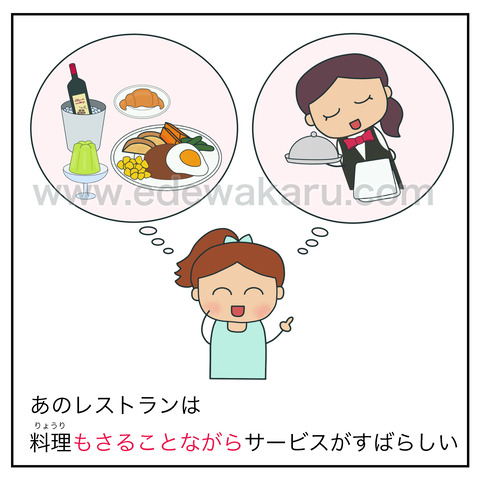
あのレストランは、料理もさることながらサービスがすばらしい
→あのレストランは、料理はもちろんすばらしいが、サービスはもっとすばらしいThat restaurant’s service is wonderful, in addition to its food. →That restaurant’s food is certainly wonderful, but its service is even more wonderful.
お金もさることながら、命はもっと大切だ
→お金はもちろん大切だが、命はもっと大切だLife is more important than money, of course. →Money is certainly important, but life is more important.
このバッグは色もさることながら、デザインがいい
→このバッグは色はもちろんいいが、デザインはもっといいThis bag’s design is good, in addition to its color. →This bag’s color is certainly good, but its design is even better.
あの女優は美しさもさることながら、演技力がすばらしい
→あの女優は美しいのはもちろんだが、演技力がとてもすばらしいThat actress’s acting ability is wonderful, in addition to her beauty. →That actress is certainly beautiful, but her acting ability is even more wonderful.
Read the original source text
Meaning
(「AもさることながらB」の形で)
Aはもちろん〜だがBはもっと〜だ
How to use it
名詞[辞書形]+もさることながら
Explanation
「AもさることながらB」の形で「Aはもちろん〜だがBはもっと〜だ」という意味を表す文型です。この文型は「Aもそうだが、さらにBもあげられる」と言いたい場合に使用されます😮
この文型はプラスのことに使われます
😊「Bのほうがもっと〜だ」と強調すると覚えておきましょう。
日本語文型辞典
Meaning
Basic information: Nもさることながら. Explanation: In the form “XもさることながらY,” it means “X is certainly so, but Y is even more so” or “X is certainly so, and Y can be mentioned as well.” It is generally used for things considered good. Examples: ① He is an impeccable son: in addition to his good university grades, he excels at every sport and is devoted to his parents. ② This dress's design is excellent, but the use of color is even more remarkable. ③ What impressed me most about that restaurant was not only its food but also its beautiful view.
Read the original source text
Meaning
基本情報Nもさることながら説明「XもさることながらY」という形で、「Xもそうであるが、Yはもっとそうである」「Xもそうであるが、さらにYもあげられる」という意味を表す。よいと思われることに使われるのが普通。例文① 彼は、大学の成績もさることながら、スポーツ万能で親孝行という申し分のない息子だ。② このドレスは、デザインもさることながら、色使いがすばらしい。③ あのレストランは、料理もさることながら、眺めの良さが最も印象的だった。
日本語文型辞典 英語版
Meaning
【もさることながら】[Nもさることながら]
Used in the form XもさることながらY and means “X is... but Y is even more so” or “there is X but, moreover, there is Y.” Usually used in reference to something which is thought to be positive.
In context 3 examples
彼は、大学の成績もさることながら、スポーツ万能で親孝行という申し分のない息子だ。
What with his good college grades and, what’s more, his outstanding sports ability, we can’t complain at all about how good a son he is to us.
このドレスは、デザインもさることながら、色使いがすばらしい。
The color scheme for this dress is truly outstanding, not to mention its design.
あのレストランは、料理もさることながら、眺めの良さが最も印象的だった。
The food at that restaurant was impressive, but the great view was even more so.
くらべてわかる日本語表現文型辞典
Meaning
Meaning 1: A is certainly important too, but B is more important.
Meaning 2: The degree of B is greater than that of A.
How to use it
AもさることながらB
[Noun—no suffix] もさることながら
In context 8 examples
相手の気持ちもさることながら、まず君自身の気持ちが重要だ。
Your partner's feelings matter too, but your own feelings are more important first.
結婚するには愛情もさることながら、経済力のある人を選ぶべきだ。
When getting married, love matters, of course, but you should choose someone who is financially capable.
科学の発見には、才能もさることながら、運の要素も大きいんですよ。
In scientific discoveries, luck is a major factor, alongside talent.
用地買収もさることながら、まず周辺住民の同意を取り付けねば。
Acquiring the land is one thing, but first we must secure the consent of the surrounding residents.
彼はディベート大会で論理もさることながら、気迫で相手を圧倒した。
At the debate tournament, he overwhelmed his opponent with sheer force of spirit, as well as logic.
あの人の経験不足もさることながら、やる気のなさにはまいったよ。
His lack of experience was one thing, but his lack of motivation really got to me.
日本の夏は温度もさることながら、湿度も高くて過ごしにくい。
Japanese summers are hard to endure because the humidity is high as well as the temperature.
あの店は料理もさることながら、サービスも行き届き、すばらしい。
That restaurant is wonderful: its food is excellent, and its service is meticulous too.
Read the original source text
Meaning
意味1:確かにAも大切だが、Bのほうがより重要だ。
意味2:AよりもBのほうがもっと程度が進んでいる。
How to use it
AもさることながらB
[名詞-∅]もさることながら
日本語NET JLPT文法解説まとめ
Meaning
~ is naturally so, but in addition, ...
How to use it
N + もさることながら
Explanation
While ~ is naturally so, moreover, ...
The content that follows in the sentence is emphasized.
In context 3 examples
最近の携帯電話はデザインもさることながら、カメラの性能がとても良い。
Recent mobile phones have great camera performance, quite apart from their design.
このバンドはメロディーもさることながら、歌詞もいい。
This band has good lyrics, quite apart from its melodies.
日本語は私にとって漢字もさることながら、文法も難しい。
For me, Japanese grammar is difficult, quite apart from kanji.
Read the original source text
Meaning
〜は当然そうだが、その他にも・・・だ
How to use it
N + もさることながら
Explanation
While ~ is naturally so, moreover, ...
文の後の内容が強調される。
毎日のんびり日本語教師
How to use it
Noun + もさることながら
Explanation
Used to say, “~ is important too, but ~ is even more important.”
The first part gives an obvious example, and the second part mentions something even more important than the first. In other words, the point one wants to convey is always in the second part.
Notes
Similar pattern: “【N1 Grammar】~言わずもがな”
Similar pattern: “【N2 Grammar】~はもとより/はもちろん”
In context 16 examples
その顔の美しさもさることながら、何より声が素敵。
Her voice is wonderful above all, though the beauty of her face is remarkable too.
このアニメはストーリーもさることながら、世界観やキャラ設定もよく作られている。
The story of this anime is excellent, and its world and character designs are also very well developed.
筋肉質な体もさることながら、その体以上に心も男らしい。
Not only is he muscular, but his heart is even more manly than his body.
このカフェは外観もさることながら、店内も和を感じさせる作りになっている。
This café’s interior, like its exterior, is designed to evoke a traditional Japanese feel.
ここの料理はそのボリュームもさることながら、視覚的な満足感もすごい。
The food here is not only generous in portion; it is also visually very satisfying.
私の好きなアイドルは性格もさることながら、ファンサービスも嫌な顔一つせずにしてくれる。
My favorite idol is lovely in personality, and also provides fan service without ever looking displeased.
このゲームはその知名度もさることながら、年1回大会も開催されている。
This game is well known, and it also holds a tournament once a year.
彼女は私服のセンスもさることながら、細かいところのアクセサリーにまでこだわるところも素敵。
Her sense of style in casual clothes is lovely, and she also pays attention to even the smallest accessories.
美貌もさることながらスポーツもできるなんて。彼女にあって私に無いものがありすぎる。
Not only is she beautiful, but she can play sports too. There are so many things she has that I don’t.
お洋服もさることながら、モデルさんも素敵だ。
The clothes are lovely, and the model is lovely too.
ラーメンもさることながらチャーハンも美味い。
The ramen is delicious, and so is the fried rice.
日中のお散歩は人もさることながら、ワンちゃんにも配慮してあげてください。
When taking a walk during the day, please be considerate of people and, above all, dogs.
私、抜け毛もさることながら、1人目を産んでから白髪が酷い。
I have hair loss, of course, but my gray hair has been terrible since I had my first child.
中途採用は経験もさることながら、一番重要視しているのは「人柄」です。
For mid-career hiring, experience matters, but what we value most is “personality.”
最近は日中もさることながら、夜も暑さで寝苦しくなりました。
Recently, it’s been hot and hard to sleep at night as well as during the day.
元々の才能もさることながら努力も怠らないし、彼女は本当にすごい子だ。
She has innate talent, of course, but she also never neglects her efforts. She’s truly amazing.
Read the original source text
How to use it
名詞+もさることながら
Explanation
「~も重要だが~はもっと重要」と述べるときに使います。
前件では自明である例を挙げ、後件では前件以上に重要なことに触れます。つまり伝えたいポイントは常に後件にあります。
Notes
似ている文型「【N1文法】~言わずもがな」
似ている文型「【N2文法】~はもとより/はもちろん」
NINJAL 日本語文型データベース
Meaning
This is used when you want to emphasize that one thing is certainly true, but something else is even more so in addition to it.
How to use it
Nもさることながら
Notes
「~」 is filled by a word expressing something that is easy to anticipate. After 「~もさることながら」 comes a word expressing something to be emphasized more than 「~」.
「も」 may also be attached to the word expressing what is to be emphasized.
In context 6 examples
このコーヒーショップはコーヒーの味もさることながら、店の雰囲気がとてもいい。
The coffee at this coffee shop is certainly good, but the atmosphere is especially nice.
青井先生は人気がある。説明のわかりやすさもさることながら、学生の意見を引き出し、学生に寄り添う授業の進め方が魅力的だ。
Professor Aoi is popular. The explanations are easy to understand, and, even more appealing, the way the professor draws out students' opinions and engages with them is attractive.
ショッピングサイトで買うものを選ぶときは、値段もさることながら、買った人が好意的な感想を寄せているかどうかも大事なポイントだと思う。
When choosing something to buy on a shopping site, I think an important point is not only the price but also whether buyers have left positive reviews.
今日のコンサートは素晴らしかった。演奏者の技量もさることながら、客席とステージとが一体になったような盛り上がりが感じられた。
Today's concert was wonderful. The performers' skill was impressive, and there was also an excitement that made it feel as if the audience and the stage had become one.
このチームは勝てないだろう。守備の悪さもさることながら、攻撃力の弱さが致命的だ。
This team probably won't win. Their defense is poor, but what is fatal is their weak offense.
転職先は、待遇もさることながら、社内の人間関係もとてもよかった。
At my new job, the benefits were good, and the relationships among people at the company were very good too.
Read the original source text
Meaning
~も当然そうだが、それに追加して、他のことはもっとそうだと強調して言いたいときに使います。
How to use it
Nもさることながら
Notes
「~」には、予想しやすい事柄を表す言葉がきます。「~もさることながら」の後には、「〜」より強調したい事柄を表す言葉がきます。
強調したい事柄を表す言葉に「も」をつけることもあります。
IMABI
Addition
Read this IMABI lesson ↗Explanation
Addition: ~に加えて, ~にとどまらず, ~もさることながら, ~はおろか, ~はもちろん, ~はもとより, ~ともあれ
When a speaker feels obligated to mention yet another thing into the mix, that is usually done so with negative connotation, and it is this that will be the theme of this lesson.
~に加えて
The transitive verb 加える roughly translates to “to add,” but it may also be translated as “to count (someone) in,” “to deal (damage),” “or even “to gather (speed).”
1. 料理に胡椒こしょうは一つまみも加える必要はない。
There is no need to add a pinch of pepper to a dish.
2. お茶に砂糖を加える。
To mix sugar in the tea.
3. 圧力を加える。
To add pressure.
咥える should not, however, be confused with the homophonous transitive verb 咥える・銜える, which means “to put in one’s mouth,” although they are etymologically tied.
4. 子供は指を銜くわえる嫌いがある。
Children have the tendency to have their fingers in their mouth.
Perhaps the most important use of this verb is its appearance in the phrase ~に加えて meaning “in addition to.” It is used a lot in enumerating negative situations.
5. 彼女は日本語に加えて、英語もあまり分からないみたいだね。
In addition to Japanese, it looks like she barely understands English.
6. イギリスに加えて、フランスもドイツも多文化主義の非を鳴らしています。
In addition to England, France and Germany are also denouncing multiculturalism.
7. そのことに加えて、彼は自分の名前を忘れたよ!
In addition to that, he also forgot his own name!
8. 5日のニューヨーク株式市場かぶしきしじょうは、東京市場で株価が大幅おおはばに値下がりしたことに加えて、アメリカが景気を下支したざさえするために行っている量的緩和りょうてきかんわの縮小しゅくしょう時期など、アメリカの金融きんゆう政策に対する不安から幅広い銘柄めいがらに売り注文が広がりました。
As for the New York Stock Exchange on the fifth, selling orders have spread in a wide range of brands from worries towards American financial policies such as the quantitative easing curtailment period America is carrying out in order to backup the economy in addition to the large drop in prices due to the Tokyo Exchange.
From NHK.
~にとどまらず
The speech modal ~にとどまらず attaches to nouns which can be perceived as some sort of parameter/level/stage with which the following clause indicates an extension of said parameter.
10. マスメディアによる情報というものは、今や一国にとどまらず、世界中に伝わる。
Information by the media doesn’t stay in one country now; it travels the world.
11. 農作物は、台風に襲われた直後にとどまらず、一年中その影響を受ける。
Crops don’t just receive the effects directly after being hit by a typhoon; they feel the impact throughout the year.
12. 彼女は成功にとどまらず、社会貢献に尽力した。
She not only stopped at success, but she also labored as a contribution to society.
Though ~にとどまらず usually attaches itself to nouns, it can on occasion follow the 連体形 of verbs, but in doing so, it is not used with static verbs, as such verbs do not agree with the concept of extending parameters.
13. 一人の人間の明るさは、場を明るくするにとどまらず、周囲の人々に心身の活力をも与えるものである。
The brightness of a person not only brightens up the area, but also it gives energy to the hearts and minds of the surrounding people.
14. 更に執刀した岡山大学病院の大藤剛宏医師は手術後の記者会見で「中葉を使った移植は男の子1人を助けるにとどまらず、これまで助けることができなかった子どもたちに光が当たるという意義がある」と話しました。
In addition, Dc. Oto Takahiro of Okayama University Hospital who did the surgery in a press conference afterwards said that “the transplant using the middle lobe [of the lung] does not just save this one boy, but it gives light to other children that have not been able to be helped till now”.
From the NHK article 『生体肺移植の男児 容体安定』 on 2013年7月2日
When used with adjectives/adjectival noun predicates, the nature of the situation must be in some state of transition to account for an extension of the parameter being described to remain grammatical. So, although adjectival expressions may literally be static by definition, they can be implemented in dynamic circumstances.
As this pattern follows the 連体形, but because it is also generally restricted to rather stiff written language, we can expect it to follow the である-連体形 for adjectival nouns, but as for adjectives1, we find that the particle だけ (only) is placed in between the adjective (though still in the 連体形) and ~に留まらず.
15. あの法令は単に違憲であるにとどまらず、ネットのおかげで実効性も失われて久しい。
That ordinance is not only simply unconstitutional, but thanks to the Internet, it has lost its effectiveness for quite some time.
16. 健康に良いだけにとどまらず、シジミは旨味成分もたくさん含まれています。
Freshwater clams are not just good for your health, but they also contain lots of umami components.
Though not grammatically necessary and in some sense redundant, the particle だけ can generally be seen used with this pattern in general, resulting in ~だけにとどまらず.
17. 弊社は社会貢献だけにとどまらず、様々な活動を展開しております。
Our company is not limiting itself to just contributing to society but is expanding its reach into all sorts of activities.
Orthography Note: Though not typically written in Kanji, its Kanji spelled is ~に留まらず.
~もさることながら
The pattern ~もさることながら follows nouns deemed to obviously be of a certain quality (most often positive), and that the following clause adds to the worth/validity of said statement. This, in turn, is translated into English as “it goes without saying that…”
18. 中華料理ちゅうかりょうりは味あじもさることながら、健康けんこうにいいですよ。
It goes without saying that Chinese food is tasty, but it’s also good for you.
19. 彼女は人柄もさることながら、その頭の働きの良さで周囲の人をぐいぐいと引っ張っていくんですよ。
Her personality goes without saying, and her great mind pulls those around towards her.
Orthography Note: The full Kanji spelling of this pattern is 然る事乍ら.
Grammar Note: 然る is an old-fashioned 連体詞 derived from the Classical Japanese verb 然り, which has the meaning of “to be said/some thing” in a very vague sense, and if it were directly translated into something in Modern Japanese, it would be closest to そういう or とある, which results in it directly equating to “such.” Given how affirming the noun-predicate is, we see that the particle ながら attaches itself to state that the two clauses of the sentence are concurrently in agreeance to that effect.
~はもちろん・もとより・おろか
~はもちろん(のこと)is used when juxtaposing two predicates as being “as matter of fact.” The first clause which it attaches to must be a nominal(ized) phrase, but what follows after it is typically a verbal/adjectival which affirms the first predicate.
In the examples that follow, we can see how the literal meaning of もちろん, that being “of course,” can be taken literally here. To truly understand how this pattern works regarding nuance, though, let’s posit that the first clause is X and the second clause is Y. In the mind of the speaker, X is mentioned first as it has the highest relevance or the highest recognition of being obvious, whereas Y adds to what is obvious or fully expected given knowledge of the situation. Y may at times be far more impressive than Y, but the reason why X is mentioned first is because it has the most relevance.
Speech Style Note: While ~はもちろん is largely used in the written language, whenever it is utilized in the spoken language, it is often rendered as ~もちろんのこと, which grammatically allows for said dependent clause to more clearly function as a noun-predicate that is more parallel in structure to predicate Y.
20. 彼は英語はもちろん、スペイン語も韓国語もできます。
Not to mention English, he can also speak Spanish and Korean.
21 あの子は書くのはもちろん、読むこともできない。
That kid can’t even read, let alone write.
22. 彼は、母語はもちろん(のこと)、他にも7つの言語も話せますよ。
Not only his native language, but he can also speak seven other languages.
23. 彼は修士を得るのはもちろん、入学さえできない。
He can’t even enter college, let alone receive a master’s degree.
Now, whenever Y is not something that cannot be deemed obvious given the situation at hand, ~はもちろん becomes ungrammatical, and it would need to be replaced with something broader such as ~だけでなく.
24. この米には、もみ{だけでなく 〇・はもちろん X}、砂まで入ってるのよ。
Not only is there husks in this rice, there’s even sand in it.
While it may be intrinsically obvious that someone who excels in his main language does indeed have mastery in other languages like in Ex. 22, there is nothing intrinsic about rice being contaminated with all sorts of things.
~はもとより
The nuance spin that ~はもとより provides is that it quality X is “principally” so. Meaning, based on principle, X is that standard which is both most pertinent and obvious in nature, and then Y builds onto that execution of standard. Just as with ~はもちろん(のこと), X is a nominal(ized) phrase, while Y is usually a verbal/adjectival predicate which expands on that notion.
25. 彼女は料理はもとより食器も洗ってくれます。
She not only cooks, but she also washes the dishes.
26. 彼は英語はもとより、スペイン語も韓国語もできます。
Not to mention English, he can also speak Spanish and Korean.
27. 低賃金、劣悪な労働条件、一方的な首切りなどの経済・労働問題はもとより、各種の人道的問題までも引き起こしている。
They are not only suffering from low wages, cases of poor working condition, and economic and labor problems such as one-sided layoffs, they are also troubled to the extent of various forms of discrimination.
28. 地方ごとに、味はもとより、料理の仕方も違ってきますね。
With each region, not to mention flavor, but even cooking methods differ, don’t they?
~はおろか
The word おろか indicates that the noun in the dependent clause X is negligible in how bad Y is obviously true.
29. 一ドルはおろか一セントも持ってないよ。
I don’t have a cent, let alone a dollar!
30. 父はおろか、僕の犬でさえ反対したようだ。
Not to mention my father, even my dog seemed to object.
31. 僕はバイオリンはおろか、ギターも弾けないんだ。
I can’t even play the guitar, much less a violet.
32. あの子は話すのはおろか、足も動かせません。
That child can’t even move her legs, let alone speak.
漢字 Notes: The Kanji spellings of these phrases are as follows:
①おろか → 疎か
②もちろん → 勿論
③もとより →【元・固・素】より.
~ともあれ
~ともあれ is an adverbial phrase that means “never mind/putting aside.” It is also seen in 何はともあれ meaning “in any case.” Grammatically speaking, あれ is the 已然形 of the existential verb ある, which means that as a whole, this adverbial phrase pinpoints the noun in said dependent clause X is already obviously an established issue, but that Y is the ‘real’ problem at hand.
33. 中国語はともあれ、問題は日本語の勉強なんだぞ。
Never mind Chinese, the problem is my Japanese studies!
34. 何はともあれ、後でしよう。
In any case, let’s do (this) later.
In older language, the き-連体形 of adjectives does become valid with this grammar structure.
i. 良き素材で醸されたお酒は香味や余韻の良きにとどまらず、飲み手にはその格に相応しい陶酔感をもたらします。
Sake brewed with excellent ingredients not only has superb flavor and aftertaste, as it provides a level of intoxication befitting of its worth to the consumer. ↩︎
In context 32 examples
料理に胡椒こしょうは一つまみも加える必要はない。
There is no need to add a pinch of pepper to a dish.
お茶に砂糖を加える。
To mix sugar in the tea.
圧力を加える。
To add pressure.
子供は指を銜くわえる嫌いがある。
Children have the tendency to have their fingers in their mouth.
彼女は日本語に加えて、英語もあまり分からないみたいだね。
In addition to Japanese, it looks like she barely understands English.
イギリスに加えて、フランスもドイツも多文化主義の非を鳴らしています。
In addition to England, France and Germany are also denouncing multiculturalism.
そのことに加えて、彼は自分の名前を忘れたよ!
In addition to that, he also forgot his own name!
5日のニューヨーク株式市場かぶしきしじょうは、東京市場で株価が大幅おおはばに値下がりしたことに加えて、アメリカが景気を下支したざさえするために行っている量的緩和りょうてきかんわの縮小しゅくしょう時期など、アメリカの金融きんゆう政策に対する不安から幅広い銘柄めいがらに売り注文が広がりました。
As for the New York Stock Exchange on the fifth, selling orders have spread in a wide range of brands from worries towards American financial policies such as the quantitative easing curtailment period America is carrying out in order to backup the economy in addition to the large drop in prices due to the Tokyo Exchange.
マスメディアによる情報というものは、今や一国にとどまらず、世界中に伝わる。
Information by the media doesn’t stay in one country now; it travels the world.
農作物は、台風に襲われた直後にとどまらず、一年中その影響を受ける。
Crops don’t just receive the effects directly after being hit by a typhoon; they feel the impact throughout the year.
彼女は成功にとどまらず、社会貢献に尽力した。
She not only stopped at success, but she also labored as a contribution to society.
一人の人間の明るさは、場を明るくするにとどまらず、周囲の人々に心身の活力をも与えるものである。
The brightness of a person not only brightens up the area, but also it gives energy to the hearts and minds of the surrounding people.
更に執刀した岡山大学病院の大藤剛宏医師は手術後の記者会見で「中葉を使った移植は男の子1人を助けるにとどまらず、これまで助けることができなかった子どもたちに光が当たるという意義がある」と話しました。
In addition, Dc. Oto Takahiro of Okayama University Hospital who did the surgery in a press conference afterwards said that “the transplant using the middle lobe [of the lung] does not just save this one boy, but it gives light to other children that have not been able to be helped till now”.
あの法令は単に違憲であるにとどまらず、ネットのおかげで実効性も失われて久しい。
That ordinance is not only simply unconstitutional, but thanks to the Internet, it has lost its effectiveness for quite some time.
健康に良いだけにとどまらず、シジミは旨味成分もたくさん含まれています。
Freshwater clams are not just good for your health, but they also contain lots of umami components.
弊社は社会貢献だけにとどまらず、様々な活動を展開しております。
Our company is not limiting itself to just contributing to society but is expanding its reach into all sorts of activities.
中華料理ちゅうかりょうりは味あじもさることながら、健康けんこうにいいですよ。
It goes without saying that Chinese food is tasty, but it’s also good for you.
彼女は人柄もさることながら、その頭の働きの良さで周囲の人をぐいぐいと引っ張っていくんですよ。
Her personality goes without saying, and her great mind pulls those around towards her.
彼は英語はもちろん、スペイン語も韓国語もできます。
Not to mention English, he can also speak Spanish and Korean.
彼は、母語はもちろん(のこと)、他にも7つの言語も話せますよ。
Not only his native language, but he can also speak seven other languages.
彼は修士を得るのはもちろん、入学さえできない。
He can’t even enter college, let alone receive a master’s degree.
この米には、もみ{だけでなく 〇・はもちろん X}、砂まで入ってるのよ。
Not only is there husks in this rice, there’s even sand in it.
彼女は料理はもとより食器も洗ってくれます。
She not only cooks, but she also washes the dishes.
彼は英語はもとより、スペイン語も韓国語もできます。
Not to mention English, he can also speak Spanish and Korean.
低賃金、劣悪な労働条件、一方的な首切りなどの経済・労働問題はもとより、各種の人道的問題までも引き起こしている。
They are not only suffering from low wages, cases of poor working condition, and economic and labor problems such as one-sided layoffs, they are also troubled to the extent of various forms of discrimination.
地方ごとに、味はもとより、料理の仕方も違ってきますね。
With each region, not to mention flavor, but even cooking methods differ, don’t they?
一ドルはおろか一セントも持ってないよ。
I don’t have a cent, let alone a dollar!
父はおろか、僕の犬でさえ反対したようだ。
Not to mention my father, even my dog seemed to object.
僕はバイオリンはおろか、ギターも弾けないんだ。
I can’t even play the guitar, much less a violet.
あの子は話すのはおろか、足も動かせません。
That child can’t even move her legs, let alone speak.
中国語はともあれ、問題は日本語の勉強なんだぞ。
Never mind Chinese, the problem is my Japanese studies!
何はともあれ、後でしよう。
In any case, let’s do (this) later.