絵でわかる日本語
Meaning
due to 〜
caused by 〜
How to use it
Verb [た-form or ている-form] + ために
Adjective or noun [plain form] + ために
* な-adjective: “〜なために”; noun: “〜のために”
Explanation
“〜ために” is a sentence pattern expressing cause or reason, meaning “because of 〜.” The “に” in “〜ために” can be omitted. 😊
[Examples]
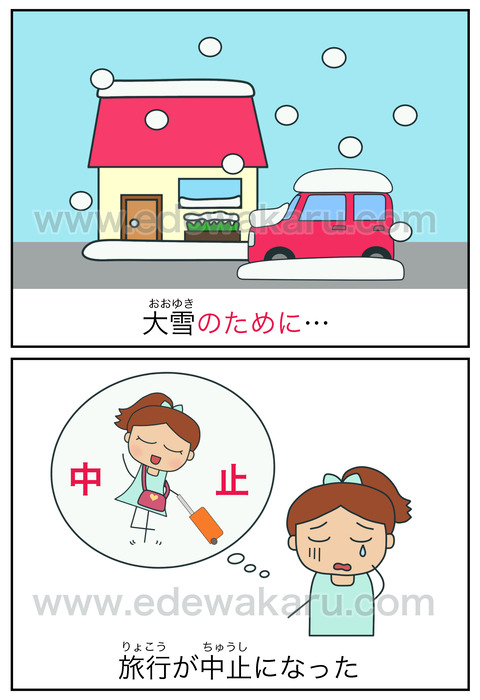
The trip was canceled because of heavy snow.
I was late because there had been an accident.
Also, as with “〜おかげで” (Review: 〜おかげで) and “〜せいで” (Review: 〜せいで), there is the form “〜ためか,” which is used when the cause or reason is not clearly known. It means “probably because of 〜.” 😮
The trip was canceled because of heavy snow. (The cause is clearly known to be “heavy snow.”)
The trip was canceled, perhaps because of heavy snow. (It is not clear whether the cause was “heavy snow.”)
Be careful: conjectures, commands, requests, and intentions cannot follow “〜ために.” 😨
[Examples]
❌ The trip will probably be canceled because of the heavy snow.
❌ Put on a coat because of the heavy snow.
❌ May I take the day off school because of the heavy snow?
❌ Let’s give up on going on the trip because of the heavy snow.
“〜ために・〜ためか” are formal expressions, so “〜ので” or “〜から” are generally used in conversation. 😉
There is also a “〜ために” that expresses purpose, so review that as well.
In context 3 examples
大雪のために旅行が中止になった
→大雪が原因で、りょこうが中止になったThe trip was canceled because of heavy snow. → The trip was canceled because heavy snow was the cause.
事故があったために、遅刻してしまった
→事故があったのが原因で、遅刻してしまったI was late because there had been an accident. → I was late because an accident had occurred.
昨日はとても寒かったために、カゼをひいてしまった
→昨日はとても寒かったのが原因で、カゼをひいてしまったI caught a cold because it was very cold yesterday. → I caught a cold because it was very cold yesterday.
Read the original source text
Meaning
〜が原因で
How to use it
動詞[た形・ている形]+ために
形容詞・名詞[普通形]+ために
*な形容詞:「ーなために」名詞:「ーのために」
Explanation
「〜ために」は原因・理由を表す文型で、「〜が原因で」という意味です。「〜ために」の「に」は省略することができます😊
[例]
大雪
のため
旅行が中止になった
事故があった
ため、遅刻してしまった
また「〜おかげで」(復習:〜おかげで)や「〜せいで」(復習:〜せいで)と同じように「〜ためか」という形があり、はっきりと原因・理由がわかっていない時に使います。「たぶん〜が原因で」という意味になります😮
大雪
のために
旅行が中止になった(
原因は「大雪」とはっきりわかっている)
大雪
のためか
旅行が中止になった(
原因は「大雪」かどうかはっきりわからない)
「〜ために」の後ろには【推測】【命令】【依頼】【意志】などは使えませんので注意しましょう
😨
[例]
❌大雪のために、旅行は中止でしょう
❌大雪のために、コートを着なさい
❌大雪のために、学校を休んでもいいですか?
❌大雪のために、旅行に行くのはやめよう
「〜ために・〜ためか」はかたい言い方ですので、会話では「〜ので」や「〜から」を使うのが一般的です😉
「〜ために」には【目的】を表すものもありますので、復習しておきましょう。