絵でわかる日本語
Usage 1
Read this source entry ↗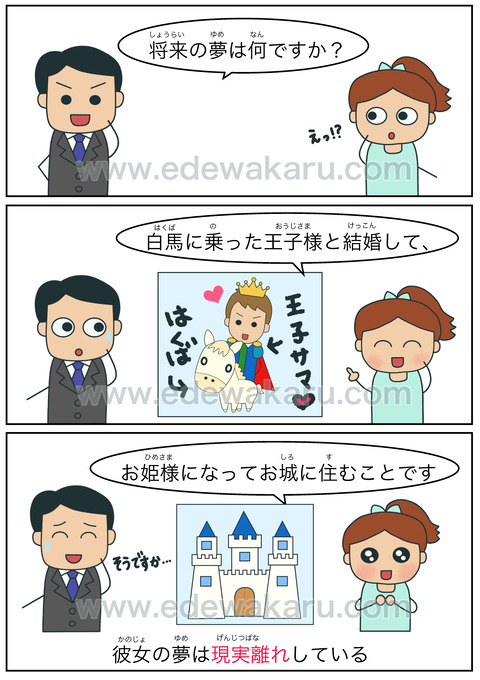
Meaning
Very different from …
Far removed from …
How to use it
Noun[dictionary form]+離れ
Explanation
“A離れ” is a sentence pattern meaning “very different from the typical A” or “far removed from A.” It is read “〜ばなれ.” It is used when you want to say that something is completely different in degree from “A.”
It is used in the forms “〜離れしている” and “〜離れした+noun.” The words used with it are mostly fixed, so learn some of them.
[Commonly used words]
・
現実
離れ
・
人間
離れ
・
日本人
離れ
・
新人
離れ
・
素人
離れ
・
世間
離れ
・
浮世
離れ, etc.
“〜離れ” has other usages as well, so review them. 😊
【Related sentence patterns】
In context 5 examples
彼女の夢は現実離れしている
→現実からかけ離れている(現実的ではない)Her dream is far removed from reality. →It is far removed from reality (unrealistic).
あの歌手は新人離れした歌唱力(かしょうりょく)で、みんなを感動させた
→普通の新人とは全然違うすばらしい歌唱力で感動させたThat singer moved everyone with a singing ability that was beyond that of a typical newcomer. →They moved everyone with an outstanding singing ability completely unlike that of an ordinary newcomer.
彼が持つ技術は人間離れしている
→彼は普通の人にはできない、すばらしい技術を持っているHis skills are superhuman. →He has amazing skills that ordinary people could not manage.
彼女は日本人離れしたスタイルで、モデルとして活躍している
→一般的な日本人とは違うスタイルで、活躍しているShe is thriving as a model with a figure unlike that of a typical Japanese person. →She is thriving with a figure that differs from that of a typical Japanese person.
社長の世間離れした金銭感覚(きんせんかんかく)は理解できない…
→一般人とは全然違う金銭感覚は理解できないI can’t understand the president’s out-of-touch sense of money… →I can’t understand his sense of money, which is completely different from that of ordinary people.
Read the original source text
Meaning
〜とすごく違う
〜からかけ離れている
How to use it
名詞[辞書形]+離れ
Explanation
「A離れ」は「一般的なAとすごく違う」「Aからかけ離れている」という意味の文型です。読み方は「〜ばなれ」です。「A」 の程度と全然違うと言いたい時に使われます。
「〜離れしている」「〜離れした+名詞」
の形で使われます。使われる単語はほとんど決まっていますので、いくつか覚えておきましょう。
[よく使われる単語]
・
現実
離れ
・
人間
離れ
・
日本人
離れ
・
新人
離れ
・
素人
離れ
・
世間
離れ
・
浮世
離れ など
「〜離れ」には他にも用法がありますので、復習をしておきましょう😊
【関連文型】
Usage 2
Read this source entry ↗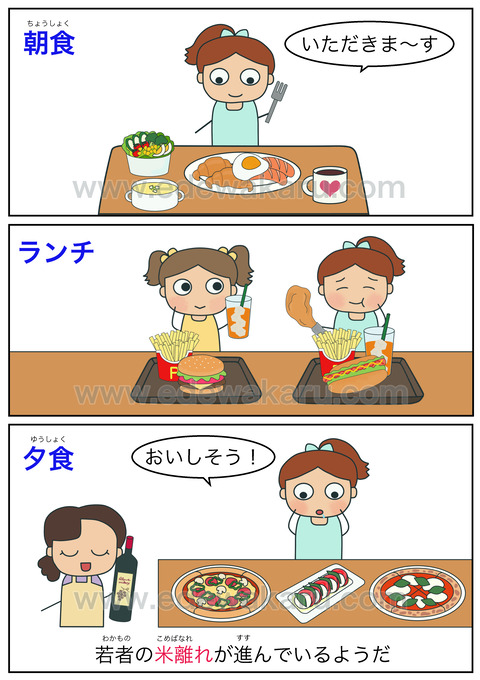
Meaning
To stop doing …
To stop using …
How to use it
Noun[dictionary form]+離れ
Explanation
“〜離れ” is a sentence pattern that expresses losing interest or concern, and is used to mean “to stop doing …” or “to stop using ….” It is used when something that many people used to do or use is no longer done or used. Be careful: when using it as a verb, the form is “〇〇離れする,” not “〇〇離れる.”
[Commonly used “〜離れ” expressions]
・
テレビ
離れ
・
米
離れ(
お米
離れ・
ごはん
離れ)
・
車
離れ
・
活字
離れ
・
映画
離れ
・
政治
離れ
・
選挙
離れ
・
新聞
離れ
・
旅行
離れ(overseas travel disengagement)
・
お酒
離れ(beer disengagement), etc.
Learn some commonly used “〜離れ” expressions. 😊
【Related sentence patterns】
In context 4 examples
若者の米離れが進んでいるようだ
→若者がお米を食べなくなってきているようだIt seems young people are increasingly eating less rice. →It seems young people are starting to eat less rice.
妻:なんでも、最近の子はテレビを見ないそうよ夫:そうだ…テレビ離れが進む一方だな
→テレビを見なくなる人が多くなる一方だなWife: I hear that kids these days don’t watch TV. Husband: That’s right… More and more people are turning away from TV. →More and more people are stopping watching TV.
お金がかかるからか、車離れする人が増えている
→車に乗らなくなる人が増えているPerhaps because it costs money, more people are giving up cars. →More people are stopping driving cars.
若い人の選挙離れは深刻だそうだ
→若い人が選挙に行かなくなったことは深刻な問題だApparently, young people’s disengagement from elections is a serious problem. →It is a serious problem that young people have stopped voting.
Read the original source text
Meaning
〜しなくなる
〜を使わなくなる
How to use it
名詞[辞書形]+離れ
Explanation
「〜離れ」は興味や関心がなくなってしまうことを表す文型で、「〜しなくなる」「〜を使わなくなる」という意味で使われます。今まではたくさんの人がやったり使ったりしていたものが使われなくなったりする場合に使用されます。動詞として使う場合は「〇〇離れる」ではなく、「〇〇離れする」になりますので気をつけましょう。
[よく使われる「〜離れ」]
・
テレビ
離れ
・
米
離れ(
お米
離れ・
ごはん
離れ)
・
車
離れ
・
活字
離れ
・
映画
離れ
・
政治
離れ
・
選挙
離れ
・
新聞
離れ
・
旅行
離れ(海外旅行離れ)
・
お酒
離れ(ビール離れ) など
よく使われる「〜離れ」をいくつか覚えておきましょう😊
【関連文型】
Usage 3
Read this source entry ↗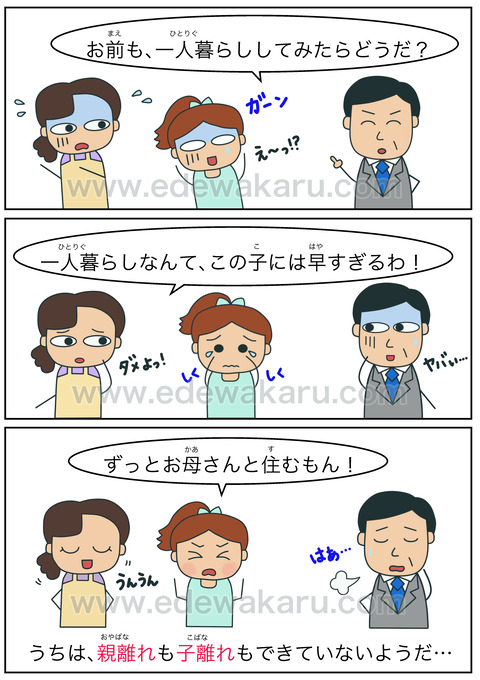
Meaning
To become independent by moving away from …
How to use it
Noun[dictionary form]+離れ
Explanation
“〜離れ” is a sentence pattern meaning “to become independent by moving away from ~” or “to become independent without relying on ~.” The words it is used with are fixed, so I think it’s best to memorize each as a single word. It is read as “〜banare,” and when used as a verb, it becomes “〜離れする.”
[Words it is used with]
・親離れ (becoming independent from one’s parents)
・子離れ (letting one’s child become independent)
・乳離れ (weaning; becoming independent)
・巣離れ (leaving the nest; becoming independent)
[Meanings]
親離れ
→A child moving away from their parents and becoming independent
子離れ
→Supporting a child as they become independent
乳離れ
→①A baby growing up and stopping breastfeeding
②A child moving away from their parents and becoming independent
巣離れ
→①A baby bird growing up and leaving the nest
②A child growing up, moving away from their parents, and becoming independent
“〜離れ” has other uses too, so let’s review them 😊
[Related grammar patterns]
Read the original source text
Meaning
〜から離れて独立する
How to use it
名詞[辞書形]+離れ
Explanation
「〜離れ」は「〜から離れて自立する」「〜に依存しないで、独立する」という意味の文型です。使われる単語は決まっていますので、1つの単語として覚えておくといいと思います。また読み方は「〜ばなれ」で、動詞として使う場合は「〜離れする」になります。
[使われる単語]
・
親離れ
・
子離れ
・
乳離れ
・
巣離れ
[意味]
親離れ
→子供が親から離れて自立すること
子離れ
→子供が自立することを応援すること
乳離れ
→①赤ちゃんが成長して母乳を飲まなくなること
②子供が親から離れて自立すること
巣離れ
→①ひな鳥が成長して、巣から出ていくこと
②子供が成長して、親から離れて自立すること
「〜離れ」には他にも用法がありますので復習をしておきましょう😊
【関連文型】