DoJG 日本語文法辞典(全集)
Meaning
Even if; although
How to use it
(i) {V/Adjective(い/な)} て | も | |
| 話しても | Even is someone talks |
| 食べても | Even if someone eats |
| 高くても | Even if it is expensive |
| 静かでも | Even if it is quiet |
(ii) Noun | でも | |
| 先生でも | even if someone is a teacher |
Explanation
[x] is used when that which is expressed in the main clause is not what is expected from the content of the dependent ([x]) clause.
In context 11 examples
私は雨が降っても行く・行きます。
I'll go there even if it rains.
私は寒くても出かける・出かけます。
I'll go out even if it is cold.
僕がトムでも同じことをしただろう・でしょう。
Even if I were Tom, I would probably have done the same thing.
中山さんは本を買っても読みません。
Mr. Nakayama doesn't read books even if he buys them.
私は四時間歩いても疲れなかった。
I didn't get tired although I walked for four hours.
何を食べても美味しいです。
No matter what I eat, it tastes good.
誰に聞いても分からなかった。
No matter who I asked, I couldn't get the answer.
A:煙草を吸ってもいいですか。 B:はい、いいです。
A: May I smoke? B: Yes, you may.
どんなに日本語が難しくてもやってみます。
No matter how difficult Japanese may be, I will try it.
どんなに丈夫でも体には気をつけた方がいい。
No matter how healthy you are, you’d better take good care of yourself.
井上さんが先輩でも僕ははっきり言うつもりだ。
I intend to speak straightforwardly, even if Mr. Inoue is my senior.
日本語文型辞典
Meaning
Core information
N / Na でも; A-くても; V-ても
Explanation
A form consisting of the predicate’s て-form combined with 「も」. With nouns and な-adjectives, it becomes 「でも」. In casual spoken language, the forms 「たって」 and 「だって」 are also used.
This expresses a concessive condition that negates a sequential conditional relationship of the form 「XならばY」, in which Y holds if X holds. In examples ① and ⑥, it negates relationships such as “if you are sick, you can take the day off” and “if you return to your country, you will forget the kindness of the people here,” expressing that even if condition X holds, Y does not. As in ⑨, the adverb 「たとえ」 may also be used.
This lists two or more conditions and expresses that the same result occurs whichever condition (or any of the conditions) is met.
a. …ても
When conditional sentences with different conditions but the same result are listed, as in 「XならばZ」 and 「YならばZ」, the second conditional sentence is expressed with 「ても」, as in 「Y(であっ)てもZ」. It means that the result is the same under either condition, and can be rephrased as 「XてもYてもZ」.
b. …ても…ても
In the form 「XてもYても(…ても)Z」, two or more conditions are listed to mean that the same result occurs in either (or any) case.
c. V-てもV-なくても
This lists conditions in a positive and negative relationship, in a form such as 「…してもしなくても」, and expresses that the result does not change either way.
d. V-てもV-ても
The same verb is repeated to emphasize that no matter how much effort is made, the desired result cannot be obtained. A negative expression usually follows, but a positive expression may follow, as in the example below. Even then, the result carries a negative implication of being undesirable.
This is used when an interrogative such as 「何、どこ、だれ、どれ、いつ、どう」 appears in a 「ても」 condition. It expresses that the consequent event is sure to occur (or, in the negative, is sure not to occur), whatever the condition may be.
a. いくら…ても
「いくらXても」 expresses a high frequency or degree of an action or state. It is used when the consequent event occurs unaffected by even such a powerful condition. The result often goes against expectations. For example, ① says that, contrary to the expectation “a glamorous profession must be all fun,” there are many hardships; ⑥ says that, contrary to the expectation “if I listen to the tape a lot, I’ll come to understand it,” the speaker still does not come to understand it.
b. どんなに…ても
This is used in the same way as A above. 「どんなに」 can be replaced with 「いくら」, but 「いくら」 is more conversational.
c. 疑問詞…ても
This means “Y in any case” and expresses that no matter what element is placed in the interrogative position, the consequent event Y is sure to occur (or, in the negative, is sure not to occur).
d. どうV-ても
Used with verbs expressing volitional actions, this means that trying various things still does not produce the expected result.
e. なん+助数詞+V-ても
This is used with verbs expressing actions and means that the same result occurs no matter how many times the action is repeated. As in ①–③, the result often continues to go against expectations, but a desirable situation may also continue, as in ④ and ⑤.
A counterfactual conditional sentence that denies the relationship 「XしていたらYしていただろう」 (“if X had happened, Y would have happened”). In the form 「XしてもYしなかっただろう」, it is used to hypothetically state that even if the counterfactual X had held, it would not have affected the fact that Y did not occur. For example, ① denies the sequential counterfactual condition 「努力していれば合格できただろう」 (“if I had worked hard, I could have passed”; in fact, the speaker did not work hard and failed). It means “I did not actually work hard, but even if I had, the fact that I failed would not have changed.” ② denies the sequential counterfactual condition 「努力しなければ合格できなかっただろう」 (“if I had not worked hard, I could not have passed”; in fact, the speaker worked hard and passed). It means “I did work hard, but even if I had not, the fact that I passed would not have changed.”
In the form 「XてもYた」, the sentence ends with the past 「タ」 form, and both X and Y refer to events that actually occurred. For example, ① means “It rained, but the sports day was held.” Here, 「ても」 has a meaning similar to 「が」, 「けれども」, or 「のに」. However, when 「ても」 follows a verb expressing an action, it carries the nuance that the action was repeated or carried out to an extreme degree, yet the expected result was not obtained. Therefore, as in ④, when a sentence is accompanied by 「いくら」, 「ても」 cannot be replaced with 「が」, 「けれども」, or 「のに」.
The same verb is used to intensify its meaning. For example, ① emphasizes deep gratitude, and ② emphasizes strong regret. This is a somewhat idiomatic expression, and only a limited range of verbs can be used. 「死んでも死にきれない」 is used as an emphatic expression meaning “I can’t give up” or “I’ll regret it.”
This means that doing something will not resolve the situation. The expression includes a feeling of resignation.
An idiomatic expression formed by combining the 「ても」 form of 「V-たい」 with the negative form of 「V-れる」 expressing ability. It means “want to do so, but cannot.” It is used to emphasize that one cannot do something because circumstances do not allow it, or when making an excuse.
⇾てもいい
⇾てもかまわない
⇾てもさしつかえない
⇾てもしかたがない
⇾てみる5⇾てみる6
⇾てもよろしい
How to use it
…ても
…ても
question word…ても
…ても…ただろう
…ても…た
V-てもR-きれない
V-てもとうなるものでもない
V-たくてもV-れない
…てもいい
10 …てもかまわない
11 …てもさしつかえない
12 …てもしかたがない
13 …てもみない
14 …てもよろしい
In context 67 examples
この仕事は、病気でも休めない。
I can’t take time off from this job even if I’m sick.
その車がたとえ10万円でも、今の私には買えない。
Even if that car cost only 100,000 yen, I couldn’t afford it right now.
不便でも、慣れた機械の方が使いやすい。
Even if it’s inconvenient, the machine I’m used to is easier to use.
風が冷たくても平気だ。
I don’t mind even if the wind is cold.
ほしくなくても、食べなければいけない。
Even if I don’t want to, I have to eat.
国へ帰っても、ここの人々の親切は忘れないだろう。
Even when I return to my country, I probably won’t forget the kindness of the people here.
今すぐできなくても、がっかりする必要はない。
You don’t need to be discouraged even if you can’t do it right away.
わたしは、まだ勉強不足だから、今試験を受けても受からないだろう。
I’m still not prepared enough, so even if I take the exam now, I probably won’t pass.
たとえ両親に反対されても彼との結婚はあきらめない。
Even if my parents oppose it, I won’t give up marrying him.
2を二乗すると4になりますが、2を二乗しても4になります。
Squaring 2 gives 4, and squaring 2 still gives 4.
飛行機で行くと料金は片道2万円ぐらいですが、新幹線で行っても費用はだいたい同じです。
Going by plane costs about 20,000 yen one way, but it costs about the same even if you go by bullet train.
A:演奏会、あと20分で始まるんですが、タクシーで行けば間に合うでしょうか。
B:会場は駅の近くですから、歩いて行っても間に合うと思いますよ。A: The concert starts in 20 minutes. Do you think we’ll make it if we take a taxi? B: The venue is near the station, so I think we’ll make it even if we walk.
(例) 2を二乗しても、-2を二乗しても4になります。
(Example) Whether you square 2 or square −2, you get 4.
うちの子供は、ニンジンでもピーマンでも、好き嫌いを言わないで食べます。
My child eats both carrots and green peppers without being picky.
天気がよくても悪くても、雨が降っても風がふいても、新聞配達の仕事は休めない。
Whether the weather is good or bad, whether it rains or the wind blows, I can’t take a day off from my newspaper delivery job.
道を歩いてもデパートヘ入っても人でいっぱいだ。
Whether I walk along the street or go into a department store, it’s packed with people.
辞書で調べても先生に聞いても、まだこの文の意味が理解できない。
Even after looking it up in the dictionary and asking the teacher, I still can’t understand the meaning of this sentence.
スポーツをしても映画を見ても気が晴れない。
Neither playing sports nor watching a movie cheers me up.
今回のレポートは出しても出さなくても、成績には全く影響ありません。
Whether I submit this report or not, it won’t affect my grade at all.
全員が参加してもしなくても、一応人数分の席を確保しておきます。
Whether everyone participates or not, I’ll reserve enough seats for everyone just in case.
1日ぐらいなら、食べても食ベなくても、体重はたいして変化しない。
For just one day or so, whether I eat or not, my weight doesn’t change much.
このズボンは洗っても洗っても汚れが落ちない。
No matter how much I wash these trousers, the stain won’t come out.
宿題が多すぎて、やってもやっても終わらない。
There’s too much homework; no matter how much I do, I can’t finish it.
働いても働いても、暮らしは全然楽にならない。
No matter how much I work, my life doesn’t get any easier at all.
(例) 追い払っても追い払ってもついてくる。
雑草は取っても取ってもすぐ生えてくる。(Example) No matter how many times I chase it away, it keeps following me. No matter how many times I pull up the weeds, they quickly grow back.
いくら華やかな職業でも、つらいことはたくさんある。
No matter how glamorous the profession is, there are many hardships.
いくら高い車でも、使わなかったら宝のもちぐされだ。
No matter how expensive a car is, it’s wasted if you don’t use it.
給料がいくらよくても、休日のない職場には行きたくない。
No matter how good the salary is, I don’t want to work at a place with no days off.
いくら騒いでも、ここは森の中の一軒家だから大丈夫だ。
No matter how much noise we make, it’s fine because this is a house in the middle of the forest.
いくらお金を貰っても、この絵は絶対手放せない。
No matter how much money I’m offered, I absolutely can’t part with this painting.
このテープの会話は、いくら聞いてもよく分からない。
No matter how many times I listen to the conversations on this tape, I can’t understand them well.
このコンピュータはどんなに複雑な問題でも解いてしまう。
This computer can solve even the most complicated problems.
どんなにつらくても頑張ろう。
No matter how hard things get, let’s keep going.
どんなに熱心に誘われても、彼女はプロの歌手にはなりたくなかった。
No matter how earnestly she was invited, she didn’t want to become a professional singer.
どんなに大きい地震がきても、この建物なら大丈夫だ。
No matter how large an earthquake comes, this building will be safe.
妻は、わたしがどんなに怒っても平気である。
My wife doesn’t mind no matter how angry I get.
だれが電話してきても、取りつがないでください。
Please don’t put through anyone who calls.
どんな仕事でも、彼は快く引き受けてくれる。
He’ll gladly take on any kind of work.
本は、どこで買っても同じ値段だ。
Books cost the same no matter where you buy them.
あの人はいつ見ても美しい。
That person is beautiful whenever I see them.
何をしても、あのショックが忘れられない。
No matter what I do, I can’t forget that shock.
どう言ってみても、硬の決心を変えさせることはできなかった。
No matter how I tried to persuade him, I couldn’t change his resolve.
どう計算してみても、そこへ着くまで10時間はかかる。
No matter how I calculate it, it will take ten hours to get there.
どうがんばっても、前を走っている三人を追い抜くのは無理だと思った。
No matter how hard I tried, I thought it would be impossible to overtake the three people running ahead.
何回聞いても名前が覚えられない。
No matter how many times I hear it, I can’t remember the name.
この論文は何度読み返しても、理解できない。
No matter how many times I reread this paper, I can’t understand it.
何回話し合っても、この問題は簡単には解決できないだろう。
No matter how many times we discuss it, this problem probably won’t be easy to solve.
あの店の料理は何度食べてもあきない。
I never get tired of eating at that restaurant, no matter how many times I go.
あの映画は何回見ても面白い。
That movie is interesting no matter how many times I watch it.
たとえ、努力しても合格できなかっただろう。
Even if I had worked hard, I probably wouldn’t have passed.
彼は頭がいいので、努力しなくても合格できただろう。
He’s smart, so he probably would have passed even without working hard.
人をだまして金儲けをするような商売では、たとえ成功しても両親は喜んでくれなかっただろう。
If he had succeeded in a business that makes money by cheating people, his parents probably wouldn’t have been happy, even then.
雨でも運動会は行われた。
The sports day was held even though it was raining.
頭が痛くても学校を休まなかった。
I didn’t miss school even though I had a headache.
ドアは強く押しても開かなかった。
The door wouldn’t open even when I pushed hard.
いくら待っても彼女は現れなかった。
No matter how long I waited, she didn’t show up.
この本は難しすぎて、辞書を引いて読んでも、ほとんど理解できなかった。
This book was so difficult that even after reading it with a dictionary, I could barely understand it.
(誤) いくら待った{が/けれど/のに}彼女は現れなかった。
(Incorrect) No matter how long I waited, she didn’t show up.
彼の親切に対しては、いくら感謝してもしきれない。
I can never thank him enough for his kindness.
学生時代になぜもっと勉強しておかなかったのかと、悔やんでも悔やみきれない。
I can’t regret enough that I didn’t study more when I was a student.
ここで負けたら、死んでも死にきれない。
If I lose here, I won’t be able to rest in peace.
いまから抗議してもどうなるものでもない。
There’s no point in protesting now.
もう一度彼に会ってもどうなるものでもないと彼女は思った。
She thought there was no point in seeing him one more time.
性格は直らないのだから、あの人に説教してもどうなるものでもない。
There’s no point in lecturing that person, since people don’t change their personalities.
急に仕事が入って、飲みに行きたくても行けないのだ。
I suddenly got called in to work, so even though I want to go out for a drink, I can’t.
きらいな先生の前では、泣きたくても泣けない。
I can’t cry even though I want to, in front of the teacher I dislike.
医者に止められているので、甘いものは食べたくても食べられない。
The doctor has forbidden it, so even though I want to, I can’t eat sweets.
Read the original source text
Meaning
基本情報N/Na でもA-くてもV-ても説明述語のテ形と「も」の組合わさったもの。名詞、ナ形容詞の場合は「でも」となる。くだけた話しことばでは「たって」「だって」の形も使われる。
Xが成り立てばYが成り立つという「XならばY」の順援的な条件関係を否定する逆接条件を表す。①⑥の例で言えば「病気なら休める」「国へ帰ったらここの人々の親切を忘れる」という関係を否定し、Xという条件が成り立つてもYが成り立たないことを表す。⑨のように、副詞の「たとえ」が用いられる場合もある。
二つまたはそれ以上の条件を並べ上げ、どちらの(どの)条件が成立した場合でも同じ結果になることを表す。
a. …ても
「XならばZ」「YならばZ」のように、異なる条件で結果が同じになるような条件文が並べられる場合、二番目の条件文は「Y(であっ)てもZ」のように「ても」で表される。どちらの条件でも同じ結果になるという意味を表すもので、「XてもYてもZ」という形に言いかえることができる。
b. …ても…ても
「XてもYても(…ても)Z」の形で二つ(以上)の条件を並べ上げて、どちらの(どの)場合でも同じ結果になるという意味を表す。
c. V-てもV-なくても
「…してもしなくても」のような形で、肯定と否定の関係をもつ条件を並べ、どちらの場合でも結果が変わらないことを表す。
d. V-てもV-ても
同じ動詞を繰り返して用い、いくら努力しても望む結果が得られないことを強調する場合に用いる。後ろにはたいてい否定表現が続くが、次のように肯定表現が続くこともある。その場合も、その結果が望ましくないという否定的な意味が含まれる。
「何、どこ、だれ、どれ、いつ、どう」などの疑問詞が「ても」の条件に用いられる場合で、どのような条件であっても、必ず帰結の事態が成立する(否定形ではそれが成立しない)ことを表す。
a. いくら…ても
「いくらXても」で動作や状態の頻度や程度が大きい様子を表し、そのような強力な条件であっても、それに影響されずに結果の事態が成立するような場合に用いられる。結果は予想・期待に反したものである場合が多い。例えば①は、「華やかな職業だったら楽しいことばかりだろう」という予想に反して、「つらいことはたくさんある」ということを、⑥は、「テープをたくさん聞けば分かるようになるだろう」という予想に反して「分かるようにならない」という結果が述べられている。
b. どんなに…ても
上のAと同様の用法。「どんなに」は「いくら」で言いかえが可能だが、「いくら」のほうが話しことば的。
c. 疑問詞…ても
「どのような場合でもY」という意味で、疑問詞の部分にどんな要素を当てはめても必ず帰結の事態Yが成立する(否定形ではそれが成立しない)ことを表す。
d. どうV-ても
意志的な行為を表す動詞を用いて、あれこれやってみても期待通りにならないという意味を表す。
e. なん+助数詞+V-ても
動作を表す動詞が用いられ、何度繰り返しても同じ結果になることを表す。①~③のように、期待に反した結果が続くことが多いが、④⑤のように望ましい事態が続く場合もある。
「XしていたらYしていただろう」という関係を否定する、反事実条件文。「XしてもYしなかっただろう」という形で、事実に反するXが成立していてもYの不成立という事実には影響を与えなかっただろうと仮想的に述べるのに使う。例えば①は、順接の反事実条件「努力していれば合格できただろう」(実際は努力しなかったので合格できなかった)の条件関係を否定するもので、「実際は努力しなかったが、仮に努力しても合格できなかったという事実は変わらなかっただろう」という意味を表す。②は、順接の反事実条件「努力しなければ合格できなかっただろう」(実際は努力したので合格できた)を否定するもので、「実際には努力したが、仮に努力しなくても合格できたという事実は変わらなかっただろう」という意味を表す。
「XてもYた」の形で、文末にタ形が用いられ、XもYも実際に起こった出来事を表す。例えば①は「雨が降ったけれども運動会は行われた」という意味。この場合「ても」は「が」「けれども」や「のに」などと似た意味を表すが、「ても」が動作を表す動詞に続く場合は、その動作が繰り返し行われた、あるいは極端な程度まで行われたにもかかわらず期待する結果が得られなかったというニュアンスがある。したがって、④のように「いくら」を伴う文の場合、「ても」を「が」「けれども」や「のに」で言いかえることはできない。
同一の動詞を使って、その意味を強める。たとえば①は深く感謝していることを、②は強く後悔していることを強調する。やや慣用的な表現で、使える動詞は限定されている。「死んでも死にきれない」は「あきらめられない」とか「後悔する」の強調表現として使う。
あることをしても解決には至らないという意味。あきらめの気持ちをふくむ表現。
「V-たい」の「ても」の形と可能を表す「V-れる」の否定形を組合わせて使う慣用的表現で、「そうしたくてもできない」という意味を表す。事情が許さないのでできないことを強調したり、言い訳をするような場合に用いられる。
⇾てもいい
⇾てもかまわない
⇾てもさしつかえない
⇾てもしかたがない
⇾てみる5⇾てみる6
⇾てもよろしい
How to use it
…ても
…ても
疑問詞…ても
…ても…ただろう
…ても…た
V-てもR-きれない
V-てもとうなるものでもない
V-たくてもV-れない
…てもいい
10 …てもかまわない
11 …てもさしつかえない
12 …てもしかたがない
13 …てもみない
14 …てもよろしい
絵でわかる日本語
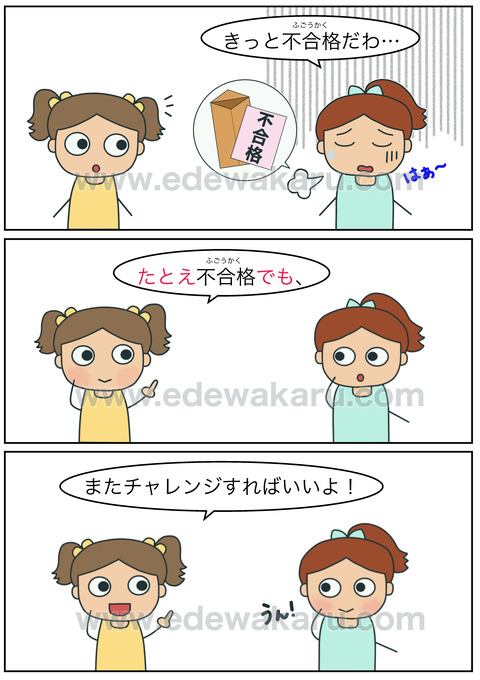
Meaning
even if the situation becomes ~
even if it becomes ~, it is ~
How to use it
たとえ + verb [て-form] + ても
たとえ + い-adjective [ーく] + ても
たとえ + な-adjective [dictionary form] + でも
たとえ + noun [dictionary form] + でも・であっても
Explanation
「たとえAてもB」 means “Even if the situation becomes A, B” or “Even supposing A, B.” Use it when you want to say, “The possibility of A is low, but even if A happens, B will remain unchanged.”
[Examples]
①
たとえ
不合格
でも、またチャレンジすればいいよ
→Even if you fail, you can try again.
②
たとえ
冗談
でも、友達を傷つけることを言うべきではない
→Even if it’s a joke, you shouldn’t say things that hurt your friends.
③
たとえ
お母さんに反対され
ても、アメリカに留学するつもりだ
→Even if my mother objects, I intend to study abroad in America.
④
たとえ
毎日寝ずに勉強し
ても、絶対に合格できないと思うわ
→Even if I studied every day without sleeping, I don’t think I could pass.
⑤もちろん!
たとえ
台風が来
ても、必ず参加するわ!!
→Even if a typhoon comes, I’ll definitely take part!
Let’s review Japanese grammar. 😉
[Japanese Grammar List (in gojūon order)]
In context 2 examples
A:今年はN1を受けるの?B:まさか!たとえ毎日寝ずに勉強しても、絶対に合格できないと思うわ
A: Are you taking N1 this year? B: No way! Even if I studied every day without sleeping, I don’t think I could pass.
A:明日のパーティーには参加するの?B:もちろん!たとえ台風が来ても、必ず参加するわ!!
A: Are you going to the party tomorrow? B: Of course! Even if a typhoon comes, I’ll definitely be there!!
Read the original source text
Meaning
もし〜という状況になっても
〜になっても、〜だ
How to use it
たとえ+動詞[て形]+ても
たとえ+い形容詞[ーく]+ても
たとえ+な形容詞[辞書形]+でも
たとえ+名詞[辞書形]+でも・であっても
Explanation
「たとえAてもB」は「もしAという状況になってもBだ」「AだとしてもBだ」という意味の文型です。「Aになる可能性は低いが、もしAでも、変わらずBだ」と言いたい時に使います。
[例]
①
たとえ
不合格
でも、またチャレンジすればいいよ
→もし不合格になっても、またチャレンジすればいいよ
②
たとえ
冗談
でも、友達を傷つけることを言うべきではない
→冗談だとしても、友達を傷つけることを言うべきではない
③
たとえ
お母さんに反対され
ても、アメリカに留学するつもりだ
→もし反対されても、アメリカに留学するつもりだ
④
たとえ
毎日寝ずに勉強し
ても、絶対に合格できないと思うわ
→仮に毎日寝ずに勉強しても、絶対に合格できないと思うわ
⑤もちろん!
たとえ
台風が来
ても、必ず参加するわ!!
→仮に台風が来ても、必ず参加するわ
日本語文法の復習をしておきましょう😉
【日本語文法リスト(あいうえお順)】
どんなときどう使う 日本語表現文型辞典
Meaning
even if
How to use it
Vても / イAくても / ナAでも / Nでも
Explanation
B:いいえ、勉強が大変なので、いい仕事があってもアルバイトはしません。
社員:ええ、この仕事は日本語が上手に話せなくても、できますよ。
1)「~ても/でも、…」の形で、「~」が成立すると、当然「…」が成り立つはずなのに、成り立たないという意味を表す(逆接仮定)。譲歩の意味でも使う。
2) ❷ のように「たら・ば・と」の質問に「いいえ」で答える場合にも使う。
3) ❶ ❷ のように仮定のことにも、 ❸ ❹ のように既定のことにも、 ❻ のように両方になる場合にも使う。
4) ❺ ❻ のように、疑問詞とともによく使う。
5)くだけた会話では ❺ ❻ のように「でも」が「だって」、「ても」が「たって」になる。
2)Used as negative answer to questions using たら, ば, and と.
4)Often used in pattern "interrogative + ても," as in sentences ❺ and ❻ .
5)In informal speech でも becomes だって, ても becomes たって as in sentences ❺ and ❻ .
1)Something that naturally should occur does not (paradoxical supposition). Also used to indicate compromise.
3)Used for suppositions, as in sentences ❶ and ❷ , for established facts, as in sentences ❸ and ❹ , and for situations that are both, as in sentence ❻ .
In context 6 examples
わたしはタイ語を知らないので、読んでもわかりません。
I don’t know Thai, so even if I read it, I can’t understand it.
A:いい仕事があったら、アルバイトをしますか。
A: If you found a good job, would you work part-time?
この会社は給料は安いんですが、給料が高くなくても、わたしはこの会社で働きたいです。
The pay at this company is low, but I want to work here even if the pay isn’t high.
ジム:その仕事は日本語が下手でも、できるでしょうか。
Jim: Could I do that job even if my Japanese isn’t very good?
部屋の外から「山田さーん」と何回呼んだって、返事がないんです。
I’ve called “Mr. Yamada!” over and over from outside the room, but there’s no answer.
こんな言葉、いくら調べたって、辞書にはありませんよ。
No matter how much you look this word up, it isn’t in the dictionary.
Read the original source text
Meaning
even if
How to use it
Vても/イAくても/ナAでも/Nでも
Explanation
B:いいえ、勉強が大変なので、いい仕事があってもアルバイトはしません。
社員:ええ、この仕事は日本語が上手に話せなくても、できますよ。
1)「~ても/でも、…」の形で、「~」が成立すると、当然「…」が成り立つはずなのに、成り立たないという意味を表す(逆接仮定)。譲歩の意味でも使う。
2) ❷ のように「たら・ば・と」の質問に「いいえ」で答える場合にも使う。
3) ❶ ❷ のように仮定のことにも、 ❸ ❹ のように既定のことにも、 ❻ のように両方になる場合にも使う。
4) ❺ ❻ のように、疑問詞とともによく使う。
5)くだけた会話では ❺ ❻ のように「でも」が「だって」、「ても」が「たって」になる。
2)Used as negative answer to questions using たら, ば, and と.
4)Often used in pattern "interrogative + ても," as in sentences ❺ and ❻ .
5)In informal speech でも becomes だって, ても becomes たって as in sentences ❺ and ❻ .
1)Something that naturally should occur does not (paradoxical supposition). Also used to indicate compromise.
3)Used for suppositions, as in sentences ❶ and ❷ , for established facts, as in sentences ❸ and ❹ , and for situations that are both, as in sentence ❻ .
日本語NET JLPT文法解説まとめ
Meaning
An expression of concession.
How to use it
V (て-form) + も
イA + くても
なA + でも
N + でも
Explanation
even if
In context 22 examples
親に反対されても、僕たちは結婚するつもりです。
Even if our parents oppose us, we intend to get married.
明日は大事な試験の日なので、熱があっても学校に行きます。
Tomorrow is an important exam day, so I'll go to school even if I have a fever.
考えても、全然答えがわかりません。
Even after thinking about it, I still can't figure out the answer at all.
明日は雨が降っても、イベントを行います。
Even if it rains tomorrow, we'll hold the event.
宝くじが当たっても、高価な物を買うつもりはありません。
Even if I win the lottery, I don't intend to buy anything expensive.
語学留学しても、ちゃんと勉強しないと話せるようになりませんよ。
Even if you study abroad to learn a language, you won't become able to speak it unless you study properly.
たとえ1万円もらっても、バンジージャンプはしたくない。
Even if I were given 10,000 yen, I wouldn't want to bungee jump.
友達にメールしても、全然返事が返ってこない。
Even when I email my friend, I don't get a reply at all.
漢字を一生懸命覚えても、次の日には忘れてしまうんです。どうしたらいいですか。
Even though I work hard to memorize kanji, I forget them the next day. What should I do?
もうすぐテストですから、眠くても勉強しなければなりません。
The test is coming up soon, so I have to study even if I'm sleepy.
暑くても、エアコンは使いません。扇風機で十分です。
Even if it's hot, I don't use the air conditioner. A fan is enough.
体に悪くても、私はタバコを吸います。
Even though it's bad for my health, I smoke.
外の音がうるさくても、私は簡単に寝ることができます。
Even if the noise outside is loud, I can fall asleep easily.
あのレストランの料理は評判が悪いし、安くても絶対に行かない。
That restaurant has a bad reputation for its food, and I absolutely won't go even if it's cheap.
成績が悪くても、日本語の勉強は好きなので、卒業してからも続けたい。
Even if my grades are bad, I like studying Japanese, so I want to continue after I graduate.
便利でも、電車を使いません。
Even though it's convenient, I don't use the train.
大変でも、やるしかありません。
Even if it's difficult, I have no choice but to do it.
嫌いでも、野菜はちゃんと食べなさい。
Even if you don't like them, make sure you eat your vegetables.
ダメでもやってみる価値はあります。
Even if it doesn't work, it's worth trying.
お金がないので、半額でも買いません。
I don't have any money, so I won't buy it even at half price.
お金がないので、日曜日でも働きます。
I don't have any money, so I work even on Sundays.
私は土曜日でも、7時に起きます。
I get up at seven even on Saturdays.
Read the original source text
Meaning
逆接の表現
How to use it
V(て形) + も
イA + くても
なA + でも
N + でも
Explanation
even if
毎日のんびり日本語教師
Usage 1
Read this source entry ↗How to use it
Verb て-form + も + verb て-form + も~ない
Explanation
The て-form of the same verb is repeated twice. It expresses that the goal is not achieved no matter how many times the action is performed. In many cases, the second part takes a negative form, though a positive form sometimes occurs.
Notes
Nothing in particular.
In context 8 examples
逃げても逃げても追いかけてくる。
No matter how many times I run away, they keep chasing me.
洗っても洗っても汚れが落ちない。(就算再洗都洗不掉污垢。)
No matter how much I wash it, the stain won’t come out. (No matter how many times I wash it, I can’t get rid of the dirt.)
噛んでも噛んでも噛み切れない。(就算再咬咬不动。)
No matter how much I bite, I can’t bite through it. (No matter how many times I bite, I can’t chew through it.)
雑草は抜いても抜いてもしつこく生えてくる。
No matter how many times you pull out the weeds, they stubbornly grow back.
宿題やってもやっても終わらない。
No matter how much I do my homework, I never finish.
倒しても倒しても起き上がってくる。
No matter how many times I knock it down, it gets back up.
食べても食べても減っている気がしない。(就算再吃都不觉得减少了)
No matter how much I eat, it doesn’t feel like the amount is going down. (Even though I keep eating, it doesn’t seem to be getting any less.)
遊んでも遊んでも遊び足りない。(玩儿再多也觉着玩不够。)
No matter how much I play, I never feel like I’ve played enough. (Even after playing a lot, I still want to play more.)
Read the original source text
How to use it
動て形+も+動て形+も~ない
Explanation
同じ動詞のテ形を2回繰り返して接続します。その動作を何度行っても目標が達成されないことを表します。多くの場合は後件に否定形が呼応しますが、稀に肯定形が来る場合もあります。
Notes
特になし
Usage 2
Read this source entry ↗How to use it
Verb, te-form + も + verb, te-form + も
i-adjective, te-form + も + i-adjective, te-form + も
na-adjective stem + でも + na-adjective stem + でも
Noun + でも + noun + でも
Explanation
Gives two examples and expresses that the result does not change even if either of those conditions holds.
Notes
Similar grammar pattern: “【N3 Grammar】~ても~なくても”
In context 8 examples
ネットで調べても人に聞いてみても分からなかった。
I couldn’t figure it out even after looking it up online or asking someone.
気分転換に散歩してみてもカラオケ行ってみても気分が良くならない。
My mood doesn’t improve even when I try going for a walk to change my mood or go to karaoke.
雨が降っても雪が降っても行かなければならない。
I have to go whether it rains or snows.
辛くても逃げたくても、我慢しなければならないときもある。
Sometimes you have to endure it, even when it’s painful or you want to run away.
薬を飲んでも運動してみても、便秘が治らない。
My constipation won’t go away, even when I take medicine or try exercising.
話しかけてみても、体を揺すってみても反応がない。
There’s no response even when I try talking to them or shaking them.
帽子を被ってもマスクをしていても、歩き方から誰なのか分かる。
Even if someone is wearing a hat or a mask, I can tell who they are from the way they walk.
運動しても食事制限しても痩せなかった。
I didn’t lose weight even when I exercised or restricted my diet.
Read the original source text
How to use it
動て形+も+動て形+も
い形容詞て形+も+い形容詞て形+も
な形容詞語幹+でも+な形容詞語幹+でも
名詞+でも+名詞+でも
Explanation
2つの例を挙げ、それらの条件が成立したとしても結果が変わらないことを表します。
Notes
似ている文型「【N3文法】~ても~なくても」
日本語文型辞典 英語版
Meaning
【ても】[N/Na でも][A-くても][V-ても]A combination of the te-form of a predicate and も. For nouns and na-adjectives, it becomes でも. In informal spoken language, the forms たって and だって are also used.
Expresses a converse condition that negates the resultative conditional “If X happens, then Y results” (XならばY). For example, the ...ても constructions in
(1)
and
(6)
, respectively, negate the relationship between the conditions “If I get sick, I can take time off” and “After I return home, I’ll forget the kindness of the people here”; these express that even if condition X arises, condition Y will not result. Example
(9)
shows how the adverb たとえ is sometimes used with this construction.
a. ...ても
4.
B:会場は駅の近くですから、歩いて行っても間に合うと思いますよ。
The hall is near the station, so I think you can make it in time even if you walk.
When two clauses expressing different conditions that yield the same outcome are presented sequentially, as in XならばZ and YならばZ, the second conditional clause is expressed with ても, in the form Y(であっ)てもZ. Since this construction conveys the meaning that either condition will yield the same result, it can be rephrased as XてもYてもZ.
(例)2を二乗しても、-2を二乗しても4になります。
Either squaring 2 or squaring minus 2 will yield
4.
b. ...ても...ても
The construction XてもYても (...ても) Z juxtaposes two (or more) conditions and conveys the meaning that either (or any) one of them will yield the same result.
c. V-てもV-なくても
In forms like ...してもしなくても, this juxtaposes an affirmative condition with a negative one to express the idea that, whichever the case, the outcome will not change.
d. V-てもV-ても
The same verb is repeated in order to emphasize that, no matter how much effort one makes, the desired outcome cannot be obtained. Although the final clause is usually a negative expression, there are cases, as shown below, when an affirmative expression may follow. Even in these cases, however, the implication is that the outcome is undesirable.
(例)追い払っても追い払ってもついてくる。
No matter how often I chase it away, it keeps on following me.
(例)雑草は取っても取ってもすぐ生えてくる。
I weed and weed, but they grow back in no time at all.
a. いくら...ても
いくらXても expresses that the frequency or degree of an action or situation is very great. Used to say that, although this is a powerful condition, it has no effect on the realization of a outcome.
The outcome is usually contrary to anticipation or expectation. For example, in
(1)
, the expectation that “If you have a spectacular occupation, it must always be enjoyable” is contradicted by the second clause “...there will be many difficult challenges.” In
(6)
, the resulting situation is “I still don’t understand,” which runs counter to the expected outcome “If I listen to this video many times, I should be able to understand it.”
b. どんなに...ても
Usage is the same as いくら...ても (Usage a) above. どんなに can be replaced by いくら, but the latter is more conversational.
c. 疑問詞...ても
Means どのような場合でもY (no matter what the situation is, Y holds true). No matter what element is linked to the question word, this expresses that the end result will always be situation Y (or, in the case of a negative form, that it will always fail to be Y).
d. どうV-ても
Uses a verb of intentional action to express that, no matter what measures are taken, the outcome will not meet one’s expectations.
e. なん+助数詞+V-ても
Uses an action verb to express the notion that no matter how many times the action is done, the outcome is still the same. The outcome expressed in the last part of the sentence is often contrary to expectation, as in
(1)
-
(3)
. However, it can sometimes be a desirable situation, as in
(4)
and
(5)
.
This is a counter-factual conditional that negates the propositional relation XしていたらYしていただろう (if someone had done X, then s/he probably would have done Y). In the form XしてもYしなかっただろう (even if someone had done X, s/he probably wouldn’t have done Y), it is used to state the assumption that even if X had happened, it would have had no effect on the fact that Y did not happen.
For example,
(1)
denies the conditional relationship in the resultative counter-factual conditional “If he had worked hard, then he probably would have passed” (which means he didn’t work hard and thus failed).
(1)
means “He did not actually work hard, but even if he had, the result probably still would have been failure.”
(2)
negates the resultative counter-factual conditional “If he hadn’t worked hard, then he probably wouldn’t have passed” (which means he actually did work hard and thus passed).
(2)
means “He did work hard, but even if he hadn’t, the result probably still would have been success.”
The construction XてもYた, which uses the ta-form at the end of the sentence, expresses the fact that both X and Y happened. For example,
(1)
means “it rained, but the sports meet was held.” While the ても form used here is similar in meaning to が, けれども, or のに, when ても is used after an action verb, it conveys the nuance that the action was repeated, or that although the action was carried out to an extreme degree, the anticipated outcome was not obtained. Thus, in sentences like
(4)
, which include いくら, it is not possible to replace ても with が, けれども, or のに.
(×)いくら待った{が/けれど/のに}彼女は現れなかった。
We waited how long, {but/however/even though} she didn’t show up.
The same verb is repeated to emphasize its meaning. For example,
(1)
shows deep appreciation, and
(2)
emphasizes a strong sense of regret. This construction is rather idiomatic, and the range of verbs that can be used is limited. 死んでも死にきれない in
(3)
is a strong expression of being unable to give up on something or feeling deep regret.
Means that even if some action is attempted, it will not lead to a solution. Conveys a feeling of resignation.
An idiomatic expression that combines the ても form of V-たい with the negative form of a V-れる potential verb. Means “even if I want to, I cannot.” Used to emphasize that circumstances do not allow a certain action, or to make an excuse.
1
1
1
1
【てみる】5、
6
1
How to use it
1. ...ても〈converse condition〉
2. ...ても〈parallel condition〉Presents two or more conditions and expresses that no matter which condition is realized, the outcome will be the same.
3. 疑問詞...てもWhen question words such as 何, どこ, だれ, どれ, いつ, and どう are used with a ても conditional, the meaning is that, no matter what the condition is, the resulting situation is inevitable. (When a negative form follows, it means that the situation will fail to occur.)
4. ...ても...ただろう
5. ...ても...た
6. V-てもR-きれない
7. V-てもどうなるものでもない
8. V-たくてもV-れない
9. ...てもいい→
0. ...てもかまわない→
1. ...てもさしつかえない→
2. ...てもしかたがない→
3. ...てもみない→
4. ...てもよろしい→
In context 64 examples
この仕事は、病気でも休めない。
I can’t take time off from this job even if I get sick.
その車がたとえ 10 万円でも、今の私には買えない。
Even if that car cost only 100,000 yen, I’m not in a position to buy it now.
不便でも、慣れた機械の方が使いやすい。
It’s easier to use a machine that you’re used to, even if it’s a little inconvenient.
風が冷たくても平気だ。
Even if the wind is cold, it doesn’t bother me.
ほしくなくても、食べなければいけない。
Even if you don’t want to, you have to eat something.
国へ帰っても、ここの人々の親切は忘れないだろう。
Even after I return home, I don’t think I’ll ever forget the kindness of the people here.
今すぐできなくても、がっかりする必要はない。
You don’t have to be discouraged if you can’t do it right away.
わたしは、まだ勉強不足だから、今試験を受けても受からないだろう。
I still haven’t studied enough, so if I took the test now, I doubt I’d pass.
たとえ両親に反対されても彼との結婚はあきらめない。
Even if my parents are against it, I’m not going to give up on marrying him.
2を二乗すると4になりますが、-2を二乗しても4になります。
If you square 2 you get 4, and if you square minus 2 you also get
飛行機で行くと料金は片道2万円ぐらいですが、新幹線で行っても費用はだいたい同じです。
The fare for a one-way plane ticket is about 20,000 yen, but going by shinkansen (bullet train) costs about the same.
A:演奏会、あと 20 分で始まるんですが、タクシーで行けば間に合うでしょうか。
The concert starts in about twenty minutes—can I still make it if I take a taxi?
うちの子供はニンジンでもピーマンでも好き嫌いを言わないで食べます。
Our child isn’t picky—she’ll eat carrots and green peppers and everything.
天気がよくても悪くても、雨が降っても風がふいても、新聞配達の仕事は休めない。
Whether the weather is good or bad, whether the rain falls or the wind blows, delivering newspapers is a job that doesn’t allow for holidays.
道を歩いてもデパートへ入っても人でいっぱいだ。
Whether I walked on the streets or went into department stores, there were crowds of people everywhere.
辞書で調べても先生に聞いても、まだこの文の意味が理解できない。
Even after consulting my dictionary and asking my teacher, I still don’t understand what this sentence means.
スポーツをしても映画を見ても気が晴れない。
Even playing sports or watching movies doesn’t lift my spirits.
今回のレポートは出しても出さなくても、成績には全く影響ありません。
Your grade will not be affected at all, regardless of whether or not you submit this report.
全員が参加してもしなくても、一応人数分の席を確保しておきます。
Whether everyone comes or not, I will at least make sure there are enough seats for all the members.
1日ぐらいなら食べても食べなくても体重はたいして変化しない。
Eating or not eating for just one day won’t change your weight that much.
このズボンは洗っても洗っても汚れが落ちない。
I’ve washed and washed these pants but still can’t get them clean.
宿題が多すぎて、やってもやっても終わらない。
I have so much homework that even though I work and work I’m still never finished.
働いても働いても、暮らしは全然楽にならない。
No matter how hard I work, it never gets easier to make a living.
いくら華やかな職業でも、つらいことはたくさんある。
No matter how spectacular the occupation, there will be many difficult challenges.
いくら高い車でも、使わなかったら宝のもちぐされだ。
However expensive a car may be, if you don’t use it, it’s a waste of a valuable possession.
給料がいくらよくても、休日のない職場には行きたくない。
No matter how good the salary is, I don’t want to work at a place where there are no days off.
いくら騒いでも、ここは森の中の一軒家だから大丈夫だ。
This is the only house in the middle of a forest, so you can make as much noise as you want.
いくらお金を貰っても、この絵は絶対手放せない。
No matter how much money I might get for it, I’ll never give up this picture.
このビデオの会話は、いくら聞いてもよく分からない。
I can’t understand the conversation on this video, no matter how many times I listen to it.
このコンピューターはどんなに複雑な問題でも解いてしまう。
This computer can solve any problem, no matter how complex.
どんなにつらくても頑張ろう。
I will keep on trying, no matter how hard it gets.
どんなに熱心に誘われても、彼女はプロの歌手にはなりたくなかった。
No matter how fervently she was scouted, she did not want to become a professional singer.
どんなに大きい地震がきても、この建物なら大丈夫だ。
No matter how big an earthquake may hit, this building is safe.
妻はわたしがどんなに怒っても平気である。
My wife stays calm, no matter how angry I get.
だれが電話して来ても、取りつがないでください。
No matter who calls, please don’t put them through.
どんな仕事でも、彼は快く引き受けてくれる。
He readily agrees to do any kind of work.
本は、どこで買っても同じ値段だ。
Books are the same price wherever you buy them.
あの人はいつ見ても美しい。
She’s beautiful no matter when you see her.
何をしても、あのショックが忘れられない。
Whatever I do, I can’t forget the shock I felt.
どう言ってみても、彼の決心を変えさせることはできなかった。
No matter how I put it, I couldn’t find a way to make him change his mind.
どう計算してみても、そこへ着くまで 10 時間はかかる。
No matter how you calculate, it’s going to take ten hours to get there.
どうがんばっても、前を走っている三人を追い抜くのは無理だと思った。
I thought that, no matter how hard I tried, it was going to be impossible for me to overtake the three runners in front.
何回聞いても名前が覚えられない。
However many times I hear them, I can’t remember names.
この論文は何度読み返しても、理解できない。
No matter how many times I re-read this paper, I can’t make sense of it.
何回話し合っても、この問題は簡単には解決できないだろう。
This is not a problem that will be easily solved, no matter how many times we talk about it.
あの店の料理は何度食べてもあきない。
I never get tired of the food at that restaurant, no matter how often I eat it.
あの映画は何回見ても面白い。
That movie is always fun to watch.
たとえ、努力しても合格できなかっただろう。
I don’t think I could have passed even if I’d tried.
彼は頭がいいので、努力しなくても合格できただろう。
He’s really smart, so he probably could have passed without much effort.
人をだまして金儲けをするような商売では、たとえ成功しても両親は喜んでくれなかっただろう。
In a business where you earn money by deceiving people, I doubt that my parents would have been happy for me even if I’d succeeded.
雨でも運動会は行われた。
The sports meet was held even though it rained.
頭が痛くても学校を休まなかった。
He didn’t miss school even when he had headaches.
ドアは強く押しても開かなかった。
The door wouldn’t open, even when I pushed hard on it.
いくら待っても彼女は現れなかった。
No matter how long we waited, she didn’t show up.
この本は難しすぎて、辞書を引いて読んでも、ほとんど理解できなかった。
This book was too difficult—I could hardly understand any of it, even reading it with a dictionary.
彼の親切に対しては、いくら感謝してもしきれない。
I cannot thank him enough for all of his kindness.
学生時代になぜもっと勉強しておかなかったのかと、悔やんでも悔やみきれない。
There is no limit to the regret I feel that I didn’t study harder during my school days.
ここで負けたら、死んでも死にきれない。
I can’t bear to die if we lose now.
いまから抗議してもどうなるものでもない。
Raising an objection now won’t accomplish anything.
もう一度彼に会ってもどうなるものでもないと彼女は思った。
She concluded that even if she met with him one more time, it would still be pointless.
性格は直らないのだから、あの人に説教してもどうなるものでもない。
His personality can’t be mended, so even giving him a lecture will accomplish nothing.
急に仕事が入って、飲みに行きたくても行けないのだ。
Some urgent business has come up, so however much I want to go out drinking, I can’t.
きらいな先生の前では、泣きたくても泣けない。
I couldn’t cry in front of a teacher I hate, even if I wanted to.
医者に止められているので、甘いものは食べたくても食べられない。
No matter how much I want to, I can’t eat sweets, since my doctor has told me not to.
AIUEO JLPT Grammar
Meaning
「〜ても・でも」is a conjunction expressing strong contrast, showing that the second clause remains unaffected regardless of the situation or condition presented in the first clause.
How to use it
Verb て-form + ても; Adjectival noun て-form + ても; Noun + でも; Adjectival noun + でも
In context 5 examples
雨が降っても行きます。
I will go even if it rains.
お金がなくても幸せです。
I am happy even if I don’t have money.
忙しくても連絡してください。
Please contact me even if you are busy.
好きでも嫌いでも食べなければなりません。
You have to eat it whether you like it or not.
日曜日でも働きます。
I work even on Sundays.
Read the original source text
Meaning
「〜ても・でも」is a conjunction expressing strong contrast, showing that the second clause remains unaffected regardless of the situation or condition presented in the first clause.
How to use it
動詞て形+ても形容動詞て形+ても名詞+でも形容動詞+でも
Explanation · 日本語
「〜ても・でも」は、強い逆接の意味を表し、前の文で述べた状況や条件に影響されず、後の文で述べたことが変わらないことを示します。
Bunpro Grammar Reference
Meaning
Even if, Even though
How to use it
Verb[て]+も
[い]Adjective[て]+も
[な]Adjective+で+も
Noun+で+も
Verb[なくて]+も
[い]Adjective[なくて]+も
[な]Adjective+でなくて(1)+も
Noun+でなくて(1)+も
(1) じゃなくて
Nuance
A phrase that may be used with many types of words, to express that even though (A), (B).
Explanation
The combination of the conjunction particle て (or the case-marking particle で), with the adverbial particle も, often has the nuance of 'even if (A)', or 'even though (A)'.
To use this structure, simply conjugate a verb or い-Adjective into its て-form, and then add も.
For nouns and な-Adjectives, でも will be used instead.
あの人に言っても何も変わりません。
Nothing will change even if you talk to him.
お茶は冷たくても美味しいから好きです。
I like tea because it tastes good even if it is cold.
彼女は仕事が大変でも諦めません。
She will not give up on work even if it is difficult.
安い電子レンジでも弁当は温められます。
Even with a cheap microwave you can warm up bentos.
This grammar pattern may also be used for highlighting negative sentences, and will translate similarly to 'even if not (A)', or 'even though not (A)' in these cases.
これは明日までに終わらなくてもいいから。
It's okay even if you don't finish this by tomorrow.
頭が痛くなくてもこの薬を飲んでください。
Please take this medicine, even if your head doesn't hurt.
野菜は好きじゃなくても食べた方がいい。
Even if you don't like vegetables, you should eat them.
運転手じゃなくてもシートベルトをしなくてはいけない。
Even if you're not the driver, you need to wear your seatbelt.
Fun Fact
でも (the form after nouns and な-Adjectives) is often considered to be an adverbial particle itself, and there is often debate amongst native speakers as to whether でも is actually a word, or simply a standard grouping of で, the case marking particle and も, the adverbial particle. However, It may be easier to remember でも as its own word, for learning purposes.
In context 20 examples
- 試合に負けても、諦めません。
Even if I lose the game, I won't quit.
- 野菜は好きじゃなくても食べた方がいい。
Even if you don't like vegetables, you should eat them.
- これは明日までに終わらなくてもいいから。
It's okay even if you don't finish this by tomorrow.
- あの人に言っても何も変わりません。
Nothing will change even if you talk to him.
- お茶は冷たくても美味しいから好きです。
I like tea because it tastes good even if it is cold.
- 安い電子レンジでも弁当は温められます。
Even with a cheap microwave you can warm up bentos.
- 運転手じゃなくてもシートベルトをしなくてはいけない。
Even if you're not the driver, you need to wear your seatbelt.
- 彼女は仕事が大変でも諦めません。
She will not give up on work even if it is difficult.
- 頭が痛くなくてもこの薬を飲んでください。
Please take this medicine, even if your head doesn't hurt.
- トレーニングをしても、痩せない。
Even if I work out, I don't lose weight.
- 靴下を履いても、足が冷たいです。
Even if I wear socks, my feet get cold.
- たくさんサラダを食べても、お腹いっぱいにならないんですよ。
Even if I eat a lot of salad, I don't get full.
- 子供に何回も起きてと言っても、起きなかった。
Even though I told the kid to wake up multiple times, he didn't get up.
- 映画館に行っても、見たい映画がない。
Even if I were to go to the movie theater, there aren't any movies I want to see.
- サッカーの練習をしても全然上手になれない。
Even if I practice soccer, I can't improve.
- 遅くなっても、是非家に寄ってください。
Even if it gets late, by all means, please stop by the house.
- 1000年生きても、世の中にあるものを全部見ることが出来ない。
Even if I live for 1000 years, I can't see everything the world has to offer.
- 先輩を怒らせても、世界の終わりじゃないから大丈夫。
Even if you anger your senpai, it isn't the end of the world so it is ok.
- 彼と相談をしても、何も決まらないので困ります。
Even if I consult with him, since we can't decide on anything, we end up having trouble.
- 退院しても、まだ車椅子を使わなくてはいけない。
Even though I am being released from the hospital, I must use a wheelchair.
文法
Meaning
An expression of concession.
How to use it
V (て-form) + も
イA + くても
なA + でも
N + でも
In context 12 examples
親に反対されても、僕たちは結婚するつもりです。
Even if our parents oppose us, we intend to get married.
明日は大事な試験の日なので、熱があっても学校に行きます。
Tomorrow is an important exam day, so I'll go to school even if I have a fever.
考えても、全然答えがわかりません。
Even after thinking about it, I still can't figure out the answer at all.
もうすぐテストですから、眠くても勉強しなければなりません。
The test is coming up soon, so I have to study even if I'm sleepy.
暑くても、エアコンは使いません。扇風機で十分です。
Even if it's hot, I don't use the air conditioner. A fan is enough.
体に悪くても、私はタバコを吸います。
Even though it's bad for my health, I smoke.
便利でも、電車を使いません。
Even though it's convenient, I don't use the train.
大変でも、やるしかありません。
Even if it's difficult, I have no choice but to do it.
嫌いでも、野菜はちゃんと食べなさい。
Even if you don't like them, make sure you eat your vegetables.
お金がないので、半額でも買いません。
I don't have any money, so I won't buy it even at half price.
お金がないので、日曜日でも働きます。
I don't have any money, so I work even on Sundays.
私は土曜日でも、7時に起きます。
I get up at seven even on Saturdays.
Read the original source text
Meaning
逆接の表現
How to use it
V(て形) + も
イA + くても
なA + でも
N + でも
Yokubi — The Common Grammar Guide (https://yoku.bi)
Explanation
Unrelated to the **subject marker** が, the **conjunction** が states that, even though the former statement is true, the latter statement is also true. With が, both statements are independent clauses. Often, but not always, the second statement is in contrast with the first statement. This is commonly translated as "but" or "although", but there are cases where it's simply just an "and" and there is no contrast at all.
が attaches after a complete sentence, meaning after nouns and な adjectives it **requires** だ (or です). ですが is common in speech and everyday polite language, but だが sounds too stiff and it's almost exclusively left to written or very formal language.
Same as が, there is also the conjunction けど. Their usage and meaning can be considered pretty much the same. Just like with が, both ですけど and だけど exist and are very common in conversational tone in real life too. けど comes across as less formal than が.
けど and が both cover a formality/politeness space that can feel very nuanced, so here's a few rules of thumb. These aren't actual rules, just general advice:
- If the entire sentence is in plain form, use (だ)けど
- If it's conversational language, don't use (だ)が
- If the entire sentence is in polite form, use ですが
- Ending a statement with polite form but using けど in the middle is common, but can come across as unnatural if the politeness level isn't appropriate
A very common usage of が/けど is to introduce something as a topic in an indirect manner. In this usage it does not have a nuance of adversative ("but"). It is simply introducing something before talking about it. It is common to see this usage with the explanatory の particle like なんだけど or なんですが:
This usage is very common when easing the listener into a request or question you have for them:
This type of phrase is so common that in many situations the speaker doesn't even need to provide an explanation after the んですが/んだけど, to the point where the second half of the sentence can be completely dropped.
けど can also show up as けれど and けれども. They are *mostly* the same, but the longer it is, the more formal it sounds.
しかし is an interjection. It sounds formal. English speakers tend to overuse this because it resembles how we use "but" at the beginning of sentences in our language but in Japanese it is not that common.
ても is a combination of the て form and も. It works as a conjunction stating that the statement after it is true *despite* the statement before it. This is like an adversative, but it's not always one.
There is also でも that can be used to add an adversative "but" meaning at the beginning of a new sentence.
In context 1 examples
そんな事言わなくてもわかっているんだろ?
Even if I don't tell you that, you understand right?
NINJAL 日本語文型データベース
Meaning
[1] Used when saying that, if a hypothetical condition such as ~ were met, a certain situation should naturally result, but contrary to expectation it does not.
This is the form used when “〜” is a verb or i-adjective, or the negative form of a na-adjective or noun.
When “~” contains a question word (“何・どこ・誰,” etc.), or when verbs or adjectives with similar or opposite meanings are repeated as “〜ても〜ても,” it expresses that the same result holds under any condition.
Also, “いくら~ても・どんなに〜ても” and repetitions of the same verb as “~ても~ても” express that the result remains the same, unaffected even when the degree or frequency of “~” is high.
“泣いても笑っても” is an idiomatic expression.
[2] Used when saying that, if a condition such as ~ were met, a certain situation should naturally result, but contrary to expectation it does not.
This is the form used when “〜” is a verb or i-adjective, or the negative form of a na-adjective or noun.
When “~” contains a question word (“何・どこ・誰,” etc.), or when verbs or adjectives with similar or opposite meanings are repeated as “〜ても〜ても,” it expresses that the same result holds under any condition.
Also, “いくら~ても・どんなに〜ても” and repetitions of the same verb as “~ても~ても” express that the result remains the same, unaffected even when the degree or frequency of “~” is high.
How to use it
Notes
[1] “~” is followed by a clause expressing a hypothetical situation that has not actually occurred. After “~ても” comes a clause expressing a situation different from what is expected.
[2] “~” is followed by a clause expressing a fact. After “~ても” comes a clause expressing a situation different from what is expected.
In context 50 examples
「この大雪だと、タクシーを呼んでも来ないと思いますよ」
“With this heavy snow, I don’t think a taxi will come even if you call one.”
たとえあと2か月あっても、この仕事は終わらないでしょう。
Even if we had another two months, this job probably wouldn’t be finished.
いくら待っても、彼はきっと来ないでしょう。
No matter how long I wait, he probably won’t come.
もし両親が賛成してくれなくても、あの人と結婚するつもりだ。
Even if my parents don’t approve, I intend to marry that person.
今回の試験は簡単そうだから、勉強しなくてもいい点が取れるかもしれない。
This exam seems easy, so I might get a good score even without studying.
「田中さんは楽天家だから、どこに行ってもうまくやっていけますよ」
“Tanaka is an optimist, so wherever he goes, he’ll manage just fine.”
今の私の経済状態では、働いても働いても生活は楽にならないと思う。
Given my financial situation now, I think my life won’t get any easier no matter how much I work.
泣いても笑っても、これが学生時代最後の試合だ。
Whether I win or lose, this is the last match of my student days.
たとえ睡眠時間が短くても、翌朝すっきりと目が覚めて、一日中元気に過ごせることもある。
Even with little sleep, sometimes you wake up refreshed the next morning and can stay energetic all day.
もしも試験の結果がよくなくても気にしないことにしよう。
I’ll try not to worry, even if my exam results aren’t good.
どんなにつらくても、必ず仕事と勉強を両立させて、大学を卒業しようと決意した。
I resolved to balance work and study and graduate from university, no matter how hard it gets.
今夜のパーティーがいくら楽しくても、最終電車に間に合うように帰るつもりだ。
No matter how much fun tonight’s party is, I intend to leave in time to catch the last train.
悲しくても苦しくても、誰も私のことを助けてはくれないだろう。
Whether I’m sad or suffering, no one will help me.
暑くても寒くても、人間の体温は36度から37度に保たれている。
Whether it is hot or cold, the human body temperature is maintained at 36 to 37 degrees.
有名ではなくても、おいしいワインを作る工房を作りたいです。
I want to establish a winery that makes delicious wine, even if it isn’t famous.
たとえ来年入社してくる新入社員が優秀でなくても、立派なビジネスマンに鍛え上げる自信が私にはある。
Even if the new employees who join next year aren’t excellent, I’m confident I can train them into fine businesspeople.
周りがそれほど静かじゃなくても、職場に近くて家賃が安いマンションがあれば、引っ越したいと思っています。
Even if it isn’t that quiet around here, I’m thinking of moving if there’s an apartment close to work with low rent.
たとえ音程やリズムが正確じゃなくても、心をこめて歌えば、熱意はきっと聴衆に届くはずだ。
Even if the pitch and rhythm aren’t accurate, if you sing with all your heart, your passion will surely reach the audience.
書道をやってみませんか。はじめは上手じゃなくても、こつをつかめば、きれいな字が書けるようになりますよ。
Why don’t you try calligraphy? Even if you’re not good at first, once you get the hang of it, you’ll be able to write beautifully.
もし就職先が希望の会社でなくても、しばらくそこで働くつもりです。
Even if the job I get isn’t at the company I want, I intend to work there for a while.
「もう一度生まれ変わっても君と巡り会いたい」と恋人に言われたら、たとえ本心ではなくてもうれしいだろう。
If my lover said, “Even if we were born again, I’d want to meet you,” I’d be happy even if they didn’t really mean it.
こんな静かな場所でおしゃべりをしたら、たとえ大きい声でなくても、目立ってしまう。
If you chat in such a quiet place, you’ll stand out even if you don’t speak loudly.
昨日の試験は何点ぐらいだろう。それほどいい点じゃなくても、合格点なら満足だけど。
I wonder what score I got on yesterday’s test. I’d be satisfied if it was a passing score, even if it wasn’t especially high.
たとえ本物のダイヤモンドではなくても、彼女が身につければ、本物のように見えてしまうだろう。
Even if it isn’t a real diamond, if she wears it, it’ll probably look like one.
この評論家の文章は、何度読んでも私には理解できない。
No matter how many times I read this critic’s writing, I can’t understand it.
解熱剤を飲んでも熱が下がらなくて、苦しい夜だった。
It was a miserable night; I took fever-reducing medicine, but my fever didn’t come down.
30分待っても友達が待ち合わせ場所に来なかったので、電話してみました。
My friend didn’t come to the meeting place even after I waited 30 minutes, so I tried calling.
山田さんの家は、いつ行っても留守だ。
Whenever I go to Yamada’s house, no one is home.
私が嘘をついたことをどんなに謝っても、父は許してくれませんでした。
No matter how much I apologized to my father for lying, he wouldn’t forgive me.
先生はこの問題の解き方を詳しく説明してくれなかったが、説明してもらわなくても、自分で理解できた。
The teacher didn’t explain in detail how to solve this problem, but I was able to understand it on my own without having it explained to me.
ダンスの練習を続けると、何も考えなくても体が動くようになる。
If you keep practicing dancing, your body will move without you having to think about it.
覚えても覚えても、漢字をすぐ忘れてしまうのは私だけだろうか。
Am I the only one who forgets kanji right away, no matter how much I memorize?
この扉は押しても引いても動かなくて、困っている。
This door won’t move whether I push or pull it, and I’m at a loss.
実家が近くても、時間がないのでなかなか帰れません。
Even though my family home is nearby, I can hardly ever go back because I don’t have time.
明日は試験なので、遊びたくても勉強しなければならない。
I have an exam tomorrow, so even though I want to play, I have to study.
確かにこの仕事は条件がいいが、いくら条件がよくても、興味のない仕事は引き受けないことにしているのだ。
It’s true that the conditions for this job are good, but no matter how good they are, I’ve decided not to accept work that doesn’t interest me.
湿度が高いと、今日のように気温が高くなくても熱中症になることがある。
When the humidity is high, you can get heatstroke even if the temperature isn’t high, as it is today.
時間がないときは、安くなくてもついコンビニで食べ物や飲み物を買ってしまう。
When I’m short on time, I end up buying food and drinks at a convenience store, even if they aren’t cheap.
つらくても苦しくても、優勝を目指して一生懸命練習している。
No matter how hard or painful it is, I’m practicing as hard as I can with the goal of winning.
うちの家族は、私が作った料理がおいしくてもおいしくなくても何も言ってくれない。食べられれば何でもいいらしい。
My family never says anything whether the food I make tastes good or bad. It seems anything is fine as long as they can eat it.
生のトマトが好きじゃなくても、ビタミンCをとりたいなら生で食べたほうがいい。
Even if you don’t like raw tomatoes, if you want to get vitamin C, you should eat them raw.
仕事そのものは嫌ではなくても、人間関係の問題で退職した人をたくさん知っています。
I know many people who left their jobs because of relationship problems, even though they didn’t dislike the work itself.
元貴族の屋敷は、門構えは立派でなくても、建物の内装が実に豪華だという場合がよくある。
In former aristocrats’ mansions, the gate may not be impressive, but the building’s interior is often truly luxurious.
駅前のベトナム料理の店は、本格的じゃなくても十分においしかったです。
The Vietnamese restaurant in front of the station was delicious enough, even if it wasn’t authentic.
プロポーズされたのはハンバーガーショップでした。全然ロマンチックじゃなくても私の心は幸せでいっぱいでした。
I was proposed to at a hamburger restaurant. Even though it wasn’t romantic at all, my heart was filled with happiness.
この用事は今日でなくても明日でもいい。
This errand doesn’t have to be done today; tomorrow is fine too.
店員「欲しいものがあるなら、お金を払わないと。こんな常識的なことは、大人でなくても知っているはずだよ」
Shop assistant: “If there’s something you want, you have to pay for it. Even a child should know something this obvious.”
今日は入場料無料って書いてある。よかった。今日だけは子どもじゃなくても無料なんだ。
It says admission is free today. Great. Today, even adults can get in for free.
「この寮には、留学生じゃなくても住めるんですね。知りませんでした」
“So you can live in this dorm even if you’re not an international student. I didn’t know that.”
本調子ではなくても、試合にはなんとか勝てたので、うれしかったです。
I was happy because, even though I wasn’t in top form, I somehow managed to win the match.
Read the original source text
Meaning
[1] ~という仮定の条件が成立した場合には当然ある事態が成立するはずだが、予想に反してそうならないと言いたいときに使います。
「〜」が動詞、イ形容詞と、ナ形容詞の否定、名詞の否定の場合の形です。
「~」に疑問詞(「何・どこ・誰」など)があるときや、似ている意味や対立する意味の動詞や形容詞を「〜ても〜ても」と繰り返すときは、どのような条件の場合にも同じ結果になることを表します。
また、「いくら~ても・どんなに〜ても」、同じ動詞を繰り返す「~ても~ても」は、「~」の程度や頻度が高い場合にも、それに影響されないで、同じ結果になることを表します。
「泣いても笑っても」は慣用的な言い方です。
[2] ~という条件が成立した場合には当然ある事態が成立するはずだが、予想に反してそうならないと言いたいときに使います。
「〜」が動詞、イ形容詞と、ナ形容詞の否定、名詞の否定の場合の形です。
「~」に疑問詞(「何・どこ・誰」など)があるときや、似ている意味や対立する意味の動詞や形容詞を「〜ても〜ても」と繰り返すときは、どのような条件の場合にも同じ結果になることを表します。
また、「いくら~ても・どんなに〜ても」、同じ動詞を繰り返す「~ても~ても」は、「~」の程度や頻度が高い場合にも、それに影響されないで、同じ結果になることを表します。
How to use it
Notes
[1] 「~」には現実には起こっていない仮定のことを表す文がきます。「~ても」の後には、予想されることとは異なる事態を表す文がきます。
[2] 「~」には事実を表す文がきます。「~ても」の後には、予想されることとは異なる事態を表す文がきます。