絵でわかる日本語
Usage 1
Read this source entry ↗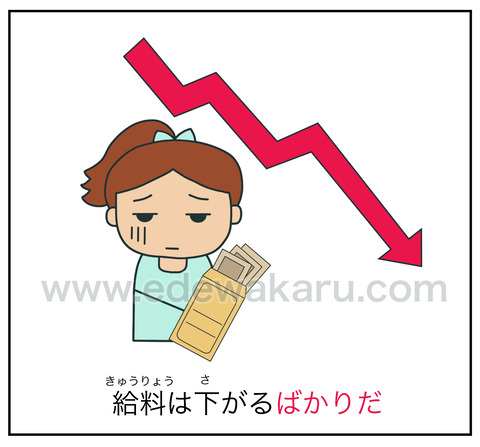
Meaning
A change is progressing in a bad direction
How to use it
Verb [dictionary form]+ばかりだ
Explanation
“〜ばかりだ” is a sentence pattern used to mean “(a state or situation) is progressing in a bad direction.” It is very similar to “〜一方だ” (Comparison: 〜一方だ), but “〜ばかりだ” has a more limited range of use. 😨
[〜一方だ]
⭕️ Used for “good things”
⭕️ Used for “bad things”
⭕️ Connects to nouns: “〜の一方だ”
⭕️ Connects to adjectives: “(い-adjective) くなる一方だ,” “(な-adjective) になる一方だ”
[〜ばかりだ]
❌ Not used for “good things”
⭕️ Used for “bad things”
❌ Does not connect to nouns
⭕️ Connects to adjectives
Remember that, as shown above, “〜一方だ” can be used in more situations. 😉
[“ばかり” patterns]
〜たばかり
〜てばかりいる・〜てばかりだ
〜てばかりはいられない・〜てばかりもいられない
〜と言わんばかりに・〜とばかりに
〜とばかり思っていた
〜とばかりは言えない
〜ばかり (quantity word + ばかり)
〜ばかりだ
〜ばかりだ (preparations completed)
〜ばかりで
〜ばかりでなく〜も
〜ばかりに
〜ばかりの (figurative use)
〜ばかりは
〜んばかり
In context 3 examples
給料は下がるばかりだ
→給料はずっと下がっているMy salary just keeps going down. → My salary has been steadily going down.
最近、仕事は増えるばかりだ
→最近、仕事はずっと増え続けているRecently, my workload just keeps increasing. → Recently, my workload has been continually increasing.
雨と風は強まるばかりだ
→雨と風はどんどん強まっているThe rain and wind are just getting stronger. → The rain and wind are getting stronger and stronger.
Read the original source text
Meaning
変化が悪い方向に進行している
How to use it
動詞[辞書形]+ばかりだ
Explanation
「〜ばかりだ」は「(状態や状況が)悪い方向に進行している」という意味で使用される文型です。「〜一方だ」(比較:〜一方だ)ととても似ていますが、
「〜ばかりだ」の方が使える範囲が限定されています
😨
[〜一方だ]
⭕️「いいこと」に使う
⭕️「悪いこと」に使う
⭕️名詞接続「〜の一方だ」
⭕️形容詞接続「(い形容詞)くなる一方だ」「(な形容詞)になる一方だ」
[〜ばかりだ]
❌「いいこと」に使う
⭕️「悪いこと」に使う
❌名詞接続
⭕️形容詞接続
上のように「〜一方だ」の方が何にでも使うことができると覚えておきましょう😉
【「ばかり」シリーズ】
〜たばかり
〜てばかりいる・〜てばかりだ
〜てばかりはいられない・〜てばかりもいられない
〜と言わんばかりに・〜とばかりに
〜とばかり思っていた
〜とばかりは言えない
〜ばかり(数量詞+ばかり)
〜ばかりだ
〜ばかりだ(準備完了)
〜ばかりで
〜ばかりでなく〜も
〜ばかりに
〜ばかりの(比喩)
〜ばかりは
〜んばかり
Usage 2
Read this source entry ↗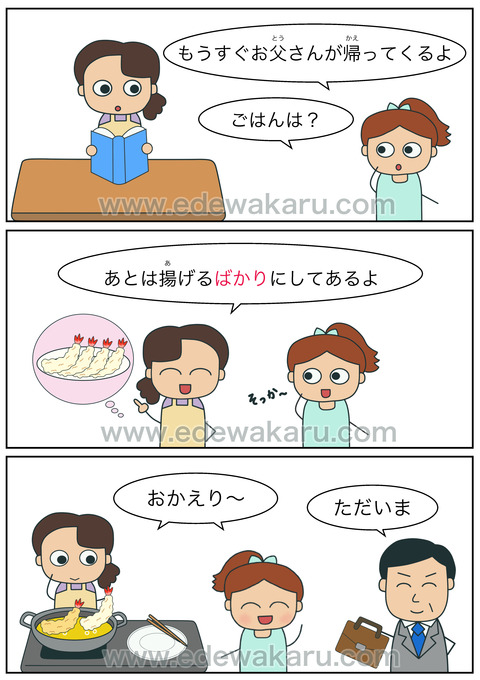
Meaning
All that remains is to ~
It is in a state where ~ can be done at any time
How to use it
Verb [dictionary form]+ばかりだ
Explanation
「〜ばかりだ」 is a sentence pattern meaning “all that remains is to ~.” It is used when you want to say that the preparations are complete and the next action can be done right away, as in “Everything is prepared, and all that remains is to ~” or “The preparations are complete, so it is in a state where ~ can be done at any time” 😊 This pattern is often used in the forms 「〜ばかりにしてある」 and 「〜ばかりになっている」.
[Common forms]
・〜ばかりにしてある
・〜ばかりになっている
You may have few opportunities to study 「〜ばかりだ」 meaning [all prepared], but it’s good to remember it as one of the 「ばかり」 series.
[The 「ばかり」 series]
〜たばかり
〜てばかりいる・〜てばかりだ
〜てばかりはいられない・〜てばかりもいられない
〜と言わんばかりに・〜とばかりに
〜とばかり思っていた
〜とばかりは言えない
〜ばかり (quantity word+ばかり)
〜ばかりだ
〜ばかりだ (all prepared)
〜ばかりで
〜ばかりでなく〜も
〜ばかりに
〜ばかりの (figurative)
〜ばかりは
〜んばかり
In context 5 examples
あとは揚げるばかりにしてあるよ
→料理の準備は完了していて、あとは揚げるだけの状態だ(復習:〜てある)Everything is ready to fry; all that remains is to fry it. → The food is all prepared, and all that remains is to fry it. (Review: 〜てある)
必要なものは全部準備した。あとは出かけるばかりだ
→準備は全部できていて、いつでも出かけられる状態だI prepared everything I need. All that remains is to go out. → Everything is prepared, and I can go out at any time.
今日までがんばって勉強をしてきた。あとは結果を待つばかりだ
→あとは結果を待つだけの状態だ(復習:〜てくる)I’ve worked hard studying up to today. All that remains is to wait for the results. → All that remains is to wait for the results. (Review: 〜てくる)
引越しの準備はできた。もう車に乗せるばかりになっている
→いつでも車に乗せることができる状態になっているThe preparations for the move are done. Everything is ready to be loaded into the car. → It is in a state where we can load everything into the car at any time.
ジュースも買ったし、ケーキもできた。あとはお客さんが来るのを待つばかりだ
→準備はできたので、あとはお客さんを待つだけの状態だI bought juice, and the cake is ready. All that remains is to wait for the guests to arrive. → Everything is ready, so all that remains is to wait for the guests.
Read the original source text
Meaning
あとは〜するだけだ
いつでも〜できる状態だ
How to use it
動詞[辞書形]+ばかりだ
Explanation
「〜ばかりだ」は「あとは〜するだけだ」という意味を表す文型です。
「準備は全部終わっていて、あとは〜するだけだ」「準備が終わっているので、いつでも〜できる状態だ」というように、準備が完了していて、次の行動がすぐにできる状態だと言いたい時に使われます
😊この文型は
「〜ばかりにしてある」「〜ばかりになっている」
の形がよく使用されます。
[よく使われる形]
・〜ばかりにしてある
・〜ばかりになっている
[準備完了]を表す「〜ばかりだ」は勉強する機会が少ないですが、「ばかりシリーズ」の1つとして覚えておくといいと思います。
【「ばかり」シリーズ】
〜たばかり
〜てばかりいる・〜てばかりだ
〜てばかりはいられない・〜てばかりもいられない
〜と言わんばかりに・〜とばかりに
〜とばかり思っていた
〜とばかりは言えない
〜ばかり(数量詞+ばかり)
〜ばかりだ
〜ばかりだ(準備完了)
〜ばかりで
〜ばかりでなく〜も
〜ばかりに
〜ばかりの(比喩)
〜ばかりは
〜んばかり
Usage 3
Read this source entry ↗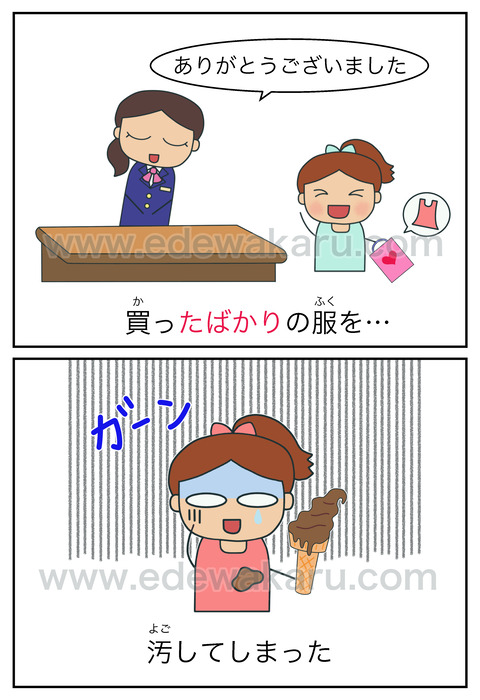
Meaning
a state in which not much time has passed since ~ was done
I just did ~
How to use it
Verb [た-form] + ばかり
Verb [た-form] + ばかりの + noun
Explanation
“〜たばかり” is a sentence pattern expressing a state in which not much time has passed since something was done, but it can also be used when some time has passed, so understand each meaning. 😌
① I just bought these clothes.
→ Immediately after buying them
* Immediately after = right afterward
② I bought these clothes just one week ago.
→ It is OK to use this because the speaker feels that one week ago was recent.
③ I just got married last year.
→ Usually, “last year” feels like a long time ago, but it is OK to use this because the speaker feels that not much time has passed since getting married.
[Summary]
・Immediately afterward
・When a little time has passed
・Even when a long time has passed, if the speaker feels it was recent
“〜たばかり” can be used in these cases, so be sure to learn it well. 😊
Also, remember that “〜たばかり” has the form “〜たばかりの + noun.” “〜たところ” is a similar pattern, but it does not have the form “〜たところの + noun,” so be careful. 😨
⭕️ clothes I just bought
❌ clothes I just bought (〜たところ)
[For those who want to learn more]
“〜ばっかり・〜ばっか” (Review: colloquial forms “〜ばっかり・〜ばっか”) are colloquial forms of the limiting “〜ばかり,” but they can also be used with “〜たばかり.” 😮
[Examples]
I got these clothes dirty even though I’d just bought them.
I bought these clothes just one week ago.
“〜たばかり” is taught at the beginner level, but it is used very frequently, so be sure to learn it well 😀 Those taking N4 should review the difference between it and “〜たところ” 😉
[The “ばかり” series]
〜たばかり
〜てばかりいる・〜てばかりだ
〜てばかりはいられない・〜てばかりもいられない
〜と言わんばかりに・〜とばかりに
〜とばかり思っていた
〜とばかりは言えない
〜ばかり (quantity + ばかり)
〜ばかりだ
〜ばかりだ (preparation complete)
〜ばかりで
〜ばかりでなく〜も
〜ばかりに
〜ばかりの (metaphorical)
〜ばかりは
〜んばかり
In context 3 examples
買ったばかりの服を汚してしまった
→さっき買った服を汚してしまったI got the clothes I’d just bought dirty. → I got the clothes I bought just a little while ago dirty.
この服は1週間前に買ったばかりだ
→この服は1週間前に買った(買ってからあまり時間が経っていない)I bought these clothes just one week ago. → I bought these clothes one week ago (not much time has passed since I bought them).
去年結婚したばかりだ
→去年結婚した(結婚してからあまり時間が経っていないと感じている)I just got married last year. → I got married last year (I feel that not much time has passed since I got married).
Read the original source text
Meaning
〜てから、時間があまり経っていない状態
さっき〜した
How to use it
動詞[た形]+ばかり
動詞[た形]+ばかりの+名詞
Explanation
「〜たばかり」は「〜てから、時間があまり経っていない状態」を表す文型ですが、少し時間が経過した場合にも使われますのでそれぞれの意味を理解しておきましょう😌
①この服はさっき買っ
たばかりだ
→
買った直後
*直後→すぐ後
②この服は1週間前に買っ
たばかりだ
→
1週間前を最近だと感じている
ので使用OK
③去年結婚し
たばかりだ
→普通「去年」というと、長い時間が経過していると感じるが、
話者は結婚してからまだあまり時間が経っていないと感じている
ので使用OK
[まとめ]
・直後
・少し時間が経過している場合
・長い時間が経過していても話者は最近のことだと感じる場合
「〜たばかり」はこのような場合に使えますので、しっかりと覚えておきましょう😊
また
「〜たばかり」には「〜たばかりの+名詞」の形があるので覚えておきましょう。「〜たところ」は似ている文型ですが、「〜たところの+名詞」の形はありませんので気をつけてください
😨
⭕️買っ
たばかり
の服
❌買っ
たところ
の服
【余裕のある人へ】
「〜ばっかり・〜ばっか」(復習:口語形「〜ばっかり・〜ばっか」)は限定の「〜ばかり」を表す口語形ですが、「〜たばかり」にも使用することが可能です😮
[例]
買っ
たばっかり
の服を汚してしまった
この服は1週間前に買っ
たばっかり
だ
「〜たばかり」は初級で勉強する文型ですが、とてもよく使われますのでしっかりと覚えておきましょう😀N4を受ける人は「〜たところ」との違いを復習しておきましょう😉
【「ばかり」シリーズ】
〜たばかり
〜てばかりいる・〜てばかりだ
〜てばかりはいられない・〜てばかりもいられない
〜と言わんばかりに・〜とばかりに
〜とばかり思っていた
〜とばかりは言えない
〜ばかり(数量詞+ばかり)
〜ばかりだ
〜ばかりだ(準備完了)
〜ばかりで
〜ばかりでなく〜も
〜ばかりに
〜ばかりの(比喩)
〜ばかりは
〜んばかり
どんなときどう使う 日本語表現文型辞典
Meaning
just continues to
How to use it
Vる + ばかりだ
Explanation
ますます~していく
1)ものごとの変化が悪い方向にだけ進んでいることを表す。
2)変化を表す動詞と接続する。
1)Some change continues in bad direction.
2)Connects with verbs expressing change.
In context 3 examples
このままではジムの日本語の成績は下がるばかりだ。なんとかしなくてはならない。
At this rate, Jim’s Japanese grades will only keep falling. We have to do something.
最近の田中委員長の行動はよいとは言えない。彼への不信感は増すばかりだ。
Recently, Chairman Tanaka’s actions have been far from admirable. Distrust of him is only growing.
選挙のときの対立が原因で、党内の二つのグループの関係は悪くなるばかりだ。
Because of the conflict during the election, relations between the two groups within the party are only getting worse.
Read the original source text
Meaning
just continues to
How to use it
Vる+ばかりだ
Explanation
ますます~していく
1)ものごとの変化が悪い方向にだけ進んでいることを表す。
2)変化を表す動詞と接続する。
1)Some change continues in bad direction.
2)Connects with verbs expressing change.
日本語NET JLPT文法解説まとめ
Meaning
"More and more ~"
Indicates that something continues to change in a bad direction.
How to use it
V (dictionary form) + ばかりだ
Explanation
It indicates that things are changing for the worse.
In context 5 examples
薬を飲んでいるのに、症状は悪くなるばかりだ。
Even though I'm taking medicine, my symptoms are only getting worse.
田中夫婦の仲は悪くなるばかりなので、近いうちに離婚することになるだろう。
The relationship between the Tanaka couple is only getting worse, so they will probably divorce before long.
就職してから運動する機会が減り、体重は増えるばかりだ。
Since starting work, I've had fewer opportunities to exercise, and my weight is only going up.
水不足による影響で、野菜の値段は上がるばかりだ。
Because of the water shortage, vegetable prices are only going up.
人手不足で、仕事が増えるばかりだ。
With the labor shortage, the workload is only increasing.
Read the original source text
Meaning
「ますます~していく」
物事が悪い方向に変化が進んで行くことを表す。
How to use it
V(辞書形) + ばかりだ
Explanation
It indicates that things are changing for the worse.
毎日のんびり日本語教師
Usage 1
Read this source entry ↗How to use it
動辞形+ばかり
Explanation
There are two meanings.
① Attached to the dictionary form of a verb expressing change, it indicates that the situation continues to change in a bad direction.
「~一方だ」 has the same meaning and can be used for both good and bad things, so it can be substituted only when describing something bad.
② It indicates that preparations have been completed, or that preparations are complete and one is ready to move on to the next action at any time.
Notes
The 「ばかり」 series
In context 8 examples
犯人がいまだ捕まらず、被害女性は増えるばかりだ。
The culprit still hasn't been caught, and the number of female victims just keeps increasing.
急な出費が重なって貯金は減るばかりだ。
Unexpected expenses keep piling up, and my savings just keep dwindling.
近年若者の投票率は下がるばかり。
In recent years, the voting rate among young people has only been going down.
言い訳すればするほど、イメージは悪化するばかりだ。
The more he makes excuses, the worse his image just keeps getting.
色々な薬を飲んでいるけど、症状は悪くなるばかりだ。
I'm taking all kinds of medicine, but my symptoms just keep getting worse.
部屋の掃除は終わったし、あとは彼女が来るのを待つばかりだ。
The room is clean, and all that's left is to wait for her to come.
必要なものをバックに詰め、あとは出かけるばかりだ。
I've packed what I need in my bag; all that's left is to head out.
いまはただ祈るばかりだ。(现在只有祈祷了。)
All I can do now is pray. (All that's left now is to pray.)
Read the original source text
How to use it
動辞形+ばかり
Explanation
意味が2つあります。
①変化を表す動詞辞書形について、事態が悪い方向へと変化し続けていることを表します。
同じ意味の「~一方だ」は良いことにも悪いことにも使えますので、悪いことを表す場合だけ言い換えることができます。
②事前の準備が完了したこと、あるいは事前の準備が完了していつでも次の行動に移れる状態であることを表します。
Notes
「ばかり」シリーズ
Usage 2
Read this source entry ↗How to use it
① Noun (+ particle) + ばかり
② Quantity + ばかり
Explanation
① Expresses that only a certain thing or state exists and is being repeated.
It often conveys the speaker's critical attitude, but it can also be used with a positive meaning.
② Attaches to a quantity and indicates a value around that amount. Leaving the quantity imprecise gives it a softer nuance.
Notes
The 「ばかり」 series
In context 12 examples
うちの子は友達とばかり遊んでいて、勉強を全くしてくれない。
My child does nothing but play with friends and won't study at all.
ベッドに入っても気付いたらスマホばかりしている。
Even when I get into bed, before I know it I'm just using my phone.
ここ数日はずっと雨ばかり降っている。
It's been raining nonstop for the past few days.
彼は私にばかり当たりが強い。
He's especially hard on me.
部長にばかり責任を押し付けるのはかわいそうだ。
It's unfair to put all the blame on the department head.
部屋の中にばかりいると運動不足になります。
If you stay inside all the time, you'll get too little exercise.
頭の中でばかり考えて、実行に移さない。
I do nothing but think about it in my head and never put it into action.
ここは良いものばかりで目移りする。
Everything here is so good that I can't decide what to choose.
2日ばかり休みをいただけませんか?(可以休息两天吗。)
Could I have about two days off? (Could I take two days off?)
ここから200mばかり行ったところを右に曲がってください。
Please turn right about 200 meters from here.
少しばかり約束の時間を過ぎてしまった。
I ended up going a little over the agreed time.
5000円ばかり貸してください。
Please lend me about 5,000 yen.
Read the original source text
How to use it
①名詞(+助詞)+ばかり
②数量詞+ばかり
Explanation
①ある物事や状態だけが存在し、それが繰り返されていることを表します。
多くは話し手の批判的な態度を表しますが、プラスの意味で用いられることもあります。
②数量詞に接続して、その数量前後の値を表します。数量を明確にしないことで柔らかなニュアンスとなります。
Notes
「ばかり」シリーズ
AIUEO JLPT Grammar
Meaning
This sentence pattern expresses that something continues in one direction, especially when situations are worsening or progressing in a single direction.
How to use it
Verb dictionary form + ばかりだ
In context 5 examples
物価は上がるばかりだ。
Prices keep rising.
彼の病状は悪くなるばかりです。
His condition is only getting worse.
日本の人口は減るばかりだ。
Japan’s population continues to decrease.
仕事は増えるばかりで、休む暇がない。
The work keeps increasing, and there’s no time to rest.
問題は解決するどころか、増えるばかりだ。
The problems are not being solved; they are just increasing.
Read the original source text
Meaning
This sentence pattern expresses that something continues in one direction, especially when situations are worsening or progressing in a single direction.
How to use it
動詞辞書形+ばかりだ
Explanation · 日本語
この文型は、物事が特定の方向に進み続けていることを表す表現です。特に、状況が悪化していく場合や、変化が一方向に進む場合に使われます。
Bunpro Grammar Reference
Meaning
(Only) continue to, Keep on -ing, More and more
How to use it
Verb[る]+ ばかりだ
Verb[る]+ ばかりで + Phrase
Verb[る]+ ばかりです
Verb[る]+ ばかりで + Phrase
Nuance
A slightly formal phrase that presents some kind of trend that is only intensifying further.
Explanation
Occasionally, the adverbial particle ばかり is combined with verbs in their attributive form, to show that (A) is the only thing that is occuring. It may also imply that (A) is happening 'more and more', or that 'it keeps on (A)'. This phrase utilizes ばかり's standard meaning of 'only', and combines it with the auxiliary verb だ (or です).
ガソリンの値段は上がっていくばかりだ。
The price of gas keeps rising.
最近は全然体を鍛えていないから、筋肉がなくなっていくばかりだ。
Recently I haven't been working out, so I keep on losing muscle.
日本の人口は減るばかりです。
Japan's population continues to drop.
この辺は犯罪が多いので、治安が悪くなるばかりです。
Because there are so many crimes around here, the public safety of the area continues to get worse.
As can be seen with these sentences, this use of ばかり is paired almost exclusively with verbs that describe some form of change (higher/lower, stronger/weaker, better/worse, faster/slower, etc).
If the speaker would like to express further information in a (B) part of the sentence, だ will simply get changed to its conjunctive form で, before continuing.
この町の治安が悪くなるばかりで、しばらく良くなりそうもない。
The public order of this town keeps on getting worse, and it doesn't look like it will get better anytime soon.
観光客が減るばかりで、周りの店が潰れていっている。
The amount of tourists keeps on dropping, and the stores around us are closing.
Caution
This use of ばかり is primarily seen with negative trends. However, this is not a grammatical rule, and positive trends may also sometimes appear with ばかりだ.
毎日夜遅くまで働いているから、疲れがたまっていくばかりだ。
Because I work until late at night everyday, I keep getting more exhausted.
病院を変えてから、体調が良くなっていくばかりだ。
Ever since I changed hospitals, my health keeps on getting better.
In context 20 examples
- 彼は傲慢になるばかりだ。
He continues to get more arrogant. (only)
- ガソリンの値段は上がっていくばかりだ。
The price of gas keeps rising.
- 最近は全然体を鍛えていないから、筋肉がなくなっていくばかりだ。
Recently I haven't been working out, so I keep on losing muscle.
- 日本の人口は減るばかりです。
Japan's population continues to drop.
- この辺は犯罪が多いので、治安が悪くなるばかりです。
Because there are so many crimes around here, the public safety of the area continues to get worse.
- この町の治安が悪くなるばかりで、しばらく良くなりそうもない。
The public order of this town keeps on getting worse, and it doesn't look like it will get better anytime soon.
- 観光客が減るばかりで、周りの店が潰れていっている。
The amount of tourists keeps on dropping, and the stores around us are closing.
- おじいさんの健康が衰えるばかりだ。
The state of grandpa's health keeps on declining. (only)
- 最近、ビットコインの価値が下がるばかりだ。
Recently, the price of bitcoin keeps on dropping. (only)
- 癌のため、体が弱っていくばかりです。
Because of the cancer, my body continues to get weaker. (only)
- 夏休みになってから、日本語を忘れていくばかりだ。
I have been continuously forgetting Japanese since summer vacation started. (only)
- 値段が上がるばかりで、安くなる気配がない。
The price only continues to go up and there is no indication of it ever going down. (only)
- ほうっておけば悪くなるばかりだ。なんとかしないと。
If I continue on like this it will get even worse. I must do something... (only)
- 一生懸命治療しているのに、この患者の体調は悪くなるばかりだ。
Despite receiving dedicated therapy, this patient's condition continues to get worse. (only)
- 金融危機なのに、ビットコインの価値は上がるばかりだ。
Despite the financial crisis, Bitcoin's value continues to rise. (only)
- 近くにゴミ捨て場があるので、この辺りの土地の価値は減るばかりだ。
Because the garbage dump is nearby, the value of land around here continues to decrease. (only)
- 日本のような先進国では、出生率は低下するばかりだ。
In developed countries similar to Japan the birth rate keeps on decreasing. (only)
- 彼は妻を亡くしてから、うつ病が重くなるばかりだ。
Since his wife's death, his depression continues to worsen. (only)
- 毎日夜遅くまで働いているから、疲れがたまっていくばかりだ。
Because I work until late at night everyday, I keep getting more exhausted.
- 病院を変えてから、体調が良くなっていくばかりだ。
Ever since I changed hospitals, my health keeps on getting better.
文法
Meaning
"More and more ~"
Indicates that something continues to change in a bad direction.
How to use it
V (dictionary form) + ばかりだ
In context 5 examples
薬を飲んでいるのに、症状は悪くなるばかりだ。
Even though I'm taking medicine, my symptoms are only getting worse.
田中夫婦の仲は悪くなるばかりなので、近いうちに離婚することになるだろう。
The relationship between the Tanaka couple is only getting worse, so they will probably divorce before long.
就職してから運動する機会が減り、体重は増えるばかりだ。
Since starting work, I've had fewer opportunities to exercise, and my weight is only going up.
水不足による影響で、野菜の値段は上がるばかりだ。
Because of the water shortage, vegetable prices are only going up.
人手不足で、仕事が増えるばかりだ。
With the labor shortage, the workload is only increasing.
Read the original source text
Meaning
「ますます~していく」
物事が悪い方向に変化が進んで行くことを表す。
How to use it
V(辞書形) + ばかりだ
NINJAL 日本語文型データベース
Meaning
Used when you especially want to say that only a little time has passed since an action or event was completed.
It is often used with “~から・~ので・~だが・~のに” and similar expressions to explain the situation in the following sentence.
How to use it
Vたばかりだ
Notes
It can be used even when the action expressed by “~” was not completed just moments ago, if the speaker judges that only a short time has passed.
“〜ばかり” is treated as a noun and used in forms such as “〜ばかりではない・〜ばかりだった・〜ばかりで・〜ばかりの.”
In context 6 examples
「お子さん、おいくつ?」「今年の春、小学校に入ったばかりです」
“How old is your child?” “They just started elementary school this spring.”
この町に引っ越してきたばかりなので、近所にどんな店があるかよく知らない。
I’ve only just moved to this town, so I don’t really know what shops are in the neighborhood.
このドライヤー、買ったばかりなのに、もう調子が悪くなってしまった。
I only just bought this hair dryer, but it’s already started acting up.
先週末に公開されたばかりの映画が早くも話題になっている。
A movie that only opened last weekend is already generating buzz.
私は日本に来たばかりで、まだ日本の生活に慣れていません。
I’ve only just come to Japan, and I still haven’t gotten used to life here.
洗濯物はさっき干したばかりだから、まだ乾いていないと思う。
I only just hung the laundry out, so I don’t think it’s dry yet.
Read the original source text
Meaning
ある動作・出来事の完了からまだ時間が少ししか経っていないということを、特に言いたいときに使います。
「~から・~ので・~だが・~のに」などと一緒に後の文の状況を説明するのに使うことが多いです。
How to use it
Vたばかりだ
Notes
「~」の動作の完了直後でなくても、話し手が時間経過が短いと判断した場合は使えます。
「〜ばかり」を名詞として扱い、「〜ばかりではない・〜ばかりだった・〜ばかりで・〜ばかりの」などのような形で使います。