くらべてわかる日本語表現文型辞典
Meaning
Meaning 1: The degree or quantity of A is astonishing. A keeps happening, one after another.
Meaning 2: In the form “AわBわ(で)C,” explains the reason for C by saying that there is A and B, and so on.
How to use it
AわAわ (AわBわ(で)C)
Connection 1:
[Verb—dictionary form] わ [Verb—dictionary form] わ
Connection 2:
{Verb—dictionary form / i-adjective—い / na-adjective—だ} わ {Verb—dictionary form / i-adjective—い / na-adjective—だ} わ
Notes
【Note 1】
・With verbs formed with する, the following part is often just “する.”
【Note 2】
・A and B do not have to be the same part of speech.
○社長は厳しいわ、仕事はたくさんあるわ、嫌になってしまった。 — The president is strict, there’s lots of work, and I’ve had enough.
In context 8 examples
サッカー会場の外にもサポーターがいるわいるわ、大騒ぎをしていた。
There were supporters everywhere outside the soccer stadium, and they were making a huge commotion.
みんな若いだけあって、食べるわ食べるわ、料理はすぐになくなった。
They’re all young, so they ate and ate, and the food was gone in no time.
彼は初めての曲がヒットするわするわで、たちまち売れっ子歌手だ。
His very first song became a hit, and soon he was a popular singer.
何でも聞いてくださいと言ったばかりに、会場から質問が出るわ出るわ、予定時間をオーバーしてしまった。
I’d just said, “Ask me anything,” and questions came pouring in from the audience, so we went over the allotted time.
二日酔いで吐き気がするわ、頭痛がするわ、最悪の一日だった。
I felt nauseous and had a headache from my hangover; it was the worst day.
小遣いをくれるわ、ほしいものを買ってくれるわで、おじいちゃんとおばあちゃんはとても優しい。
They give me spending money and buy me the things I want; Grandpa and Grandma are so kind.
バイト先でトイレ掃除をさせられたが、汚いわ、臭いわで、一日でやめてしまった。
I was made to clean the toilet at my part-time job, but it was dirty and smelly, so I quit after one day.
このパソコン、使い方が簡単だわ、便利だわ、今や私の仕事の必需品になっている。
This computer is easy to use and convenient; it has become an essential part of my work.
Read the original source text
Meaning
意味1:Aの程度や数量が驚くほどだ。どんどん、次々にA。
意味2:「AわBわ(で)C」の形で。Cの理由をAだしBだしと説明する表現。
How to use it
AわAわ(AわBわ(で)C)
接続1:
[動詞-る形]わ[動詞-る形]わ
接続2:
{動詞-ル形/イ形-い/ナ形-だ}わ{動詞-ル形/イ形-い/ナ形-だ}わ
Notes
【注意1】
・する動詞の場合は、後ろは「する」だけになることが多い。
【注意2】
・AとBの品詞は同じでなくてもよい。
○社長は厳しいわ、仕事はたくさんあるわ、嫌になってしまった。
絵でわかる日本語
Usage 1
Read this source entry ↗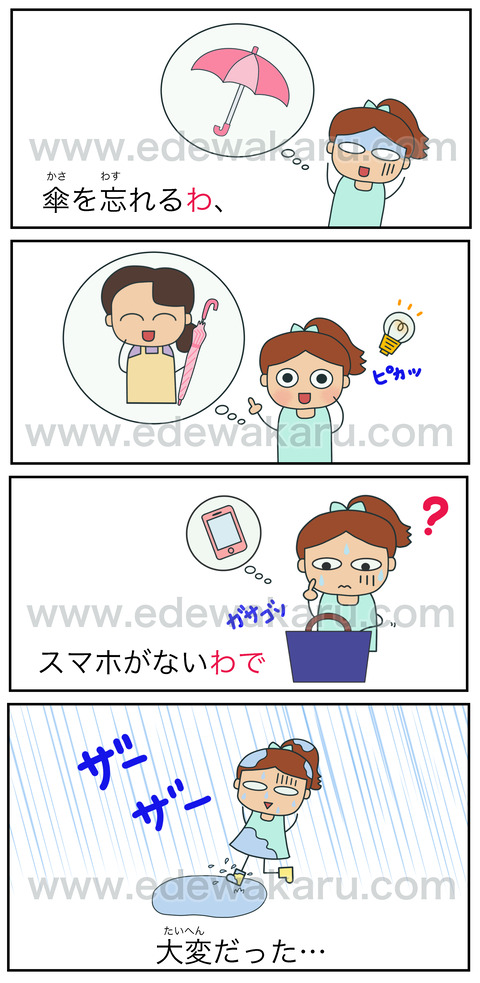
Meaning
There was ~ and ~ (and it was difficult/a lot to deal with).
There was ~ and ~ (and it was troublesome).
How to use it
Verb/adjective [plain form] + わ + verb/adjective [plain form] + わで
Explanation
“〜わ〜わで” is a sentence pattern used with the meaning “there was ~ and ~.” It is used when bad things happen at the same time and you want to say “it was difficult” or “it was troublesome” 😊 Because “difficult” and “troublesome” are feelings about unpleasant things, this pattern is not used for good things 😨
[Examples]
❌あのレストランの料理は、おいしいわ、安いわで最高だった
The food at that restaurant was delicious, inexpensive, and wonderful.
→“Delicious,” “inexpensive,” and “wonderful” are good things.
❌成績が上がるわ、彼氏ができるわでいいことずくめの1年だった (Review: 〜ずくめ [nothing but ~])
My grades improved and I got a boyfriend, so it was a year full of good things.
→“My grades improved,” “I got a boyfriend,” and “a year full of good things” are good things.
Also, the “で” in “〜わ〜わで” can be omitted 😊
[Examples]
傘を忘れるわ、スマホがないわで大変だった
I forgot my umbrella, and I didn’t have my smartphone, so it was awful.
=傘を忘れるわ、スマホがないわ 大変だった
バイトがあるわ、テストが近いわで忙しい
I have a part-time job, and exams are coming up, so I’m busy.
=バイトがあるわ、テストが近いわ 忙しい
Remember to distinguish “〜わ〜わで” from “〜わ〜わ,” which expresses degree 😀 I’ll cover the degree usage of “〜わ〜わ” next time 😉
In context 4 examples
傘を忘れるわ、スマホがないわで大変だった
→傘を忘れるし、スマホがないし大変だったI forgot my umbrella, and I don’t have my smartphone, so it was awful. →I forgot my umbrella, and I don’t have my smartphone, so it was awful.
バイトがあるわ、テストが近いわで忙しい
→バイトがあるし、テストが近いし忙しいI have a part-time job, and exams are coming up, so I’m busy. →I have a part-time job, and exams are coming up, so I’m busy.
運動はしないわ、お酒は飲むわでやせるはずがない
→運動はしないし、お酒は飲むし、やせるはずがないHe doesn’t exercise and drinks alcohol, so there’s no way he’ll lose weight. →He doesn’t exercise, and he drinks alcohol, so there’s no way he’ll lose weight.
あのレストランの料理は、まずいわ、高いわで最悪だった
→あのレストランの料理は、まずいし、高いし最悪だったThe food at that restaurant was awful and expensive, so it was the worst. →The food at that restaurant was bad and expensive, so it was the worst.
Read the original source text
Meaning
〜し〜し(大変だった)
〜し〜し(困った)
How to use it
動詞・形容詞[普通形]+わ+動詞・形容詞[普通形]+わで
Explanation
「〜わ〜わで」は「〜し〜し」という意味で使われる文型です。悪いことが一度に発生して「大変だ」「困った」と言いたい時に使用します
😊「大変だ」「困った」という気持ちはよくないことに使いますので、この文型はいいことには使いません😨
[例]
❌あのレストランの料理は、おいしい
わ、安い
わ
で最高だった
→「おいしい」「安い」「最高」はいいこと
❌成績が上がるわ、彼氏ができるわでいいことずくめの1年だった(復習:〜ずくめ)
→「成績が上がる」「彼氏ができる」「いいことずくめ」はいいこと
また、「〜わ〜わで」の「で」は省略することができます😊
[例]
傘を忘れるわ、スマホがない
わで
大変だった
=傘を忘れる
わ、スマホがない
わ
大変だった
バイトがある
わ、テストが近い
わで
忙しい
=バイトがある
わ、テストが近い
わ
忙しい
「〜わ〜わで」は程度を表す「〜わ〜わ」と区別して覚えておきましょう😀程度を表す「〜わ〜わ」はまた次回載せます😉
Usage 2
Read this source entry ↗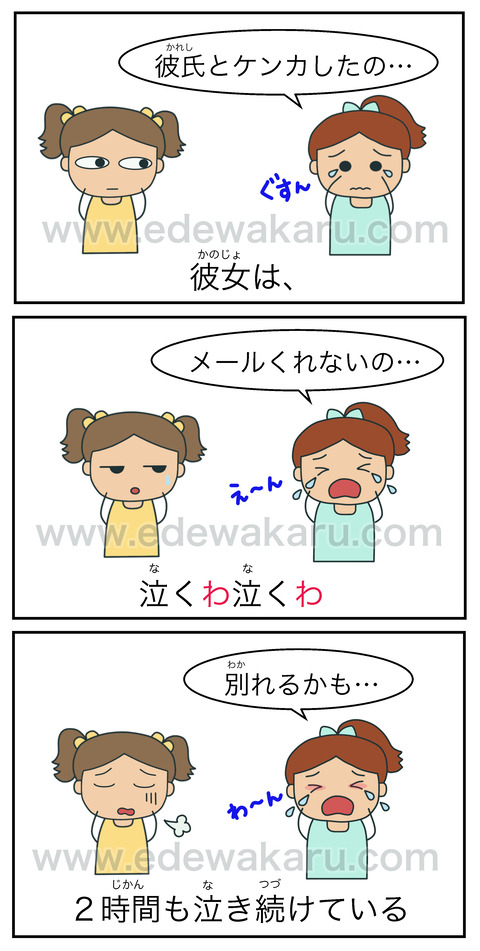
Meaning
There is/are a great many ~.
Do ~ a great deal.
How to use it
Verb [dictionary form] + わ + verb [dictionary form] + わ
Explanation
“〜わ〜わ” is a sentence pattern meaning “do ~ a great deal,” “there is a great deal of ~,” or “there are a great many ~” (people/things) 😀 Remember that the same verb is repeated 😊 It is used to express a large quantity or to say that something occurred in large amounts.
[Examples]
①泣くわ泣くわ
Cry and cry
→A large amount of crying
②人がいるわいるわ
There are people everywhere
→A large quantity
③ゴミがあるわあるわ
There is garbage everywhere
→A large quantity
④ビールを飲むわ飲むわ
Drink beer and drink beer
→A large amount consumed
[When the quantity is large] → There is a great deal of ~ / There are a great many ~
[When the amount occurring is large] → Do ~ a great deal
It is useful to remember it as above 😃 Also, remember to distinguish it from “〜わ〜わで,” which expresses bad things happening at the same time 😊 (Review: 〜わ〜わで.)
This pattern is perfect when you want to say you were surprised because there was “a large quantity” or “a large amount of something happening,” so try using it too 😉
In context 3 examples
彼女は泣くわ泣くわ、2時間も泣き続けている
→彼女はすごく泣いて、2時間も泣き続けている(復習:〜も(数量詞+も))She keeps crying and crying; she has been crying for two whole hours. →She is crying a great deal and has been crying for two whole hours (Review: 〜も [as many/much as]).
オープンしたばかりのデパートには人がいるわいるわ、大混雑だった
→オープンしたばかりのデパートには人がたくさんいて、大混雑だった(復習:〜たばかり)(復習:文法比較「〜たばかりvs〜たところ」)There were people everywhere in the department store that had just opened; it was packed. →There were a lot of people in the department store that had just opened, and it was packed (Review: 〜たばかり [just did]; grammar comparison: 〜たばかり vs. 〜たところ).
この家にはゴミがあるわあるわ、とても汚い
→この家にはゴミがたくさんあって、とても汚いThere is garbage everywhere in this house; it’s very dirty. →There is a lot of garbage in this house, and it’s very dirty.
Read the original source text
Meaning
すごくたくさん〜がある・いる
すごく〜する
How to use it
動詞[辞書形]+わ+動詞[辞書形]+わ
Explanation
「〜わ〜わ」は「すごく〜する」「すごくたくさん〜がある」「すごくたくさん〜がいる」という意味を表す文型です。
同じ動詞を繰り返して使うと覚えておきましょう
😀これは数量が多いことを表したり、発生した量が多いと言いたい時に使われる文型です😊
[例]
①泣く
わ
泣く
わ
→
発生量が多い
②人がいる
わ
いる
わ
→
数量が多い
③ゴミがある
わ
ある
わ
→
数量が多い
④ビールを飲む
わ
飲む
わ
→
発生量が多い
【数量が多いとき】→すごくたくさん〜がある・すごくたくさん〜がいる
【発生量が多いとき】→すごく〜する
上のように覚えておくと便利です😃 また、1度に悪いことが同時に発生することを表す「〜わ〜わで」とは区別して覚えておきましょう😊(復習:〜わ〜わで)
「数量が多い」「発生量が多い」からびっくりしたと言いたいときにぴったりな文型ですので、みなさんも使ってみてくださいね😉
毎日のんびり日本語教師
How to use it
Verb dictionary form + わ + Verb dictionary form + わ(で)
い-adjective basic form + わ + い-adjective basic form + わ(で)
な-adjective stem + だわ + な-adjective stem + だわ(で)
Noun + だわ + Noun + だわ(で)
Explanation
Used to state a reason or cause.
Two things are mentioned as the reasons for the result or situation described in the latter clause.
It often conveys the speaker’s exasperation with things.
It seems to be used more often in a negative sense. (All the examples in this dictionary describe undesirable results, and no positive uses have been found.)
Notes
Nothing in particular.
In context 8 examples
おごるとは言ったものの、みんな食うわ飲むわで5万円もかかった。
Although I said I’d treat everyone, they ate and drank so much that it cost 50,000 yen.
不味いわ高いわで、もう二度とこんな弁当買わん。
It’s both awful-tasting and expensive, so I’m never buying a lunch box like this again.
同級生はみんな結婚するわ子供産まれるわで、私だけ取り残されてる感じがする。
All my classmates are getting married and having children, and I feel like I’m the only one being left behind.
味が薄いわ具が大きいわで手料理が家族に不評だった。
The homemade meal was unpopular with my family because the flavor was too mild and the ingredients were too big.
メガネ割れるわ階段踏み外すわで、近頃ついてない。
My glasses broke and I missed a step on the stairs, so I’ve had nothing but bad luck lately.
頭痛いわ気持ち悪いわで、とてもメシなんか食えやしない。
My head hurts and I feel sick, so there’s no way I can eat anything.
父の運転、急に車線変えるわ信号無視するわで怖すぎ。
My dad’s driving is terrifying: he suddenly changes lanes and runs red lights.
暑いわ臭いわでもう二度とあんなところ行きたくない。
It’s hot and smelly, so I never want to go to a place like that again.
Read the original source text
How to use it
動辞形+わ+動辞形+わ(で)
い形容詞基本形+わ+い形容詞基本形+わ(で)
な形容詞語幹+だわ+な形容詞語幹+だわ(で)
名詞+だわ+名詞+だわ(で)
Explanation
理由、原因を述べるときに使います。
何か2つの事象を挙げ、それらが理由で後件のような結果・状況になったことを表します。
話者の物事に対する煩わしさが表れやすいです。
どちらかというと悪い意味の用法が多めに感じます。(当辞書の例文はいずれも好ましくない結果を述べており、良い意味での用法は確認できません)
Notes
特になし
AIUEO JLPT Grammar
Meaning
「〜わ」is an ending particle used primarily by women to express emotions softly. It conveys the speaker’s feelings, empathy, or confirmation. While it is commonly used in women’s speech, men may occasionally use it too.
In context 5 examples
このケーキ、美味しいわ。
This cake is delicious.
お元気でいてくださいね、心配していますわ。
Please stay healthy, I am worried about you.
今日は疲れたわ。早く寝よう。
I’m tired today. Let’s go to bed early.
気をつけてね。ここは滑りやすいわよ。
Please be careful. It’s slippery here.
簡単ではないわ。
It’s not easy.
Bunpro Grammar Reference
Usage 1
Meaning
You know?, Oh?, Ever so, Oh how I ever (emphasis)
How to use it
Phrase + わ
Nuance
A sentence-ending particle that places light emphasis on something, usually in order to highlight an opinion. Mainly used by women.
Explanation
The sentence-ending particle わ initially stems from the adverbial particle は, however, they are used in quite different ways. わ will primarily be used by women to either emphasize something, or for the purpose of convincing the person they are talking to that their statement is true.
This could be translated as 'you know!', 'oh?', 'ever so (A)', or 'oh how I ever (A)' in English, where (A) is some fact that they want to highlight.
わ may be used after the plain form of words, which means any verb, adjective, or auxiliary verb in their unconjugated forms.
私もそろそろ帰るわ。
I am also going to start heading home soon, you know?
誕生日覚えてくれていたの?嬉しいわ。
You remembered my birthday? Oh I am happy!
それはお母さんにもらった指輪だわ。
That is a ring I received from my mother, you know!
出かけるのは明日ですわ。
The day that I am going out is tomorrow, you know?
Note that both だ and です are acceptable. This is because both だ and です are different auxiliary verbs that are in their plain form, rather than one being a conjugation of the other.
Usage of わ by younger women is becoming less and less common in recent generations.
Caution
わ may also be used by men. However, this use puts emphasis on either surprise or light exasperation. This exasperation is usually in relation to something that is true, but cannot be helped.
あ~、今日も疲れたわ。早く帰りたい。
Ugh, I'm tired today, as usual you know. I wanna go home already.
そういうこと平気で言えるやつマジ無理だわ。
I really can't deal with people who can say stuff like that without hesitation.
あいつマジでだるいわ。
That dude is such a pain to be around.
わ used by men for these purposes is still very common in some parts of Japan. Particularly the west. Thankfully, there is a very obvious pitch difference between the わ that is used in female speech, and the わ that is used in male speech.
Notes
Non-JLPT
In context 19 examples
- 私もその香水が欲しいわ!
I want that perfume too, you know!
- それはお母さんにもらった指輪だわ。
That is a ring I received from my mother, you know!
- 出かけるのは明日ですわ。
The day that I am going out is tomorrow, you know?
- 私もそろそろ帰るわ。
I am also going to start heading home soon, you know?
- 誕生日覚えてくれていたの?嬉しいわ。
You remembered my birthday? Oh I am happy!
- 過去の彼氏たちのことは忘れたわ。
I have moved on from my ex boyfriends, you know!
- あら、あのキラキラの指輪は綺麗だわ!
My, that sparkling ring is oh so beautiful?
- 私にバラの花束をくれるの?素敵だわ!
You will give me a bouquet of roses? Oh how thoughtful!
- 女の子に暴力を振るう人は嫌いだわ。
Oh how I ever so hate people that exert violence toward women.
- 高い所にグラスがあるわ。取ってくれる?
The glass is in a high place, you know? Would you grab it for me?
- 高級ブランドのバッグをなくしたの。困ったわ。
I lost a high-class, brand bag. Oh how troubling.
- ハーバード大学に合格したの?!それはすごいわ!
You succeeded in getting into Harvard?! That is ever so amazing!
- ファンタジーの本より犯罪推理小説の方が面白いわ。
Crime deduction novels are more interesting than fantasy books, you know?
- 夜遅くにアイスを食べてはいけないわ。太るわよ。
You mustn't eat ice cream late at night, you know? You'll get fat, you know?
- 明日は友達の結婚式だから、ネイルをしなくてはいけないわ。
Because it's my friend's wedding ceremony tomorrow, I have got to get my nails done you know?
- 私はピアノを弾いたりフルートを吹いたりするのが好きだわ。
Oh how I ever so enjoy things like playing the piano and the flute.
- あ~、今日も疲れたわ。早く帰りたい。
Ugh, I'm tired today, as usual you know. I wanna go home already.
- そういうこと平気で言えるやつマジ無理だわ。
I really can't deal with people who can say stuff like that without hesitation.
- あいつマジでだるいわ。
That dude is such a pain to be around.
Read the original source text
Meaning
You know?, Oh?, Ever so, Oh how I ever (emphasis)
How to use it
Phrase + わ
Nuance
A sentence-ending particle that places light emphasis on something, usually in order to highlight an opinion. Mainly used by women.
Explanation
The sentence-ending particle わ initially stems from the adverbial particle は, however, they are used in quite different ways. わ will primarily be used by women to either emphasize something, or for the purpose of convincing the person they are talking to that their statement is true.
This could be translated as 'you know!', 'oh?', 'ever so (A)', or 'oh how I ever (A)' in English, where (A) is some fact that they want to highlight.
わ may be used after the plain form of words, which means any verb, adjective, or auxiliary verb in their unconjugated forms.
私もそろそろ帰るわ。
I am also going to start heading home soon, you know?
誕生日覚えてくれていたの?嬉しいわ。
You remembered my birthday? Oh I am happy!
それはお母さんにもらった指輪だわ。
That is a ring I received from my mother, you know!
出かけるのは明日ですわ。
The day that I am going out is tomorrow, you know?
Note that both だ and です are acceptable. This is because both だ and です are different auxiliary verbs that are in their plain form, rather than one being a conjugation of the other.
Usage of わ by younger women is becoming less and less common in recent generations.
Caution
わ may also be used by men. However, this use puts emphasis on either surprise or light exasperation. This exasperation is usually in relation to something that is true, but cannot be helped.
あ~、今日も疲れたわ。早く帰りたい。
Ugh, I'm tired today, as usual you know. I wanna go home already.
そういうこと平気で言えるやつマジ無理だわ。
I really can't deal with people who can say stuff like that without hesitation.
あいつマジでだるいわ。
That dude is such a pain to be around.
わ used by men for these purposes is still very common in some parts of Japan. Particularly the west. Thankfully, there is a very obvious pitch difference between the わ that is used in female speech, and the わ that is used in male speech.
Notes
Non-JLPT
Nuance · 日本語
軽い強調を意味する終助詞で、通常は意見を強調するために使用される。主に女性に使用される。
Usage 2
Meaning
~and ~and, Keep ~ing, One after another, So much, So many, One after the other
How to use it
Verb[る]+ わ + Verb[る]+ わ(*)
(*) The same verb has to be repeated
Nuance
A formal particle construction, emphasizing the speaker's astonishment about (A) happening one after the other, or to a large degree.
Explanation
わ is an adverbial particle that is commonly used in cases of stress of emphasis in Japanese. When appearing after the dictionary form of a verb that is being repeated, it highlights a large amount, something happening successively, or more and more. It will often be translated as 'more and more (A)', '(A) keeps on happening', or 'so much (A)'. わ~わ may be used either positively or negatively.
To use this structure, simply place わ after the verb, and then repeat the same verb with a second わ.
もう、昨日子供達が喧嘩して泣くわ泣くわで大変だったんだから。
Oh my god, it was so hectic yesterday because the kids got into a fight and cried so much.
空き家を買ったのはいいけど、家中にはゴキブリがいるわいるわ。多分自分じゃ何もできないから業者に頼むしかなさそう。
I bought a vacant house, and that's exciting, but there are so many cockroaches all over the house. I probably won't be able to do anything myself, so I will have to call someone.
私の息子なんて、部活を始めてからというもの食べるわ食べるわ、食費が心配だよ。
Ever since my son has started after school activities, he eats so much that I am worried about the cost of food.
わ~わ primarily emphasizes the speaker's surprise in regard to the amount or extent of (A). This structure is predominantly used by men, but it may also sometimes be used by women. However, there are several different variations of わ depending on where they appear in sentences, each of which have gender usage tendencies that will need to be learned.
In many cases where a する verb is being used with わ~わ, the second instance of the action will be omitted, with する appearing by itself. For example, instead of 勉強するわ勉強するわ, 勉強するわするわ would be used.
あの子は医者になりたいって決めてから、毎日勉強するわするわ。
Ever since he has decided that he wants to be a doctor, he studies a lot.
Fun Fact
わ is simply an emphatic version of the usual は adverbial particle, and originates from は being changed to わ. Due to this, the literal meaning can be thought of as a stronger version of the standard 'as for (A)' meaning of は. This would come across something like 'as for (A), it did (A)', with the repetition itself adding to the emphasis.
In context 10 examples
- 「病院に入院してた時、いろいろ検査したらまあ、出るわ出るわ…(思った以上のことが指摘された)。」
'When I was in the hospital, they did various tests and, well, they just kept coming up...' (the results that were worse than expected)
- 私の息子なんて、部活を始めてからというもの食べるわ食べるわ、食費が心配だよ。
Ever since my son has started after school activities, he eats so much that I am worried about the cost of food.
- あの子は医者になりたいって決めてから、毎日勉強するわするわ。
Ever since he has decided that he wants to be a doctor, he studies a lot.
- もう、昨日子供達が喧嘩して泣くわ泣くわで大変だったんだから。
Oh my god, it was so hectic yesterday because the kids got into a fight and cried so much.
- 空き家を買ったのはいいけど、家中にはゴキブリがいるわいるわ。多分自分じゃ何もできないから業者に頼むしかなさそう。
I bought a vacant house, and that's exciting, but there are so many cockroaches all over the house. I probably won't be able to do anything myself, so I will have to call someone.
- 「新婚旅行から戻ったらメールボックスには郵便物があるわあるわ、つかえてしまって引っ張ることができなかった。」
'When we got back from our honeymoon, there was so much mail in the mailbox that it was stuck and I couldn't pull it out.'
- 「子供が転んで泣くわ泣くわ。なだめるの大変だった。」
'Our child fell and cried so much that it was hard to calm her down.'
- 「先輩は面白いのなんのって喋ると笑うわ笑うわ。」
'Senpai is so funny, that I laugh so much whenever he talks.'
- 「ちょっとからかっただけで、あいつ怒るわ怒るわ。」
'He gets so angry just by teasing him a bit.'
- 「雨だろうが雪だろうが、走るわ走るわ。もう走る病気って感じだよ。」
'Whether it is rain or snow, he keeps on running. It seems that he has an incurable passion for running.'
Usage 3
Meaning
And...so, And...because, Since
How to use it
(A) (1)+ わ + (B) (1) + わ(で)
(1) Verb[る]、[い]Adjective、[な]Adjective + だ、Noun + だ
Nuance
A formal particle construction, emphasizing what happened due to the speakers frustration about events similar to (A) happening one after the other.
Explanation
As mentioned in the わ grammar point, わ is an adverbial particle that is commonly used in cases of stress of emphasis in Japanese. When used after either verbs, い-Adjectives, な-Adjectives, or nouns in their standard forms, it generally implies that (A) and (B) are negative factors that have lead to (C), where (C) is either a negative outcome, or a negative opinion. It will often be translated simply as 'with (A) and (B), (C)'.
To use this structure, simply place わ after a word, and then repeat the same after a second (different) word. In the case of な-Adjective or nouns, だわ will be used. The case-marking particle で will then follow the second わ, indicating 'with', or 'as a consequence of'.
昨日はクライアントに怒られるわ、自分の上司に暴言吐かれるわで大変だった。
I had a bad day yesterday because my client was mad at me and because my boss yelled at me.
このアパートはボロいわ狭いわで最悪な物件だ。
This apartment sucks because it is run-down and small.
新しく入ってきた新人はクライアントには無礼だわ、クレーム対応が下手だわで、どこから教育していいかわからない。
The newbie that just joined is rude to our clients and bad at handling complaints, so I don't know how I should train him.
携帯を買ってくれたこと自体は嬉しかったんだけど、5年前のモデルだわ画面は割れているわで使い物にならなそうだったから、自分で新しい携帯を買った。
I am happy that they bought me a phone, but it was a 5 year old model and the screen was broken and didn't look like I would be able to use it, so I went ahead and bought myself a new phone.
わ~わで, like わ, primarily emphasizes the speaker's surprise in regard to the words that appear before it. However, unlike わ, where the same verb will be repeated in order to highlight an excessive extent, わ~わで simply indicates surprise in terms of irritation or frustration. This structure is predominantly used by men, but it may also sometimes be used by women. However, there are several different variations of わ depending on where they appear in sentences, each of which have gender usage tendencies that will need to be learned.
In essence, わ is used in the same way as し~し, where the words that they are being attached to are just being listed as reasons. Additionally, the で may occasionally be omitted.
Fun Fact
わ is simply an emphatic version of the usual は adverbial particle, and originates from は being changed to わ. Due to this, the literal meaning can be thought of as a stronger version of the standard 'as for (A)' meaning of は.
Caution
While this grammar pattern is used almost exclusively with a negative nuance, it may, in rare cases, have a positive nuance.
今年は宝くじには当たるわ、長年付き合っていた彼氏にプロポーズされるわで、幸せなことが沢山あってとても嬉しい。
I am very happy this year because I won the lottery and my boyfriend of many years is going to propose to me. (Positive meaning)
In context 23 examples
- 「今朝の通勤時は、急に雨が降ってくるわ傘は壊れるわで大変だった。」
'I had a hard time getting to work this morning because it suddenly started raining and my umbrella broke.'
- このアパートはボロいわ狭いわで最悪な物件だ。
This apartment sucks because it is run-down and small.
- 新しく入ってきた新人はクライアントには無礼だわ、クレーム対応が下手だわで、どこから教育していいかわからない。
The newbie that just joined is rude to our clients and bad at handling complaints, so I don't know how I should train him.
- 携帯を買ってくれたこと自体は嬉しかったんだけど、5年前のモデルだわ画面は割れているわで使い物にならなそうだったから、自分で新しい携帯を買った。
I am happy that they bought me a phone, but it was a 5 year old model and the screen was broken and didn't look like I would be able to use it, so I went ahead and bought myself a new phone.
- 昨日はクライアントに怒られるわ、自分の上司に暴言吐かれるわで大変だった。
I had a bad day yesterday because my client was mad at me and because my boss yelled at me.
- 「今日はタンスに小指をぶつけるわ、道でつまずくわで、ついてなかった。」
'I was not lucky today because I hit my little finger on the dresser and tripped on the street.'
- 「朝から犬に吠えられるわ、鳥のウンチが頭に落ちてくるわで…(最低な一日だったわ)。」
'The dogs barked at me in the morning and the bird pooped on my head, so... (it was a horrible day.)'
- 「あのレストラン、料理に虫が入ってるわ、クレームいったら切れられるわで最低だったの。」
'Speaking of that restaurant, it was the worst since they had bugs in the food, and when I complained about it, I was ignored.'
- お母さんに怒られるわ先生にも怒られるわ、気分が悪い。
Having been gotten angry at by my mother and my teacher one after the other, I feel terrible.
- 財布をなくすわ鍵をなくすわ、本当に自己管理が全くできていない。
Losing my wallet and losing my keys one after the other, I honestly can’t look after myself.
- このバイトは力仕事だわ未払いの時があるわ、もうやってられません。
This part-time job is physical work and sometimes the pay is overdue, I can’t put up with it anymore.
- 彼氏に浮気されるわ友人には裏切られるわ…もう生きていたくなくなる…!
Being cheated on my boyfriend and betrayed by my friends one after the other... I’m starting to not want to live anymore...!
- ここのレストラン、接客態度は悪いわ値段は高いわで、全くいいところがない。
The customer service at this restaurant is bad and the price is high, so there aren’t any good points.
- 今日はいつもより寒いわ風は強いわで、観光なんてしていられません。
Today is colder than usual and the wind is strong, so it’s impossible to do something like sightseeing.
- 今日は風が冷たいわ曇っているわで、観光日和ではない。
Because the wind is cold today and it’s cloudy, it’s not ideal weather for sightseeing.
- 変な匂いがするわ湿気があるわで、このホテルの客室は最悪だ。
Because there is a strange smell and it’s humid, this hotel’s guest rooms are the worst.
- このマットレス、硬すぎるわ小さすぎるわで、買う価値がまったくない。
Because this mattress is too hard and too small, it’s not worth buying at all.
- 友達とアニメのキャラについての話、A(エー):「だって興味深いもん」
B(ビー):「そのキャラがつまらないわ寒いわ退屈だわで擁護のしようもない。」Chat with a friend about anime character, A: 'But he is interesting!.' B: 'This character is boring, dull and mind-numbing, so there's no way to defend him.'
- あのレストランは、接客態度が最高だわご飯は美味しいわで、また行きたいの!
Because the service at that restaurant is amazing and the food is delicious, let’s go again. (Rare positive use for emphasis)
- 彼って料理が上手だわ、仕事をちゃんとしているわで、本当に魅力的でならない。
Because he is good at cooking, and he is thorough with his work, he is so attractive I can’t stand it. (Rare positive use for emphasis)
- ずっと付き合ってた彼女に振られるわ、両親が亡くなるわで、この一年は最悪だった。
Because I was dumped by the girl I was dating for ages, and my parents passed away, this last year was the worst.
- A(エー):「顔色が悪いね。」
B(ビー):「そうなんだよね。昨日の夜、ルームメイトがうるさいわ、蚊にたくさんさされるわでちっとも眠れなかった。」A: 'Oh, you look pale!' B: 'Yeah, I know. I couldn't sleep at all last night because of my noisy roommate and all the mosquito bites.'
- 今年は宝くじには当たるわ、長年付き合っていた彼氏にプロポーズされるわで、幸せなことが沢山あってとても嬉しい。
I am very happy this year because I won the lottery and my boyfriend of many years is going to propose to me. (Positive meaning)
Usage 4
Meaning
Emphasis (sentence ending particle)
How to use it
Verb + わ(1)
[い]Adjective + わ(1)
[な]Adjective + や + わ(1)
Noun + や + わ(1)
(1) で
Verb[ます] + わ
[い]Adjective + です + わ
[な]Adjective + です + わ
Noun + です + わ
Nuance
A sentence ending particle used in Kansai, used for emphasis and highlight information.
Explanation
The sentence ending particle よ in standard Japanese has 2 possible alternatives in 関西弁. These are わ, and で. わ and で are considered sentence ending particles themselves in 関西弁, and behave slightly differently to their standard Japanese counterparts. As replacements for よ, わ and で will express to the listener that something is being emphasized, or that new information is being conveyed.
Either で or わ may be used at the end of a sentence in which new information is being conveyed. However, when preceded by a noun or な-Adjective, the regular combination of だよ (or ですよ) will be replaced with either やわ, or やで (や being the 関西弁 equivalent of だ or です).
Caution
です is also regularly seen with わ, as it is not always replaced by や. Despite this, で (as a sentence ending particle) may not be used with です. This is the primary grammatical difference between で and わ that will need to be remembered.
Caution
In standard Japanese, わ is a sentence ending particle that is primarily used by women to add a slight nuance of emphasis, exclamation, or determination. The primary difference between the standard Japanese わ, and the 関西弁 わ is intonation. In 関西弁 わ is said with a falling tone (and may be used by men or women), while the standard わ is said with a rising tone (and is almost exclusively used by women).
Notes
Kansai dialect
In context 22 examples
- これはペンですよ。
これはペンですわ。This is a pen.
- この子こう見えてめっちゃ頭いいんやで。
Despite how this person looks, they are very smart.
- 前のトラックがデカすぎて信号が見えへんわ。
The truck in front of us is so big that I can't see the traffic lights.
- その鍋暑いで、気をつけや!
That pot is hot, be careful.
- 串カツはソースやろ。味噌カツは嫌いやわ。
Kushi-katsu should be sauce. I don't like miso-katsu. (Kushi-katsu should be eaten with sauce! I don't like miso-katsu.)
- この仕事をするのは私だよ。
この仕事をするのは私やで。The person who does this job is me.
- ここですよ。
ここやで。It's here!
- 本があるよ。
本があるで。A book is here! / There is a book!
- ひまな一日だよ。
ひまな一日やわ。It is such a quiet day. (A day full of free time)
- あの人はトムだよ。
あの人はトムやで。That person is Tom!
- 彼女は私の妹ですよ。
彼女は私の妹ですわ。She is my sister.
- 私は野菜が嫌いよ。
私は野菜が嫌いやわ。I dislike vegetables!
- 流石に無理ですわ。
As expected, it's impossible. (Standard declaration)
- 流石に無理やわ。
As expected, it's impossible. (Stating to someone)
- 流石に無理やで。
As expected, it's impossible. (Stating to someone)
- 流石に無理ですで。
As expected, it's impossible. (Unnatural)
- これは凄く便利ですわ。
This is very useful. (Standard declaration)
- これは凄く便利やわ。
This is very useful. (Stating to someone)
- これは凄く便利やで。
This is very useful. (Stating to someone)
- これは凄く便利ですで。
This is very useful. (Unnatural)
- お腹がいっぱい過ぎてもう食べられないわ。
I am so full and I can't any more. (Feminine)
- これ以上食えんわ。
I can't eat more than this. (I can't eat anymore)
Read the original source text
Meaning
Emphasis (sentence ending particle)
How to use it
Verb + わ(1)
[い]Adjective + わ(1)
[な]Adjective + や + わ(1)
Noun + や + わ(1)
(1) で
Verb[ます] + わ
[い]Adjective + です + わ
[な]Adjective + です + わ
Noun + です + わ
Nuance
A sentence ending particle used in Kansai, used for emphasis and highlight information.
Explanation
The sentence ending particle よ in standard Japanese has 2 possible alternatives in 関西弁. These are わ, and で. わ and で are considered sentence ending particles themselves in 関西弁, and behave slightly differently to their standard Japanese counterparts. As replacements for よ, わ and で will express to the listener that something is being emphasized, or that new information is being conveyed.
Either で or わ may be used at the end of a sentence in which new information is being conveyed. However, when preceded by a noun or な-Adjective, the regular combination of だよ (or ですよ) will be replaced with either やわ, or やで (や being the 関西弁 equivalent of だ or です).
Caution
です is also regularly seen with わ, as it is not always replaced by や. Despite this, で (as a sentence ending particle) may not be used with です. This is the primary grammatical difference between で and わ that will need to be remembered.
Caution
In standard Japanese, わ is a sentence ending particle that is primarily used by women to add a slight nuance of emphasis, exclamation, or determination. The primary difference between the standard Japanese わ, and the 関西弁 わ is intonation. In 関西弁 わ is said with a falling tone (and may be used by men or women), while the standard わ is said with a rising tone (and is almost exclusively used by women).
Notes
関西弁
Nuance · 日本語
関西で情報や文全体を強調する際に使われる文末助詞。
Yokubi — The Common Grammar Guide (https://yoku.bi)
Explanation
Some particles can go at the end of sentences and are used to show how the speaker feels or provide additional emotional impact. The descriptions given in this lesson are not literal. They're just a way to represent the underlying tone. This is an incredibly nuanced topic and it can only be acquired through a lot of exposure.
Providing translations for the example sentences in this section is going to be very hard, because English does not use this type of language and it is often lost in (natural) translation, so be aware of that.
The sentence ending particle ね feels as though the speaker wants the listener to agree. ね can also come at the beginning of a sentence, and it serves as a way to get attention from the listener. In this usage, especially when duplicated (ね、ね!) it can come across as feminine/cute.
な(ぁ) indicates self-directed emphasis. You often use it when you feel emotionally moved or relieved by something (often positive, but can be used negatively too). Note that there's a different sentence-ender that can conflict with this one, and in such places, this one is usually written with the vowel elongated. In spoken language the tone is different.
よ feels as though the speaker wants to notify the listener about some piece of information. The listener may already know about it, but the speaker emphasizes that this information might be new or interpreted in a new way and wants the listener to be aware of that.
To show a simple difference in usage between よ and ね:
Both of these sentences mean the same thing at the core, but ね can only be used if both speaker and listener have tasted the food, while よ is used when the speaker wants the listener (who hasn't tasted the food) to know that they think food is good.
ぞ indicates assertion, it can sound a bit coarse, but it's not necessarily impolite. It can feel slightly masculine, but in certain expressions and contexts women use it too.
ぜ is like ぞ but feels more lighthearted. In fact, it can turn otherwise assertive statements into suggestions. It's not used often in real life and can sound comical if used incorrectly.
The ending particle わ has three main uses:
- Feminine emphasis similar to よ, this is almost exclusively found in fictional media and is often used to represent some stereotypical お嬢様 characters, especially in the form of ですわ
- Neutral casual usage, this is pretty much standard across all Japan and mostly gender neutral. It has the nuance of a self-reflected よ. You use it emphatically when you are stating to yourself some subjective feeling you just now came to realize.
- Kansai dialect わ. Not much needs to be said since we're not studying dialects in this guide, but you might come across it if you consume content with kansai speech which is very common.
People often confuse the feminine わ with the neutral わ, but they are very different. In real life it is extremely common for guys to use わ so don't be fooled by it.
There are many more particles like these and covering all of them is an unrealistic expectation. You will come across them as you consume Japanese media, just don't be surprised when you do. Remember that for the most part they don't change the meaning of sentences, they just add vibes.
A lot of these particles can also be chained together (よ \+ ね \-\> よね) and there is an implicit order of precedence (ねよ is wrong, よね is correct). We won't be covering them but just be aware that they assume a meaning that means more than just the sum of its parts. All vibes, of course.
One last note to mention is the role of だ after nouns and な-adjectives at the end of sentences before attaching particles. The "proper" way in Japanese is to use だ (or です) if the sentence ends with a noun or な-adjective, and then add the particle right after:
However, it is grammatically acceptable to remove this だ and attach the particle directly to the noun. This can often feel feminine and the usage in real life is much more limited than in fictional media.
In context 1 examples
そんなことはどうでもいいですわ
I don't care about that (feminine)
日本語文型辞典
Meaning
Used when several undesirable things happen one after another, listing them as examples to emphasize the speaker’s dismay. What follows usually describes how difficult or troublesome the situation is.
Repeating the same verb expresses surprise that the quantity or frequency of something’s existence or occurrence is unexpectedly high. What follows often describes the resulting situation.
How to use it
…わ…わ(で)
V-るわ V-るわ
In context 7 examples
昨日は山登りに行ったが、雨に降られるわ道に迷うわで、散々だった。
Yesterday I went mountain climbing, but it poured on us and we got lost, so it was a complete disaster.
今週は試験はあるわレポートの締切は近いわで、寝る間もない。
This week we have exams and report deadlines are coming up, so I don’t even have time to sleep.
このごろ忙しくて、もう家事はたまるわ、まともな食事はしないわ……。
I’ve been so busy lately that the housework is piling up and I’m not eating proper meals…
あいつは高校生のくせにタバコは吸うわお酒は飲むわ無断外泊はするわ、悪いことばかりしていて親を泣かせている。
Even though he’s only in high school, he smokes, drinks, and stays out overnight without permission—he keeps doing bad things and making his parents cry.
新しくできた水族館に行ったら、人がいるわいるわ、魚なんか全然見えないぐらいの人出だった。
When I went to the newly opened aquarium, there were so many people that you couldn’t see the fish at all.
忙しくて新聞がたまるわたまるわ、もう2週間分も読んでいない。
I’ve been so busy that the newspapers just keep piling up; I haven’t read two weeks’ worth.
部屋を久しぶりに掃除したら、ごみが出るわ出るわ、段ボール箱にいっぱいになった。
When I cleaned my room for the first time in ages, garbage kept turning up until I had a whole cardboard box full.
Read the original source text
Meaning
良くないことがらが一度に重なって起こるときに、それらを例示的に並べて困った気持ちを強調して表す。後にそのことで大変だ、困ったという内容が続く。
同じ動詞を繰り返して、存在や発生の量や頻度が予想外に多いことへの驚きを表す。後にそのことによって結果的に発生する事態が続くことが多い。
How to use it
…わ…わ(で)
V-るわV-るわ
日本語文型辞典 英語版
Meaning
When several bad things occur all at once, this is used to list them as exemplificatory and to emphasize a feeling of annoyance. What follows are details of how (it) was terrible because of those things or that the person was annoyed because of those things.
Repeating the same verb, expresses surprise that the quantity of a thing or the frequency of an occurrence is higher than expected. Often, details of the resulting situation follow.
How to use it
1. ... and ...; ... and so on
2. V-る and V-る; V-る a lot
In context 7 examples
昨日は山登りに行ったが、雨に降られるわ道に迷うわで、散々だった。
Yesterday I went mountain-climbing but it rained and I got lost; it was terrible.
今週は試験はあるわレポートの締切は近いわで、寝る間もない。
This week I have an exam and the deadline of my report is close; there’s barely time to sleep.
このごろ忙しくて、もう家事はたまるわ、まともな食事はしないわ...。
I’m so busy these days; the housework is piling up, I’m not eating properly....
あいつは高校生のくせにタバコは吸うわお酒は飲むわ無断外泊はするわ、悪いことばかりしていて親を泣かせている。
That guy’s a senior high school student but he smokes, drinks alcohol and stays out all night without permission; he reduces his parents to tears just doing bad things all the time.
新しくできた水族館に行ったら、人がいるわいるわ、魚なんか全然見えないぐらいの人出だった。
When I went to the new aquarium there were people on top of people! It was such a large turnout that I couldn’t see the fish at all.
忙しくて新聞がたまるわたまるわ、もう2週間分も読んでいない。
I’m really busy and the newspapers keep piling up; I haven’t read them for two weeks already.
部屋を久しぶりに掃除したら、ごみが出るわ出るわ、段ボール箱にいっぱいになった。
When I cleaned my room for the first time in a long while, there was so much rubbish that it filled a cardboard box.
Read the original source text
Meaning
When several bad things occur all at once, this is used to list them as exemplificatory and to emphasize a feeling of annoyance. What follows are details of how (it) was terrible because of those things or that the person was annoyed because of those things.
Repeating the same verb, expresses surprise that the quantity of a thing or the frequency of an occurrence is higher than expected. Often, details of the resulting situation follow.
How to use it
1. ...わ...わ(で)
2. V-るわV-るわ
NINJAL 日本語文型データベース
Meaning
[1] Gives two examples in the 「〜」 parts to express that there are various other conditions or situations besides those examples. It is a way to give concrete examples while explaining the speaker’s feelings or opinions stated in the following sentence. It is often used particularly when expressing negative feelings or opinions such as “it was difficult” or “I was tired.”
It can also take the form 「〜わ〜わで」 to emphasize the reasons.
[2] Repeats the same verb to express surprise that the quantity or frequency was greater than the speaker had expected. It can also take the form 「〜わ〜わで」 for emphasis.
How to use it
Notes
[1] The two 「〜」 parts may sometimes take different parts of speech. There are usually two instances of 「〜わ」 in a sentence, but there may be three or more.
[2] The sentence that follows 「〜わ〜わ」 often says what the result was.
In context 22 examples
姉の子どもを1時間だけ預かったのだが、泣くわわめくわ、本当に大変だった。
I looked after my sister’s child for just an hour, but they cried and screamed, and it was really difficult.
親友と大げんかしてしまった。謝りたくても、電話も出ないわ、メッセージにも無反応だわ、もうどうしたらいいのかわからない。
I had a huge fight with my best friend. I want to apologize, but they won’t answer the phone and won’t respond to my messages. I don’t know what to do anymore.
楽しみにしていた旅行だったのに、切符をなくすわ、カメラが故障するわ、大雨で観光できないわで、散々だった。
It was a trip I’d been looking forward to, but I lost my ticket, my camera broke, and I couldn’t sightsee because of the heavy rain. It was a complete disaster.
先週は本当に忙しかった。子どもの学校から急に呼び出されるわ、仕事でも課長の代理で会議に行かされるわで、ゆっくりできる時間がなかった。
I was really busy last week. I was suddenly called to my child’s school, and at work I was sent to a meeting as the section chief’s proxy; I had no time to relax.
今住んでいる部屋は冬寒いわ夏暑いわで、一年中エアコンが欠かせない。
The room I live in now is cold in winter and hot in summer, so I need air conditioning all year round.
最近新しくできた歯医者に行ってみた。しかし、治療費は高いわ予約は取りにくいわ、もう行かないだろう。
I tried going to the new dentist that opened recently. But the treatment is expensive and it’s hard to get an appointment, so I probably won’t go again.
私の髪の毛はかたいわ量は多いわ癖があるわで、なかなか思い通りの髪型ができない。
My hair is coarse, thick, and unruly, so it’s hard to get the hairstyle I want.
ストーリーもおもしろくないわ出ている役者もよくないわ。見る価値はない映画だった。
The story isn’t interesting, and the actors in it aren’t good either. It was a movie not worth watching.
サービスの内容は航空会社によって異なる。LCCは安いけれども、食事はおいしくないわ座席は狭いわ、長時間のフライトには向かない。
The services offered vary by airline. Low-cost carriers are cheap, but the food isn’t good and the seats are cramped, so they’re not suited to long flights.
前の課長はいい人だったのに、今の課長は無神経だわ時間にルーズだわで、周りの人からあまり信頼されていない。
The previous section chief was a good person, but the current one is insensitive and lax about time, so people around them don’t trust them very much.
同期入社の田村は、仕事は雑だわ仕事を覚えるのは遅いわ人の話は聞かないわ。これまで散々迷惑をかけられた。
Tamura, who joined the company at the same time as I did, does sloppy work, is slow to learn the job, and doesn’t listen to people. They’ve caused me a lot of trouble over the years.
青山さんは、家庭環境が複雑だわ自分に自信がないわで、恋愛に対して消極的だ。
Aoyama is passive about romance because of a complicated family background and a lack of self-confidence.
最近近所に引っ越してきた人は、自治会の活動に協力的ではないわあいさつもしないわ。あまり印象が良くない。
The person who recently moved into the neighborhood isn’t cooperative with the residents’ association and doesn’t even greet people. They haven’t made a very good impression.
スマホだわ最新のゲーム機だわ、時代の変化は速い。何がいいのか、私にはさっぱりわからない。
Smartphones and the latest game consoles—the times are changing fast. I have no idea what’s good.
今日予定されていたマラソン大会は、大雨だわ風は強いわで、延期されることになった。
The marathon scheduled for today has been postponed because of heavy rain and strong winds.
私は30歳になっても無職だわ貯金もないわ人付き合いも苦手だわで、いつまでも親に心配をかけている。情けない。
Even at 30, I’m unemployed, have no savings, and am bad at socializing, so I keep making my parents worry. It’s pathetic.
この本の著者は教育について論じているが、学者ではないわ教育者でもないわで、説得力が乏しい気がする。
The author of this book discusses education, but they are neither a scholar nor an educator, so I feel the argument lacks persuasiveness.
今年の冬は寒い。3月になっても雪が降るわ降るわ。なかなか暖かくならない。
This winter is cold. It kept snowing and snowing, even in March. It’s taking a long time to warm up.
旅行中、友達はお土産を買うわ買うわ。あっという間に10万円も使ってしまった。
During the trip, my friend kept buying souvenirs. They spent as much as 100,000 yen in no time.
掃除をし始めたら、ゴミが出るわ出るわで、ゴミ袋10袋分もゴミが出た。
When I started cleaning, trash kept piling up, until there was enough to fill ten garbage bags.
中学生の甥っ子と回転寿司に行った。食べるわ食べるわ、たった30分で30皿の寿司を食べ終えた。
I went to a conveyor-belt sushi restaurant with my middle-school-aged nephew. He kept eating and eating, finishing 30 plates of sushi in just 30 minutes.
姪っ子はまだ5歳なのにしゃべるわしゃべるわ、食事中もおしゃべりが止まらない。
My niece is only five, but she talks and talks; she doesn’t stop chatting even during meals.
Read the original source text
Meaning
[1] 〜の部分に2つの例を挙げて、〜の他にもさまざまな状態や様子があることを表します。後の文で述べている話し手の感想や意見について例を挙げながら具体的に説明する言い方です。特に「大変だった・疲れた」などの否定的な感想や意見を述べるときによく使います。
理由を強調するときは「〜わ〜わで」の形でも使います。
[2] 同じ動詞をくり返して使い、話し手が思っていた予想以上の量や頻度であったという驚きを表したいときに使います。強調するとき「〜わ〜わで」の形でも使います。
How to use it
Notes
[1] 2つの「〜」には異なる品詞がくる場合もあります。「〜わ」は1文中にふつう2つですが、3つ以上のこともあります。
[2] 「〜わ〜わ」の後に続く文は、その結果どうなったのかをいうことが多いです。