AIUEO JLPT Grammar
Meaning
This sentence pattern is used to express that one takes an action appropriate for a specific condition or situation, emphasizing the condition.
How to use it
Verb と + あれば; i-adjective (dictionary form) と + あれば; na-adjective と + あれば; Noun と + あれば
In context 5 examples
大切な友人の頼みとあれば、何でも手伝うつもりだ。
If it’s an important friend’s request, I’ll be willing to help with anything.
親は子供のこととあれば、どんな犠牲も厭わない。
Parents are willing to make any sacrifice if it’s for their children.
家族の安全とあれば、どんな危険も冒す覚悟だ。
If it’s for the safety of my family, I’m prepared to take any risk.
彼の将来のためとあれば、厳しい指導も必要だろう。
If it’s for his future, strict guidance may be necessary.
真相を知るためとあれば、どんな努力も惜しまない。
If it’s to find out the truth, I’ll spare no effort.
Read the original source text
Meaning
This sentence pattern is used to express that one takes an action appropriate for a specific condition or situation, emphasizing the condition.
How to use it
動詞と+あれば形容詞辞書形と+あれば形容動詞と+あれば名詞と+あれば
Explanation · 日本語
この文型は、自分にとって特別な条件や状況に対して、それに見合った行動をすることや、その条件を強調する表現です。
文法
Meaning
If it’s …; used when you want to say that if the preceding condition holds, it is unavoidable or can’t be helped that what follows will happen.
How to use it
V (plain form) + とあれば
い-adjective (plain form) + とあれば
な-adjective + とあれば
N + とあれば
In context 6 examples
生きるためとあれば、罪を犯しても良いものでしょうか。
If it's to survive, is it all right to commit a crime?
私は愛する妻や息子のためとあれば、何でもする。
If it's for my beloved wife or son, I'll do anything.
命が助かるとあれば、いくらでも払います。
If it means saving a life, I'll pay any amount.
金のためとあれば、彼は友達さえも裏切る。
If it's for money, he'll even betray his friends.
親友の頼みとあれば、仕方がない。手伝ってあげるよ。
If it's a request from my best friend, I can't very well refuse. I'll help you.
そうとあれば善は急げだ。早速取り掛かろう。
If that's the case, there's no time like the present. Let's get started right away.
Read the original source text
Meaning
〜なら 前件なら、後件の内容が起こるのはやむ終えない、仕方がないと言いたい時に使う。
How to use it
V(普通形)+ とあれば
イA(普通形)+ とあれば
ナA + とあれば
N + とあれば
Bunpro Grammar Reference
Meaning
(Emphatic) if, If it is the case that, As (you wish)
How to use it
Noun + (だ)+ とあれば
Nuance
A formal, hypothetical construction, emphasizing that if it is the case that (A), (B). If the existing circumstance is (A), (B).
Explanation
とあれば is a grammar pattern in Japanese that is used as an emphatic version of なら 'if'. It will primarily be used in formal situations, or for literary effect, such as in a novel. It may be translated as 'if (A) is the case, then (B)', or 'should (A) be true, then (B)'.
This is a combination of the case-marking particle と, and the hypothetical form of the う-Verb ある 'to be', あれば.
とあれば will primarily follow nouns, but is occasionally also seen after other structures such as verbs and adjectives when the と is being used as a quotation.
データを復元できるとあれば、いくらでも出します!
If it is for recovering my data, I would pay whatever you offer!
状態がいいとあれば4万円ぐらいで売れると思いますよ。
If it is in good condition, I think you'd be able to sell it for 40,000 yen.
先輩の指示とあれば従わないわけにはいけないけど、絶対私のやり方の方が効率がいいと思うのに。
It is my Senpai's orders so I have to do it, but I swear my way is a lot more efficient.
お前の頼みとあればやるしかないだろ。俺に任せろ。
If it is your wish, I have to do it. Leave it up to me.
(A) is often some special circumstance or condition that leads to the conclusion or assumption of (B), were (A) to be accurate. As this expression is emphatic, (B) will usually indicate something that must be done, or can't be avoided, with structures like しかない, なければならない, ざるを得ない, etc.
Fun Fact
とあれば tends to appear with のため before it quite often. This can be translated as 'if for the purpose of (A)', and will describe the lengths that the speaker is willing to go for (A) in (B).
息子のためとあればどれだけでも残業をする。
If it is for my son, I will do as much overtime as I have to.
In context 18 examples
- 息子のためとあれば、火の中でも飛び込みます。
If it is for my son, I would even dive into a fire.
- データを復元できるとあれば、いくらでも出します!
If it is for recovering my data, I would pay whatever you offer!
- 状態がいいとあれば4万円ぐらいで売れると思いますよ。
If it is in good condition, I think you'd be able to sell it for 40,000 yen.
- お前の頼みとあればやるしかないだろ。俺に任せろ。
If it is your wish, I have to do it. Leave it up to me.
- 先輩の指示とあれば従わないわけにはいけないけど、絶対私のやり方の方が効率がいいと思うのに。
It is my Senpai's orders so I have to do it, but I swear my way is a lot more efficient.
- 市民の願いとあればスーパーヒーローはいつでも出動するんだとか。
I hear that the hero would mobilize at any moment if it were the wish of the citizens.
- 社員:「そんな会社のトップからの誘いとあれば無視できない」
Company employee: 'If it is an invitation from the head of the company, then it cannot be ignored.'
- 母はいつも「愛する孫のためとあれば、どんな頼みも聞くわ」と言っています。
Mom always says, ‘if it is my beloved grandchild, then I would listen to any request’.
- 小説:「皇帝陛下の命令とあればせざるを得ない!」
Novel: 'If it is his Highness's order, then I will have no choice but to do it.'
- A(エー):「あすの朝でも発てるか?」
B(ビー):「必要とあれば(行くしかない)ね」A: 'Are you leaving tomorrow morning?' B: 'If it is necessary (I will have no choice, but to go).'
- A(エー):「お願いがあって。ねえ聞いてくれる?」
B(ビー):「もちろん!A(エー)さんの望みとあれば何でも聞いちゃうよ。なに?」A: 'I have a request. Will you listen?' B: 'Of course. If it is your wish, I will listen to everything. What (is it)?'
- 映画の悪役:「ふむ、それが其方の意見とあれば仕方ない。今ここで死んでもらおう。」
Movie villain: ‘Hmm, it cannot be helped if that is your opinion. I will have you die here right now.’
- ホテルの受付係:「必要とあればアイロンとアイロン台もお貸ししますのでお申し付け下さい。」
Hotel receptionist: ‘If it is necessary, we can also lend an iron and ironing board, so please let us know.’
- 富や権力のためとあれば身内や同僚を殺してしまうなんて、彼女はなんて冷酷なのだろう…。
Something like killing those close to you or your colleagues if it is for the sake of wealth and power, just how ruthless is she, I wonder.
- 小説、誘拐犯:「おまえの父親は、おまえのためとあれば、法外に巨額の身代金でも喜んで払うだろう。」
Novel, kidnapper: 'Your father, if it is for you, will gladly pay even an absurdly large ransom.'
- 昇給のためには日本語能力試験の合格書がいるとあれば、それを手に入れるために必死に勉強します。
If I need a certificate of passing the JLPT in order to get a raise, then I will study with all my might to get my hands on one.
- 生きるためとあれば、万引きを犯す人の気持ちも理解できなくはないが、まずはそのような社会を改善しなくては…!
If it is to survive, it’s not that I don’t understand the feelings of those who commit theft, but we need to improve a society like that first and foremost.
- 息子のためとあればどれだけでも残業をする。
If it is for my son, I will do as much overtime as I have to.
Read the original source text
Meaning
(Emphatic) if, If it is the case that, As (you wish)
How to use it
Noun + (だ)+ とあれば
Nuance
A formal, hypothetical construction, emphasizing that if it is the case that (A), (B). If the existing circumstance is (A), (B).
Explanation
とあれば is a grammar pattern in Japanese that is used as an emphatic version of なら 'if'. It will primarily be used in formal situations, or for literary effect, such as in a novel. It may be translated as 'if (A) is the case, then (B)', or 'should (A) be true, then (B)'.
This is a combination of the case-marking particle と, and the hypothetical form of the う-Verb ある 'to be', あれば.
とあれば will primarily follow nouns, but is occasionally also seen after other structures such as verbs and adjectives when the と is being used as a quotation.
データを復元できるとあれば、いくらでも出します!
If it is for recovering my data, I would pay whatever you offer!
状態がいいとあれば4万円ぐらいで売れると思いますよ。
If it is in good condition, I think you'd be able to sell it for 40,000 yen.
先輩の指示とあれば従わないわけにはいけないけど、絶対私のやり方の方が効率がいいと思うのに。
It is my Senpai's orders so I have to do it, but I swear my way is a lot more efficient.
お前の頼みとあればやるしかないだろ。俺に任せろ。
If it is your wish, I have to do it. Leave it up to me.
(A) is often some special circumstance or condition that leads to the conclusion or assumption of (B), were (A) to be accurate. As this expression is emphatic, (B) will usually indicate something that must be done, or can't be avoided, with structures like しかない, なければならない, ざるを得ない, etc.
Fun Fact
とあれば tends to appear with のため before it quite often. This can be translated as 'if for the purpose of (A)', and will describe the lengths that the speaker is willing to go for (A) in (B).
息子のためとあればどれだけでも残業をする。
If it is for my son, I will do as much overtime as I have to.
Nuance · 日本語
もし(A)が事実なら(B)であるということを強調する時に使われる丁寧な仮定の文法。もし(A)という状況ならば(B)である。
Explanation · 日本語
「とあれば」は、「もし」を意味する「なら」の強調版として使われる表現です。「もし (A) という状況なら、(B)」や「(A) が本当なら (B)」という意味で、主に改まった場面で使われたり、小説などで文学的な表現として使われたりします。
この表現は、格助詞「と」と、動詞「ある」の仮定形「あれば」が組み合わさってできています。
「とあれば」は、主に名詞の後に付けて使われますが、「と」が引用を表す場合には、動詞や形容詞などにも続けて使うことができます。
データを復元できるとあれば、いくらでも出します!
If it is for recovering my data, I would pay whatever you offer!
状態がいいとあれば4万円ぐらいで売れると思いますよ。
If it is in good condition, I think you'd be able to sell it for 40,000 yen.
先輩の指示とあれば従わないわけにはいけないけど、絶対私のやり方の方が効率がいいと思うのに。
It is my Senpai's orders so I have to do it, but I swear my way is a lot more efficient.
お前の頼みとあればやるしかないだろ。俺に任せろ。
If it is your wish, I have to do it. Leave it up to me.
(A) には、(A) が事実であると仮定したときに、(B) という結論や判断につながる、特別な状況や条件が入ることが多いです。これは強調表現なので、(B) には「しかない」「なければならない」「ざるを得ない」のような、避けられないことや義務を表す言い回しがよく使われます。
豆知識
「とあれば」は、「のためとあれば」の形で「のため」と一緒に使われることがよくあります。これは「(A) という目的のためなら」という意味で、話し手が「(A) のためにどこまでやるか」という覚悟や姿勢を表す表現です。
息子のためとあればどれだけでも残業をする。
If it is for my son, I will do as much overtime as I have to.
どんなときどう使う 日本語表現文型辞典
Meaning
if for…
How to use it
N + とあれば
Explanation
~なら
1)「~とあれば」の形で、「~のためなら、または、~のためだから、そのことは必要だ、受け入れられる」と言いたいときに使う。
2)慣用的に「~ためとあれば」の形で使われることが多い。後には依頼や誘いの文は来ない。
2)Often used in idiom ためとあれば. Requests and invitations do not follow.
1)Necessary or acceptable because is for something.
In context 2 examples
子どもの教育費とあれば、多少の出費もしかたがない。
When it comes to a child’s education expenses, a certain amount of spending can’t be helped.
彼は人柄がいいから、彼のためとあれば協力を惜しまない人が多いだろう。
He has a good character, so many people would be willing to help if it were for his sake.
Read the original source text
Meaning
if for…
How to use it
N+とあれば
Explanation
~なら
1)「~とあれば」の形で、「~のためなら、または、~のためだから、そのことは必要だ、受け入れられる」と言いたいときに使う。
2)慣用的に「~ためとあれば」の形で使われることが多い。後には依頼や誘いの文は来ない。
2)Often used in idiom ためとあれば. Requests and invitations do not follow.
1)Necessary or acceptable because is for something.
絵でわかる日本語
Meaning
〜if
How to use it
Verb, adjective, or noun [plain form] + とあれば
Explanation
“AとあればB” is a pattern meaning “if A, then B.” It is used to say “if the situation is A, then B must be done” or “if A, then B is unavoidable.” “〜のためとあれば” means “if it is for the sake of 〜” and is used very often.
“〜とあれば” is often used with expressions such as “〜わけにはいかない” and “〜ないわけにはいかない,” so let’s learn them together 😊
In context 6 examples
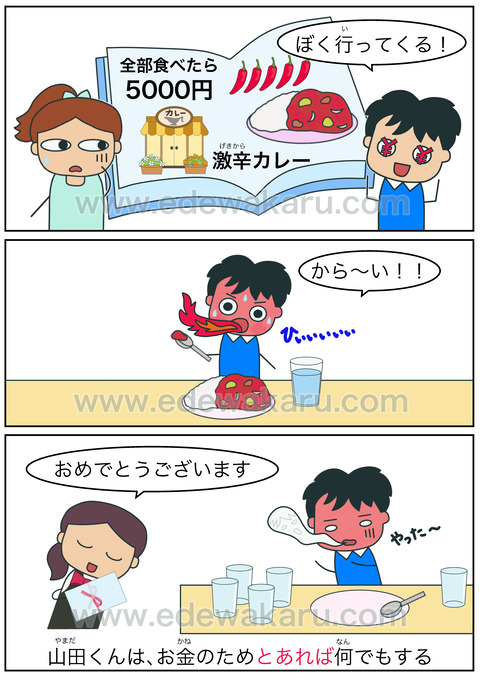
山田くんは、お金のためとあれば何でもする
→山田くんは、お金のためなら何でもするYamada will do anything if it’s for money. →Yamada will do anything for money.
A:彼女、男の子に大人気だねB:かわいくて性格もいいとあれば、モテて当然だよ
→かわいくて性格もいいなら、モテて当然だよA: She’s really popular with boys, isn’t she? B: If she’s cute and has a nice personality, of course she’s popular. →If she’s cute and has a nice personality, of course she’s popular.
社長の誘いとあれば、断るわけにはいかない…
→社長の誘いなら、断るわけにはいかない…If it’s the company president’s invitation, I can’t turn it down… →If it’s the company president’s invitation, I can’t turn it down…
彼女の頼みとあれば、手伝ってあげないわけにはいかない
→彼女の頼みなら、手伝ってあげないわけにはいかないIf it’s her request, I can’t refuse to help her. →If it’s her request, I can’t refuse to help her.
初めての一人暮らしとあれば、不安になるのもしかたがない
→初めての一人暮らしなら、不安になるのもしかたがないIf it’s her first time living alone, it’s understandable that she’d feel anxious. →If it’s her first time living alone, it’s understandable that she’d feel anxious.
A:両親が、留学のために300万円も出してくれたの!B:よかったね!親は子供のためとあれば、何だってするものなのよ
→親は子供のためなら、何だってするものなのよA: My parents gave me as much as three million yen so I could study abroad! B: That’s great! Parents will do anything for their children, if it’s for their children’s sake. →Parents will do anything for their children.
Read the original source text
Meaning
〜なら
How to use it
動詞・形容詞・名詞[普通形]+とあれば
Explanation
「AとあればB」は「AならB」という意味の文型です。「Aという状態ならBしなければならない」「AならBになるのはしかたがない」と言いたい時に使われます。 「〜のためとあれば」は「〜のためなら」という意味で、とてもよく使われます。
「〜とあれば」は「〜わけにはいかない」「〜ないわけにはいかない」などとよく使われますので、一緒に覚えておきましょう😊
日本語NET JLPT文法解説まとめ
Meaning
“If it means ...”
Used when you want to say that if the preceding clause is the case, then what follows is unavoidable or can't be helped.
How to use it
V (plain form) + とあれば
い-adjective (plain form) + とあれば
な-adjective + とあれば
N + とあれば
Explanation
If the first condition is met, then it is inevitable or unavoidable that the content of the latter will occur.
In context 6 examples
生きるためとあれば、罪を犯しても良いものでしょうか。
If it's to survive, is it all right to commit a crime?
私は愛する妻や息子のためとあれば、何でもする。
If it's for my beloved wife or son, I'll do anything.
命が助かるとあれば、いくらでも払います。
If it means saving a life, I'll pay any amount.
金のためとあれば、彼は友達さえも裏切る。
If it's for money, he'll even betray his friends.
親友の頼みとあれば、仕方がない。手伝ってあげるよ。
If it's a request from my best friend, I can't very well refuse. I'll help you.
そうとあれば善は急げだ。早速取り掛かろう。
If that's the case, there's no time like the present. Let's get started right away.
Read the original source text
Meaning
"〜なら "
前件なら、後件の内容が起こるのはやむを得ない、仕方がないと言いたい時に使う。
How to use it
V(普通形)+ とあれば
イA(普通形)+ とあれば
ナA + とあれば
N + とあれば
Explanation
If the first condition is met, then it is inevitable or unavoidable that the content of the latter will occur.
毎日のんびり日本語教師
How to use it
Verb plain form + とあれば
い-adjective plain form + とあれば
な-adjective stem + とあれば
Noun + とあれば
Explanation
It expresses giving one's all to make the following clause happen for the person or thing in the preceding clause, or that, given the situation in the preceding clause, one absolutely must do what is stated in the following clause.
It can be rephrased with the hypothetical 「なら」, but 「なら」 does not carry the nuance described above.
Notes
Similar sentence pattern: 「【N1文法】~とあっては」
In context 8 examples
彼女の頼みとあれば、協力しないわけにはいかない。
If it's a request from her, I can't refuse to help.
必要とあれば力を貸します。
If you need it, I'll lend you a hand.
それが運命とあれば仕方がない。
If that's fate, then it can't be helped.
お急ぎとあればいつでも連絡してください。
If you're in a hurry, please contact me anytime.
金のためとあれば彼は何でもする。
If it's for money, he'll do anything.
平和のためとあれば自分が犠牲になってもいい。
If it's for peace, I'm willing to sacrifice myself.
Aさんのお願いとあれば、それに応えないわけにはいかない。
If it's a request from A, I can't help but respond.
必要とあれば入院して手術を行います。
If necessary, I will be admitted to the hospital and undergo surgery.
Read the original source text
How to use it
動詞普通形+とあれば
い形容詞普通形+とあれば
な形容詞語幹+とあれば
名詞+とあれば
Explanation
前項の人物や物事のために全力で後件の実現にあたること、あるいは前項の状況下である以上必ず後件をしなければならないことを表します。
仮定の「なら」に言い換えられますが、「なら」には上記のようなニュアンスが含まれません。
Notes
似ている文型「【N1文法】~とあっては」
NINJAL 日本語文型データベース
Meaning
Used to state the speaker's judgment that if a special condition of 「〜」 holds, a certain outcome will naturally follow.
How to use it
V plain form + とあれば
i-A plain form + とあれば
na-A plain form + とあれば (「na-Aだ」 may also take the form 「na-A+とあれば」)
N plain form + とあれば (「Nだ」 may also take the form 「N+とあれば」)
Notes
「〜」 may describe either a fact or a hypothetical situation. After 「〜とあれば」 comes a sentence expressing the speaker's judgment, intention, or wish.
In context 18 examples
ここに空港ができるとあれば、ホテル業者はすぐに周辺の土地に目をつけるだろう。
If an airport is built here, hotel operators will probably turn their attention to the surrounding land right away.
実験にこれ以上お金はかけられないとあれば、別の方法を考えなければ……。
If we can't spend any more money on the experiment, we'll have to think of another way...
芸術大学を卒業したとあれば、それなりの才能を持っているはずだ。
If he graduated from an art university, he must have a certain amount of talent.
インターネットで検索して何も情報を見つけられなかったとあれば、そのような会社は実在しないと考えるべきではないか。
If you searched the internet and couldn't find any information, shouldn't you conclude that such a company doesn't exist?
あれだけ強引に進めたのに、その結果うまくいかなかったとあれば、主催者の責任問題は免れないだろう。
If they pushed ahead so forcefully and it still didn't work out, the organizers will probably have to take responsibility.
母は、体にいいとあれば何でもやってみたいと思っていたようだ。
My mother seemed to want to try anything if it was good for her health.
命がもう長くないとあれば、人は一日一日を大切に生きるのではないだろうか。
If a person's life is nearly over, wouldn't they cherish each day?
国家試験の問題が例年以上に難しかったとあれば、合格者は当然少なくなるはずだ。
If the national exam questions were harder than in previous years, then naturally there should be fewer successful candidates.
講演会の参加希望者がさほど多くなかったとあれば、来年は企画を見直さなければならないだろう。
If there weren't very many people interested in attending the lecture, we would probably have to review the plan for next year.
この貸しホールは研修会やパーティなどにご利用いただけます。テーブル、椅子、マイクなどの備品は大体そろっていますが、そのほかに必要とあれば、何でもご用意します。
This rental hall can be used for training sessions, parties, and so on. We have most of the necessary equipment, such as tables, chairs, and microphones, but if you need anything else, we will provide it.
高卒で弁護士になるのも不可能ではないとあれば、あとはもう目標に向けて頑張るだけだ。
If becoming a lawyer with only a high school diploma isn't impossible, all that's left is to work hard toward that goal.
あの議員の記者会見での発言が、ジェンダー差別の点で不適切だったとあれば、マスコミは黙ってはいないはずだ。
If that lawmaker's remarks at the press conference were inappropriate in terms of gender discrimination, the media won't stay silent.
政府側の説明がさほど丁寧でなかったとあれば、国民は納得しないだろう。
If the government's explanation wasn't very thorough, the public won't be convinced.
みなさん、ぜひ私の赴任地に遊びに来てください。お望みとあれば、どこかいい観光地に案内しますよ。
Everyone, please come visit me at my new post. If you like, I'll show you around a good tourist spot.
一人で3人の子どもたちを育てなければなりません。子どもたちのためとあれば、たいていのことは我慢します。
I have to raise three children on my own. If it's for my children, I'll put up with most things.
台風でリンゴ畑がひどい損害を受けた。これも運命だとあれば、受け入れよう。
The typhoon badly damaged the apple orchard. If this too is fate, I'll accept it.
スーパーなどで売っている生鮮食品には生産地を表示したラベルが貼ってある。それが正しい表示ではないとあれば、消費者はクレームをつけるはずだ。
Fresh foods sold at supermarkets and similar stores have labels showing where they were produced. If that information isn't accurate, consumers will surely complain.
この大学は新設されたばかりで、今年も入学試験は難しくなかった。狭き門ではなかったとあれば、今後は受験者が増えるだろう。
This university was only recently established, and this year's entrance exam wasn't difficult either. If it wasn't hard to get in, the number of applicants will probably increase in the future.
Read the original source text
Meaning
〜という特別な条件なら、当然ある事態になるという話し手の判断を述べるときに使います。
How to use it
V普通形+とあれば
i-A普通形+とあれば
na-A普通形+とあれば(「na-Aだ」→「na-A+とあれば」の形になることもある)
N普通形+とあれば(「Nだ」→「N+とあれば」の形になることもある)
Notes
「〜」は事実でも仮定のことでもいいです。「〜とあれば」の後には、話し手の判断・意向・希望を表す文がきます。
IMABI
と Combination Particles II
Read this IMABI lesson ↗Explanation
と Combination Particles II
In the next two lessons we will learn about more combination particles with と.
とも とあって とあれば といっ{た・て}
とも
とも is an emphatic version of the case particle と. Do not confuse with the conjunctive/final particle とも.
1. 君とも逢あえなくなるだろう。
I probably won’t be able to see you.
とあって
とあって means “because under the circumstances that/due to the fact that”.
2. 三連休とあって、すごい人出だ。
There is a turnout due to the fact that it is a three-day weekend.
3. 先生の頼みとあっては、お断りできません。
Because it is at your request, I cannot decline.
4. 素晴らしいホテルとあって、サービスは素晴らしい。
Since it is a wonderful hotel, the service is wonderful.
5. 休日とあって人出が多い。
It is also that there is a lot of people out on the holidays.
といって・といった
{と・そう}いった is placed after a list of nouns that are listed with particles like や, と, and とか to mean “such as”. といって means “however”. When not at the beginning of the sentence, it is often translated as “because” or “that…”. Though these phrases are from 言う, they are normally written in かな.
8. うちの息子は、科学や世界史といった科目が得意です。(From a mother)
Our son is good at subjects such as chemistry and world history.
9. 日本は、確かに経済大国となりました。{と言って・しかし}、国民一人一人の暮らしが豊かになったわけではあ りません。
Japan has certainly become an “economic giant”. However, that doesn’t mean that the way of life for each individual citizen has become wealthy.
Sentence Note: といって would not suitable for writing, but it would be fine in speech.
10a. 私は同意しました。だからといって、(私が)満足まんぞくしているわけではありません。
10b. 私は同意しましたが、満足しているわけではありません。
I agreed, but that doesn’t mean I am satisfied.
11a. そのように感じたからといって、誰も彼らを非難できませんよ。(Less natural ordering)
11b. 彼らがそのように感じたからといって、誰も非難できませんよ。
Nobody can blame them that they felt that way.
12. 今はこれといってすることがない。
I have nothing particular to do now.
13. 試験が終ったからといって努力を怠おこたってはいけない。
You mustn’t give up your efforts because the exam is over.
14. 彼女はケーキとかそういったものを焼いた。
She baked cakes and stuff like that.
15. 「真理」とか「美び」といった抽象的ちゅうしょうてきな言葉
Abstract words such as “truth” and “beauty
~からといって means “while it’s true that/even though/just because”. It normally sends a message of warning. The clause that follows should be negative in some way, either grammatically or in perspective. Don’t let translation confuse you.
A similar phrase is からに, which means “just by/from” and is used with the non-past. からには, on the other hand, expresses determination and is equivalent to “now that.”
16. 天才てんさいだからといって威張いばるなよ。
Don’t brag just because you’re a genius.
17. 皆みなそういうからには怖こわい話だよ。
Just by everyone saying it, it’s a scary story!
18. 彼は約束やくそくしたからには必かならずやる(男だ)。
He will surely do it just from promising.
Variant Notes:
1. からといって may be からって(ー) in colloquial speech or からとて in formal texts.
2. からには may be からは in literary language.
とあれば
Also as とあらば, which is more poetic/nostalgic and old-fashioned, it shows a case established in a latter event(s) and is best translated as “if it is the case that”.
19. お望みとあらば、今すぐ。(Slightly archaic)
(Go) right now if it is your wish.
20. 必要とあればすぐに伺います。(A little old-fashioned)
I will come immediately if it is necessary.
In context 22 examples
君とも逢あえなくなるだろう。
I probably won’t be able to see you.
三連休とあって、すごい人出だ。
There is a turnout due to the fact that it is a three-day weekend.
先生の頼みとあっては、お断りできません。
Because it is at your request, I cannot decline.
素晴らしいホテルとあって、サービスは素晴らしい。
Since it is a wonderful hotel, the service is wonderful.
休日とあって人出が多い。
It is also that there is a lot of people out on the holidays.
うちの息子は、科学や世界史といった科目が得意です。(From a mother)
Our son is good at subjects such as chemistry and world history.
日本は、確かに経済大国となりました。{と言って・しかし}、国民一人一人の暮らしが豊かになったわけではあ りません。
Japan has certainly become an “economic giant”. However, that doesn’t mean that the way of life for each individual citizen has become wealthy.
私は同意しました。だからといって、(私が)満足まんぞくしているわけではありません。
I agreed, but that doesn’t mean I am satisfied.
私は同意しましたが、満足しているわけではありません。
I agreed, but that doesn’t mean I am satisfied.
そのように感じたからといって、誰も彼らを非難できませんよ。(Less natural ordering)
Nobody can blame them that they felt that way.
彼らがそのように感じたからといって、誰も非難できませんよ。
Nobody can blame them that they felt that way.
今はこれといってすることがない。
I have nothing particular to do now.
試験が終ったからといって努力を怠おこたってはいけない。
You mustn’t give up your efforts because the exam is over.
彼女はケーキとかそういったものを焼いた。
She baked cakes and stuff like that.
「真理」とか「美び」といった抽象的ちゅうしょうてきな言葉
Abstract words such as “truth” and “beauty
天才てんさいだからといって威張いばるなよ。
Don’t brag just because you’re a genius.
皆みなそういうからには怖こわい話だよ。
Just by everyone saying it, it’s a scary story!
彼は約束やくそくしたからには必かならずやる(男だ)。
He will surely do it just from promising.
からといって may be からって(ー) in colloquial speech or からとて in formal texts.
からといって may appear as からって(ー) in colloquial speech, or as からとて in formal texts.
からには may be からは in literary language.
からには may appear as からは in literary language.
お望みとあらば、今すぐ。(Slightly archaic)
(Go) right now if it is your wish.
必要とあればすぐに伺います。(A little old-fashioned)
I will come immediately if it is necessary.
Read the original source text
Explanation
と Combination Particles II
In the next two lessons we will learn about more combination particles with と.
とも とあって とあれば といっ{た・て}
とも
とも is an emphatic version of the case particle と. Do not confuse with the conjunctive/final particle とも.
1. 君とも逢あえなくなるだろう。
I probably won’t be able to see you.
とあって
とあって means “because under the circumstances that/due to the fact that”.
2. 三連休とあって、すごい人出だ。
There is a turnout due to the fact that it is a three-day weekend.
3. 先生の頼みとあっては、お断りできません。
Because it is at your request, I cannot decline.
4. 素晴らしいホテルとあって、サービスは素晴らしい。
Since it is a wonderful hotel, the service is wonderful.
5. 休日とあって人出が多い。
It is also that there is a lot of people out on the holidays.
といって・といった
{と・そう}いった is placed after a list of nouns that are listed with particles like や, と, and とか to mean “such as”. といって means “however”. When not at the beginning of the sentence, it is often translated as “because” or “that…”. Though these phrases are from 言う, they are normally written in かな.
8. うちの息子は、科学や世界史といった科目が得意です。(From a mother)
Our son is good at subjects such as chemistry and world history.
9. 日本は、確かに経済大国となりました。{と言って・しかし}、国民一人一人の暮らしが豊かになったわけではあ りません。
Japan has certainly become an “economic giant”. However, that doesn’t mean that the way of life for each individual citizen has become wealthy.
Sentence Note: といって would not suitable for writing, but it would be fine in speech.
10a. 私は同意しました。だからといって、(私が)満足まんぞくしているわけではありません。
10b. 私は同意しましたが、満足しているわけではありません。
I agreed, but that doesn’t mean I am satisfied.
11a. そのように感じたからといって、誰も彼らを非難できませんよ。(Less natural ordering)
11b. 彼らがそのように感じたからといって、誰も非難できませんよ。
Nobody can blame them that they felt that way.
12. 今はこれといってすることがない。
I have nothing particular to do now.
13. 試験が終ったからといって努力を怠おこたってはいけない。
You mustn’t give up your efforts because the exam is over.
14. 彼女はケーキとかそういったものを焼いた。
She baked cakes and stuff like that.
15. 「真理」とか「美び」といった抽象的ちゅうしょうてきな言葉
Abstract words such as “truth” and “beauty
~からといって means “while it’s true that/even though/just because”. It normally sends a message of warning. The clause that follows should be negative in some way, either grammatically or in perspective. Don’t let translation confuse you.
A similar phrase is からに, which means “just by/from” and is used with the non-past. からには, on the other hand, expresses determination and is equivalent to “now that.”
16. 天才てんさいだからといって威張いばるなよ。
Don’t brag just because you’re a genius.
17. 皆みなそういうからには怖こわい話だよ。
Just by everyone saying it, it’s a scary story!
18. 彼は約束やくそくしたからには必かならずやる(男だ)。
He will surely do it just from promising.
Variant Notes:
1. からといって may be からって(ー) in colloquial speech or からとて in formal texts.
2. からには may be からは in literary language.
とあれば
Also as とあらば, which is more poetic/nostalgic and old-fashioned, it shows a case established in a latter event(s) and is best translated as “if it is the case that”.
19. お望みとあらば、今すぐ。(Slightly archaic)
(Go) right now if it is your wish.
20. 必要とあればすぐに伺います。(A little old-fashioned)
I will come immediately if it is necessary.