日本語文型辞典
Meaning
A casual conversational expression meaning “といったら.” Used to bring something up as a topic while conveying the speaker’s affection, teasing, admonishment, criticism, concern, or similar feelings. Used mainly by children and women.
Attached to an imperative or a te-form, it is used to speak forcefully to someone with the feeling, “I’ve told you to do this, so why aren’t you doing it?” The same verb is often repeated. The imperative form is used by men. Casual conversational speech.
Used in response to what the other person has said to reject their suspicion of the speaker or something similar. Casual conversational speech.
Expresses an extreme degree. Casual conversational speech.
How to use it
Nったら
Vったら
…ったら
ったらない
In context 12 examples
太郎ったら、女の子の前で赤くなってるわ。
Taro, look at him blushing in front of the girl!
A:松井さん昔はほんとうに小さくてかわいかったけど、今はすっかりいいお母さんだね。
B:まあ先生ったら。小学校を卒業してからもう20年ですもの。A: Matsui was really little and cute back then, but now she’s such a wonderful mother. B: Oh, Professor, you’re teasing me! It’s already been 20 years since I graduated from elementary school.
A:このカレンダーの赤丸なんだったかな。
B:もうあなたったら忘れたの。私たちの結婚記念日じゃありませんか。A: What was the red circle on this calendar for? B: Oh, you! Have you forgotten already? It’s our wedding anniversary.
多恵子ったら、どうしたのかしら。いくら呼んでも返事がないけど。
I wonder what’s wrong with Taeko. No matter how many times I call her, she doesn’t answer.
お母さんったら。ちゃんと話を聞いてよ。
Mom, come on. Listen to what I’m saying.
こっちへ来いったら。
Come over here, I said!
やめろったらやめろよ。
Stop it, I said! Stop it!
やめてったらやめてよ。
Stop it, I said! Stop it!
A:ひとりで出来るの?
B:出来るったら。A: Can you do it by yourself? B: I said I can!
A:飲んだらコーヒーカップちゃんと洗って。
B:うん、わかった。
A:ほんとにわかったの?コーヒーカップは?
B:わかったったら。同じことそう何度も言うなよ。A: When you’re done drinking, make sure you wash the coffee cup. B: Yeah, got it. A: Do you really understand? What about the coffee cup? B: I said I got it. Don’t keep saying the same thing over and over.
うちのおやじ、うるさいったらない。
My old man is unbearably annoying.
あの時のあいつのあわてかたったらなかったよ。
The way that guy panicked back then was unbelievable.
Read the original source text
Meaning
「といったら」の意味で、くだけた話しことばに用いる。話し手が親しみ、からかい、たしなめ、非難、心配などの気持ちを込めて話題に取り上げるのに用いる。主に子供、女性が使う。
命令形や、テ形に付いて、「こう言っているのにどうしてそうしないのだ」という気持ちで相手に強く言うのに用いる。同じ動詞を繰り返して使うことが多い。命令形は男性が使う。くだけた話しことば。
相手の言葉を受けて、相手の自分に対する疑いなどをはねつける気持ちを表す。くだけた話しことば。
程度が激しいことを表す。くだけた話しことば。
How to use it
Nったら
Vったら
…つたら
ったらない
絵でわかる日本語
Usage 1
Read this source entry ↗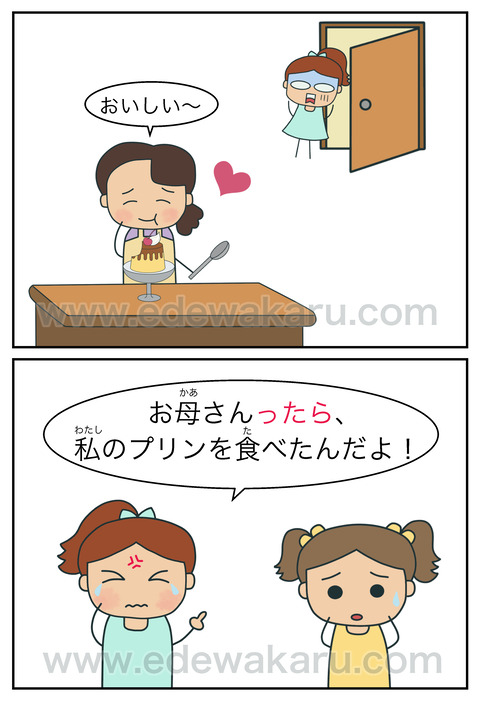
Meaning
(With emotion) “as for 〜”
How to use it
Noun [dictionary form] + ったら
Explanation
“〜ったら” is a sentence pattern used with the same meaning as “は,” which marks the topic. Compared with “は,” it is characterized by more strongly expressing the speaker’s feelings, such as surprise, being moved, reproach, or worry. 😮
[Examples]
Mom ate my pudding.
Mom ate my pudding! → Emphasizes anger and reproach.
[For those who want to learn more]
“〜ったら” is the colloquial form of “〜といったら,” so it can be substituted for it. However, while “〜といったら” can be used to express an association or connection, as with “〜といえば” and “〜というと,” “〜ったら” cannot. 😨 (Review: 〜といえば・〜というと)
[Examples]
⭕️ Speaking of spring, cherry blossoms.
⭕️ When you say spring, cherry blossoms.
⭕️ As for spring, cherry blossoms.
❌ Spring cherry blossoms.
“〜ったら” can only be used when speaking with emotion, so be careful. 😊 Also remember that in most cases it is an expression used by women. 😉
In context 4 examples
お母さんったら、私のプリンを食べたんだよ!【怒り】
→お母さんは、私のプリンを食べたんだよ!Mom ate my pudding! [Anger] → Mom ate my pudding!
うちの息子ったら、ゲームしてばかりいるの… (復習:〜てばかりいる)【失望】
→うちの息子は、ゲームしてばかりいるの…My son is always playing games... (Review: 〜てばかりいる) [Disappointment] → My son is always playing games...
山田さんったら、酔ってはケンカするの(復習:〜ては〜)【非難】
→山田さんは、酔ってはケンカするのYamada gets drunk and picks fights. (Review: 〜ては〜) [Reproach] → Yamada gets drunk and picks fights.
夫:君はいつもキレイだね妻:あなたったら、お世辞が上手ね【嬉しいという気持ち】
→あなたは、お世辞が上手ねHusband: You always look beautiful. Wife: Oh, you’re such a flatterer. [Feeling happy] → You’re such a flatterer.
Read the original source text
Meaning
(感情を込めて)〜は
How to use it
名詞[辞書形]+ったら
Explanation
「〜ったら」は主題を表す「は」と同じ意味で使われる文型です。
「は」に比べて、話者の感情[驚き・感動・非難・心配など]をよく表すのが特徴です
😮
[例]
お母さん
は
私のプリンを食べたんだよ
お母さん
ったら
私のプリンを食べたんだよ→【怒り】【非難】の気持ちを強調
【余裕のある人へ】
「〜ったら」は「〜といったら」の口語形ですのでチェンジすることができます。しかし、「〜といえば・〜というと」のように【関連・連想】を表す場合は「〜といったら」は使えますが、「〜ったら」使えません
😨(復習:〜といえば・〜というと)
[例]
⭕️春
といえば
桜だ
⭕️春
というと
桜だ
⭕️春
といったら
桜だ
❌春
ったら
桜だ
「〜ったら」感情を込めて言う場合以外は使えませんので気をつけて下さい
😊また、ほとんどの場合は女性が使う表現だということも覚えておいてください😉
Usage 2
Read this source entry ↗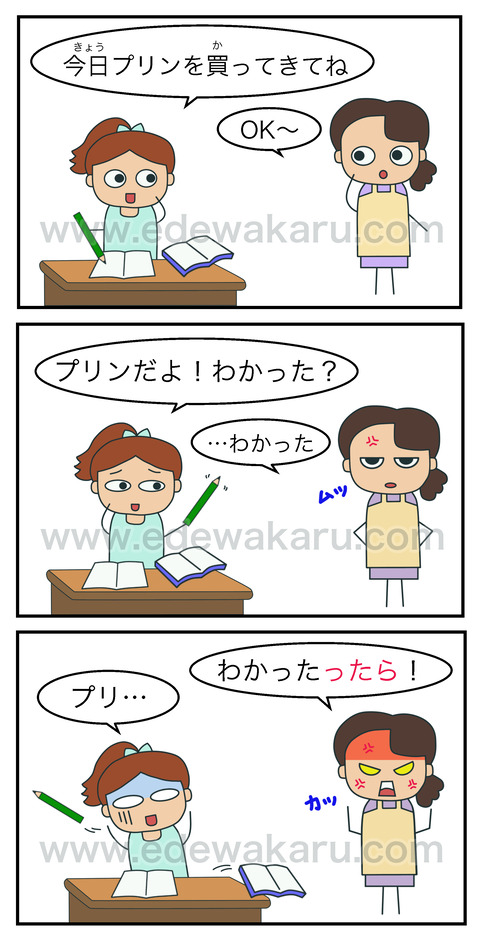
Meaning
Emphasizes one’s own point to the other person
[Example 1]
Daughter: Buy pudding today, okay?
Mother: OK~
Daughter: I mean pudding! Got it?
Mother: ...I got it.
Daughter: Pudding...
Mother: I said I got it!
[Example 2]
Mother: Did you do your homework?
Daughter: I did.
Mother: Really?
Daughter: I said I did!!
How to use it
Verb [plain form] + ったら
Explanation
“〜ったら” is a sentence pattern that expresses the speaker’s irritation when the other person does not understand what they are trying to say. It is used in conversations with family and friends, so be careful not to use it with someone of higher status. 😨
[For those who want to learn more]
“〜ったら” can also be used to repeat the same verb and say something forcefully to the other person. 😮 In this case, it is used with the imperative form or the て-form.
[Examples]
やめろったら
I said stop!
食べろったら
I said eat!
帰ってったら
I said come home!
Men use the imperative form, so women should avoid using it. Women should use the て-form. 😉
“〜ったら” is used with almost the same meaning as “〜ってば.”
(Review: 〜ってば)
Be careful: when repeating the expression, you cannot change it to “〜ってば.” 😨 If you have forgotten “〜ってば,” review it. 😊
Read the original source text
Meaning
相手に自分の主張を強調する
【例文1】
娘:今日プリンを買ってきてね
母:OK〜
娘:プリンだよ!わかった?
母:…わかったよ
娘:プリ…
母:わかった
ったら!
【例文2】
母:宿題やったの?
娘:やったよ
母:本当に?
娘:やった
ったら!!
How to use it
動詞[普通形]+ったら
Explanation
「〜ったら」は相手に自分の言いたいことがわかってもらえずに、話者がイライラしている様子を表す文型です。これは家族や友達との会話で使われるものですから、
目上の人には使わないように気をつけてください
😨
【余裕のある人へ】
「〜ったら」は同じ動詞を繰り返して、相手に強く言うのにも使われます😮この場合、【命令形】【て形】に使われます。
[例]
やめろ
ったら
やめろよ!
食べろ
ったら
食べろよ!
帰って
ったら
帰ってよ!
【命令形】は男性が使うものですから、女性は使わないようにしましょう。女性は【て形】を使うようにしてくださいね😉
「〜ったら」は「〜ってば」とほとんど同じ意味で使用されます。
(復習:〜ってば)
繰り返す場合は「〜ってば」にチェンジできませんので気をつけてください
😨「〜ってば」を忘れてしまった人は復習しておいてくださいね😊
日本語文型辞典 英語版
Meaning
B:まあ先生ったら。小学校を卒業してからもう 20 年ですもの。
Well, Sensei (Professor), it’s already been twenty years since I graduated.
B:もうあなたったら忘れたの。私たちの結婚記念日じゃありませんか。
You’ve forgotten? It’s our wedding anniversary!
Used in informal spoken language and means “as for....” Used when the speaker raises a topic with feelings of closeness, teasing, criticism, or worry implied. Mostly used by children and women.
Attached to imperative forms or te-forms to make a strong suggestion to the listener, with the feeling of “why won’t you do such-and-such, even though I’m telling you to?” The same verb is often repeated. The imperative form is used by men. Informal spoken language.
B:出来るったら。
I said I can.
B:うん、わかった。
OK, sure.
A:ほんとにわかったの? コーヒーカップは?
Did you really understand? Where is your coffee cup?
B:わかったったら。同じことそう何度も言うなよ。
Hey, I said I understood. Don’t say the same thing over and over!
Expresses the feeling of refuting a doubt which the listener has expressed to the speaker. Follows a statement by the listener. Informal spoken language.
Expresses that the degree is severe. Informal spoken language.
How to use it
1. Nったら
2. Vったら
3. ...ったら
4. ったらない
In context 12 examples
太郎ったら、女の子の前で赤くなってるわ。
Look at that Taro blushing in front of the girls!
A:松井さん昔はほんとうに小さくてかわいかったけど、今はすっかりいいお母さんだね。
Matsui-san, you were so cute and little back in those days, and now you’re every inch a mother.
A:このカレンダーの赤丸なんだったかな。
What is this red circle on the calendar?
多恵子ったら、どうしたのかしら。いくら呼んでも返事がないけど。
What happened to Taeko? She won’t reply no matter how many times I call her.
お母さんったら。ちゃんと話を聞いてよ。
Come on, Mother. Listen to me carefully!
こっちへ来いったら。
I said come here.
やめろったらやめろよ。
(a man speaking) I said to stop, so stop it!
やめてったらやめてよ。
(a woman speaking) I told you to stop, so why don’t you stop?
A:ひとりで出来るの?
Can you do it alone?
A:飲んだらコーヒーカップちゃんと洗って。
Be sure to wash your coffee cup after you’re done.
うちのおやじ、うるさいったらない。
My old man (Dad) is a real pain.
あの時のあいつのあわてかたったらなかったよ。
I can’t tell you how much he panicked at that time.
Read the original source text
Meaning
B:まあ先生ったら。小学校を卒業してからもう 20 年ですもの。
Well, Sensei (Professor), it’s already been twenty years since I graduated.
B:もうあなたったら忘れたの。私たちの結婚記念日じゃありませんか。
You’ve forgotten? It’s our wedding anniversary!
Used in informal spoken language and means “as for....” Used when the speaker raises a topic with feelings of closeness, teasing, criticism, or worry implied. Mostly used by children and women.
Attached to imperative forms or te-forms to make a strong suggestion to the listener, with the feeling of “why won’t you do such-and-such, even though I’m telling you to?” The same verb is often repeated. The imperative form is used by men. Informal spoken language.
B:出来るったら。
I said I can.
B:うん、わかった。
OK, sure.
A:ほんとにわかったの? コーヒーカップは?
Did you really understand? Where is your coffee cup?
B:わかったったら。同じことそう何度も言うなよ。
Hey, I said I understood. Don’t say the same thing over and over!
Expresses the feeling of refuting a doubt which the listener has expressed to the speaker. Follows a statement by the listener. Informal spoken language.
Expresses that the degree is severe. Informal spoken language.
How to use it
1. Nったら
2. Vったら
3. ...ったら
4. ったらない
Bunpro Grammar Reference
Meaning
Cannot tell, describe, say, express or find words for how, Words cannot express, Too … for words, Extremely
How to use it
More common patterns:
Noun + たら(1) + ありゃしない(2)
[い]Adjective[さ](3) + たら(1) + ありゃしない(2)
Less common patterns:
Verb + たら(1) + ありゃしない(2)
[な]Adjective + たら(1) + ありゃしない(2)
(1) といったら
(2) ありはしない
(3)[い]Adjective
Nuance
A very casual, hypothetical structure, emphasizing that (A) cannot be described. When it's (A), there's nothing to be said. Only used negatively.
In context 6 examples
- 「凹凸の多い地形は走りにくいと言ったらありはしない。」
'I cannot tell you how difficult it is to run on uneven terrain.'
- 「犬を飼ったのに世話をしないなんて、無責任ったらありゃしない。」
'I cannot tell you how irresponsible it is to keep a dog but not take care of it.'
- 上司:「君は毎日毎日、会社に遅刻して来て。見苦しいったらありゃしないぞ。」
Boss: 'You are late for work every single day. I can't tell you how unseemly it is!'
- 「さだおさんの企業が倒産してからの元従業員の連中の態度と言ったらありゃしない。」
'I cannot express the attitude of Sadao's former employees after his company went bankrupt.'
- 「昨晩遅くに帰宅したルームメイトに起こされた。腹がたつったらありゃしない。」
'I was awoken by my roommate who returned home late last night. I can't tell you how angry I am.'
- 厳しいおばあさん:「大人のくせにそんな態度!全くみっともないったらありゃしないのよ。」
Strict grandmother: 'You are an adult, and you are acting like that. I can't express how disgraceful it is!'
IMABI
~ったら & ~ってば
Read this IMABI lesson ↗Explanation
~ったら & ~ってば
~ったら and ~ってば are technically the colloquial contractions of ~といったら and ~といえば respectively. Although they can be used solely as colloquial contractions of these patterns, they have also each evolved their own unique usages that we will primarily be learning about in this lesson.
~ったら
As stated above, ~ったら can simply be used as a very colloquial contraction of ~といったら, as demonstrated in the following example sentences.
1. 俺おれが来きいったら、来い!
When I say come, come!
2. カレーったらカレーだ!
Now this is curry!
3. うるさいったらうるさい!
God, you’re so annoying!
As can be deduced from these three examples, a lot of emotion is packed into this contraction, and it can be used in both positive and negative connotations. Ex. 1 even demonstrates how it can be used in a commanding manner.
~ったらない
The tone that can be seen in Ex. 2 can be expanded upon in the pattern ~ったらない. This can be viewed as a simplification of ~と言ったら他にない. Essentially, “there isn’t anything as…as” whatever is being discussed. Or, “it is impossible” for whatever you’re discussing to be “any more” like how you’re describing it because it is already so very “x.” Lastly, as far as its usage is concerned, it can go after nouns, adjectives, or verbs.
4. この子犬こいぬ、可愛かわいいったらない。
This puppy couldn’t be any cuter!
5. テキサス州しゅうの暑あつさといったらない。
The heat in Texas couldn’t get any hotter than this.
6. お袋ふくろの心配しんぱいったらなかった。
You can imagine how worried my mother was.
7. 日本語にほんごの曖昧あいまいさったらない。
Japanese couldn’t be vaguer.
8. このイワシ、臭くささったらない
These sardines, they couldn’t smell any worse!
Spelling Note: イワシ is seldom spelled as 鰯. For those of you who notice 鰮 as an option when typing, this character is essentially not used in Japanese, but it does incidentally mean “small fish” in Chinese.
9. 今いまの時代じだい、携帯けいたいやパソコンなどがないなら、不自由ふじゆうといったらない。
One couldn’t possibly be any more inconvenienced without having cellphones, PCs, etc. in this day in age.
10. みんなの前まえで転ころんで、恥はずかしいったらない。
There couldn’t be anything more embarrassing than tripping in front of everyone.
11. このところ、残業続ざんぎょうつづきで疲つかれると言いったらない。
You can imagine how tired I’ve been from continued overtime recently.
12. 成人女性せいじんじょせいの着物姿きものすがたの美うつくしさったらない。
There’s nothing as beautiful as an adult woman in kimono.
~ったらありゃしない
An even more emphatic variation of this is ~ったらありゃしない. This is essentially only used with adjectives. As seen below, some variation in its appearance can be found. You can see the ったら part uncontracted as といったら, see ったら as ったりゃ, or see the りゃ part elongated as りゃあ.
13. 1いっヶか月げつもお風呂ふろに入はいらないのは汚きたないといったらありゃしない。
One couldn’t possibly be any filthier than when one hasn’t bathed in over a month.
14. 寒さむいったりゃありゃしない!
It couldn’t be possibly colder than this!
15. 羨うらやましいったりゃありゃしない。
I couldn’t possibly be more jealous.
Expressing Annoyance
As you can imagine, if it can be used in such a positive manner, it can be used in the exact opposite way. Whenever ったら is seen after proper nouns, you can express exasperating frustration.
16. 兄貴あにきったらまだ寝ねてるぞ。
Ugh, my big brother…he’s still sleeping.
17. 神田かんださんったら、よく言いうよね。
Oh, Kanda-san, you say that a lot, don’t you.
18. 雅美まさみったら、無茶言むちゃいわないで。
Ugh, Masami, don’t say something so absurd.
19. もう彼氏かれしったら・・・
Ugh, my boyfriend…
20.トランプ大統領だいとうりょうったら、就任しゅうにん1いっヶか月げつで、じゃんじゃん大統領令だいとうりょうれいをサインしているけど、その速さが怖い!
Gah, President Trump has been signing executive orders like crazy in his first month since being inaugurated, but it’s the speed of that which is scary!
21. 自衛隊じえいたいったら、本当ほんとうにお堅けんいんだなあ。
The Self Defense Force is so uptight.
~ってば
As stated in the introduction, at its basic understanding, ~ってば can be viewed as a very colloquial contraction of ~といえば.
22. 暇ひまってば暇ひまでしょう。
When talking about free time, it (should be) free time, you know.
23. ブドウってばフランス産さんがいいなぁ。
Speaking of grapes, ones made-in-France are really good.
24. この和菓子わがしってば、ぴったりだね。
Speaking of this wagashi, it’s perfect, huh.
25. 海うみってば、昨日きのうまでずいぶん荒あれてたね。
Speaking of the sea, it was pretty rough until yesterday, huh.
Similarly to ~ったら but with far more anger behind it, ~ってば can be used to sharply criticize. It is a great way to indicate annoyance or giving a sharp command by expressing your annoyance.
26. 辰己たつみってば!
Gah, Tatsumi!!!
27. 違ちがうってば!
I said it’s wrong!
28. 早はやく持もってきなさいってば!
I told you to hurry and bring it!
29. 要いらないってば、要いらない!
When I say it’s not needed, it’s not needed!
30. ヤダったらヤダってば!
When I say no, I mean no!
In context 30 examples
俺おれが来きいったら、来い!
When I say come, come!
カレーったらカレーだ!
Now this is curry!
うるさいったらうるさい!
God, you’re so annoying!
この子犬こいぬ、可愛かわいいったらない。
This puppy couldn’t be any cuter!
テキサス州しゅうの暑あつさといったらない。
The heat in Texas couldn’t get any hotter than this.
お袋ふくろの心配しんぱいったらなかった。
You can imagine how worried my mother was.
日本語にほんごの曖昧あいまいさったらない。
Japanese couldn’t be vaguer.
このイワシ、臭くささったらない
These sardines, they couldn’t smell any worse!
今いまの時代じだい、携帯けいたいやパソコンなどがないなら、不自由ふじゆうといったらない。
One couldn’t possibly be any more inconvenienced without having cellphones, PCs, etc. in this day in age.
みんなの前まえで転ころんで、恥はずかしいったらない。
There couldn’t be anything more embarrassing than tripping in front of everyone.
このところ、残業続ざんぎょうつづきで疲つかれると言いったらない。
You can imagine how tired I’ve been from continued overtime recently.
成人女性せいじんじょせいの着物姿きものすがたの美うつくしさったらない。
There’s nothing as beautiful as an adult woman in kimono.
1いっヶか月げつもお風呂ふろに入はいらないのは汚きたないといったらありゃしない。
One couldn’t possibly be any filthier than when one hasn’t bathed in over a month.
寒さむいったりゃありゃしない!
It couldn’t be possibly colder than this!
羨うらやましいったりゃありゃしない。
I couldn’t possibly be more jealous.
兄貴あにきったらまだ寝ねてるぞ。
Ugh, my big brother…he’s still sleeping.
神田かんださんったら、よく言いうよね。
Oh, Kanda-san, you say that a lot, don’t you.
雅美まさみったら、無茶言むちゃいわないで。
Ugh, Masami, don’t say something so absurd.
もう彼氏かれしったら・・・
Ugh, my boyfriend…
トランプ大統領だいとうりょうったら、就任しゅうにん1いっヶか月げつで、じゃんじゃん大統領令だいとうりょうれいをサインしているけど、その速さが怖い!
Gah, President Trump has been signing executive orders like crazy in his first month since being inaugurated, but it’s the speed of that which is scary!
自衛隊じえいたいったら、本当ほんとうにお堅けんいんだなあ。
The Self Defense Force is so uptight.
暇ひまってば暇ひまでしょう。
When talking about free time, it (should be) free time, you know.
ブドウってばフランス産さんがいいなぁ。
Speaking of grapes, ones made-in-France are really good.
この和菓子わがしってば、ぴったりだね。
Speaking of this wagashi, it’s perfect, huh.
海うみってば、昨日きのうまでずいぶん荒あれてたね。
Speaking of the sea, it was pretty rough until yesterday, huh.
辰己たつみってば!
Gah, Tatsumi!!!
違ちがうってば!
I said it’s wrong!
早はやく持もってきなさいってば!
I told you to hurry and bring it!
要いらないってば、要いらない!
When I say it’s not needed, it’s not needed!
ヤダったらヤダってば!
When I say no, I mean no!