AIUEO JLPT Grammar
Meaning
This sentence pattern is used when someone continues their actions despite ignoring the expectations, circumstances, or emotions of others.
How to use it
Noun を + よそに
In context 5 examples
批判をよそに、彼は独自のスタイルを貫いた。
Disregarding the criticism, he stuck to his own style.
周囲の反対をよそに、彼女は起業した。
Despite the opposition from those around her, she started her own business.
周囲の心配をよそに、彼は冒険に出かけた。
Ignoring the concerns of those around him, he set out on a dangerous adventure.
みんなの忠告をよそに、彼は無謀な計画を進めた。
Ignoring everyone’s advice, he proceeded with his reckless plan.
先生の指導をよそに、彼は我流で勉強を続けた。
Ignoring the teacher’s guidance, he continued to study in his own way.
Read the original source text
Meaning
This sentence pattern is used when someone continues their actions despite ignoring the expectations, circumstances, or emotions of others.
How to use it
名詞を+よそに
Explanation · 日本語
この文型は、周囲の期待や状況、感情を無視して、自分の行動を続ける場合に使われます。
文法
Meaning
without worrying about ~ / without fearing ~ / regardless of ~
How to use it
N + をよそに
Notes
It is often used when criticizing someone.
In context 5 examples
息子は親の心配をよそに、仕事もせずに毎日遊んでばかりしている。
Paying no heed to his parents' worries, their son spends every day just playing around without even working.
息子は親の期待をよそに、医学部を卒業しても医者にならずアルバイトで生計を立てている。
Contrary to his parents’ expectations, even after graduating from medical school, their son didn’t become a doctor and earns a living through part-time jobs.
住民の反対をよそに、マンションの建設工事が始まった。
Despite the residents’ opposition, construction of the apartment building began.
子育てて苦しんでいる私をよそに、旦那はテレビばかり見ていて手伝おうとしない。
While I struggle with raising the children, my husband just watches TV and won’t help.
二人は周囲の反対をよそに、結婚してしまった。
The two got married despite the opposition of those around them.
Read the original source text
Meaning
〜を心配しないで / 〜を恐れないで / 〜に関係なく
How to use it
N + をよそに
Notes
相手を非難するときに使うことが多い。
Bunpro Grammar Reference
Meaning
Ignoring, Disregarding, Despite
How to use it
Noun + をよそに
Phrase + の + をよそに
Nuance
A formal construction used when doing (B), despite the situation of (A). Making (A) another place, (B). Often critical of (B).
Explanation
を余所に is used to express that (A) is something that effectively has nothing to do with the speaker, or that the speaker is ignoring it in relation to something else. It may be translated as 'ignoring (A)', or 'disregarding (A)'. It is a combination of the adverbial particle を, the noun 余所 'other place', and the case-marking particle に. Due to this, its literal meaning is close to 'putting (A) completely aside, (B)'.
This structure will follow nouns, or phrases that have been nominalized with の. It is reasonably formal, so will be seen more often in writing.
彼は親の心配をよそに、毎晩夜遅くまで友達と遊んでいる。
Ignoring his parent's worries, he hangs out with his friends every night until late at night.
社長は社員の反対をよそに、仕事の効率を上げるために休憩所を撤去した。
Ignoring objections from his workers, the president got rid of the break room in order to increase efficiency.
彼は周囲の視線をよそに、コンビニの店員に暴言を吐き続けていた。
Ignoring the eyes of those around him, he continued to lash out on the convenience store worker.
The most common pattern for をよそに to follow is that (A) expresses some overall situation, while (B) indicates an action that is being done without any thought or care given toward those circumstances. Because of this, it is often used critically about actions that are seen as irresponsible.
Caution
While this grammar point will primarily highlight the actions of people, it will generally not be used to refer to the speaker's own actions.
私は両親の反対をよそに、彼と結婚することにした。
Ignoring my parents' objections, I decided to marry him. (Unnatural Japanese)
In context 17 examples
- メアリーと武は親の反対を余所に一緒になった。
Ignoring objections from their parents, Mary and Takeshi got together.
- 彼は親の心配をよそに、毎晩夜遅くまで友達と遊んでいる。
Ignoring his parent's worries, he hangs out with his friends every night until late at night.
- 彼は周囲の視線をよそに、コンビニの店員に暴言を吐き続けていた。
Ignoring the eyes of those around him, he continued to lash out on the convenience store worker.
- 社長は社員の反対をよそに、仕事の効率を上げるために休憩所を撤去した。
Ignoring objections from his workers, the president got rid of the break room in order to increase efficiency.
- 母の心配を余所に、彼は商船の船員になった。
Ignoring his mother's worries, he has become a merchant seaman.
- 彼は泣いている子猫を余所に、そのまま猫を置き去りにして行ったのです。
Disregarding that it was a crying kitten, he completely abandoned it and went like that.
- ピーターは周りの忠告を余所に、MMO(エムエムオー)RPG(アールピージー)ゲームばかりすることを存分に楽しんだ。
Ignoring the advice of those close to him, Peter does nothing but play MMORPG games to his heart's content.
- 私たちがその衝撃的な言葉の意味をまだ飲み込めてないのを余所に彼女は説明を続けた。
Ignoring that we still haven't digested the meaning of her shocking remark, she continued the explanation.
- 彼女は両親の心配を余所に都内での一人暮らし生活を謳歌しているようだ。
Disregarding her parents’ concerns, she seems to be reveling in the fact that she is living alone in the city center.
- 浪人生活で苦しんでいる僕を余所に、友達たちは毎日楽しそうな生活を送っています。
Despite that I am struggling with my jobless life, my friends are leading a fun life every day.
- 地域住民の反対の声を余所に、自治体が空港建設の計画を進めている。
Ignoring the voices of opposition, the local government carries forward the plan of airport construction.
- 豪雨の天気予報を余所に傘を持たずに家を出た兄がずぶ濡れで帰ってきました。
Disregarding the forecast of heavy rain, my brother left the house without an umbrella and returned home soaking wet.
- 幸原さんは仲間の学生や教師の期待を余所に、学校を中退し、気の向くままに旅に出た。
Mr. Yukihara, ignoring the expectations of his fellow students and teachers, dropped out of school and embarked on a journey at his fancy.
- 経済的に苦しんでいる多くの国民を余所に贅沢三昧をしている政治家がいるなんて、許せません。
Disregarding the many citizens struggling economically, the fact that there are politicians that are living lavishly is something that I can’t let slide.
- 周囲の視線を余所に駅の構内でイチャイチャしているカップルを見て良い気分になる人はいないだろう。
Disregarding being in the line of sight of those around them, I doubt there are any people that enjoy seeing couples make out within the train station premises.
- 妊娠と出産で心身にダメージを負った私を余所に毎週同僚と飲みに行く夫をみて、長年の愛が一瞬で冷めてしまいました。
Ignoring me, who has suffered mental and physical stress with pregnancy and birth, seeing my husband go off and drink with his colleagues every week has made my long love for him instantly wear off.
- 私は両親の反対をよそに、彼と結婚することにした。
Ignoring my parents' objections, I decided to marry him. (Unnatural Japanese)
Read the original source text
Meaning
Ignoring, Disregarding, Despite
How to use it
Noun + をよそに
Phrase + の + をよそに
Nuance
A formal construction used when doing (B), despite the situation of (A). Making (A) another place, (B). Often critical of (B).
Explanation
を余所に is used to express that (A) is something that effectively has nothing to do with the speaker, or that the speaker is ignoring it in relation to something else. It may be translated as 'ignoring (A)', or 'disregarding (A)'. It is a combination of the adverbial particle を, the noun 余所 'other place', and the case-marking particle に. Due to this, its literal meaning is close to 'putting (A) completely aside, (B)'.
This structure will follow nouns, or phrases that have been nominalized with の. It is reasonably formal, so will be seen more often in writing.
彼は親の心配をよそに、毎晩夜遅くまで友達と遊んでいる。
Ignoring his parent's worries, he hangs out with his friends every night until late at night.
社長は社員の反対をよそに、仕事の効率を上げるために休憩所を撤去した。
Ignoring objections from his workers, the president got rid of the break room in order to increase efficiency.
彼は周囲の視線をよそに、コンビニの店員に暴言を吐き続けていた。
Ignoring the eyes of those around him, he continued to lash out on the convenience store worker.
The most common pattern for をよそに to follow is that (A) expresses some overall situation, while (B) indicates an action that is being done without any thought or care given toward those circumstances. Because of this, it is often used critically about actions that are seen as irresponsible.
Caution
While this grammar point will primarily highlight the actions of people, it will generally not be used to refer to the speaker's own actions.
私は両親の反対をよそに、彼と結婚することにした。
Ignoring my parents' objections, I decided to marry him. (Unnatural Japanese)
Nuance · 日本語
(A)という状況にいながら(B)をしているということを表す時に使われる丁寧な文法。(A)を別の場所として、(B)。(B)は批判的に見られていることが多い。
Explanation · 日本語
「を余所に 」は、(A) が話し手にとって実際には関係がないこと、または何か関係があっても、それを無視していることを表します。「(A) を無視して」や「(A) を気にしないで」といった意味で使われます。この表現は、副助詞「を」、名詞「余所」、格助詞「に」が組み合わさったものです。そのため、文字通りの意味は「(A) を別の場に置いて、(B) をする」だと言えます。
「を余所に 」は、名詞や「の」で名詞化された語句の後に続いて使われます。やや改まった表現なので、主に書き言葉で見られます。
彼は親の心配をよそに、毎晩夜遅くまで友達と遊んでいる。
Ignoring his parent's worries, he hangs out with his friends every night until late at night.
社長は社員の反対をよそに、仕事の効率を上げるために休憩所を撤去した。
Ignoring objections from his workers, the president got rid of the break room in order to increase efficiency.
彼は周囲の視線をよそに、コンビニの店員に暴言を吐き続けていた。
Ignoring the eyes of those around him, he continued to lash out on the convenience store worker.
最もよく使われる用法は、(A) で全体の状況を示し、(B) でその状況を考慮や配慮に入れずに行われる行動を示すというパターンです。そのため、「を余所に 」は無責任に見える行動を批判的に述べるときによく使われます。
注意点
この文法は「人」の行動に使われるものではありますが、基本的に話し手自身の行動には使われません。
私は両親の反対をよそに、彼と結婚することにした。
Ignoring my parents' objections, I decided to marry him. (Unnatural Japanese)
DoJG 日本語文法辞典(全集)
Meaning
Indifferent to ~; contrary to ~; ignoring ~; despite
How to use it
(i) NP | をよそに | |
| 不景気をよそに | Indifferent to economic recession |
(ii) Sinformalの | をよそに | だ cannot be used before の. Adjectiveなstem{な/である}の;Nounであるの |
| 困っているのをよそに | Indifferent to the fact that someone is having trouble |
| 不便{な/である}のをよそに | Ignoring the inconvenience |
| 不況であるのをよそに | Indifferent to the state of depression |
Explanation
A compound particle that expresses someone’s indifference to warnings, criticism, advice, accusations, opposition, anxiety, wishes, eagerness, provocative actions, etc.
In context 8 examples
首相は国民の批判をよそにイラク戦争支持を表明した。
Setting aside people's criticism, the prime minister declared his support for the Iraq War.
青春時代、友達がデートに明け暮れるのをよそに、僕は家に一人こもってSFを読んでいた。
During my adolescent years, I secluded myself at home and read science fiction, ignoring my friends, who were spending all their time dating.
今回のイベントは、我々の心配をよそに多くの参加者を集め、大成功だった。
Despite our worries, many people participated in the event, so it turned out to be a big success.
たび重なる妻の忠告をよそに、彼は酒もタバコもやめなかった。
Ignoring his wife's repeated advice, he never quit drinking and smoking.
彼はその恋を自身の最後の恋と感じて、周囲の警告をよそにのめり込んでいった。
Feeling that it would be his last chance for love, he ignored the warnings of those around him, and allowed himself to get deeply involved.
2006年12月、様々な反対の声をよそに、教育基本法改正案が国会の十分な審議を経ることなく可決された。
In December 2006, the revision of the Fundamental Law of Education was passed without sufficient deliberation by the Diet, despite opposition from various sectors.
平和を希求する市民による核兵器廃絶への切なる願いをよそに、核兵器開発、核軍拡競争は、今なおとどまるところを知りません。
Despite the heartfelt pleas of peace-minded citizens who want to abolish all nuclear weapons, the nuclear arms race and the development of nuclear weapons still know no limits.
多くの国々が経済発展ばかりに躍起になっているのをよそに、この国は個人の豊かな生活を基盤にした幸福を追求している。
Contrary to the many countries in the world that enthusiastically pursue economic growth, this country is pursuing happiness based on an affluent life for individuals.
どんなときどう使う 日本語表現文型辞典
Meaning
indifferent to
How to use it
N + をよそに
Explanation
~を自分とは関係ないものとして
「本当は自分に関係のあることととらえなければいけないのに、自分とは関係ないものとして」という意味で使う。
ン行をよそに
Even though party in question should be interested in something, is indifferent to it.
In context 4 examples
家族の期待をよそに、彼は結局大学には入らずにアルバイト生活を続けている。
Ignoring his family’s expectations, he ultimately did not go to university and continues to live on part-time jobs.
老人や低所得者層の不安をよそに、ふたたび増税が計画されている。
Despite the concerns of the elderly and low-income groups, another tax increase is being planned.
忙しそうに働く人々をよそに彼は一人マイペースで自分の研究に打ち込んでいた。
While the people around him worked busily, he devoted himself to his research alone, at his own pace.
うちの父は、中高年のパソコンブームをよそに、今でも、手書きの手紙を丁寧に書く。
Despite the computer boom among middle-aged and older people, my father still carefully writes letters by hand.
Read the original source text
Meaning
indifferent to
How to use it
N+をよそに
Explanation
~を自分とは関係ないものとして
「本当は自分に関係のあることととらえなければいけないのに、自分とは関係ないものとして」という意味で使う。
ン行をよそに
Even though party in question should be interested in something, is indifferent to it.
絵でわかる日本語
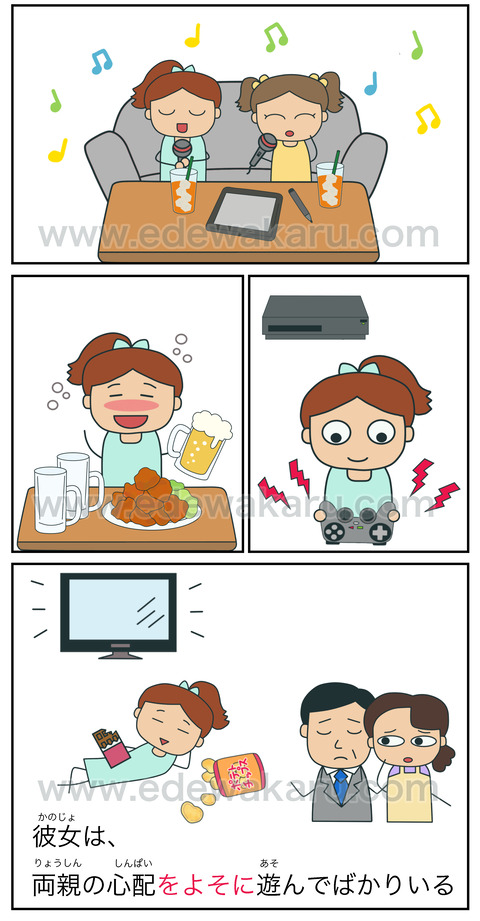
Meaning
ignoring ~
without caring about ~
regardless of ~
How to use it
Noun [dictionary form] +をよそに
Explanation
「〜をよそに」 is a sentence pattern meaning “ignoring ~” or “without caring about ~.” It can also express lack of connection, as in “regardless of ~.” When it is used to mean “ignoring ~” or “without caring about ~,” it tends to occur with certain fixed words, so it may be useful to learn some of them 😊
[Words often used with 「〜をよそに」]
・心配をよそに (ignoring someone’s worries)
・期待をよそに (contrary to expectations)
・反対をよそに (ignoring opposition)
・非難をよそに (ignoring condemnation)
・批判をよそに (ignoring criticism)
・忠告をよそに (ignoring advice), etc.
Remember that 「〜をよそに」 is used with a sense of reproach, as in “doing ~ without considering other people” 😉
(Review: 〜を込めて・〜を込めた)
In context 4 examples
彼女は、親の心配をよそに遊んでばかりいる
→彼女は、親が心配しているのを気にしないで遊んでばかりいる(復習:〜てばかりいる・〜てばかりだ)She does nothing but play, ignoring her parents’ worries. →She does nothing but play, without caring that her parents are worried (Review: 〜てばかりいる・〜てばかりだ)
彼は、お母さんの期待をよそに会社を辞めてしまった
→彼は、お母さんの期待を無視して会社を辞めてしまったHe quit his job, ignoring his mother’s expectations. →He quit his job, disregarding his mother’s expectations.
国民の反対をよそに、法律が変えられた
→国民が反対しているのを無視して、法律が変えられたThe law was changed, ignoring the opposition of the people. →The law was changed, disregarding the fact that the people were opposed.
あのデパートは不景気をよそに売り上げを上げている
→あのデパートは不景気なのに関係なく、売り上げを上げているThat department store is increasing its sales regardless of the economic downturn. →That department store is increasing its sales, unaffected by the economic downturn.
Read the original source text
Meaning
〜を無視して
〜を気にしないで
〜に関係なく
How to use it
名詞[辞書形]+をよそに
Explanation
「〜をよそに」は「〜を無視して」「〜を気にしないで」という意味を表す文型です。
また、「〜に関係なく」というように、無関係を表す場合もあります。「〜を無視して」「〜を気にしないで」の意味で使われる場合は、よく使われる単語が決まっていますので、いくつか覚えておくといいと思います😊
[「〜をよそに」とよく使う文型]
・心配をよそに
・期待をよそに
・反対をよそに
・非難をよそに
・批判をよそに
・忠告をよそに など
「〜をよそに」は「他の人のことを考えずに〜している」というように、非難の気持ちを込めて使われると覚えておきましょう😉
(復習:〜を込めて・〜を込めた)
くらべてわかる日本語表現文型辞典
Meaning
Meaning 1: Do B as if ignoring A.
Meaning 2: B is a state that contrasts with state A.
How to use it
AをよそにB
[Verb—る form] + の + をよそに
[Noun—∅] をよそに
Explanation
[Contrast 1]
“AをしりめにB” (Meaning 1, p. 338)
With “AをしりめにB,” B involves looking askance at situation A while putting oneself in a superior position. B with “AをよそにB” need not imply taking a superior position.
○受験勉強の追い込みに一生懸命な級友たちをしりめに、彼女は推薦入試で楽々と合格した。 — While her classmates were working hard to cram for their entrance exams, she easily passed through an early recommendation-based admission.
○受験勉強の追い込みに一生懸命な級友たちをよそに、彼女は推薦入試で楽々と合格した。 — While her classmates were working hard to cram for their entrance exams, she easily passed through an early recommendation-based admission.
Also, A in “AをよそにB” is often other people’s concern, opposition, expectations, or support.
○忠告をよそに危険水域で泳いでいる。 — Ignoring the warning, he is swimming in a dangerous area.
×忠告をしりめに危険水域で泳いでいる。 — Ignoring the warning, he is swimming in a dangerous area.
In context 8 examples
その場の騒然とした空気をよそに、講師は淡々と語り続けた。
Ignoring the tense atmosphere in the room, the lecturer calmly continued speaking.
大規模な反対運動をよそに、核実験は行われた。
Despite a large-scale protest movement, the nuclear test was carried out.
忠告をよそに、危険水域で泳ぐ。
Ignoring the warning, he swims in a dangerous area.
同期生の華やかな活躍をよそに、彼は大学院に残り、研究を続けた。
While his former classmates were enjoying brilliant careers, he stayed in graduate school and continued his research.
周囲の不安の声をよそに、本人はいたって強気でいる。
Despite the worried voices around him, he himself remains thoroughly confident.
加熱するファンの期待をよそに、チームの成績は下降していった。
Despite fans’ mounting expectations, the team’s results kept declining.
マスコミの興奮をよそに、選挙戦は静かに始まった。
Despite the media’s excitement, the election campaign began quietly.
パソコン需要の低迷をよそに、携帯市場の活況は持続している。
Despite sluggish demand for personal computers, the mobile market continues to thrive.
Read the original source text
Meaning
意味1:Aを無視するかのようにB。
意味2:Aという状態とは対照的な状態B。
How to use it
AをよそにB
[動詞-る形]+の+をよそに
[名詞-∅]をよそに
Explanation
【対比1】
「AをしりめにB」(意味1 P.338)
「AをしりめにB」はAという状況を横目で見ながら、自分は優位な位置に立つということがBにくる。「AをよそにB」のBは優位な位置に立つという意味でなくても使える。
○受験勉強の追い込みに一生懸命な級友たちをしりめに、彼女は推薦入試で楽々と合格した。
○受験勉強の追い込みに一生懸命な級友たちをよそに、彼女は推薦入試で楽々と合格した。
さらに、「AをよそにB」のAは他者からの心配・反対・期待・応援などが多い。
○忠告をよそに危険水域で泳いでいる。
×忠告をしりめに危険水域で泳いでいる。
日本語NET JLPT文法解説まとめ
Meaning
without worrying about ~ / without fearing ~ / regardless of ~
How to use it
N + をよそに
Explanation
without worrying about ~ / without fearing ~ / regardless of ~
It is often used to criticize someone.
It is often used to criticize someone.
In context 5 examples
息子は親の心配をよそに、仕事もせずに毎日遊んでばかりいる。
Ignoring his parents’ concerns, the son does nothing but play every day without working.
息子は親の期待をよそに、医学部を卒業しても医者にならずアルバイトで生計を立てている。
Contrary to his parents’ expectations, even after graduating from medical school, their son didn’t become a doctor and earns a living through part-time jobs.
住民の反対をよそに、マンションの建設工事が始まった。
Despite the residents’ opposition, construction of the apartment building began.
子育てて苦しんでいる私をよそに、旦那はテレビばかり見ていて手伝おうとしない。
While I struggle with raising the children, my husband just watches TV and won’t help.
二人は周囲の反対をよそに、結婚してしまった。
The two got married despite the opposition of those around them.
Read the original source text
Meaning
〜を心配しないで / 〜を恐れないで / 〜に関係なく
How to use it
N + をよそに
Explanation
without worrying about ~ / without fearing ~ / regardless of ~
相手を非難するときに使うことが多い。
It is often used to criticize someone.
毎日のんびり日本語教師
How to use it
Noun + をよそに
Explanation
This sentence pattern expresses ignoring or paying no attention at all to other people’s concerns, expectations, criticism, or opinions, or to the surrounding circumstances.
The latter clause usually describes something undesirable.
The kanji 「余所」 and 「他所」 are used infrequently.
Notes
The “構わない” series
In context 10 examples
雨の予報をよそに傘も持たず出かけていった。
Ignoring the forecast for rain, they went out without even taking an umbrella.
自分の失敗をよそに他人の批判ばかりしている。
Ignoring his own failures, he does nothing but criticize others.
親の心配をよそに四六時中部屋にこもっている。
Ignoring their parents’ concerns, they stay cooped up in their room all the time.
冷たい周囲の視線をよそにイチャイチャしている。(不顾周围冷酷的目光调情。)
They’re making out, ignoring the cold stares around them. (They’re flirting, heedless of the cold looks from those around them.)
夜勤を終えた私は通勤する人をよそに毎日帰宅する。
After finishing my night shift, I go home every day while ignoring the commuters.
親の心配をよそに、朝まで帰らない。(不顾父母的担心彻夜而归。)
Ignoring my parents’ concerns, I don’t come home until morning. (I stay out all night, heedless of my parents’ worries.)
彼はこんなにも緊迫した状況をよそににやけている。
He is smirking, oblivious to this tense situation.
コロナをよそにオリンピックが盛り上がっています。
The Olympics are generating excitement, heedless of COVID.
恥ずかしがる私をよそに、彼はどんどん攻めてくる。
Ignoring my embarrassment, he keeps coming on to me.
周囲の反対をよそにやりたい放題する。
I do whatever I want, heedless of the opposition around me.
Read the original source text
How to use it
名詞+をよそに
Explanation
他人の心配、期待、批判、評価や周囲の状況を無視したり、全く気にしないことを表す文型です。
後件では通常良くないことが述べられます。
「余所」や「他所」などの漢字がありますが使われることは少ないです。
Notes
「構わない」シリーズ
IMABI
Disregard IV
Read this IMABI lesson ↗Explanation
Disregard IV: {に・も}構わず, をよそに, & にもめげず(に)
In this fourth and final installation of expressions concerning disregard, we will cover expressions that revolve around the subject not caring about “X” when doing “Y.”
{に・も}かまわず
The verb 構う means “to mind/be concerned with.” Typically, it is used as an intransitive verb, which is why it takes に in most of the following examples.
1. 私わたしは全然構ぜんぜんかまいません。
I don’t mind at all.
2. 私わたしに構かまわないでください。
Don’t bother me.
3. 他人たにんのことに構かまっていられない。
I have too many of my own problems to deal with the problems of others.
In the expression {に・も}構わず, it is used to show that one doesn’t care about “X” as one goes about doing “Y.” The use of も makes the verb transitive, and it is also makes the expression more emphatic overall.
4. 母親ははおやは合鍵あいかぎを持もっているので、時間じかんに構かまわず押おしかけてくることもあります。
My mother has a duplicate key, so she often comes intruding on me regardless of the time.
5. 彼かれは雨あめに濡ぬれるのもかまわずお店みせへ歩あるき続つづけた。
He continued walking to the store whilst not caring about getting wet.
6. あの男性だんせいは、近所きんじょの人ひとの迷惑めいわくも構かまわず、毎晩遅まいばんおそくまで騒さわいでいる。
That man makes racket late into the night every evening without caring about the trouble it causes his neighbors.
7. 彼女かのじょは人目ひとめもかまわず泣なき出だした。
She burst into tears without caring about attention from others.
8. ぎっくり腰ごしは場所ばしょも時間じかんもかまわず襲おそってくるものです。
A strained back attacks irrespective of place and time.
9. あの店みせの常連客じょうれんきゃくのほとんどは、値段ねだんも構かまわず高価こうかな商品しょうひんを買かい求もとめる老婦人ろうふじんだ。
Most of the regular customers of that shop are old women who buy expensive products without caring about price.
10. 彼かれは家族かぞくの心配しんぱいもかまわず、実家じっかを出でて上京じょうきょうした。
He left his parents’ home and went to Tokyo without caring about his family’s worries.
11. 彼女かのじょは給料きゅうりょうもかまわずに好すきな仕事しごとをやることにした。
She decided to work that she liked without carrying about the salary.
12. 何なんにも構かまわずに、ありのままで自分じぶんになるんだ。
I will be my true self without carrying about anything.
13. 所構ところかまわずゴミを捨すてる人ひとが気きになります。
People who throw trash away indiscriminately of place bother me.
14. 私わたしにかまわず、お先さきにどうぞ。
Please don’t mind me. Go on ahead.
15. 彼かれらは周囲しゅうい{に・も}かまわずキスしたりイチャイチャしたりしていた。
They were kissing and making out without regard to their surroundings.
~をよそに
The expression をよそに is used to show that one completely disregards and shoves “X” as one goes ahead and does “Y.” It is often used with words like 批判 (criticism), 反対 (opposition), 心配 (worry), etc.
16. 国民こくみんの反対はんたいの声こえをよそに、改正案かいせいあんが可決かけつされた。
Despite voices of opposition from the people, the reform bill was passed.
17. 県民けんみんの抗議こうぎをよそに、軍事基地ぐんじきちの建設計画けんせつけいかくが進すすめられている。
Despite protest from the people of the prefecture, construction plans for the military base are underway.
18. 親おやの心配しんぱいをよそに、腕うでが折おれてギプスをしている憲太郎けんたろうはまたも友達ともだちと遊あそびに出でかけてしまった。
Kentaro, who broke his arm which is in a cast, went out again to have fun with friends despite his parents’ worries.
19. 共和党きょうわとうは、国民こくみんの批判ひはんをよそに、今年ことしも増税法案ぞうぜいほうあんを提出ていしゅつした。
The Republican Party has submitted a tax increase bill this year as well despite criticism from the people.
20. 先生せんせいに怒鳴どなられて皆みなが緊張きんちょうしているのをよそに、彼氏かれしだけぼんやりと馬鹿ばかみたいに天井てんじょうを向むいていた。
Only my boyfriend is the one looking up at the ceiling aimlessly like an idiot despite everyone being nervous from being shouted at by the teacher.
21. 彼かれは両親りょうしんの心配しんぱいをよそに、ゲームに没頭ぼっとうしている。
He has lost himself in gaming despite his parents’ worries.
22. 雨あめの予報よほうをよそに、傘かさを持もたずにタイミングよく素晴すばらしい晴天せいてんで、彼氏かれしと一緒いっしょに湖みずうみのほとりを散歩さんぽすることができた。
I was able to walk along the lake together with my boyfriend without bringing umbrellas under wonderful clear skies thanks to good timing despite the forecast for rain.
23. 住民じゅうみんの不安ふあんをよそに、知事ちじが原発げんぱつの再稼働さいかどうを認みとめた。
Despite uneasiness that the residents have, the governor has approved the resuming operations of nuclear power.
24. 家族かぞくの期待きたいをよそに、弟おとうとは結局大学けっきょくだいがくには入はいらずにアルバイト生活せいかつを続つづけている。
My little brother, despite the family’s expectations, ended up not getting into college and continues being a part-time worker.
25. お祭りの渋滞をよそに、素通りして帰宅した。
I passed by the congestion from the festival when I returned home.
26. 彼は医者の忠告をよそに、毎日お酒を飲んでいる。
Despite his doctor’s warning, he drinks every day.
27. 核兵器禁止条約かくへいききんしじょうやくをよそに、北朝鮮きたちょうせんやイランなどといった国くには核実験かくじっけんを行おこない続つづけている。
There are nations such as North Korea and Iran that continue performing nuclear tests despite the Nuclear Weapons Convention.
28. 国民こくみんの非難ひなんをよそに、その汚職政治家おしょくせいじかはまたしても議席ぎせきに返かえり咲ざいた。
The corrupt politician made yet another comeback to his seat despite reproach from the people.
The word よそ, especially when written as 他所・余所, may also mean “elsewhere.”
29. 他所よその店みせに行ぎょうきな!
Go to another store!
30. 今夜こんやは他所よしょに泊とまらなきゃ。
I have to stay somewhere else tonight.
にもめげず(に)
The pattern にもめげず(に) is used after nouns that relate to personal adversity that the speaker then overcomes somehow in situation Y. This phrase is typically literary, but the subject of the action is painted in a very positive light.
31. 彼は度重たびかさなる不幸ふこうにもめげず、いつも前向まえむきだった。
He was always positive in the face of repeated sorrows.
32. この町まちの梨なしは、悪条件あくじょうけんにもめげず、立派りっぱに美味しいです。
This town’s peaches are splendidly delicious even with unfavorable conditions.
33. 彼かれはどんな困難こんなんにもめげずに夢ゆめを諦あきらめなかった。
He didn’t give up on his dreams despite whatever hardship.
34. その選手せんしゅは、苦境くきょうにもめげず、試合しあいに向むかってメダルを勝かち取とった。
The athlete thought nothing of his predicament, faced the match, and won the medal.
35. 田中たなかはどんな不幸ふこうや不運ふうんにもめげず、いつも笑顔えがおを絶たやさない。
Tanaka never stops smiling, not discouraged by whatever sorrow or misfortune.
36. 数々かずかずの試練しれんにもめげず、ヒロインひろいんが未来みらいを切きり開ひらいていく。
Not discouraged by numerous trials, the heroine opens up the future.
37. 大地震おおじしんにもめげずに 元気げんきで健気けなげな島しまの人々ひとびとにほっとした。
I was relieved with how the people of the island were gallant and vigorous, and not discouraged by the great quake.
38. 台風たいふうにもめげずに沖縄おきなわから行いってきました。
I’ve returned from Okinawa despite the typhoon.
39. 彼は病気びょうきにもめげず、多忙たぼうな毎日まいにちにもへこたれずに楽たのしく生いきている。
He lives happily and not discouraged even as each day is busy despite his illness.
40. 日本にほんのモノづくり企業きぎょうは、どんな逆風ぎゃくふうにもめげず、知恵ちえと忍耐力にんたいりょくで克服こくふくしてきた。
Japan’s manufacturers have overcome all sorts of adversity with wit and perseverance.
In context 40 examples
私わたしは全然構ぜんぜんかまいません。
I don’t mind at all.
私わたしに構かまわないでください。
Don’t bother me.
他人たにんのことに構かまっていられない。
I have too many of my own problems to deal with the problems of others.
母親ははおやは合鍵あいかぎを持もっているので、時間じかんに構かまわず押おしかけてくることもあります。
My mother has a duplicate key, so she often comes intruding on me regardless of the time.
彼かれは雨あめに濡ぬれるのもかまわずお店みせへ歩あるき続つづけた。
He continued walking to the store whilst not caring about getting wet.
あの男性だんせいは、近所きんじょの人ひとの迷惑めいわくも構かまわず、毎晩遅まいばんおそくまで騒さわいでいる。
That man makes racket late into the night every evening without caring about the trouble it causes his neighbors.
彼女かのじょは人目ひとめもかまわず泣なき出だした。
She burst into tears without caring about attention from others.
ぎっくり腰ごしは場所ばしょも時間じかんもかまわず襲おそってくるものです。
A strained back attacks irrespective of place and time.
あの店みせの常連客じょうれんきゃくのほとんどは、値段ねだんも構かまわず高価こうかな商品しょうひんを買かい求もとめる老婦人ろうふじんだ。
Most of the regular customers of that shop are old women who buy expensive products without caring about price.
彼かれは家族かぞくの心配しんぱいもかまわず、実家じっかを出でて上京じょうきょうした。
He left his parents’ home and went to Tokyo without caring about his family’s worries.
彼女かのじょは給料きゅうりょうもかまわずに好すきな仕事しごとをやることにした。
She decided to work that she liked without carrying about the salary.
何なんにも構かまわずに、ありのままで自分じぶんになるんだ。
I will be my true self without carrying about anything.
所構ところかまわずゴミを捨すてる人ひとが気きになります。
People who throw trash away indiscriminately of place bother me.
私わたしにかまわず、お先さきにどうぞ。
Please don’t mind me. Go on ahead.
彼かれらは周囲しゅうい{に・も}かまわずキスしたりイチャイチャしたりしていた。
They were kissing and making out without regard to their surroundings.
国民こくみんの反対はんたいの声こえをよそに、改正案かいせいあんが可決かけつされた。
Despite voices of opposition from the people, the reform bill was passed.
県民けんみんの抗議こうぎをよそに、軍事基地ぐんじきちの建設計画けんせつけいかくが進すすめられている。
Despite protest from the people of the prefecture, construction plans for the military base are underway.
親おやの心配しんぱいをよそに、腕うでが折おれてギプスをしている憲太郎けんたろうはまたも友達ともだちと遊あそびに出でかけてしまった。
Kentaro, who broke his arm which is in a cast, went out again to have fun with friends despite his parents’ worries.
共和党きょうわとうは、国民こくみんの批判ひはんをよそに、今年ことしも増税法案ぞうぜいほうあんを提出ていしゅつした。
The Republican Party has submitted a tax increase bill this year as well despite criticism from the people.
先生せんせいに怒鳴どなられて皆みなが緊張きんちょうしているのをよそに、彼氏かれしだけぼんやりと馬鹿ばかみたいに天井てんじょうを向むいていた。
Only my boyfriend is the one looking up at the ceiling aimlessly like an idiot despite everyone being nervous from being shouted at by the teacher.
彼かれは両親りょうしんの心配しんぱいをよそに、ゲームに没頭ぼっとうしている。
He has lost himself in gaming despite his parents’ worries.
雨あめの予報よほうをよそに、傘かさを持もたずにタイミングよく素晴すばらしい晴天せいてんで、彼氏かれしと一緒いっしょに湖みずうみのほとりを散歩さんぽすることができた。
I was able to walk along the lake together with my boyfriend without bringing umbrellas under wonderful clear skies thanks to good timing despite the forecast for rain.
住民じゅうみんの不安ふあんをよそに、知事ちじが原発げんぱつの再稼働さいかどうを認みとめた。
Despite uneasiness that the residents have, the governor has approved the resuming operations of nuclear power.
家族かぞくの期待きたいをよそに、弟おとうとは結局大学けっきょくだいがくには入はいらずにアルバイト生活せいかつを続つづけている。
My little brother, despite the family’s expectations, ended up not getting into college and continues being a part-time worker.
お祭りの渋滞をよそに、素通りして帰宅した。
I passed by the congestion from the festival when I returned home.
彼は医者の忠告をよそに、毎日お酒を飲んでいる。
Despite his doctor’s warning, he drinks every day.
核兵器禁止条約かくへいききんしじょうやくをよそに、北朝鮮きたちょうせんやイランなどといった国くには核実験かくじっけんを行おこない続つづけている。
There are nations such as North Korea and Iran that continue performing nuclear tests despite the Nuclear Weapons Convention.
国民こくみんの非難ひなんをよそに、その汚職政治家おしょくせいじかはまたしても議席ぎせきに返かえり咲ざいた。
The corrupt politician made yet another comeback to his seat despite reproach from the people.
他所よその店みせに行ぎょうきな!
Go to another store!
今夜こんやは他所よしょに泊とまらなきゃ。
I have to stay somewhere else tonight.
彼は度重たびかさなる不幸ふこうにもめげず、いつも前向まえむきだった。
He was always positive in the face of repeated sorrows.
この町まちの梨なしは、悪条件あくじょうけんにもめげず、立派りっぱに美味しいです。
This town’s peaches are splendidly delicious even with unfavorable conditions.
彼かれはどんな困難こんなんにもめげずに夢ゆめを諦あきらめなかった。
He didn’t give up on his dreams despite whatever hardship.
その選手せんしゅは、苦境くきょうにもめげず、試合しあいに向むかってメダルを勝かち取とった。
The athlete thought nothing of his predicament, faced the match, and won the medal.
田中たなかはどんな不幸ふこうや不運ふうんにもめげず、いつも笑顔えがおを絶たやさない。
Tanaka never stops smiling, not discouraged by whatever sorrow or misfortune.
数々かずかずの試練しれんにもめげず、ヒロインひろいんが未来みらいを切きり開ひらいていく。
Not discouraged by numerous trials, the heroine opens up the future.
大地震おおじしんにもめげずに 元気げんきで健気けなげな島しまの人々ひとびとにほっとした。
I was relieved with how the people of the island were gallant and vigorous, and not discouraged by the great quake.
台風たいふうにもめげずに沖縄おきなわから行いってきました。
I’ve returned from Okinawa despite the typhoon.
彼は病気びょうきにもめげず、多忙たぼうな毎日まいにちにもへこたれずに楽たのしく生いきている。
He lives happily and not discouraged even as each day is busy despite his illness.
日本にほんのモノづくり企業きぎょうは、どんな逆風ぎゃくふうにもめげず、知恵ちえと忍耐力にんたいりょくで克服こくふくしてきた。
Japan’s manufacturers have overcome all sorts of adversity with wit and perseverance.