絵でわかる日本語
Meaning
With the help of 〜
With 〜’s help
How to use it
Noun [dictionary form] + をたよりに
Noun [dictionary form] + をたよりにして
Explanation
“AをたよりにB” is a sentence pattern meaning “do B with A’s help” or “do B with the help of A.” Written in kanji, “〜をたよりに” is “〜を頼りに.” Also, “〜をたよりに” can be changed to “〜をたよりにして” or “〜をたよりとして.”
[Examples]
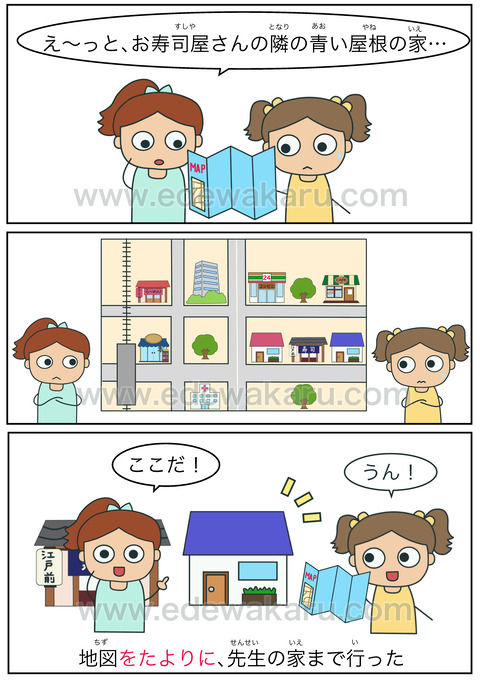
I went to my teacher’s house with the help of a map.
= I went to my teacher’s house using a map as a guide.
= I went to my teacher’s house with a map as my guide.
You may not have many opportunities to study “〜をたよりに・〜をたよりにして・〜をたよりとして,” but if you’re taking N2 or above, be sure to learn them 😊
In context 6 examples
地図をたよりに、先生の家まで行った
→地図を助けに、先生の家まで行ったI went to my teacher’s house with the help of a map. → I went to my teacher’s house with a map as my guide.
毎朝、辞書をたよりに英語の新聞を読んでいます
→辞書を助けに、英語の新聞を読んでいますEvery morning, I read English newspapers with the help of a dictionary. → I read English newspapers with the help of a dictionary.
翻訳アプリをたよりに、海外旅行をした
→翻訳アプリの助けを借りて、海外旅行をしたI traveled abroad with the help of a translation app. → I traveled abroad with the help of a translation app.
彼は、親のお金をたよりに生活している
→親の助けを借りて生活しているHe lives on his parents’ money. → He lives with his parents’ help.
子供の頃の記憶をたよりに、昔よく行ったレストランを探した
→子供の頃の記憶を助けに、昔よく行ったレストランを探したI searched for a restaurant I often went to in the past, relying on my childhood memories. → I searched for a restaurant I often went to in the past with the help of my childhood memories.
親戚のおばさんをたよりに、上京しました
→親戚のおばさん助けを借りて、上京しましたI moved to Tokyo with the help of my aunt, who is a relative. → I moved to Tokyo with my aunt’s help.
Read the original source text
Meaning
〜を助けに
〜の助けを借りて
How to use it
名詞[辞書形]+をたよりに
名詞[辞書形]+をたよりにして
Explanation
「AをたよりにB」は「Aを助けにBする」「Aの助けを借りてBする」という意味の文型です。「〜をたよりに」は漢字で書くと「〜を頼りに」になります。また、「〜をたよりに」は「〜をたよりにして」「〜をたよりとして」にチェンジすることができます。
[例]
地図をたよりに、先生の家まで行った
=地図をたよりにして、先生の家まで行った
=地図をたよりとして、先生の家まで行った
「〜をたよりに・〜をたよりにして・〜をたよりとして」は勉強する機会が少ないかもしれませんが、N2以上を受ける人は覚えておきましょう😊
日本語文型辞典
Meaning
Basic information: NをたよりにV. Means “with the help of something” or “relying on something.” In speech, “…をたよりにして” and “…をたよりとして” are also used. Similar expressions are “…をたのみにして” and “…をたのみとして.” Examples: ① If you weren’t here, what would I have to rely on to go on living? ② The international student keeps reading “The River Without a Bridge” on his own, relying on a dictionary with marginal notes. ③ Relying only on his white cane, that person lived for 70 years and then died. ④ Relying only on her natural drive to take action, she is traveling the world by motorcycle.
Read the original source text
Meaning
基本情報NをたよりにV説明「何かの助けを借りて」「何かに依存して」という意味。話しことばでは「…をたよりにして」「…をたよりとして」とも言う。よく似た表現に「…をたのみにして」「…をたのみとして」がある。例文① あなたがいなければ、これからわたしは何をたよりに(して)生きていけばいいのですか。② その留学生は差し辞書をたよりに、ひとりで「橋のない川」を読みつづけている。③ 白いつえだけをたよりに、その人は70年生き、そして死んでいった。④ もちまえの行動力だけをたよりに、彼女はバイクで世界中を旅している。
日本語文型辞典 英語版
Meaning
【をたよりに】[NをたよりにV]
Means “with the aid of something,” “depending on something.” In speech ...をたよりにして and ...をたよりとして are also used. Similar expressions are ...をたのみにして and ...をたのみとして.
In context 4 examples
あなたがいなければ、これからわたしは何をたよりに(して)生きていけばいいのですか。
If you are not going to be there for me, what should I look up to as my guide in life?
その留学生は、辞書をたよりに、ひとりで「橋のない川」を読みつづけている。
That exchange student continues reading “The River with no Bridge” by himself with the help of a dictionary.
白いつえだけをたよりに、その人は 70 年生き、そして死んでいった。
That person lived to seventy relying solely on a white cane and then died.
もちまえの行動力だけをたよりに、彼女はバイクで世界中を旅している。
She is traveling all over the world on a bike relying solely on her own resourcefulness.